

How Covid lockdowns primed the current financial crisis

By Christian Parenti

Source: The Grayzone

The lockdowns and the stimulus required to keep the economy alive helped drive inflation. Then the Fed jacked up interest rates. And all hell broke loose.

On Friday March 10th, 2023, Silicon Valley Bank (SVB) died of Covid. Alright, it’s a little more complicated than that, but Covid lockdowns followed by massive government stimulus were a critical – and massively under-acknowledged – factor in propelling the bank’s demise.

At the heart of the crisis is the gigantic pile of low-interest debt that was issued during the height of the pandemic. While private-sector pandemic-era debt like corporate bonds also soared, US government debt like Treasury bonds piled up.

In a nutshell, during the pandemic the government issued enormous amounts of extremely low interest government debt — about $4.2 trillion of it. But now interest rates, including on government debt, are higher than they have been in 15 years and investors are dumping their old low-interest debt. As they dump, the resale price of the old debt goes down. The more it declines, the more investors want to dump. And thus, a panic is born. 

To understand the problem fully, the question of US government debt has to be put into its larger context, which is: the pandemic response as a whole.

When news of the Covid virus first broke in December 2019, the 2 Year Treasury bond was being offered at 1.64% interest; the 10 year was at about 1.80%, and the resale value of such bonds on secondary markets was strong. Then, in March 2020, as Covid cases and deaths spiked, the US began to shutter its economy with panicked lockdowns that were supposed to “flatten the curve” or slow the spread of the virus and thus protect the hospitals. But Covid was politicized and the lockdowns were extended.  

As the lockdowns dragged on, the US economy began to collapse, shrinking at a record-shattering annualized rate of 31.4% during the second quarter of fiscal year 2020.

To avoid total economic devastation, the federal government began massive debt-financed spending. In March 2020, Trump signed into law the $2.2 trillion economic stimulus bill the CARES Act, or Coronavirus Aid, Relief, and Economic Security. Then, in March 2021, Biden signed the American Rescue Plan Act which contained $1.9 trillion more in Covid relief. Finally, in April 2021, another trillion or so of Covid relief arrived in the Consolidated Appropriations Act. 

Thanks to these laws, every industry and most people received public money. There was increased and extended unemployment payments, as well as the so-called “stimmy checks” or stimulus payments to everyone earning under $75,000 a year (about half the population). The Paycheck Protection Program spent almost a trillion dollars. The Provider Relief Fund doled out $178 billion to the healthcare system. 

All this debt spending kept millions of people in their homes, and helped feed, employ, and care for millions more. The measures allowed hundreds of thousands of businesses to stay afloat even as many thousands of others went under. The impact of the spending on Americans’ well-being was generally positive. For a moment, the US child poverty rate was cut in half, falling to 5.2%. 

But the economically destructive lockdowns were not necessary and did not work. Covid fanatics maintain that the lockdowns were unavoidable because the virus is so deadly. That, however, is uninformed. Last year I explained in detail how the Lockdown Left got the Covid crisis wrong. Not a single critic has challenged any of the facts I presented so there is little point in rehashing them all here. 

Those who advocated an alternative to ham-fisted lockdowns, like the authors of the Great Barrington Declaration, which called for “focused protection” of vulnerable groups like the elderly, were viciously targeted in a reputation destruction campaign covertly orchestrated by former NIH director Francis Collins and de facto Covid czar Anthony Fauci. Never mind that the document’s authors were three eminently qualified scientists: Sunetra Gupta, professor of Theoretical Epidemiology at Oxford University; Jay Bhattacharya, professor of medicine at Stanford; and Martin Kulldorff, formerly a professor of medicine and biostatistics at Harvard. They were portrayed as far-right cranks who were almost eager to see millions die. But now, they have been vindicated.

Ultimately, the federal government spent $4.2 trillion propping up the economy that it was simultaneously choking to death with lockdowns. These two contradictory pressures laid the groundwork for the recent bank failures. Government mandated lockdowns hit the economy like a body blow. Factories closed, small businesses went under, ports and logistic hubs reduced operations, and about 2 million mostly older workers simply resigned. But at the same time, the federal government injected vast amounts of purchasing power into the economy, thus boosting consumption.

These two, contradictory government moves imposed almost unbearable pressure on supply chains. As shortages mounted, prices began to surge. Put simply: lockdowns plus stimulus equaled inflation.

Consider just one of the most important bottlenecks in the whole economy. During lockdown, many commercial driving license schools were closed. This helped create a shortage of about 80,000 truckers. If trucks do not roll supplies run low and prices go up.

At first, the official line on inflation – parroted by the Lockdown Left – maintained that inflation was “transitory.” But it was not. Inflation peaked at 9.1% in June 2022 while wage growth lagged at about 5%. In April 2020 during the worst of the lockdown, the Federal Reserve’s Federal Funds Rate sank to 0.5%. By February 2022, it had only risen to 0.8%.  

Meanwhile, inflation was surging. By February 2022, inflation had reached 7.9%. Only then did the Fed, in an effort to tamp down prices, begin raising interest rates at the fastest pace rate in its history. The federal Funds rate was around 4.57% when SVB went under. Perhaps a massive wave of taxation could have soaked up enough liquidity to have helped cool prices, but that was a political impossibility. The more politically palatable response in Washington was for the Federal Reserve to raise interest rates. 

Herein lies the problem. During the height of the lockdowns, banks bought up enormous amounts of government debt. As the Wall Street Journal put it: “U.S. banks are suffering the aftereffects of a Covid-era deposit boom that left them awash in cash that they needed to put to work. Domestic deposits at federally insured banks rose 38% from the end of 2019 to the end of 2021, FDIC data show. Over the same period, total loans rose 7%, leaving many institutions with large amounts of cash to deploy in securities as interest rates were near record lows.” Awash in deposits with not enough demand for loans, the banks bought US government securities. Their purchases surged 53% between 2019 and the end of 2021, to a total of $4.58 trillion, according to Fed data reported by the Wall Street Journal.

Because so much debt was being issued, it carried super-low interest rates. For example, on July 27, 2020, the 10 Year Treasury was offered at an annual interest rate of only 0.55%. This is fine if you are the borrower of money, but if you are the lender (that is to say, a bank giving the federal government money in exchange for a Treasury bond), it means your income stream will be reduced to a mere trickle. If inflation rises, it essentially disappears. 

As the yield on new government debt reached toward 5% and inflation hung stubbornly at around 6.4%, all of that old, low-interest, pandemic-era debt started to look like garbage and banks began unloading it. The more that banks dumped old debt, the less value that debt had on resale markets. The lower its resale value, the more the banks wanted to dump it. SVB lost almost $2 billion selling off Government securities. And when they announced the loss, their stock price plunged by 60%. 

At the same time, many of SVB’s clients were withdrawing money. This was in part because rising interest rates made borrowing new money more expensive and thus incentivized the use of savings in day-to-day business operations. Also, higher inflation and higher interest rates made low-earning bank deposits less attractive and compelled depositors to redeploy their surplus capital towards higher-earning investments. So, just as SVB needed cash, deposits were evaporating.

By the end of the week of March 10, the four biggest banks in the United States had lost $51 billion because of their panicked dumping of pandemic-era debt. Right after SVB was taken under government control, state regulators closed the New York-based Signature Bank. Before the weekend was over the Federal Reserve announced the creation of a new lending facility that would ensure that “banks have the ability to meet the needs of all their depositors.” Furthermore, the Fed said it was “prepared to address any liquidity pressures that may arise.”

It would seem that the federal government is ready to execute another de facto partial nationalization of US banking, just as they did in 2008 via emergency “cash injections” and then the Troubled Assets Relief Program (TARP). In this current crisis, banks can avoid losses on their low-interest debt if they do not sell it before its maturity. For that to happen, the banks need money. The Fed has said it will pour enormous amounts of money into the banks while all of the relevant officials have proclaimed that the banking system will somehow pay for this. All of this will almost certainly mean even more government debt will be issued. 

Already, interest payments on the federal debt are one of the largest single items in the US budget – set to reach $400 billion this year. That is almost half as much as the grotesquely overdeveloped military budget. By comparison, federal spending on housing is only $78 billion.

Shoring up the banking system is necessary because if it collapses, the whole economy goes with it. At least in the short term, Americans are hostages of the US financial system. But government intervention without any new regulations and taxes upon the financial sector will likely mean more inflation and a bigger financial bubble. By refusing to properly tax the top 1%, the federal government also commits itself to more austerity for the many and more welfare for the rich, because rising government debt means a rising portion of our taxes must go toward interest payments. 

This system of crisis-prone, hyper-financialized capitalism seems ever more like a junkie. If it doesn’t get its regular fix of public sector help, it will simply collapse and die. 

Even if the federal government can stanch the current crisis, the pandemic debt story is global and very likely to cause trouble for some time to come. As a 2021 report by the World Bank put it: “The debt buildup during the pandemic-induced global recession of 2020 was the largest in several decades. This was true for all types of debt—total, government, and private debt; and advanced-economy and EMDE [emerging market and developing economy] debt; external and domestic debt. In 2020, total global debt reached 263 percent of GDP and global government debt 99 percent of GDP, their highest levels in half a century.” 

The US intelligentsia and its media elites are finally beginning to reckon with the impact of misguided and authoritarian lockdowns on student learning and the psychological and physical health of millions. But in all the discussion of the current bank runs, the pivotal role of lockdowns in priming the crisis remains overlooked.
The Engineered Stagflationary Collapse Has Arrived – Here’s What Happens Next

By Brandon Smith

Source: Alt-Market.us

In my 16 years as an alternative economist and political writer I have spent around half that time warning that the ultimate outcome of the Federal Reserve’s stimulus model would be a stagflationary collapse. Not a deflationary collapse, or an inflationary collapse, but a stagflationary collapse. The reasons for this were very specific – Mass debt creation was being countered with MORE debt creation while many central banks have been simultaneously devaluing their currencies through QE measures. On top of that, the US is in the unique position of relying on the world reserve status of the dollar and that status is diminishing.

It was only a matter of time before the to forces of deflation and inflation met in the middle to create stagflation. In my article ‘Infrastructure Bills Do Not Lead To Recovery, Only Increased Federal Control’, published in April of 2021, I stated that:

Production of fiat money is not the same as real production within the economy… Trillions of dollars in public works programs might create more jobs, but it will also inflate prices as the dollar goes into decline. So, unless wages are adjusted constantly according to price increases, people will have jobs, but still won’t be able to afford a comfortable standard of living. This leads to stagflation, in which prices continue to rise while wages and consumption stagnate.

Another Catch-22 to consider is that if inflation becomes rampant, the Federal Reserve may be compelled (or claim they are compelled) to raise interest rates significantly in a short span of time. This means an immediate slowdown in the flow of overnight loans to major banks, an immediate slowdown in loans to large and small businesses, an immediate crash in credit options for consumers, and an overall crash in consumer spending. You might recognize this as the recipe that created the 1981-1982 recession, the third-worst in the 20th century.

In other words, the choice is stagflation, or deflationary depression.”

It’s clear today what the Fed has chosen. It’s important to remember that throughout 2020 and 2021 the mainstream media, the central bank and most government officials were telling the public that inflation was “transitory.” Suddenly in the past few months this has changed and now even Janet Yellen has admitted that she was “wrong” on inflation. This is a misdirection, however, because the Fed knows exactly what it is doing and always has. Yellen denied reality, but she knew she was denying reality. In other words, she was not mistaken about the economic crisis, she lied about it.

As I outlined last December in my article ‘The Fed’s Catch-22 Taper Is A Weapon, Not A Policy Error’:

‘First and foremost, no, the Fed is not motivated by profits, at least not primarily. The Fed is able to print wealth at will, they don’t care about profits – They care about power and centralization. Would they sacrifice “the golden goose” of US markets in order to gain more power and full bore globalism? Absolutely. Would central bankers sacrifice the dollar and blow up the Fed as an institution in order to force a global currency system on the masses? There is no doubt; they’ve put the US economy at risk in the past in order to get more centralization.’

The Fed has known for years that the current path would lead to inflation and then market destruction, and here’s the proof – Fed Chairman Jerome Powell actually warned about this exact outcome in October of 2012:

“I have concerns about more purchases. As others have pointed out, the dealer community is now assuming close to a $4 trillion balance sheet and purchases through the first quarter of 2014. I admit that is a much stronger reaction than I anticipated, and I am uncomfortable with it for a couple of reasons.First, the question, why stop at $4 trillion? The market in most cases will cheer us for doing more. It will never be enough for the market. Our models will always tell us that we are helping the economy, and I will probably always feel that those benefits are overestimated. And we will be able to tell ourselves that market function is not impaired and that inflation expectations are under control. What is to stop us, other than much faster economic growth, which it is probably not in our power to produce?

When it is time for us to sell, or even to stop buying, the response could be quite strong; there is every reason to expect a strong response. So there are a couple of ways to look at it. It is about $1.2 trillion in sales; you take 60 months, you get about $20 billion a month. That is a very doable thing, it sounds like, in a market where the norm by the middle of next year is $80 billion a month. Another way to look at it, though, is that it’s not so much the sale, the duration; it’s also unloading our short volatility position.”

As we all now know, the Fed waited until their balance sheet was far larger and until the economy was MUCH weaker than it was in 2012 to unleash tightening measures. They KNEW the whole time exactly what was going to happen.

It is no coincidence that the culmination of the Fed’s stimulus bonanza has arrived right after the incredible damage done to the economy and the global supply chain by the covid lockdowns. It is no coincidence that these two events work together to create the perfect stagflationary scenario. And, it’s no coincidence that the only people who benefit from these conditions are proponents of the “Great Reset” ideology at the World Economic Forum and other globalist institutions. This is an engineered collapse that has been in the works for many years.

The goal is to “reset” the world, to erase what’s left of free market systems, and to establish what they call the “Shared Economy” system. This system is one in which the people who survive the crash will be made utterly dependent on government through Universal Basic Income and one that will restrict all resource usage in the name of “carbon reduction.” According to the WEF, you will own nothing and you will like it.

The collapse is engineered to create crisis conditions so frightening that they expect the majority of the public to submit to a collectivist hive mind lifestyle with greatly reduced standards. This would be accomplished through UBI, digital currency models, carbon taxation, population reduction, rationing of all commodities and a social credit system. The goal, in other words, is complete control through technocratic authoritarianism.

All of this is dependent on the exploitation of crisis events to create fear in the population. Now that economic destabilization has arrived, what happens next? Here are my predictions…

The Fed Will Hike Interest Rates More Than Expected, But Not Enough To Stop Inflation

Today, we are witnessing the poisonous fruits of a decade-plus of massive fiat money creation and we are now at the stage where the Fed will reveal its true plan. Hiking interest rates fast, or hiking them slow. Fast hikes will mean an almost immediate crash in markets (beyond what we have already seen), slow hikes will mean a drawn out process of price inflation and general uncertainty.

I believe the Fed will hike more than expected, but not enough to actually slow inflation in necessities. There will be an overall decline in luxury items, recreation commerce and non-essentials, but most other goods will continue to climb in cost. It is to the advantage of globalists to keep the inflation train running for another year or longer.

In the end, though, the central bank WILL declare that the pace of interest rates is not enough to stop inflation and they will revert to a Volcker-like strategy, pushing rates up so high that the economy simply stops functioning altogether.

Markets Will Crash And Unemployment Will Abruptly Spike

Stock markets are utterly dependent on Fed stimulus and easy money through low interest rate loans – This is a fact. Without low rates and QE, corporations cannot engage in stock buybacks. Meaning, the tools for artificially inflating equities are disappearing. We are already seeing the effects of this now with markets dropping 20% or more.

The Fed will not capitulate. They will continue to hike regardless of the market reaction.

As far as jobs are concerned, Biden and many mainstream economists constantly applaud the low unemployment rate as proof that the American economy is “strong,” but this is an illusion. Covid stimulus measures temporarily created a dynamic in which businesses needed increased staff to deal with excess retail spending. Now, the covid checks have stopped and Americans have maxed out their credit cards. There is nothing left to keep the system afloat.

Businesses will start making large job cuts throughout the last half of 2022.

Price Controls

I have no doubt that Joe Biden and Democrats will seek to enforce price controls on many goods as inflation continues, and there will be a handful of Republicans that will support the tactic. Price controls actually lead to a reduction in supply because they remove all profits and thus all incentive for manufacturers to keep producing goods. What usually happens at that point is government steps in to nationalize manufacturing, but this will be substandard production and at a much lower yield.

In the end, supplies are reduced even further and prices go even higher on the black market because no one can get their hands on most goods anyway.

Rationing

Yes, rationing at the manufacturing and distribution level is going to happen, so be sure to buy what you need now before it does. Rationing occurs in the wake of price controls or supply chain disruptions, and usually this coincides with a government propaganda campaign against “hoarders.”

They will hold up a few exaggerated examples of people who buy truckloads of merchandise to scalp prices on the black market. Then, not long after, they will accuse preppers and anyone who bought goods BEFORE the crisis of “hoarding” simply because they planned ahead.

Rationing is not only about controlling the supply of necessities and thus controlling the population by proxy; it is also about creating an atmosphere of blame and suspicion within the public and getting them to snitch on or attack anyone that is prepared. Prepared people represent a threat to the establishment, so expect to be demonized in the media and organize with other prepared people to protect yourself.

Be Ready, It Only Gets Worse From Here On

It might sound like I am predicting success of the Great Reset program, but I actually believe the globalists will fail in the end. That’s not going to stop them from making the attempt. Also, the above scenarios are only predictions for the near term (within the next couple of years). There will be many other problems that stem from these situations.

Naturally, food riots and other mob actions will become more commonplace, perhaps not this year, but by the end of 2023 they will definitely be a problem. This will coincide with the return of political unrest in the US as leftist factions, encouraged by globalist foundations, demand more government intervention in poverty. At the same time, conservatives will demand less government interference and less tyranny.

At bottom, the people who are prepared might be called a lot of mean names, but as long as we organize and work together, we will survive. Many unprepared people will NOT survive. Understand that the economic conditions ahead of us are historically destructive; there is no way that serious consequences can be avoided for a large part of the population, if only because they refuse to listen and to take proper steps to protect themselves.

The denial is over. The crash is here. Time to take action if you have not done so already.

The Long Cycles Have All Turned: Look Out Below

By Charles Hugh Smith

Source: Of Two Minds

Long cycles operate at such a glacial pace they’re easily dismissed as either figments of fevered imagination or this time it’s different.

But since Nature and human nature remain stubbornly grounded by the same old dynamics, cycles eventually turn and the world changes dramatically. Nobody thinks the cyclical turn is possible until it’s already well underway.

Multiple long cycles are turning in unison:

1. The cycle of interest rates: down for 40+ years (last turn, 1981), now up for an unknown but consequential period of time.

2. The cycle of inflation / deflation: the 40-year period of low real-world inflation and rip-roaring speculative debt-asset inflation has ended and now an era of scarcity, real-world inflation and speculative debt-asset deflation begins.

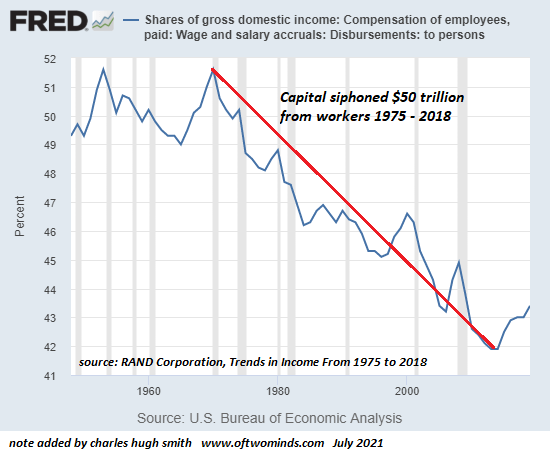
3. The cycle of capital-labor balance: capital has dominated labor for 40+ years, siphoning $50 trillion from labor. This cycle has now turned and the rebalancing is underway: it’s capital’s turn to surrender gains and power.

4. The cycle of social order-disorder: as documented by historian Peter Turchin and others, social order (in Turchin’s phrase, the integrative phase) holds sway for about 50 years and then it gives way to an era of social disorder (the disintegrative phase). This phase doesn’t end with mild reforms nobody even notices, it ends with a rebalancing of social, political and economic power.

5. The cycle of wealth/power inequality: wealth–and the political power it buys–becomes increasingly concentrated in the hands of the few at the expense of the many. This feeds economic and political dysfunction and exploitation that must be remedied by reducing extremes of wealth-power inequality.

6. The cycle of speculative excess: those in power protect their wealth and the wealth of their cronies by instituting moral hazard, the disconnect of risk and consequence: the central state and central bank backstop and bail out the most egregious big speculators, who keep all their gains and transfer their losses to the public.

The public concludes the only way to get ahead in such a rigged financial system is to belly up to the gaming tables and gamble that the next bubble will never pop because those in power won’t ever let it pop.

But alas, humans do not possess god-like powers, they only possess hubris, and so all bubbles pop: the more extreme the bubble, the more devastating the pop. The faint cries that fade to silence are: but this time it’s different! and the Fed will save us! That’s not how cycles work: all the god-like powers are revealed as hubris, which arouses the fatal ire of Nemesis.

National Bankruptcy as a Board Game

By Dmitry Orlov

Source: Club Orlov

Most people are familiar with the game Monopoly. Its goal is to teach capitalist kiddies a valuable lesson about capitalism; namely, that in running a business it isn’t useful to shoot for some happy modicum of accommodation with your competitors or to strive for a sustainable steady state. Instead, what you need to do to survive (never mind win) is to grow as quickly as possible and eat up your competitors alive, or you’ll get eaten up yourself. That’s not just a game; that’s exactly how capitalism actually works, and if that doesn’t work for you (it doesn’t for most people) then that’s exactly how capitalism doesn’t work.

And so the Waltons couldn’t just run Walmart as a mart; they had to make it into a global empire—just in order to survive. Now, most governments in the world realize that this sort of unbridled capitalism is harmful and seek to regulate it. For instance, Russia has a Federal Antimonopoly Service. The US Justice Department has an Antitrust Division, which is aptly named if its mission is to destroy Americans’ trust in their government’s ability to regulate business. It also has a website which currently says: “Due to the lapse in appropriations, Department of Justice websites will not be regularly updated.” Perhaps that’s all right for a country that seeks to monopolize everything—international finance and law, defense procurement and, of course, the dispensation of “freedom and democracy” and “universal values.”

Most people are also familiar with the concept of national debt. The federal debt of the US government currently equals… never mind; it’s going up much faster than you can write it down. If you want to watch it go up real time, you can look it up here. The exact number is useless: if you take a snapshot of it—say, $21,921,420,945,123.00—that will no longer be the payoff amount by the time you write out the check, and if you write out the check, no matter who you are, it will bounce. But it won’t even get that far: if you mail that check to the US Treasury Department, they wouldn’t be able to deposit it because “Due to the lapse in appropriations…” (You get the picture.)

The debt goes up all the time, and the rate at which it goes up is accelerating. The concept of acceleration may not be intuitive for some of you, so let me explain. Debt goes up with some speed. Acceleration is the amount by which that speed increases, measured in, for example, dollars per minute per minute. Calculating it is a fun little arithmetic exercise. During Barak Obama’s reign it went up by $8.6 trillion, starting from $11.6 trillion and gong up to $20.2 trillion. Trump plans to add $4.8 trillion during his first three years. (Relevant numbers can be looked up here).

Thus, Obama’s velocity was $8.6 trillion over 8 years—roughly $1 trillion per year or $2 million per minute while Trump’s velocity is roughly $1.6 trillion per year or a little over $3 million per minute. Therefore, the acceleration is only a few cents per minute per minute—but it sure adds up! Acceleration tends to sneak up on you. For instance, if you want to gain some intuitive appreciation for acceleration due to gravity (9.81m or 32 feet per second per second) then try jumping off a chair while keeping your knees straight. You can also ponder the fact that satellites that fall out of Earth’s orbit tend to burn up on reentry as they decelerate due to friction with the atmosphere.

Any sane, numerate person can tell you that increases in debt are fine provided your revenues are increasing significantly faster, but if that’s not the case then the eventual result is bankruptcy. And that is most definitely not the case. Hence the name of this board game is National Bankruptcy. But I am not sure what the objective of the game should be. Is it to go bankrupt as quickly and efficiently as possible, or is to go bankrupt as slowly and painfully as possible?

I am quite sure that players who aren’t on a path to national bankruptcy would prefer to keep it that way, and would furthermore prefer to be rid of all sovereign debt issued by whoever is going to go bankrupt before that happens. (Russia seems to have that problem solved already while China is far behind.) In any case, I am a very serious person who doesn’t like jokes and doesn’t have time to play games, board games included, so I’ll leave it to others to ponder such questions. Still, the board game metaphor seems useful for discussing this topic.

One problem with playing this game is the problem of scale. People have a problem appreciating such huge numbers. They are familiar with what a dollar is, but what’s a trillion? Here it is, represented as double-stacked pallets of $100 bills.

That seems a bit cumbersome for our board game. Reasonable values for the chips in our National Bankruptcy game would be $100 billion, $500 billion and $1 trillion. We could use a few $5 trillion and $10 trillion chips too, though not too many because I doubt that the game would go on long enough to make them useful.

I propose that for the sake of this game we introduce a handy new unit called a “piffle” which is equal to $100 billion. A trillion is 10 piffles, 10 trillion is 100 piffles. Then our chips can be 1, 5, 10, 50 and 100 piffles. Piffles allow us to express various huge quantities without going through any arithmetic contortions. US federal debt is currently 220 piffles. US trade deficit for 2018 was 6 piffles while the US defense budget was 7 piffles. For 2019 the federal budget deficit (covered by increased borrowing) is 10 piffles and rising while tax revenues are just 3 piffles and falling. The interest payment on federal debt is 3 piffles but with rising interest rates it’s going to 5 piffles within a few years.

Speaking of rising interest rates… just today Trump wished for 0% interest rates again, like Obama had while he was running up his 80 piffles’ worth of debt. But now it’s hovering around 3% and is unlikely to go down no matter what Trump wishes. Why? Well, here’s the reason. The US imports much more than it exports because it can’t afford to or lacks the ability to make all the stuff it needs; that’s why there are 6 piffles’ worth of trade deficit. When other nations sell to the US more than they buy, they end up holding lots of piffles, and since the US needs lots of piffles (remember, the budget deficit is 10 piffles) it makes plenty of sense to borrow that money right back. A little while back it was possible to borrow it back at 0% interest because the US was powerful enough to threaten those who refused to play this game with military annihilation (cue pictures of bombed-out Libya and Iraq). But times have changed, and unless the US bribes its debt-holders with 3% interest rate or better—no deal.

How have times changed? There are two effects worth mentioning. First, the military annihilation threat isn’t working any more. Yes, the US still spends a stunning, record-shattering sum of 7 piffles on defense, but none of that is working. Call it the free money effect. When people spend their own hard-earned money, they tend to be careful with it, but if it’s somebody else’s money that they got for free never intending to pay it back, then they tend to throw caution to the wind. And so US military spending has become less and less effective over time, in one of two ways: procurement costs have gone through the roof, and the resulting products have become useless.

In terms of procurement costs, the purchasing parity between the US and (just as an example) Russia seems to be at least ten to one: to get the same result, the US has to spend at least ten times more than Russia. And so although Russia spends well less than 1 piffle on defense, its military is far more effective. In terms of product uselessness, the Pentagon now resembles a woman who has a closet jam-packed with expensive designer labels but has absolutely nothing to wear because her entire wardrobe is no longer fashionable. There is the entire set of aircraft carriers none of which can operate close enough to enemy shores to be of any use at all because they can be readily sunk using hypersonic rockets launched from very far away. There are the stockpiles of Tomahawk cruise missiles which can’t make it past Soviet-era air defense systems (with a few electronics and software upgrades). There are the Patriot air defense systems which are useless even for stopping Soviet-era SCUD missiles, never mind anything more modern.

Add to this Russia’s (and soon China’s) new hypersonic weapons with conventional payloads and new air and space defense systems such as the S-400: these provide what’s known as “escalation dominance.” Suppose the US does something unspeakably nasty and Russia and/or China decide to teach it a lesson. They now have the ability to blow up any target within the US without getting anywhere near it and without placing any of their military assets at risk.

They could, for instance, take out the US electric grid in a way that will take many months to get it back on line. They can then reliably intercept anything that the US tries to retaliate with. Of course, the US can become suicidal—that’s always a risk—and launch a full-on nuclear first strike, then sit back and wait to be completely obliterated along with much of the rest of the planet. But that’s not a military strategy, that’s pure suicide, and the officers in charge of military strategy tend to be emotionally stable family men who look forward to playing with their grandchildren upon retirement.

So, why then should the US continue to spend 7 piffles on defense? The sad answer is that it will go bankrupt whether it zeroes out the defense budget or not. If the defense budget goes to 0, then there is still 3 piffles’ worth of budget deficit left, plus those 6 piffles of trade deficit aren’t going anywhere but up. But what about MAGA?—you might ask—What about firing up US manufacturing, bringing the jobs back and exporting our way out of this? After all, if we turn those 6 piffles of trade deficit into 6 piffles of trade surplus, suddenly it all works out and bankruptcy becomes avoidable.

No, sorry, that just not realistic. You see, in order to get an industrial economy going again the US needs several things. It needs cheap energy, cheap labor, low cost of doing business and readily available markets, both domestic and export. And the US doesn’t have any of these. In terms of energy—and oil is by far the most important form of energy—in 2019 the US will import exactly as much oil as it did in 1998—around 8 million barrels a day. Yes, the shale oil industry has sprung up in the meantime, and the US is currently producing 11.5 million barrels per day. But also in the meantime US oil consumption has gone up a lot—to 20 million barrels a day, which is a stunning 20% of the world’s consumption for 4.4% of the world’s population.

And so the oil deficit is still very much there. Plus the shale oil patch has never made any money but has accumulated over 2 piffles’ worth of debt and has spent over a piffle’s worth more than it made. With interest rates going up they are unlikely to be able to borrow enough to keep up the same hectic drilling rate, and with declines from existing wells at over half a million barrels per day per month it won’t take many months to whittle down that 11.5 million barrels per day, forcing the US to either boost imports or cut consumption.

But the oil price has gone down a lot lately, so there shouldn’t be a problem in any case, right? Again, sorry, no. Peak Oil for most countries has come and gone. There is now only a handful of countries left that are able to meaningfully boost oil production: Russia, Canada (mostly tar sands), Iran, Iraq, United Arab Emirates, Kuwait and Brazil. Russia has recently announced that it isn’t planning to boost production. Saudi Arabia is a huge oil producer but does not seem to have any spare capacity left. Canada’s tar sands patch is a money-losing environmental disaster. Iran and Iraq (call them Iranq, since they are both Shia Moslem, are politically aligned and neither loves America too much) aren’t exactly going to gallop to the rescue. That leaves UAE, Kuwait and Brazil, and if you add them all up together that’s nowhere near enough. So, get ready for oil price spikes, followed by a wave of demand destruction, followed by oil price collapses, followed by supply destruction—you know, the usual.

Moving on to labor. In order to stay competitive, the US will need to lower its median wage a lot. It has to be lower than what the Chinese and the Southeast Asians earn because the US needs to outcompete them to steal their export market share. Without various other major changes this will cause US workers to either rebel or starve to death in short order. The changes involve nationalizing medicine and education to drive down their costs by a factor of 1000 or so, converting to public transportation and pretty much banning the use of private cars to make transportation affordable, putting up high-rises right next to factories for affordable worker housing and so on. That’s a lot of piffles’ worth of effort!

The cost of doing business is a tough one too. The US spends way more on courts and lawyers, insurance and regulatory compliance than most other countries, and the regulatory maze that entrepreneurs have to run in order to run even a small and simple business is very costly and absolutely confounding. How does one take a machete to that whole ridiculous, corrupt scheme? I have no idea. It’s an imponderable. The Chinese would probably just call it a “cultural revolution,” round up all the lawyers and the bureaucrats, make them wear dunce caps and sandwich boards that say “I am what is wrong with this country” and march them in procession while pelting them with rocks and beating them with sticks. Something like that…

Finally, there is the question of export markets. What exactly is the US going to export more effectively than other countries are exporting already? China out-manufactures just about anybody on the planet and isn’t about to give up its spot. Russia exports grain and other foodstuffs (all non-GMO, unlike the US), nuclear and space technology, defense technology (that actually works) and much else. Pakistan and India, and various other countries, export textiles. The world is full up with product. It’s consumers to bankrupt that are in short supply. And if the US cuts its labor rates to make itself competitive, then its consumer base will shrink rather dramatically.

So it looks like bankruptcy is it, no use fighting it. But what should the US do in the meantime? I suggest that it should put up some really huge walls—just for the sake of leaving behind some spectacular ruins for future generations to marvel at. The one along the southern border seems to be going up already, but there should be at least two more. There needs to be a wall along the Mason-Dixon line, because given the heated state of US politics there needs to be a way to prevent people from trying to reenact the Civil War (a misnomer, that!) with actual real weapons and live ammo. And there also needs to be a wall along the northern border, to keep various groups of armed troglodytes from escaping to Canada and ransacking it (it’s the least we can do for our peaceful northern neighbors). How much will these three walls cost? Glad you asked! They will cost roughly 0.005 piffles apiece, 0.015 piffles total—a truly piffling amount. That’s my 0.000000002 piffle’s worth. But, you know, it’s the thought that counts.

Oh, and if you want to actually design this National Bankruptcy board game, please resist the temptation to contact me about it. Seriously, I don’t like games, board games especially. I am a very serious person who doesn’t have time for such piffles.

The Federal Reserve and the Global Fracture

Octopus 1912

An Interview with Finnish Journalist Antti J. Ronkainen

Michael Hudson

Source: The Unz Review

Antti J. Ronkainen: The Federal Reserve is the most significant central bank in the world. How does it contribute to the domestic policy of the United States?

Michael Hudson: The Federal Reserve supports the status quo. It would not want to create a crisis before the election. Today it is part of the Democratic Party’s re-election campaign, and its job is to serve Hillary Clinton’s campaign contributors on Wall Street. It is trying to spur recovery by resuming its Bubble Economy subsidy for Wall Street, not by supporting the industrial economy. What the economy needs is a debt writedown, not more debt leveraging such as Quantitative Easing has aimed to promote. But the Fed is in a state of denial that the U.S. and European economies are plagued by debt deflation.

The Fed uses only one policy: influencing interest rates by creating bank reserves at low give-away charges. It enables banks too make easy gains simply by borrowing from it and leaving the money on deposit to earn interest (which has been paid since the 2008 crisis to help subsidize the banks, mainly the largest ones). The effect is to fund the asset markets – bonds, stocks and real estate – not the economy at large. Banks also are heavy arbitrage players in foreign exchange markets. But this doesn’t help the economy recover, any more than the ZIRP (Zero Interest-Rate Policy) since 2001 has done for Japan. Financial markets are the liabilities side of the economy’s balance sheet, not the asset side.

The last thing either U.S. party wants is for the election to focus on this policy failure. The Fed, Treasury and Justice Department will be just as pro-Wall Street under Hillary. There would be no prosecutions of bank fraud, there would be another bank-friendly Attorney General, and a willingness to subsidize banks now that the Dodd-Frank bank reform has been diluted from what it originally promised to be.


So let’s go back to beginning. When the Great Financial Crisis escalated in 2008 the Fed’s response was to lower its main interest rate to nearly zero. Why?

The aim of lowering interest rates was to provide banks with cheap credit. The pretense was that banks might lend to help the economy get going again. But the Fed’s idea was simply to re-inflate the Bubble Economy. It aimed at restoring the value of the mortgages that banks had in their loan portfolios. The hope was that easy credit would spur new mortgage lending to bid housing prices back up – as if this would help the economy rather than simply raising the price of home ownership.

But banks weren’t going to make mortgage loans to a housing market that already was over-lent. Instead, homeowners had to start paying down the mortgages they had taken out. Banks also reduced their credit-card exposure by a few hundred billion dollars. So instead of receiving new credit, the economy was saddled with having to repay debts.

Banks did make money, but not by lending into the “real” production and consumption economy. They mainly engaged in arbitrage and speculation, and lending to hedge funds and companies to buy their own stocks yielding higher dividend returns than the low interest rates that were available.


In addition to the near zero interest rates, the Fed bought US Treasury bonds and mortgage backed securities (MBS) with almost $4 trillion during three rounds of Quantitative Easing stimulus. How have these measures affected the real economy and financial markets?

In 2008 the Federal Reserve had a choice: It could save the economy, or it could save the banks. It might have used a fraction of what became the vast QE credit – for example $1 trillion – to pay off the bad mortgages and write them down. That would have helped save the economy from debt deflation. Instead, the Fed simply wanted to re-inflate the bubble, to save banks from having to suffer losses on their junk mortgages and other bad loans.

Keeping these debts on the books, in full, let banks foreclose on defaulting homeowners. This intensified the debt-deflation, pushing the economy into its present post-2008 depression. The debt overhead is keeping it depressed.

One therefore can speak of a financial war waged by Wall Street against the economy. The Fed is a major weapon in this war. Its constituency is Wall Street. Like the Justice and Treasury Departments, it has been captured and taken hostage.

Federal Reserve chairwoman Janet Yellen’s husband, George Akerlof, has written a good article about looting and fraud as ways to make money. But instead of saying that looting and fraud are bad, the Fed has refused to regulate or move against such activities. It evidently recognizes that looting and fraud are what Wall Street is all about – or at least that the financial system would come crashing down if an attempt were made to clean it up!

So neither the Fed nor the Justice Department or other U.S. Government agencies has sanctioned or arrested a single banker for the trillions of dollars of financial fraud. Just the opposite: The big banks where the fraud was concentrated have been made even larger and more dominant. The effect has been to drive out of business the smaller banks not so involved in derivative bets and other speculation.

The bottom line is that banks made much more by getting Alan Greenspan and the Clinton-Bush Treasury officials to deregulate fraud than they could have made by traditional safe lending. But their gains have increased the economy’s overhead.


Do you believe Mike Whitney’s argument that QE was about a tradeoff between the Fed and the government: the Fed pumped the new bubble and saved the banks that the government didn’t need to bail out more banks. The government’s role was to impose austerity so that inflation and employment didn’t rise – which would have forced the Fed to raise interest rates, ending its QE program? source: http://www.counterpunch.org/2016/01/15/the-chart-that-explains-everything/]

That was a great chart that Mike put up from Richard Koo, and you should reproduce it here. It shows that the Fed’s enormous credit creation had zero effect on raising commodity prices or wages. But stock market prices doubled in just six years, 2008-15, and bond prices rose to new peaks. Banks left much of the QE credit on deposit with the Fed, earning an interest giveaway premium.

(Richard Koo: “The struggle between markets and central banks has only just begun,”

http://www.businessinsider.com/richard-koo-struggle-between-markets-and-central-banks-has-only-just-begun-2015-9?r=UK&IR=T

The important point is that the Fed (backed by the Obama Administration) refused to use this $4 trillion to revive the production-and-consumption economy. It claimed that such a policy would be “inflationary,” by which it meant raising employment and wage levels. The Fed thus accepted the neoliberal junk economics proposing austerity as the answer to any problem – austerity for the industrial economy, not the Fed’s own Wall Street constituency.


According to a Fed staff report, QE would lower the exchange rate of dollar to the other currencies causing competitiveness boost for the U.S. firms. Former finance minister of Brazil Guido Mantega, as well as the chairman of Central Bank of India Raghuram Rajan, have described the Fed’s QE as a “currency war.” What’s your take?

The Fed’s aim was simply to provide banks with low-interest credit. Banks lent to hedge funds to buy securities or make financial bets that yielded more than 0.1 percent. They also lent to companies to buy their own stock, and to corporate raiders for debt-financed mergers and acquisitions. But banks didn’t lend to the economy at large, because it already was “loaned up,” and indeed, overburdened with debt.

Lower interest rates did spur the “carry trade,” as they had done in Japan after 1990. Banks and hedge funds bought foreign bonds paying higher rates. The dollar drifted down as bank arbitrageurs could borrow from the Fed at 0.1 percent to lend to Brazil at 9 percent. Buying these foreign bonds pushed up foreign exchange rates against the dollar. That was a side effect of the Fed’s attempt to help Wall Street make financial gains. It simply didn’t give much consideration to how its QE flooding the global economy with surplus dollars would affect U.S. exports – or foreign countries.

Exchange rate shifts don’t affect export trends as much as textbook models claim. U.S. arms exports to the Near East, and many technology exports are non-competitive. However, a looming problem for most countries is what may happen when ending QE increases the dollar’s exchange rate. If U.S. interest rates go back up, the dollar will strengthen. That would increase the cost to foreign countries of paying dollar-denominated debts. Countries that borrowed all dollars at low interest will need to pay more in their own currencies to service these debts. Imagine what would happen if the Federal Reserve let interest rates rise back to a normal level of 4 or 5 percent. The soaring dollar would push debtor economies toward depression on capital account much more than it would help their exports on trade account.


You have said that QE is fracturing the global economy. What do you mean by that?

Part of the flood of dollar credit is used to buy shares of foreign companies yielding 15 to 20 percent, and foreign bonds. These dollars are turned over to foreign central banks for domestic currency. But central banks are only able to use these dollars to buy U.S. Treasury securities, yielding about 1 percent. When the People’s Bank of China buys U.S. Treasury bonds, it’s financing America’s dual budget and balance-of-payment deficits, both of which stem largely from military encirclement of Eurasia – while letting U.S. investors and the U.S. economy get a free ride.

Instead of buying U.S. Treasury securities, China would prefer to buy American companies, just like U.S. investors are buying Chinese industry. But America’s government won’t permit China even to buy gas station companies. The result is a double standard. Americans feel insecure having Chinese ownership in their companies. It is the same attitude that was directed against Japan in the late 1980s.

I wrote about this financial warfare and America’s free lunch via the dollar standard in Super Imperialism (2002) and The Bubble and Beyond (2012), and about how today’s New Cold War is being waged financially in Killing the Host (2015).


The Democrats loudly criticized the Bush administration’s $700 billion TARP-program, but backed the Fed’s QE purchases worth of almost $4 trillion during the Obama administration. How does this relate to the fact that officially, QE purchases were intended to support economic recovery?

I think you’ve got the history wrong. My Killing the Host describes how the Democrats supported TARP, while the Republican Congress opposed it on populist grounds. Republican Treasury Secretary Hank Paulson offered to use some of the money to aid over-indebted homeowners, but President-elect Obama blocked that – and then appointed Tim Geithner as Treasury Secretary. FDIC head Sheila Bair and by SIGTARP head Neil Barofsky have written good books about Geithner’s support for Wall Street (and especially for Citigroup and Goldman Sachs) against the interests of the economy at large.

If you are going to serve Wall Street – your major campaign contributors – you are going to need a cover story pretending that this will help the economy. Politicians start with “Column A”: their agenda to reimburse their campaign contributors – Wall Street and other special interests. Their public relations team and speechwriters then draw up “Column B”: what public voters want. To get votes, a rhetorical cover story is crafted. I describe this in my forthcoming J is for Junk Economics, to be published in March. It’s a dictionary of Orwellian doublethink, political and economic euphemisms to turn the vocabulary around and mean the opposite of what actually is meant.


How do TARP and QE relate to the Federal Reserve’s mandate about price stability?

There are two sets of prices: asset prices and commodity prices and wages. By “price stability” the Fed means keeping wages and commodity prices down. Calling depressed wage levels “price stability” diverts attention from the phenomenon of debt deflation – and also from the asset-price inflation that has increased the advantages of the One Percent over the 99 Percent. From 1980 to the present, the Fed has inflated the largest bond rally in history as a result of driving down interest rates from 20 percent in 1980 to nearly zero today, as you have noted.

Chicago School monetarism ignores asset prices. It pretends that when you increase the money supply, this increases consumer prices, commodity prices and wages proportionally. But that’s not what happens. When banks created credit (money), they don’t lend much to people to buy goods and services or for companies to make capital investments to employ more workers. They lend money mainly to transfer ownership of assets already in place. About 80 percent of bank loans are mortgages, and the rest are largely for stocks and bond purchases, including corporate takeovers and stock buybacks or debt-leveraged purchases. The effect is to bid up asset prices, while loading down the economy with debt in the process. This pushes up the break-even cost of doing business, while imposing debt deflation on the economy at large.

Wall Street isn’t so interested in exploiting wage labour by hiring it to produce goods for sale, as was the case under industrial capitalism in its heyday. It makes its gains by riding the wave of asset inflation. Banks also gain by making labour pay more interest, fees and penalties on mortgages, and for student loans, credit cards and auto loans. That’s the postindustrial financial mode of exploiting labor and the overall economy. The Fed’s QE program increases the price at which stocks, bonds and real estate exchange for labour, and also promotes debt leverage throughout the economy.


Why don’t economists distinguish between asset-price and commodity price inflation?

The economics curriculum has been turned into an exercise for students to pretend that a hypothetical parallel universe exists in which the rentier classes are job creators, necessary to help economies recover. The reality is that financial modes of getting rich by debt leveraging creates a Bubble Economy – a Ponzi scheme leading to austerity and shrinking markets, which always ends in a convulsion of bankruptcy.

The explanation for why this is not central to today’s economic theory is that the discipline has been captured by this neoliberal tunnel vision that overlooks the financial sector’s maneuvering to make quick trading profits in stocks, bonds, mortgages and derivatives, not to take the time and effort to develop long-term markets. Rentiers seek to throw a cloak of invisibility around how they make money. They know that if economists don’t measure their wealth and the public does not see it, voters will be less likely to bring pressure to regulate and tax it.

Today’s central economic problem is that inflating asset prices by debt leveraging extracts more interest and financial charges. When the resulting debt deflation ends up hollowing out the economy, creditors try to blame labour, or government spending (except for bailouts and QE to help Wall Street). It is as if debtors are exploiting their creditors.


If there is a new class war, what is the current growth model?

It’s an austerity model, as you can see from the eurozone and from the neoliberal consensus that cites Latvia as a success story rather than a disaster leading to de-industrialization and emigration. In real democracies, if economies polarize like they are doing today, you would expect the 99 Percent to fight back by electing representatives to enact progressive taxation, regulate finance and monopolies, and make public investment to raise wages and living standards. In the 19th century this drive led parliaments to rewrite the tax rules to fall more on landlords and monopolists.

Industrial capitalism plowed profits back into new means of production to expand the economy. But today’s rentier model is based on austerity and privatization. The main way the financial sector always has obtained wealth has been by privatizing it from the public domain by insider dealing and indebting governments.

The ultimate financial business plan also is to lend with an eye to end up with the debtor’s property, from governments to companies and families. In Greece the European Central Bank, European Commission and IMF demanded that if the nation’s elected representatives did not sell off the nation’s ports, land, islands, roads, schools, sewer systems, water systems, television stations and even museums to reimburse the dreaded austerity troika for its bailout of bondholders and bankers, the country would be isolated from Europe and faced with a crash. That forced Greece to capitulate.

What seems at first glance to be democracy has been hijacked by politicians who accept the financial class war ideology that the way for an economy to get rich is by austerity. That means lowering wages, unemployment, and dismantling government by turning the public domain over to the financial sector.

By supporting the banking sector even in its predatory and outright fraudulent behavior, U.S. and European governments are reversing the trajectory along which 19th-century progressive industrial capitalism and socialism were moving. Today’s rentier class is not concerned with long-term tangible investment to earn profits by hiring workers to produce goods. Under finance capitalism, an emerging financial over-class makes money by stripping income and assets from economies driven deeper into debt. Attacking “big government” when it is democratic, the wealthy are all in favor of government when it is oligarchic and serves their interests by rolling back the past two centuries of democratic reforms.


Does the Fed realize global turbulences what its unconventional policies have caused?

Sure. But the Fed has painted itself in a corner: If it raises interest rates, this will cause the stock and bond markets to go down. That would reverse the debt leveraging that has kept these markets up. Higher interest rates also would bankrupt Third World debtors, which will not be able to pay their dollar debts if dollars become more expensive in their currencies.

But if the Fed keeps interest rates low, pension funds and insurance companies will have difficulty making the paper gains that their plans imagined could continue exponentially ad infinitum. So whatever it does, it will destabilize the global economy.


China’s stock market has crashed, western markets are very volatile, and George Soros has said that the current financial environment reminds him of the 2008 crash. Should we be worried?

News reports make it sound as if debt-ridden capitalist economies will face collapse if the socialist countries don’t rescue them from their shrinking domestic markets. I think Soros means that the current financial environment is fragile and highly debt-leveraged, with heavy losses on bad loans, junk bonds and derivatives about to be recognized. Regulators may permit banks to “extend and pretend” that bad loans will turn good someday. But it is clear that most government reports and central bankers are whistling in the dark. Changes in any direction may pull down derivatives. That will cause a break in the chain of payments when losers can’t pay. The break may spread and this time public opinion is more organized against 2008-type bailouts.

The moral is that debts that can’t be paid, won’t be. The question is, how won’t they be paid? By writing down debts, or by foreclosures and distress sell-offs turning the financial class into a ruling oligarchy? That is the political fight being waged today – and as Warren Buffet has said, his billionaire class is winning it.


That’s all for now. Thank you Michael!