Biotech Giants Using GMOs to Build Food Tyranny

By Colin Todhunter

Source: Off-Guardian

The article below was written the day before India’s state-run biotech regulator, the Genetic Engineering Appraisal Committee (GEAC), approved genetically modified (GM) mustard for commercial cultivation. This decision was taken on 26 October 2022.

The regulatory clearance for GM mustard means the crop is fit for environmental release. However, the Supreme Court has yet to rule on the matter and government stated a while back that it would wait until that ruling is in.

What follows provides insight into the deceptions and scientific fraud that underpin this decision as well as the consequences for food and agriculture.

We are currently seeing rising food prices due to a combination of an engineered food crisis for geopolitical reasons, financial speculation by hedge funds, pension funds and investment banks and profiteeringby global grain trade conglomerates like Cargill, Louis Dreyfus, ADM and Bunge.

In addition, agri firms like Bayer, Syngenta (ChemChina) and Corteva cynically regard current circumstances as an opportunity to promote their agenda and seek commercialisation of unregulated and improperly tested genetically engineered (GE) technologies.

These companies have long promoted the false narrative that their hybrid seeds and their GE seeds, along with their agrichemicals, are essential for feeding a growing global population. This agenda is orchestrated by vested interests and career scientists – many of whom long ago sold their objectivity for biotech money – lobby groups and disgraced politiciansand journalists.

Meanwhile, in an attempt to deflect and sway opinion, these industry shills also try to depict their critics as being Luddites and ideologically driven and for depriving the poor of (GE) food and farmers of technology.

This type of bombast disintegrates when confronted with the evidence of a failing GE project.

As well as this kind of emotional blackmail, prominent lobbyists like Mark Lynas– unable or unwilling to acknowledge that genuine food security and food sovereignty can be achieved withoutproprietary products – trot out other baseless and absurd claims that industry critics are Kremlin stooges, while displaying their ignorance of geopolitics.

Indeed, who would you turn to for an analysis of current US-Russia relations? An advocate for GE foods and pesticides who makes inaccurate claims from his perch at the Gates Foundation-funded Cornell Alliance for Science. Or a renowned academic like Professor Michael Hudson whose specialist field covers geopolitics.

But it would not be the first time that an industry activist like Lynas has ventured beyond his field of claimed expertise to try to score points.

However, dirty tricks and smears are par for the course because the agri biotech emperor has been shown to have no clothes time and again – GE is a failing, often detrimental technology in search of a problem. And if the problem does not exist, the reality of food insecurity will be twisted to serve the industry agenda, and regulatory bodies and institutions supposedly set up to serve the public interest will be placed under intense pressure or subverted.

The performance of GE crops has been a hotly contested issue and, as highlighted in a 2018 piece by PC Kesavan and MS Swaminathan in the journal Current Science, there is sufficiently strong evidence to question their efficacy and the devastating impacts on the environment, human health and food security, not least in places like Latin America.

new report by Friends of the Earth (FoE) Europe shows that big global biotech corporations like Bayer and Corteva, which together already control 40% of the global commercial seed market, are now trying to cement complete dominance. Industry watchdog GMWatch notes these companies are seeking to increase their control over the future of food and farming by extensively patenting plants and developing a new generation of genetically modified organisms (GMOs).

These companies are moving to patent plant genetic information that can occur naturally or as a result of genetic modification. They claim all plants with those genetic traits as their “invention”. Such patents on plants would restrict farmers’ access to seeds and impede breeders from developing new plants as both would have to ask for consent and pay fees to the biotech companies.

Corteva has applied for some 1,430 patents on new GMOs, while Bayer has applications for 119 patents.

Mute Schimpf, food campaigner at Friends of the Earth Europe, says:

Big biotech’s strategy is to apply for wide patents that would also cover plants which naturally present the same genetic characteristics as the GMOs they engineered. They will be lining their pockets from farmers and plant breeders, who in turn will have a restricted access to what they can grow and work with.”

For instance, GMWatch notes that Corteva holds a patent for a process modifying the genome of a cell using the CRISPR technique and claims the intellectual property rights to any cells, seeds and plants that include the same genetic information, whether in broccoli, maize, soy, rice, wheat, cotton, barley or sunflower.

The agri biotech sector is engaged in a corporate hijack of agriculture while attempting to portray itself as being involved in some kind of service to humanity.

And this is a global endeavour, which is also currently being played out in India.

GM MUSTARD

recent report on the Down to Earth website stated that the Genetic Engineering Appraisal Committee (GEAC), India’s apex regulatory body, might approve the commercial cultivation of GM mustard. In response, concerned citizens have written to the government, objecting to the potential approval of unsafe, unneeded and unwanted GMOs.

The decision whether to allow the commercialisation of what would be the first GE food crop in India has been dragging on for years. COVID delayed the process, but a decision on GM mustard now appears to be close.

However, serious conflicts of interest, sleight of hand and regulatory delinquency – not to mention outright fraud – could mean the decision coming down in favour of commercialisation.

The bottom line is government collusion with global agribusiness, which is trying to hide in the background, despite much talk of Professor Pental and his team at Delhi University being independent developers of GM mustard (DMH 11).

GM mustard presents an opportunity to make various herbicide tolerant (HT) mustard hybrids using India’s best germ plasm, which would be an irresistible money spinner for the seed and chemical manufacturers.

In 2016, campaigner Aruna Rodrigues petitioned India’s Supreme Court seeking a moratorium on the release of any GMOs into the environment pending a comprehensive, transparent and rigorous biosafety protocol in the public domain conducted by agencies of independent expert bodies, the results of which are made public.

In her writ, Rodrigues stated:

In 2002, Proagro Seed Company (now Bayer), applied for commercial approval for exactly the same construct that Prof Pental and his team are now promoting as HT Mustard DMH 11. The reason today matches Bayer’s claim then of 20% better yield increase (than conventional mustard). Bayer was turned down because the ICAR [Indian Council of Agricultural Research] said that their field trials did not give evidence of superior yield.”

The petition says that 14 years later invalid field trials and unremittingly fraudulent data now supposedly provide evidence of a superior yield of 25%.

Rodrigues continues:

HT DMH 11 is the same Bayer HT GMO construct – a herbicide tolerant GMO of three alien genes. It employs, like the Bayer construct, pollen sterilisation technology BARNASE, with the fertility restorer gene BARSTAR (B & B system) (modified from the original genes sourced from a soil bacterium) and the herbicidal bar gene in each GMO parental line. The employment of the B & B system is to facilitate the making of hybrids as mustard is largely a self-pollinating crop (but outcrosses at rates of up to 20%). There is no trait for yield. HT DMH 11 is straightforwardly an herbicide tolerant (HT) crop, though this aspect has been consistently marginalised by the developers over the last several years.”

In order to produce a hybrid, two parent lines had to be genetically modified. Barnase and barstar technology was used in the parent lines. And the outcome is three GMOs: the two parents and the offspring, DMH 11, which will be ideal for working with glufosinate (Bayer’s ‘Liberty’ and ‘Basta’).

According to Rodrigues:

… the plan is that the official route for the first-time release of a HT crop and a food crop will be through HT DMH 11 and/or its two HT parental lines by stealth. Since the claimed YIELD superiority of HT DMH 11 through the B & B system over non-GMO varieties and hybrids is quite simply NOT TRUE…”

In her numerous affidavits submitted to India’s Supreme Court, Rodrigues has set out in some detail why GE crops are a threat to human health and the environment and are unsuitable for India. She briefly communicated some of her concerns in a 2020 interview titled GMO Issue Reaches Boiling Point in India: Interview with Aruna Rodrigues.

Moreover, various high-level reports have advised against introducing GM food crops to India: The ‘Jairam Ramesh Report’ of February 2010, imposing an indefinite moratorium on Bt Brinjal; The ‘Sopory Committee Report’ (August 2012); The ‘Parliamentary Standing Committee’ (PSC) Report on GM crops (August 2012); and The ‘Technical Expert Committee (TEC) Final Report’ (June-July 2013).

These reports conclude that GM crops are unsuitable for India and that existing biosafety and regulatory procedures are inadequate. Appointed by the Supreme Court, the TEC was scathing about the regulatory system prevailing in India, highlighting its inadequacies and inherent serious conflicts of interest. The TEC recommended a 10-year moratorium on commercial release of GM crops. The PSC also arrived at similar conclusions.

According to eminent lawyer Prashant Bhushan, these official reports attest to just how negligent India’s regulators are and to a serious lack of expertise on GM issues within official circles.

Aruna Rodrigues long ago noted the abysmal state of GMO regulatory oversight in the country and the need for the precautionary principle to be applied without delay. But not much has changed and the regulatory position basically remains the same.

Rodrigues asserts that the two parent lines and the hybrid DMH-11 require full independent testing, which has not occurred. And it has not occurred because of a conflict of interest and regulatory delinquency.

Rodrigues notes:

India is suddenly faced with the deregulation of GMOs. This is disastrous and alarming, without ethics and a scientific rationale.”

GM mustard is said to out-yield India’s best cultivars by 25-30%. The choice of the correct ‘comparators’ is an absolute requirement for the testing of any GMO to establish whether it is required in the first place. But Rodrigues argues that the choice of deliberately poor ‘comparators’ is at the heart of the fraud.

In the absence of adequate and proper testing and sufficient data, no statistically valid conclusions of mean seed yield (MSY) of DMH 11 could be drawn anyhow. Yet they were drawn by both the regulators and developers who furthermore self-conducted and supervised the trials. Without valid data to justify it, DMH 11 was allowed in pre-commercial large scale field trials in 2014-15.

For an adequate basis for a comparative assessment of MSY, Rodrigues argues it was absolutely necessary for the comparison to include the cross (hybrid) between the non-modified parental lines (nearest isogenic line), at the very start of the risk assessment process and throughout the subsequent stages of field testing, in addition to other recommended ‘comparators’. None of this was done.

Deliberately poor non-GMO mustard varieties were chosen to promote prospects for DMH 11 as a superior yielding GMO hybrid, which then passed through ‘the system’ and was allowed by the regulators, a classic non-sequitur by both the regulators and Dr Pental.

The fraud continued, according to Rodrigues, by actively fudging yield data of DMH 11 by 15.2% to show higher MSY. In her various Supreme Court petitions, she has offered a good deal of evidence to show how it was done.

Rodrigues says:

It matters not a jot if HT DMH 11 is not approved. What does matter is that its two HT (GMO) parental lines are: HT Varuna-barnase and HT EH 2-barstar will be used ‘for introgressing the bar-barnase and bar- barstar genes into new set of parental line to develop next generation of hybrids with higher yields” (according to the developer and regulator).”

She says this extraordinary admission confirms that the route to any number of ‘versions’ of HT mustard DMH 11 is invested in these two GMOs as parents – India will have hundreds of low-yielding HT mustard hybrids, using India’s best mustard cultivars at great harm to farmers and contaminating the country’s seeds and mustard germ plasm irreversibly.

In effect, according to Rodrigues, India faces a three-in-one regulatory jugglery in a brazen display of collusion to fraud the nation by regulatory institutions of governance.

Moreover, HT mustard DMH 11 will make no impact on the domestic production of mustard oil, which was a major reason why it was being pushed in the first place. The argument was that GM mustard would increase productivity and this would help reduce imports of edible oils.

Until the mid-1990s, India was virtually self-sufficient in edible oils. Then import tariffs were reduced, leading to an influx of cheap (subsidised) edible oil imports that domestic farmers could not compete with. This effectively devastated the home-grown edible oils sector and served the interests of palm oil growers and US grain and agriculture commodity company Cargill.

It came as little surprise that in 2013 India’s then Agriculture Minister Sharad Pawar accused US companies of derailing the nation’s oil seeds production programme.

Whether in India, Europe or elsewhere, the industry’s agenda is to use GE technology to secure intellectual property rights over all seeds (and chemical inputs) and thus gain total control over food and farming. And given what has been set out here – they seek to achieve this by all means necessary.


More Billions to Ukraine as America Falls Apart

By Ron Paul

Source: Ron Paul Institute

There is a video clip making the rounds showing President Biden speaking at a recent NATO summit about the seven billion dollars the US government had – at that time – provided to Ukraine. Attached to that is another clip showing the horrific state of several US major cities, including in Pennsylvania, California, and Ohio. The video of American cities is shocking: endless landscapes of filth, trash, homelessness, open fires on the street, drug-addicted zombies. It doesn’t look like the America most of us remember.

Watching Biden bragging about sending billions of dollars to corrupt leaders overseas with American cities looking like bombed-out Iraq or Libya is US foreign policy in a nutshell. The Washington elites tell the rest of America that they must “promote democracy” in some far-off land. Anyone who objects is considered in league with the appointed enemy of the day. Once it was Saddam, then Assad and Gaddafi. Now it’s Putin. The game is the same, only the names are changed.

What is seldom asked, is what is in this deal for those Americans who suffer to pay for our interventionist foreign policy. Do they really think a working American in Ohio or Pennsylvania is better off or safer because we are supposedly protecting Ukraine’s borders? I think most Americans would wonder why they aren’t bothering to protect our own borders.

A reported 200,000 illegals crossed the border into the US in July alone. You can believe they are learning quickly about the free money provided by the US government to illegals. They’ll probably get a voting card as well.

Last Friday the Pentagon announced that yet another $775 million would be sent to Ukraine. As Antiwar.com reported, it was the eighteenth weapons package to Ukraine in six months. Has there ever been a more idiotic US intervention in history?

Supporters of this proxy war may celebrate more aid to Ukraine, but the reality is that it is in no way aid to Ukraine. That’s not how the system works. It is money created out of thin air by the Fed and appropriated by Congress to be spent propping up the politically-connected military-industrial complex. It is a big check written by middle America to rich people who run Raytheon and Lockheed Martin. Americans watch their budget being stretched to the limit while the Beltway fat-cats loosen their belts to continue enjoying the gravy train.

Bloomberg reported earlier this summer that inflation is costing the average American household more than $5,200 this year. Inflation is a tax on middle class and poor Americans. The wealthy – like those who run Raytheon and Lockheed Martin – always get the new money first, before prices go up. The rest of us watch as the dollar buys less and less.

As Washington salivates over fighting Russia in Ukraine, the rest of America feels like we’re becoming Zimbabwe. How long until it takes a trillion dollars for a loaf of bread? Will there be a run on wheelbarrows?

There is a way out. It’s called “non-interventionism.” The war in Ukraine was caused by the US regime change in 2014 and the neocon insistence that Ukraine join NATO. The State Department and CIA thought it was a great victory to overthrow the elected government, but meanwhile the rest of us get the bill. No NATO and not one more penny for Ukraine!

Global Planned Financial Tsunami Has Just Begun

By F. William Engdahl

Source: Global Research

Since the creation of the US Federal Reserve over a century ago, every major financial market collapse has been deliberately triggered for political motives by the central bank. The situation is no different today, as clearly the US Fed is acting with its interest rate weapon to crash what is the greatest speculative financial bubble in human history, a bubble it created. Global crash events always begin on the periphery, such as with the 1931 Austrian Creditanstalt or the Lehman Bros. failure in September 2008. The June 15 decision by the Fed to impose the largest single rate hike in almost 30 years as financial markets are already in a meltdown, now guarantees a global depression and worse.

The extent of the “cheap credit” bubble that the Fed, the ECB and Bank of Japan have engineered with buying up of bonds and maintaining unprecedented near-zero or even negative interest rates for now 14 years, is beyond imagination. Financial media cover it over with daily nonsense reporting , while the world economy is being readied, not for so-called “stagflation” or recession. What is coming now in the coming months, barring a dramatic policy reversal, is the worst economic depression in history to date. Thank you, globalization and Davos.

Globalization

The political pressures behind globalization and the creation of the World Trade Organization out of the Bretton Woods GATT trade rules with the 1994 Marrakesh Agreement, ensured that the advanced industrial manufacturing of the West, most especially the USA, could flee offshore, “outsource” to create production in extreme low wage countries. No country offered more benefit in the late 1990s than China. China joined WHO in 2001 and from then on the capital flows into China manufacture from the West have been staggering. So too has been the buildup of China dollar debt. Now that global world financial structure based on record debt is all beginning to come apart.

When Washington deliberately allowed the September 2008 Lehman Bros financial collapse, the Chinese leadership responded with panic and commissioned unprecedented credit to local governments to build infrastructure. Some of it was partly useful, such as a network of high-speed railways. Some of it was plainly wasteful, such as construction of empty “ghost cities.” For the rest of the world, the unprecedented China demand for construction steel, coal, oil, copper and such was welcome, as fears of a global depression receded. But the actions by the US Fed and ECB after 2008, and of their respective governments, did nothing to address the systemic financial abuse of the world’s major private banks on Wall Street and Europe , as well as Hong Kong.

The August 1971 Nixon decision to decouple the US dollar, the world reserve currency, from gold, opened the floodgates to global money flows. Ever more permissive laws favoring uncontrolled financial speculation in the US and abroad were imposed at every turn, from Clinton’s repeal of Glass-Steagall at the behest of Wall Street in November 1999. That allowed creation of mega-banks so large that the government declared them “too big to fail.” That was a hoax, but the population believed it and bailed them out with hundreds of billions in taxpayer money.

Since the crisis of 2008 the Fed and other major global central banks have created unprecedented credit, so-called “helicopter money,” to bailout the major financial institutions. The health of the real economy was not a goal. In the case of the Fed, Bank of Japan, ECB and Bank of England, a combined $25 trillion was injected into the banking system via “quantitative easing” purchase of bonds, as well as dodgy assets like mortgage-backed securities over the past 14 years.

Quantitative madness

Here is where it began to go really bad. The largest Wall Street banks such as JP MorganChase, Wells Fargo, Citigroup or in London HSBC or Barclays, lent billions to their major corporate clients. The borrowers in turn used the liquidity, not to invest in new manufacturing or mining technology, but rather to inflate the value of their company stocks, so-called stock buy-backs, termed “maximizing shareholder value.”

BlackRock, Fidelity, banks and other investors loved the free ride. From the onset of Fed easing in 2008 to July 2020, some $5 trillions had been invested in such stock buybacks, creating the greatest stock market rally in history. Everything became financialized in the process. Corporations paid out $3.8 trillion in dividends in the period from 2010 to 2019. Companies like Tesla which had never earned a profit, became more valuable than Ford and GM combined. Cryptocurrencies such as Bitcoin reached market cap valuation over $1 trillion by late 2021. With Fed money flowing freely, banks and investment funds invested in high-risk, high profit areas like junk bonds or emerging market debt in places like Turkey, Indonesia or, yes, China.

The post-2008 era of Quantitative Easing and zero Fed interest rates led to absurd US Government debt expansion. Since January 2020 the Fed, Bank of England, European Central Bank and Bank of Japan have injected a combined $9 trillion in near zero rate credit into the world banking system. Since a Fed policy change in September 2019, it enabled Washington to increase public debt by a staggering $10 trillion in less than 3 years. Then the Fed again covertly bailed out Wall Street by buying $120 billion per month of US Treasury bonds and Mortgage-Backed Securities creating a huge bond bubble.

A reckless Biden Administration began doling out trillions in so-called stimulus money to combat needless lockdowns of the economy. US Federal debt went from a manageable 35% of GDP in 1980 to more than 129% of GDP today. Only the Fed Quantitative Easing, buying of trillions of US government and mortgage debt and the near zero rates made that possible. Now the Fed has begun to unwind that and withdraw liquidity from the economy with QT or tightening, plus rate hikes. This is deliberate. It is not about a stumbling Fed mis-judging inflation.

Energy drives the collapse

Sadly, the Fed and other central bankers lie. Raising interest rates is not to cure inflation. It is to force a global reset in control over the world’s assets, it’s wealth, whether real estate, farmland, commodity production, industry, even water. The Fed knows very well that Inflation is only beginning to rip across the global economy. What is unique is that now Green Energy mandates across the industrial world are driving this inflation crisis for the first time, something deliberately ignored by Washington or Brussels or Berlin.

The global shortages of fertilizers, soaring prices of natural gas, and grain supply losses from global draught or exploding costs of fertilizers and fuel or the war in Ukraine, guarantee that, at latest this September-October harvest time, we will undergo a global additional food and energy price explosion. Those shortages all are a result of deliberate policies.

Moreover, far worse inflation is certain, due to the pathological insistence of the world’s leading industrial economies led by the Biden Administration’s anti-hydrocarbon agenda. That agenda is typified by the astonishing nonsense of the US Energy Secretary stating, “buy E-autos instead” as the answer to exploding gasoline prices.

Similarly, the European Union has decided to phase out Russian oil and gas with no viable substitute as its leading economy, Germany, moves to shut its last nuclear reactor and close more coal plants. Germany and other EU economies as a result will see power blackouts this winter and natural gas prices will continue to soar. In the second week of June in Germany gas prices rose another 60% alone. Both the Green-controlled German government and the Green Agenda “Fit for 55” by the EU Commission continue to push unreliable and costly wind and solar at the expense of far cheaper and reliable hydrocarbons, insuring an unprecedented energy-led inflation.

Fed has pulled the plug

With the 0.75% Fed rate hike, largest in almost 30 years, and promise of more to come, the US central bank has now guaranteed a collapse of not merely the US debt bubble, but also much of the post-2008 global debt of $303 trillion. Rising interest rates after almost 15 years mean collapsing bond values. Bonds, not stocks, are the heart of the global financial system.

US mortgage rates have now doubled in just 5 months to above 6%and home sales were already plunging before the latest rate hike. US corporations took on record debt owing to the years of ultra-low rates. Some 70% of that debt is rated just above “junk” status. That corporate non-financial debt totaled $9 trillion in 2006. Today it exceeds $18 trillion. Now a large number of those marginal companies will not be able to rollover the old debt with new, and bankruptcies will follow in coming months. The cosmetics giant Revlon just declared bankruptcy.

The highly-speculative, unregulated Crypto market, led by Bitcoin, is collapsing as investors realize there is no bailout there. Last November the Crypto world had a $3 trillion valuation. Today it is less than half, and with more collapse underway. Even before the latest Fed rate hike the stock value of the US megabanks had lost some $300 billion. Now with stock market further panic selling guaranteed as a global economic collapse grows, those banks are pre-programmed for a new severe bank crisis over the coming months.

As US economist Doug Noland recently noted, “Today, there’s a massive “periphery” loaded with “subprime” junk bonds, leveraged loans, buy-now-pay-later, auto, credit card, housing, and solar securitizations, franchise loans, private Credit, crypto Credit, DeFi, and on and on. A massive infrastructure has evolved over this long cycle to spur consumption for tens of millions, while financing thousands of uneconomic enterprises. The “periphery” has become systemic like never before. And things have started to Break.”

The Federal Government will now find its interest cost of carrying a record $30 trillion in Federal debt far more costly. Unlike the 1930s Great Depression when Federal debt was near nothing, today the Government, especially since the Biden budget measures, is at the limits. The US is becoming a Third World economy. If the Fed no longer buys trillions of US debt, who will? China? Japan? Not likely.

Deleveraging the bubble

With the Fed now imposing a Quantitative Tightening, withdrawing tens of billions in bonds and other assets monthly, as well as raising key interest rates, financial markets have begun a deleveraging. It will likely be jerky, as key players like BlackRock and Fidelity seek to control the meltdown for their purposes. But the direction is clear.

By late last year investors had borrowed almost $1 trillion in margin debt to buy stocks. That was in a rising market. Now the opposite holds, and margin borrowers are forced to give more collateral or sell their stocks to avoid default. That feeds the coming meltdown. With collapse of both stocks and bonds in coming months, go the private retirement savings of tens of millions of Americans in programs like 401-k. Credit card auto loans and other consumer debt in the USA has ballooned in the past decade to a record $4.3 trillion at end of 2021. Now interest rates on that debt, especially credit card, will jump from an already high 16%. Defaults on those credit loans will skyrocket.

Outside the US what we will see now, as the Swiss National Bank, Bank of England and even ECB are forced to follow the Fed raising rates, is the global snowballing of defaults, bankruptcies, amid a soaring inflation which the central bank interest rates have no power to control. About 27% of global nonfinancial corporate debt is held by Chinese companies, estimated at $23 trillion. Another $32 trillion corporate debt is held by US and EU companies. Now China is in the midst of its worst economic crisis since 30 years and little sign of recovery. With the USA, China’s largest customer, going into an economic depression, China’s crisis can only worsen. That will not be good for the world economy.

Italy, with a national debt of $3.2 trillion, has a debt-to-GDP of 150%. Only ECB negative interest rates have kept that from exploding in a new banking crisis. Now that explosion is pre-programmed despite soothing words from Lagarde of the ECB. Japan, with a 260% debt level is the worst of all industrial nations, and is in a trap of zero rates with more than $7.5 trillion public debt. The yen is now falling seriously, and destabilizing all of Asia.

The heart of the world financial system, contrary to popular belief, is not stock markets. It is bond markets—government, corporate and agency bonds. This bond market has been losing value as inflation has soared and interest rates have risen since 2021 in the USA and EU. Globally this comprises some $250 trillion in asset value a sum that, with every fed interest rise , loses more value. The last time we had such a major reverse in bond values was forty years ago in the Paul Volcker era with 20% interest rates to “squeeze out inflation.”

As bond prices fall, the value of bank capital falls. The most exposed to such a loss of value are major French banks along with Deutsche Bank in the EU, along with the largest Japanese banks. US banks like JP MorganChase are believed to be only slightly less exposed to a major bond crash. Much of their risk is hidden in off-balance sheet derivatives and such. However, unlike in 2008, today central banks can’t rerun another decade of zero interest rates and QE. This time, as insiders like ex-Bank of England head Mark Carney noted three years ago, the crisis will be used to force the world to accept a new Central Bank Digital Currency, a world where all money will be centrally issued and controlled. This is also what Davos WEF people mean by their Great Reset. It will not be good. A Global Planned Financial Tsunami Has Just Begun.

The Engineered Stagflationary Collapse Has Arrived – Here’s What Happens Next

By Brandon Smith

Source: Alt-Market.us

In my 16 years as an alternative economist and political writer I have spent around half that time warning that the ultimate outcome of the Federal Reserve’s stimulus model would be a stagflationary collapse. Not a deflationary collapse, or an inflationary collapse, but a stagflationary collapse. The reasons for this were very specific – Mass debt creation was being countered with MORE debt creation while many central banks have been simultaneously devaluing their currencies through QE measures. On top of that, the US is in the unique position of relying on the world reserve status of the dollar and that status is diminishing.

It was only a matter of time before the to forces of deflation and inflation met in the middle to create stagflation. In my article ‘Infrastructure Bills Do Not Lead To Recovery, Only Increased Federal Control’, published in April of 2021, I stated that:

Production of fiat money is not the same as real production within the economy… Trillions of dollars in public works programs might create more jobs, but it will also inflate prices as the dollar goes into decline. So, unless wages are adjusted constantly according to price increases, people will have jobs, but still won’t be able to afford a comfortable standard of living. This leads to stagflation, in which prices continue to rise while wages and consumption stagnate.

Another Catch-22 to consider is that if inflation becomes rampant, the Federal Reserve may be compelled (or claim they are compelled) to raise interest rates significantly in a short span of time. This means an immediate slowdown in the flow of overnight loans to major banks, an immediate slowdown in loans to large and small businesses, an immediate crash in credit options for consumers, and an overall crash in consumer spending. You might recognize this as the recipe that created the 1981-1982 recession, the third-worst in the 20th century.

In other words, the choice is stagflation, or deflationary depression.”

It’s clear today what the Fed has chosen. It’s important to remember that throughout 2020 and 2021 the mainstream media, the central bank and most government officials were telling the public that inflation was “transitory.” Suddenly in the past few months this has changed and now even Janet Yellen has admitted that she was “wrong” on inflation. This is a misdirection, however, because the Fed knows exactly what it is doing and always has. Yellen denied reality, but she knew she was denying reality. In other words, she was not mistaken about the economic crisis, she lied about it.

As I outlined last December in my article ‘The Fed’s Catch-22 Taper Is A Weapon, Not A Policy Error’:

‘First and foremost, no, the Fed is not motivated by profits, at least not primarily. The Fed is able to print wealth at will, they don’t care about profits – They care about power and centralization. Would they sacrifice “the golden goose” of US markets in order to gain more power and full bore globalism? Absolutely. Would central bankers sacrifice the dollar and blow up the Fed as an institution in order to force a global currency system on the masses? There is no doubt; they’ve put the US economy at risk in the past in order to get more centralization.’

The Fed has known for years that the current path would lead to inflation and then market destruction, and here’s the proof – Fed Chairman Jerome Powell actually warned about this exact outcome in October of 2012:

“I have concerns about more purchases. As others have pointed out, the dealer community is now assuming close to a $4 trillion balance sheet and purchases through the first quarter of 2014. I admit that is a much stronger reaction than I anticipated, and I am uncomfortable with it for a couple of reasons.First, the question, why stop at $4 trillion? The market in most cases will cheer us for doing more. It will never be enough for the market. Our models will always tell us that we are helping the economy, and I will probably always feel that those benefits are overestimated. And we will be able to tell ourselves that market function is not impaired and that inflation expectations are under control. What is to stop us, other than much faster economic growth, which it is probably not in our power to produce?

When it is time for us to sell, or even to stop buying, the response could be quite strong; there is every reason to expect a strong response. So there are a couple of ways to look at it. It is about $1.2 trillion in sales; you take 60 months, you get about $20 billion a month. That is a very doable thing, it sounds like, in a market where the norm by the middle of next year is $80 billion a month. Another way to look at it, though, is that it’s not so much the sale, the duration; it’s also unloading our short volatility position.”

As we all now know, the Fed waited until their balance sheet was far larger and until the economy was MUCH weaker than it was in 2012 to unleash tightening measures. They KNEW the whole time exactly what was going to happen.

It is no coincidence that the culmination of the Fed’s stimulus bonanza has arrived right after the incredible damage done to the economy and the global supply chain by the covid lockdowns. It is no coincidence that these two events work together to create the perfect stagflationary scenario. And, it’s no coincidence that the only people who benefit from these conditions are proponents of the “Great Reset” ideology at the World Economic Forum and other globalist institutions. This is an engineered collapse that has been in the works for many years.

The goal is to “reset” the world, to erase what’s left of free market systems, and to establish what they call the “Shared Economy” system. This system is one in which the people who survive the crash will be made utterly dependent on government through Universal Basic Income and one that will restrict all resource usage in the name of “carbon reduction.” According to the WEF, you will own nothing and you will like it.

The collapse is engineered to create crisis conditions so frightening that they expect the majority of the public to submit to a collectivist hive mind lifestyle with greatly reduced standards. This would be accomplished through UBI, digital currency models, carbon taxation, population reduction, rationing of all commodities and a social credit system. The goal, in other words, is complete control through technocratic authoritarianism.

All of this is dependent on the exploitation of crisis events to create fear in the population. Now that economic destabilization has arrived, what happens next? Here are my predictions…

The Fed Will Hike Interest Rates More Than Expected, But Not Enough To Stop Inflation

Today, we are witnessing the poisonous fruits of a decade-plus of massive fiat money creation and we are now at the stage where the Fed will reveal its true plan. Hiking interest rates fast, or hiking them slow. Fast hikes will mean an almost immediate crash in markets (beyond what we have already seen), slow hikes will mean a drawn out process of price inflation and general uncertainty.

I believe the Fed will hike more than expected, but not enough to actually slow inflation in necessities. There will be an overall decline in luxury items, recreation commerce and non-essentials, but most other goods will continue to climb in cost. It is to the advantage of globalists to keep the inflation train running for another year or longer.

In the end, though, the central bank WILL declare that the pace of interest rates is not enough to stop inflation and they will revert to a Volcker-like strategy, pushing rates up so high that the economy simply stops functioning altogether.

Markets Will Crash And Unemployment Will Abruptly Spike

Stock markets are utterly dependent on Fed stimulus and easy money through low interest rate loans – This is a fact. Without low rates and QE, corporations cannot engage in stock buybacks. Meaning, the tools for artificially inflating equities are disappearing. We are already seeing the effects of this now with markets dropping 20% or more.

The Fed will not capitulate. They will continue to hike regardless of the market reaction.

As far as jobs are concerned, Biden and many mainstream economists constantly applaud the low unemployment rate as proof that the American economy is “strong,” but this is an illusion. Covid stimulus measures temporarily created a dynamic in which businesses needed increased staff to deal with excess retail spending. Now, the covid checks have stopped and Americans have maxed out their credit cards. There is nothing left to keep the system afloat.

Businesses will start making large job cuts throughout the last half of 2022.

Price Controls

I have no doubt that Joe Biden and Democrats will seek to enforce price controls on many goods as inflation continues, and there will be a handful of Republicans that will support the tactic. Price controls actually lead to a reduction in supply because they remove all profits and thus all incentive for manufacturers to keep producing goods. What usually happens at that point is government steps in to nationalize manufacturing, but this will be substandard production and at a much lower yield.

In the end, supplies are reduced even further and prices go even higher on the black market because no one can get their hands on most goods anyway.

Rationing

Yes, rationing at the manufacturing and distribution level is going to happen, so be sure to buy what you need now before it does. Rationing occurs in the wake of price controls or supply chain disruptions, and usually this coincides with a government propaganda campaign against “hoarders.”

They will hold up a few exaggerated examples of people who buy truckloads of merchandise to scalp prices on the black market. Then, not long after, they will accuse preppers and anyone who bought goods BEFORE the crisis of “hoarding” simply because they planned ahead.

Rationing is not only about controlling the supply of necessities and thus controlling the population by proxy; it is also about creating an atmosphere of blame and suspicion within the public and getting them to snitch on or attack anyone that is prepared. Prepared people represent a threat to the establishment, so expect to be demonized in the media and organize with other prepared people to protect yourself.

Be Ready, It Only Gets Worse From Here On

It might sound like I am predicting success of the Great Reset program, but I actually believe the globalists will fail in the end. That’s not going to stop them from making the attempt. Also, the above scenarios are only predictions for the near term (within the next couple of years). There will be many other problems that stem from these situations.

Naturally, food riots and other mob actions will become more commonplace, perhaps not this year, but by the end of 2023 they will definitely be a problem. This will coincide with the return of political unrest in the US as leftist factions, encouraged by globalist foundations, demand more government intervention in poverty. At the same time, conservatives will demand less government interference and less tyranny.

At bottom, the people who are prepared might be called a lot of mean names, but as long as we organize and work together, we will survive. Many unprepared people will NOT survive. Understand that the economic conditions ahead of us are historically destructive; there is no way that serious consequences can be avoided for a large part of the population, if only because they refuse to listen and to take proper steps to protect themselves.

The denial is over. The crash is here. Time to take action if you have not done so already.

The Worst Economic Gloom In 50 Years

By Michael Snyder

Source: Activist Post

We haven’t seen anything like this in decades.  Energy prices are soaring to unprecedented heights.  Food shortages in some parts of the world are starting to become quite severe.  Rampant inflation is out of control all over the globe.  Meanwhile, economic activity is slowing down everywhere that you look.  Some are comparing this current crisis to the “stagflation” of the 1970s, but I believe that is a far too optimistic assessment.  Just about everyone can see that economic conditions are rapidly deteriorating, and there is a tremendous amount of alarm about what the months ahead will bring.

According to a brand new Wall Street Journal-NORC survey that was just released, the percentage of Americans that believe that the state of the U.S. economy is “poor or not so good” is 83 times larger than the percentage of Americans who believe that the state of the U.S. economy is “excellent”…

A severe pessimism grips the U.S. economy and Americans report the highest level of dissatisfaction with their financial situation in at least half a century, poll results released Monday show.

Eighty-three percent of Americans describe the state of the economy as poor or not so good, according to a Wall Street Journal-NORC Poll. Only one percent describe the economy as “excellent.”

I would like to talk to someone from the one percent of Americans who still believe that the U.S. economy is in “excellent shape”.

To me, it is always fascinating to find someone who can completely deny reality even when all of the evidence points in the other direction.

The same survey found that the percentage of Americans who are “not at all satisfied with their financial condition” is the highest in at least 50 years

Thirty-five percent said they are not at all satisfied with their financial condition, the highest level of dissatisfaction since NORC began asking the question every few years starting in 1972.

Sixty-three percent of Americans say they are extremely or very concerned about the price of gas. Fifty-four percent say they are extremely or very concerned about the impact of high grocery prices on their household’s financial situation. Just 13 percent say they not very or not at all concerned about gas prices and 19 percent about grocery prices.

In other words, this is the gloomiest that Americans have been about their own personal finances in at least five decades.

Wow.

One of the big reasons why people feel this way is because the price of just about everything is going up.

In particular, the price of gasoline has been making national headlines just about every day.  On Tuesday, it set another brand new record

The national average price of gas is now $4.955, reflecting an over three-cent jump overnight, 28-cent rise in the last week, and nearly 64-cent rise in the last month. Diesel also hit another record on Tuesday, reaching $5.719.

Currently, 16 states are experiencing an average price of gas of $5.00 or more. That includes Maine ($5.023), Massachusetts ($5.21), New Jersey ($5.032), Pennsylvania ($5.031), Michigan ($5.214), Ohio ($5.061), Indiana ($5.234), Illinois ($5.532), Idaho ($5.025), Alaska ($5.469), Hawaii ($5.493), Washington ($5.489), Oregon ($5.485), Nevada ($5.564), Arizona ($5.181), and California ($6.390). California’s Mono County appears to be reporting the highest gas price average in the Golden State — $7.213.

Unfortunately, there is a growing consensus among the experts that this is just the beginning.  Here is one example

With the summer travel season just getting underway, demand for gasoline, coupled with the cut-off of Russian oil shipments due to the war in Ukraine, is sending oil prices higher on global markets.

The national average for gasoline could be close to $6 by later this summer according to Tom Kloza, global head of energy analysis for the OPIS, which tracks gas prices for AAA.

And here is another example

GasBuddy head of petroleum analysis Patrick De Haan provided insight into record-high gas prices, warning on Wednesday that “we’re going to be swimming in these high prices for a while.”

Speaking on “Varney & Co.” on Wednesday, De Haan also revealed his forecasts for how high prices at the pump will climb, arguing that they could reach a national average of $6 a gallon in the coming months, but “what seems like more of a guarantee is that $5 mark.”

Others are even more pessimistic.  In fact, the head of commodity trading giant Trafigura just warned that the price of oil could actually make a “parabolic ” move in the months ahead.

Needless to say, energy prices have a domino effect throughout the entire economy.  When commentator Anthony B. Sanders contacted moving companies about his coming move out of state, he could hardly believe the quotes that he was given

As I line up my move from Fairfax VA to Columbus OH, I am getting a variety of quotes from moving companies. And wow! The cost of moving using a national moving company for a 4 bedroom house is $15,000 to $20,500. That includes International, North American and Bekins.

One of the reasons for the high cost of moving is the massive increase in diesel fuel used for trucking. Diesel fuel under Biden has risen 117%. And since it was revealed that natural gas often is used for electric charging stations, and NATGAS is up 281% under Biden (but there aren’t many electric moving trucks yet).

Could you imagine paying $20,000 to move from Virginia to Ohio?

In the old days, you could purchase your own new vehicle for that much money.

In this crazy environment, some companies are attempting to hide inflation by shrinking their package sizes

“Joining the parade of downsized products is cereal stalwart Honey Bunches of Oats, which has seen the weight of its standard box, previously 14.5 ounces, lessen to 12 ounces — a reduction of roughly 17 percent,” the U.K. paper said.

Angel Soft toilet paper has also reduced its size from 425 sheets per roll to 320, while Bounty paper towels have cut their rolls from 165 sheets per roll to 147 late last year. Gatorade also cut its bottle size from 32 ounces to 28 ounces.

Do they actually believe that we will not notice that the packages have changed?

And this isn’t just happening here in the United States.  At this point, this is taking place all over the globe

In the U.S., a small box of Kleenex now has 60 tissues; a few months ago, it had 65. Chobani Flips yogurts have shrunk from 5.3 ounces to 4.5 ounces. In the U.K., Nestle slimmed down its Nescafe Azera Americano coffee tins from 100 grams to 90 grams. In India, a bar of Vim dish soap has shrunk from 155 grams to 135 grams.

Our standard of living is falling with each passing day, and that process is only going to accelerate during the second half of this year.

In a desperate attempt to keep living the way that they always have, many Americans are turning to their credit cards at an alarming rate.

Needless to say, that is only a short-term solution.

And at the same time, overall economic activity continues to slow down

A closely followed measurement from the Atlanta Federal Reserve Bank suggests the economy could be headed for a second-quarter decline in gross domestic product, the broadest measure of goods and services produced in a country. The GDPNow tracker shows the economy grew at an annualized pace of just 0.9% in the spring, a steep decline from its previous estimate of 1.3% on June 1.

If U.S. GDP is actually negative for the second quarter, that will be two quarters in a row, and that will mean that we are officially in a recession right now.

But what we are heading into in 2023 and beyond is not going to be just a “recession”.

Ultimately, we are heading into the sort of “nightmare scenario” that I have warned about for years.

It took decades of very foolish decisions for us to reach this point, and our leaders in Washington continue to make very foolish decisions.

So the truth is that there are no long-term solutions in sight.

Only pain.

So if the American people are this upset about the economy now, how will they be feeling six months down the road?

Is Housing a Bubble That’s About to Crash?

By Charles Hugh Smith

Source: Of Two Minds

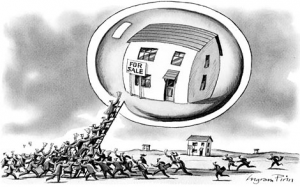
Are we heading into another real estate bubble / crash? Those who say “no” see the housing shortage as real, while those who say “yes” see the demand as a reflection of the Federal Reserve’s artificial goosing of the housing market via its unprecedented purchases of mortgage-backed securities and “easy money” financial conditions.

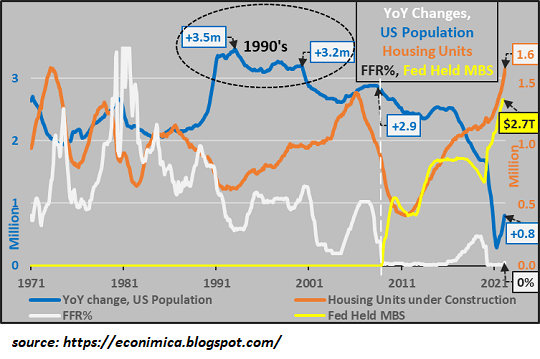
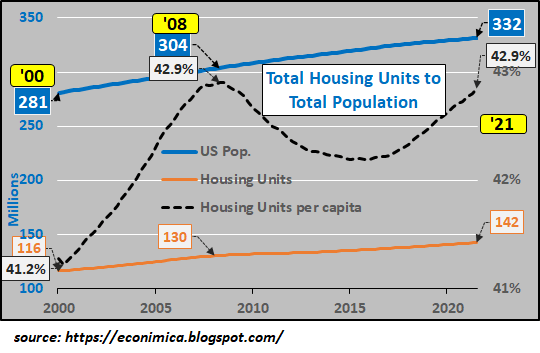
My colleague CH at econimica.blogspot.com recently posted charts calling this assumption into question. The first chart (below) shows the U.S. population growth rate plummeting as housing starts soar, and the second chart shows housing unit per capita, which has just reached the same extreme as the 2008 housing bubble.

Demographics and housing do not reflect a housing shortage nationally, though there could be scarcities locally, of course, and other factors such as thousands of units being held off the market as short-term rentals or investments by overseas buyers who have no interest in renting their investment dwellings.

On a per capita basis, housing has reached previous bubble levels. That suggests housing shortages are artificial or local, not structural.

Next, let’s consider how the current housing bubble differs from previous bubbles in the late 1970s and 2000s. In my view, the previous bubbles were driven by demographics, inflation and monetary policy: in the late 70s, the 65 million-strong Baby Boom generation began buying their first homes, pushing demand higher while inflation soared, making real-world assets such as housing more desirable.

Once the Federal Reserve pushed interest rates to 18%, mortgage rates rose in lockstep and housing crashed as few could afford sky-high housing prices at sky-high mortgage rates.

The housing bubble of 2007-08 was largely driven by declines in mortgage rates (as the Fed pursued an “easy money” policy to escape the negative effects of the Dot-Com stock market bubble crash) and a loosening of credit/mortgage standards. These fueled a bubble that morphed into a speculative free-for-all of no-down payment and no-document loans.

This decline in the cost of borrowing money (mortgage rates) enabled a sharp rise in the price of housing, a speculative boom that was greatly accelerated by “innovations” in the mortgage market such as zero down payments loans, interest-only loans, home equity loans, and no-document “liar loans”–mortgages underwritten without the usual documentation of income and net worth.

These forces generated a speculative frenzy of house-flipping, leveraging the equity in the family home to buy two or three homes under construction and selling them before they were even completed for fat profits, and so on.

Needless to say, the pool of potential buyers expanded tremendously when people earning $25,000 a year could buy $500,000 houses on speculation.

Once the bubble popped, the pool of buyers shrank along with the home equity.

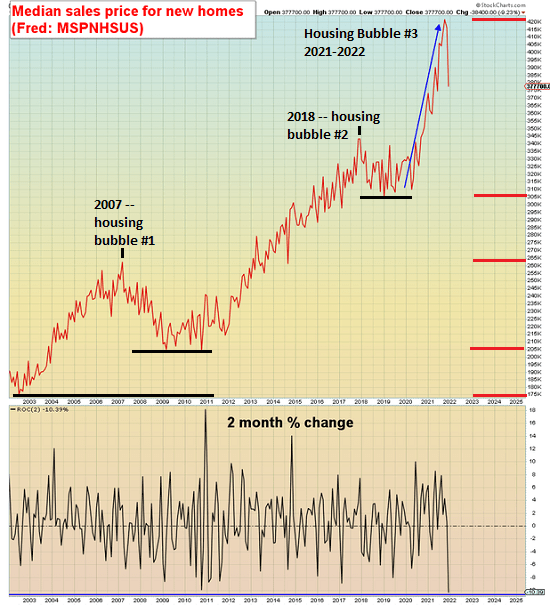
If we study this chart below of new home prices (courtesy of Mac10), we can see that the 21st century’s Bubble #2 rose as the Federal Reserve pushed mortgage rates far below historic norms. Once rates reached a bottom, the 7-year inflation of home prices (from 2011 to 2018) began rolling over.

This deflation of home prices was reversed by the pandemic recession, as the Fed’s vast expansion of credit and mortgage-buying, which pushed mortgage rates to new lows. Trillions of dollars in new credit and cash stimulus ignited a speculative frenzy in stocks, bonds and real estate, a frenzy which drove bubble #3 to extraordinary heights.

All this unprecedented fiscal and monetary stimulus also ignited inflation, and so rates are rising in response. Bubble #3 is already deflating, at least by the measure of new home prices.

But the current bubble has a number of dynamics that weren’t big factors in previous bubbles.

One is the rise of remote work. Many people have been working remotely since the late 1990s enabled Internet-based work, but the pandemic greatly increased the pool of employers willing to accept remote work as a permanent feature of employment.

This trend has been well documented, but the consequences are still unfolding: remote workers are no longer trapped in unaffordable, congested cities and suburbs.

Several other trends have attracted much less attention, but I see them as equally consequential.

1. Housing in many urban zones are out of reach of all but the top 10% without extraordinary sacrifice, and now that employment isn’t necessarily tied to urban zones, the bottom 90% of young people without family wealth or high incomes are coming to realize the benefits of urban living are not worth the extreme sacrifices needed to buy an overvalued house.

A middle-class life–home ownership, financial security, leisure and surplus income to invest in one’s family and well-being–is no longer affordable for the majority of young Americans.

Few are willing to concede this because it reveals the neofeudal nature of American life. Those who bought homes in coastal urban zones 20+ years ago are wealthy due to soaring housing valuations while young people can’t even afford the rent, much less buying a house.

If you’re not making $250,000 or more a year as a couple, the only hope for a middle-class life that includes leisure and some surplus income to invest is top move to some place with much lower housing and other costs. That place is rural America.

2. The benefits of urban living are deteriorating while the sacrifices and downsides are increasing. Urban living is fun if you’re wealthy, not so fun if you don’t have plenty of surplus income to spend.

Urban problems such as homelessness, traffic congestion and crime are endemic and unresolvable, though few are willing to state the obvious. Americans are expected to be optimistic and to count on some new whiz-bang technology to solve all problems.

Unfortunately, problems generated by dysfunctional, overly complex institutions, corruption and unaffordable costs can’t be solved by some new technology, and so the decay of cities will only gather momentum.

The hope that billions of federal stimulus funding would solve these problems is about to encounter reality as the funds dry up and all the problems remain or have actually expanded despite massive “investments” in solutions.

Few analysts have looked at the finances of high-cost cities. The decline in bricks-and-mortar retail, rising crime, soaring junk fees, rents and property taxes have all made urban small business insanely costly and therefore risky.

Small businesses are the core sources of employment and taxes. As high costs, crime, etc. choke small businesses, employment and tax revenues drop and commercial real estate sits empty, generating decay and defaults.

Once office and retail space is no longer affordable or necessary, commercial real estate crashes in value as owners who bought at the top default and go bankrupt.

People need shelter but they don’t need office space or to start a bricks-and-mortar retail business.

As urban finances unravel, cities won’t have the funding to run their bloated, inefficient, overly complex and unaccountable bureaucracies.

3. In geopolitics, we speak of the core and the periphery. Empires have a core (Rome and central Italy in the Roman Empire) and a periphery (Britain, North Africa, Egypt, the Levant).

As finances and trade decay and costs soar, the periphery is surrendered to maintain the core.

In urban zones, the same dynamic will become increasingly visible: the peripheral neighborhoods will be underfunded to continue protecting the wealthy enclaves.

Crime will skyrocket in the periphery even as residents of the wealthy enclaves see little decay in their neighborhoods.

This asymmetry–already extreme–will drive social unrest and disorder. This is a self-reinforcing feedback: as the periphery neighborhoods deteriorate, the remaining businesses flee and the smart money sells and moves away.

Tax revenues plummet and city services decay even further, persuading hangers-on to move before it gets even worse. Cities compensate for the lower revenues by increasing taxes on the remaining residents and cutting services.

Each turn of the screw triggers more closures and selling and fewer tax revenues.

4. Dependency chains will become increasingly consequential: the greater a city’s dependency on essentials trucked/shipped from hundreds or thousands of of kilometers/miles away, the more prone that city will be to disruptions of essentials: food, energy, materials and infrastructure.

Though few are willing to dwell on such vulnerabilities, most cities are totally dependent on diesel fueled fleets of trucks, rail and jet fuel for luxuries flown in from afar for virtually all goods. Cities produce very little in the way of essentials such as food and energy.

The past reliability of long supply chains has instilled a confidence that these supply chains stretching thousands of kilometers and miles are unbreakable and forever. They aren’t, and the initial disruptions will be a great shock to Americans who believe full gas tanks and fully stocked store shelves are their birthright.

5. As I’ve explained in my new book Global Crisis, National Renewalthe era of cheap, reliable abundance has drawn to a close and now we are entering an era of scarcity in essentials.

Another reality few discuss is the relative stability of global weather over the past 40 years. As weather becomes less reliable, so too do crop yields and food supplies.

Globalization has poured capital into expanding acreage under cultivation to the point that the planet’s forests are being decimated to grow more soy to feed animals to be slaughtered for human consumption.

On the margins, land that was once productive has been lost to desertification. Fresh water aquifers have been drained and glaciers feeding rivers are melting away. Soil fertility has declined even as fertilizer use has expanded.

The low-hanging fruit of GMO seeds, fertilizers, insecticides, herbicides and Green Revolution hybrids have all been plucked. The gains have been reaped but now the downsides of these dependencies are becoming increasingly consequential: fertilizer costs are rising fast, insects and diseases are evading chemicals and vaccines, and the vulnerabilities of mono-crop, industrialized agriculture and animal husbandry threaten to cascade into crop failures, soaring prices and shortages.

6. This will have two consequences: rural incomes which have been falling for decades due to globalization (i.e. bringing in cheap food from places with no environmental standards, cheap labor and few taxes / social costs) will start rising sharply, fueling a reversal in the long decline of rural communities based on agricultural income.

The soaring costs of essentials will reduce the disposable income of the bottom 90%, reducing the money they’ll have to spend on eating out, retail shopping, etc.–all the surplus spending that drives cities’ economies and tax revenues.

Few (if any) commentators forecast a cyclical reversal of the demographic trend of people moving from rural locales to cities. I think this trend has already reversed and will gather momentum as cities become increasingly unlivable, disposable incomes decline as scarcities push prices higher and people flee for lower cost, more secure environs.

7. As I often note, following what the super-wealthy are doing is a pretty sound investment strategy because the super-wealthy spend freely to buy the best advice and are highly motivated to protect their wealth.

People who live in well-known, highly desirable rural towns (Telluride, Jackson Hole, Lake Tahoe, etc.) are describing a feeding frenzy of wealthy urbanites buying multi-million dollar homes. Small cities such as Bozeman, MT and Ashville, NC are experiencing a flood of new residents that is straining infrastructure and pushing housing prices out of reach for local residents with average wages.

8. Rural towns in the U.S., Italy, Japan and even Switzerland are trying to attract new residents with offers of free land, subsidized rent, low cost homes, etc. This shows that the trends are global and not limited to any one nation. Would you take free land in rural America?

The decay of urban life isn’t yet consequential enough to push people into making a major move, but once someone has been robbed, repeatedly found human feces on their doorstep or experienced scarcities that trigger the madness of crowds, the decision to leave becomes much, much easier.

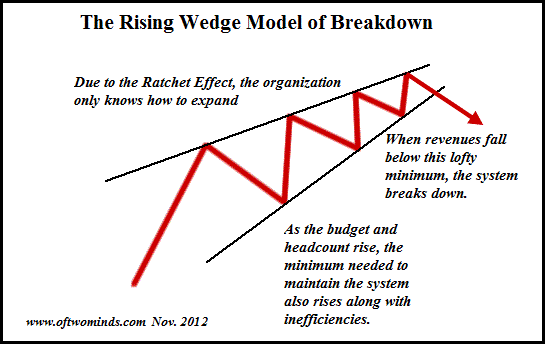
Some cities will manage the decline of employment and tax revenues more gracefully than others. Most will suffer from the dynamic I’ve often described on the blog: the Ratchet Effect. Costs move effortlessly higher as tax revenues have increased in one speculative bubble after another, but once revenues drop, cities have no mechanisms or political constituency to manage a sharp, long-term decline in revenues.

They then become prone to the other dynamic I’ve described, the Rising Wedge Breakdown (see chart below): as agencies and institutions become sclerotic, unaccountable and self-serving, even a relatively modest cut in revenues triggers institutional collapse, as the system requires 100% funding to function. A 10% reduction doesn’t cause a 10% decline in service, it causes an 50% decline in service, on the way to complete dysfunction.

Few believe cities can unravel, but remote work, geographic arbitrage (discussed below), tightening credit, rising crime, the decline of commercial real estate, end of massive stimulus, scarcities, the madness of crowds, the decline of civic services and amenities and an insanely high cost of living all have consequences and second-order effects.

What were beneficial synergies become fatal synergies as dynamics reverse and begin reinforcing each other.

So let’s put all this together.

A. The cycle of declining interest rates and inflation has ended and a cycle of much higher interest and mortgage rates and inflation is beginning. Higher mortgages rates will depress housing prices as only the highest income households will be able to afford today’s prices once mortgage rates rise.

B. The decay of urban finances and quality of life will accelerate as stimulus ends, credit dries up and inflation decimates disposable income.

C. The stress of trying to make enough money to afford the high costs of city/suburban living as the real estate bubble pops and the benefits of city living decline will burn out increasing numbers of people who will have no choice but to find more affordable, more secure and more livable places.

D. While the wealthy have already secured second or third homes in the toniest desirable towns, there are still opportunities for lower cost, more secure residences in rural areas.

E. This migration, even at the margins, will further depress urban housing prices and push prices in desirable rural locales higher.

F. This migration will have regional, ethnic and cultural variations. For example, some African-Americans leaving the upper Midwest are finding favor with communities in the South where family, church and cultural ties beckon.

G. Correspondent John F. used the phrase geographic arbitrage which means earning money remotely in high-wage sectors while living some place that’s low cost and secure.

I wrote about this many years ago in my post about young Japanese maintaining a part-time remote-work gig while pursuing farming in rural communities: Degrowth Solutions: Half-Farmer, Half-X (July 19, 2014).

H. Though monetary / inflationary forces will pop housing prices based solely on low mortgage rates, this doesn’t mean housing everywhere will decline: as burned out urbanites seek lower cost, more secure and livable places in rural locales, homes in desirable towns and small cities could rise sharply because they’re starting from such low levels.

I. If urban areas decay rapidly, housing prices could plummet much faster than most people think possible.

When cities lose employment, tax revenues and desirability, they can go down fast. Property values can fall in half and then by 90%.

How is this possible? Supply and demand: if demand falls off a cliff, there won’t be buyers for thousands of homes that come on the market all at once. This is just like a stock market in which buyers disappear, as no one wants to buy an asset that’s rapidly losing value.

As I’ve noted many times, prices for assets are set on the margins: the last sale of a house resets the price for the entire neighborhood.

The stock market is easily manipulated by the big players, who can stop a slide in prices by buying huge chunks of stocks and call options. There are no equivalent forces which can stop a decline in housing prices.

And since rates will rise regardless of what the Federal Reserve does because global capital is demanding a real return above inflation, then the hope for lower mortgage rates to support bubble-level housing prices will be in vain.

How low could housing go? As explained above, there will likely be very asymmetric declines and increases in housing valuations going forward. But on a technical-analysis level, we can anticipate a general decline to previous lows, first to the 2019 lows and then to the 2011 lows.

Some analysts believe inflation will funnel capital into housing as investors seek assets that will go up with inflation, but this is a murky forecast: the bottom 90% of American households are already priced out of coastal housing, so inflation only robs their wages of purchasing power. They don’t have any hope of buying a house anywhere near current prices.

Corporations are buying thousands of houses for the rental income, but once all the stimulus runs out and the excesses of speculation reverse, they’ll find few renters can afford their sky-high rents. At that point corporate buyers become corporate sellers, but they won’t find buyers willing or able to pay their asking prices, which are based on bubble pricing, not reality.

All these swirling currents will affect housing valuations in different places differently. Some areas could see 50% declines while others see 50% increases, regardless of mortgage rates or Fed policy.

What will become most desirable is a low cost of living, security and livability, which includes community, reduced dependency on long supply chains and local production of essentials.

We are all prone to believing the recent past is a reliable guide to the future. But in times of dynamic reversals, the past is an anchor thwarting our progress, not a forecast.

As Food Shortages Loom, US Kids Starve, Biden to Send $33 Billion MORE to Ukraine to Keep War Going

By Matt Agorist

Source: The Free Thought Project

In 2019, Ukraine’s Volodymyr Zelensky was elected to president of Ukraine after running on a platform of ending the conflict in the Donbass region and making peace with Russia. Unfortunately, however, these goals were not in synch with the US hegemony and instead of pushing for peace, the US supported the far right neo-Nazis who promised to kill Zelensky if he sought peace. 

Over the next two years, the United States continued to funnel weapons, money, and training into Ukraine, ensuring a future conflict with Russia by instigating military conflict directly on their border. In February of this year, Russian president Vladimir Putin announced that a line had been crossed and he then invaded Ukraine, kicking off a violent and deadly war.

Just a few weeks into the war, Russia offered concessions as spokesman Dmitry Peskov announced that Moscow will end the invasion immediately if Ukraine amends its constitution to ensure it stays neutral and doesn’t join NATO, it acknowledges Crimea as Russian territory, and recognizes the separatist republics of Donetsk and Luhansk as independent states.

Since then, the United States has recommended that Ukraine not accept a peace deal and instead continue to allow their people to be used as cannon fodder while US taxpayers are fleeced for billions to fight a proxy war with Russia.

Since the war began in February, Biden has authorized more than $14 billion in your tax dollars to arm literal Nazis in the region. This week, because very few people have spoken out against this war, that request more than doubled and Biden asked Congress for a whopping $33 billion more. 

While encouraging Ukraine to take the deal offered by Russia would be far more effective than US tax dollars at ending the suffering and helping Ukrainians, the military industrial complex is uninterested in such a move.

It is no surprise that the stock market associated with the military industrial complex is booming as the rest of the market plummets.

What’s more, as the politically elite send billions to the other side of the world, 3.7 million children have been pushed into poverty here at home.

According to a recently released Columbia University report, by late January 3.7 million U.S. children were plunged back into poverty, as the government ended the child tax credit.

What’s more, the elite have been publicly warning the world of massive food shortages and supply chain issues — yet here we are sending billions Nazis to prevent Ukraine from seeking peace.

Just last month, the extremely creepy yet exceedingly influential Klaus Schwab warned that “History is truly at a turning point. We do not yet know the full extent and the systemic and structural changes which will happen” but he said that “we do know the global energy systems, food systems, and supply chains will be deeply affected.”

It’s not just the real-life version of Dr. Evil making these warnings either. As we reported at the time, the president of the ominously connected multi-trillion-dollar asset fund, BlackRock, Rob Kapito told oil and gas executives the same week that “entitled” Americans are about to deal with shortages of food and other goods, and should prepare accordingly.

“For the first time, this generation is going to go into a store and not be able to get what they want,” Kapito told a meeting of the Texas Independent Producers and Royalty Owners Association. “And we have a very entitled generation that has never had to sacrifice.”

“I would put on your seat belts because this is something that we haven’t seen,” Kapito added, warning that Americans will soon face “scarcity inflation” – or rising prices compounded by shortages of everything from food and consumer goods to oil and gas.

President Joe Biden has been telling Americans for months now that they have to foot the bill for the war in Ukraine and “do their part” by sending billions to Zelensky and paying high prices for oil. Around the same time Schwab and Kapito made their warnings, Biden took his position to a whole new level, telling Americans that food shortages are “gonna be real.”

This week, Goya Foods CEO Bob Unanue has issued a similar warning: “We are on the precipice of a global food crisis.”

In a Wednesday interview, Unanue told Fox Business’s Maria Bartiromo, “Americans will have to tighten their belts and consume less,” in response to her question about a potential food shortage crisis.

Though the government has been telling us these higher prices and supply chain issues are Russia’s fault, those who have been paying attention have warned since last year that Biden’s policies – which involved spending more in his first eight months than former President Donald Trump did in 2018 and 2019 combined, and throttling domestic energy production – would trigger price spikes and supply chain disruptions for ordinary Americans.

Trump definitely played a role as well by printing nearly 7 trillion in his last year in office. This is why inflation was already at a 40-year high, before the war began and as spending increases, hard times are seemingly inevitable. The Ukraine invasion is most assuredly playing a role in this debacle but it will be the straw that broke the camels back, not the main driver.

Whatever actually sets off this shortage, rest assured that the people warning us about it will be the last to suffer from it. It will be the poor and middle class who suffer the most from these issues.

As Max Blumenthal reminds us, “200,000 small businesses were wrecked and millions left jobless and alone in the name of public health. Now gas and food prices must surge to protect freedom and stand for Ukraine. You will own nothing and be happy and if you don’t like it, you might be a Russian conspiracist.”

The Inflation Crisis Of 2022 Is Now Worse Than Anything That We Experienced During The 1970s

By Michael Snyder

Source: Activist Post

Most Americans don’t realize this, but we truly have entered historic territory.  As you will see below, the inflation crisis of 2022 has now escalated to a level that is beyond anything that we experienced during the horrible Jimmy Carter era of the 1970s.  If you are old enough to have been alive back then, you probably remember the constant headlines about inflation.  And you also probably remember that it seemed like the impotent administration in power in Washington was powerless to do anything about it.  In other words, it was a lot like what we are going through today.  Unfortunately for us, this new economic crisis is still only in the very early chapters.

Of course the mainstream media would like us to believe that what we are experiencing today is not even close to what Americans went through in the late 1970s and early 1980s.  According to CNN, the U.S. inflation rate hit a peak of 14.6 percent in the first half of 1980…

The inflation rate hit a record high of 14.6% in March and April of 1980. It helped to lead to Carter’s defeat in that fall’s election. It also led to some significant changes in the US economy.

Compared to that, the numbers we have been given in early 2022 seem rather tame.  On Tuesday, we learned that the official rate of inflation in the U.S. hit 8.5 percent in the month of March…

Prices that consumers pay for everyday items surged in March to their highest levels since the early days of the Reagan administration, according to Labor Department data released Tuesday.

The consumer price index, which measures a wide-ranging basket of goods and services, jumped 8.5% from a year ago on an unadjusted basis, above even the already elevated Dow Jones estimate for 8.4%.

8.5 percent is much lower than 14.6 percent, and so to most people it would seem logical to conclude that we are still a long way from the kind of nightmarish crisis that our nation endured during the waning days of the Carter administration.

But is that the truth?

In reality, we can’t make a straight comparison between the official rate of inflation in 2022 and the official rate of inflation in 1980.  The way that the inflation rate is calculated has been changed more than 20 times since 1980, and every time it was changed the goal was to make the official rate of inflation appear to be lower.

What we really need is an apples-to-apples comparison; fortunately, John Williams over at shadowstats.com has done the math for us.

According to Williams, if the inflation rate was still calculated the way that it was back in 1980, the official rate of inflation would be somewhere around 17 percent right now.

17 percent!

That means that the inflation that we are seeing now is even worse than anything that Americans went through during the Jimmy Carter era.

And government figures for individual categories seem to confirm that inflation is now wildly out of control.  For example, the price of gasoline has risen by 48 percent over the past year…

The price of gasoline rose by 48.0 percent from March 2021 to March 2022, according to numbers released today by the Bureau of Labor Statistics.

In just one month—from February to March—the seasonally adjusted price of gasoline went up 18.3 percent.

Vehicle prices have escalated to absurd levels as well.  If you can believe it, the average retail selling price of a used vehicle at CarMax has risen by 39.7 percent in just 12 months…

CarMax experienced a slowdown in fourth-quarter used car sales volume as its average retail selling price jumped 39.7% year-over-year to $29,312, an increase of approximately $8,300 per unit.

And I discussed yesterday, home prices in the United States have jumped 32.6 percent over the past two years.

We have entered a full-blown inflationary nightmare, and the Biden administration is trying to blame Vladimir Putin for it.

Needless to say, that is extremely disingenuous of Biden, because prices were already skyrocketing even before the war in Ukraine started.

But it is true that the war is making economic problems even worse all over the globe, and that isn’t going to end any time soon.

A couple of weeks ago there was a bit of optimism that some sort of a ceasefire agreement could be reached, but now there appears to be no hope that there will be one any time soon.

On Tuesday, Putin told the press that peace talks have reached “a dead end”

Talks with Ukraine have reached “a dead end,” Russian President Vladimir Putin said in fresh Tuesday remarks. “We will not stop military operations in Ukraine until they succeed.” He explained that Ukraine has “deviated” from agreements and any possible prior progress reached during the Istanbul meetings, according to state-run RIA.

The strong remarks aimed at both Kiev and the West were given during a joint presser with his Belarusian counterpart Alexander Lukashenko. He further hailed that the military operations is still going “according to plan,” Bloomberg reports, however while admitting to the domestic population that “Russian logistics and payment systems remain a weakness and the long-term impact of western measures could be more painful.” But he also said the county has withstood the economic “blitzkrieg” from the West.

And Volodymyr Zelenskyy is now saying that the return of Crimea is a “red line” for him

Ukrainian President Volodymyr Zelensky named recognition of the annexation of the Crimea region as one of his red lines for Moscow in any potential peace talks with Russian President Vladimir Putin to end war between the two countries.

Russia annexed the southern region of Crimea in 2014. Russian-backed separatists and forces, as well Ukrainian soldiers, have since been fighting in the eastern region of Ukraine.

Russia will never, ever willingly give Crimea back to Ukraine.

Anyone who thinks otherwise is simply being delusional.

So unless someone changes their tune, this war between Russia and Ukraine is going to keep going until someone achieves total victory.

And that could take a really long time.

Meanwhile, global food supplies will get tighter and tighter, and global economic conditions will continue to rapidly deteriorate.

In other words, the kind of nightmare scenario that I have been warning about for years is now upon us.

And so what happens if another “black swan event” or two hits us later in 2022?

We are so vulnerable right now, and it wouldn’t take much at all to push us over the edge and into an unprecedented worldwide crisis of epic proportions.