
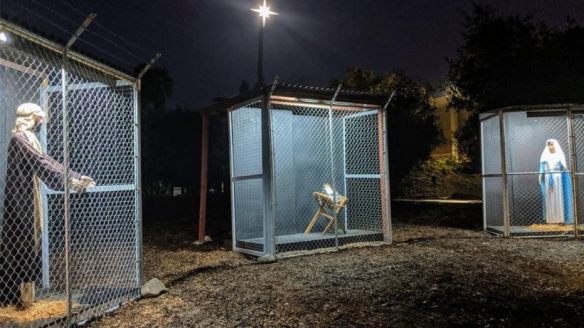
The Child That Christmas Forgot: How Would Jesus Fare in the American Police State?

By John W. Whitehead

Source: The Rutherford Institute

“Once upon a midnight clear, there was a child’s cry, a blazing star hung over a stable, and wise men came with birthday gifts. We haven’t forgotten that night down the centuries. We celebrate it with stars on Christmas trees, with the sound of bells, and with gifts… We forget nobody, adult or child. All the stockings are filled, all that is, except one. And we have even forgotten to hang it up. The stocking for the child born in a manger. It’s his birthday we’re celebrating. Don’t let us ever forget that. Let us ask ourselves what He would wish for most. And then, let each put in his share, loving kindness, warm hearts, and a stretched out hand of tolerance. All the shining gifts that make peace on earth.”—The Bishop’s Wife (1947)

The Christmas story of a baby born in a manger is a familiar one.

The Roman Empire, a police state in its own right, had ordered that a census be conducted. Joseph and his pregnant wife Mary traveled to the little town of Bethlehem so that they could be counted. There being no room for the couple at any of the inns, they stayed in a stable (a barn), where Mary gave birth to a baby boy, Jesus. Warned that the government planned to kill the baby, Jesus’ family fled with him to Egypt until it was safe to return to their native land.

Yet what if Jesus had been born 2,000 years later?

What if, instead of being born into the Roman police state, Jesus had been born at this moment in time? What kind of reception would Jesus and his family be given? Would we recognize the Christ child’s humanity, let alone his divinity? Would we treat him any differently than he was treated by the Roman Empire? If his family were forced to flee violence in their native country and sought refuge and asylum within our borders, what sanctuary would we offer them?

A singular number of churches across the country are asking those very questions, and their conclusions are being depicted with unnerving accuracy by nativity scenes in which Jesus and his family are separated, segregated and caged in individual chain-link pens, topped by barbed wire fencing.

These nativity scenes are a pointed attempt to remind the modern world that the narrative about the birth of Jesus is one that speaks on multiple fronts to a world that has allowed the life, teachings and crucifixion of Jesus to be drowned out by partisan politics, secularism, materialism and war.

The modern-day church has largely shied away from applying Jesus’ teachings to modern problems such as war, poverty, immigration, etc., but thankfully there have been individuals throughout history who ask themselves and the world: what would Jesus do?

What would Jesus—the baby born in Bethlehem who grew into an itinerant preacher and revolutionary activist, who not only died challenging the police state of his day (namely, the Roman Empire) but spent his adult life speaking truth to power, challenging the status quo of his day, and pushing back against the abuses of the Roman Empire—do?

Dietrich Bonhoeffer asked himself what Jesus would have done about the horrors perpetrated by Hitler and his assassins. The answer: Bonhoeffer risked his life to undermine the tyranny at the heart of Nazi Germany.

Aleksandr Solzhenitsyn asked himself what Jesus would have done about the soul-destroying gulags and labor camps of the Soviet Union. The answer: Solzhenitsyn found his voice and used it to speak out about government oppression and brutality.

Martin Luther King Jr. asked himself what Jesus would have done about America’s warmongering. The answer: declaring “my conscience leaves me no other choice,” King risked widespread condemnation when he publicly opposed the Vietnam War on moral and economic grounds.

Even now, despite the popularity of the phrase “What Would Jesus Do?” (WWJD) in Christian circles, there remains a disconnect in the modern church between the teachings of Christ and the suffering of what Jesus in Matthew 25 refers to as the “least of these.”

As the parable states:

“Then the King will say to those on his right, ‘Come, you who are blessed by my Father; take your inheritance, the kingdom prepared for you since the creation of the world. For I was hungry and you gave me something to eat, I was thirsty and you gave me something to drink, I was a stranger and you invited me in, I needed clothes and you clothed me, I was sick and you looked after me, I was in prison and you came to visit me.’ Then the righteous will answer him, ‘Lord, when did we see you hungry and feed you, or thirsty and give you something to drink? When did we see you a stranger and invite you in, or needing clothes and clothe you? When did we see you sick or in prison and go to visit you?’ The King will reply, ‘Truly I tell you, whatever you did for one of the least of these brothers and sisters of mine, you did for me.’ Then he will say to those on his left, ‘Depart from me, you who are cursed, into the eternal fire prepared for the devil and his angels. For I was hungry and you gave me nothing to eat, I was thirsty and you gave me nothing to drink, I was a stranger and you did not invite me in, I needed clothes and you did not clothe me, I was sick and in prison and you did not look after me.’ They also will answer, ‘Lord, when did we see you hungry or thirsty or a stranger or needing clothes or sick or in prison, and did not help you?’ He will reply, ‘Truly I tell you, whatever you did not do for one of the least of these, you did not do for me.’”

This is not a theological gray area: Jesus was unequivocal about his views on many things, not the least of which was charity, compassion, war, tyranny and love.

After all, Jesus—the revered preacher, teacher, radical and prophet—was born into a police state not unlike the growing menace of the American police state. When he grew up, he had powerful, profound things to say, things that would change how we view people, alter government policies and change the world. “Blessed are the merciful,” “Blessed are the peacemakers,” and “Love your enemies” are just a few examples of his most profound and revolutionary teachings.

When confronted by those in authority, Jesus did not shy away from speaking truth to power. Indeed, his teachings undermined the political and religious establishment of his day. It cost him his life. He was eventually crucified as a warning to others not to challenge the powers-that-be.

Can you imagine what Jesus’ life would have been like if, instead of being born into the Roman police state, he had been born and raised in the American police state?

Consider the following if you will.

Had Jesus been born in the era of the America police state, rather than traveling to Bethlehem for a census, Jesus’ parents would have been mailed a 28-page American Community Survey, a mandatory government questionnaire documenting their habits, household inhabitants, work schedule, how many toilets are in your home, etc. The penalty for not responding to this invasive survey can go as high as $5,000.

Instead of being born in a manger, Jesus might have been born at home. Rather than wise men and shepherds bringing gifts, however, the baby’s parents might have been forced to ward off visits from state social workers intent on prosecuting them for the home birth. One couple in Washington had all three of their children removed after social services objected to the two youngest being birthed in an unassisted home delivery.

Had Jesus been born in a hospital, his blood and DNA would have been taken without his parents’ knowledge or consent and entered into a government biobank. While most states require newborn screening, a growing number are holding onto that genetic material long-term for research, analysis and purposes yet to be disclosed.

Then again, had Jesus’ parents been undocumented immigrants, they and the newborn baby might have been shuffled to a profit-driven, private prison for illegals where they first would have been separated from each other, the children detained in make-shift cages, and the parents eventually turned into cheap, forced laborers for corporations such as Starbucks, Microsoft, Walmart, and Victoria’s Secret. There’s quite a lot of money to be made from imprisoning immigrants, especially when taxpayers are footing the bill.

From the time he was old enough to attend school, Jesus would have been drilled in lessons of compliance and obedience to government authorities, while learning little about his own rights. Had he been daring enough to speak out against injustice while still in school, he might have found himself tasered or beaten by a school resource officer, or at the very least suspended under a school zero tolerance policy that punishes minor infractions as harshly as more serious offenses.

Had Jesus disappeared for a few hours let alone days as a 12-year-old, his parents would have been handcuffed, arrested and jailed for parental negligence. Parents across the country have been arrested for far less “offenses” such as allowing their children to walk to the park unaccompanied and play in their front yard alone.

Rather than disappearing from the history books from his early teenaged years to adulthood, Jesus’ movements and personal data—including his biometrics—would have been documented, tracked, monitored and filed by governmental agencies and corporations such as Google and Microsoft. Incredibly, 95 percent of school districts share their student records with outside companies that are contracted to manage data, which they then use to market products to us.

From the moment Jesus made contact with an “extremist” such as John the Baptist, he would have been flagged for surveillance because of his association with a prominent activist, peaceful or otherwise. Since 9/11, the FBI has actively carried out surveillance and intelligence-gathering operations on a broad range of activist groups, from animal rights groups to poverty relief, anti-war groups and other such “extremist” organizations.

Jesus’ anti-government views would certainly have resulted in him being labeled a domestic extremist. Law enforcement agencies are being trained to recognize signs of anti-government extremism during interactions with potential extremists who share a “belief in the approaching collapse of government and the economy.”

While traveling from community to community, Jesus might have been reported to government officials as “suspicious” under the Department of Homeland Security’s “See Something, Say Something” programs. Many states, including New York, are providing individuals with phone apps that allow them to take photos of suspicious activity and report them to their state Intelligence Center, where they are reviewed and forwarded to law-enforcement agencies.

Rather than being permitted to live as an itinerant preacher, Jesus might have found himself threatened with arrest for daring to live off the grid or sleeping outside. In fact, the number of cities that have resorted to criminalizing homelessness by enacting bans on camping, sleeping in vehicles, loitering and begging in public has doubled.

Viewed by the government as a dissident and a potential threat to its power, Jesus might have had government spies planted among his followers to monitor his activities, report on his movements, and entrap him into breaking the law. Such Judases today—called informants—often receive hefty paychecks from the government for their treachery.

Had Jesus used the internet to spread his radical message of peace and love, he might have found his blog posts infiltrated by government spies attempting to undermine his integrity, discredit him or plant incriminating information online about him. At the very least, he would have had his website hacked and his email monitored.

Had Jesus attempted to feed large crowds of people, he would have been threatened with arrest for violating various ordinances prohibiting the distribution of food without a permit. Florida officials arrested a 90-year-old man for feeding the homeless on a public beach.

Had Jesus spoken publicly about his 40 days in the desert and his conversations with the devil, he might have been labeled mentally ill and detained in a psych ward against his will for a mandatory involuntary psychiatric hold with no access to family or friends. One Virginia man was arrested, strip searched, handcuffed to a table, diagnosed as having “mental health issues,” and locked up for five days in a mental health facility against his will apparently because of his slurred speech and unsteady gait.

Without a doubt, had Jesus attempted to overturn tables in a Jewish temple and rage against the materialism of religious institutions, he would have been charged with a hate crime. Currently, 45 states and the federal government have hate crime laws on the books.

Had anyone reported Jesus to the police as being potentially dangerous, he might have found himself confronted—and killed—by police officers for whom any perceived act of non-compliance (a twitch, a question, a frown) can result in them shooting first and asking questions later.

Rather than having armed guards capture Jesus in a public place, government officials would have ordered that a SWAT team carry out a raid on Jesus and his followers, complete with flash-bang grenades and military equipment. There are upwards of 80,000 such SWAT team raids carried out every year, many on unsuspecting Americans who have no defense against such government invaders, even when such raids are done in error.

Instead of being detained by Roman guards, Jesus might have been made to “disappear” into a secret government detention center where he would have been interrogated, tortured and subjected to all manner of abuses. Chicago police have “disappeared” more than 7,000 people into a secret, off-the-books interrogation warehouse at Homan Square.

Charged with treason and labeled a domestic terrorist, Jesus might have been sentenced to a life-term in a private prison where he would have been forced to provide slave labor for corporations or put to death by way of the electric chair or a lethal mixture of drugs.

Indeed, as I show in my book Battlefield America: The War on the American People, given the nature of government then and now, it is painfully evident that whether Jesus had been born in our modern age or his own, he still would have died at the hands of a police state.

Thus, as we draw near to Christmas with its celebrations and gift-giving, we would do well to remember that what happened on that starry night in Bethlehem is only part of the story. That baby in the manger grew up to be a man who did not turn away from evil but instead spoke out against it, and we must do no less.
Democrats rally to defend fired Attorney General Sessions, Special Counsel Mueller

By Tom Eley

Source: WSWS.org

The Democrats and their fake “left” allies held war-mongering demonstrations in a number of cities on Thursday in defense of the fired far-right attorney general, Jeff Sessions, and the anti-Russia investigation being conducted by Special Counsel Robert Mueller.

Wednesday’s ouster of Sessions and his replacement by Trump ally Matthew G. Whitaker has brought forth a wave of condemnation from Democratic Party figures and their media allies, including the New York Times and Washington Post, asserting that the move is the prelude to Trump’s closing down of the Justice Department probe into allegations of Russian “meddling” in the 2016 elections and possible collusion by the Trump campaign.

Trump had repeatedly denounced Sessions for having recused himself from the Russia investigation in March of 2017, leaving Deputy Attorney General Rod Rosenstein, a defender of the investigation, in overall charge of its conduct. Whitaker, a former US attorney and now acting attorney general and therefore responsible for overseeing the Mueller probe, is on record criticizing Mueller and suggesting that the Justice Department could cut off funding for his office.

Mueller’s investigation has been at the center of a McCarthyite-style campaign against Russia spearheaded by the intelligence agencies and the Democratic Party, based on fabricated claims that Russian President Vladimir Putin interfered in the presidential election to undermine the candidacy of Democrat Hillary Clinton and boost Trump. It has been used as a weapon in the drive by the Democrats and sections of the military/intelligence establishment to force Trump to adopt a more aggressive posture against Moscow and in the war for regime-change in Syria.

To the extent that the Democrats oppose the right-wing Trump administration, it is on this entirely reactionary basis. In the lead-up to Tuesday’s midterm elections, they not only called no demonstrations, they were entirely silent on Trump’s fascistic attacks on immigrants, his deployment of troops to the border against the caravan of Central American asylum seekers, and his pledge to overturn the 14th Amendment guarantee of birthright citizenship—a cornerstone of the Bill of Rights.

Following the election, in which the Democrats won control of the House of Representatives, the party leadership called repeatedly for bipartisan unity and collaboration with Trump, underscoring their essential agreement with his policies of war, austerity and repression. It was only when Trump fired Sessions, a right-wing anti-immigrant zealot, that they swung into action, reviving their denunciations of Trump as a stooge of Putin.

The aim of shifting the Trump administration to a war footing against Russia has been achieved to the extent that there is now a substantial risk of nuclear conflict between the US and the second-leading nuclear power. War could quickly erupt in a number of flash points, especially Syria, where Russian soldiers, sailors and airmen carry out combat operations within miles of their American counterparts, as well as US-allied Islamist proxies armed by Saudi Arabia.

Though promoted in the media and sponsored by over 50 Democratic Party-linked organizations, including MoveOn.org, the rallies on Tuesday were small, reflecting the lack of support in the general population for the anti-Russia crusade. The protests were notable primarily for their unvarnished right-wing and neo-McCarthyite character.

Two of the largest were in Washington DC and New York City, which each drew roughly 1,000 demonstrators, many of whom held hammer and cycle posters with Putin’s image. Sessions began his career as a segregationist in Jim Crow Alabama and went on to become a right-wing Republican senator from the state. Mueller, for his part, was director of the FBI from 2001 to 2013, during which time he helped institute mass domestic surveillance and other sweeping attacks on democratic rights linked to the so-called “war on terror.”

At the Washington demonstration, Democratic Congressman Jamie Raskin led those in attendance in a round of applause for Sessions. Randi Weingarten, president of the American Federation of Teachers, appealed to the military against Trump, declaring, “You are the defenders of our democracy,” and led a chant of “protect Mueller.”

In defending Sessions, the Democrats and their allies are rallying around the most rightwing attorney general in American history, who, prior to joining the Trump cabinet, had won a well-earned reputation as a bitter opponent of civil rights. As attorney general, Sessions will primarily be remembered for the persecution of immigrants, most notably the separation of immigrant children from their parents and their imprisonment in detention camps built in the desert.

The task of spearheading the attack on immigrants and democratic rights will now fall, pending the installation of a permanent attorney general, to Whitaker, who has boasted that he interprets the Constitution from a biblical standpoint. His very first act as head of the Department of Justice was to issue, in conjunction with the Department of Homeland Security, a directive stripping the right to asylum from anyone who enters the US over the Mexican border and has not first gained legal status—a move that is tantamount to abolishing the right to asylum, which is guaranteed under international and US law.

This move, a new landmark in the attack on immigrants, due process and basic democratic rights, has been virtually ignored by the media and the Democratic Party. It was not mentioned in the press release calling Thursday’s demonstration, nor by speakers at the demonstrations in Washington and New York.

Jesus Was Born in a Police State

By John W. Whitehead

Source: The Rutherford Institute

“Jesus is too much for us. The church’s later treatment of the gospels is one long effort to rescue Jesus from ‘extremism.’”—author Gary Wills, What Jesus Meant

The Christmas narrative of a baby born in a manger is a familiar one.

The Roman Empire, a police state in its own right, had ordered that a census be conducted. Joseph and his pregnant wife Mary traveled to the little town of Bethlehem so that they could be counted. There being no room for the couple at any of the inns, they stayed in a stable, where Mary gave birth to a baby boy, Jesus.

Unfortunately, Jesus was born into a police state not unlike the growing menace of the American police state. When he grew up, he had powerful, profound things to say—things that would change how we view people, alter government policies and change the world. “Blessed are the merciful,” “Blessed are the peacemakers,” and “Love your enemies” are just a few examples of his most profound and revolutionary teachings.

When confronted by those in authority, Jesus did not shy away from speaking truth to power. Indeed, his teachings undermined the political and religious establishment of his day. It cost him his life. He was eventually crucified as a warning to others not to challenge the powers-that-be.

Yet what if Jesus, the revered preacher, teacher, radical and prophet, had been born 2,000 years later? What if, instead of being born into the Roman police state, he had been born and raised in the American police state?

Consider the following if you will.

Had Jesus been born in the era of the America police state, rather than traveling to Bethlehem for a census, Jesus’ parents would have been mailed a 28-page American Community Survey, a mandatory government questionnaire documenting their habits, household inhabitants, work schedule, how many toilets were in their home, etc. The penalty for not responding to this invasive survey can go as high as $5,000.

Instead of being born in a manger, Jesus might have been born at home. Rather than wise men and shepherds bringing gifts, however, the baby’s parents might have been forced to ward off visits from state social workers intent on prosecuting them for the home birth. One couple in Washington had all three of their children removed after social services objected to the two youngest being birthed in an unassisted home delivery.

Had Jesus been born in a hospital, his blood and DNA would have been taken without his parents’ knowledge or consent and entered into a government biobank. While most states require newborn screening, a growing number are holding onto that genetic material long-term for research, analysis and purposes yet to be disclosed.

Then again, had Jesus’ parents been undocumented immigrants, they and the newborn baby might have been shuffled to a profit-driven, private prison for illegals where they would have been turned into cheap, forced laborers for corporations such as Starbucks, Microsoft, Walmart, and Victoria’s Secret. There’s quite a lot of money to be made from imprisoning immigrants, especially when taxpayers are footing the bill.

From the time he was old enough to attend school, Jesus would have been drilled in lessons of compliance and obedience to government authorities, while learning little about his own rights. Had he been daring enough to speak out against injustice while still in school, he might have found himself tasered or beaten by a school resource officer, or at the very least suspended under a school zero tolerance policy that punishes minor infractions as harshly as more serious offenses.

Had Jesus disappeared for a few hours let alone days as a 12-year-old, his parents would have been handcuffed, arrested and jailed for parental negligence. Parents across the country have been arrested for far less “offenses” such as allowing their children to walk to the park unaccompanied and play in their front yard alone.

Rather than disappearing from the history books from his early teenaged years to adulthood, Jesus’ movements and personal data—including his biometrics—would have been documented, tracked, monitored and filed by governmental agencies and corporations such as Google and Microsoft. Incredibly, 95 percent of school districts share their student records with outside companies that are contracted to manage data, which they then use to market products to us.

From the moment Jesus made contact with an “extremist” such as John the Baptist, he would have been flagged for surveillance because of his association with a prominent activist, peaceful or otherwise. Since 9/11, the FBI has actively carried out surveillance and intelligence-gathering operations on a broad range of activist groups, from animal rights groups to poverty relief, anti-war groups and other such “extremist” organizations.

Jesus’ anti-government views would certainly have resulted in him being labeled a domestic extremist. Law enforcement agencies are being trained to recognize signs of anti-government extremism during interactions with potential extremists who share a “belief in the approaching collapse of government and the economy.”

While traveling from community to community, Jesus might have been reported to government officials as “suspicious” under the Department of Homeland Security’s “See Something, Say Something” programs. Many states, including New York, are providing individuals with phone apps that allow them to take photos of suspicious activity and report them to their state Intelligence Center, where they are reviewed and forwarded to law-enforcement agencies.

Rather than being permitted to live as an itinerant preacher, Jesus might have found himself threatened with arrest for daring to live off the grid or sleeping outside. In fact, the number of cities that have resorted to criminalizing homelessness by enacting bans on camping, sleeping in vehicles, loitering and begging in public has doubled.

Viewed by the government as a dissident and a potential threat to its power, Jesus might have had government spies planted among his followers to monitor his activities, report on his movements, and entrap him into breaking the law. Such Judases today—called informants—often receive hefty paychecks from the government for their treachery.

Had Jesus used the internet to spread his radical message of peace and love, he might have found his blog posts infiltrated by government spies attempting to undermine his integrity, discredit him or plant incriminating information online about him. At the very least, he would have had his website hacked and his email monitored.

Had Jesus attempted to feed large crowds of people, he would have been threatened with arrest for violating various ordinances prohibiting the distribution of food without a permit. Florida officials arrested a 90-year-old man for feeding the homeless on a public beach.

Had Jesus spoken publicly about his 40 days in the desert and his conversations with the devil, he might have been labeled mentally ill and detained in a psych ward against his will for a mandatory involuntary psychiatric hold with no access to family or friends. One Virginia man was arrested, strip searched, handcuffed to a table, diagnosed as having “mental health issues,” and locked up for five days in a mental health facility against his will apparently because of his slurred speech and unsteady gait.

Without a doubt, had Jesus attempted to overturn tables in a Jewish temple and rage against the materialism of religious institutions, he would have been charged with a hate crime. Currently, 45 states and the federal government have hate crime laws on the books.

Had anyone reported Jesus to the police as being potentially dangerous, he might have found himself confronted—and killed—by police officers for whom any perceived act of non-compliance (a twitch, a question, a frown) can result in them shooting first and asking questions later. Daniel Shaver, 26 years old, was crawling on the floor, sobbing and begging for his life, and had just reached down to pull up his shorts when a police officer opened fire on him with an AR-15 rifle. “If you move, we’re going to consider that a threat and we are going to deal with it and you may not survive it,” the cop shouted at Shaver before his partner started shooting.

Rather than having armed guards capture Jesus in a public place, government officials would have ordered that a SWAT team carry out a raid on Jesus and his followers, complete with flash-bang grenades and military equipment. There are upwards of 80,000 such SWAT team raids carried out every year, many on unsuspecting Americans who have no defense against such government invaders, even when such raids are done in error.

Instead of being detained by Roman guards, Jesus might have been made to “disappear” into a secret government detention center where he would have been interrogated, tortured and subjected to all manner of abuses. Chicago police “disappeared” more than 7,000 people into a secret, off-the-books interrogation warehouse at Homan Square.

Charged with treason and labeled a domestic terrorist, Jesus might have been sentenced to a life-term in a private prison where he would have been forced to provide slave labor for corporations or put to death by way of the electric chair or a lethal mixture of drugs.

Either way, whether Jesus had been born in our modern age or his own, he still would have died at the hands of a police state.

Indeed, as I show in my book Battlefield America: The War on the American People, what Jesus and other activists suffered in their day is happening to those who choose to speak truth to power today.

For those who celebrate Christmas as a season of miracles, it is indeed a time for joy and thanksgiving. Yet it should also be a time of reckoning, re-awakening and re-commitment to making this world a better place for all humanity.

Remember, what happened on that starry night in Bethlehem is only part of the story. That baby in the manger grew up to be a man who did not turn away from evil but instead spoke out against it, and we must do no less.

Thus, we are faced with a choice: remain silent in the face of evil or speak out against it. As Nobel Prize-winning author Albert Camus proclaimed:

What the world expects of Christians is that Christians should speak out, loud and clear, and that they should voice their condemnation in such a way that never a doubt, never the slightest doubt, could rise in the heart of the simplest man. That they should get away from abstraction and confront the blood-stained face history has taken on today. The grouping we need is a grouping of men resolved to speak out clearly and to pay up personally.

Another Unsolvable Issue for Americans

Mass Incarceration, Prison Labor in the United States

By John Stanton

Source: Dissident Voice

The Federal Prison Industries (FPI) under the brand UNICOR operates approximately 52 factories (prisons) across the United States. Prisoners manufacture or assemble a number of products for the US military, homeland security, and federal agencies according to the UNICOR/FPI website.  They produce furniture, clothing and circuit boards in addition to providing computer aided design services and call center support for private companies.

UNICOR/FPI makes its pitch for employing call center support personnel to firms thinking about off-shoring their call center functions. The logic is that, hey!, they may be prisoners, but it’s keeping the jobs in the USA that matters. Fair enough. That approach cuts out the middleman though, those Americans desperate for any kind of work but, through no fault of their own, are not behind prison bars and employable by UNICOR/FPI.

Sure, it seems a heartless statement and there are any number of angles to take on why the USA is the world’s number one incarcerator: Capitalism, racism, social and political injustice, a pay-as-you-go legal system, bone-headed policy makers, prison lobbyists, the death penalty, employment/unemployment, drugs, gangs, costs/prices and a host of behavioral, psychological and environmental issues that I have missed.

Inevitably the black hole that is money eventually sucks in and corrupts everyone from those in local communities desperate for the work a prison facility provides to those investors who profit from the prison industry. They earn their livelihoods and take their profits from the misery and labor squeezed from their human property — those prisoners who self-destructed and others who are serving terms way too long for the crime committed.

For the Love of Money

From October 2016 through March 2017, UNICOR/FPI sold $252,414,987 million worth of goods and services.

The prison labor industry is very keen on promoting its role in assembling the US military’s widely used Single Channel Ground and Airborne Radio System (SINCGARS). In January defense contractor Harris Corp. was awarded a $403 million contract by the US Defense Logistics Agency for spare parts supporting tactical radio systems, which includes SINCGARS.

UNICOR/FPI is a major supplier of SINCGARS radios, mounts, antennas, and installation and repair kits and when hard-mounted, our SINCGARS equipment meets rigorous military standards for shock and vibration in aircraft and tactical vehicles, such as Bradley’s and Humvees. Through our nationwide network of factories and trained technicians, we have successfully met aggressive production and distribution needs for this crucial communication equipment in Middle East military operations.

Some of the purchases by the US Department of Defense include $14.8 million for electronic components, $887 thousand for communications equipment, $26.7 million for office furniture, $27.1 million for special purpose clothing and $7.5 million for body armor. The Department of Homeland Security spent $372,255 on administrative support. The Executive Office of the US President spent $389 for signs and identification plates.

Fight Fire with Inmates

According to a Mother Jones article in 2015 somewhere between 30 and 40 percent of California’s forest firefighters are state prison inmates with some 4,000 working at any one time on fire lines. So dependent on the inmates was California that prison reforms that would see the release of some of the incarcerated firefighters were put on hold for fear of losing the manpower to fight California blazes. Then California attorney general Kamala Harris, now a US Senator, was behind the effort to keep the “cheap” firefighters behind bars,

Prison reform advocates have raised concerns that the state is so reliant on the cheap labor of inmate firefighters that policymakers may be slow to adopt prison reforms as a result. The concern was magnified last fall, when lawyers for state Attorney General Kamala Harris argued that extending an early prison-release program to “all minimum custody inmates at this time would severely impact fire camp participation—a dangerous outcome while California is in the middle of a difficult fire season and severe drought.” Harris has since said she was “troubled” by the argument, and the state has ruled that minimum custody inmates, including firefighters, are eligible for the program so long as it proves not to deplete the numbers of inmate firefighters.

US Immigration and Customs Enforcement detains women, men, children, and LGBTQI individuals in over 200 county jails and for-profit prisons, according to the grass roots group CIVIC. Some of these individuals include legal permanent residents with longstanding family and community ties, asylum-seekers, and victims of human trafficking.

It was former President Bill Clinton (Democrat) who started to load up detention centers and jails with immigrants, CIVIC noted.

In 1996, President Bill Clinton signed the Antiterrorism and Effective Death Penalty Act (AEDPA) and the Illegal Immigration Reform and Immigrant Responsibility Act (IIRIRA), which doubled the number of people in immigration detention from 8,500 each day in 1996 to 16,000 in 1998. Today, the detention population has increased fourfold to approximately 34,000 individuals each day, due in part to a congressionally mandated lock-up quota.

President Donald Trump’s (Republican) animosity to immigrants is well known. He and his aptly named attorney general Jefferson Beauregard Sessions will make sure detention centers and prisons are overfilled with men, women and children from Mexico, Central and South America. Trump and Session’s maniacal quest wage war on crime, drugs and terrorism will likely ensure that many thousands more will find themselves locked away and working for UNICOR/FPI or lining the pockets of private prison company owners.

Immigrants Too

The non-profit group Towards Justice reported that a lawsuit is moving forward pitting private prison corporation against immigrants who were forced into labor while in detention.

For the first time in history, a federal court allowed a class of immigrant detainees to jointly proceed with forced labor claims against the country’s second-largest private prison provider. Judge Kane in the District of Colorado certified a class of between 50,000 and 60,000 current and former immigrant detainees held at GEO’s Aurora, Colorado detention facility since 2004. These individuals, some of whom were found to legally reside in this country after months in detention, allege that they were forced to clean the detention center without pay and under threat of solitary confinement. This practice allowed GEO to reduce labor costs at the Aurora facility, where it employs just one custodian to maintain a detention center that houses up to 1,500 people at a time.

Everyone Has Their Hands in the Pie

In January 2017, the Prison Policy Initiative (prisonpolicy.org) worked up a study titled Following the Money of Mass Incarceration. It shines the light on some of the unsettling reasons why the USA will never be able to reduce its reliance on mass incarceration. Those who depend on money that the prison industry provides will never give it up. It’s not just private companies but local communities, bondsmen, unions all the way up to the US Department of Defense who collect fees or purchase UNICOR/FPI products and services at dirt cheap prices.

Bail bond companies that collect $1.4 billion in nonrefundable fees from defendants and their families actively work to block reforms that threaten its profits, even if reforms could prevent people from being detained in jail because of their poverty. Specialized phone companies win monopoly contracts and charge families up to $24.95 for a 15-minute phone call. Commissary vendors that sell goods to incarcerated people — who rely largely on money sent by loved ones — is an even larger industry that brings in $1.6 billion a year. 38 towns and cities in the U.S., more than 10% of all revenue is collected from court fines and fees. In St. Louis County, five towns generated more than 40% of their annual revenue from court fines and fees in 2013.

The over-incarceration of Americans is just one more vexing issue, piled on many—Afghanistan, Syria, education, Trump/Clinton’s health care, taxes–in which US citizens find themselves trapped and unable to reach across the pro/con divide and cause change.