
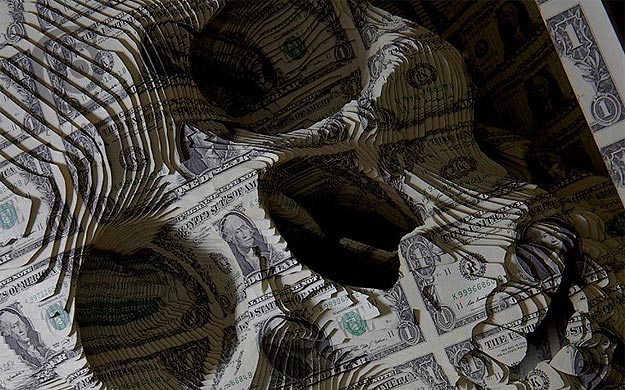
Global Economic War Is Coming And The Threat To The US Dollar Is Real

By Brandon Smith

Source: Alt-Market.us

In a recent statement posted to social media, Tucker Carlson explained succinctly his many reasons for traveling to Russia to interview President Vladimir Putin. His decision, mired in an avalanche of outrage from leftist media talking heads and a multitude of western politicians, was inspired by Carlson’s concern that Americans have been misdirected by corporate propaganda leaving the public completely uneducated on the war in Ukraine and what tensions with the East might lead to.

I agree. In fact, I don’t think the majority of Americans have a clue what the real consequences of a global war with Russia and its allies would look like. Even if the conflict never resulted in shots fired and stayed confined to the realm of economic warfare, the US and most of Europe would be devastated by the effects.

Carlson specifically mentioned dangers to the status of the US dollar, and I suspect this comment probably mystified a great number of people. Most of the population cannot fathom the idea of a US dollar implosion set in motion by a foreign dump of the greenback as the world reserve currency. They really do believe the dollar is invincible.

The most delusional people are, unfortunately, those within mainstream economic circles. They just can’t seem to grasp that the west is in the midst of financial collapse already, and war would accelerate the effects to levels not seen since the Great Depression.

I have been warning about this outcome for many years. I think I have made my position clear in the past; I suspect the conflict between east and west has been carefully engineered over the course of a decade or more, and Russia is not innocent in this affair.

Russia has consistently collaborated with globalist institutions including the International Monetary Fund in the effort to create a new “global reserve currency system.” In other words, the interests of Russia and the globalists do indeed intersect in a number of ways and the war in Ukraine has not necessarily changed that.  Time Magazine even complained last year about the IMF issuing positive reports about Russia’s economy – They thought the organization was going to repeat the false NATO narrative that Russia was in the midst of fiscal implosion.  Instead, the IMF essentially praised Russia’s resiliency in the face of sanctions.

As I noted in 2014 in my article ‘False East/West Paradigm Hides Rise Of Global Currency’ in reference to the burgeoning war with Ukraine.

I would remind pro-Putin cheerleaders that Putin and the Kremlin first pushed for the IMF to take control of the Ukrainian economy, and the IMF is now demanding that Ukraine fight Russia in exchange for financial support. This might seem like irony to more foolhardy observers; but to those who are aware of the false East/West paradigm, it is all the part of a greater plan for consolidation of power.”

I also argued that:

“I have warned for quite some time that the development of East/West tensions would be used as a cover for a collapse of the dollar system. I have warned that among the American media this collapse would be blamed on an Eastern dump of foreign exchange reserves and treasuries, resulting in a global domino-effect ending U.S. world reserve status.”

From the moment Ukrainian President Viktor Yanukovych was deposed (many argue that this was done with the help of western intel agencies) the agenda for WWIII was set in motion. Both sides seemed to create the circumstances by which a conflagration was unavoidable.

Russia, strangely, supported the intervention of the IMF to secure Ukraine’s economy. The IMF then asserted that Ukraine would have to fight Russia to keep control of the Donbas or risk losing the financial aid that was keeping the country alive. Is this irony, or is there something else going on here?

NATO started arming Ukraine, and Ukraine used those arms to slaughter civilians in the Donbas. The eastern population wanted to join with Russia, and Ukraine had no intention of allowing this (IMF funding was on the line). In the meantime, the government began openly discussing the official inclusion of Ukraine into NATO. Russia then invaded, taking the Donbas. Now the entire region is a powder keg and both sides are ready to light the fuse.

But let’s look at this situation as if there was no globalist involvement in facilitating the crisis, just for a moment as an exercise in critical thinking…

If I had to pick a side that is “more right” in their position, it would have to be Russia, but not for the reasons many leftists might imagine when conservatives defend Russia.  The bottom line is that the left blindly follows establishment dictates while the rest of us are at least willing to look at the situation from both sides (which is the same thing Tucker Carlson is doing, and he’s being accused of treason for it).

Imagine if China was working to create a military alliance with Mexico with the potential for the Chinese military to stage long range weapons and soldiers on the American southern border? Imagine the chaos that this would cause in the US (maybe they would finally secure the border)? That’s what Russia was facing with Ukraine. Hell, America almost initiated global nuclear war when the Soviets staged missiles in Cuba in 1962. Military operations so close to the borders of major national powers are not a joke.

This was exact rationale for the war on Ukraine cited by Putin in his discussion with Tucker Carlson, and it makes sense.  Again, if we look at the events without the prospect of globalist interference.  But what if we start to consider who benefits the most from this war?

I certainly don’t trust Putin, but that doesn’t negate the Orwellian behavior of European and American political leaders. There is something going on here beyond the typical mechanisms of geopolitical brinkmanship. The conflict has wide ranging consequences and only serves the goals of a select group of elites.  I suspect elements of both Russia and NATO governments are either knowingly or unwittingly serving these interests.

It is undeniable. It is a verifiable reality – Many of our political leaders and elitist institutions are corrupt beyond comprehension. They are seeking an authoritarian reformation, a “great economic reset” and they are triggering multiple conflicts around the world. We saw the mask come off during covid. These people are not merely misguided; they are monsters, and they are hungry. It’s not beyond them to conjure a worldwide calamity and sacrifice the west like a goat on the altar to get the total centralization they desire.

The East/West paradigm plays into this plan perfectly. The BRICS nations are poised to drop the dollar as world reserve; some have already done so in bilateral trade. Make no mistake, if the conflict in Ukraine (and other parts of the world like Syria or Iran) continues to escalate nations like China will move to dump their dollar holdings just as Russia did. As the largest importer/exporter in the world, many countries would follow China’s lead and shift into a basket of currencies instead of the dollar for international trade.

What does this mean?

The dollar, which has been hyperinflated through more than a decade of Federal Reserve QE money printing, has continued to remain stable only because it is the world reserve and the petro-currency. Foreign banks hold trillions in US currency in overseas coffers for this very reason. With the loss of reserve status, an endless river of dollars will then flood back into the US as foreign investors diversify away from the Fed note. Result? Massive inflationary collapse.

This is what’s at stake. This is what Tucker Carlson was referring to, and far too many in America just don’t get it. Globalists benefit because this is what they have been working towards for decades – The deconstruction of US society and the economy so that the “old world order” can be replaced with their “new world order” of Central Bank Digital Currencies.  An IMF one-world currency basket and a host of other highly unpleasant socialist changes would swiftly follow.

The BRICS might be working with the IMF because they see the dethroning of the dollar as an opportunity to gain greater influence over international trade.  Or, maybe they are controlled opposition and they are scrambling for a seat at the NWO table.  In the end, the fall of the dollar would be a watershed moment for the formation of a global currency system.

And the best part for globalists is, they will be seen as the “heroes” when it’s all over. They spent the better part of the last century setting up America for economic failure through their devaluation of the dollar and the creation of a national debt trap. The system was going to break anyway, but now they can divert all blame to war and the “arrogance of nation states” and then come to the rescue with their dystopian digital money.

An east/west conflict opens the door to the Great Reset.  It is, in a lot of ways, the core of the Reset.  Everything in the new world order agenda relies on it.  Right now, the only thing holding back the tide is the public’s general refusal to fight. No one is interested in going overseas to die in a meaningless battle for Ukraine (Zelensky is truly delusional if he thinks Americans will shed blood in his trenches – Even a draft would be an utter failure). No one is interested in starting WWIII, whether it be nuclear or just economic.

I think the establishment’s outrage over Tucker Carlson interviewing Putin is based on their fear that western audiences are already skeptical of the motives behind the conflict and an unfiltered discussion on the war might galvanize this feeling.  The notion of war is becoming harder and harder for the establishment to sell.

This, however, does not negate the ability of NATO or Russia in expanding the crisis beyond Ukraine into other regions or into financial subterfuge (again, keep your eyes on Syria and Iran). Ultimately, they want us to choose sides, but only from the list of sides they approve. Liberty minded groups in the west need to choose our OWN side and fight for our own interests. It can’t be about NATO vs Russia, it has to be about free people vs the globalists. This is the only way these disaster events will ever end.
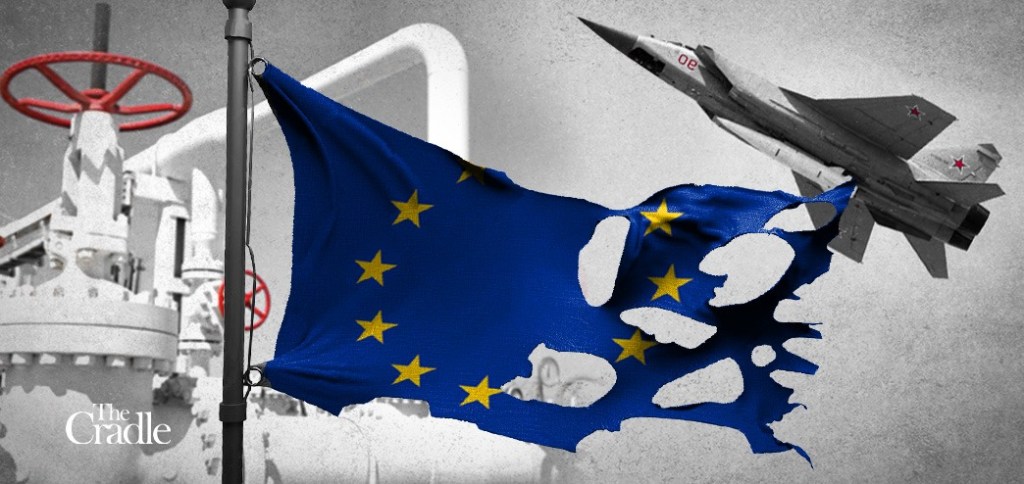
Sit back and watch Europe commit suicide

Washington’s competition with rising power Russia is so fierce, it is willing to sacrifice Europe.Photo Credit: The Cradle

If the US goal is to crush Russia’s economy with sanctions and isolation, why is Europe in an economic free fall instead?

By Pepe Escobar

Source: The Cradle

The stunning spectacle of the European Union (EU) committing slow motion hara-kiri is something for the ages. Like a cheap Kurosawa remake, the movie is actually about the US-detonated demolition of the EU, complete with the rerouting of some key Russian commodities exports to the US at the expense of Europeans.

It helps to have a 5th columnist actress strategically placed – in this case astonishingly incompetent European Commission head Ursula von der Lugen – with her vociferous announcement of a crushing new sanctions package: Russian ships banned from EU ports; road transportation companies from Russia and Belarus prohibited from entering the EU; no more coal imports (over 4.4 billion euros a year).

In practice, that translates into Washington shaking down its wealthiest western clients/puppets. Russia, of course, is too powerful to directly challenge militarily, and the US badly needs some of its key exports, especially minerals. So, the Americans will instead nudge the EU into imposing ever-increasing sanctions that will willfully collapse their national economies, while allowing the US to scoop everything up.

Cue to the coming catastrophic economic consequences felt by Europeans in their daily life (but not by the wealthiest five percent): inflation devouring salaries and savings; next winter energy bills packing a mean punch; products disappearing from supermarkets; holiday bookings almost frozen. France’s Le Petit Roi Emmanuel Macron – perhaps facing a nasty electoral surprise – has even announced: “food stamps like in WWII are possible.”

We have Germany facing the returning ghost of Weimar hyperinflation. BlackRock President Rob Kapito said, in Texas,“for the first time, this generation is going to go into a store and not be able to get what they want.” African farmers are unable to afford fertilizer at all this year, reducing agricultural production by an amount capable of feeding 100 million people.

Zoltan Poszar, former NY Fed and US Treasury guru, current Credit Suisse grand vizir, has been on a streak, stressing how commodity reserves – and, here, Russia is unrivaled – will be an essential feature of what he calls Bretton Woods III (although, what’s being designed by Russia, China, Iran and the Eurasia Economic Union is a post-Bretton Woods).

Poszar remarks that wars, historically, are won by those who have more food and energy supplies, in the past to power horses and soldiers; today to feed soldiers and fuel tanks and fighter jets. China, incidentally, has amassed large stocks of virtually everything.

Poszar notes how our current Bretton Woods II system has a deflationary impulse (globalization, open trade, just-in-time supply chains) while Bretton Woods 3 will provide an inflationary impulse (de-globalization, autarky, hoarding of raw materials) of supply chains and extra military spending to be able to protect what will remain of seaborne trade.

The implications are of course overwhelming. What’s implicit, ominously, is that this state of affairs may even lead to WWIII.

Rublegas or American LNG?

The Russian roundtable Valdai Club has conducted an essential expert discussion on what we at The Cradle have defined as  Rublegas – the real geoeconomic game-changer at the heart of the post-petrodollar era. Alexander Losev, a member of the Russian Council for Foreign and Defense Policy, offered the contours of the Big Picture. But it was up to Alexey Gromov, Chief Energy Director of the Institute of Energy and Finance, to come up with crucial nitty-gritty.

Russia, so far, was selling 155 billion cubic meters of gas to Europe each year. The EU rhetorically promises to get rid of it by 2027, and reduce supply by the end of 2022 by 100 billion cubic meters. Gromov asked “how,” and remarked, “any expert has no answer. Most of Russia’s natural gas is shipped over pipelines. This cannot simply be replaced by Liquified Natural Gas (LNG).”

The risible European answer has been “start saving,” as in “prepare to be worse off” and “reduce the temperature in households.” Gromov noted how, in Russia, “22 to 25 degrees in winter is the norm. Europe is promoting 16 degrees as ‘healthy’, and wearing sweaters at night.”

The EU won’t be able to get the gas it needs from Norway or Algeria (which is privileging domestic consumption). Azerbaijan would be able to provide at best 10 billion cubic meters a year, but “that will take 2 or 3 years” to happen.

Gromov stressed how “there’s no surplus in the market today for US and Qatar LNG,” and how prices for Asian customers are always higher. The bottom line is that “by the end of 2022, Europe won’t be able to significantly reduce” what it buys from Russia: “they might cut by 50 billion cubic meters, maximum.” And prices in the spot market will be higher – at least $1,300 per cubic meter.

An important development is that “Russia changed the logistical supply chains to Asia already.” That applies for gas and oil as well:  “You can impose sanctions if there’s a surplus in the market. Now there’s a shortage of at least 1.5 million barrels of oil a day. We’ll be sending our supplies to Asia – with a discount.” As it stands, Asia is already paying a premium, from 3 to 5 dollars more per barrel of oil.

On oil shipments, Gromov also commented on the key issue of insurance: “Insurance premiums are higher. Before Ukraine, it was all based on the Free on Board (FOB) system. Now buyers are saying ‘we don’t want to take the risk of taking your cargo to our ports.’ So they are applying the Cost, Insurance and Freight (CIF) system, where the seller has to insure and transport the cargo. That of course impacts revenues.”

An absolutely key issue for Russia is how to make the transition to China as its key gas customer. It’s all about the Power of Siberia 2, a new 2600-km pipeline originating in the Russian Bovanenkovo and Kharasavey gas fields in Yamal, in northwest Siberia – which will reach full capacity only in 2024. And, first, the interconnector through Mongolia must be built – “we need 3 years to build this pipeline” – so everything will be in place only around 2025.

On the Yamal pipeline, “most of the gas goes to Asia. If the Europeans don’t buy anymore we can redirect.” And then there’s the Arctic LNG 2 project – which is even larger than Yamal: “the first phase should be finished soon, it’s 80 percent ready.” An extra problem may be posed by the Russian “Unfriendlies” in Asia: Japan and South Korea. LNG infrastructure produced in Russia still depends on foreign technologies.

That’s what leads Gromov to note that, “the model of mobilization-based economy is not so good.” But that’s what Russia needs to deal with at least in the short to medium term.

The positives are that the new paradigm will allow “more cooperation within the BRICS (the emerging economies of Brazil, Russia, India, China and South Africa that have been meeting annually since 2009);” the expansion of the International North South Transportation Corridor (INSTC); and more interaction and integration with “Pakistan, India, Afghanistan and Iran.”

Only in terms of Iran and Russia, swaps in the Caspian Sea are already in the works, as Iran produces more than it needs, and is set to increase cooperation with Russia in the framework of their strengthened strategic partnership.

Hypersonic geoeconomics

It was up to Chinese energy expert Fu Chengyu to offer a concise explanation of why the EU drive of replacing Russian gas with American LNG is, well, a pipe dream. Essentially the US offer is “too limited and too costly.”

Fu Chengyu showed how a lengthy, tricky process depends on four contracts: between the gas developer and the LNG company; between the LNG company and the buyer company; between the LNG buyer and the cargo company (which builds vessels); and between the buyer and the end user.

“Each contract,” he pointed out, “takes a long time to finish. Without all these signed contracts, no party will invest – be it investment on infrastructure or gas field development.” So actual delivery of American LNG to Europe assumes all these interconnected resources are available – and moving like clockwork.

Fu Chengyu’s verdict is stark: this EU obsession on ditching Russian gas will provoke “an impact on global economic growth, and recession. They are pushing their own people – and the world. In the energy sector, we will all be harmed.”

It was quite enlightening to juxtapose the coming geoeconomic turbulence – the EU obsession in bypassing Russian gas and the onset of Rublegas – with the real reasons behind Operation Z in Ukraine, completely obscured by western media and analysts.

A US Deep State old pro, now retired, and quite familiar with the inner workings of the old OSS, the CIA precursor, all the way to the neocon dementia of today, provided some sobering insights:

“The whole Ukraine issue is over hypersonic missiles that can reach Moscow in less than four minutes. The US wants them there, in Poland, Romania, Baltic States, Sweden, Finland. This is in direct violation of the agreements in 1991 that NATO will not expand in Eastern Europe. The US does not have hypersonic missiles now but should – in a year or two. This is an existential threat to Russia. So they had to go into the Ukraine to stop this.  Next will be Poland and Romania where launchers have been built in Romania and are being built in Poland.”

From a completely different geopolitical perspective, what’s really telling is that his analysis happens to dovetail with Zoltan Poszar’s geoeconomics: “The US and NATO are totally belligerent. This presents a real danger to Russia. The idea that nuclear war is unthinkable is a myth. If you look at the firebombing of Tokyo against Hiroshima and Nagasaki, more people died in Tokyo than Hiroshima and Nagasaki. These cities were rebuilt. The radiation goes away and life can restart. The difference between firebombing and nuclear bombing is only efficiency. NATO provocations are so extreme, Russia had to place their nuclear missiles on standby alert. This is a gravely serious matter. But the US ignored it.”

Are Americans Rational?

By Dmitry Orlov

Source: Club Orlov

I’ve been holding back on commenting on current events because they are far too silly. At this point it is safe to say that the elections in the US have been thoroughly botched and that, no matter who is ultimately chosen as president for the next four years, enough questions will remain in the minds of enough people to thoroughly delegitimize the national leadership in the eyes of at least half the country.

Just this morning I got a missive from Paul Craig Roberts containing the following bullet points:

• Joe Biden’s Twitter account has 20 million followers. Trump’s Twitter account has 88.8 million followers.

• Joe Biden’s Facebook account has 7.78 million followers. Trump’s Facebook account has 34.72 million followers. How likely is it that a person with four to five times the following of his rival lost the election?

• Joe Biden, declared by the biased presstitutes to be president by landslide, gave a Thanksgiving Day message and only 1,000 people watched his live statement. Where is the enthusiasm?

• Trump’s campaign appearances were heavily attended and that Biden’s were avoided. Somehow a candidate who could not draw supporters to his campaign appearances won the presidency.

• Despite Biden’s total failure to animate voters during the presidential campaign, he received 15 million more votes than Barack Obama did in his 2012 re-election.

• Biden won despite underperforming Hillary Clinton’s 2016 vote in every urban US county, but outperformed Clinton in Democrat-controlled Detroit, Milwaukee, Atlanta, and Philadelphia, the precise cities where the most obvious and most blatant electoral fraud was committed.

• Biden won despite receiving a record low share of the Democrat primary vote compared to Trump’s share of the Republican primary vote.

• Biden won despite Trump bettering his 2016 vote by ten million votes and Trump’s record support from minority voters.

• Biden won despite losing the bellwether counties that have always predicted the election outcome and the bellwether states of Ohio and Florida.

• Biden won in Georgia, a completely red state with a red governor and legislature both House and Senate. Somehow a red state voted for a blue president.

• Biden won despite the Democrats losing representation in the House.

• In Pennsylvania 47 memory cards containing more than 50,000 votes are missing.

• Pennsylvania 1.8 million ballots were mailed out to voters, but 2.5 million mail-in ballots were counted.

Roberts is a Republican and therefore believes that the Democrats stole the election. A Democrat, once it turns out that Trump won after all, would believe the opposite. But that makes no difference because, as I keep repeating, the US is not a democracy and it doesn’t matter who is its president.

It is not a democracy because the vast majority of votes—all Democratic votes in Republican states and all Republican votes in Democratic states—are simply thrown away. That’s roughly half the electorate who have no chance of making their vote count in the state where they live. Of course, they could move to a different state, in which case their vote would be thrown away for the opposite reason—lost as part of a superfluously large majority.

This is easy enough to explain to any rational person—but not to the vast majority of Americans, for whom such logic goes in one ear and comes out the other. In short, they are not rational. Worse than that, their leaders are not rational either. This brings us to the second point—that it doesn’t matter who is president.

Trump keeps talking about making America great—by bringing manufacturing back from China. Except that the opposite has happened over the past four years: China’s industrial production has continued to grow (although more slowly than before) while in the US it has continued to decline. Nor is is there any reason at all to think that this is going to change over the next four years.

Biden keeps talking about America continuing as the leader of the free world—except that America is no longer the leader of much of anything and there is no reason to think that anything can be done to reverse this slide. Thus, no matter who becomes (or remains) president, the US administration will continue to wallow in nostalgia while steadfastly refusing to admit defeat.

This defeat has multiple elements. First, the shale oil gamble is over. Drilling rates have collapsed, many shale oil companies are bankrupt, and US oil production is set to plummet from over 12 million barrels per day at its peak to around 5 million by next June (according to Art Berman, whose opinion I trust). After that point the US will once again become a major oil importer, and since no other swing producers are available this will drive up oil prices, perhaps beyond the previous all-time record of $150/barrel, resulting in a US oil import bill of half a trillion dollars a year. But it is doubtful whether that much extra oil can be produced at almost any price.

Second, national bankruptcy is looming ever closer. The federal government now overspends its revenues by a factor of two or more, meaning that for every dollar of federal revenue it borrows and spends at least two. Previously, despite its already ridiculous size and exponential growth rate, US federal debt could be given an appearance of legitimacy because enough foreign buyers could be found for it; but this is no longer the case. And so this debt is looking less and less legitimate because it is being monetized—simply printed into existence—as the Federal Reserve degenerates into a pure pyramid scheme.

Third, the US dollar (along with some other currencies to which it is tied) is poised on the edge of a hyperinflationary wipe-out. In an effort to shore up the economy a great deal of money has been unleashed into the economy and it went chasing after stocks, keeping it from triggering hyperinflation. Thus we have the truly bizarre combination of a record-high stock market along with record-high bankruptcies, foreclosures and evictions. At some point confidence in the stock market will evaporate and all of this notional money will go chasing after anything that isn’t made of paper (with the possible exception of toilet paper). Much of this notional money will evaporate as people liquidate their stock holdings, but enough will remain to result in hoarding and hyperinflation. The US dollar will devalue internationally and the US will lose access to imports.

Fourth, the US has lost its lead militarily, definitely to Russia and possibly to China and Iran. Its major military asset is its aircraft carrier fleet, which is by now completely useless because it can be destroyed using conventional weapons from a safe stand-off distance which is greater than the reach of its aircraft. Consequently, it cannot be deployed close enough to an enemy shore to make its aircraft useful. US military bases, hundreds of which are scattered all over the globe, but mostly clustered along Russia’s and China’s borders, are also useless militarily, as demonstrated by Iran’s rocket attacks against two of them in Iraq. In short, the entire US military is by now more of a liability than an asset—likely to draw the US into a military confrontation which it cannot win.

Now, do you hear these points discussed in the national media, in the course of the election campaign or otherwise? Do these points come up at all in conversations with colleagues, neighbors, friends and family? Are these topics of discussion in high school civics classes? (Wait, what high school civics classes?) No? And yet they are real, and their consequences are at this point unavoidable, and refusing to acknowledge them will only exacerbate their effects.

Collapse is bad enough when you and everyone around you can acknowledge it. But if everyone from the president (pick either one) to the lowliest convenience store clerk is incapable of accepting it as real and thinking through some of the immediate consequences, that makes it much, much worse. I refuse to accept any of the responsibility for this dreadful state of affairs; I’ve been doing all I can to warn people for a decade and a half now. It is now pointless for me to issue any more warnings. All I can do now is watch the inevitable unfold.