Washington’s Wars Eroding its Global Clout

By Salman Rafi Sheikh

Source: New Eastern Outlook

If war is politics by other means, Washington’s ongoing wars in the Middle East and Eastern Europe are meant to buttress its global influence on the one hand and undermine its competitors on the other. But the question is: how is this politics by other means working out for Washington? Not so good. Russia’s recent military victories in Ukraine and China’s expansive inroads into the Middle East alongside the growing anti-Americanism in the region (due to Washington’s support for Israel and its inability to prevent a genocide of the Palestinians) indicate an overall American inability to shape global geopolitics in unilateral ways to the exclusive advantage of Washington and its allies in Europe and elsewhere.

Russia’s recent military gains in Ukraine, for example, have very clearly established its military credentials as a power that has been able to withstand the combined military strength of the US and its European allies assembled in the North Atlantic Treaty Organization (NATO). What does this mean for Washington’s policies in Central Asia? Most certainly, Washington cannot simply present Russia as a ‘weak’ military power that can be simply ‘isolated’. But more than that, Russia is utilising its victories over NATO in various ways.

For instance, when the NATO-backed Russia-Ukraine military conflict began, most reports in the mainstream US media began to spread false messaging about Central Asia potentially moving itself out of the so-called ‘Russian clout’. The US saw in it an opportunity to push itself into the region. But this has turned out to be a fiasco. When the US imposed sanctions on Russia, many Russian companies began to relocate their businesses to Central Asia, directly contributing to Central Asia’s impressive 4.8 percent growth rate in 2023. According to the findings of the European Bank for Reconstruction and Development, the region is forecast to register an even more impressive level of growth at almost 5.7 percent in 2024-25.

In other words, thanks to Washington’s sanctions, the Russian political economy is now more deeply connected with Central Asia than it was before February 2021, which is also strengthening the Eurasian Economic Union. Now that this integration is working for the advantage of Central Asia means that the latter have little to no incentive to pay too much attention to Washington and/or the imperatives of moving decisively to Washington. It means that not only has the Biden administration’s policy of NATO expansion via Ukraine failed so far in Ukraine itself, but the ‘new’ Central Asia policy it inaugurated in the wake of the Russia-Ukraine conflict has also failed to make any impact on the ground. Russia defeated US design also by approaching relations with the Central Asian States in ways that gave them enough space to stay neutral in the conflict. While the West saw this neutrality as a sign of Russian weakness in the region and the Central Asian States’ growing assertiveness, it failed to read how this was part of Russia’s strategy to cultivate its ties in a more balanced way. This balance is also pretty evident in the ways Russia has not objected to, or even resisted, China’s growing footprint in the region, although reports in the Western media often see China’s role in Central Asia at the expense of Russia. But the West seems to have been misreading this region.

As far as Washington’s war in the Middle East is concerned, its military support for Israel plus its inability to stop genocide has eroded its credibility. Suppose Washington has been supporting Israel to maintain its dominance in the Middle East. In that case, Washington’s excessive support is now derailing its objectives, since the Middle East is now exercising a lot more strategic autonomy vis-à-vis Washington than was the case until a few years ago.

In the past few months, a flurry of Chinese activity indicates it much more clearly than anything else. China has convened leadership summits, met with Arab delegates, supported their stance vis-à-vis Israel, and held joint military exercises with one of the US’ most important allies in the region (Saudi Arabia). The UAE, otherwise a close US ally and one of the first states to sign the Abraham Accords to recognise Israel and establish diplomatic ties with it, actually withdrew from the US-led naval task force in May 2023, indicating policy and interest-based differences.

The UAE is also a country in the Middle East that has over 100,000 Chinese living there and involved in many businesses. But when it comes to the Middle East itself, and the fact that many countries in the region are involved in China’s Belt & Road Initiative (BRI), we see the region’s trade with China registering an overall growth of almost 45 percent in 2021 and 27 percent in 2022.

Given the economic integration, the Middle East is turning out to be a region where Washington’s clout is receding fast, without any signs of recovery in the immediate future at least. Although US strikes in the Red Sea on the Houthis are meant to indicate Washington’s willingness to offer a security umbrella to the Gulf states (against Iran-backed groups), the region appears to be past the point where it must have the US on its side to ensure security. Gulf states’ perceptions of Iran as an enemy are changing, thanks to Beijing’s mediation.

As far as Washington’s support for Israel is concerned and as far as the threat of a wider war in the region it is posing, Gulf states are on the edge of a conflict that might directly undermine their modernization programmes – development projects that mainly involve China in various capacities.

Therefore, if Washington’s involvement in the Israel war was meant to bring back the era of US dominance, the exact opposite is happening, both in the Middle East and Central Asia, which happen to be two of the world’s most energy-rich regions.

It’s War: The Real Meat Grinder Starts Now

By Pepe Escobar

Source: Strategic Culture Foundation

No more shadow play. It’s now in the open. No holds barred. 

Exhibit 1: Friday, March 22, 2024. It’s War. The Kremlin, via Peskov, finally admits it, on the record.

The money quote:

“Russia cannot allow the existence on its borders of a state that has a documented intention to use any methods to take Crimea away from it, not to mention the territory of new regions.”

Translation: the Hegemon-constructed Kiev mongrel is doomed, one way or another. The Kremlin signal: “We haven’t even started” starts now.

Exhibit 2: Friday afternoon, a few hours after Peskov. Confirmed by a serious European – not Russian – source. The first counter-signal.

Regular troops from France, Germany and Poland have arrived, by rail and air, to Cherkassy, south of Kiev. A substantial force. No numbers leaked. They are being housed in schools. For all practical purposes, this is a NATO force.

That signals, “Let the games begin”. From a Russian point of view, Mr. Khinzal’s business cards are set to be in great demand.

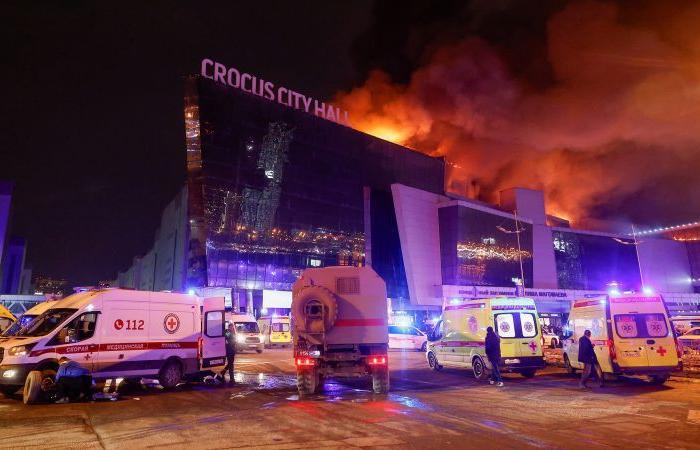
Exhibit 3: Friday evening. Terror attack on Crocus City, a music venue northwest of Moscow. A heavily trained commando shoots people on sight, point blank, in cold blood, then sets a concert hall on fire. The definitive counter-signal: with the battlefield collapsing, all that’s left is terrorism in Moscow.

And just as terror was striking Moscow, the US and the UK, in southwest Asia, was bombing Sana’a, the Yemeni capital, with at least five strikes.

Some nifty coordination. Yemen has just clinched a strategic deal in Oman with Russia-China for no-hassle navigation in the Red Sea, and is among the top candidates for BRICS+ expansion at the summit in Kazan next October.

Not only the Houthis are spectacularly defeating thalassocracy, they have the Russia-China strategic partnership on their side. Assuring China and Russia that their ships can sail through the Bab-al-Mandeb, Red Sea and Gulf of Aden with no problems is exchanged with total political support from Beijing and Moscow.

The sponsors remain the same

Deep in the night in Moscow, before dawn on Saturday 23. Virtually no one is sleeping. Rumors dance like dervishes on countless screens. Of course nothing has been confirmed – yet. Only the FSB will have answers. A massive investigation is in progress.

The timing of the Crocus massacre is quite intriguing. On a Friday during Ramadan. Real Muslims would not even think about perpetrating a mass murder of unarmed civilians under such a holy occasion. Compare it with the ISIS card being frantically branded by the usual suspects.

Let’s go pop. To quote Talking Heads: “This ain’t no party/ this ain’t no disco/ this ain’t no fooling around”. Oh no; it’s more like an all-American psy op. ISIS are cartoonish mercenaries/goons. Not real Muslims. And everyone knows who finances and weaponizes them.

That leads to the most possible scenario, before the FSB weighs in: ISIS goons imported from the Syria battleground – as it stands, probably Tajiks – trained by CIA and MI6, working on behalf of the Ukrainian SBU. Several witnesses at Crocus referred to “Wahhabis” – as in the commando killers did not look like Slavs.

It was up to Serbia’s Aleksandar Vucic to cut to the chase. He directly connected the “warnings” in early March from American and British embassies directed at their citizens not to visit public places in Moscow with CIA/MI6 intel having inside info about possible terrorism, and not disclosing it to Moscow.

The plot thickens when it is established that Crocus is owned by the Agalarovs: an Azeri-Russian billionaire family, very close friends of…

… Donald Trump.

Talk about a Deep State-pinpointed target.

ISIS spin-off or banderistas – the sponsors remain the same. The clownish secretary of the National Security and Defense Council of Ukraine, Oleksiy Danilov, was dumb enough to virtually, indirectly confirm they did it, saying on Ukrainian TV, “we will give them [Russians] this kind of fun more often.”

But it was up to Sergei Goncharov, a veteran of the elite Russia Alpha anti-terrorism unit, to get closer to unwrapping the enigma: he told Sputnik the most feasible mastermind is Kyrylo Budanov – the chief of the Main Directorate of Intelligence at the Ukrainian Ministry of Defense.

The “spy chief” who happens to be the top CIA asset in Kiev.

It’s got to go till the last Ukrainian

The three exhibits above complement what the head of NATO’s

military committee, Rob Bauer, previously told a security forum in Kiev: “You need more than just grenades – you need people to replace the dead and wounded. And this means mobilization.”

Translation: NATO spelling out this is a war until the last Ukrainian.

And the “leadership” in Kiev still does not get it. Former Minister of Infrastructure Omelyan: “If we win, we will pay back with Russian oil, gas, diamonds and fur. If we lose, there will be no talk of money – the West will think about how to survive.”

In parallel, puny “garden-and jungle” Borrell admitted that it would be “difficult” for the EU to find an extra 50 billion euros for Kiev if Washington pulls the plug. The cocaine-fueled sweaty sweatshirt leadership actually believes that Washington is not “helping” in the form of loans, but in the form of free gifts. And the same applies for the EU.

The Theater of the Absurd is unmatchable. The German Liver Sausage Chancellor actually believes that proceeds from stolen Russian assets “do not belong to anyone”, so they can be used to finance extra Kiev weaponizing.

Everyone with a brain knows that using interest from “frozen”, actually stolen Russian assets to weaponize Ukraine is a dead end – unless they steal all of Russia’s assets, roughly $200 billion, mostly parked in Belgium and Switzerland: that would tank the Euro for good, and the whole EU economy for that matter.

Eurocrats better listen to Russian Central Bank major “disrupter” (American terminology) Elvira Nabiullina: The Bank of Russia will take “appropriate measures” if the EU does anything on the “frozen”/stolen Russian assets.

It goes without saying that the three exhibits above completely nullify the “La Cage aux Folles” circus promoted by the puny Petit Roi, now known across his French domains as Macronapoleon.

Virtually the whole planet, including the English-speaking Global North, had already been mocking the “exploits” of his Can Can Moulin Rouge Army.

So French, German and Polish soldiers, as part of NATO, are already in the south of Kiev. The most possible scenario is that they will stay far, far away from the frontlines – although traceable by Mr. Khinzal’s business activities.

Even before this new NATO batch arriving in the south of Kiev, Poland – which happens to serve as prime transit corridor for Kiev’s troops – had confirmed that Western troops are already on the ground.

So this is not about mercenaries anymore. France, by the way, is only 7th in terms of mercenaries on the ground, largely trailing Poland, the US and Georgia, for instance. The Russian Ministry of Defense has all the precise records.

In a nutshell: now war has morphed from Donetsk, Avdeyevka and Belgorod to Moscow. Further on down the road, it may not just stop in Kiev. It may only stop in Lviv. Mr. 87%, enjoying massive national near-unanimity,  now has the mandate to go all the way. Especially after Crocus.

There’s every possibility the terror tactics by Kiev goons will finally drive Russia to return Ukraine to its original 17th century landlocked borders: Black Sea-deprived, and with Poland, Romania, and Hungary reclaiming their former territories.

Remaining Ukrainians will start to ask serious questions about what led them to fight – literally to their death – on behalf of the US Deep State, the military complex and BlackRock.

As it stands, the Highway to Hell meat grinder is bound to reach maximum velocity.

China’s unexpected gains from the Red Sea crisis

Despite Beijing’s maritime security priority, Yemen’s Red Sea ban on Israeli-linked shipping has boosted China’s regional standing while miring its US adversary in an unwinnable crisis.

By Giorgio Cafiero

Source: The Cradle

The Gaza war’s expansion into the Red Sea has created an international maritime crisis involving a host of countries. Despite a US-led bombing campaign aimed at deterring Yemen’s Ansarallah-aligned navy from carrying out missile and drone strikes in the Red Sea, the armed forces continue to ramp up attacks and now are using “submarine weapons.” 

As these clashes escalate dangerously, one of the world’s busiest bodies of water is rapidly militarizing. This includes the recent arrival to the Gulf of Aden of a Chinese fleet, including the guided-missile destroyer Jiaozuo, the missile frigate Xuchang, a replenishment vessel, and more than 700 troops – including dozens of special forces personnel – as part of a counter-piracy mission. 

Beijing has voiced its determination to help restore stability to the Red Sea. “We should jointly uphold the security on the sea lanes of the Red Sea in accordance with the law and also respect the sovereignty and territorial integrity of the countries along the Red Sea coast, including Yemen,” Chinese Foreign Minister Wang Yi emphasized last month.

As the largest trading nation in the world, China depends on the Red Sea as its “maritime lifeline.” Most of the Asian giant’s exports to Europe go through the strategic waterway, and large quantities of oil and minerals that come to Chinese ports transit the body of water. 

The Chinese have also invested in industrial parks along Egypt and Saudi Arabia’s Red Sea coasts, including the TEDA–Suez Zone in Ain Sokhna and the Chinese Industrial Park in Saudi Arabia’s Jizan City for Primary and Downstream Industries. 

Chinese neutrality in West Asia

Prior to the sending of the 46th fleet of the Chinese People’s Liberation Army Navy, Beijing’s response to Ansarallah’s maritime attacks had been relatively muted. China has since condemned the US–UK airstrikes against Ansarallah’s military capabilities in Yemen, and refused to join the western-led naval coalition, Operation Prosperity Guardian (OPG).

China’s response to mounting tension and insecurity in the Red Sea is consistent with Beijing’s grander set of foreign policy strategies, which include respect for the sovereignty of nation-states and a doctrine of “non-interference.” 

In the Persian Gulf, China has pursued a balanced and geopolitically neutral agenda resting on a three-pronged approach: enemies of no one, allies of no one, and friends of everyone. 

China’s position vis-à-vis all Persian Gulf countries was best exemplified almost a year ago when Beijing brokered a surprise reconciliation agreement between Iran and Saudi Arabia, in which it played the role of guarantor. 

In Yemen, although China aligns with the international community’s non-recognition of the Ansarallah-led government in Sanaa, Beijing has nonetheless initiated dialogues with those officials and maintained a non-hostile stance – unlike many Arab and western states.

Understanding Beijing’s regional role 

Overall, China tries to leverage its influence in West Asian countries to mitigate regional tensions and advance stabilizing initiatives. Its main goal is ultimately to ensure the long-term success of President Xi Jinping’s multi-trillion dollar Belt and Road Initiative (BRI) and keep trade routes free of conflict. 

Often labeled by the west as a “free rider,” China is accused of opportunistically benefiting from US- and European-led security efforts in the Persian Gulf and the northwestern Indian Ocean without contributing to them. 

But given China’s anti-piracy task force in the Gulf of Aden and its military base in Djibouti, this accusation isn’t entirely justified.

Beijing’s motivations for staying out of OPG were easy to understand: first, China has no interest in bolstering US hegemony; second, joining the naval military coalition could upset its multi-vector diplomacy vis-à-vis Ansarallah and Iran; and third, the wider Arab–Islamic world and the rest of the Global South would interpret it as Chinese support for Israel’s war on Gaza. 

Rejecting the OPG mission has instead bolstered China’s regional image as a defender of the Palestinian cause.

Speaking to The Cradle, Javad Heiran-Nia, director of the Persian Gulf Studies Group at the Center for Scientific Research and Middle East Strategic Studies in Iran, said: 

[Beijing’s] cooperation with the West in securing the Red Sea will not be good for China’s relations with the Arabs and Iran. Therefore, China has adopted political and military restraint to avoid jeopardizing its economic and diplomatic interests in the region.

Dropping the blame on Washington’s doorstep

Beijing recognizes the Red Sea security crisis to be a direct “spillover” from Gaza, where China has called for an immediate ceasefire.

As Yun Sun, co-director of the China Program at the Washington-based Stimson Center, informed The Cradle:

The Chinese do see the crisis in the Red Sea as a challenge to regional peace and stability but see the Gaza crisis as the fundamental origin of the crisis. Therefore, the solution to the crisis in the Chinese view will have to be based on ceasefire, easing of the tension and returning to the two-state solution.

Jean-Loup Samaan, a senior research fellow at the National University of Singapore’s Middle East Institute, agrees, telling The Cradle:

Chinese diplomats have been carefully commenting on the events, but in Beijing’s narrative, the rise of attacks is a consequence of Israel’s war in Gaza – and perhaps more importantly the US policy in support [of] the Netanyahu government.

But in January, after the US and UK began their bombing campaign of Ansarallah targets in Yemen, China began to weigh in with serious concerns about the Red Sea crisis. Beijing noted that neither Washington nor London had received authorization for the use of force from the UN Security Council, and, therefore, as Sun explained it, the US–UK strikes “lack legitimacy in the Chinese view.”  

How the Red Sea Crisis benefits Beijing

China has capitalized on intensifying anger directed against the US from all over the Islamic world and Global South. The Gaza war and its spread into the Red Sea have delivered Beijing some easy soft-power gains and reinforced to Arab audiences the vital importance of multipolarity.
This point was drummed home by Victor Gao, vice president of the Center for China and Globalization, when he told the 2023 Doha Forum: 

The fact that there is only one single country which [on 8 December, 2023] vetoed the United Nations Security Council Resolution calling for ceasefire in the Israel-Palestine War should convince all of us that we should be very lucky living not in the unipolar World.

Certainly, China has experienced some economic repercussions from the Red Sea crisis, although the extent of this is difficult to calculate. Yet Beijing’s political gains appear to trump any associated financial losses. As Sun explained to The Cradle, “The crisis does affect China, but the loss has been mostly economic and minor, while the gains are primarily political as China stands with the Arab countries on Gaza.”

In some ways, China has actually gained economically from the Red Sea crisis. With Ansarallah making a point of only targeting Israel-linked vessels, there is a widespread view that Chinese ships operating in the area are immune from Yemeni attacks. 

After many international container shipping lines decided to reroute around South Africa to avoid Ansarallah’s missiles and drones, two ships operating under the Chinese flag – the Zhong Gu Ji Lin and Zhong Gu Shan Dong – continued transiting the Red Sea. 
As Bloomberg reported early this month:

Chinese-owned merchant ships are getting hefty discounts on their insurance when sailing through the Red Sea, another sign of how Houthi attacks in the area are punishing the commercial interests of vessels with ties to the West.

US officials have since implored Beijing to pressure Iran into ordering the de-facto Yemeni government to halt maritime attacks. Those entreaties have failed, however, largely because Washington incorrectly assumes that Beijing holds influence over Tehran and that Iran can make demands of Ansarallah. Regardless, the fact that the US would turn to China for such help amid escalating tensions in the Red Sea is a boost to Beijing’s status as a go-to power amid global security crises.

China also has much to gain from the White House’s disproportionate focus on Gaza and the Red Sea. Since October–November 2023, the US has had significantly less bandwidth for its South China Sea and Taiwan files. In turn, this frees Beijing to act more confidently in West Asia while the US remains distracted. According to Heiran-Nia:

The developments in the Red Sea will keep America’s focus on the region and not open America’s hand to expand its presence in the Indo–Pacific region, [where] America’s main priority is to contain China. The war in Ukraine has the same advantage for China. While the connectivity of the Euro–Atlantic region with the Indo–Pacific region is expanding to contain China and increase NATO cooperation with the Indo–Pacific, the tensions in [West Asia] and Ukraine will be a boon for China.

Ultimately, the Red Sea crisis and Washington’s failure to deter Ansarallah signal yet another blow to US hegemony. From the Chinese perspective, the growing Red Sea conflict serves to further isolate the US and highlight its limitations as a security guarantor – particularly in light of its unconditional support for Israel’s brutal military assault on Gaza.

It is reasonable to call China a winner in the Red Sea crisis.

The World’s Gyre

Bu Alastair Crooke

Source: Strategic Culture Foundation

The U.S. is edging closer to war with Iraq’s Popular Mobilisation Forces, a state security agency composed of armed groups, some of which are close to Iran, but which for the main are Iraqi nationalists. The U.S. carried out a drone strike in Baghdad, Wednesday that killed three members of the Kataeb Hizbullah forces, including a senior commander. One of the assassinated, al-Saadi, is the most senior figure to have been assassinated in Iraq since the 2020 drone strike that killed senior Iraqi Commander al-Muhandis and Qassem Soleimani.

The target is puzzling as Kataeb more than a week ago suspended its military operations against the U.S. (at the request of the Iraqi government). The stand down was widely published. So why was this senior figure assassinated?

Tectonic twitches often are sparked by a single egregious action: the one final grain of sand which – on top of the others – triggers the slide, capsizing the sandpile. Iraqis are angry. They feel that the U.S. wantonly violates their sovereignty – showing contempt and disdain for Iraq, a once great civilisation, now brought low in the wake of U.S. wars. Swift and collective retaliation has been promised.

One act, and a gyre can begin. The Iraqi government may not be able to hold the line.

The U.S. tries to separate and compartmentalise issues: AnsarAllah’s Red Sea blockade is ‘one thing’; attacks on U.S. bases in Iraq and Syria, an unrelated ‘another’. But all know that such separateness is artificial – the ‘red’ thread woven through all these ‘issues’ is Gaza. The White House (and Israel) however, insists the connecting thread instead to be Iran.

Did the White House think this through properly, or was its latest assassination viewed as a ‘sacrifice’ to appease the ‘gods of war’ in the Beltway, clamouring to bomb Iran?

Whatever the motive, the Gyre turns. Other dynamics are running that will be fuelled by the attack.

The Cradle highlights one significant shift:

“by successfully obstructing Israeli vessels from traversing the Bab al-Mandab Strait, the Ansarallah-led Sanaa government has emerged as a powerful symbol of resistance in defence of the Palestinian people – a cause deeply popular across Yemen’s many demographics. Sanaa’s position stands in stark contrast to that of the Saudi and Emirati-backed government in Aden, which, to the horror of Yemenis, welcomed attacks by U.S. and British forces on 12 January”.

“The U.S.–UK airstrikes have prompting some heavyweight internal defections … a number of Yemeni militias previously aligned with the UAE and Saudi Arabia, consequently switched allegiance to Ansarallah … Disillusionment with the coalition will have profound political and military implications for Yemen, reshaping alliances, and casting the UAE and Saudi Arabia as national adversaries. Palestine continues to serve as a revealing litmus test throughout West Asia – and now in Yemen too – exposing those who only-rhetorically claim the mantle of justice and Arab solidarity”.

Yemen military defections – How does this matter?

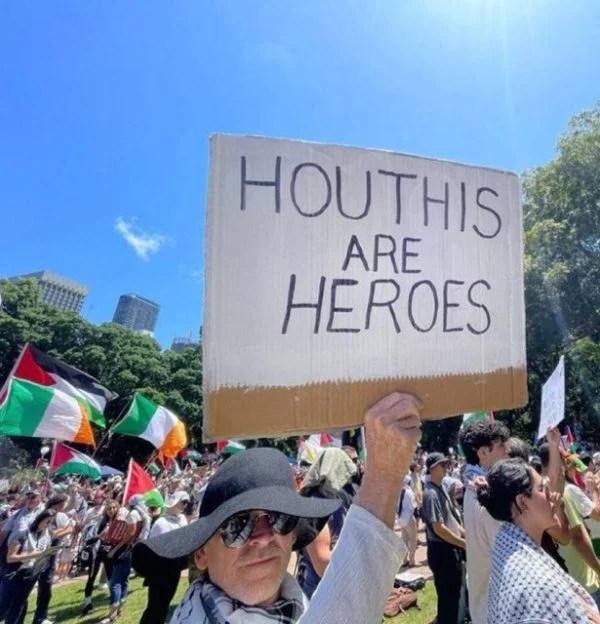
Well, the Houthis and AnsarAllah have become heroes across the Islamic World. Look at social media. The Houthis are now the ‘stuff of myth’: Standing up for Palestinians whilst others don’t. A following is taking hold. AnsarAllah’s ‘heroic’ stance may lead to the ousting of western proxies, and so to dominate that ‘rest of Yemen’ they presently do not control. It seizes too, the Islamic world imagination (to the concern of the Arab Establishment).

In the immediate aftermath of the assassination of al-Saadi, Iraqis took to the streets of Baghdad chanting: “God is Great, America is the Great Satan”.

Do not imagine this ‘turn’ is lost on others – on the Iraqi Hashd al-Sha’abi, for example; or on the (Palestinians) of Jordan; or on the mass foot-soldiers of the Egyptian army; or indeed in the Gulf. There are 5 billion smartphones extant today. The ruling class do watch the Arabic channels, and view (nervously) social media. They worry that anger against the western flouting of international law may boil over, and they will be unable to contain it: What price the ‘Rules Order’ now since the International Court of Justice upended the notion of a moral content to western culture?

The wrongheadedness of U.S. policy is astonishing – and now has claimed the most central tenet in the ‘Biden strategy’ for resolving the crisis in Gaza. The ‘dangle’ of Saudi normalisation with Israel was viewed in the West as the pivot – around which Netanyahu would either be forced to give up on his maximalist security control from the River to the Sea mantra, or see himself pushed aside by a rival for whom the ‘normalisation bait’ held the allure of likely victory in the next Israeli elections.

Biden’s spokesperson was flagrant in this respect:

“[We] … are having discussions with Israel and Saudi Arabia … about trying to move forward with a normalization arrangement between Israel and Saudi Arabia. So those discussions are ongoing as well. We certainly received positive feedback from both sides that they’re willing to continue to have those discussions”.

The Saudi Government – possibly angry at the U.S. recourse to such deceptive language – duly kicked the plank out from beneath the Biden platform: It issued a written statement confirming unequivocally that: “there will be no diplomatic relations with Israel unless an independent Palestinian state is recognized on the 1967 borders, with East Jerusalem as its capital, and that the Israeli aggression on the Gaza Strip stops – and all Israeli occupation forces are withdraw from the Gaza Strip”. The Kingdom stands by the 2002 Arab Peace Initiative, in other words.

Of course, no Israeli could campaign on that platform in Israeli elections!

Recall how Tom Friedman set out how the ‘Biden Doctrine’ was supposed to fit together as a interlinked whole: First, through taking a “strong and resolute stand on Iran” the U.S. would signal to “our Arab and Muslim allies, that it needs to take on Iran in a more aggressive manner … that we can no longer allow Iran to try to drive us out of the region; Israel into extinction and our Arab allies into intimidation by acting through proxies — Hamas, Hezbollah, the Houthis and Shiite militias in Iraq — while Tehran blithely sits back and pays no price”.

The second strand was the Saudi dangle that would inevitably pave the path into the (third) element which was the “building of a credible legitimate Palestinian Authority as … a good neighbour to Israel …”. This “bold U.S. commitment to a Palestinian state would give us [Team Biden] legitimacy to act against Iran”, Friedman foresaw.

Let us be plain: this trifecta of policies, rather than gel into a single doctrine, are falling like dominoes. Their collapse owes to one thing: The original decision to back Israel’s use of overwhelming violence across Gaza’s civil society – ostensibly to defeat Hamas. It has turned the region and much of the World against the U.S. and Europe.

How did this happen? Because nothing changed by way of U.S. policies. It was the same old western bromides from decades ago: financial threats, bombing and violence. And the insistence on one mandatory ‘stand with Israel’ narrative (with no discussion).

The rest of the world has grown tired of it; even defiant towards it.

So to put it bluntly: Israel has now come face-to-face with the (self-destructive) inconsistency within Zionism: How to maintain special rights for Jews on territory in which there is an approximately equal number of non-Jews? The old answer has been discredited.

The Israeli Right argues that Israel then must go for broke: All or nothing. Take the risk of wider war (in which Israel, may or may not, be ‘victorious’); tell Arabs to move elsewhere; or abandon Zionism and themselves move on.

The Biden Administration, rather than help Israel look truth in the eye, has discarded the task of obliging Israel to face up to the contradictions in Zionism, in favour of restoring the broken status quo ante. Some 75 years after the founding of the Israeli state, as former Israeli negotiator, Daniel Levy, has. noted:

‘[We are back to] “the “banal debate” between the U.S. and Israel over “whether the bantustan shall be repackaged and marketed as a ‘state’”.

Could it have been different? Probably not. The reaction comes from deep in Biden’s nature.

The trifecta of U.S. failed responses paradoxically has nonetheless facilitated Israel’s slide to the Right (as evidenced by all recent polling). And has – absent a hostage deal; absent a Saudi credible ‘dangle’; or any credible path to a Palestinian State – precisely opened the path for the Netanyahu government to pursue his maximalist exit from collapsed deterrence through securing a ‘grand victory’ over the Palestinian resistance, Hizbullah, and even – he hopes – Iran.

None of these objectives can be achieved without U.S. help. Yet, where is Biden’s limit: Support for Israel in a Hizbullah war? And were it to widen, support for Israel in an Iran war too? Where is the limit?

The incongruity, coming as it does, at a moment when the West’s Ukraine Project is imploding, suggests that Biden may see himself needing some ‘grand victory’, as much as does Netanyahu.

Arab regimes collude with Israel’s genocide and ethnic cleansing of Gaza

By By Jean Shaoul

Source: Defend Democracy Press

As Israel’s fascist government prepares to launch a massive ground invasion to take over Rafah city, discussions are now under way about setting up 15 campsites—each with around 25,000 tents—across the southwestern part of the Gaza Strip, to house the million-plus Palestinians that have taken refuge in the city.

These tent cities are to be funded by the United States and Arab despots and operated by the butcher of Cairo, Egypt’s Abdel Fattah el-Sisi. Egypt and other Arab regimes are in effect providing Israeli Prime Minister Benjamin Netanyahu with the ability to claim he has assured the “safe passage” he said he would provide so that the planned ground invasion could take place. As Netanyahu again declared as Israel mounted a massive aerial bombardment of the city, his real goal is “total victory”—which means killing as many Palestinians as possible and driving the rest into the desert.

That such proposals could even be discussed with the Arab regimes confirms that their collusion with Israel’s genocidal offensive against Gaza, from day one, has now become direct participation in its ethnic cleansing through a second Nakba.

Israel has already killed at least 29,000 people, mostly women, children and the elderly, buried thousands more under the rubble, and displaced approximately 86 percent of Gaza’s population—1.7 million out of 2.3 million people. The majority are now sheltering in Rafah, close to the border with Egypt where they face famine, lack access to clean water and medical care and the imminent prospect of extermination.

Egypt: Israel’s border guard

Egypt, the most populous Arab state with 104 million people and the key frontline state, has for decades played a criminal role as a direct accomplice in Israel’s suppression of the Palestinians and its de facto border guard.

Since signing a peace treaty with Israel in 1979, Cairo has extended its ties with Tel Aviv, importing natural gas from Israel for refining and re-export, coordinating security over their shared border and the Gaza Strip, maintaining Israel’s blockade on Gaza, and strictly limiting the movement of people and goods across its borders after Hamas took control in 2007. Egypt stood by when Israel launched murderous assaults on the besieged enclave in 2008-9, 2012, 2014, the 2018-29 Great March of Return and 2021.

When the Gaza offensive started in October, Israel’s “wartime proposal” to push Gaza’s 2.3 million Palestinians into Egypt’s Sinai desert was met with a furious response from Cairo. However, this was not out of any concern for the Palestinians but because of what El-Sisi called “Gaza’s existential threat to Egypt’s national security.” If a million Gazans crossed the border, he warned, this would lead to a resurgence of Islamist “militancy” in Sinai.

When El-Sisi refers to a resurgence of Islamist militancy, he means a renewal of the mass popular opposition known as the 25 January Revolution, which in 2011, at the height of the “Arab Spring”, ended Mubarak’s personal rule. On July 3, 2013, the junta was able to resume power in a military coup thanks to the political bankruptcy of the bourgeois liberal opposition and their pseudo-left appendages in the Revolutionary Socialists, who provided leading personnel for the anti-Islamist Tamarod movement through which the military and its billionaire backers prepared the political ground for the coup. El-Sisi has brutally crushed all dissent ever since and the last thing he wants is millions of displaced and angry Palestinians to act as the focus for broader political opposition to his regime, to US imperialism and all its allies in the region.

The army has already fortified the concrete border wall with Gaza, installing barbed wire to prevent the Palestinians from crossing into the Sinai and deploying troops and 40 tanks along the border.

El-Sisi, speaking at a press conference on October 18 with German Chancellor Olaf Scholz in Cairo, argued that Israel could move Gaza’s Palestinians to Israel’s Negev desert instead of Sinai “until Israel is capable of defeating Hamas and Islamic Jihad. Afterwards, Palestinians could return to their homeland.”

Reports are circulating, citing the Sinai Foundation for Human Rights, that Egypt is constructing an eight-square-mile walled enclosure in northern Sinai to host Palestinians forcibly expelled from Gaza, though this is described as a “contingency plan” in the event Palestinians succeed in breaching the reinforced border.

But wherever the de facto concentration camps being discussed are eventually established, Egypt and the other Arab regimes involved are giving a greenlight for mass murder in Rafah. On Sunday, with breathtaking cynicism Egyptian officials, responding to these latest proposals for tent cities, told Israel that they would not object to a military operation in Rafah as long as it is conducted without harming Palestinian civilians. Army Radio also said that Egypt had emphatically denied reports it might pullout of its 1979 Camp David treaty if Israel attacked Rafah.

All the oil-rich despots are working openly with Israel to enable it to pursue its genocidal war, even deepening their ties to ensure Israel can continue the war without hindrance. They cover their treachery with crocodile tears over the plight of the Palestinians in Gaza, support for South Africa’s case against Israel at the International Court of Justice and appeals for an urgent meeting of the toothless UN Security Council that is subject to Washington’s veto “to prevent Israel from causing an imminent humanitarian disaster for which everyone who supports the aggression is responsible.”

Jordan: Repressing Palestinian protests

Jordan has played the most open role in repressing popular opposition to Israel. It shares a long border with Israel and is home to over 2.2 million registered Palestinian refugees driven there by wars between 1947 and 1967, and their descendants. Around half of its 11 million population are of Palestinian descent, of whom around two thirds have been granted citizenship, but they face discrimination while nearly 400,000 still live in 10 refugee camps. Jordan has maintained a “cold peace” with Israel following a US Clinton administration-brokered normalization treaty in 1994.

The Jordanian government has banned protests along its border with the West Bank and clamped down on protests against Israel’s war on Gaza. According to Human Rights Watch (HRW), it has “arrested or harassed” over 1,000 pro-Palestine protesters who have called for the Jordanian government to take action against Israel. Lama Fakih, HRW’s Middle East director, said “Jordanian authorities are trampling the right to free expression and assembly to tamp down Gaza-related activism.”

Last week, the authorities arrested activist, Khaled al-Natour, after he shared posts calling for the lifting of the blockade on Gaza, as part of the government’s heightened crackdown on pro-Palestine activists, under a controversial new cybercrime law. According to Amnesty International, the vaguely worded law, passed in August, gives the government huge latitude to crack down on free speech and has been used to arrest and charge at least six political activists for their “social media posts expressing pro-Palestinian sentiments or criticizing the authorities’ policies towards Israel and advocating for public strikes and protests.”

Arab regimes keeping Israel’s economy running

Jordan, along with several other Arab states, is also playing a central role in keeping Israel’s economy functioning during the war.

According to Israel’s television Channel 13, the United Arab Emirates-based PureTrans FZCO and Israel-based Trucknet, which provides logistics technology for the Arab shipping companies, are transporting vital goods, including food, plastics, chemicals and electronic devices and components, between Dubai’s Jebel Ali Port and Haifa port, via roads passing through Saudi Arabia and Jordan.

The route was established prior to the Gaza offensive. In June, Miri Regev, Israel’s Minister of Transportation and Road Safety, announced plans to develop the route, stating on X/Twitter that “the overland transportation of the goods will shorten the time by 12 days and greatly reduce the existing waiting time due to the wire problem. We will do it and we will succeed.” In September, Trucknet signed a shipping agreement with the UAE and Bahrain.

The plans also include a railway line, yet to be agreed, linking the UAE and Israel with a high-speed train service between Israel’s northern city of Beit She’an and southern port of Eilat on the Red Sea.

The route has assumed greater strategic significance since October and especially because of Houthi attacks on Israeli-linked shipping in the Red Sea, helping Israel circumvent the shipping blockade and cutting the 14-day sea route around the Cape to four days.

Acutely conscious of the mass opposition within its already restive population to Israel’s genocidal war, Jordan denied that goods were being transported to Israel via its territory. But television reports showing trucks from the UAE crossing Jordanian territory to reach Israel exposed this lie, sparking anger and demonstrations against Jordan’s ‘shameful land bridge’ to Israel.

The Dubai-Haifa “land corridor” was in fact first mooted in 2017 by Israel’s transport minister Yisrael Katz and highlighted at the signing in 2020 of the Abraham Accords with the UAE and Bahrain–and later with Sudan and Morrocco–that ended the participants’ long-standing economic boycott of Israel. It made apparent Israel’s economic ties with the Gulf states that had long been kept under wraps.

The Accords not only signified the ditching of their long defunct adherence to securing a “two-state solution,” even as Netanyahu threatened to annex one third of the West Bank, illegally occupied by Israel since the 1967 Arab Israeli war. It crucially paved the way for trade and investment deals with Tel Aviv, particularly in arms, technology and cyberware, and Israel’s broader economic integration into the region begun clandestinely after the 1993 Oslo Accords.

Saudi Arabia and the planned war against Iran

Bahrain could only sign up to the Accords with the tacit consent of its paymaster in Saudi Arabia. Riyadh is now directly involved in the Dubai-Haifa corridor as part of its efforts to extract as many concessions as possible from Washington, including a defence agreement, commitment of “security” support, arms and fighter jets and help with a civilian nuclear program, even as it expanded its economic and political links with China to strengthen its bargaining position.

The land corridor is a key concern for the US and European imperialist powers. It is aimed at positioning the Israeli port of Haifa as a major gateway to Europe, altering the political and economic map of the region by bypassing the Red Sea and furthering Israel’s integration into the Gulf states’ economies.

Haifa would be the linchpin of the India-Middle East Europe Economic Corridor (IMEC), a major transport infrastructure project aimed at integrating India, the Gulf and Europe while avoiding Iran, which would bring India closer to US imperialism and counter China’s Belt and Road Initiative. Oman’s Salalah Port, which has extensive ties with India, could also become part of the new network.

The project, which excludes Turkey, the largest non-oil economy in the Middle East, has aroused Ankara’s wrath, with government officials saying that the most suitable route for east-west trade passes through Turkey not Greece. It also undermines Egypt’s Suez Canal that is already suffering financial losses from the diversion of shipping round the Cape, intensifying its economic and social crisis.

The Arab regimes now account for one quarter of Israel’s $12.5 billion defence exports. Leaders from the UAE have also reiterated their commitment to the Abraham Accords, with UAE presidential foreign affairs adviser Anwar Gargash telling a conference in Dubai last month, “The UAE has taken a strategic decision, and strategic decisions are long-term.”

The bilateral flow of goods has exploded, expanding from $11.2 million in 2019 to $2 billion, excluding software, from January to August 2023, according to Israel’s UAE ambassador. The UAE-Israel partnership deal that came into force last year lowered tariffs with the aim of increasing bilateral trade to $10bn within five years. While far less than Israel’s trade with the European Union and Turkey, this is nevertheless far more than Israel’s trade with Egypt and Jordan.

As Israeli CEOs told the Financial Times, amid the Gaza genocide it has been “business as usual,” with new investment plans going ahead and the UAE’s airline continuing its flights to Tel Aviv even as others cancel theirs.

While Saudi Arabia was never a “frontline state” in the Arab Israeli conflict, in October 1973 it led the Organisation of Petroleum Exporting Countries’ (OPEC) ban on the export of oil to those countries that had supported Israel during the October 1973 Arab Israeli War. The war began after Egypt and Syria launched a surprise attack on Israel in an ultimately unsuccessful attempt to recover the territories lost in the 1967 war. Only Iraq and Libya did not take part in the oil embargo that was lifted in March 1974, by which time the price of oil had risen nearly threefold, massively increasing the oil states’ wealth and reactionary political influence in the region.

50 years later, there has been no mention of a similar embargo in defence of the 2.3 million Palestinians in Gaza, indicating the monarchies’ backing for Israel’s war, paid for and planned by the Biden administration, to assert US hegemony over the resource-rich region and suppress all opposition to Washington and its regional allies and to their own regime.

Israel’s war on Gaza has done nothing to derail Washington’s long-running efforts to broker a normalization deal between Israel and Saudi Arabia. A potential Saudi-Israel deal is a crucial part of its bid to settle the Gaza conflict with Riyadh indicating its willingness to proceed with discussions. For their part, the US and UK have consolidated the reversal of their previous opposition to Riyadh’s war to unseat the Houthis in Yemen, launching hundreds of aerial strikes on the Houthis in response to their attacks on shipping linked to Israel aimed at putting pressure on Israel to end its war and blockade of Gaza.

The Arab regimes, whose populations hold them in contempt, have made a pact with the devil: support for Israel—and by implication US imperialism—in return for Washington’s commitment to back their “security” in the event of a new “Arab Spring” or mass movement to unseat them, and to wage war against Iran, which has backed opposition forces to their rule, as part of its preparations for war on China.

Stupid Macho U.S. Electioneering Will Push Biden Into Doomed War

By Finian Cunningham

Source: Strategic Culture Foundation

Predictably, Joe Biden is being flayed by the Republicans over the killing of three U.S. troops in Jordan by Iraqi militants.

The Democrat president is slammed for being weak and a coward by his political opponents.

Donald Trump, his main Republican rival, mocked Biden as a “loser” and said the attacks on U.S. troops were because of the president’s “weakness and surrender”.

Nikki Haley, the other Republican vying for the presidential election this year, also taunted Biden for showing spinelessness toward Iran. She called for direct retaliation on the Islamic Republic “with the full force of American strength”. Logically, that could imply the use of nuclear weapons.

Unanimously across the mainstream U.S. political spectrum, it was assumed that Iran was ultimately responsible for the deadly attack on the U.S. military base on Sunday in Jordan where three military servicemen were killed and 34 were reportedly wounded, according to early reports.

The attack was claimed by Iraqi militants, the Kata’ib Hezbollah, as part of an umbrella group known as the Islamic Resistance. The militants are believed to be an alliance of militias based in Iraq, Syria, Palestine, Lebanon, and Yemen. The latter two include Hezbollah and the Ansar Allah movement also known as the Houthis. All are allied with Iran. But each is understood to have its own agency in directing and executing operations.

These groups have carried out hundreds of attacks on U.S. and Israeli bases since October 7 when Israel launched its offensive on Gaza following the deadly raid on Israel by Hamas. The Yemenis bring a maritime dimension to the region-wide resistance with the ongoing targeting of U.S. and other ships in the Red Sea area.

Iran has denied that it was involved in the latest attack on the U.S. base in Jordan. Tehran also denies it is behind the Yemeni operations in the Red Sea.

Iran and the resistance groups say they are an anti-imperialist alliance that is united by opposition to the U.S.-backed Zionist genocide in Gaza. These groups are not “Islamist” in the mold of Islamic State and its hardline Sunni (Wahhabi or Takfiri) offshoots. Far from it. The resistance groups were galvanized to defeat the Islamists which have been fomented and supported covertly by the United States for its regime change war in Syria. That proxy war was defeated after Russia intervened in 2015 in support of Syria.

The Americans are locked into a downward spiral created by their own flawed logic and cumulative imperialist occupation in the region.

Even President Biden has accused Iran of being responsible for the killing of the three U.S. military personnel. Biden vowed to respond at a time of “our choosing”.

So, Washington unquestioningly determines that Iran is the master culprit. That means the U.S. has committed itself to going after Tehran without any evidence or realistic understanding of where such a direction is leading. That is, how bad it could get for the Americans.

In a U.S. election year shaping up to be more fraught than ever, and with Biden facing dwindling poll numbers, the White House incumbent is highly susceptible to being goaded by Republican adversaries.

Trump has already been hammering Biden for being weak and frail. With the Middle East turning into a cauldron over the Israeli slaughter in Gaza, the Commander-in-Chief is cornered to show mettle. Biden is a hostage of stupid macho politics and bankrupt American imperialism. Diplomacy is simply not an option for the empire, according to its own logic and delusions.

After the deadly drone strike on the U.S. base in Jordan, Republican Senator Tom Cotton dialed up the revenge with the usual warmongering ranting and raving: “The only answer to these attacks must be devastating retaliation against Iran’s terrorist force… Anything less will confirm Joe Biden as a coward.”

Senate Republican leader Mitch McConnell said Biden’s inaction was the problem because it was emboldening enemies in the Middle East, saying: “The time to start taking this aggression seriously was long before more brave Americans lost their lives.”

How hilarious that Biden is scoffed at for being dovish. During his long career, he has been one of the most warmongering politicians in Washington. He backed the U.S.-led NATO wars in former Yugoslavia, Iraq, Afghanistan, Libya, Syria, and presently in Ukraine. The only thing cowardly about Biden is that he is a craven tool of the military-industrial complex and a pathetic psychopath.

Biden is also known for his bad temper and macho knee-jerk character. We can be quite certain that the Republican taunts about his supposed pusillanimous policy in the Middle East will get his hackles up. Biden has already taken a reckless militarist position over supporting Israeli aggression. The shocking mass killing of over 26,000 Palestinian civilians under a brutal blockade of starvation has shocked the world and in particular Arab and Muslim people. And yet Biden has not paused in his “unwavering support” for Israel.

Biden has led U.S. imperialism out of the quagmire of Afghanistan into an even bigger quagmire in the Middle East. With the goading by his equally brainless political rivals, the Americans are plowing further into disaster.

With over 50 military bases strung across the Middle East in 10 countries and with over 50,000 U.S. troops stationed in the region, the Americans are sitting ducks for the resistance. The advent of drones and newer missile technology is a new realm of warfare the Americans have not adapted to with their land garrisons in remote deserts and gaudy warships.

The death of three U.S. troops has long been on the cards. The stupid American politicians think they are going to get revenge. They have no idea what is coming to them given the long history of U.S. aggression, provocation, and illegal occupation in the region. The support of Israel’s genocide, the heartrending scenes of children being torn apart by American bombs, the bombing of Yemen – the poorest Arab country – the crazed threats to Iran, the insufferable American arrogance, and decades of impunity are all now welling up in the Middle East.

The stupid American politicians are digging a hole for themselves and have no awareness of how to reverse it. Democrats, Republicans, Biden, Trump, and so on, they are all a ship of fools.

“Not Wanting” A Wider Middle East War, the U.S. Has Started One

By Edward Curtin

Source: Dissident Voice

You have to hand it to the U.S. and its henchmen for brazenness.  In order to protect their client state Israel and its genocide in Gaza, the U.S., together with the UK, have in one week launched air and sea attacks on the Houthis in Yemen five times, referring to it as “self-defense” in their Orwellian lingo.  The ostensible reason being Yemen’s refusal to allow ships bound for Israel, which is committing genocide in Gaza, to enter the Red Sea, while permitting other ships to pass freely.

To any impartial observer, the Houthis should be lauded.  Yet, while the International Court of Justice considers the South African charge of genocide against Israel that is supported by overwhelming evidence, the U.S. and its allies have instigated a wider war throughout the Middle East while claiming they do not want such a war.  These settler colonial states want genocide and a much wider war because they have been set back on their heels by those they have mocked, provoked, and attacked – notably the Palestinians, Syrians, and Russians, among others.

While the criminalization of international law does not bode well for the ICJ’s upcoming ruling or its ability to stop Israeli’s genocide in Gaza, Michel Chossudovsky, of Global Research, as is his wont, has offered a superb analysis and suggestion for those who oppose such crimes: that Principle IV of the Nuremberg Charter – “The fact that a person [e.g. Israeli, U.S. soldiers, pilots] acted pursuant to order of his [her] Government or of a superior does not relieve him [her] from responsibility under international law, provided a moral choice was in fact possible to him.” – should be used to supplement the South African charges and appeal directly to the moral consciences of those asked to carry out acts of genocide. He writes:

Let us call upon Israeli and American soldiers and pilots “to abandon the battlefield”, as an act of refusal to participate in a criminal undertaking against the People of Gaza.  

South Africa’s legal procedure at the ICJ should be endorsed Worldwide. While it cannot be relied upon to put a rapid end to the genocide, it provides support and legitimacy to the “Disobey Unlawful Orders, Abandon the Battlefield”  campaign under Nuremberg Charter Principle IV.

While such an approach will not stop the continuing slaughter, it would remind the world that each person who participates in and supports it bears a heavy burden of guilt for their actions; that they are morally and legally culpable.  This appeal to the human heart and conscience, no matter what its practical effect, will at least add to the condemnation of a genocide happening in real time and full view of the world, even though no one will ever be prosecuted for such crimes since any real just use of international law has long disappeared.  Yet there is a edifying history of such conscientious objection to immoral war making, and though each person makes the decision in solitary witness, individual choices can inspire others and the solitary become solidary, as Albert Camus reminded us at the end of his short story, “The Artist at Work.”

With each passing day, it becomes more and more evident that Israel/U.S.A. and their allies do want a wider war.  Iran is their special focus, with Gaza, the West Bank, Lebanon, Syria, Iraq, and Yemen targets on the way.  Anyone who supports the genocide in Gaza, explicitly or through silence, bears responsibility for the conflagration to come.  There are no excuses.

And the facts show that it is axiomatic that waging war has been the modus operandi of the U.S./Israeli alliance for a long time.  Just as in early 2003 when the Bush administration said they were looking for a peaceful solution to their fake charges against Sadam Hussein with his alleged “weapons of mass destruction,” the Biden administration is lying, as the Bush administration lied about September 11, 2001 to launch its ongoing war on terror, starting in Afghanistan.  Without an expanded war, President Biden – aka the Democrats, since he will most probably not be the candidate – and his psychopathic partner Benjamin Netanyahu, will not survive.  It is bi-partisan war-mongering, of course, internationally and intramurally, since both U.S. political parties are controlled by the Israel Lobby and billionaire class that owns Congress and the “defense” industry that thrives on never-ending war to such an extent that even the notable independent candidate for the presidency, Robert Kennedy, Jr., who is running as an anti-war candidate, fully supports Israel which is tantamount to supporting Biden’s expanding war policy.

Biden and Netanyahu, who are always claiming after the fact that they were surprised by events or were fed bad advice by their underlings, are dumb scorpions. They are stupid but deadly.  And many people in the West, while perhaps decent people in their personal lives, are living in a fantasy world of “sincere ignorance and conscientious stupidity,” in MLK, Jr.’s words, as the growing threat of a world war increases and insouciance reigns.

Neither the Israeli nor American government can allow themselves to be humiliated, U.S./NATO by the Russians in Ukraine and the Israelis by the Palestinians.  Like cornered criminals with lethal weapons, they will kill as many as they can on their way down, taking their revenge on the weakest first.

Their “mistakes” are always well intentioned.  They stumble into wars through faulty intelligence.  They drop the ball because of bureaucratic mix-ups. They miscalculate the perfidy of the moneyed elites whom allegedly they oppose while pocketing their cash and ushering them into the national coffers out of necessity since they are too big to fail.  They never see the storm coming, even as they create it.  Their incompetence or the perfidy of their enemies is the retort to all those “nut cases” who conjure up conspiracy theories or plain facts to explain their actions or lack thereof.  They are innocent.  Always innocent.  And they can’t understand why those they have long abused reach a point when they will no longer impetrate for mercy but will fight fiercely for their freedom.

All signs point to a major war on the horizon.  Both the U.S.A. and Israel have been shown to be rogue states with no desire to negotiate a peaceful world.  Believing in high-tech weapons and massive firepower, neither has learned the hard lesson that anti-colonial wars have historically been won by those with far less weapons but with a passionate desire to throw off the chains of their oppressors.  Vietnam is the text-book case, and there are many others.  Failure to learn is the name of their game.

The Zionist project for a Greater Israel is doomed to fail, but as it does, desperate men like Biden and Netanyahu are intent on launching desperate acts of war.  Exactly when and how this expanded war will blaze across the headlines is the question.  It has started, but I think it prudent to expect a black swan event sometime this year when all hell will break loose.  The genocide in Gaza is the first step, and the U.S./Israel, “not wanting” a wider war, have already started one.

(For an excellent history lesson on the Zionist oppression of Palestinians and the current genocide, listen to Max Blumenthal’s and Miko Peled’s impassioned talk – “Where is the War in Gaza Going? – delivered from the heart of darkness, Washington D.C.  Two Jewish men who know the difference between Zionism and Judaism and whose consciences are aflame with justice for the oppressed Palestinians.)

Are the Houthis Being Punished for ‘Doing the Right Thing’?

By Mike Whitney

Source: The Unz Review

“Whoever does not try to stop a genocide, has lost his humanity.” Mohammed Al-Bukhaiti, Houthi spokesman

Events in the Middle East are spinning out of control. In the last week, the United States has attacked Houthi positions on the Yemeni mainland 7 times while the Houthis have launched 5 attacks on commercial vessels and US warships in the Red Sea. At the same time, Iran has launched multiple attacks on sites in Syria, Iraq and Pakistan, while Israel has hit targets in both Lebanon and Damascus. Adding more fuel to the fire, the IDF has continued its relentless assault on Palestinians living in Gaza resulting in scores of new deaths and injuries. In short, there’s been a sharp uptick in military activity across the Middle East that is steadily increasing. This suggests that the low-intensity conflict we have seen for the last few weeks is about to explode into something much more violent, far-reaching and unpredictable. Many analysts believe we are on the brink of full-blown regional war which—in view of recent developments—may be unavoidable. This is from an article at the Washington Post:

The Biden administration is crafting plans for a sustained military campaign targeting the Houthis in Yemen after 10 days of strikes failed to halt the group’s attacks on maritime commerce…

Officials say they don’t expect that the operation will stretch on for years like previous U.S. wars in Iraq, Afghanistan or Syria. At the same time they acknowledge they can identify no end date or provide an estimate for when the Yemenis’ military capability will be adequately diminished…..

While the attacks have so far taken a greater toll on Europe than the United States…the Houthi campaign is already beginning to reshape the global shipping map. Some firms have chosen to reroute ships around the Cape of Good Hope off southern Africa, while major oil companies including BP and Shell suspended shipments through the area…

“It’s impossible to forecast exactly what’s going to happen, and certainly not [to predict] future operations,” the first U.S. official said. “But the principle that it simply can’t be tolerated for a terrorist organization … with these advanced capabilities to essentially shut down or control shipping through a key international choke point is one that we feel very strongly about.”…

U.S. officials also are concerned that attacking the Houthis has thrust the United States into a conflict with little exit strategy and limited support from key allies. Notably, America’s most powerful Gulf partners have withheld their backing for the American operation. The prime minister of Qatar, a key U.S. ally in the Gulf, has warned that Western strikes would not halt the violence and could fuel regional instability. As Houthis vow to fight on, U.S. prepares for sustained campaignWashington Post

While the Washington Post article provides little new information, it does help to clarify a few important points:

  1. That the US is now embroiled in another “sustained military campaign” (War) that has not been approved by the UN Security Council, the US Congress or the American people. It’s clear that our domestic politics have deteriorated to the point where the president alone decides whether the country goes to war or not. And, not surprisingly, those wars invariably advance the interests of the billionaire elites who guide policy behind the fig leaf of representative government. In truth, all the war-making powers rest with them.
  2. Since, airstrikes alone will not “degrade” the Houthis military capability, “the operation will stretch on for years.” (So, get ready for another 20-year stint like Afghanistan)
  3. The real reason the administration has eschewed direct dialogue with the Houthis, is because “it simply can’t be tolerated for a terrorist organization …to control shipping through a key international choke point.” This is a tacit admission that Washington refuses to negotiate with people it doesn’t consider its equal. Thus, the only option available, is to “shoot first and ask questions later.”
  4. Interestingly, the Post admits that “the Houthis have thrust the United States into a conflict with little exit strategy and limited support from key allies.” What the authors should have added is that everything about the current strategy violates the so-called Powell Doctrine. There is no clearly attainable objective, nor have the risks and costs been fully analyzed, nor have all other non-violent options been exhausted, nor is there a plausible exit strategy, nor is the action supported by the American people, nor does the US have broad international support, nor is a vital national security interest threatened. All of the main precepts of the Powell Doctrine have been shrugged off by Biden’s foreign policy team. As a result, there’s no planning, no endgame, and no strategic objective, which is why the plan to wage war on Yemen is, perhaps, the most impulsive and poorly-thought out operation in recent times.

There’s also no guarantee that the plan will work at all. In fact, there is every reason to believe it will backfire spectacularly creating an even bigger crisis. Check out this clip from an article at Responsible Statecraft:

It would seem that the real threat here is the escalation from continued U.S. airstrikes, which are killing people. As RS has reported on these pages time and again, the Houthis are battle hardened and even emboldened by the reaction of the West to their provocations. … a number of realist voices are decrying the folly of once again falling into a spiral of retaliatory violence that will likely lead to a real military crisis, even the death of U.S. service members, before it is done.

“They (strikes) won’t work. They won’t sufficiently degrade Houthi capability or will stop their attacks on shipping,” says Ben Friedman, senior fellow of Defense Priorities. “Why do something that is so evidently reckless? Restraint reminds us that no such law says we must conduct airstrikes that won’t work. We always have the option not to employ pointless violence.” US strikes Yemen again, but Houthi attacks keep coming, Responsible Statecraft

The fact that 8 years of relentless airstrikes by the Saudis only served to strengthen the Houthis, has not dampened the administration’s enthusiasm for more of the same. Biden is convinced that the identical policy will produce a different result. But isn’t that the definition of “insanity”? And where do we see evidence that the prescribed method actually works: Afghanistan? Iraq? Syria? Libya? Ukraine? Are these the shining examples of ‘military triumph’ that have convinced Biden that he’s on the right track?

But even if the Biden team had a coherent military strategy, there would still be a fundamental problem with the current approach, mainly because it’s morally wrong. The United States should work alongside those who are trying to enforce the Genocide Convention, not treat them as enemies. The Houthis have taken a constructive and (so far) non-lethal approach to Israel’s depredations in Gaza, an approach that is consistent with Article 1 of the Convention on the Prevention and Punishment of the Crime of Genocide which clearly states:

The Contracting Parties confirm that genocide, whether committed in time of peace or in time of war, is a crime under international law which they undertake to prevent and to punish.

The Houthis blockade of Israel-linked commercial ships passing through the Red Sea also hews to the tenets of The Responsibility to Protect – known as R2P which “was unanimously adopted in 2005 at the UN World Summit, the largest gathering of Heads of State and Government in history”, a document which—by the way—was signed by representatives of the United States. Here’s a short excerpt from the text:

Each individual State has the responsibility to protect its populations from genocide, war crimes, ethnic cleansing and crimes against humanity…. The international community, through the United Nations, also has the responsibility to use appropriate diplomatic, humanitarian and other peaceful means, in accordance with Chapters VI and VIII of the Charter, to help to protect populations from genocide, war crimes, ethnic cleansing and crimes against humanity….

Pillar 1

Every state has the Responsibility to Protect its populations from four mass atrocity crimes: genocide, war crimes, crimes against humanity and ethnic cleansing.

Pillar 2

The wider international community has the responsibility to encourage and assist individual states in meeting that responsibility.

Pillar 3

If a state is manifestly failing to protect its populations, the international community must be prepared to take appropriate collective action, in a timely and decisive manner and in accordance with the UN Charter. WhatIsR2P? , Global Center for the Responsibility to Protect

While it’s true that the Houthis have not garnered UNSC approval for their unilateral blockade of Israeli-bound ships, that is because the US blocks all such measures just as it blocked the previous Ceasefire resolutions. But the fact that the international community is unable to enforce basic humanitarian precepts—due to the obstructionism of the US— does not absolve people or states from doing their duty. It would be vastly preferable to have the UN’s authorization, but it is not absolutely necessary. The higher priority is saving the lives of innocent people. Here’s how Houthi spokesman, Mohammed Al-Bukhaiti summed it up in a recent statement on Twitter:

Taking action to support the oppressed… is a true test of morality… and whoever does not take action to stop the crime of genocide… has lost his humanity.

Moral… values.. do not change with the race and religion of the person… If another group of humans were subjected to the injustice that the Palestinians are subjected to, we would take action to support them, regardless of their religion and race.

… the Yemeni people (are committed) ​​… to achieve a just peace that guarantees the dignity, safety and security of all countries and peoples Mohammed Al-Bukhaiti @M_N_Albukhaiti

Is it naive of us to think that the Houthis are acting in accordance with universally-accepted principles of justice and humanity? Are we wrong in assuming that the Houthis sound like men who can be reasoned with and with who one could negotiate an agreement that would end the blockade and the onslaught in Gaza at the same time? If that is so, then they why doesn’t Biden engage the group diplomatically instead of bombarding their ports and cities?

And, just for the record: The administration and their allies in the media continue to imply that the traffic in the Red Sea is at historic lows due to the “indiscriminate” attacks on commercial ships by the Houthis. But that is not the case. On Monday, Iranian Foreign Minister Hossein Amir-Abdollahian (in a visit to the United Nations) produced documentary evidence that traffic in the Red Sea remains relatively normal excluding the fact that Israel-linked ships are prevented from sailing the waterway. In other words, the western media is deliberately misleading the American people to accelerate the rush to war. Here’s the story from Press TV (Iranian state media):

The Iranian foreign minister noted that satellite images show that approximately 230 merchant vessels and oil tankers were cruising in the Red Sea at the time that the US and UK carried out their strikes against Yemen.

“This means that they (Americans and Britons) have well understood Yemenis’ point that only ships heading towards ports operated by the occupying Israeli regime will be blocked,” Amir-Abdollahian said. Iran has sternly warned Washington against attacks on Yemen, says Iranian foreign minister, Press TV

The Iranian FM’s remarks are underscored by an official Houthi statement that was published on X and which says the following:

The Yemeni Navy is steadfast to its commitment to ongoing operations in the Red Sea until the cessation of the blockade and the aggression against Gaza. Consequently, maritime activities and navigation in the Red Sea are securely facilitated for all vessels excluding those affiliated with Israel or bound for Israeli ports. For ships unaffiliated with Israel, it is crucial to maintain uninterrupted communication with Yemeni authorities throughout their entire journey through the following channels (radio and email) The Yemeni Armed Forces reiterates its dedication to conducting operations in strict adherence to international legal principles aimed at preventing genocide and punishing those responsible for it. Additionally, it underscores its commitment to facilitating unimpeded traffic flow and upholding maritime security in the Red Sea and the broader region. Yemeni Navy: “Here’s exactly what you have to do to identify your vessels so they’re not targeted” Houthi Spokesman

The idea that the Houthis are attacking commercial vessels willy-nilly just doesn’t pass the ‘smell test’. What’s more likely is that the narrative has been tweaked in order to demonize a rival of Israel.

Finally, I have taken the liberty of transcribing a short video by Tim Anderson who argues that the Houthis have not only seized the moral high-ground, but that the United States and Israel are acting in a way that is reckless, hypocritical and damaging to their own best interests. I think you’ll find it’s worth your time:

The United States has designated the Houthis as a foreign terrorist organization for what amounts to trying to stop Israel’s genocide…. Now the stated purpose of Ansar Allah’s (AKA—The Houthis) blockade, is to uphold Article 1 of the UN Genocide Convention. And given that Yemen is a member to the UN Genocide Convention, the Houthis say they have an obligation to stop the shipment of weapons and other supplies to Israel while it commits a genocide. …The US is saying that the “terrorists” aren’t the ones perpetrating a genocide, …but the ones who are trying to stop a genocide. …

Designating Ansar Allah as terrorists is also deeply ironic because the US is currently enforcing two unilateral economic blockades of Cuba and Venezuela. …and, unlike Ansar Allah’s blockade of Israel, which has yet to kill anyone, US blockades have killed thousands of people….Ansar Allah is using their blockade to stop a genocide whereas the US blockades are intended to starve and collectively punish the countries they target and can be considered a form of genocide. …

Ansar Allah is not being punished because of terrorism. They are being punished because their blockade is working. Israel imports 99% of its goods by sea. …The Israeli port of Eilat has been blocked by the Houthis and seen an 85% decrease in activity…. The shipping companies are going to pass the costs onto consumers which is going to cause prices to rise and imported goods to become scarcer. …The war resembles an economic recession for Israel. A survey taken in November found that one in three businesses in Israel is operating at 20% capacity or less, and more than half of Israeli businesses lost 50% of their revenue. According to the labor ministry, 18% of the Israeli workforce have been called up to fight the war which has left a huge hole in the Israeli workforce…. Over a million Israelis have left the country, tourism has collapsed, business investment has collapsed, and all in all the Israeli Treasury predicts that Israels GDP will have fallen 15% in the forth quarter, and that the war will cost Israel a total of $58 billion. …

State Department records show that for decades US elites were concerned they would lose control of the Red Sea. And, in 2015, the US would go on to arm, fund and support a genocidal war waged by Saudi Arabia against Ansar Allah. The war pushed two-thirds of the population to the brink of starvation and caused the worst cholera outbreak in human history. But it still failed to defeat Ansar Allah. And, now the same Yemeni people who faced a US-backed genocide only a few years ago, are now mounting the most disruptive actions against the US-backed genocide in Gaza. This is, of course, is humiliating to the United States.

It wasn’t so long ago, the US considered Nelson Mandela and his supporters “terrorists”. Then they defeated South African apartheid. In that sense, this latest terrorist designation of the Houthi movement, is just a continuation of this very long trend. Terrorism is a highly politicized term. Of course, apartheid states and their supporters are going to consider attempts to end their apartheid states as terrorism. But in Palestine and the Middle East, the real terrorists are the ones that are carpet-bombing hospitals, schools and entire neighborhoods; Israel and the United States.