When Shelter Becomes a Speculative Asset, Society Unravels

By Charles Hugh Smith

Source: Of Two Minds

Does anyone really believe that the renunciation of massive, sustained stimulus of speculation in housing would leave housing valuations unchanged because valuations are solely the result of “shortages”?

Let’s begin by stipulating that speculation (i.e. gambling) is part of human nature. The role of regulations and policy is to limit the damage that gambling inevitably inflicts when “sure things” cliff-dive into losses.

In other words, where the speculative frenzy and money flows matters. When the South Sea Bubble expanded circa 1713-1720, this flood tide of speculative capital did not distort the cost of shelter and bread in England; it was limited to a purely financial marketplace of shares in the company. When the bubble imploded in 1720, the losses fell mostly on wealthy investors like Isaac Newton.

The same can be said of the speculative mania of the dot-com era: the bubble and collapse were limited to the tech sector and those participating in the sector and the speculative frenzy. The cost of rent and bread did not double due to the speculative bubble’s inflation or bursting.

In contrast, when speculation floods into shelter / housing, it fatally distorts the cost of housing non-speculators must pay. I say fatally because shelter, along with food, energy and water (the FEW resources), are essential to life. These are not discretionary things we can decide not to have. When the price of essentials soars due to speculation that only rewards the speculators at the expense of non-speculators, the fuse of social disorder is lit.

Anyone who believes policies that encourage the wealthy to hoard housing to the point that the bottom 80% (or the bottom 95% in some areas) cannot afford to buy a home are just peachy is overdosing Delusionol. The social consequences are severe and uncontainable once the worm turns.

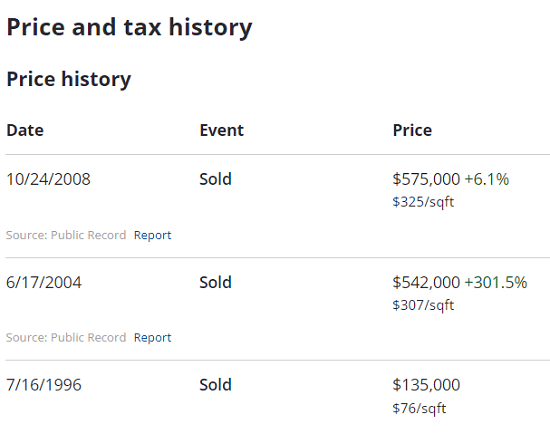
Exhibit #1 in Shelter Becoming a Speculative Asset is a modest house in the San Francisco Bay Area that sold for $135,000 in mid-1996. By modest I mean small, old, and on a small lot in a neighborhood of other small lots and homes. (A screenshot of the Zillow history is below.)

Today the home’s value is estimated to be about ten times higher: $1.35 million. Let’s do some basic math to understand just how distorted this market has become.

The median household income in 1996 was about $39,000. For a house costing $135,000, this represents 3.5 ratio of income to housing, well within the traditional ratio of 4 to 1 (4 X income = cost of the home).

Median household income has almost doubled to $75,000, roughly in line with inflation according to the Bureau of Labor Statistics. According to the BLS, the house that cost $135,000 in July 1996 would now cost $264,000 when adjusted for inflation, and the $39,000 median income would be $76,000.

Let’s say the house appreciated above the rate of inflation to $300,000 today. That’s still within the 4 to 1 ratio of income to house cost (4 X $75,000 = $300,000.) So even though the house rose 2.2X in cost, it would still be affordable to a median household.

At a value of $1.35 million, a household would need to make $337,500 annually–an income that is in the top 5% of households–to buy the house today. In other words, an income that is 4.5 times the median household income is the minimum needed to buy this modest house.

The house is now worth 4.5 times what it would have been worth if it had appreciated well above inflation.

The conventional argument holds that this four-fold increase in housing costs is due solely to a shortage of housing. Let’s consider some data before concluding this is the only dynamic in play.

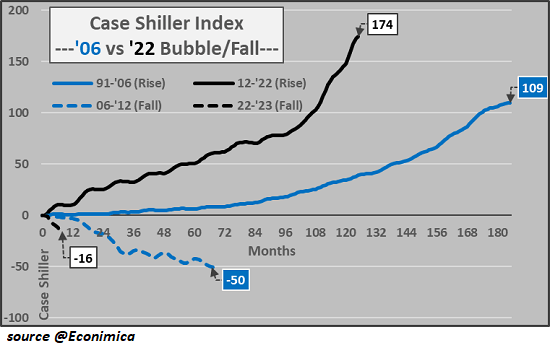
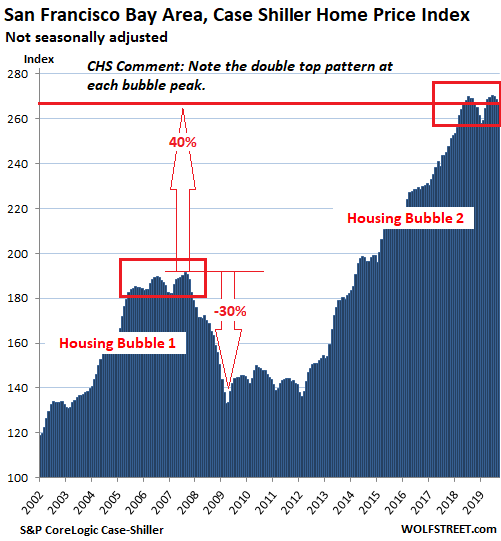
Chart #1: Case Shiller housing index: this chart shows two massive housing bubbles in the past 20 years.

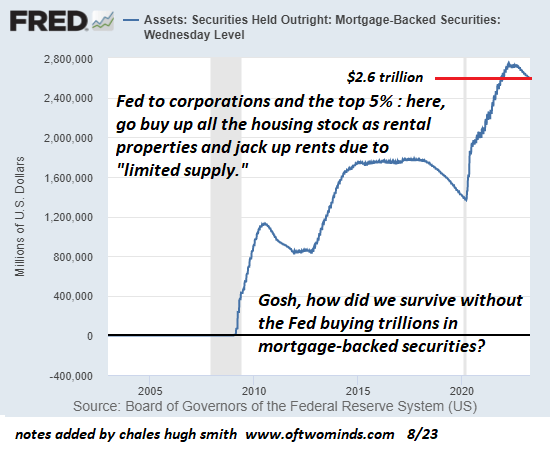
Chart #2: Federal Reserve’s purchases of mortgage backed securities (MBS) to goose the housing market. The “housing shortage” argument claims the unprecedented Fed purchases of trillions of dollars of MBS is not correlated to the housing bubble, but this claim makes no sense: dropping mortgage rates to unprecedented lows while soaking up trillions of dollars in securitized mortgages was like injecting speculative crack cocaine into the housing market. Gosh, how did we survive without the Fed buying $2.5 trillion in mortgages?

Chart #3: the current housing bubble compared to the 2000-2006 housing bubble: today’s bubble is even more extreme than housing bubble #1.

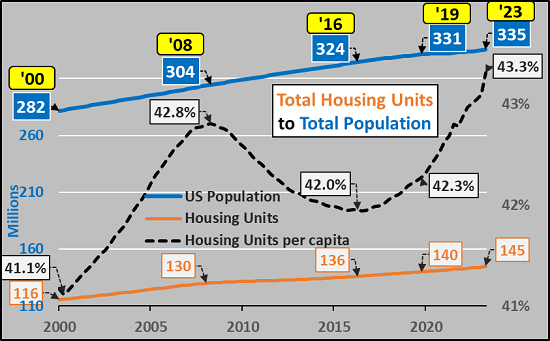
Chart #4: housing per capita (per person) has reached a new high: if there’s such a severe shortage of housing, how can the housing per capita be at an all-time high? Population rose 4 million in the past 4 years while 5 million housing units were added–plus a pig-in-a-python of housing in the pipeline.

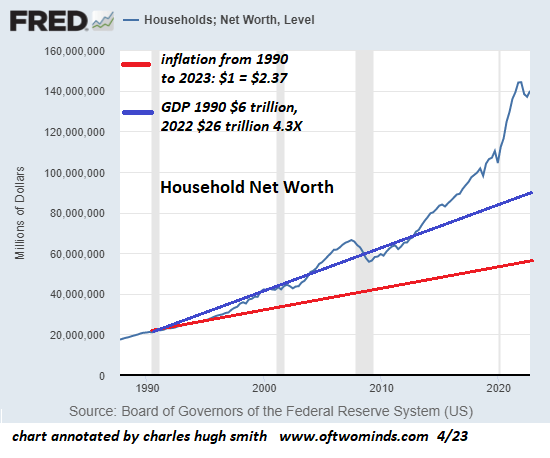
Chart #5: household net worth is $50 trillion above trend, the direct result of massive monetary and fiscal stimulus. Tens of trillions of dollars were borrowed into existence and pumped into so-called risk assets–assets such as housing that the wealthy buy for speculative appreciation.

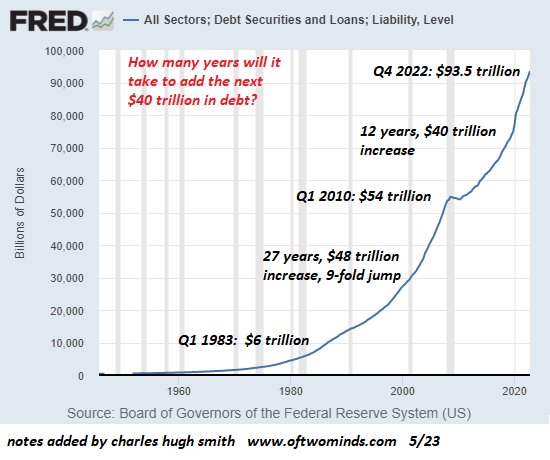
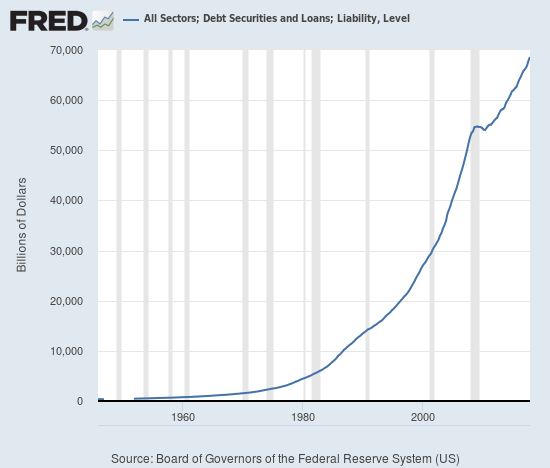
Chart #6: total debt–private and public–soared from $20 trillion in 1996 to $95 trillion now. Is it merely coincidental that this is $55 trillion above the trendline of inflation, which would have placed total debt at $40 trillion today?

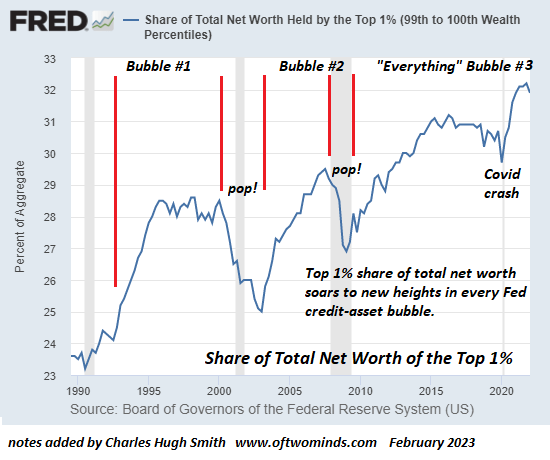
Chart #7: net worth of the top 1% households, which soared from 23% of all net worth to 32%: this 9% gain in the percentage of all household net worth represents a gain of $14 trillion above and beyond the $28.7 trillion in gains registered by the 23% they owned in 1990.

1990 total net worth: $21 trillion, 23% = $4.8 trillion; 2023 total net worth: $146 trillion, 23% = $33.5 trillion; $33.5 trillion – $4.8 trillion = $28.7 trillion.

This unprecedented bubble in housing valuations is due not to shortages but to decades of massive financial stimulus that incentivized speculative capital to flood into housing as a low-risk way to skim stupendous gains for creating zero gains in productivity. If you doubt this, then run this scenario and tell us what happens:

The Fed dumps its entire portfolio of mortgage backed securities and stipulates it will never buy any again. It also renounces all the other stimulus gimmicks that incentivized expansions of debt and speculation.

Does anyone really believe that the renunciation of massive, sustained stimulus of speculation in housing would leave housing valuations unchanged because valuations are solely the result of “shortages”? If so, there’s a little shack under the Brooklyn Bridge I’ll let you have for a couple of million. I’m sure the Airbnb rent will mint you millions.

Is Housing a Bubble That’s About to Crash?

By Charles Hugh Smith

Source: Of Two Minds

Are we heading into another real estate bubble / crash? Those who say “no” see the housing shortage as real, while those who say “yes” see the demand as a reflection of the Federal Reserve’s artificial goosing of the housing market via its unprecedented purchases of mortgage-backed securities and “easy money” financial conditions.

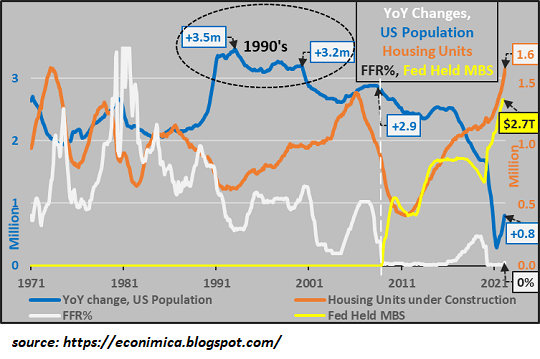
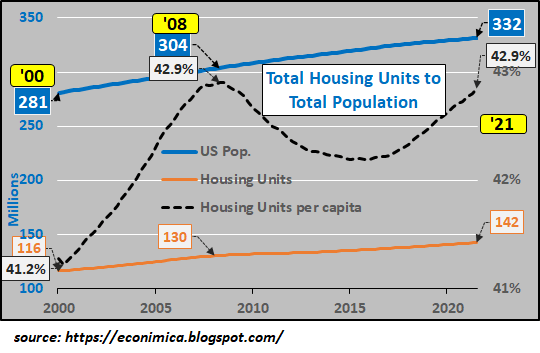
My colleague CH at econimica.blogspot.com recently posted charts calling this assumption into question. The first chart (below) shows the U.S. population growth rate plummeting as housing starts soar, and the second chart shows housing unit per capita, which has just reached the same extreme as the 2008 housing bubble.

Demographics and housing do not reflect a housing shortage nationally, though there could be scarcities locally, of course, and other factors such as thousands of units being held off the market as short-term rentals or investments by overseas buyers who have no interest in renting their investment dwellings.

On a per capita basis, housing has reached previous bubble levels. That suggests housing shortages are artificial or local, not structural.

Next, let’s consider how the current housing bubble differs from previous bubbles in the late 1970s and 2000s. In my view, the previous bubbles were driven by demographics, inflation and monetary policy: in the late 70s, the 65 million-strong Baby Boom generation began buying their first homes, pushing demand higher while inflation soared, making real-world assets such as housing more desirable.

Once the Federal Reserve pushed interest rates to 18%, mortgage rates rose in lockstep and housing crashed as few could afford sky-high housing prices at sky-high mortgage rates.

The housing bubble of 2007-08 was largely driven by declines in mortgage rates (as the Fed pursued an “easy money” policy to escape the negative effects of the Dot-Com stock market bubble crash) and a loosening of credit/mortgage standards. These fueled a bubble that morphed into a speculative free-for-all of no-down payment and no-document loans.

This decline in the cost of borrowing money (mortgage rates) enabled a sharp rise in the price of housing, a speculative boom that was greatly accelerated by “innovations” in the mortgage market such as zero down payments loans, interest-only loans, home equity loans, and no-document “liar loans”–mortgages underwritten without the usual documentation of income and net worth.

These forces generated a speculative frenzy of house-flipping, leveraging the equity in the family home to buy two or three homes under construction and selling them before they were even completed for fat profits, and so on.

Needless to say, the pool of potential buyers expanded tremendously when people earning $25,000 a year could buy $500,000 houses on speculation.

Once the bubble popped, the pool of buyers shrank along with the home equity.

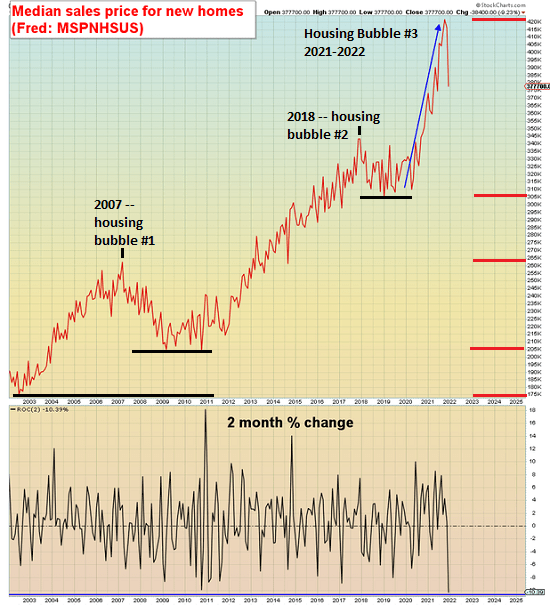
If we study this chart below of new home prices (courtesy of Mac10), we can see that the 21st century’s Bubble #2 rose as the Federal Reserve pushed mortgage rates far below historic norms. Once rates reached a bottom, the 7-year inflation of home prices (from 2011 to 2018) began rolling over.

This deflation of home prices was reversed by the pandemic recession, as the Fed’s vast expansion of credit and mortgage-buying, which pushed mortgage rates to new lows. Trillions of dollars in new credit and cash stimulus ignited a speculative frenzy in stocks, bonds and real estate, a frenzy which drove bubble #3 to extraordinary heights.

All this unprecedented fiscal and monetary stimulus also ignited inflation, and so rates are rising in response. Bubble #3 is already deflating, at least by the measure of new home prices.

But the current bubble has a number of dynamics that weren’t big factors in previous bubbles.

One is the rise of remote work. Many people have been working remotely since the late 1990s enabled Internet-based work, but the pandemic greatly increased the pool of employers willing to accept remote work as a permanent feature of employment.

This trend has been well documented, but the consequences are still unfolding: remote workers are no longer trapped in unaffordable, congested cities and suburbs.

Several other trends have attracted much less attention, but I see them as equally consequential.

1. Housing in many urban zones are out of reach of all but the top 10% without extraordinary sacrifice, and now that employment isn’t necessarily tied to urban zones, the bottom 90% of young people without family wealth or high incomes are coming to realize the benefits of urban living are not worth the extreme sacrifices needed to buy an overvalued house.

A middle-class life–home ownership, financial security, leisure and surplus income to invest in one’s family and well-being–is no longer affordable for the majority of young Americans.

Few are willing to concede this because it reveals the neofeudal nature of American life. Those who bought homes in coastal urban zones 20+ years ago are wealthy due to soaring housing valuations while young people can’t even afford the rent, much less buying a house.

If you’re not making $250,000 or more a year as a couple, the only hope for a middle-class life that includes leisure and some surplus income to invest is top move to some place with much lower housing and other costs. That place is rural America.

2. The benefits of urban living are deteriorating while the sacrifices and downsides are increasing. Urban living is fun if you’re wealthy, not so fun if you don’t have plenty of surplus income to spend.

Urban problems such as homelessness, traffic congestion and crime are endemic and unresolvable, though few are willing to state the obvious. Americans are expected to be optimistic and to count on some new whiz-bang technology to solve all problems.

Unfortunately, problems generated by dysfunctional, overly complex institutions, corruption and unaffordable costs can’t be solved by some new technology, and so the decay of cities will only gather momentum.

The hope that billions of federal stimulus funding would solve these problems is about to encounter reality as the funds dry up and all the problems remain or have actually expanded despite massive “investments” in solutions.

Few analysts have looked at the finances of high-cost cities. The decline in bricks-and-mortar retail, rising crime, soaring junk fees, rents and property taxes have all made urban small business insanely costly and therefore risky.

Small businesses are the core sources of employment and taxes. As high costs, crime, etc. choke small businesses, employment and tax revenues drop and commercial real estate sits empty, generating decay and defaults.

Once office and retail space is no longer affordable or necessary, commercial real estate crashes in value as owners who bought at the top default and go bankrupt.

People need shelter but they don’t need office space or to start a bricks-and-mortar retail business.

As urban finances unravel, cities won’t have the funding to run their bloated, inefficient, overly complex and unaccountable bureaucracies.

3. In geopolitics, we speak of the core and the periphery. Empires have a core (Rome and central Italy in the Roman Empire) and a periphery (Britain, North Africa, Egypt, the Levant).

As finances and trade decay and costs soar, the periphery is surrendered to maintain the core.

In urban zones, the same dynamic will become increasingly visible: the peripheral neighborhoods will be underfunded to continue protecting the wealthy enclaves.

Crime will skyrocket in the periphery even as residents of the wealthy enclaves see little decay in their neighborhoods.

This asymmetry–already extreme–will drive social unrest and disorder. This is a self-reinforcing feedback: as the periphery neighborhoods deteriorate, the remaining businesses flee and the smart money sells and moves away.

Tax revenues plummet and city services decay even further, persuading hangers-on to move before it gets even worse. Cities compensate for the lower revenues by increasing taxes on the remaining residents and cutting services.

Each turn of the screw triggers more closures and selling and fewer tax revenues.

4. Dependency chains will become increasingly consequential: the greater a city’s dependency on essentials trucked/shipped from hundreds or thousands of of kilometers/miles away, the more prone that city will be to disruptions of essentials: food, energy, materials and infrastructure.

Though few are willing to dwell on such vulnerabilities, most cities are totally dependent on diesel fueled fleets of trucks, rail and jet fuel for luxuries flown in from afar for virtually all goods. Cities produce very little in the way of essentials such as food and energy.

The past reliability of long supply chains has instilled a confidence that these supply chains stretching thousands of kilometers and miles are unbreakable and forever. They aren’t, and the initial disruptions will be a great shock to Americans who believe full gas tanks and fully stocked store shelves are their birthright.

5. As I’ve explained in my new book Global Crisis, National Renewalthe era of cheap, reliable abundance has drawn to a close and now we are entering an era of scarcity in essentials.

Another reality few discuss is the relative stability of global weather over the past 40 years. As weather becomes less reliable, so too do crop yields and food supplies.

Globalization has poured capital into expanding acreage under cultivation to the point that the planet’s forests are being decimated to grow more soy to feed animals to be slaughtered for human consumption.

On the margins, land that was once productive has been lost to desertification. Fresh water aquifers have been drained and glaciers feeding rivers are melting away. Soil fertility has declined even as fertilizer use has expanded.

The low-hanging fruit of GMO seeds, fertilizers, insecticides, herbicides and Green Revolution hybrids have all been plucked. The gains have been reaped but now the downsides of these dependencies are becoming increasingly consequential: fertilizer costs are rising fast, insects and diseases are evading chemicals and vaccines, and the vulnerabilities of mono-crop, industrialized agriculture and animal husbandry threaten to cascade into crop failures, soaring prices and shortages.

6. This will have two consequences: rural incomes which have been falling for decades due to globalization (i.e. bringing in cheap food from places with no environmental standards, cheap labor and few taxes / social costs) will start rising sharply, fueling a reversal in the long decline of rural communities based on agricultural income.

The soaring costs of essentials will reduce the disposable income of the bottom 90%, reducing the money they’ll have to spend on eating out, retail shopping, etc.–all the surplus spending that drives cities’ economies and tax revenues.

Few (if any) commentators forecast a cyclical reversal of the demographic trend of people moving from rural locales to cities. I think this trend has already reversed and will gather momentum as cities become increasingly unlivable, disposable incomes decline as scarcities push prices higher and people flee for lower cost, more secure environs.

7. As I often note, following what the super-wealthy are doing is a pretty sound investment strategy because the super-wealthy spend freely to buy the best advice and are highly motivated to protect their wealth.

People who live in well-known, highly desirable rural towns (Telluride, Jackson Hole, Lake Tahoe, etc.) are describing a feeding frenzy of wealthy urbanites buying multi-million dollar homes. Small cities such as Bozeman, MT and Ashville, NC are experiencing a flood of new residents that is straining infrastructure and pushing housing prices out of reach for local residents with average wages.

8. Rural towns in the U.S., Italy, Japan and even Switzerland are trying to attract new residents with offers of free land, subsidized rent, low cost homes, etc. This shows that the trends are global and not limited to any one nation. Would you take free land in rural America?

The decay of urban life isn’t yet consequential enough to push people into making a major move, but once someone has been robbed, repeatedly found human feces on their doorstep or experienced scarcities that trigger the madness of crowds, the decision to leave becomes much, much easier.

Some cities will manage the decline of employment and tax revenues more gracefully than others. Most will suffer from the dynamic I’ve often described on the blog: the Ratchet Effect. Costs move effortlessly higher as tax revenues have increased in one speculative bubble after another, but once revenues drop, cities have no mechanisms or political constituency to manage a sharp, long-term decline in revenues.

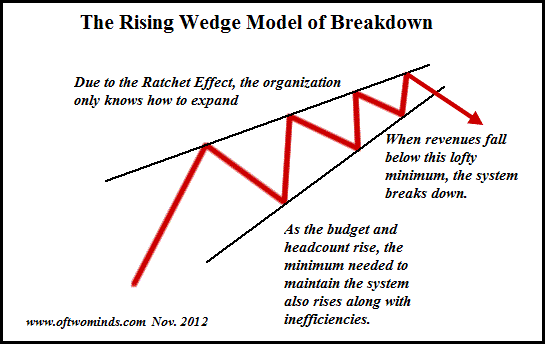
They then become prone to the other dynamic I’ve described, the Rising Wedge Breakdown (see chart below): as agencies and institutions become sclerotic, unaccountable and self-serving, even a relatively modest cut in revenues triggers institutional collapse, as the system requires 100% funding to function. A 10% reduction doesn’t cause a 10% decline in service, it causes an 50% decline in service, on the way to complete dysfunction.

Few believe cities can unravel, but remote work, geographic arbitrage (discussed below), tightening credit, rising crime, the decline of commercial real estate, end of massive stimulus, scarcities, the madness of crowds, the decline of civic services and amenities and an insanely high cost of living all have consequences and second-order effects.

What were beneficial synergies become fatal synergies as dynamics reverse and begin reinforcing each other.

So let’s put all this together.

A. The cycle of declining interest rates and inflation has ended and a cycle of much higher interest and mortgage rates and inflation is beginning. Higher mortgages rates will depress housing prices as only the highest income households will be able to afford today’s prices once mortgage rates rise.

B. The decay of urban finances and quality of life will accelerate as stimulus ends, credit dries up and inflation decimates disposable income.

C. The stress of trying to make enough money to afford the high costs of city/suburban living as the real estate bubble pops and the benefits of city living decline will burn out increasing numbers of people who will have no choice but to find more affordable, more secure and more livable places.

D. While the wealthy have already secured second or third homes in the toniest desirable towns, there are still opportunities for lower cost, more secure residences in rural areas.

E. This migration, even at the margins, will further depress urban housing prices and push prices in desirable rural locales higher.

F. This migration will have regional, ethnic and cultural variations. For example, some African-Americans leaving the upper Midwest are finding favor with communities in the South where family, church and cultural ties beckon.

G. Correspondent John F. used the phrase geographic arbitrage which means earning money remotely in high-wage sectors while living some place that’s low cost and secure.

I wrote about this many years ago in my post about young Japanese maintaining a part-time remote-work gig while pursuing farming in rural communities: Degrowth Solutions: Half-Farmer, Half-X (July 19, 2014).

H. Though monetary / inflationary forces will pop housing prices based solely on low mortgage rates, this doesn’t mean housing everywhere will decline: as burned out urbanites seek lower cost, more secure and livable places in rural locales, homes in desirable towns and small cities could rise sharply because they’re starting from such low levels.

I. If urban areas decay rapidly, housing prices could plummet much faster than most people think possible.

When cities lose employment, tax revenues and desirability, they can go down fast. Property values can fall in half and then by 90%.

How is this possible? Supply and demand: if demand falls off a cliff, there won’t be buyers for thousands of homes that come on the market all at once. This is just like a stock market in which buyers disappear, as no one wants to buy an asset that’s rapidly losing value.

As I’ve noted many times, prices for assets are set on the margins: the last sale of a house resets the price for the entire neighborhood.

The stock market is easily manipulated by the big players, who can stop a slide in prices by buying huge chunks of stocks and call options. There are no equivalent forces which can stop a decline in housing prices.

And since rates will rise regardless of what the Federal Reserve does because global capital is demanding a real return above inflation, then the hope for lower mortgage rates to support bubble-level housing prices will be in vain.

How low could housing go? As explained above, there will likely be very asymmetric declines and increases in housing valuations going forward. But on a technical-analysis level, we can anticipate a general decline to previous lows, first to the 2019 lows and then to the 2011 lows.

Some analysts believe inflation will funnel capital into housing as investors seek assets that will go up with inflation, but this is a murky forecast: the bottom 90% of American households are already priced out of coastal housing, so inflation only robs their wages of purchasing power. They don’t have any hope of buying a house anywhere near current prices.

Corporations are buying thousands of houses for the rental income, but once all the stimulus runs out and the excesses of speculation reverse, they’ll find few renters can afford their sky-high rents. At that point corporate buyers become corporate sellers, but they won’t find buyers willing or able to pay their asking prices, which are based on bubble pricing, not reality.

All these swirling currents will affect housing valuations in different places differently. Some areas could see 50% declines while others see 50% increases, regardless of mortgage rates or Fed policy.

What will become most desirable is a low cost of living, security and livability, which includes community, reduced dependency on long supply chains and local production of essentials.

We are all prone to believing the recent past is a reliable guide to the future. But in times of dynamic reversals, the past is an anchor thwarting our progress, not a forecast.

The Covid-19 Dominoes Fall: The World Is Insolvent

By Charles Hugh Smith

Source: Of Two Minds

Subtract their immense debts and they have negative net worth, and therefore the market value of their stock is zero.

To understand why the financial dominoes toppled by the Covid-19 pandemic lead to global insolvency, let’s start with a household example. The point of this exercise is to distinguish between the market value of assets and net worth, which is what’s left after debts are subtracted from the market value of assets.

Let’s say the household has done very well for itself and owns assets worth $1 million: a home, a family business, 401K retirement accounts and a portfolio of stocks and other investments.

The household also has $500,000 in debts: home mortgage, auto loans, student loans and credit card balances.

The household net worth is thus $1,000,000 minus $500,000 = $500,000.

Let’s say a typical financial crisis and recession occur, and the household’s assets fall 30%. 30% of $1 million is $300,000, so the the market value of the household’s assets falls to $700,000.

Deduct the $500,000 in debts and the household’s net worth has fallen to $200,000. The point here is debts remain regardless of what happens to the market value of assets owned by the household.

Then the speculative asset bubbles re-inflate, and the household takes on more debt in the euphoric expansion of confidence to buy a larger house, expand the family business and enjoy life more.

Now the household assets are worth $2 million, but debt has risen to $1.5 million. Net worth remains at $500,000, since debt has risen along with asset values.

Alas, all bubbles pop, and the market value of the household assets decline by 30%, or $600,000. Now the household assets are worth $2,000,000 minus $600,000 or $1,400,000. The household net worth is now $1,400,000 minus $1,500,000 or negative $100,000. the household is insolvent.

On top of that, the net income of the family business plummets to near-zero in the recession, leaving insufficient income to pay all the debts the household has taken on.

This is an exact analog for the entire global economy, which pre-pandemic had assets with a market value of $350 trillion and debts of $255 trillion and thus a net worth of around $100 trillion.

The $11 trillion that has evaporated in the market value of U.S. stocks is only a taste of the losses in market value. Global stock markets has lost $30 trillion, and once yields rise despite central bank manipulations (oops, I mean intervention), $30 trillion in the market value of bonds will vanish into thin air.

The market value of junk bonds has already plummeted by trillions, and that’s not even counting the trillions lost in small business equity, shadow banking and a host of other non-tradable assets.

Then there’s the most massive asset bubble of all, real estate. Millions of properties delusional owners still think are worth $1.4 million will soon revert to a more reality-based valuation around $400,000, or perhaps even less, meaning $1 million per property will melt into air.

Once the market value of global assets falls by $100 trillion, the world is insolvent.

Everyone expecting the financial markets to magically return to January 2020 levels once the pandemic dies down is delusional. All the dominoes of crashing market valuations, crashing incomes, crashing profits and soaring defaults will take down all the fantasy-based valuations of bubblicious assets: stocks, bonds, real estate, bat guano, you name it. (Actually, bat guano will be the keeper of all the asset classes listed.)

The global financial system has already lost $100 trillion in market value, and therefore it’s already insolvent. The only question remaining is how insolvent?

Here’s a hint: companies whose shares were recently worth $500 or $300 will be worth $10 or $20 when this is over. Bonds that were supposedly “safe” will lose 50% of their market value. Real estate will be lucky to retain 40% of its current value. And so on.

As net worth crashes below zero, debts remain. The loans must still be serviced or paid off, and if the borrowers default, then the losses must be absorbed by the lenders or taxpayers, if we get a repeat of 2008 and the insolvent taxpayers are forced to bail out the insolvent financial elites.

Here’s the S&P 500. Where is the bottom? There is no bottom, but nobody dares say this. Companies with negative profits have no value other than the cash on hand and the near-zero auction value of other assets. Subtract their immense debts and they have negative net worth, and therefore the market value of their stock is zero.

Costs Are Spiraling Out of Control

By Charles Hugh Smith

Source: Of Two Minds

And how do we pay for these spiraling out of control costs? By borrowing more, of course.

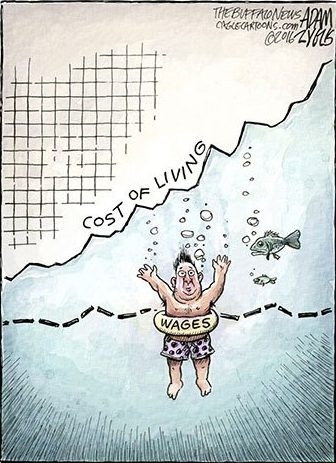
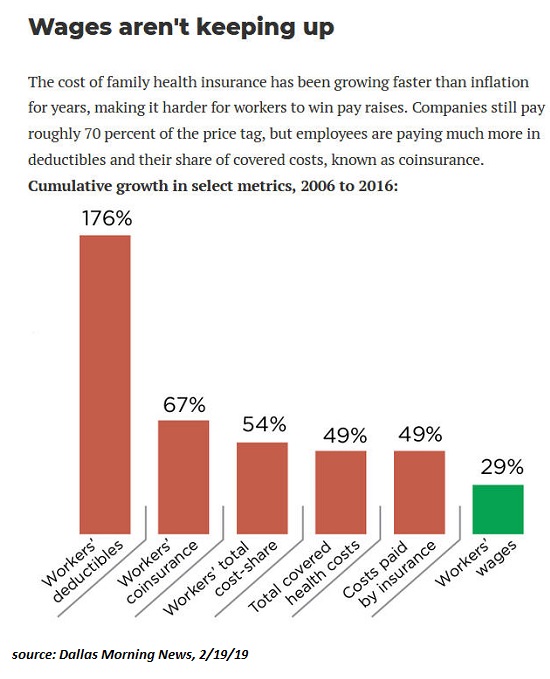
If we had to choose one “big picture” reason why the vast majority of households are losing ground, it would be: the costs of essentials are spiraling out of control. I’ve often covered the dynamics of stagnating income for the bottom 90%, and real-world inflation, i.e. a decline in purchasing power.

But neither of these dynamics fully describes the relentless upward spiral of the cost basis of our economy, that is, the cost of big-ticket essentials: housing, education and healthcare.

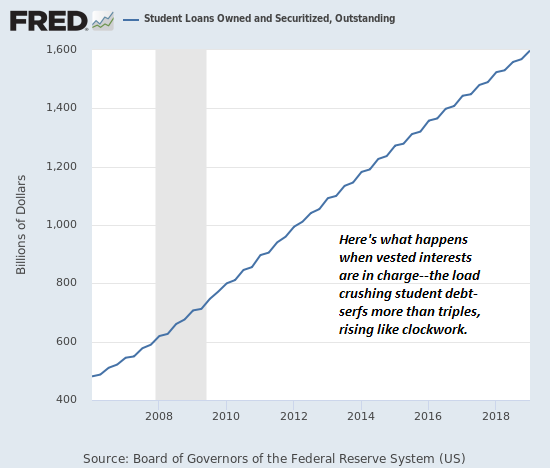
The costs of education are spiraling out of control, stripping households of income as an entire generation is transformed into debt-serfs by student loan debt. The soaring costs of healthcare are a core driver of higher costs in the education complex (and government in general), and to cover these higher costs, counties raise property taxes, which add additional cost burdens to households and enterprises as rents rise.

Rising rents push the cost structure of almost every enterprise and agency higher.

Then there’s the asset inflation created by central bank ZIRP (zero interest rate policy) which has inflated a second echo-bubble in housing that has pushed home ownership out of reach of many, adding demand for rental housing that has pushed rents into the stratosphere in Left and Right Coast cities.

The increasing dominance of monopolies and cartels has eliminated competition in sector after sector. Monopolies and cartels skim immense profits even as the value, quality and quantity of their products and services decline: The U.S. Only Pretends to Have Free Markets From plane tickets to cellphone bills, monopoly power costs American consumers billions of dollars a year.

Thanks to their political influence, monopolies and cartels have legalized looting, raising prices and evading anti-trust regulations because they can pay whatever it takes in our pay-to-play political system.

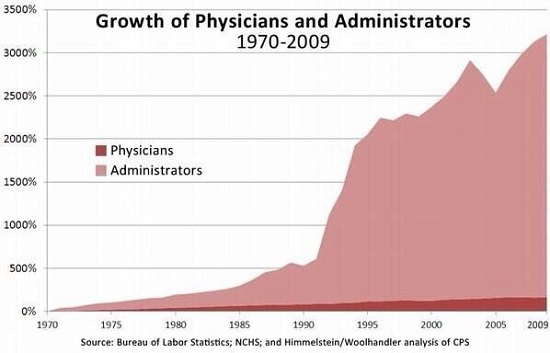
Let’s look at a few charts that illustrate the relentless rise in costs:

Do you reckon these two charts are connected–soaring costs and ballooning administrative payrolls?

Student loan debt is soaring above $1.5 trillion, guaranteeing profits to lenders and debt-serfdom to the students exiting with degrees that are in over-supply, i.e. possessing little scarcity value in an over-credentialed economy:

The echo housing bubbles in many locales exceed the nosebleed valuations of the previous bubble:

And how do we pay for these spiraling out of control costs? By borrowing more, of course:

Even at low rates of interest, the cost of servicing skyrocketing debt increases, leaving less net income to support additional borrowing.

What will it take to radically reduce the cost basis of our economy? A fundamental re-ordering that breaks up all the cartels and monopolies that push prices higher even as they deliver lower quality goods and services would be a good start.

Putting an End to the Rent Economy

By Michael Hudson and Vlado Plaga

Source: Unz Review

Interview with Vlado Plaga in the German magazine FAIRCONOMY, September 2017.

Originally, you didn’t want to become an economist. How did it come that you changed your plans and digged so deep into economics?

I found economics aesthetic, as beautiful as astronomy. I came to New York expecting to become an orchestra conductor, but I met one of the leading Wall Street economists, who convinced me that economics and finance was beautiful.

I was intrigued by the concept of compound interest and by the autumnal drain of money from the banking system to move the crops at harvest time. That is when most crashes occurred. The flow of funds was the key.

I saw that these economic cycles were mainly financial: the build-up of debt and its cancellation or wipe-out and bankruptcy occurring again and again throughout history. I wanted to study the rise and fall of financial economies.

But when you studied at the New York University you were not taught the things that really interested you, were you?

I got a PhD as a union card. In order to work on Wall Street, I needed a PhD. But what I found in the textbooks was the opposite of everything that I experienced on Wall Street in the real world. Academic textbooks describe a parallel universe. When I tried to be helpful and pointed out to my professors that the textbooks had little to do with how the economy and Wall Street actually work, that did not help me get good grades. I think I got a C+ in money and banking.

So I scraped by, got a PhD and lived happily ever after in the real world.

So you had to find out on your own… Your first job was at the Savings Banks Trust Company, a trust established by the 127 savings banks that still existed in New York in the 1960s. And you somehow hit the bull’s eye and were set on the right track, right from the start: you’ve been exploring the relationship between money and land. You had an interesting job there. What was it?

Savings banks were much like Germany’s Landesbanks. They take local deposits and lend them out to home buyers. Savings and Loan Associations (S&Ls) did the same thing. They were restricted to lending to real estate, not personal loans or for corporate business loans. (Today, they have all been turned into commercial banks.)

I noticed two dynamics. One is that savings grew exponentially, almost entirely by depositors getting dividends every 3 months. So every three months I found a sudden jump in savings. This savings growth consisted mainly of the interest that accrued. So there was an exponential growth of savings simply by inertia.

The second dynamic was that all this exponential growth in savings was recycled into the real estate market. What has pushed up housing prices in the US is the availability of mortgage credit. In charting the growth of mortgage lending and savings in New York State, I found a recycling of savings into mortgages. That meant an exponential growth in savings to lend to buyers of real estate. So the cause of rising real estate prices wasn’t population or infrastructure. It was simply that properties are worth whatever banks are able and willing to lend against them.

As the banks have more and more money, they have lowered their lending standards.

It’s kind of automatic, it’s just a mathematical law…

Yes, a mathematical law that is independent of the economy. In other words, savings grow whether or not the economy is growing. The interest paid to bondholders, savers and other creditors continues to accrue. That turns out to be the key to understanding why today’s economy is polarizing between creditors and debtors.

You wrote in “Killing the Host” that your graphs looked like Hokusai’s “Great Wave off Konagawa” or even more like a cardiogram. Why?

Any rate of interest has a doubling time. One way or another any interest-bearing debt grows and grows. It usually grows whenever interest is paid. That’s why it looks like a cardiogram: Every three months there’s a jump. So it’s like the Hokusai wave with a zigzag to reflect the timing of interest payments every three months.

The exponential growth of finance capital and interest-bearing debt grows much faster then the rest oft he economy, which tends to taper off in an S-curve. That’s what causes the business cycle to turn down. It’s not really a cycle, it’s more like a slow buildup like a wave and then a sudden vertical crash downward.

This has been going on for a century. Repeated financial waves build up until the economy becomes so top-heavy with debt that it crashes. A crash used to occur every 11 years in the 19th century. But in the United States from 1945 to 2008, the exponential upswing was kept artificially long by creating more and more debt financing. So the crash was postponed until 2008.

Most crashes since the 19th century had a silver lining: They wiped out the bad debts. But this time the debts were left in place, leading to a massive wave of foreclosures. We are now suffering from debt deflation. Instead of a recovery, there’s just a flat line for 99% of the economy.

The only layer of the economy that is growing is the wealthiest 5% layer – mainly the Finance, Insurance and Real Estate (FIRE) sector. That is, creditors living of interest and economic rent: monopoly rent, land rent and financial interest. The rest of the economy is slowly but steadily shrinking.

And the compound interest that was accumulated was issued by the banks as new mortgages. Isn’t this only logical for the banks to do?

Savings banks and S&Ls were only allowed to lend for mortgages. Commercial banks now look for the largest parts of the economy as their customers. Despite the fact that most economic textbooks describe industry and manufacturing as being the main part of economy, real estate actually is the largest sector. So most bank lending is against real estate and, after that, oil, gas and mining.

That explains why the banking and financial interests have become the main lobbyists urging that real estate, mining and oil and gas be untaxed – so that there’ll be more economic rent left to pay the banks. Most land rent and natural resource rent is paid out as interest to the banks instead of as taxes to the government.

So instead of housing becoming cheaper and cheaper it turns out to be much less affordable in our days than in the 1960s?

Credit creation has inflated asset prices. The resulting asset-price inflation is the distinguishing financial feature of our time. In a race tot he bottom, banks have steadily lowered the terms on which they make loans. This has made the economy more risky.

In the 1960s, banks required a 25-30% down payment by the buyer, and limited the burden of mortgage debt service to only 25% of the borrower’s income. But interest is now federally guaranteed up to 43% of the home buyer’s income. And by 2008, banks were making loans no down payment at all. Finally, loans in the 1960s were self-amortizing over 30 years. Today we have interest-only loans that are never paid off.

So banks loan much more of the property’s market price. That is why most of the rental value of land isn’t paid to the homeowner or commercial landlord any more. It’s paid to the banks as interest.

Was this the reason for the savings and loan crisis that hit the US in 1986 and that was responsible for the failure of 1,043 out of the 3,234 savings and loan associations in the United States from 1986 to 1995?

The problem with the savings and loan crisis was mainly fraud! The large California S&L’s were run by crooks, topped by Charles Keating. Many were prosecuted for fraud and sent to jail. By the 1980s the financial sector as a whole had become basically a criminalized sector. My colleague Bill Black has documented most of that. He was a prosecutor of the S&L frauds in the 1980s, and wrote a book “The best way to rob a bank is to own one”.

That’s a famous quotation, I also heard that.

Fraud was the main financial problem, and remains so.

Since 2007 Americans were strangled by their mortgages in the sub-prime crisis…

These were essentially junk mortgages, and once again it was fraud. Already in 2004 the FBI said that the American economy was suffering the worst wave of bank fraud in history. Yet there was no prosecution. Essentially in the United States today, financial fraud is de-criminalized. No banker has been sent to jail, despite banks paying hundreds of billions of dollars of fines for financial fraud. These fines are a small portion of what they took illegally. Such payments are merely a cost of doing business. The English language was expanded to recognize junk loans. Before the financial crash the popular press was using the word “junk mortgages” and “Ninjas”: “No Income, No Jobs, no Assets”. So everybody knew that there was fraud, and the bankers knew they would not go to jail, because Wall Street had become the main campaign contributor to the leading politicians, especially in the Democratic party. The Obama Administration came in basically as representatives of the bank fraudsters. And the fraud continues today. The crooks have taken over the banking system. It is hard for Europeans to realize that that this really has happened in America. The banks have turned into gangsters, which is why already in the 1930s President Roosevelt coined the word “banksters”.

I also heard the nice English sayings “Too big to fail” or “Too big to jail”…
But what has become of those 10 million households that ended up losing their homes to foreclosure? How are their economic and living conditions today? What has become of their houses? The economy has recovered…

Most of the houses that were foreclosed on have been bought out by hedge funds for all cash. In the wake of 2008, by 2009 and 2010 hedge funds were saying “If you have $5,000,000 to invest, we’re going to buy these houses that are being sold at distress prices. We’re going to buy foreclosed properties for all cash, because we can make a larger rate of return simply by renting them out.” So there has been a transfer of property from homeowners to the financial sector. The rate of home-ownership in America is dropping.

The economy itself has not recovered. All economic growth since 2008 has accrued only to the top 5% of the economy. 95% of the economy has been shrinking by about 3% per year… and continues to shrink, because the debts were kept in place. President Obama saved the banks and Wall Street instead of saving the economy.

That’s why we live in an “age of deception” as the sub-title of your latest book suggests, I guess?

“People have the idea that when house prices go up, somehow everybody’s getting richer. And it’s true that the entry to the middle class for the last hundred years has been to be able to own your own home…”

What is deceptive is the fact that attention is distracted away from how the real world works, and how unfair it is. Economics textbooks teach that the economy is in equilibrium and is balanced. But every economy in the world is polarizing between creditors and debtors. Wealth is being sucked up to the top of the economic pyramid mainly by bondholders and bankers. The textbooks act as if the economy operates on barter. Nobel prices for Paul Samuelson and his followers treat the economy as what they call the “real economy,” which is a fictitious economy that in theory would work without money or debt. But that isn’t the real economy at all. It is a parallel universe. So the textbooks talk about a parallel universe that might exist logically, but has very little to do with how the real economy works in today’s world.

If you had a picture you’d see me nodding all the time, because that’s what I also found out: if you look at the mathematics, it is polarizing all the time, it is de-stabilizing. Without government interference we’d have crash after crash… It is not under control anymore.

But you also suggest that there’s another factor that makes housing prices go up – and that’s property tax cuts. Why?

“Taxes were shifted off the Donald Trumps of the world and onto homeowners….”

Whatever the tax collector relinquishes leaves more rental income available to be paid to the banks. Commercial real estate investors have a motto: “Rent is for paying interest.” When buyers bid for an office building or a house, the buyer who wins is the one who is able to get the largest bank loan. And that person is the one who pays all the rent to the bank. The reason why commercial investors were willing to do this for so many decades is that they wanted to get the capital gain – which really was the inflation of real estate prices as a result of easier credit. But now that the economy is “loan up,” prospects for further capital gains are gone. So the prices are not rising much anymore. There is no reason to be borrowing. So the system is imploding.

So, how could we change the situation and make land a public utility?

There are two ways to do this. One way is to fully tax the land’s rental value. Public investment in infrastructure – roads, schools, parks, water and sewer systems – make a location more desirable. A subway line, like the Jubilee tube line in London, increases real estate prices all along the line. The resulting rise in rents increases prices for housing. This rental value could be taxed back by the community to pay for this infrastructure. Roads and subways, water and sewer systems could be financed by re-capturing the rental value of the land that this public investment creates. But that is not done. A free lunch is left in private hands.

The alternative is direct public ownership of the land, which would be leased out to whatever is deemed to be most socially desirable, keeping down the rental cost. In New York City, for instance, restaurants and small businesses are being forced out. They’re closing down because of the rising rents. The character of the economy is changing. It is getting rid of the bookstores, restaurants and low-profit enterprises. Either there should be a land tax, or public ownership of the land. Those are the alternatives. If you tax away the land’s rent, it would not be available to be paid to the banks. You could afford to cut taxes on labor. You could cut the income tax, and you could cut taxes on consumption. That would reduce the cost of living.

To me that’s pretty close to the position of Georgists on how to handle land, isn’t it?

I don’t like to mention Henry George, because he didn’t have a theory of land rent or of the role of the financial sector and debt creation. The idea of land tax came originally from the Physiocrats in France, François Quesnay, and then from Adam Smith, John Stuart Mill, and in America from Thorstein Veblen and Simon Patten. All of these economists clarified the analysis of land rent, who ended up with it, and how it should be taxed. In order to have a theory of how much land rent there is to tax, you need a value and price theory. Henry George’s value theory was quite confused. Worst of all, he spent the last two decades of his life fighting against socialists and labor reformers. He was an irascible journalist, not an economist.

The classical economists wrote everything you need to know about land rent and tax policy. That was the emphasis of Adam Smith, John Stuart Mill… all the classical economists. The purpose of their value and price theory was to isolate that part of the economy’s income that was unearned: economic rent, land rent, monopoly rent, and financial interest. I think it is necessary to put the discussion of tax policy and rent policy back in this classical economic context. Henry George was not part of that. He was simply a right-wing journalist whom libertarians use to promote neoliberal Thatcherite deregulation and anti-government ideology. In Germany, his followers were among the first to support the Nazi Party already in the early 1920s, for instance, Adolf Damaschke. Anti-Semitism also marked George’s leading American followers in the 1930s and ‚40s.

So I guess I have to go back a bit further in history, to read the original Physiocrats as well…

John Stuart Mill is good, Simon Patten is good, Thorstein Veblen is wonderful. Veblen was writing about the financialization of real estate in the 1920s in his Absentee Ownership. I recently edited a volume on him: Absentee Ownership and its Discontents (ISLET, Dresden, 2016).

Germany’s land tax reform seems to go in the wrong direction. Germany has to establish new rules for it’s “Grundsteuer” that in fact is a mingled tax on land and the buildings standing on it, based on outdated rateable values of 1964 (in the West) and 1935 (in the East). The current reform proposals of the federal states will maintain this improper mingling and intend a revenue neutral reform of this already very low tax. It brings about 11 billion Euro to the municipal authorities, but this is only 2% of the total German tax revenue, whereas wage tax and sales tax make up for 25% each. We need a complete tax shift, don’t we?

Germany is indeed suffering from rising housing prices. I think there are a number of reasons for this. One is that Germans have not had a real estate bubble like what occurred in the US or England. They did lose money in the stock market, and many decided simply to put their money in their own property. There is also a lot of foreign money coming into Germany to buy property, especially in Berlin.

The only way to keep housing prices down is to tax away the rise in the land value. If this is done, speculators are not going to buy. Only homeowners or commercial users will buy for themselves. You don’t want speculators or bank credit to push up prices. If Germany lets its housing prices rise, it is going to price its labor out of the market. It would lose its competitive advantage, because the largest expense in every wage-earner’s budget is the cost of housing. In Ricardo’s era it was food; today it is housing. So Germany should focus on how to keep its housing prices low.

I’d like to come back to the issue of interest once more. The English title of “Der Sektor” is “Killing the host – How Financial Parasites and Debt Bondage Destroy the Global Economy”. It’s much more coming to the point. It struck me that you mention John Brown. He wrote a book called “Parasitic wealth or Money Reform” in 1898. I came across his book some years ago and thought that he was somehow America’s Helmut Creutz of the 19th century. He was a supporter of Henry George, but in addition John Brown analyzed and criticized the interest money system and its redistribution of wealth. He said that labour is robbed of 33% of its earnings by the parasitic wealth with subtle and insidious methods, so that it’s not even suspected. Why does almost nobody know this John Brown?

John Brown’s book is interesting. It is somewhat like that of his contemporary Michael Flürscheim. Brown’s book was published by Charles Kerr, a Chicago cooperative that also published Marx’s Capital. So Brown was a part of the group of American reformers who became increasingly became Marxist in the 19th and early 20thcentury. Most of the books published by Kerr discussed finance and the exponential growth of debt.

The economist who wrote most clearly about how debt grew by its own mathematics was Marx in Vol. III of Capital and his Theories of Surplus Value . Most of these monetary writers were associated with Marxists and focused on the tendency of debt and finance to grow exponentially by purely mathematical laws, independently of the economy, not simply as a by-product of the economy as mainstream economics pretends.

So you recommend reading his book?

Sure, it is a good book, although only on one topic. Also good is Michael Flürscheim’s Clue to the Economic Labyrinth (1902). So is Vol. III of Capital.

Brown’s plan of reforms included the nationalization of banks and the establishment of a bank service charge in lieu of interest. The latter sounds remarkably up-to-date. In Germany the banks are raising charges because of the decrease in their interest margins. How is your view on the matter of declining interest rates?

Well, today declining interest rates are the aim of central bank Quantitative Easing. It hasn’t helped. The most important question to ask is: what are you going to make your loans for? Most lending at these declining interest rates has been parasitic and predatory. There’s a lot of corporate take-over lending to companies that borrow to buy other companies. There is an enormous amount of stock market credit that has helped bid up stock prices with low-interest credit and arbitrage. This has inflated asset prices for stocks, bonds and real estate. If the result of low interest rates is simply to inflate asset prices, the only way this can work is to have a heavy tax on capital gains, that is asset price gains. But in the US, England, and other countries there are very low taxes on capital gains, and so low interest rates simply make housing more expensive, and make stocks and buying a flow retirement income (in the form of stocks or bonds that yield dividends and interest) much more expensive.

I guess Brown is getting to the positive aspects of low interest also.

What Brown was talking about were the problems of finance. In the final analysis there is only one ultimate solution: to write down the debts. Nobody really wants to talk about debt cancellation, because they try to find a way to save the system. But it can’t be fixed so that debts can keep growing at compound rates ad infinitum. Any financial system tends to end in a crash. So the key question is how a society is NOT going not to pay debts that go bad. Will it let creditors foreclose, as has occurred in the US? Or are you going to write down the debts and wipe out this overgrowth of creditor claims? That’s the ultimate policy that every society has to face.

Very topical, the German Bundesbank sees the combination of low interest rates and a booming housing market as a dangerous cocktail for the banking sector. “The traffic lights have jumped to yellow or even to dark yellow”, Andreas Dombret said, after the Bundesbank had denied the problem in the last years by dismissing it as Germany’s legitimate catch-up effects. The residential property prices have gone up by 30% since 2010, in the major cities even by more than 60%. The share of real estate loans in the total credit portfolio is significantly rising. The mortgage loans of the households have increased in absolute terms as well as relative to their income. It’s only due to the low interest rates that the debt service has not increased yet. But the banks and savings companies are taking on the risk: the mortgages with terms of more than ten years have risen to more than 40% of the residential real estate loans. The interest-change risks lie with the banks. Don’t we have to face up to the truth that interest rates shouldn’t go up again?

What should be raised are taxes on the land, natural resource rent and monopoly rent. The aim should be to keep housing prices low instead of speculation. Land rent should serve as the tax base, as the classical economists said it should. Adam Smith, John Stuart Mill… all urged that the basis of the tax system should be real-estate and natural resource rent, not income taxes (which add to the cost of labor), the cost of labor and not value-added taxes (which increase consumer prices). So tax policy and debt write-downs today are basically the key to economic survival.

Banking should be a public utility. If you leave banking in the present hands, you’re leaving it in the hands of the kind of crooks that brought about the financial crisis of 2008.

Couldn’t the subprime-crisis have been prevented if the Fed had introduced negative interest rates in the 1990s?

No. The reason there was the crash was fraud and speculation. It was junk mortgages and the financialization of the economy. Pension funds and people’s savings were turned over to the financial sector, whose policy is short-term. It seeks gains mainly by speculation and asset price inflation. So the problem is the financial system. I think the Boeckler foundation has annual meetings in Berlin that focus on financialization and explain what the problem is.

Yes, that’s a big topic. The financial sector is interested, as you said, in short-term gains, but people who want to save for their retirement are interested in long-term stability – that is contradictory. Do you know the “Natural Economic Order by Free Land and Free Money” by Silvio Gesell?

It is not practical for today’s world, it is very abstract. The solution to the financial problem really has to be ultimately a debt write-down, and a shift to the tax system, as the classical economists talked about.

Gesell was also advocating the taxing of land. I think he had something in mind with bidding for the land, letting the market fix the prices.

He did not go beneath the surface to ask what kind of market do you want. Today, the market for real estate is a financialized market. As I said, the basic principle is that most rent is paid out as interest. The value of real estate is whatever a bank will lend against it. Unless you have a theory of finance and the overall economy, you really don’t have a theory of the market.

You are advocating a revival of classical economics. What did the classical economists understand by a free economy?

They all defined a free economy as one that is free from land rent, free from unearned income. Many also said that a free economy had to be free from private banking. They advocated full taxation of economic rent. Today’s idea of free market economics is the diametric opposite. In an Orwellian doublethink language, a free market now means an economy free for rent extractors, free for predators to make money, and essentially free for financial and corporate crime. The Obama Administration de-criminalized fraud. This has attracted the biggest criminals – and the wealthiest families – to the banking sector, because that’s where the money is. Crooks want to rob banks, and the best way to rob a bank is to own one. So criminals become bankers. You can look at Iceland, at HSBC, or at Citibank and Wells-Fargo in the news today. Their repeated lawbreaking and criminal activities have been shown to be endemic in the US. But nobody goes to jail. You can steal as much money as you want, and you’ll never go to jail if you’re a banker and pay off the political parties with campaign contribution. It’s much like drug dealers paying off crooked police forces. So crime is pouring into the financial system.

I think this is what’s going to cause a return to classical economics – the realization that you need government banks. Of course, government banks also can be corrupted, so you need some kind of checks and balances. What you need is an honest legal system. If you don’t have a legal system that throws crooks in jail, your economy is going to be transformed into something unpleasant. That’s what is happening today. I think that most Europeans don’t want to acknowledge that that’s what happened in America (USA). There is such an admiration of America that there is a hesitancy to see that it has been taken over by financial predators (a.k.a. “the market”).

We always hear that oligarchies are in the east, in Russia, but hardly anyone is calling America an oligarchy… although alternative media says that it’s just a few families that rule the country.

Yes.


Michael Hudson is the author of Killing the Host (published in e-format by CounterPunch Books and in print by Islet). His new book is J is For Junk Economics. He can be reached at mh@michael-hudson.com

 

Global House Price Crash Led by Major Cities And Rapid Exit Of Investors

property-market-crash-investwithalex

By Graham Vanbergen

Source: TruePublica

The global house price crash is being led by the most important cities in the world and where they are not falling yet, they soon will be.

The fault lies directly in the lap of central banks as quantitative easing caused an enormous injection of cash into economies, forcing interest rates to fall the their lowest levels in history. This knee-jerk over-reaction effectively halted price corrections that should have fully unfolded but didn’t and put rocket boosters under house price inflation the world over.

With banks and their financial services operations now seen by the public as nothing more than criminal gangs operating with impunity, both legally saved money and laundered cash needed a safe haven. Normal people know nothing about derivatives, day-trading and the like. Property is something most people know something about. Criminals just want to harbour ill gotten gains.

With institutional investors, individuals looking to boost pension incomes, criminals with global reach and an aspirational general public all combined, mountains of cash found their way into property. The international property bubble inflated as the market uncoupled from both the economy and reality.

In Britain, a blinkered Chancellor, unable to see the obvious, supported naive first time buyers in various ways all at the expense of the taxpayer in the hope of winning votes in his 2020 bid. By then the housing market in Britain will have crashed and all his first time buyer voters will be in negative equity for another decade.

It now takes an average skilled worker 14 years to buy a 600q ft one bed apartment in London, the equivalent of renting it for 30 years. What could go wrong?

Sales in London have now dropped by a quarter, prices are already deflating with some commentators blaming new stamp duty/taxation rules imposed for April this year. This is just another reason for the impending decline soon to engulf London and then ripple out to the rest of the country. The average price of a property in Britain is 300 per cent higher today than 20 years ago and that includes the biggest financial crash since the Great Depression.

Hong Kong is experiencing property price falls with most commentators expecting declines of 20 per cent, some at 30 per cent and a few at 40 per cent. The government backed builders to construct rented property to ease the ridiculous prices required to buy an apartment. It took ten years and now rental prices have fallen back just as property investment has taken a nosedive.

In Sydney there’s been a total collapse of business investment and corresponding increase in property investment as Australians got on the ‘get-rich-quick’ bandwagon. Prices are now falling at around 1.5 per cent a month. Not much you might think but by mid 2016, prices could easily be off 12 per cent with no indication of the bottom.

So over-stretched are they in Vancouver it is estimated that a normal price correction of 20 per cent would completely wipe out ten per cent of homeowners. Not surprising as house prices there are by some estimates now 30 per cent overvalued.

America’s most important housing market, San Fransico is about the feel the big house price chill after its epic over-heating. It managed an eye-watering 103 per cent increase in some plush areas in just four years. Affordability has tanked and only the top 10 per cent of earners in the city can now afford to own a home there. If prices fall back to 2008 levels, the 60 to 70 per cent average increase in prices since then could dive with catastrophic consequences.

In The Netherlands just 7 per cent of properties sell for more than the asking price – about the norm for the country. In Amsterdam that figure is about 60 per cent. Housing stock has vaporised and prices today have shot past the 2008 peak. These are the ominous signs of a price correction. Amsterdam may continue to rise for a short while but soon the party will be over.

In Geneva, Switzerland 90 per cent of all household debt is mortgaged. Since 2008, property prices have increased what some might say is a modest 24.3 per cent. Price falls are expected for several reasons; the imposition of a countercyclical capital buffer (CCB) to prevent the real estate market from further overheating, other stricter (mortgage) lending controls and a squeeze on immigration which was causing house price inflation. Switzerland’s mortgage market is 140 per cent of GDP. Expectations are that prices will deflate more slowly, but deflate they will.

The French property market had the dubious distinction of being the most overvalued in Europe in 2011. Even the OECD gave a stern warning that Paris was about to implode – it probably knew best as that is where it’s office are located. Property prices in Paris rose 278 per cent in eleven years to 2011 with two well known French economists predicting steady house price falls for the next ten years totalling 35 per cent to 2025 and a best case scenario of falls until 2020.

What all this says now is obvious. The financial crash in 2008 was caused by reckless banks deliberately overextending mortgage lending that led to the public speculating in the property market. Central banks then pumped trillions of dollars, euros and pounds into the market in order to save the banks. It saved them in part by deliberately inflating property prices.

Investors are now getting out of the game. They know the QE scam is over. As ZeroHedge reportsHow Billionaires Are Investing In 2016: “The Only Winning Move Is Not To Play The Game“. Here they report that the rich and powerful have ended their investment strategies; the only way now is to hold cash, duck and see what happens as the global markets in all asset classes unravel. It confirms what is being said here; that all this ‘funny money’ has created growing distortions in nearly all asset prices—from stocks to bonds to real estate.

The UBS global real estate bubble index for 2016 makes for sobering reading, predicting falls in 10 major cities this year. Fortune reports that the “world is headed for disaster, and will take the prices of equities down with it. How much? Edwards predicts the U.S. stock market could plunge as much as 75%. That would be worse than during the financial crisis, in which stocks from their peak to trough dropped a brutal 62%.”

Even the Oracle of Omaha, Warren Buffet has got this all wrong as his stock is heading south and about to enter ‘bear’ territory.

Bloomberg agrees: “Fed Up Investors Yank Cash From Almost Everything Just Like 2008“.

And what they mean by everything is not just stocks and bonds. The FTGlobal property bubble fears mount as prices and yields spike”. Here the FT reports that returns for rental income (globally) has collapsed when a crash in massively overleveraged property triggered the 2008 international banking crash. Time to get out.

Everyone got into property because prices were expected to beat bond prices, and they did.

When the worlds biggest, wealthiest and most powerful start losing their shirts they rapidly divest to save the proverbial bacon. Result? Asset prices fall and house prices with it. The global house price crash is on and coming to a town near you.