
West Admits Ukraine is Losing Proxy War

By Brian Berletic

Source: New Eastern Outlook

After nearly 2 years of portraying the ongoing conflict in Ukraine as unfolding in Kiev and the collective West’s favor, a sudden deluge of admissions have begun saturating Western headlines noting that Ukraine is not only losing, but that there is little or nothing its Western backers can do to change this fact.

What had been a narrative of Ukraine’s steady gains and indomitable fighting spirit has now been replaced by the reality of Ukraine’s catastrophic losses (as well as net territorial losses) and a steady collapse of morale among troops. What had been narratives of Russian forces poorly trained and led, equipped with inadequate quantities of antiquated weapons and dwindling ammunition stockpiles, have now been replaced by admissions that Russia’s military industrial base is out-producing the US and Europe combined while fielding weapon systems either on par with their Western counterparts, or able to surpass Western capabilities entirely.

Ukraine’s Catastrophic Losses 

Ukrainian losses, especially after 5 full months of failed offensive operations, are almost impossible to hide now.

The London Telegraph in its article, “Ukraine’s army is running out of men to recruit, and time to win,” published as far back as August of this year admitted:

The war in Ukraine is now one of attrition, fought on terms that increasingly favour Moscow. Kyiv has dealt admirably with shortages of Western equipment so far, but a shortage of manpower – which it is already having to confront – may prove fatal.

The article also claimed:

It’s a brutal but simple calculation: Kyiv is running out of men. US sources have calculated that its armed forces have lost as many as 70,000 killed in action, with another 100,000 injured. While Russian casualties are higher still, the ratio nevertheless favours Moscow, as Ukraine struggles to replace soldiers in the face of a seemingly endless supply of conscripts.

The article paints a bleak picture of continued Ukrainian military operations that are almost certainly unsustainable.

The claim of 70,000 killed in action among Ukrainian troops is a gross underestimate, while claims that “Russian casualties are higher still” are not only unsubstantiated, but contradicted elsewhere among Western sources.

Mediazona, a media platform maintained by US government-backed Russian opposition figures, has tracked Russian casualties from February 2022 onward by allegedly tracking public information regarding the death of Russian soldiers.

Its numbers cannot be entirely verified, but on the few occasions the Russian Ministry of Defense released Russian casualty numbers, they were relatively close to Mediazona’s claims versus the cartoonish claims made by Ukraine’s General Staff – claims that are often unquestionably repeated by Western governments and media organizations.

A more recent article published by Business Insider in late October titled, “Ukraine official says it can’t properly use its Western kit because it has so few soldiers left, report says,” confirms that Ukraine’s losses and resulting manpower crisis is only getting worse.

The article reports:

A Ukrainian official said Ukraine’s army is suffering a manpower shortage that is hampering its ability to use Western-donated weapons, Time magazine reported. Since the start of the war, several Ukrainian officials have blamed their difficulty repelling Russia’s invasion on the slow pace of deliveries by its allies. 

However, in the Time report, an unnamed source identified as a close aide to President Volodymyr Zelenskyy highlighted a different problem. “We don’t have the men to use them,” the aide said in reference to the Western weapons. Although Ukraine doesn’t give public figures, Western estimates suggest it has suffered in excess of 100,000 casualties.

In addition to irreversible losses in manpower, Ukraine is also losing territory despite 5 months of intensive offensive operations and the fact that the Russian military leadership has repeatedly stated Russia’s goal is to eliminate Ukraine’s military, not take territory.

The New York Times in a September article titled, “Who’s Gaining Ground in Ukraine? This Year, No One,” would note:

Ukraine’s counteroffensive has struggled to push forward across the wide-open fields in the south. It is facing extensive minefields and hundreds of miles of fortifications — trenches, anti-tank ditches and concrete obstacles — that Russia built last winter to slow Ukrainian vehicles and force them into positions where they could be more easily targeted. When both sides’ gains are added up, Russia now controls nearly 200 square miles more territory in Ukraine compared with the start of the year.

Along with steep losses in manpower and a net loss in territory, Ukraine suffers from an equally damaging loss of equipment. Compounding materiel losses is the fact Western military industrial production is incapable of replacing these losses.

Military Industrial Production: West Running Out as Russia Ramps Up 

Last year, Western politicians and the Western media promoted the idea that superior Western military equipment would easily sweep aside Russia’s dwindling numbers of supposedly antiquated weapon systems. One article published by the London Telegraph in early June of this year was even titled, “British-made tanks are about to sweep Putin’s conscripts aside.”

Nothing could have been further from the truth.

Instead, Russian military equipment has proven itself capable if not superior to Western weapon systems and, together with Russia’s massive military industrial base, it has both outnumbered and outfought Ukrainians trained and equipped by the West.

This was admitted in the New York Times’ September article, Russia Overcomes Sanctions to Expand Missile Production, Officials Say,” which noted:

Russia is now producing more ammunition than the United States and Europe. Overall, Kusti Salm, a senior Estonian defense ministry official, estimated that Russia’s current ammunition production is seven times greater than that of the West.

The article admits that Russia has doubled tank production, increased missile production, and is producing at least as many as 2 million artillery shells a year – more than the US and Europe combined currently produce and more than the US and Europe combined if and when they meet increased production targets between 2025-2027.

A more recent article published by The Economist titled, “Russia is starting to make its superiority in electronic warfare count,” admits that Russia has developed an “impressive range of EW [electronic warfare] capabilities to counter NATO’s highly networked systems.” It explains how Russian EW capabilities have rendered precision-guided weapons provided by NATO to Ukraine ineffective, including GPS-guided Excalibur 155mm artillery shells, JDAM guided bombs, and HIMARS-launched GPS-guided rockets.

The article also discusses the impact Russian EW capabilities have on Ukrainian drones which are lost by the thousands week-to-week. And as Russian EW capabilities disrupt Ukraine’s ability to use guided weapons and drones on and over the battlefield, the article admits Russia is able to produce at least twice as many drones as Ukraine giving Russia yet another quantitative and qualitative advantage.

Despite much of the hype surrounding talk of equipping Ukraine with NATO-provided F-16 fighter aircraft, more sober Western analysts have gradually admitted that between Russia’s vast and growing aerospace forces and its superior integrated air defense systems, NATO-provided F-16s will fare no better than the Soviet-era aircraft Ukraine had and lost throughout the duration of the Special Military Operation.

After months, even years of “game-changers” sent to Ukraine only to prove incapable of matching let alone exceeding Russian military capabilities, the game is indeed revealed to have been changed – in favor of Russia and a military doctrine built on vast military industrial production, cheap-but-effective weapon systems, and most importantly, a doctrine built to fight and win against a peer or near-peer adversary.

This stands in stark contrast to a West who has shaped its military for decades to push over developing or failed states around the globe in military-mismatches, atrophying the technological, industrial, and strategic capabilities the US and its allies would have needed to put in place years ahead of time to “win” their proxy war against Russia in Ukraine.

The “solution” to Russia’s now admitted advantage in terms of quality and quantity on and over the battlefield is to “increase production” and “collect data” on Russian capabilities to then “develop counters to them.” However, these are processes that could take years to yield results, all while Russia continues expanding its capabilities to maintain this qualitative and quantitative edge.

And as this process continues to unfold, the US continues simultaneously seeking a similar conflict with China, which possesses an even larger industrial base than Russia.

One wonders how many lives could have been spared had these recent admissions across the Western media regarding Russia’s actual military capabilities been presented long before provoking conflict with Russia in the first place through Washington and Brussels’ long-standing policy of encroaching upon Russia’s borders. One wonders how many lives may yet be saved if the collective West learns from its current mistakes before repeating them all over again in a senseless conflict triggered by efforts to likewise encroach upon and provoke China.

$850 Billion Chicken Comes Home to Roost.

War Reveals U.S. Military’s Longtime Disinterest in War.

Signe’s second toon du jour SIGN17e Military

By Andrew Cockburn

Source: Spoils of War

Watching a recent video of Ukrainian troops scrambling out of a U.S.-supplied Bradley armored fighting vehicle just after it hit a mine, I remembered how hard the U.S. Army bureaucrats and contractors who developed the weapon had fought to keep this vehicle a death trap for anyone riding inside. As originally designed, Bradleys promptly burst into flame when hit with anything much more powerful than a BB pellet, incinerating anyone riding inside. The armor bureaucrats were well aware of this defect, but pausing development for a redesign might have hurt their budget, so they delayed and cheated on tests to keep the program on track. Prior to one test, they covertly substituted water-tanks for the ammunition that would otherwise explode. Only when Jim Burton, a courageous air force lieutenant colonel from the Pentagon’s testing office, enlisted Congress to mandate a proper live fire test were the army’s malign subterfuges exposed and corrected. His principled stand cost him his career, but the Bradley was redesigned, rendering it less potentially lethal for passengers. Hence, forty years on, the survival of those lucky Ukrainians.

This largely forgotten episode serves as a vivid example of an essential truth about our military machine: it is not interested in war.

How else to understand the lack of concern for the lives of troops, or producing a functioning weapon system? As Burton observed in his instructive 1993 memoir Pentagon Wars, the U.S. defense system is “a corrupt business — ethically and morally corrupt from top to bottom.”

Nothing has happened in the intervening years to contradict this assessment, with potentially grim consequences for men and women on the front line. Today, for example, the U.S. Air Force is abandoning its traditional role of protecting and coordinating with troops on the ground, otherwise known as Close Air Support, or CAS. Given its time-honored record of bombing campaigns that had little or no effect on the course of wars, CAS has probably been the only useful function (grudgingly) performed by the service.

The Air Force has always resented the close support mission, accepting the role only because handing it to the Army would entail losing budget share. Thus the A-10 “Warthog” aircraft, specifically dedicated to CAS, was developed by the air force only to ward off a threat from the Army to steal the mission with a new helicopter. As it turned out, the A-10, thanks to the dedicated genius of its creators, notably the late Pierre Sprey, was supremely suited to the mission. But its successful record cuts no ice with the air force, which has worked with might and main to get rid of the A-10 ever since the threat of an army competitor in the eternal battle for budget share had been eliminated.

That campaign is now entering its final stages. The air force is not only getting rid of its remaining fleet of A-10s, it is also eliminating the capability to perform the close air support mission by phasing out the training for pilots and ground controllers essential for this highly specialized task. True, the service claims that the infamously deficient F-35 “fighter” can and will undertake the mission, but that is a laughable notion for many reasons, including the fact that the plane’s 25 mm cannon cannot shoot straight. The consequences for American troops on the ground in future wars will be dire, but their fate apparently carries little weight when set against the unquenchable urge of the air force to assert its independence from the messy realities of ground combat, where wars are won or lost. Thus its hopes and budget plans are focussed on costly systems of dubious relevance to warfare such as the new B-21 bomber, the new Sentinel ICBM, and the Next Generation Air Dominance fighter, none of which will fly for years to come, except in the form of cash out of our pockets.

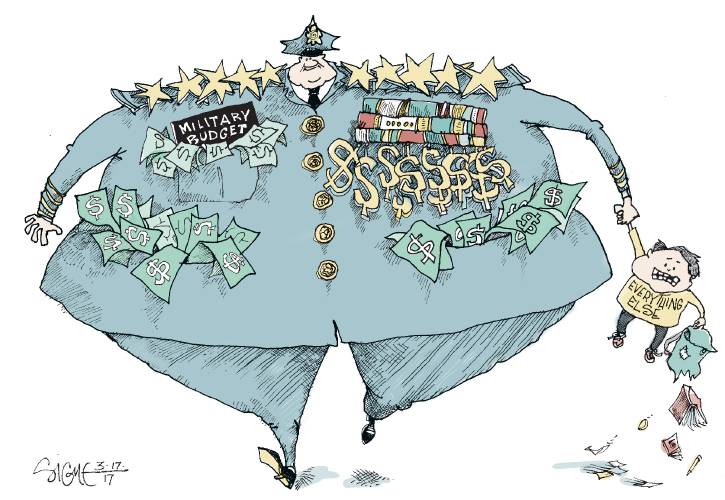
Pentagon spending this year is projected to nudge $850 billion. (The total national security bill is already way past a trillion, but that’s another story.) Yet, even when endowed with such a gigantic pile of cash, the system is apparently incapable of furnishing the wherewithal for even a limited war, such as the one currently underway in Ukraine. The conflict has been marked by successive announcements that progressively more potent weapon systems are being shipped to the Ukrainians -Javelins anti-tank missiles, 155 mm Howitzers, HIMARS precision long range missiles, Patriots air defense missiles, Abrams tanks, with F-16 fighters in the offing. A U.S. military intelligence officer pointed out to me recently the actual basis on which these systems are selected: “when we run out of the last system we were sending.”

Now Biden has generated global outrage by promising to send cluster bombs, known for their ability to kill and maim children fifty years after the relevant war has ended, as any Laotian farmer could tell you. The military rationale for their use is their supposed utility against “soft” targets such as dismounted infantry, radars, and wheeled vehicles. However, a former armor officer and veteran of the 1991 Gulf war recalled to me that “we disliked them intensely and pleaded with the artillery and Air Force not to employ them. They simply damaged support elements and wheels that followed us into action. After the war we treated numerous people wounded by them including our own soldiers, as well as civilians (children).”

Biden has admitted that these devices are being sent only because the U.S. is running out of the artillery ammunition that the Ukrainians actually require. “This is a war relating to munitions. And they’re running out of that ammunition, and we’re low on it,” he told a TV interviewer. So off go the cluster bombs, their passage lubricated by crocodile tears from administration officials: “I’m not going to stand up here and say it was easy…It’s a decision that required a real hard look at the potential harm to civilians” National Security Adviser Jake Sullivan told reporters. (Back when it was reported that the Russians were using cluster bombs in Ukraine, then-White House Press Secretary Jen Psaki denounced such action as “a war crime.”)

So, the richest war machine in history, having scraped its cupboard bare, is now reduced to fielding a device of dubious military utility deemed illegal by over a hundred countries. That’s what we get for our $850 billion.

A War Like No Other in Ukraine

By Peter Van Buren

Source: WeMeantWell.com

Joe Biden created for the U.S. a war like no other, one where others die and the U.S. simply sits back and pays the bills on a gargantuan scale. No attempts are made at diplomacy by the Americans, and the diplomatic efforts of others like the Chinese are dismissed as evil attempts to gain influence in the area (similar for Chinese diplomatic work in the Yemen war.) Biden is coming close to achieving 1984‘s goal of perpetual warfare while only putting a handful of American lives at risk. He has learned lessons from the Cold War, and already put them into play. Can we call it the Biden Doctrine yet?

Biden’s strategy is clear enough now after well more than a year of conflict; what he has been sending to Ukraine jumped from helmets and uniforms to F-16s in only 15 months and shows no signs of stopping. The problem is U.S. weapons are never enough for victory and always “just enough” to allow the battle to go on until then next round. If the Ukrainians think they are playing the U.S. for suckers for free arms they best check who is really paying for everything, in blood.

Putin is playing this game himself in a way, careful not to introduce anything too powerful, such as strategic bombers, and upset the balance and offer Biden the chance to intervene in the war directly (one can hear old man Biden on TV now, explaining American airstrikes are needed to prevent a genocide, the go-to excuse he learned at Obama’s knee.) That’s what the current escalation holds, airpower. Ukraine will find even with the promise of the F-16 it can’t acquire aircraft and train up pilots fast enough (minimum training time is 18-24 months), and next will be begging the U.S. to serve as its air force. As it is the planes are likely to be based out of Poland and Romania, suggesting NATO will pick up the high-skilled tasks of maintaining and repairing them. Left unclear is the NATO role in required aerial refueling to keep the planes over the battlefield. F-16s aside, a spin off bonus to all these weapons gifts is that the vast majority of transfers to date have been “presidential drawdowns.” This means the U.S. sends used or older weapons to Ukraine, after which the Pentagon can use the Congressionally-authorized funds to replenish their stocks by purchasing new arms. The irony that war machines once in Iraq are now on the ground in Ukraine can’t be missed.

The U.S. strategy seems based on creating a ghastly tie of sorts, two sides lined up across a field shooting at each other until one side called it quits for the day. Same as in 1865, same as in 1914, but the new factor is today those armies face off across those fields with 21st-century HIMARS artillery, machine guns, and other tools of killing far more effective than a musket. It is unsustainable, literally chewing up men, albeit not Americans. The question meanwhile of how many more Ukrainians have to die is answered privately by Joe Biden as “potentially all of them.” Anything else requires you to cynically believe Biden thinks he can simply purchase victory,

Up until now this has all been the Cold War playbook. Fighting to the last Afghan was a strategy perfected in Soviet-held Afghanistan in the 1980s. Yet what is different is the scale — since Russia invaded Ukraine, the United States sent over $37 billion worth of military aid to support Kiev’s war effort, the single largest arms transfer in U.S. history and one with no signs of stopping. A single F-16 costs up to $350 million a copy if bought with weapons, maintenance equipment, and spare parts kits.

Yet despite the similarities to Cold War Strategy 101, some lessons have been learned over the intervening years. One of America’s fail-points throughout the Cold War and the War on Terror was the use of puppet governments largely imposed or direly supported by American money and muscle. Because these governments lacked the support of the people (see Vietnam, Iraq, and Afghanistan) they were non-starters with the lifespan of fruit flies. Ukraine is different; the puppet government is the government, beholden to the U.S. for its very survival but more or less supported directly by the people for now.

The other lesson learned has to do with nation building, or rebuilding or reconstruction, whatever the vast post-war expenditures will be called in this conflict. No more straight-up governmental efforts as in Vietnam, Iraq, and Afghanistan. This time it will be all private enterprise. “It is obvious that American business can become the locomotive that will once again push forward global economic growth,” President Zelensky said, boasting that BlackRock, JP Morgan, and Goldman Sachs, and others “have already become part of our Ukrainian way.”

The NYT calls Ukraine “the world’s largest construction site” and predicts projects there in the multi-billions, as high in some estimates as $750 billion. It will be, says the Times, a “gold rush: the reconstruction of Ukraine once the war is over. Russia is stepping up its offensive heading into the second year of the war, but already the staggering rebuilding task is evident. Hundreds of thousands of homes, schools, hospitals and factories have been obliterated along with critical energy facilities and miles of roads, rail tracks and seaports. The profound human tragedy is unavoidably also a huge economic opportunity.” Earlier this year JP Morgan and Zelensky signed a memorandum of understanding stipulating Morgan would assist Ukraine in its reconstruction.

And maybe those large American companies have learned the lessons of Iraq and Afghanistan. Of the billions spent, much money was wasted on dead ends and much was siphoned off due to corruption. But success or failure, the contractors always got paid in our Wars of Terror. With that in mind, more than 300 companies from 22 countries signed up for a Rebuild Ukraine exhibition and conference in Warsaw. At the World Economic Forum in Davos, Switzerland, a standing-room-only crowd packed Ukraine House to discuss investment opportunities.

The eventual gold rush in rebuilding makes for an interesting addendum to the Biden strategy of fighting to the last Ukrainian. The more that is destroyed the more that needs to be rebuilt, and the potential for more money to pour into U.S. companies smart enough to wait by the trough for the killing to subside. But why wait? Drones operated by Danish companies have already mapped every bombed-out structure in the Mykolaiv Oblast region, with an eye toward using the data to help decide what reconstruction contracts should be issued.

So let’s put some lipstick on this pig of a strategy and call it the Biden Doctrine. Part I is to limit direct U.S. combat involvement while fanning the flames for others. Part II is to provide massive amounts of arms to enable a fight to the last local person. Part III is to transform the home government into a puppet instead of creating an unpopular one afresh. Part IV is to turn the reconstruction process into a profit center for American companies. How long the war lasts and how many die are cynically not part of the strategy. The off ramp in Ukraine, a diplomatic outcome that resets the map to pre-invasion 2022 levels, is clear enough to Washington. The Biden administration seems content, shamefully, not to call forcefully for diplomatic efforts but instead to bleed out the Russians as if this was Afghanistan 1980, albeit in the heart of Europe.

Those ‘Dam’ Russians… Now They’re Flooding Themselves for Propaganda!

By Finian Cunningham

Source: Strategic Culture Foundation

It’s not the Russians who are perverse and barbaric. It’s the Western regimes and their Nazi terrorist front in Ukraine.

Western media would have its consumers believe that Russians are the most devious, perverse, and self-destructive people on Earth. Following a flood of jaw-dropping, biblical proportions in the Russian-controlled Kherson region this week, the Western media amplified the Kiev regime’s talking points, which is to say, the Kiev regime’s Western sponsors’ talking points.

The Russians are destroying themselves for propaganda gain, according to those talking points.

The giant Kakhovka Hydroelectric Power Plant was spectacularly blown up by an explosion or explosions and its vast reservoir began flooding hundreds of cities and villages in the surrounding Kherson countryside. The nearby city of Nova Kakhovka with a population of 45,000 is being evacuated. Aerial images of the deluge show an unprecedented disaster with huge environmental, economic and social repercussions.

The damage from the dam’s collapse is catastrophic. The impact of displacement and destroyed livelihoods, businesses and industries will affect millions of Russian citizens. Kherson is one of the four former Ukrainian territories that voted to join the Russian Federation in referenda last year following Moscow’s military intervention in Ukraine to neutralize what was then ongoing aggression from the Kiev regime towards ethnic Russians.

Of the countless consequences from the dam’s destruction, there are two main specific impacts of priority concern. The Kakhovka power plant serves to supply water for the upstream Zaporozhye Nuclear Power Plant – Europe’s largest civilian nuclear power station. Disruption of the water supply could adversely impact the cooling systems at the nuclear plant, causing its reactors to blow up thereby creating a radiation disaster. The Zaporozhye nuclear station is in Russian-controlled territory and has been under Russian military protection since the beginning of Russia’s military intervention on February 24, 2022.

A second consequence from the dam’s collapse is the threat to cut off supply of drinking water to Russia’s Crimea Peninsula where some 3 million people live.

It is obvious who gains and who loses from the blowing up of the Kakhovka hydro facility. The NATO-backed Kiev regime has inflicted massive damage to Russian infrastructure in the Kherson region and beyond.

Yet, in spite of the patently obvious conclusion, Western media and governments are trying to tell the world that the dam was sabotaged by Russian “terrorists”. British foreign minister James (Not-So) Cleverly and the European Union’s Charles Michel were among the Western politicians who were immediately trying to cast the Kremlin as the villain.

It takes an inestimable capacity for double-think and debilitating Russophobia for such logic to be articulated with a straight face.

This a repeat of the same stultifying nonsense that followed the destruction of the Nord Stream gas pipelines last September. When the Russian-owned pipelines under the Baltic Sea were blown up, the Western governments and their dutiful media immediately blamed Russia for sabotaging its own infrastructure. It transpired later that the gas pipes were mined by the U.S. military, an act of terrorism that was ordered by President Joe Biden, according to respected veteran investigative journalist Seymour Hersh. Months later, the Western media ignored or censored out this most plausible cause as a means to delete European-Russian energy trade for America’s strategic interests.

The same double-think by Western governments and media has been deployed over the constant artillery attacks on the Zaporozhye nuclear plant. For months, the plant has been bombarded by the Kiev regime with U.S.-supplied HIMARS rockets. The unspeakable nefarious objective is to cause a nuclear catastrophe in Europe. The Russians are guarding the nuclear facility and have presented documentary evidence to the United Nations Security Council and the International Atomic Energy Agency of who is doing the shelling. Yet, the UN and IAEA as well as the Western media feign a cynical agnosticism about who the nuclear terrorists are, trying to leave question marks that Russia may be somehow inflicting self-sabotage.

The same shelling tactics have been used to hit the Kakhovka dam over many months by Kiev regime forces. It was Russia that has repeatedly warned of the imminent danger of flooding if the hydro plant was crippled. That warning has come to reality, though the Western media are defying cause, motive and past record to invert the accusations.

The Kiev regime has claimed that Russia bombed the Kakhovka dam in order to hamper its planned counteroffensive. This week saw intensified efforts along the 1000-kilometer front line between Ukrainian forces and Russian-held territory. Moscow said it repelled the attacks with heavy losses incurred by the Ukrainian side. Those battles occurred much further to the north from the Kherson region on the Black Sea where the dam was blown.

Adding two and two and getting five is the usual Western media formula because, more than ever, this media system is shown to be a propaganda service, both private and state-owned.

The shamelessness of such media’s double-think is breathtaking to any rational observer. What’s more, the Western public can more and more see through the lies and preposterous pretensions of “independent journalism”. The Western media is a war ministry aiming to demonize Russia as barbarians whose level of sub-humanity, it is implied, is deserving of war and destruction.

In case you didn’t notice, such a mindset is consistent with Nazi ideology.

It’s not the Russians who are perverse and barbaric. It’s the Western regimes and their Nazi terrorist front in Ukraine.