
If You Ever Start Trusting U.S. Businessmen, Remember Henry Ford

By Mickey Z.

Source: Dissident Voice

Henry Ford, the autocratic magnate who despised unions, tyrannized workers, and fired any employee caught driving a competitor’s model, was also an outspoken anti-Semite.

In 1918, he bought and ran a newspaper, The Dearborn Independent, that became an anti-Jewish forum. The May 22, 1920 headline blared, “The International Jew: The World’s Problem,” and thus began a series of ninety-two articles, including “The Jewish Associates of Benedict Arnold” and “The Gentle Art of Changing Jewish Names.”

By 1923, the Independent’s national circulation reached 500,000. Reprints of the articles were soon published in a four-volume set called The International Jew, which was translated into sixteen different languages.

The New York Times reported in 1922 that there was a widespread rumor circulating in Berlin claiming that Henry Ford was financing Adolf Hitler’s nationalist and anti-Semitic movement in Munich,” write James and Suzanne Pool in their book Who Financed Hitler. They add:

“Novelist Upton Sinclair wrote in The Flivver King, a book about Ford, that the Nazis got forty-thousand dollars from Ford to reprint anti-Jewish pamphlets in German translations, and that an additional $300,000 was later sent to Hitler through an intermediary.”

Ford’s plants in Germany adopted an Aryan-only hiring policy in 1935 before Nazi law required it. A year later, Ford fired Erich Diestel, manager of the automobile company’s German plants, simply because he had a Jewish ancestor.

An appreciative Adolf Hitler kept a large picture of the automobile pioneer beside his desk, explaining, “We look to Heinrich Ford as the leader of the growing Fascist movement in America.”

Hitler hoped to support such a movement by offering to import some shock troops to the U.S. to help Ford run for president.

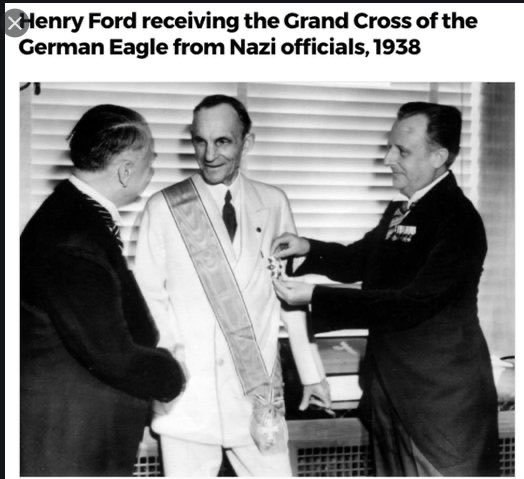
In 1938, on Henry Ford’s 75th birthday, he was awarded the Grand Cross of the Supreme Order of the German Eagle from the Führer himself.

He was the first American (General Motors’ James Mooney would be second) and only the fourth person in the world to receive the highest decoration that could be given to any non-German citizen. An earlier honoree was none other than a kindred spirit named Benito Mussolini.

When appraising history and today’s Titans of Capitalism™, keep your guard up…

On Capitalism and the Machine

By Megan Sherman

Source: Global Research

In 1935, reflecting on the creed of productivity which prevailed in modern technological societies, Bertrand Russell, philosopher, pacifist and devout humanist wrote that:

I think that there is far too much work done in the world, that immense harm is caused by the belief that work is virtuous, and that what needs to be preached in modern industrial countries is quite different from what always has been preached.”

‘In Praise of Idleness and other essays’ is a collection of striking power and originality. Whereas the receieved wisdom of his era held that virtue consisted in yielding to work, monotony and routine, Russell maintained it was not the sole end of life, that beyond work, people needed leisure and pleasure in order to fully live, that what was sought to truly advance society and fortify the human condition was the “organized diminution of work.”

Through the 1920s and 30s Fordism advocated the exact opposite and the cult of productivity began to exert a strong hold on economic and social organization in Europe, the USA and Soviet Union. In the story Brave New World, Aldous Huxley envisioned a society of tyrannical collectivism which raised hell on Earth. In this dehumanizing, nihilistic oblivion, Henry Ford was worshipped as a deity and the fundamentalism of mass production crept in to all spheres of life, rigidly classifying people whose whole lives were planned out on a callow basis of crude economic worth. It was a study in how powerful forces of sublimation and repression incarnate in the edifice of the modern world mutilate our most vital, human instincts and wrench us from our roots.

Huxley’s main belief was that technological ‘progress’ had empowered the worst bureaucrats to assimilate citizens in to a sophisticated machine of repression and control which blocked and frustrated their freedom. Although, as Russell observes, in truth “with modern technique it would be possible to distribute leisure justly without injury to civilization“, the owners of the means of production in the capitalist economy absorb modern technique in to their arsenal against collective liberation. It is not in their interests to free us from bonds.

Of the proprietary class, Russell says:

their desire for comfortable idleness is historically the source of the whole gospel of work. The last thing they have ever wished is that others should follow their example. “

That is to say that freedom and unfreedom aren’t opposites. The affluence and freedom of the proprietors actively depends on the subjugation of workers who create value.

Throughout his life Bertrand Russell was keenly involved with communities of students, activists and workers who organized against imperialism and the war machine. His belief that people could work less and live more was part of his belief that the economic system could be harnessed to more altruistic ends, justified more reasonably, attuned to satisfy people’s needs and fit to unleash their inherent creative power, instead of conforming to bourgeois imperatives.

Lately Professor Stephen Hawking has weighed in on the question of modern social organization and proffered the view that people need not be scared of machines, but ought to be wary of the systems and people who wield them. Why be scared of the unknown power of machines when what we know about the people who own them is far, far scarier?

Hawking said:

If machines produce everything we need, the outcome will depend on how things are distributed. Everyone can enjoy a life of luxurious leisure if the machine-produced wealth is shared, or most people can end up miserably poor if the machine-owners successfully lobby against wealth redistribution. So far, the trend seems to be toward the second option, with technology driving ever-increasing inequality.”

Hawking’s view is much like Russell’s and would be called post-scarcity economics. The crux of this view is that competition for resources is not a necessary feature of an economy, that material abundance may be universal instead of there being a socially imposed monopoly of access, regulated by money and work. Like trickle-down theory, scarcity economics is not necessarily based in reality. It goes without saying that obviously we need to find a way reach this economy and mode of production in accordance with environmental protection, which models after the Industrial Revolution got disastrously wrong.

The challenge of the future is to make machines our allies and not our jailers.