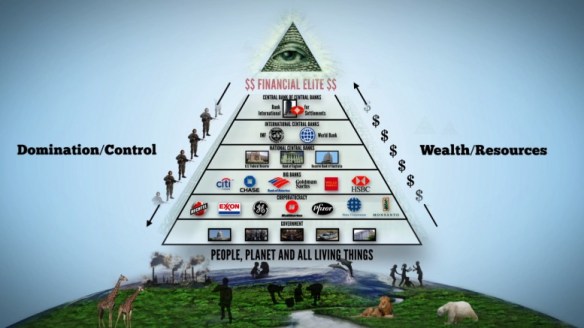
By Michael Hudson and Chris Hedges
Source: CounterPunch
CHRIS HEDGES: We’re going to be discussing a great Ponzi scheme that not only defines not only the U.S. but the global economy, how we got there and where we’re going. And with me to discuss this issue is the economist Michael Hudson, author of Killing the Host: How Financial Parasites and Debt Destroy the Global Economy. A professor of economics who worked for many years on Wall Street, where you don’t succeed if you don’t grasp Marx’s dictum that capitalism is about exploitation. And he is also, I should mention, the godson of Leon Trotsky.
I want to open this discussion by reading a passage from your book, which I admire very much, which I think gets to the core of what you discuss. You write,
“Adam Smith long ago remarked that profits often are highest in nations going fastest to ruin. There are many ways to create economic suicide on a national level. The major way through history has been through indebting the economy. Debt always expands to reach a point where it cannot be paid by a large swathe of the economy. This is the point where austerity is imposed and ownership of wealth polarizes between the One Percent and the 99 Percent. Today is not the first time this has occurred in history. But it is the first time that running into debt has occurred deliberately.” Applauded. “As if most debtors can get rich by borrowing, not reduced to a condition of debt peonage.”
So let’s start with the classical economists, who certainly understood this. They were reacting of course to feudalism. And what happened to the study of economics so that it became gamed by ideologues?
HUDSON: The essence of classical economics was to reform industrial capitalism, to streamline it, and to free the European economies from the legacy of feudalism. The legacy of feudalism was landlords extracting land-rent, and living as a class that took income without producing anything. Also, banks that were not funding industry. The leading industrialists from James Watt, with his steam engine, to the railroads …
HEDGES: From your book you make the point that banks almost never funded industry.
HUDSON: That’s the point: They never have. By the time you got to Marx later in the 19th century, you had a discussion, largely in Germany, over how to make banks do something they did not do under feudalism. Right now we’re having the economic surplus being drained not by the landlords but also by banks and bondholders.
Adam Smith was very much against colonialism because that lead to wars, and wars led to public debt. He said the solution to prevent this financial class of bondholders burdening the economy by imposing more and more taxes on consumer goods every time they went to war was to finance wars on a pay-as-you-go basis. Instead of borrowing, you’d tax the people. Then, he thought, if everybody felt the burden of war in the form of paying taxes, they’d be against it. Well, it took all of the 19th century to fight for democracy and to extend the vote so that instead of landlords controlling Parliament and its law-making and tax system through the House of Lords, you’d extend the vote to labor, to women and everybody. The theory was that society as a whole would vote in its self-interest. It would vote for the 99 Percent, not for the One Percent.
By the time Marx wrote in the 1870s, he could see what was happening in Germany. German banks were trying to make money in conjunction with the government, by lending to heavy industry, largely to the military-industrial complex.
HEDGES: This was Bismarck’s kind of social – I don’t know what we’d call it. It was a form of capitalist socialism…
HUDSON: They called it State Capitalism. There was a long discussion by Engels, saying, wait a minute. We’re for Socialism. State Capitalism isn’t what we mean by socialism. There are two kinds of state-oriented–.
HEDGES: I’m going to interject that there was a kind of brilliance behind Bismarck’s policy because he created state pensions, he provided health benefits, and he directed banking toward industry, toward the industrialization of Germany which, as you point out, was very different in Britain and the United States.
HUDSON: German banking was so successful that by the time World War I broke out, there were discussions in English economic journals worrying that Germany and the Axis powers were going to win because their banks were more suited to fund industry. Without industry you can’t have really a military. But British banks only lent for foreign trade and for speculation. Their stock market was a hit-and-run operation. They wanted quick in-and-out profits, while German banks didn’t insist that their clients pay as much in dividends. German banks owned stocks as well as bonds, and there was much more of a mutual partnership.
That’s what most of the 19th century imagined was going to happen – that the world was on the way to socializing banking. And toward moving capitalism beyond the feudal level, getting rid of the landlord class, getting rid of the rent, getting rid of interest. It was going to be labor and capital, profits and wages, with profits being reinvested in more capital. You’d have an expansion of technology. By the early twentieth century most futurists imagined that we’d be living in a leisure economy by now.
HEDGES: Including Karl Marx.
HUDSON: That’s right. A ten-hour workweek. To Marx, socialism was to be an outgrowth of the reformed state of capitalism, as seemed likely at the time – if labor organized in its self-interest.
HEDGES: Isn’t what happened in large part because of the defeat of Germany in World War I? But also, because we took the understanding of economists like Adam Smith and maybe Keynes. I don’t know who you would blame for this, whether Ricardo or others, but we created a fictitious economic theory to praise a rentier or rent-derived, interest-derived capitalism that countered productive forces within the economy. Perhaps you can address that.
HUDSON: Here’s what happened. Marx traumatized classical economics by taking the concepts of Adam Smith and John Stuart Mill and others, and pushing them to their logical conclusion. Progressive capitalist advocates – Ricardian socialists such as John Stuart Mill – wanted to tax away the land or nationalize it. Marx wanted governments to take over heavy industry and build infrastructure to provide low-cost and ultimately free basic services. This was traumatizing the landlord class and the One Percent. And they fought back. They wanted to make everything part of “the market,” which functioned on credit supplied by them and paid rent to them.
None of the classical economists imagined how the feudal interests – these great vested interests that had all the land and money – actually would fight back and succeed. They thought that the future was going to belong to capital and labor. But by the late 19th century, certainly in America, people like John Bates Clark came out with a completely different theory, rejecting the classical economics of Adam Smith, the Physiocrats and John Stuart Mill.
HEDGES: Physiocrats are, you’ve tried to explain, the enlightened French economists.
HUDSON: The common denominator among all these classical economists was the distinction between earned income and unearned income. Unearned income was rent and interest. Earned incomes were wages and profits. But John Bates Clark came and said that there’s no such thing as unearned income. He said that the landlord actually earns his rent by taking the effort to provide a house and land to renters, while banks provide credit to earn their interest. Every kind of income is thus “earned,” and everybody earns their income. So everybody who accumulates wealth, by definition, according to his formulas, get rich by adding to what is now called Gross Domestic Product (GDP).
HEDGES: One of the points you make in Killing the Host which I liked was that in almost all cases, those who had the capacity to make money parasitically off interest and rent had either – if you go back to the origins – looted and seized the land by force, or inherited it.
HUDSON: That’s correct. In other words, their income is unearned. The result of this anti-classical revolution you had just before World War I was that today, almost all the economic growth in the last decade has gone to the One Percent. It’s gone to Wall Street, to real estate …
HEDGES: But you blame this on what you call Junk Economics.
HUDSON: Junk Economics is the anti-classical reaction.
HEDGES: Explain a little bit how, in essence, it’s a fictitious form of measuring the economy.
HUDSON: Well, some time ago I went to a bank, a block away from here – a Chase Manhattan bank – and I took out money from the teller. As I turned around and took a few steps, there were two pickpockets. One pushed me over and the other grabbed the money and ran out. The guard stood there and saw it. So I asked for the money back. I said, look, I was robbed in your bank, right inside. And they said, “Well, we don’t arm our guards because if they shot someone, the thief could sue us and we don’t want that.” They gave me an equivalent amount of money back.
Well, imagine if you count all this crime, all the money that’s taken, as an addition to GDP. Because now the crook has provided the service of not stabbing me. Or suppose somebody’s held up at an ATM machine and the robber says, “Your money or your life.” You say, “Okay, here’s my money.” The crook has given you the choice of your life. In a way that’s how the Gross National Product accounts are put up. It’s not so different from how Wall Street extracts money from the economy. Then also you have landlords extracting …
HEDGES: Let’s go back. They’re extracting money from the economy by debt peonage. By raising …
HUDSON: By not playing a productive role, basically.
HEDGES: Right. So it’s credit card interest, mortgage interest, car loans, student loans. That’s how they make their funds.
HUDSON: That’s right. Money is not a factor of production. But in order to have access to credit, in order to get money, in order to get an education, you have to pay the banks. At New York University here, for instance, they have Citibank. I think Citibank people were on the board of directors at NYU. You get the students, when they come here, to start at the local bank. And once you are in a bank and have monthly funds taken out of your account for electric utilities, or whatever, it’s very cumbersome to change.
So basically you have what the classical economists called the rentier class. The class that lives on economic rents. Landlords, monopolists charging more, and the banks. If you have a pharmaceutical company that raises the price of a drug from $12 a shot to $200 all of a sudden, their profits go up. Their increased price for the drug is counted in the national income accounts as if the economy is producing more. So all this presumed economic growth that has all been taken by the One Percent in the last ten years, and people say the economy is growing. But the economy isn’t growing …
HEDGES: Because it’s not reinvested.
HUDSON: That’s right. It’s not production, it’s not consumption. The wealth of the One Percent is obtained essentially by lending money to the 99 Percent and then charging interest on it, and recycling this interest at an exponentially growing rate.
HEDGES: And why is it important, as I think you point out in your book, that economic theory counts this rentier income as productive income? Explain why that’s important.
HUDSON: If you’re a rentier, you want to say that you earned your income by …
HEDGES: We’re talking about Goldman Sachs, by the way.
HUDSON: Yes, Goldman Sachs. The head of Goldman Sachs came out and said that Goldman Sachs workers are the most productive in the world. That’s why they’re paid what they are. The concept of productivity in America is income divided by labor. So if you’re Goldman Sachs and you pay yourself $20 million a year in salary and bonuses, you’re considered to have added $20 million to GDP, and that’s enormously productive. So we’re talking in a tautology. We’re talking with circular reasoning here.
So the issue is whether Goldman Sachs, Wall Street and predatory pharmaceutical firms, actually add “product” or whether they’re just exploiting other people. That’s why I used the word parasitism in my book’s title. People think of a parasite as simply taking money, taking blood out of a host or taking money out of the economy. But in nature it’s much more complicated. The parasite can’t simply come in and take something. First of all, it needs to numb the host. It has an enzyme so that the host doesn’t realize the parasite’s there. And then the parasites have another enzyme that takes over the host’s brain. It makes the host imagine that the parasite is part of its own body, actually part of itself and hence to be protected.
That’s basically what Wall Street has done. It depicts itself as part of the economy. Not as a wrapping around it, not as external to it, but actually the part that’s helping the body grow, and that actually is responsible for most of the growth. But in fact it’s the parasite that is taking over the growth.
The result is an inversion of classical economics. It turns Adam Smith upside down. It says what the classical economists said was unproductive – parasitism – actually is the real economy. And that the parasites are labor and industry that get in the way of what the parasite wants – which is to reproduce itself, not help the host, that is, labor and capital.
HEDGES: And then the classical economists like Adam Smith were quite clear that unless that rentier income, you know, the money made by things like hedge funds, was heavily taxed and put back into the economy, the economy would ultimately go into a kind of tailspin. And I think the example of that, which you point out in your book, is what’s happened in terms of large corporations with stock dividends and buybacks. And maybe you can explain that.
HUDSON: There’s an idea in superficial textbooks and the public media that if companies make a large profit, they make it by being productive. And with …
HEDGES: Which is still in textbooks, isn’t it?
HUDSON: Yes. And also that if a stock price goes up, you’re just capitalizing the profits – and the stock price reflects the productive role of the company. But that’s not what’s been happening in the last ten years. Just in the last two years, 92 percent of corporate profits in America have been spent either on buying back their own stock, or paid out as dividends to raise the price of the stock.
HEDGES: Explain why they do this.
HUDSON: About 15 years ago at Harvard, Professor Jensen said that the way to ensure that corporations are run most efficiently is to make the managers increase the price of the stock. So if you give the managers stock options, and you pay them not according to how much they’re producing or making the company bigger, or expanding production, but the price of the stock, then you’ll have the corporation run efficiently, financial style.
So the corporate managers find there are two ways that they can increase the price of the stock. The first thing is to cut back long-term investment, and use the money instead to buy back their own stock. But when you buy your own stock, that means you’re not putting the money into capital formation. You’re not building new factories. You’re not hiring more labor. You can actually increase the stock price by firing labor.
HEDGES: That strategy only works temporarily.
HUDSON: Temporarily. By using the income from past investments just to buy back stock, fire the labor force if you can, and work it more intensively. Pay it out as dividends. That basically is the corporate raider’s model. You use the money to pay off the junk bond holders at high interest. And of course, this gets the company in trouble after a while, because there is no new investment.
So markets shrink. You then go to the labor unions and say, gee, this company’s near bankruptcy, and we don’t want to have to fire you. The way that you can keep your job is if we downgrade your pensions. Instead of giving you what we promised, the defined benefit pension, we’ll turn it into a defined contribution plan. You know what you pay every month, but you don’t know what’s going to come out. Or, you wipe out the pension fund, push it on to the government’s Pension Benefit Guarantee Corporation, and use the money that you were going to pay for pensions to pay stock dividends. By then the whole economy is turning down. It’s hollowed out. It shrinks and collapses. But by that time the managers will have left the company. They will have taken their bonuses and salaries and run.
HEDGES: I want to read this quote from your book, written by David Harvey, in A Brief History of Neoliberalism, and have you comment on it.
“The main substantive achievement of neoliberalism has been to redistribute rather than to generate wealth and income. [By] ‘accumulation by dispossession’ I mean … the commodification and privatization of land, and the forceful expulsion of peasant populations; conversion of various forms of property rights (common collective state, etc.) into exclusive private property rights; suppression of rights to the commons; … colonial, neocolonial, and the imperial processes of appropriation of assets (including natural resources); … and usury, the national debt and, most devastating at all, the use of the credit system as a radical means of accumulation by dispossession. … To this list of mechanisms, we may now add a raft of techniques such as the extraction of rents from patents, and intellectual property rights (such as the diminution or erasure of various forms of common property rights, such as state pensions, paid vacations, and access to education, health care) one through a generation or more of class struggle. The proposal to privatize all state pension rights, pioneered in Chile under the dictatorship is, for example, one of the cherished objectives of the Republicans in the US.”
This explains the denouement. The final end result you speak about in your book is, in essence, allowing what you call the rentier or the speculative class to cannibalize the entire society until it collapses.
HUDSON: A property right is not a factor of production. Look at what happened in Chicago, the city where I grew up. Chicago didn’t want to raise taxes on real estate, especially on its expensive commercial real estate. So its budget ran a deficit. They needed money to pay the bondholders, so they sold off the parking rights to have meters – you know, along the curbs. The result is that they sold to Goldman Sachs 75 years of the right to put up parking meters. So now the cost of living and doing business in Chicago is raised by having to pay the parking meters. If Chicago is going to have a parade and block off traffic, it has to pay Goldman Sachs what the firm would have made if the streets wouldn’t have been closed off for a parade. All of a sudden it’s much more expensive to live in Chicago because of this.
But this added expense of having to pay parking rights to Goldman Sachs – to pay out interest to its bondholders – is counted as an increase in GDP, because you’ve created more product simply by charging more. If you sell off a road, a government or local road, and you put up a toll booth and make it into a toll road, all of a sudden GDP goes up.
If you go to war abroad, and you spend more money on the military-industrial complex, all this is counted as increased production. None of this is really part of the production system of the capital and labor building more factories and producing more things that people need to live and do business. All of this is overhead. But there’s no distinction between wealth and overhead.
Failing to draw that distinction means that the host doesn’t realize that there is a parasite there. The host economy, the industrial economy, doesn’t realize what the industrialists realized in the 19th century: If you want to be an efficient economy and be low-priced and under-sell competitors, you have to cut your prices by having the public sector provide roads freely. Medical care freely. Education freely.
If you charge for all of these, you get to the point that the U.S. economy is in today. What if American factory workers were to get all of their consumer goods for nothing. All their food, transportation, clothing, furniture, everything for nothing. They still couldn’t compete with Asians or other producers, because they have to pay up to 43% of their income for rent or mortgage interest, 10% or more of their income for student loans, credit card debt. 15% of their paycheck is automatic withholding to pay Social Security, to cut taxes on the rich or to pay for medical care.
So Americans built into the economy all this overhead. There’s no distinction between growth and overhead. It’s all made America so high-priced that we’re priced out of the market, regardless of what trade policy we have.
HEDGES: We should add that under this predatory form of economics, you game the system. So you privatize pension funds, you force them into the stock market, an overinflated stock market. But because of the way companies go public, it’s the hedge fund managers who profit. And it’s those citizens whose retirement savings are tied to the stock market who lose. Maybe we can just conclude by talking about how the system is fixed, not only in terms of burdening the citizen with debt peonage, but by forcing them into the market to fleece them again.
HUDSON: Well, we talk about an innovation economy as if that makes money. Suppose you have an innovation and a company goes public. They go to Goldman Sachs and other Wall Street investment banks to underwrite the stock to issue it at $40 a share. What’s considered a successful float is when, immediately, Goldman and the others will go to their insiders and tell them to buy this stock and make a quick killing. A “successful” flotation doubles the price in one day, so that at the end of the day the stock’s selling for $80.
HEDGES: They have the option to buy it before anyone else, knowing that by the end of the day it’ll be inflated, and then they sell it off.
HUDSON: That’s exactly right.
HEDGES: So the pension funds come in and buy it at an inflated price, and then it goes back down.
HUDSON: It may go back down, or it may be that the company just was shortchanged from the very beginning. The important thing is that the Wall Street underwriting firm, and the speculators it rounds up, get more in a single day than all the years it took to put the company together. The company gets $40. And the banks and their crony speculators also get $40.
So basically you have the financial sector ending up with much more of the gains. The name of the game if you’re on Wall Street isn’t profits. It’s capital gains. And that’s something that wasn’t even part of classical economics. They didn’t anticipate that the price of assets would go up for any other reason than earning more money and capitalizing on income. But what you have had in the last 50 years – really since World War II – has been asset-price inflation. Most middle-class families have gotten the wealth that they’ve got since 1945 not really by saving what they’ve earned by working, but by the price of their house going up. They’ve benefited by the price of the house. And they think that that’s made them rich and the whole economy rich.
The reason the price of housing has gone up is that a house is worth whatever a bank is going to lend against it. If banks made easier and easier credit, lower down payments, then you’re going to have a financial bubble. And now, you have real estate having gone up as high as it can. I don’t think it can take more than 43% of somebody’s income to buy it. But now, imagine if you’re joining the labor force. You’re not going to be able to buy a house at today’s prices, putting down a little bit of your money, and then somehow end up getting rich just on the house investment. All of this money you pay the bank is now going to be subtracted from the amount of money that you have available to spend on goods and services.
So we’ve turned the post-war economy that made America prosperous and rich inside out. Somehow most people believed they could get rich by going into debt to borrow assets that were going to rise in price. But you can’t get rich, ultimately, by going into debt. In the end the creditors always win. That’s why every society since Sumer and Babylonia have had to either cancel the debts, or you come to a society like Rome that didn’t cancel the debts, and then you have a dark age. Everything collapses.
Michael Hudson’s new book, Killing the Host is published in e-format by CounterPunch Books and in print by Islet. He can be reached via his website, mh@michael-hudson.com. Chris Hedges’s latest book is Days of Destruction, Days of Revolt, illustrated by Joe Sacco.


 After the Crash