Long Buried Texas Fertilizer Plant Explosion Conspiracy Re-Emerges From Shadows Of Boston Bombing

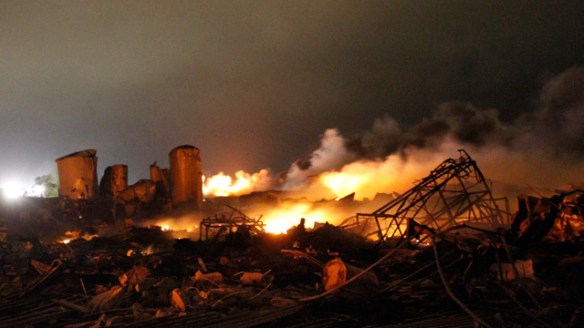
The remains of a fertilizer plant after explosion in West, Texas

By Bernie Suarez

Source: Truth and Art TV

Sometimes conspiracies are truly forgotten when there are so many other state crimes and conspiracies to choose from. Such is the case with the Waco Texas fertilizer plant “explosion” of April 17, 2013. I’m talking about the Texas fertilizer plant explosion which was conveniently buried in the immediate aftermath of the April 15, 2013 Boston bombing. I’m sure many have forgotten about this event in the same way they don’t remember or have completely forgotten that two days earlier, on the very same day of the Boston bombing “event” a wave of bombings and shootings took place in Iraq just before their elections leaving at least 75 people dead and hundreds injured. The mainstream media conveniently gave little to no attention to this story as the Boston bombing event was selected as the featured story we were supposed to be thinking about at the time.

Meanwhile in Waco Texas 2 days later, on the evening of April 17th a fertilizer plant caught fire and was being consumed in flames when some 22 minutes later a mighty suspicious massive explosion took place; an explosion captured nicely on camera by nearby residents that was so loud and so bright that many have suspected it was some sort of missile strike. Sounds crazy? You decide:

Now let’s listen in to what Nevada Governor candidate at the time David Lory VanDerBeek had to say about this. The Governor candidate breaks down some of the features of this evidence very nicely showing you the trajectory of the energy being provided by the missile. After seeing this video no one should wonder why he had no chance at winning the governor race.

The plant was owned by Adair Grain Inc a family owned food plant which also goes by or is closely associated with “Texas Grain Inc” a competitor of Monsanto who had filed a lawsuit against Monsanto accusing Monsanto of artificially inflating the price of their Roundup herbicide. This additional explosion to this day is highly suspicious and now that the mainstream media is briefly covering this story it’s a good time to examine this event a bit more closely.

According to mainstream media sources the federal government “investigators” claim the factory was an explosion waiting to happen:

The source of the explosion was ammonium nitrate stored in a wooden container at the plant, investigators have said.

The ammonium nitrate detonated with the force of approximately 15,000 pounds to 20,000 pounds (6,800 kg to 9,100 kg) of TNT, according to federal officials.

But if we examine the explosion claim we must take into consideration that the Adair Grain fertilizer plant reported to the EPA a very different picture:

The fertilizer plant that exploded Wednesday night in West, Texas, reported to the Environmental Protection Agency and local public safety officials that it presented no risk of fire or explosion, documents show.

West Fertilizer Co. reported having as much as 54,000 pounds of anhydrous ammonia on hand in an emergency planning report required of facilities that use toxic or hazardous chemicals.

But the report, reviewed Wednesday night by The Dallas Morning News, stated “no” under fire or explosive risks. The worst possible scenario, the report said, would be a 10-minute release of ammonia gas that would kill or injure no one.

The second worst possibility projected was a leak from a broken hose used to transfer the product, again causing no injuries.

The plan says the facility did not have any other dangerous chemicals on hand. It says that the plan was on file with the local fire department and that the company had implemented proper safety rules.

ATF Chief investigator Rob Elder recently announced:

“the fire has been ruled as an incendiary. This means this fire was a criminal act”.

Elder then says that numerous evidences were taken into account including, witnesses, images and video footage. But was the video evidence really taken into account? Even more intriguing, Mr Elder has announced a $50,000 award for information leading to the capture of the arsonist so if anyone wants to take him on please do. I can’t help but to be reminded of the 1933 Reichstag fire false flag in Germany and how a patsy of choice was afterward chosen and executed in the period that followed.

Let’s consider some additional ironies and peculiar accounts surrounding this explosion. According to the reported investigation conclusions:

The explosion damaged an area measuring roughly the size of 37 city blocks, Elder said, and left a crater 93 feet (28 metres) wide by 12 feet (3.7 metres) deep.

The ammonium nitrate detonated with the force of approximately 15,000 pounds to 20,000 pounds (6,800 kg to 9,100 kg) of TNT, according to federal officials.

This conjures up memories of the government claims that on 9/11 WTC 7 was packed with “diesel fuel tanks” which they would then use in an attempt to sell the theory that office fires alone could destroy the building in the controlled demolition manner in which it was destroyed.

The problem with looking at the entire story, looking at all the evidence and then listening to the government “investigation” statements (or lack thereof) is that the whole story doesn’t fit like it should, and that alone should lead us to wonder, was the fertilizer plant purposely struck with a sophisticated military missile to send Texas Grain Inc a message? Can Ammonium Nitrate alone cause such a wide and deep crater in the damaged area? And is the quality, direction and trajectory of the explosion consistent with an explosion originating from the plant as the government would have you believe?

Suspicions run high that this was not only a classic military style (think 9/11 Pentagon style) attack on the plant but specifically this may have involved a new “Advanced Hypersonic Weapon” (AHW) developed by the Army in 2011 seen here. The video below explains this possibility more in-depth. Again, you decide.

When analyzing this let’s keep in mind that conspiracies are now the norm and today it is well within reason for any critical thinker to suspect government conspiracy as a reasonable possible explanation. It is also incumbent upon us to consider all evidence including the irony of this story being buried in the height of the Boston bombing event. That they are just now briefly talking about this explosion after 3 years of hiding the story is suspicious in itself. The multiple video analysis above demonstrating reasonable probability of a sophisticated military style missile strike should matter to everyone. If true, this constitutes another blatant murderous act of violence of our government against its own people potentially on behalf of its global organized crime cartel partner Monsanto who is known to work with Blackwater/XE.

Now that investigators are officially ruling this event as a “criminal act” it will be very interesting to see if they produce a patsy of their choice in the future (Reichstag fire style) to throw off anyone suspicious of government activity in this crime.

It sure does seem like a criminal act to my eyes, and as usual no one in the mainstream media or the usual pre-selected government “investigative” body is looking for or even suspecting that the plant was ultimately pulverized by a missile strike. We all know that government investigative bodies never even look for possibilities that imply that the State is involved in the crime. So this phony search including their phony $50,000 reward will never lead to any real justice.

Don’t think for a moment the ruling class wouldn’t commit a crime like this to protect their interest and send a message. These are ultimately the same people who funded the attacks in Iraq on April 15, 2013 and organized the Boston bombing “event” on the same day. In order for truth seekers to remain vigilant and to stay on top of government crimes and conspiracies they need to take events like this serious and do their own research. It’s not about being paranoid it’s about believing your own eyes and ears, looking for patterns, exercising critical thinking, and maintaining a clear overall awareness of the big picture.


Capture, Smear, Contaminate: The Politics Of GMOs

gmo_crops_genfood_735_350-400x190

By Colin Todhunter

Source: RINF

When rich companies with politically-connected lobbyists and seats on public bodies bend policies for their own ends, we are in serious trouble. It is then that public institutions become hijacked and our choices, freedoms and rights are destroyed. Corporate interests have too often used their dubious ‘science’, lobbyists, political connections and presence within the heart of governments to subvert institutions set up to supposedly protect the public interest for their own commercial benefit. Once their power has been established, anyone who questions them or who stands in their way can expect a very bumpy ride.

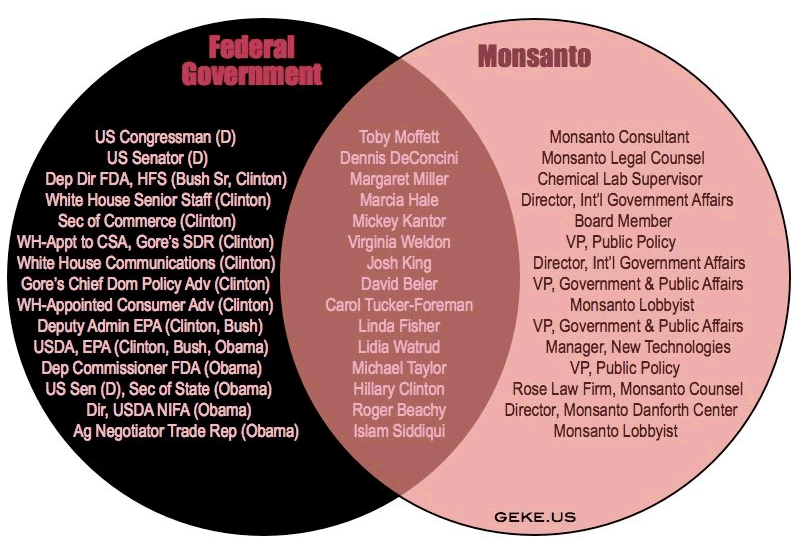
The revolving door between the private sector and government bodies has been well established. In the US, many senior figures from the Genetically Modified Organisms (GMOs) industry, especially Monsanto, have moved with ease to take up positions with the Food and Drug Administration and Evironmental Protection Agency and within the government. Writer and researcher William F Engdahl writes about a similar influence in Europe, noting the links between the GMO sector within the European Food Safety Authority. He states that over half of the scientists involved in the GMO panel which positively reviewed the Monsanto’s study for GMO maize in 2009, leading to its EU-wide authorisation, had links with the biotech industry.

“Monsanto should not have to vouchsafe the safety of biotech food. Our interest is in selling as much of it as possible. Assuring its safety is the FDA’s job” – Phil Angell, Monsanto’s director of corporate communications. “Playing God in the Garden” New York Times Magazine,October 25, 1998.

Phil Angell’s statement begs the question: then who should vouchsafe for it, especially when the public bodies have been severely comprised? Monsanto has all angles covered.

When corporate interests are able to gain access to such positions of power, little wonder they have some heavy-duty tools at their disposal to try to fend off criticism by all means necessary.

A well-worn tactic of the pro-GMO lobby is to slur and attack figures that have challenged the ‘science’ and claims of the industry. With threats of lawsuits and UK government pressure, some years ago top research scientist Dr Arpad Pusztai was effectively silenced over his research concerning the dangers of GM food. A campaign was set in motion to destroy his reputation. Professor Seralini and his team’s research was also met with intense industry pressure, with Monsanto effectively targeting the heart of science to secure its commercial interests. There are numerous examples of scientists being targeted like this. A WikiLeaks cable highlighted how GMOs were being forced into European nations by the US ambassador to France who plotted with other US officials to create a ‘retaliatory target list’ of anyone who tried to regulate GMOs. That clearly indicates the power of the industry.

What the GMO sector fails to grasp is that the onus is on it to prove that its products are safe. And it has patently failed to do this. No independent testing was done before Bush senior allowed GMOs onto the US market. The onus should not be on others to prove they are safe (or unsafe) after they are on the market, especially as public attorney Steven Druker‘s book ‘Altered Genes, Twisted Truth’ shows that GMOs are on the US market due to fraudulent practices and the bypassing of scientific evidence pointing to potential health hazards.

We therefore have the right to ask whether we should trust studies carried out by the sector itself that claims GM crops are safe? Let us turn to Tiruvadi Jagadisan for an answer.

He worked with Monsanto for nearly two decades, including eight years as the managing director of India operations. A few years ago, he stated that Monsanto “used to fake scientific data” submitted to government regulatory agencies to get commercial approvals for its products in India. The former Monsanto boss said government regulatory agencies with which the company used to deal with in the 1980s simply depended on data supplied by the company while giving approvals to herbicides. As reported in India Today, he is on record as saying that India’s Central Insecticide Board simply accepted foreign data supplied by Monsanto and did not even have a test tube to validate the data which at times was faked.

Now that scientists such as Professor Seralini are in a sense playing catch-up by testing previously independently untested GMOs, he is attacked. However, the attacks on Seralini and his study have been found to be based on little more than unscientific polemics and industry pressure. In fact, in new study, Seralini highlights the serious flaws of industry-backed studies that were apparently slanted to distort results. It remains to be seen whether he and his team are in for another bout of smears and attacks.

But this is symptomatic of the industry: it says a product is safe, therefore it is – regardless that science is being used as little more than an ideological smokescreen. We are expected to take its claims at face value. The revolving door between top figures at Monsanto and positions at the FDA makes it difficult to see where the line between lobbying and regulation is actually drawn. People are rightly suspicious of the links between the FDA and GMO industry in the US and the links between it and the regulatory body within the EU.

GM represents the so-called “Green Revolution’s” second coming. Agriculture has changed more over the last two generations than it did in the previous 12,000 years. Environmentalist Vandana Shiva notes that, after 1945, chemical manufacturers who had been involved in the weapons industry turned their attention to applying their chemical know-how to farming. As a result ‘dwarf seeds’ were purposively created to specifically respond to their chemicals. Agriculture became transformed into a chemical-dependent industry that has destroyed much biodiversity. What we are left with is crop monocultures, which negatively impact food security and nutrition. In effect, modern agriculture is part of the paradigm of control based on mass standardization and a dependency on corporate products.

The implications have been vast. Chemical-industrial agriculture has proved extremely lucrative for the oil and chemicals industry, courtesy of oil-rich Rockefeller interests which were instrumental in pushing for the green revolution throughout the world, and has served to maintain and promote Western hegemony, not least via ‘structural adjustment’ and the consequent uprooting of traditional farming practices in favour of single-crop export-oriented policies, dam building to cater for what became a highly water intensive industry, loans and indebtedness, boosting demand for the US dollar, etc.

Agriculture has been a major tool of US foreign policy since 1945 and has helped to secure its global hegemony. One must look no further than current events in Ukraine, where the strings attached to financial loans are resulting in the opening up of (GM) agriculture to Monsanto. From Africa to India and across Asia, the hijack of indigenous agriculture and food production by big corporations is a major political issue as farmers struggle for their rights to remain on the land, retain ownership of seeds, grow healthy food and protect their livelihoods.

Apart from tying poorer countries into an unequal system of global trade and reinforcing global inequalities, the corporate hijacking of food and agriculture has had many other implications, not least where health is concerned.

Dr Meryl Hammond, founder of the Campaign for Alternatives to Pesticides, told a Canadian parliament committee in 2009 that a raft of studies published in prestigious peer-reviewed journals point to strong associations between chemical pesticides and a vast range of serious life-threatening health consequences. Shiv Chopra, a top food advisor to the Canadian government, has documented how all kinds of food products that were known to be dangerous were passed by the regulatory authority and put on the market there due to the power of the food industry.

Severe anemia, permanent brain damage, Alzheimer’s, dementia, neurological disorders, reproductive problems, diminished intelligence, impaired immune system, behavioural disorders, cancers, hyperactivity and learning disability are just some of the diseases that numerous studies have linked to our food.

Of course, just like cigarettes and the tobacco industry before, trying to ‘prove’ the glaringly obvious link will take decades as deceit is passed off as ‘science’ or becomes institutionalized due to the hijacking of government bodies by the corporations involved in food production.

But anyone who questions the need for GMOs in the first place and the risks they bring and devastating impacts they have is painted as clueless and indulging in scare mongering and falsehoods, while standing in the way of human progress. But can we expect much better from an industry that has a record of smearing and attempting to ruin people who criticise it? Are those of us who question the political links of big agritech and the nature of its products ready to take lessons on ethics and high-minded notions of ‘human progress’ from anyone involved with it?

This is an industry that has contaminated crops and bullied farmers with lawsuits in North America, an industry whose companies have been charged with and most often found guilty of contaminating the environment and seriously damaging health with PCBs and dioxins, an industry complicit in concealing the deadly impact of GM corn on animals, an industry where bribery seems to be second nature (Monsanto in Indonesia), an industry associated with human rights violations in Brazil and an industry that will not label its foods in the US.

A great myth forwarded by the pro-GMO lobby is that governments are freely choosing to adopt GMOs. Any brief analysis of the politics of GM highlights that this is nonsense. Various pressures are applied and agritech companies have captured policy bodies and have a strategic hold over the WTO and trade deals like the TTIP.

For instance, take the 2005 US-India nuclear deal (allowing India to develop its nuclear sector despite it not being a signatory of the Non-Proliferation Treaty and allegedly pushed through with a cash for votes tactic in the Indian parliament). It was linked to the Knowledge Initiative on Agriculture, which was aimed at widening access to India’s agricultural and retail sectors. This initiative was drawn up with the full and direct participation of representatives from various companies, including Monsanto, Cargill and Walmart.

When the most powerful country comes knocking at your door seeking to gain access to your markets, there’s good chance that once its corporate-tipped jackboot is in, you won’t be able to get it out.

And it seems you can’t. So far, Bt cotton has been the only GM crop allowed in India, but the open field trials of many GM crops are now taking place around the country despite an overwhelming consensus of official reports warning against this. The work of numerous public bodies and research institutes is now compromised as a result of Monsanto’s strategic influence within India (see this and this).

If global victory cannot be achieved by the GMO biotech sector via the hijack of public bodies and trade deals or intimidation, then the politics of another form of contamination may eventually suffice:

“The hope of the industry is that over time the market is so flooded [with GMOs] that there’s nothing you can do about it. You just sort of surrender” – Don Westfall, biotech industry consultant and vice-president of Promar International, in the Toronto Star,January 9 2001.

Open field planting is but one way of achieving what Westfall states. Of course, there are numerous other ways too (see this).

As powerful agribusiness concerns seek to ‘consolidate the entire food chain’ with their seeds, patents and GMOs, it is clear that it’s not just the health of the nation (any nation) that is at stake but the global control of food and by implication nations.

“What you are seeing is not just a consolidation of seed companies, it’s really a consolidation of the entire food chain” – Robert Fraley, co-president of Monsanto’s agricultural sector 1996, in the Farm Journal. Quoted in: Flint J. (1998) Agricultural industry giants moving towards genetic monopolism. Telepolis, Heise.

Colin Todhunter is an independent writer: colintodhunter.com

Real Rewilding

6ae1ed82e41b1b306efe339273279b5f-565x403

By Glenn Aparicio Parry

Source: Reality Sandwich

In an attempt to circumvent enmity toward genetically modified foods, Danish scientists are proposing what they claim is a precision breeding technique called “rewilding.” It is named rewilding because it mixes current genes from a plant with ancient genes of the same plant (old genes that were either lost or bred out somewhere along the way). The name sounds harmless, even restorative, and would likely be labelled non-GMO in the US because the genes are modified from the same plant. It could even be labelled “organic” if the introduced gene is determined not to be “foreign.” Like most genetic experiments, it is difficult to know the efficacy of this technique or if it ever will be successfully introduced. The outcome of the initiative notwithstanding, I find the name “rewilding” troubling. It reminds me of other similarly deceptive euphemisms, such as “tax relief” for millionaires. Who could be against “tax relief?” It sounds like a laxative, something we need to make it through the day.

Rewilding is exactly what we need—but not through genetic breeding. We need to rewild by reconnecting with what is wild in Nature and within ourselves if we are to save humanity and many of the other species with which we share this planet. Rewilding is a biological imperative.

So, how do we do this? One important way is to use our mind and our thoughts differently, in ways that reconnect us with our wild roots. These ancient ways of instinctual and intuitive thinking are not obsolete, just suppressed, and their recovery could help promote emotional and spiritual healing. We all need a sense of belonging, especially now. But modern abstract thinking has produced the opposite result—separating us from our “environment.” This fosters alienation, depression, and if untreated, violence.

Of course, abstract thinking has its benefits, and is largely responsible for much of high level science. But we would be wrong to assume that modern rationality is the most advanced form of thought. In my view, it has actually degenerated from its roots in ancient Greece. It is true that the Greeks prized rational thinking as the pinnacle of thought, but they also considered it to be the most beautiful form of thought. The key is in the word. “Rational” comes from “ratio,” or a relationship between things. In the right proportions (what the ancient Greeks called divine proportion or the sacred ratio) the relationship between things is beautiful. It is possible to think harmonious and beautiful thoughts that are inspired by and connect us to living nature, and this is what we should aspire to do.

Original Thinking = The Best of Old and New Thought

I find it curious that genetic rewilding seeks to bring modern and ancient genes together because I often support the idea of bringing old and new together, particularly old and new ideas. If an idea is wise, it is timeless. It can be brought back as needed, even if it has fallen out of favor for so long it is forgotten and its reintroduction is misperceived as brand new. The holistic health movement is a prime example of this phenomenon. It is only after we stopped treating people as whole that we rediscovered a need to do so. I recently saw a newspaper story proclaiming “new hospitals” that have fresh air, sunlight, and gardens for the patients to walk in. The concept is actually very old, used in the sanatoriums of the Middle Ages, where people were very much treated as whole (holy), even if the technologies were not as proficient.

I am not necessarily opposed to bringing old and new genes together providing it is something that genuinely helps the plant and if the plant wants it. That’s right. You read correctly. We should ask the plant first. I am opposed to human beings playing with the DNA of other species as if those species have no rights, as if all of nature is here merely to serve us. This is a fundamental flaw in modern Western thinking.

Of course, mainstream science would scoff at the idea of communicating with plants, but this is a self-imposed limitation. As the visionary physicist David Bohm noted, “The strength of science is that it is based in lived experience. The weakness is that it only admits certain kinds of experiences as legitimate.”

In antiquity, we possessed the ability to communicate with plants, as did Goethe, living in the late 18th and early 19th centuries, and Clive Backster (albeit through the medium of a lie detector) living in the 20th century. Contemporary Indigenous peoples (and other people who have reindigenized to the land) are still able to communicate with plants. In my opinion, all of us do this to some extent, even those who think they can’t. And why shouldn’t we be able to talk with plants? After all, plants and animals are so radically interconnected that we are in a literal conspiracy; we conspire, or breathe together, taking in what the other breathes out in a sacred circle of life.

As Paula Underwood, an Oneida elder observed, the development of one ability often disables another. Our capacities to study about nature have closed off the capacity we once had to speak directly with nature. It is also possible that our abilities to experiment upon the natural world only emerged out of necessity after we had lost our ability to listen. This would explain Frances Bacon’s frustrated cry to “put Nature on a rack and torture her” to learn her secrets.

My chief complaint about genetic engineering is that it tinkers with what ought to be left alone. We do this largely because we believe that knowledge must be obtained through trial and error, but this is one of the greatest fallacies of modern mind. We are so certain that trial and error is the only way to obtain knowledge that we have trouble imagining any other way. But there is another way.

Many intact Indigenous cultures have comprehensive knowledge of plant medicine. Ask them how they know this, and they will tell you that they learned (or their ancestors learned) by directly communicating with the spirit of the plants. The rishis of India were said to have written the Vedic texts in the same way. How else could the Native peoples of the Amazon have received the recipe for making ayahuasca? It is necessary to blend two plants together to make the brew, and one of them contains the monooxidase inhibitor necessary for transforming the DMT molecule in the other to be psychoactive. It boggles the mind to predict the odds of coming upon this by trial and error. I choose instead to believe the Indigenous peoples.

Real rewilding opens the possibility of connection, even communion, with other species. We humans have the instinctual capacity to do this. Of course, instinct has become a pejorative word, something we supposedly transcended in favor of free will. But this is misguided. Instinct serves a vital purpose, connecting us with the rest of creation. Ultimately, humans cannot thrive, or even survive, if the water, air, soil, other plants and animals we share this Earth with are not respected and protected.

Humans have free will, but that does not mean we should act in our selfish interest experimenting on the rest of nature willy-nilly. Our task is to first rewild and learn what nature wants to happen, and then use our free will to align with that sacred purpose.

Ukraine a Vector for GMO Poison’s Spread Through EU

MOnsanto-Blackwater

By Ulson Gunnar

Source: Land Destroyer Report

When the Washington Post chooses to pen an insulting, condescending editorial targeting entire nations speaking up against Western impropriety, one can just as well assume the precise opposite of whatever narrative the Post is trying to push forward is true.

Regarding American biotech companies and their attempts to infest the planet with genetically modified organisms (GMOs), and in particular their attempts to corrupt the whole of Europe with their unwanted poison through a backdoor (Ukraine), has prompted Russia to speak up for their Eastern European neighbor. Up until the armed coup in 2013-2014, also known as the “Euromaidan,” Ukraine had adamantly rejected GMOs.

With an obedient client regime now installed in Kiev, a series of political, economic and military decisions have been made that have more or less extinguished Ukraine as a sovereign nation state. Along with its extinguished sovereignty comes a complete lack of desire for self-preservation, and so, sowing one’s fields with genetically tainted, unsafe, literal poison goes from being adamantly avoided, to being openly embraced.

This brings us back to the Washington Post and a recent editorial it has published. Titled, “Russia says Western investment in Ukraine’s farms is a plot to take over the world,” it first attempts to make Russia’s accusations that Monsanto is now moving in on Ukraine with plans to institute GMOs nationwide sound unfounded. That is until the Post itself admits that is precisely what Monsanto is doing. The pieces claims:

Ukraine has long tried to sell itself to Europe as the once-and-future breadbasket of the continent, promising that Western investment is the key to making its under-exploited black earth bloom. 

But official Russia would like you to know that all this agricultural development talk is really just a secret plot to help companies like Monsanto take over the world.

Then the Post openly admits:

Genetically-modified cultivation was long banned in Ukraine – as was the sale of farmland.

Then admits:

But the association agreement signed between the European Union and Ukraine last year may have created new space for the potential introduction of genetically-modified crops in Ukraine. 

Finally, the Post mentions Monsanto:

Monsanto – perhaps the most recognizable corporate name in genetically modified products – did express interest in investing in Ukraine last year. (It’s worth noting that the company operates in Russia as well, though not with GMOs, just as it has operated in Ukraine.)

Since Monsanto already operates in Ukraine, what else would it be investing in additionally that it hasn’t had the opportunity to before besides GMOs? Ukraine would serve as the perfect victim to host Monsanto and other biotech corporations’ GMO-infected products in the heart of Europe.

With the EU itself relaxing some of its regulations regarding GMOs, likely without the consent of a population increasingly conscious of the risks and actively seeking organic alternatives, biotech conglomerates hope to make GMO products spread from what will be the completely unregulated fields of Ukraine, into Europe and to become as ubiquitous and unavoidable as they are in America.

Elsewhere around the world, big-agriculture has attempted to use other backdoors to bring their products into regions they are wholly rejected, including Asia where “Golden Rice” has been proposed as the answer to fighting “vitamin A deficiency,” even  when simply planting some carrots would accomplish this goal more easily, cheaper and without the threat of tainting Asia’s rice crops with a strain consumers would reject out of hand.

In other instances, conquering Western interests, like in Afghanistan, have used “aid” as a backdoor to bring big-agriculture and GMOs into the region.

So by the Post’s own admission and by simply looking at what Monsanto and its counterparts have done all over the world already, they themselves couldn’t agree more with the Russian Federation regarding Monsanto’s obvious intentions in Ukraine and for the rest of Europe.

The Post, like many papers across America and Europe, has long-served the interests of the monied elite, with biotech and big-agriculture counted prominently among them. The Post and others will spin and obfuscate Monsanto’s intentions until it is too late to overturn the genetic corruption their crops will inflict on the once well-protected, sovereign fields of Ukraine.

Like many other things in Ukraine, the so-called “Euromaiden” that was allegedly spurred for freedom and self-determination has clearly stripped Ukraine of both its freedom and its ability to determine what is best for itself. From a military set upon its own people, to an economy looted by foreign interests, to a government directed literally by foreigners who chair it, to now fields to be sown with genetically altered poison, the ruination of Ukraine is nearly complete and a lasting testament to what the West truly means when it says “democratization.”

No One Will Buy GMO-Tainted Crops 

Included in Russia’s comments regarding the impending despoilment of Ukraine’s agricultural industry by Monsanto and others, the Post would report:

Russian Security Council Secretary Nikolai Patrushev told a meeting of his counterparts in the Shanghai Cooperation Organization on Tuesday that the West plans to grown “genetically modified crops” in Ukraine. And it’s a fool’s errand too, he suggested, because, “to put it mildly, Europe will not approve of such products.”

The Post, in its role as associate lobbyist for big-agriculture, attempts to downplay this fact. However, reported elsewhere, even within the Western media itself, are reports that the agricultural powerhouse that is the United States is now importing organic corn because consumers refuse to eat tainted GMO products grown within the States.

Bloomberg in its report “U.S. Forced to Import Corn as Shoppers Demand Organic Food” would claim:

A growing demand for organics, and the near-total reliance by U.S. farmers on genetically modified corn and soybeans, is driving a surge in imports from other nations where crops largely are free of bioengineering. 

Imports such as corn from Romania and soybeans from India are booming, according to an analysis of U.S. trade data released Wednesday by the Organic Trade Association and Pennsylvania State University.

The humiliation of a nation historically self-reliant agriculturally having to import something as basic as corn because everything grown domestically is poisoned is a lesson any Ukrainian seeking to preserve what is left of not only their dignity, but their sense of self-preservation should take note of. Even as the “miracle” of GMO evaporates amid an increasingly astute market in the United States, US corporations are buying off Ukraine’s infinitely servile regime to place Ukraine’s neck into the same noose.

However, in a way the Post is right. Russia is crazy to think Monsanto is taking over the world. The corporation, despite untold of billions pumped into lobbying, propaganda, bribes and other forms of mass persuasion, is failing miserably to convince people to ingest their poison, even in the nation their headquarters is located in. However, Russia shedding light on what Monsanto is trying to do in Ukraine, against the obvious best interests of Ukraine itself, is yet another illustration of how the “Euromaiden” putsch had nothing to do with freedom, and everything to do with Washington and Wall Street hijacking yet another nation and its resources out from under its own people under the guise of “democracy.”


Get Big or Get Out: Complex Systems and Reciprocal Ecocide

Europe-must-change-policy-on-GM-crops-warn-experts

By Gary Gripp

Source: The Hampton Institute

For awhile now I have been saying that the complex systems which supposedly serve us actually serve themselves: they call the tune and we dance as directed. But I haven’t offered a whole lot of examples of what I mean. Now I would like to remedy that by offering some examples of how systems may interlock with each other and lock us into their individual and collective agendas. I will jump in – not at the beginning, but in medias res – the world I was born into, in the middle of World War Two.

At this time, the bomb factories were manufacturing great guns here in America thanks to a discovery made in Germany in the early part of the twentieth century by Fritz Haber. The Haber process, for which Haber received the Nobel Prize, is a way of turning atmospheric nitrogen into ammonia, which can in turn be used as a basis for making military weapons like bombs. Munitions factories built amazing industrial capacity during the war years, but then, finally, the war came to an end. With such industrial infrastructure already in place, but with the cash flow drying up, there was incentive within these corporate-owned businesses to keep all their interconnected systems of extraction, production, and distribution chugging along, which, thanks to the Green Revolution, they were able to do by cranking out artificial fertilizer, pesticides, and other agro-chemicals.

During these same war years scientist Norman Borlaug was developing hybrid strains of wheat and other grains that required intensive irrigation and just the kinds of artificial fertilizers that these erstwhile bomb factories were now turning out. And thus began a revolution in land use, a population explosion, and a movement of people off the land and into cities. The institution of the small family farm, where parents and children worked together to make a living off the land, would come to be seen as an archaic way of life, and American Secretary of Agriculture, Ezra Taft Benson, would intone the new mantra of “Get big or get out” of agriculture. A later Secretary of Agriculture, Earl Butz, would enjoin those still on the farm to “plant fencerow to fencerow,” getting rid even of kitchen gardens and the trees that acted as wind breaks and thermal insulation in order to maximize “efficiency” in this industrial model of the economies of scale. In this atmosphere of postwar boom-times, America’s once small-scale farming became large-scale agribusiness where giant machines, artificial fertilizer, hybridized seed, and imported irrigation water became the order of the day. This trend continues, as less than two percent of Americans now make their living farming, while genetic engineering is touted as a technological breakthrough that will “feed the world.”

Many, many systems are involved in this revolution that has changed the face of America in our lifetimes. Two cultural institutions that preceded this land-use and societal revolution are the corporation and the banks, and both these have served as important drivers to the way things played out on the ground and in people’s lives. What keeps the banks in business is the culturally established convention of interest on debt. Money is borrowed to accomplish some desired project with the understanding (in the form of a contract) that all the money would be paid back plus a large bonus to the lenders: interest paid on debt is a huge factor in our economic system and a driver of continual growth. The system imperative of interest on debt is in fact a pyramid scheme that requires new players to enter the game in order to keep this system going. Likewise, the corporation, with its imperative to earn profits for shareholders above any societal or other value, requires management decisions that maximize profits while minimizing costs and risks to that single class of people. And this imperative is also a driver of growth. The “get big or get out” injunction applies not only to farmers; it applies at nearly all levels of business.

Between them, Fritz Haber and Norman Borlaug are credited with allowing the human population to grow to twice the size that it could have without the intervention of the systems their innovations set in motion. A burgeoning population in turn drives all the systems to do more and more: more extraction, more production, more distribution, more consumption, along with more waste products coming out of each one of these systems of the global industrial economy. Add to this the revolution of rising expectations, where everybody wants to live in the lavish way we do, and you have a recipe for using up every last asset of a living planet, until it is stripped down to a lifeless cinder. This is the direction we are headed in, and we are not slowing this juggernaut down; in fact, it is accelerating, as we add more people, more systems, and more drivers to push us at breakneck speed, toward what?

But let’s go back and consider some other implications of bomb factories becoming a driver of industrial-style agriculture. We have built one hell of a lot of dams in the last half of the twentieth century in order to supply irrigation water to chemically-enhanced crops on machine-carved, corporately-owned land. Redistributing the natural flow of rivers has been less than a boon to fish populations, including migratory fish like steelhead and salmon. Runoff of nitrogen-rich chemical fertilizers has created dead zones in the Gulf of Mexico, and everywhere this form of agriculture (temporarily) flourishes. All the little scraps of land that were once saved for wildlife by the small farmer have been effectively removed in the name of efficiency. The relationship that the small farmer once had to the land is all but gone now, replaced by a relationship to massive machines, and to the banks. All those small farmers who have lost their land to the economics of giant-sized agribusiness have surrendered a life they loved for something far less satisfactory, and how much less satisfactory is attested to by many a farmer suicide-sometimes by drinking the poisonous chemicals used to saturate the land. And the land itself is now all but dead, its living topsoil blown and washed away, and what is left depleted of its living, soil-building organisms. When the organisms that build soil health are drenched with poisons and leached away, the plants that grow in this diminished medium are robbed of much of their nutritional value, including many of the vitamins, minerals, and phytonutrients that are so important to human health. Deprived of full nutrition, the health of the people suffers-as we now see all around us.

This is just a sketch of some the interconnected systems that impinge on our lives. I personally don’t see much opportunity here for human interventions that are going to make meaningful change, and the reasons for this are several. The systems we find ourselves entangled in all seem to share in the same imperative for growth, and this growth manifests in several ways. One way it manifests can be seen is in the growth of medium-sized corporations in global mega-corporations, through mergers, buyouts, and hostile takeovers, resulting in an ever greater concentration of power in the hands of a few. This is a trend that became evident in post-war America, and has only intensified in the years since-despite lip service to anti-trust laws designed to prevent monopolistic distortions of a market that calls itself ‘free.’ The explosion of the human population, from 1.6 billion at the twentieth century’s start to 6.1 billion at its end, is another obvious example of the growth imperative gone off the rails. What may not be so obvious is how feedback loops between our population growth and the complex systems in which we were – and are – entangled, have swapped roles as driver in the growth of the other; were, and are, mutually reinforcing causes, while also being mutually reinforcing effects, of synergistic runaway growth. I personally don’t see that we humans have the clear option of disconnecting ourselves from these systems that both serve us and cause us to serve them. Something from outside this entangled relationship could break these very sticky bonds-something big, like Mother Nature, for instance. Short of such an intervention, I don’t expect to see our trajectory changing direction anytime soon.

Gates Foundation’s Seed Agenda in Africa ‘Another Form of Colonialism,’ Warns Protesters

Screen-Shot-2015-03-24-at-8.27.09-AM

‘This neoliberal agenda of deregulation and privatization poses a serious threat to food sovereignty and the ability of food producers and consumers to define their own food systems and policies,’ says campaigners

By Lauren McCauley

Source: CommonDreams.org

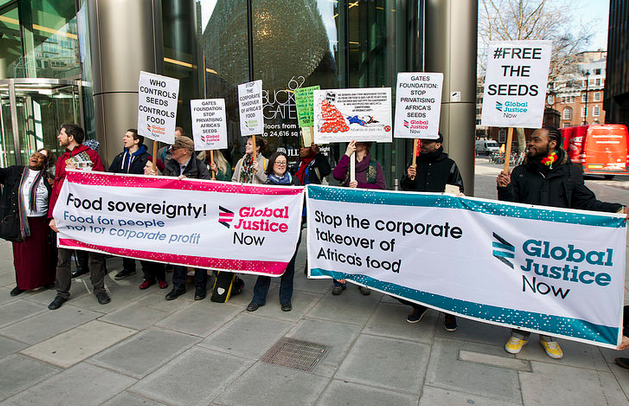
Food sovereignty activists are shining a light on a closed-door meeting between the Bill and Melinda Gates Foundation (BMGF) and the United States Agency for International Development (USAID), which are meeting in London on Monday with representatives of the biotechnology industry to discuss how to privatize the seed and agricultural markets of Africa.

Early Monday, protesters picketed outside the Gates Foundation’s London offices holding signs that called on the foundation to “free the seeds.” Some demonstrators handed out packets of open-pollinated seeds, which served as symbol of the “alternative to the corporate model promoted by USAID and BMGF.” Others smashed a piñata, which they said represented the “commercial control of seed systems;” thousands of the seeds which filled the pinata spilled across the office steps. A similar protest is expected later Monday in Seattle, Washington, where BMGF is headquartered.

The meeting was convened to discuss a report put forth by Monitor-Deloitte, which was commissioned by BMGF and USAID to develop models for the commercialization of seed production in Africa, especially “early generation seed,” and to identify ways in which the African governmental sectors could facilitate private involvement in African seed systems. The study was conducted in Ethiopia, Ghana, Nigeria, Tanzania and Zambia on maize, rice, sorghum, cowpea, common beans, cassava and sweet potato.

However, food sovereignty activists are sounding the alarm over the secret meeting. Heidi Chow, food sovereignty campaigner with Global Justice Now, which organized Monday’s protest, warned that the agenda being promoted by these stakeholders will only increase corporate control over seeds.

“This is not ‘aid’ – it’s another form of colonialism,” said Chow. “We need to ensure that the control of seeds and other agricultural resources stay firmly in the hands of small farmers who feed the majority of the population in Africa, rather than allowing big agribusiness to dominate even more aspects of the food system.”

In a blog post, Chow further explained:

For generations, small farmers have been able to save and swap seeds. This vital practice enables farmers to keep a wide range of seeds which helps maintain biodiversity and helps them to adapt to climate change and protect from plant disease. However, this system of seed saving is under threat by corporations who want to take more control over seeds. Big seed companies are keen to grow their market share of commercial seeds in Africa and alongside philanthropic organizations like the Gates Foundation and aid donors, they are discussing new ways to increase their market penetration of commercial seeds and displacing farmers own seed systems.

Corporate-produced hybrid seeds often produce higher yields when first planted, but the second generation seeds will produce low yields and unpredictable crop traits, making them unsuitable for saving and storing. This means that instead of saving seeds from their own crops, farmers who use hybrid seeds become completely dependent on the seed companies that sell them.

Further, many of the seeds produced by these biotechnology giants are sold alongside chemical fertilizer and pesticides, manufactured by the very same companies, the use of which often leads to widespread environmental destruction and other health problems.

As others noted, while the meeting attendees included representatives from the World Bank and Syngenta, the world’s third biggest seed and biotechnology company, no farmers or farming organizations were represented at the talks.

“Seeds are vital for our food system and our small farmers have always been able to save and swap seeds freely,” Ali-Masmadi Jehu-Appiah, chair of Food Sovereignty Ghana, said in a press statement. “Now our seed systems are increasingly under threat by corporations who are looking to take more control over seeds in their pursuit of profit. This meeting will push this corporate agenda to hand more control away from our small farmers and into the hands of big seed companies.”

Reporting on the Monitor-Deloitte study, Ian Fitzpatrick, a food sovereignty researcher for Global Justice Now, said that documents circulated ahead of the meeting revealed a neo-liberal agenda “laid bare.”

Fitzpatrick writes:

The report recommends that in countries where demand for patented seeds is weaker (i.e. where farmers are using their own seed saving networks), public-private partnerships should be developed so that private companies are protected from ‘investment risk’. It also recommends that that NGOs and aid donors should encourage governments to introduce intellectual property rights for seed breeders and help to persuade farmers to buy commercial, patented seeds rather than relying on their own traditional varieties.

Finally, in line with the broader neoliberal agenda of agribusiness companies across the world, the report suggests that governments should remove regulations (like export restrictions) so that the seed sector is opened up to the global market.

“This neoliberal agenda of deregulation and privatization, currently promoted in almost every sphere of human activity—from food production to health and education—poses a serious threat to food sovereignty and the ability of food producers and consumers to define their own food systems and policies,” Fitzpatrick adds.

AGRA Watch, a program of the grassroots group Community Alliance for Global Justice, notes that the BMGF-USAID commercial seed agenda further “extends U.S. foreign policy into Africa on behalf of corporate interests.”

Phil Bereano, food sovereignty campaigner with AGRA Watch and an Emeritus Professor at the University of Washington added: “This is an extension of what the Gates Foundation has been doing for several years—working with the US government and agribusiness giants like Monsanto to corporatize Africa’s genetic riches for the benefit of outsiders. Don’t Bill and Melinda realize that such colonialism is no longer in fashion? It’s time to support African farmers’ self-determination.”

The Pro-GMO Lobby: Anti-science and a Politically Motivated Agenda

gmo_crops_genfood_735_350-400x190

By Colin Todhunter

Source: RINF

The pro-GMO lobby claims that there is a scientific consensus on the safety of GM food and therefore the GMO debate is over. It claims that GMOs guarantee higher yields and less pesticide/herbicide use. The claim is also made that GM agriculture has no adverse impact on soil, the nutritional value and health of crops or biodiversity. The industry and its supporters claim that the ‘scientific community’ believes GMOs can only have positive effects and point to research to back this up.

These claims are bogus. Many analyses have highlighted the inadequacies of the research cited by the pro-GMO lobby, not least in terms of methodology, the glossing over of the significance of certain findings and conclusions that do not necessarily fit the evidence provided [1-3]. Moreover, numerous studies demonstrate the often worrying physiological abnormalities derived from ingesting GMOs as well as poor/falling yields, increased pesticide use, lower nutritional values and degraded soil and plant health (etc) associated with GM agriculture [4].

When certain pro-GMO figures proclaim that the debate over GMOs is over, their proclamations are based on propaganda, not science. They say that people who challenge their views are anti-science, politically motivated and are mounting a ‘campaign’ against the industry. Like all good propagandists, this is doublespeak.

Given the existing scientific evidence that challenges the claims of the pro-GMO lobby, a rational and reasonable response would involve applying a precautionary approach to GMOs [5] because there is clearly no scientific consensus. Yet public safety concerns are regarded by the GMO lobby as a barrier to bringing its products to the commercial market and are to be sidelined by all means possible [6-9]. To justify this, it promotes the falsehood that GMOs are ‘substantially equivalent’ to non-GMO products, which is certainly not the case [10].

It is therefore with good reason that concerned people have organised to ensure the precautionary principle is adopted or strengthened and to challenge the industry and officials that are driving the GMO agenda.

It is the GMO sector itself that is politically motivated, anti-science and mounting a campaign in favour of its products. Its faulty science has been challenged, and as a result it is unable to produce the evidence that would convince us that GMOs are safe and provide the benefits claimed. Little wonder the industry hides behind the notion of ‘commercial confidentiality’ to maintain a veil of secrecy over its own research that regulators too often accept at face value [11].

Having failed to win the day with science, it resorts to placing restrictions on independent research into its products, censors findings, intimidates, smears, bribes, uses fakery and has successfully used its wealth and power to hijack regulatory bodies and co-opt bodies and officials who propagate lies on its behalf [12-15]. Yet it is those who highlight and challenge such tactics who are attacked for attempting to derail an industry which likes to portray itself as working for the public interest.

One of the main PR weapons used by the sector is that anti-GMO campaigners are taking food from the mouths of the hungry [16]. Let’s get one thing clear: GMOs are not the answer to feeding the world [17-22] and that type of emotional blackmail will only ever work on the ignorant, misinformed and those who believe the industry’s propaganda.

There is enough scientific evidence to warrant serious concern over GMOs. After all, evidence is mounting that some of these companies may have already been poisoning us for decades with their cocktail of agricultural inputs [23,24].

However, it is easy for the layperson to become confused by an endless parade of studies claiming to back up one or other side of the debate. For that reason, sometimes they have to look beyond science to sharpen their focus. They have to look at motives. They must ask who is controlling the GMO agenda? For what purpose? What is the track record of those involved? Should we ever in a million years trust certain players given their criminal record [25]?

Commercial concerns are driven by profit. Capitalism compels companies to capture and maintain market shares. However, cartels, price rigging, threats, cronyism and having politicians in your back pocket are a much better guarantee to seize and dominate markets than any economic model taught in textbooks and based on the ‘free’ market being determined by supply and demand. Such economic theory is the smokescreen that modern day neoliberalism tries (but fails) to hide behind [26]. As far as the GMO issue is concerned, however, there is much more to it than the need to make a fast buck.

There is a reason why well-known proponents (Rockefeller, Gates) of depopulation and eugenics are involved with the GMO sector; there is a reason why these very people have funded a giant seed bank on an island in the Arctic [27,28]. There is a sinister side to this industry, which points to a heady mix of US geopolitical hegemony based on the global control of agriculture, the hijack of the world’s seeds and food supply and depopulation [29].

If the science around GMOs is confusing to some, then ambiguity is what powerful corporations want: the tobacco industry was happy for the waters to be muddied for decades over the link to lung cancer. But if ambiguity over the efficacy of GMOs does indeed reign, the underlying politics is much clearer to grasp.

colintodhunter.com 

Notes

1] http://gmwatch.org/index.php/news/archive/2014/15669-why-jon-entine-s-trillion-meal-study-won-t-save-us-from-gmo-dangers

2] http://gmwatch.org/index.php/news/archive/2014/15618-biology-fortified-misleads-the-public-on-gmo-safety

3] http://rightbiotech.tumblr.com/post/103665842150/correlation-is-not-causation

4] http://gmomythsandtruths.earthopensource.org/

5] http://www.theguardian.com/science/political-science/2013/jul/08/precautionary-principle-science-policy

6] http://corporateeurope.org/pressreleases/2014/07/agribusiness-biggest-lobbyist-eu-us-trade-deal-new-research-reveals

7] http://corporateeurope.org/trade/2013/05/open-door-gmos-take-action-eu-us-free-trade-agreement

8] http://www.gmfreeze.org/actions/42/

9] http://corporateeurope.org/food-and-agriculture/2014/05/biotech-lobbys-fingerprints-over-new-eu-proposal-allow-national-gmo

10] http://www.i-sis.org.uk/Substantial_Non-Equivalence.php

11] http://gmwatch.org/index.php/news/archive/2014/15519-the-glyphosate-toxicity-studies-you-re-not-allowed-to-see

12]http://indiatoday.intoday.in/story/Monsanto+’faked’+data+for+approvals+claims+its+ex-chief/1/83093.html

13] http://www.globalresearch.ca/gmo-scandal-the-long-term-effects-of-genetically-modified-food-on-humans/14570

14] http://www.gmwatch.org/latest-listing/1-news-items/12715-seralini-vs-fellous-a-gmo-libel-case-over-independent-expertise-and-science

15] http://www.globalresearch.ca/gmo-researchers-attacked-evidence-denied-and-a-population-at-risk/5305324

16] http://www.globalresearch.ca/the-gmo-biotech-lobbys-emotional-blackmail-and-bogus-claims-monsantos-genetically-modified-crops-will-not-feed-the-world/5407080

17] http://www.cban.ca/Resources/Topics/Feeding-the-World

18]http://www.srfood.org/images/stories/pdf/officialreports/20110308_a-hrc-16-49_agroecology_en.pdf

19] http://vivakermani.blogspot.in/2014/07/gm-food-crops-why-india-must-say-no.html

20] http://www.globalresearch.ca/india-genetically-modified-seeds-agricultural-productivity-and-political-fraud/5328227

21] http://unctad.org/en/PublicationsLibrary/tdr2013_en.pdf

22]http://www.unep.org/dewa/agassessment/reports/IAASTD/EN/Agriculture%20at%20a%20Crossroads_Global%20Report%20(English).pdf

23] http://naturalsociety.com/americans-suffering-chronic-disease-due-glyphosate-herbicides-new-study/

24] http://www.tonu.org/2013/12/03/shivchopra_squamish/

25] http://www.wakingtimes.com/2014/06/20/complete-history-monsanto-worlds-evil-corporation/

26] http://www.washingtonsblog.com/2013/05/is-every-market-rigged.html

27] http://www.naturalnews.com/034468_doomsday_seed_vault_secrets.html#

28]http://www.naturalnews.com/035105_bill_gates_monsanto_eugenics.html

29] http://www.globalresearch.ca/menace-on-the-menu-development-and-the-globalization-of-servitude/5416488

Monsanto Sues Maui for Direct Democracy, Launches New PR Campaign

maui monsanto protest

By Rebekah Wilce

Source: PR Watch

Residents of Maui County, Hawai’i voted on November 4 to ban the growing of genetically modified (GMO) crops on the islands of Maui, Lanai, and Molokai until scientific studies are conducted on their safety and benefits. Monsanto and Dow Chemical’s unit Mycogen Seeds have sued the county in federal court to stop the law passed by the people.

In Vermont, the Grocery Manufacturers Association (GMA, of which Monsanto and Dow were recently listed as members) has sued the state over its law requiring GMO labels. And Monsanto has a history of suing to prevent consumer labeling regarding its products. The company sued a number of dairies in the 1990s and 2000s for labeling milk free from recombinant bovine growth hormone (rBGH), which Monsanto developed and marketed as Posilac® (sold to Eli Lilly in 2008), the only commercially approved form. Vermont itself is no stranger to such suits. The International Dairy Foods Association sued Vermont for passing a law requiring labeling of milk containing rBGH (Monsanto wrote an amicus brief in support of the plaintiff, and GMA was a plaintiff-appellant) — and it won in federal court.

On the same day that Monsanto said it would challenge the decision of Maui’s citizens to regulate their own land and environment in court, the company also launched a new national advertising campaign as part of an effort to improve the image of the widely reviled company.

The glossy ads portray families of many cultures sitting down to eat gorgeous foods, invoking images more often seen in the pages of Saveur than in the hallways of one of the world’s largest chemical companies.

In addition to print ads in several national magazines and TV ads airing on national cable networks and several local stations in coastal cities, the campaign includes a slick new website launched in September, Discover.Monsanto.com.

The website invites questions from the public. The vast majority are skeptical, if not hostile. Others sound like they were written by Monsanto staff. Predictably, some of the hardest questions, like the one posed by Tim H., “In 2013, how much money has Monsanto spent on lobbyists in DC? What laws were these lobbyists attempting to create/amend and why?” are given short shrift.

Monsanto’s pretty TV ads target moms and millenials, according to the company’s corporate brand lead, Jessica Simmons. Monsanto has even hired a new “director of millenial engagement,” Vance Crowe, 32. He represented the company at a recent South by Southwest Eco conference in Austin, where revelations that Monsanto had paid for a panel of farmers to attend and present generated some excitement, as Tom Philpott reports in Mother Jones.

Crowe told NPR‘s “The Salt” blog, “[T]he challenge with something like SXSW Eco is that it doesn’t do anybody any good if people are so passionate that they’re yelling. The challenge is how can we enter the conversation so that people don’t feel like they have to yell to be heard?” Apparently, Crowe hopes to “enter the conversation” one party at a time. He enthusiastically describes how he and a gay colleague attended sessions on “sustainable fashion” and got invited to parties where they won fans and accolades.

Coincidentally, the front page of Discover.Monsanto.com contains, under “Here’s where we work,” a picture of corn crops being tended in Maui, with the text, “Hawaii’s unique climate allows for three to four growing seasons a year, reducing the time it takes us to develop new products. Our island roots go back more than 45 years.”

The marketing text may indicate the issue at the heart of Monsanto’s lawsuit against Maui. Those multiple growing seasons mean that “about 90 percent of all corn grown in the U.S. is genetically engineered and has been developed partially at Hawaii farms,” according to the Associated Press. Monsanto and the rest of the seed crop industry reap $146.3 million a year in sales from their activities in the state, according to a 2009 USDA report. Now Monsanto would have to substantially downsize its activity in Maui County in order to follow the new law, according to its lawsuit.

Monsanto’s new PR campaign seeks to make its brand approachable to the American consumer. Yet, with 92 percent of Americans demanding that GMO foods be labelled, according to a new Consumer Reports poll, Monsanto and its new millenial hires have their work cut out for them.

Consumer Reports recently put out a study on where GMOs are hiding in your food, including in packages labeled “natural.” You can access the report here.

Rebekah Wilce is a reporter and researcher who directs CMD’s Food Rights Network project.