The US Economy Looks Good On Paper – Here’s Why It’s Actually A Disaster In Progress

By Brandon Smith

Source: Alt-Market.us

One of my favorite false narratives floating around corporate media platforms has been the argument that the American people “just don’t seem to understand how good the economy really is right now.” If only they would look at the stats, they would realize that we are in the middle of a financial renaissance, right? It must be that people have been brainwashed by negative press from conservative sources…

I have to laugh at this claim because it’s a very common one throughout history – It’s an assertion made by almost every single political regime right before a major collapse. These people always say the same things, and when you study economics as long as I have you can’t help but throw up your hands and marvel at their dedication to the propaganda.

One example that comes to mind immediately is the delusional optimism of the “roaring” 1920s and the lead up to the Great Depression. At the time around 60% of the US population was living in poverty conditions (according to the metrics of the decade) earning less than $2000 a year. However, in the years after WWI ravaged Europe, America’s economic power was considered unrivaled.

The 1920s was an era of mass production and rampant consumerism but it was all fueled by easy access to debt, a condition which had not really existed before in America. It was this illusion of prosperity created by the unchecked application of credit that eventually led to the massive stock market bubble and the crash of 1929. This implosion, along with the Federal Reserve’s policy of raising interest rates into economic weakness, created a black hole in the US financial system for over a decade.

There are two primary tools that various failing regimes will always use to distort the true conditions of the economy: Debt and inflation. In the case of America today, we are experiencing BOTH problems simultaneously and this has made certain economic indicators appear healthy when they are, in fact, highly unstable. The average American knows this is the case because they see the effects daily. They see the damage to their wallets, to their buying power, in the jobs market and in their quality of life. This is why public faith in the economy has been stuck in the dregs since 2021.

The establishment can shove out-of-context stats in people’s faces, but they can’t force the populace to see a recovery that simply does not exist. Let’s go through a short list of the most faulty indicators and the real reasons why the fiscal picture is not as rosy as the media would like us to believe…

The “Miracle” Labor Market Recovery

In the case of the US labor market, we have a clear example of distortion through inflation. The $8 trillion+ dropped on the economy in the first 18 months of the pandemic response sent the system over the edge into stagflation land. Helicopter money has a habit of doing two things very well: Blowing up a bubble in stock markets and blowing up a bubble in retail. Hence, the massive rush by Americans to go out and buy, followed by the sudden labor shortage and the race to hire (mostly for low wage part-time jobs).

The problem with this “miracle” is that inflation leads to price explosions, which we have already experienced. The average American is spending around 30% more for goods, services and housing compared to what they were spending in 2020. This is what happens when you have too much fiat money chasing too few goods and limited production.

The jobs market looks great on paper, but the majority of jobs generated in the past few years are jobs that returned after the covid lockdowns ended (the same lockdowns Democrats tried to keep in place perpetually). The rest are jobs created through monetary stimulus, and then there is the issue of “immigrant jobs” and data that is revised to the negative months later.  I suspect we won’t ever hear the real stats unless Trump enters office in 2025.  Then the media discussion will focus intently on how terrible the labor market really is.

Part time low wage service sector jobs are not going to keep the country rolling for very long in a stagflation environment. The question is, what happens now that the stimulus punch bowl has been removed?

Just as we witnessed in the 1920s, Americans have turned to debt to make up for higher prices and stagnant wages by maxing out their credit cards to historic levels. With the central bank keeping interest rates high, the credit safety net will soon falter. This condition also goes for businesses; businesses that will soon jump headlong into mass layoffs when they realize the party is over.  It happened during the Great Depression and it will happen again today.

Stock Market Bonanza

We saw cracks in in the armor of the financial structure in 2023 with the spring banking crisis, and without the abrupt Federal Reserve backstop many more small and medium banks would have dropped dead. The weakness of US banks is offset by the relative strength of the US dollar, which lures in foreign investors hoping to protect their wealth using dollar denominated assets.

But something is amiss. Gold and Bitcoin have rocketed higher along with stocks and the dollar. This is the opposite of what’s supposed to happen. Gold and BC are supposed to be hedges against a weak dollar and weak equities, right? If global faith in the dollar and in stocks is so high, why are investors diving into protective assets like gold?

Again, as noted above, inflation distorts everything. Tens of trillions of extra dollars printed by the Fed are floating around and it’s no surprise that much of that cash is flooding into the stock market which simply pushes higher right along with prices on the shelf. But, gold and BC are telling us a more nuanced story about what’s really happening.

Right now, the US government is adding around $1 Trillion every 100 days to the national debt as the Fed holds rates higher to fight inflation.  Higher interest means exponential debt conditions, and this debt is going to crush America’s financial standing for global investors who will eventually ask HOW the US is going to handle that growing millstone? As I predicted years ago, the Fed has created a perfect Catch-22 scenario in which the US must either return to rampant inflation, or, face a debt breakdown. In either case, US dollar denominated assets will lose their appeal and stock markets will ultimately plummet.

Beyond this reality, stocks are not a leading indicator of anything, let alone the stability of the financial system. Stocks are a trailing indicator; they crash well after all the other warning signals have made it obvious that something is wrong. Average Americans, for good reason, do not care what stock markets have to say.

Healthy GDP Is A Complete Farce

Beyond the stock market, GDP is the most common out-of-context stat used by governments to convince the citizenry that all is well. It is yet another stat that is entirely manipulated by inflation. It is also manipulated by the way in which modern governments define “production and market value.”

GDP is primarily driven by spending. Meaning, the higher inflation goes, the higher prices go, and the higher GDP climbs (to a point). Eventually prices go too high, credit cards tap out and spending ceases. But, for a short time inflation makes GDP (as well as retail) look good.

Another factor that creates a bubble is the reality that government spending is actually included in the calculation of GDP. That’s right, every dollar of your tax money that the government wastes helps the establishment by propping up GDP numbers. This is why government spending increases will never stop – It’s too valuable for them to spend as a way to make the economy appear healthier than it is.

The Real Economy Is Eclipsing The Fake Economy

The bottom line is that Americans used to be able to ignore the warning signs because their bank accounts were not being directly affected. This is over. Now, every person in the country is dealing with a massive decline in buying power and higher prices across the board in all assets. Even the wealthy are seeing a compression to their profits and many are struggling to keep their businesses in the black.

The unfortunate truth is that the elections of 2024 will probably be the turning point at which the whole edifice comes tumbling down. Even if the public votes for change, the system is already broken and cannot be repaired without a complete overhaul. We have consistently avoided taking our medicine and our weaknesses have only accumulated.

People have lost faith in the economy because they have not faced this kind of uncertainty since the 1930s. Even the stagflation crisis of the 1970s will likely pale in comparison to what is about to happen. On the bright side, at least a large number of Americans are aware of the threat, as opposed to the 1920s when the vast majority of people were utterly conned by the government, the banks and the media into thinking all was well. Knowing is the first step to preparing.

Economic Earthquake Ahead? The Cracks Are Spreading Fast

By Brandon Smith

Source: The Burning Platform

One of my favorite false narratives floating around corporate media platforms has been the argument that the American people “just don’t seem to understand how good the economy really is right now.” If only they would look at the stats, they would realize that we are in the middle of a financial renaissance, right? It must be that people have been brainwashed by negative press from conservative sources…

I have to laugh at this notion because it’s a very common one throughout history – it’s an assertion made by almost every single political regime right before a major collapse. These people always say the same things, and when you study economics as long as I have you can’t help but throw up your hands and marvel at their dedication to the propaganda.

One example that comes to mind immediately is the delusional optimism of the “roaring” 1920s and the lead up to the Great Depression. At the time around 60% of the U.S. population was living in poverty conditions (according to the metrics of the decade) earning less than $2000 a year. However, in the years after WWI ravaged Europe, America’s economic power was considered unrivaled.

The 1920s was an era of mass production and rampant consumerism but it was all fueled by easy access to debt, a condition which had not really existed before in America. It was this illusion of prosperity created by the unchecked application of credit that eventually led to the massive stock market bubble and the crash of 1929. This implosion, along with the Federal Reserve’s policy of raising interest rates into economic weakness, created a black hole in the U.S. financial system for over a decade.

There are two primary tools that various failing regimes will often use to distort the true conditions of the economy: Debt and inflation. In the case of America today, we are experiencing BOTH problems simultaneously and this has made certain economic indicators appear healthy when they are, in fact, highly unstable. The average American knows this is the case because they see the effects everyday. They see the damage to their wallets, to their buying power, in the jobs market and in their quality of life. This is why public faith in the economy has been stuck in the dregs since 2021.

The establishment can flash out-of-context stats in people’s faces, but they can’t force the populace to see a recovery that simply does not exist. Let’s go through a short list of the most faulty indicators and the real reasons why the fiscal picture is not a rosy as the media would like us to believe…

The “miracle” labor market recovery

In the case of the U.S. labor market, we have a clear example of distortion through inflation. The $8 trillion+ dropped on the economy in the first 18 months of the pandemic response sent the system over the edge into stagflation land. Helicopter money has a habit of doing two things very well: Blowing up a bubble in stock markets and blowing up a bubble in retail. Hence, the massive rush by Americans to go out and buy, followed by the sudden labor shortage and the race to hire (mostly for low wage part-time jobs).

The problem with this “miracle” is that inflation leads to price explosions, which we have already experienced. The average American is spending around 30% more for goods, services and housing compared to what they were spending in 2020. This is what happens when you have too much money chasing too few goods and limited production.

The jobs market looks great on paper, but the majority of jobs generated in the past few years are jobs that returned after the covid lockdowns ended. The rest are jobs created through monetary stimulus and the artificial retail rush. Part time low wage service sector jobs are not going to keep the country rolling for very long in a stagflation environment. The question is, what happens now that the stimulus punch bowl has been removed?

Just as we witnessed in the 1920s, Americans have turned to debt to make up for higher prices and stagnant wages by maxing out their credit cards. With the central bank keeping interest rates high, the credit safety net will soon falter. This condition also goes for businesses; the same businesses that will jump headlong into mass layoffs when they realize the party is over. It happened during the Great Depression and it will happen again today.

Cracks in the foundation

We saw cracks in the narrative of the financial structure in 2023 with the banking crisis, and without the Federal Reserve backstop policy many more small and medium banks would have dropped dead. The weakness of U.S. banks is offset by the relative strength of the U.S. dollar, which lures in foreign investors hoping to protect their wealth using dollar denominated assets.

But something is amiss. Gold and bitcoin have rocketed higher along with economically sensitive assets and the dollar. This is the opposite of what’s supposed to happen. Gold and BTC are supposed to be hedges against a weak dollar and a weak economy, right? If global faith in the dollar and in the U.S. economy is so high, why are investors diving into protective assets like gold?

Again, as noted above, inflation distorts everything.

Tens of trillions of extra dollars printed by the Fed are floating around and it’s no surprise that much of that cash is flooding into the economy which simply pushes higher right along with prices on the shelf. But, gold and bitcoin are telling us a more honest story about what’s really happening.

Right now, the U.S. government is adding around $600 billion per month to the national debt as the Fed holds rates higher to fight inflation. This debt is going to crush America’s financial standing for global investors who will eventually ask HOW the U.S. is going to handle that growing millstone? As I predicted years ago, the Fed has created a perfect Catch-22 scenario in which the U.S. must either return to rampant inflation, or, face a debt crisis. In either case, U.S. dollar-denominated assets will lose their appeal and their prices will plummet.

“Healthy” GDP is a complete farce

GDP is the most common out-of-context stat used by governments to convince the citizenry that all is well. It is yet another stat that is entirely manipulated by inflation. It is also manipulated by the way in which modern governments define “economic activity.”

GDP is primarily driven by spending. Meaning, the higher inflation goes, the higher prices go, and the higher GDP climbs (to a point). Eventually prices go too high, credit cards tap out and spending ceases. But, for a short time inflation makes GDP (as well as retail sales) look good.

Another factor that creates a bubble is the fact that government spending is actually included in the calculation of GDP. That’s right, every dollar of your tax money that the government wastes helps the establishment by propping up GDP numbers. This is why government spending increases will never stop – It’s too valuable for them to spend as a way to make the economy appear healthier than it is.

The REAL economy is eclipsing the fake economy

The bottom line is that Americans used to be able to ignore the warning signs because their bank accounts were not being directly affected. This is over. Now, every person in the country is dealing with a massive decline in buying power and higher prices across the board on everything – from food and fuel to housing and financial assets alike. Even the wealthy are seeing a compression to their profit and many are struggling to keep their businesses in the black.

The unfortunate truth is that the elections of 2024 will probably be the turning point at which the whole edifice comes tumbling down. Even if the public votes for change, the system is already broken and cannot be repaired without a complete overhaul.

We have consistently avoided taking our medicine and our disease has gotten worse and worse.

People have lost faith in the economy because they have not faced this kind of uncertainty since the 1930s. Even the stagflation crisis of the 1970s will likely pale in comparison to what is about to happen. On the bright side, at least a large number of Americans are aware of the threat, as opposed to the 1920s when the vast majority of people were utterly conned by the government, the banks and the media into thinking all was well. Knowing is the first step to preparing.
The second step is securing your own financial future – that’s where physical precious metals can play a role. Diversifying your savings with inflation-resistant, uninflatable assets whose intrinsic value doesn’t rely on a counterparty’s promise to pay adds resilience to your savings. That’s the main reason physical gold and silver have been the safe haven store-of-value assets of choice for centuries (among both the elite and the everyday citizen).

How Money Printing Made Supply Chain Disruptions Even Worse

By Nicholas Baum

Source: Activist Post

Over the last few years, an unwelcome phrase has grown to plague American consumers and producers alike: supply chain issues. The recurring term is frequently offered by mainstream economists as the go-to explanation for record inflation, while the Biden Administration has seemingly twisted it into a sign of economic recovery. Commerce Secretary Gina Raimondo states,

“What we have here is a demand issue. The economy is doing better… People have money in their pocket. They’re spending that money. Demand is through the roof… Supply has to catch up.”

Although Raimondo said this back in October 2021, inflation has only worsened from an annual rate of 6.2 percent to 7.7 percent more than twelve months later, leading one to wonder if the Secretary is right that inflation is a matter of supply chains adjusting to an increase in wealth. Yet as it turns out, in the words of the Mises Institute’s Ryan McMaken, “the administration’s defenders are right about consumer demand and spending – even if for the wrong reasons.”

That is, although we’re indeed witnessing a large spike in demand (which is perhaps best quantified by changes in nominal GDP), this increase in demand is a symptom of a larger problem: the massive expansion of the money supply under the watch of the Federal Reserve and the White House. The implications of this unprecedented expansion are two-fold, not only stirring this increase in “demand” but contributing to supply chain issues through the distortion of price signals.

With state governments responding to the rise of Covid-19 by imposing lockdowns and forcibly closing “non-essential businesses,” both the Fed and the Trump and Biden Administrations stepped in with an extraordinarily expansive monetary and fiscal policy, respectively.

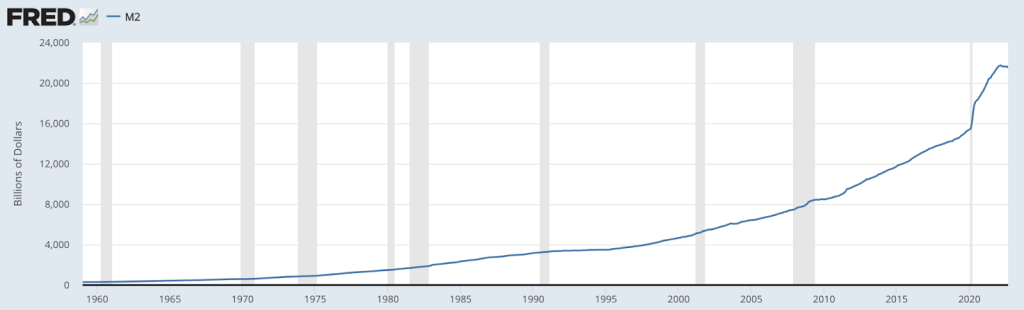
M2 is a figure for the money supply, which surged by more than $6.2 trillion, a 40 percent increase, between February 2020 and February 2022. This is the result of a variety of initiatives, from the Fed’s quantitative easing and purchase of over $2 trillion in assets to new federal programs such as stimulus checks, PPP loans, and the $1.9 trillion American Rescue Plan Act.

Through these ventures that flooded the economy with new cash, Americans indeed had more money in their pockets. The problem is, obviously, that such money soon became worth a lot less. That’s because an increase in the money supply, without a corresponding increase in economic output, means an increase in prices, with more money chasing roughly the same quantity of goods.

This is where Raimondo serves to mislead viewers in her comments; just because Americans have more money, doesn’t mean they’re any wealthier. There certainly is a large spike in demand, but that doesn’t represent an increase in the real wealth of Americans, but an increase in the amount of money they have access to thanks to an unprecedented monetary expansion.

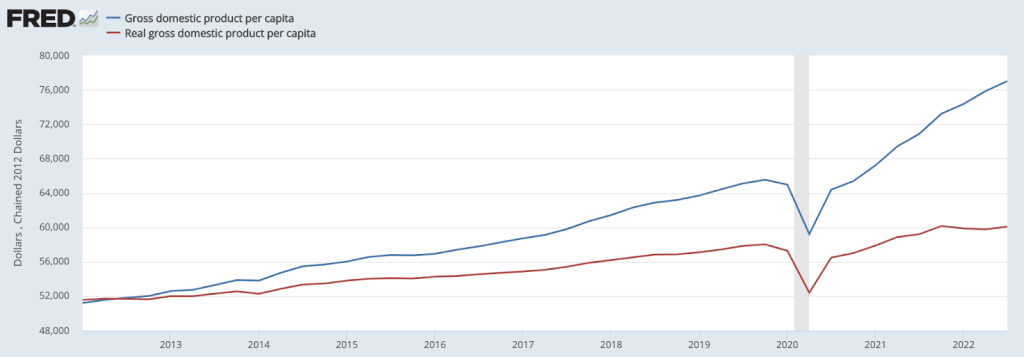
This is perhaps best represented by comparing nominal to real GDP per capita, which is a rough proxy for standard of living:

If you were to look only at nominal GDP per capita (the blue line) you would think that the average American’s wealth has increased greatly since the pandemic. This, however, is incredibly misleading, because it doesn’t take into account inflation and the decreasing value of the dollar.

The large demand increase noted by Raimondo and other economists does not reflect a growing economy and an increase in wealth but an increase in the money supply which has created upward pressure on prices. Yet just as the Biden Administration declares that “supply has to catch up,” the ability for producers to do so has been greatly strained by inflation (not to mention the aforementioned lockdowns).

That’s because of the role prices—which economist Alex Tabarrok refers to as “a signal wrapped up in an incentive” —play in coordinating economic activity. Changes in prices usually convey changes in the scarcity and demand for different goods, products, and resources. When the price of something in a company’s supply chain increases, this hurts the company’s profitability and incentivizes it to economize and find a more efficient alternative.

On a macro scale, economic growth (or recovery) comes through thousands, if not millions, of businesses and firms finding new ways to innovate and maximize profits, which is the result of comparing the prices of alternative inputs and production methods. Inflation, by raising the general price level of the economy and often affecting the price of each good differently, can cause economic discoordination and confusion because prices no longer reflect changing efficiencies and scarcities.

Even if inflation impacted all prices equally, we still wouldn’t know to what extent a rise in the price of a certain resource reflects actually important information about it, given that the rate of inflation is always changing and can only be measured in hindsight.

In the context of the last few years, this has meant that firms have essentially been blindfolded, piecing back together supply chains forcibly closed during the pandemic without the ability for prices to convey the efficiency of competing alternatives. This is exactly why “supply chain issues” has continued to be a lingering excuse for inflation and shortages, with Volkswagen chief executive Oliver Blume going so far as to say that, “Challenges to our supply chains will become the rule, not the exception.”

Nor is this a relatively recent phenomenon. Paul Volcker, the late Fed Chairman notable for remedying the United States’ last encounter with runaway inflation in the late 1970s and early 1980s, observed that, “The inflationary process itself brought so many dislocations, and stresses and strains that you were going to have a recession sooner or later.”

Given the fact that the United States technically entered a recession during the first half of 2022—at least according to a common definition of recession—Volcker’s words proved prescient. Not only has an unprecedented monetary expansion under the purview of the Fed and White House triggered a dangerous period of inflation; the inflation has also caused disruptions to the supply chain, which agencies (ironically) use as a scapegoat for inflation.

Now, with economic growth stagnant and inflation persisting at high levels, the fate of supply, demand, and the price signals that they convey rests in the hands of the problems’ culprits.

The Worst Economic Gloom In 50 Years

By Michael Snyder

Source: Activist Post

We haven’t seen anything like this in decades.  Energy prices are soaring to unprecedented heights.  Food shortages in some parts of the world are starting to become quite severe.  Rampant inflation is out of control all over the globe.  Meanwhile, economic activity is slowing down everywhere that you look.  Some are comparing this current crisis to the “stagflation” of the 1970s, but I believe that is a far too optimistic assessment.  Just about everyone can see that economic conditions are rapidly deteriorating, and there is a tremendous amount of alarm about what the months ahead will bring.

According to a brand new Wall Street Journal-NORC survey that was just released, the percentage of Americans that believe that the state of the U.S. economy is “poor or not so good” is 83 times larger than the percentage of Americans who believe that the state of the U.S. economy is “excellent”…

A severe pessimism grips the U.S. economy and Americans report the highest level of dissatisfaction with their financial situation in at least half a century, poll results released Monday show.

Eighty-three percent of Americans describe the state of the economy as poor or not so good, according to a Wall Street Journal-NORC Poll. Only one percent describe the economy as “excellent.”

I would like to talk to someone from the one percent of Americans who still believe that the U.S. economy is in “excellent shape”.

To me, it is always fascinating to find someone who can completely deny reality even when all of the evidence points in the other direction.

The same survey found that the percentage of Americans who are “not at all satisfied with their financial condition” is the highest in at least 50 years

Thirty-five percent said they are not at all satisfied with their financial condition, the highest level of dissatisfaction since NORC began asking the question every few years starting in 1972.

Sixty-three percent of Americans say they are extremely or very concerned about the price of gas. Fifty-four percent say they are extremely or very concerned about the impact of high grocery prices on their household’s financial situation. Just 13 percent say they not very or not at all concerned about gas prices and 19 percent about grocery prices.

In other words, this is the gloomiest that Americans have been about their own personal finances in at least five decades.

Wow.

One of the big reasons why people feel this way is because the price of just about everything is going up.

In particular, the price of gasoline has been making national headlines just about every day.  On Tuesday, it set another brand new record

The national average price of gas is now $4.955, reflecting an over three-cent jump overnight, 28-cent rise in the last week, and nearly 64-cent rise in the last month. Diesel also hit another record on Tuesday, reaching $5.719.

Currently, 16 states are experiencing an average price of gas of $5.00 or more. That includes Maine ($5.023), Massachusetts ($5.21), New Jersey ($5.032), Pennsylvania ($5.031), Michigan ($5.214), Ohio ($5.061), Indiana ($5.234), Illinois ($5.532), Idaho ($5.025), Alaska ($5.469), Hawaii ($5.493), Washington ($5.489), Oregon ($5.485), Nevada ($5.564), Arizona ($5.181), and California ($6.390). California’s Mono County appears to be reporting the highest gas price average in the Golden State — $7.213.

Unfortunately, there is a growing consensus among the experts that this is just the beginning.  Here is one example

With the summer travel season just getting underway, demand for gasoline, coupled with the cut-off of Russian oil shipments due to the war in Ukraine, is sending oil prices higher on global markets.

The national average for gasoline could be close to $6 by later this summer according to Tom Kloza, global head of energy analysis for the OPIS, which tracks gas prices for AAA.

And here is another example

GasBuddy head of petroleum analysis Patrick De Haan provided insight into record-high gas prices, warning on Wednesday that “we’re going to be swimming in these high prices for a while.”

Speaking on “Varney & Co.” on Wednesday, De Haan also revealed his forecasts for how high prices at the pump will climb, arguing that they could reach a national average of $6 a gallon in the coming months, but “what seems like more of a guarantee is that $5 mark.”

Others are even more pessimistic.  In fact, the head of commodity trading giant Trafigura just warned that the price of oil could actually make a “parabolic ” move in the months ahead.

Needless to say, energy prices have a domino effect throughout the entire economy.  When commentator Anthony B. Sanders contacted moving companies about his coming move out of state, he could hardly believe the quotes that he was given

As I line up my move from Fairfax VA to Columbus OH, I am getting a variety of quotes from moving companies. And wow! The cost of moving using a national moving company for a 4 bedroom house is $15,000 to $20,500. That includes International, North American and Bekins.

One of the reasons for the high cost of moving is the massive increase in diesel fuel used for trucking. Diesel fuel under Biden has risen 117%. And since it was revealed that natural gas often is used for electric charging stations, and NATGAS is up 281% under Biden (but there aren’t many electric moving trucks yet).

Could you imagine paying $20,000 to move from Virginia to Ohio?

In the old days, you could purchase your own new vehicle for that much money.

In this crazy environment, some companies are attempting to hide inflation by shrinking their package sizes

“Joining the parade of downsized products is cereal stalwart Honey Bunches of Oats, which has seen the weight of its standard box, previously 14.5 ounces, lessen to 12 ounces — a reduction of roughly 17 percent,” the U.K. paper said.

Angel Soft toilet paper has also reduced its size from 425 sheets per roll to 320, while Bounty paper towels have cut their rolls from 165 sheets per roll to 147 late last year. Gatorade also cut its bottle size from 32 ounces to 28 ounces.

Do they actually believe that we will not notice that the packages have changed?

And this isn’t just happening here in the United States.  At this point, this is taking place all over the globe

In the U.S., a small box of Kleenex now has 60 tissues; a few months ago, it had 65. Chobani Flips yogurts have shrunk from 5.3 ounces to 4.5 ounces. In the U.K., Nestle slimmed down its Nescafe Azera Americano coffee tins from 100 grams to 90 grams. In India, a bar of Vim dish soap has shrunk from 155 grams to 135 grams.

Our standard of living is falling with each passing day, and that process is only going to accelerate during the second half of this year.

In a desperate attempt to keep living the way that they always have, many Americans are turning to their credit cards at an alarming rate.

Needless to say, that is only a short-term solution.

And at the same time, overall economic activity continues to slow down

A closely followed measurement from the Atlanta Federal Reserve Bank suggests the economy could be headed for a second-quarter decline in gross domestic product, the broadest measure of goods and services produced in a country. The GDPNow tracker shows the economy grew at an annualized pace of just 0.9% in the spring, a steep decline from its previous estimate of 1.3% on June 1.

If U.S. GDP is actually negative for the second quarter, that will be two quarters in a row, and that will mean that we are officially in a recession right now.

But what we are heading into in 2023 and beyond is not going to be just a “recession”.

Ultimately, we are heading into the sort of “nightmare scenario” that I have warned about for years.

It took decades of very foolish decisions for us to reach this point, and our leaders in Washington continue to make very foolish decisions.

So the truth is that there are no long-term solutions in sight.

Only pain.

So if the American people are this upset about the economy now, how will they be feeling six months down the road?

The Fed Has Triggered A Stagflationary Disaster That Will Hit Hard This Year

By Brandon Smith

Source: Alt-Market.US

I don’t think I can overstate the danger that the U.S. economy is in right now as we enter 2022. While most people are caught up in the ongoing drama of Covid-19, a REAL threat looms over the nation in the form of a stagflationary tidal wave. The mainstream media is attempting to place the blame on “supply chain disruptions,” but this is a misrepresentation of the issue.

The two factors are indeed intertwined, but the reality is that inflation is the cause of supply chain disruptions, not the result of supply chain disruptions. If we look at the underlying stats for price rises in essential products we can get a clearer picture.

Before I get into my argument, I really want to stress that this is a precarious time and I suggest that people prepare accordingly. In just the past few months I have seen personal expenses rise at least 20% overall, and I’m sure it’s the same or worse for most of you. Stocking necessities and safe-haven investments with intrinsic value like physical precious metals are a good choice for protecting whatever buying power your dollars have left…

Higher prices everywhere

The Consumer Price Index (CPI) is officially at the highest levels in 40 years. CPI measurements often diminish the scale of the problem because they do not include things like food, energy and housing which are core expenses for the public. CPI calculations have also been “adjusted” over the past few decades by the government to express a more positive view on inflation. If we look at the inflation numbers at Shadowstats, calculated according to the same methods they used in the 1980’s, we see a dramatic increase in CPI which paints a more dire (but more accurate) picture.

U.S. food prices have spiked to levels not seen since 2008 at the onset of the credit and derivatives collapse that brought about tens of trillions of dollars in Federal Reserve bailouts.

If we look beyond the 2008 crisis, food costs do not see a similar jump until the 1980s. Rising food prices in the US are often obscured by creative accounting and “shrinkflation” (shrinking packages and rising prices), but if we look at global food prices the average is a 30% jump in the past year.

Rental and home prices have also gone into the stratosphere. Rental costs went up around 18% in 2021, and this is an extension of a trend that has been prevalent for the past decade. Prices have been rising for a while, it’s just that now the avalanche has accelerated.

Home prices are currently out of the range of most new potential home buyers. Values jumped 16% in the past year alone, with the average property costing $408,000. Home sales continue to remain elevated compared to two years ago despite inflating prices for one reason and one reason only – the mass migration of Americans away from the draconian mandates and bureaucracy of blue states into more conservative states.

I live in Montana, a primary destination for people relocating, and from my experience the majority of these people are conservatives seeking to escape the vaccine and lockdown mandates in places like California, New York and Illinois. They see the writing on the wall and they are trying to get ahead of the economic and social calamity that will surely befall such states.

I would also note that home sales have finally begun to flatten in the past six months but prices are not dropping, which is a trend that I think needs to be explored further because it illustrates the larger issue of stagflation.

When inflation becomes stagflation

Understand that prices are not just rising because of increased demand (demand is starting to fall in many sectors), prices are rising because of increased money supply and dollar devaluation which is not yet being reflected in the Dollar Index.

Take a look at U.S. GDP and you will see that for the past several years it has tracked in tandem with price inflation. Obviously, if prices inflate then this means people are spending more, which then leads to higher U.S. GDP; it’s like magic, right? In other words, inflation makes it seem as though U.S. GDP is always improving.

However, this has not been the case in the past couple of years.

Official GDP has flattened despite the fact that U.S. money supply and inflation have rocketed higher. What does this mean? I believe it is a sign of stagflation and a reckoning in 2022. If we examine inflation adjusted GDP numbers from Shadowstats we see that GDP has declined rather aggressively in the past couple of years.

We can also see odd tendencies in oil and gasoline prices. While it’s true that gas prices have been higher in the past, this does not address the full context of the situation. U.S. travel spending has declined 12% since 2019 and airline travel has dropped at least 21% in the past year. Average gasoline usage dropped after 2019 and still has not recovered. Yet, gas prices continue to rise? In other words, travel demand is stagnant but prices are INCREASING – this is another signal of inflationary pressures and dollar devaluation. Oil is priced in dollars globally, and therefore any inflation in the dollar will be readily visible in oil. This would help explain why pandemic paranoia and reduced travel have not caused gas prices to drop.

If the current momentum continues the majority of necessities in the U.S. will not be affordable for most people by next year. We are looking at a fast-moving decline in production along with a swift explosion in prices. In other words, a stagflationary disaster.

This is the Federal Reserve’s fault

I and many other alternative economists have been warning about the inevitable inflation/stagflation crisis for years, but the most important factor to understand is WHO is responsible this event?

The mainstream financial media is going to protect the government and the Federal Reserve at all costs during this breakdown. They are going to blame Covid, the lockdowns here and overseas as well as the supply chain bottleneck.

The Fed is the true culprit, though.

While there have been many American Presidents and other politicians that have supported the Fed in its inflationary activities, the central bank itself needs to be held accountable for the downturn that is about to occur. This is a process that started back at the founding of the Fed, but spread like cancer after the crash of 2008 and the introduction of 12+ years of stimulus and bailout measures along with near-zero interest rates.

The inflationary end-game

The pandemic is the perfect cover for the inflationary end game. In 2008 the response to the crisis was to print and pump dollars into banks and corporations in the U.S. and around the globe. This money supply was held in corporate coffers and in central banks overseas, which slowed the effects of inflation. This set the precedent for subversive stimulus policies by giving the Fed a blank check to do whatever it wanted.

In 2020, the Fed created trillions more but this time the money was injected directly into the U.S. economy through Covid stimulus checks, PPP loans and other measures. In the alternative economic field we call this “helicopter money.” These dollars triggered a massive retail buying spree in 2020, but with more dollars in the economy chasing less goods prices are now spiking much higher.

The big discussion today is whether or not the Fed will taper their asset purchases, reduce their balance sheet and raise interest rates to counter inflation?

The fact is it won’t matter; inflation/stagflation will continue or even accelerate as the Fed tapers. With a taper comes the threat of a flattening yield curve in Treasury bonds as well as the danger of bonds and dollars being dumped by foreign investors and central banks. If the trillions upon trillions of dollars being held overseas come flooding back into the U.S., inflation will continue at its current pace or erupt even higher. In fact, the world’s ownership of dollars reached a 26-year low recently. The global transition away from the dollar, toward inflation-resistant investments, has already begun.

This is not a policy error

I explained this Catch-22 threat in my recent article The Fed’s Catch-22 Taper Is a Weapon, Not a Policy Error. In that essay I outline the Fed’s documented history of creating economic disasters that conveniently end up benefiting their friends in the international banks.

I also explained (with evidence) how the Federal Reserve actually takes its marching orders from the Bank for International Settlements, a globalist institution which along with the International Monetary Fund and World Economic Forum is openly seeking a one-world economic system and one-world currency system.

I do not believe that the Fed’s actions are a product of ignorance or stupidity or basic greed. I do not believe the Fed is scrambling to keep the U.S. economy afloat. I believe according to the evidence that the Fed knows exactly what it is doing. The pandemic offers a perfect scapegoat for an engineered crash of the U.S. economy which the Fed is trying to facilitate.

Why? Because the more desperate people are financially, the easier they are to buy off with false promises and a loaf of bread. They are easier to control. On top of that, with the U.S. economy reduced to second- or third-world status, it is easier to sell the public on the predetermined solution – total global centralization and far less freedom.

As the stagflationary crash plays out, never forget who was really the cause of the public’s suffering. In the fog of national crisis it is easy for the establishment to shift blame and responsibility and to cloud the truth. The inflation calamity is about to get much worse, and as it does we need to rally newly awakened people to take action against the central bankers and globalists behind it.

Mass Distraction And Fake “V-Shaped” Recovery Provide Cover For The Fed Induced Crash

By Brandon Smith

Source: Alt-Market.com

This article, originally titled ‘The Fed Just Got Cover For The Collapse Of The US Economy’, was written by Brandon Smith and first published at Birch Gold Group

The scapegoating has already started. In almost every sector of the economy that is collapsing, the claim is that “everything was fine until the pandemic happened”. From tumbling web news platforms to small businesses to major corporations, the coronavirus outbreak and the national riots will become the excuse for failure. The establishment will try to rewrite history and many people will go along with it because the truth makes them look bad.

And what is the truth? The truth is that the U.S. economy – and in some ways, the global economy – was already collapsing. The system’s dependency on ultra-low interest rates and central bank stimulus created perhaps the largest debt bubble in history – the Everything Bubble. And that bubble began imploding at the end of 2018, triggered primarily by the Federal Reserve raising rates and dumping its balance sheet into economic weakness, just like it did at the start of the Great Depression. Fed Chair Jerome Powell knew what would happen if this policy was initiated; he even warned about it in the minutes of the October 2012 Federal Open Market Committee, and yet once he became the head of the central bank, he did it anyway.

For a year leading up to the pandemic, the Fed was struggling to maintain and suppress a repo market liquidity crisis. National debtcorporate debt and consumer debt were at all-time highs. Companies were desperate for new stimulus, and they were getting crumbs from the Fed, rather than the tens of trillions that they needed just to stay afloat. The central bank had sabotaged the economy, but they had to keep it in a state of living death until they had a perfect cover event for the collapse. The pandemic and inevitable civil unrest do the job nicely.

What many people do not understand is that the Fed does not care about the economy. In fact, every Fed action since its inception in 1913 has led to the downfall of the U.S. The Fed is not a maintenance man trying to stave off collapse; the Fed is a suicide bomber willing to destroy everything including itself in order to serve a greater ideology.

Total global centralization is the goal, and every new disaster is exploited to this end by the establishment. “Order out of chaos” is the motto of the global elites; in other words, in every crisis there is “opportunity”. This crisis has been no different. Suggested solutions have ranged from the creation of a cashless society operating on a digital currency system, to permanent lockdowns in the name of stopping “global warming”, to a surveillance state and medical tyranny utilizing 24/7 tracking of citizens in order to “stop the spread of the virus”. But how does the establishment plan to get people to go along with such freedom-crushing policies?

The pandemic by itself is not enough. The George Floyd riots may be a motivator, but they might fizzle out over time. The real catalyst, as I have said for many years now, will be an ongoing economic crash. This crash, engineered in 2008, has been a long time coming. Everything that is happening today is an extension of what happened over a decade ago. That said, the current phase was set in motion in 2018, as noted above.

The virus and the lockdowns solidified the crash, and while some people including Trump are calling for a V-shaped recovery, this is not going to happen.  Perhaps Trump is referring to stock markets artificially inflated by the Fed stimulus backstop?  Is anyone gullible enough to believe the stock market represents the real economy?  Because today’s jobs report from the BLS, despite all the hype, does not suggest V-shaped recovery to me.  The US lost 40 million jobs in the span of 6 weeks.  The BLS reports a gain of 2.5 million jobs in May as the country “reopened”.  So, we are still down nearly 38 million jobs in the past couple months yet the BLS stats are being called “stunning” and a “sign of recovery”?

The assumption being made here I think is that job gains will now be constant each month from now on.  I think not.  I think the jobs that were gained in May are the peak, and every jobs report after today will disappoint.  Here’s why…

The latest Fed models predict a GDP plunge of 52.8%, and the manner in which the Fed calculates GDP is actually rigged to the upside. It is difficult to predict the REAL fall in data, but we know it will likely be larger than 52%. Keep in mind that this crash is in the 2nd quarter, while the Fed pumped trillions into the system. What exactly did this money printing buy? Well, stock markets stabilized, but the rest of the economy didn’t, and stock market optimism isn’t going to last much longer either is there are renewed lockdowns.

The primary reason we now face a second Great Depression is because the small business sector has been destroyed. Small businesses are vital to the U.S. economy, representing around 50% of the job market. The closures resulted in around 40 million job losses in the past two months. Add that to the 95 million Americans that have been out of work but not counted by the BLS as unemployed – as well as the 11 million people that are counted – and you are looking at nearly 150 million working age people not generating an income.

The latest BLS jobs gains and the way they are being hyped by the media are suspicious to me.  It seems as if the establishment is trying to convince the public that the pandemic will have no affect on the economy and that their jobs will simply be waiting for them after every new shutdown (as long as they adhere to the rules and restriction set up by state and federal governments).

But it’s only going to get worse from here on…

The public doesn’t realize it yet, but many of the businesses that shut down over the past couple months are not coming back. Sure, a lot of them will try to reopen, and there will be a last gasp of activity during the next month or two, but the levels of debt attached to these ventures was already high before the pandemic hit. The recent small business bailouts seemed as if they were designed to give people false hope. According to figures out of JP Morgan, of the 300,000 clients that applied for the small business aid, only 18,000 actually received any. And, of that 18,000, many were larger corporation, not small businesses.

Business sectors most affected include retail and service, which crashed a record 16.4% overall in April. Food service lost approximately 30% of sales. Electronics and appliances lost 60%. Clothing plunged 78%. Auto sales fell 33% in May, and the expected rebound after the reopening has been disappointing.

The businesses most likely to die first are those that had large debt obligations before the lockdowns, as well as those that received no bailout money. Even though companies like General Electric, Verizon, IBM and Tesla all have massive debt issues, they may be kept alive by government bailouts, at least for a time. Small businesses, on the other hand, appear to be slated for destruction.

In particular, I suspect most restaurants besides major chains will go into bankruptcy. Boutique stores and clothing outlets will run out of money fast. Movie theater chains will collapse. Car rental outlets will collapse. Tourism businesses will close en masse and tourism towns will suffer profit losses despite the “reopening” in some states. Larger companies, like airlines, will continue to decline, and they will have to diversify into other areas, such as shipping, in order to survive. The auto industry is not coming back any time soon.

In the case of restaurants, the social distancing requirements reduce the number of customers that they can seat at any given time. Restaurants were already suffering major declines before the pandemic, and while take-out venues might have seen an uptick because of the lockdowns, this will not last as people begin to run out of cash and start cooking at home.

The same goes for small boutique stores, which rely on consumers with expendable cash flows. Such consumers no longer exist, and notions of “extra cash” will disappear along with waning government checks. As for tourism, I think there will be some travel, as lockdown restrictions are partially lifted. Many people in the cities will try to get away for a week or two just to escape and feel normal for a little while. However, I also think mainstream economists are underestimating the number of people who will refuse to travel because of concerns about coming in contact with the coronavirus. Just as retail refuses to rebound, so will tourism profits.

Air travel is unlikely to improve for the same reasons. Social distancing makes airplane flights a losing investment as passenger capacity is reduced. New car sales will remain stagnant because people are traveling less, and the used car market is being stocked with product as average people sell off vehicles to get extra cash to make ends meet.

All of these factors result in long-term job losses and debt defaults for small businesses as well as some larger companies. Which means much higher poverty rates and further dependency on government welfare programs.

The real test for the public will come when lockdowns return. I realize that there is a bit of denial in the population when it comes to this idea. I see many people operating on the assumption that the “reopening” is a long-term situation. I assure you, it is not. As I have noted in many previous articles, the establishment intends to use what I call “wave theory”, or a cycle of shutdowns and openings over the span of a year or longer. There WILL be new lockdowns, if not in the name of a resurgence in COVID infections, it will be in the name of stopping the national riots.

The response from the American people will be critical here. Will we support further lockdowns or martial law, even though the measures would harm us economically? Or will the public resist? Will the political left embrace a second lockdown in the face of further infection spikes? Will conservatives embrace lockdowns in the face of leftist protests and riots? Both sides of the political spectrum are being tempted with the use of a totalitarian government response in order to ensure their personal “safety”.

People must be made to understand the reality of our situation: the economy has already been undermined and this threat is far greater than either the virus or the riots. This is the danger that is being hidden by the pandemic and civil unrest distractions, and it is a threat that the government has no means or intention of saving us from. We must save ourselves, and doing that requires preparation and acceptance that the world is changed.

Neoliberal Economics Destroyed the Economy and the Middle Class

By Paul Craig Roberts

Source: PaulCraigRoberts.com

According to official US government economic data, the US economy has been growing for 10.5 years since June of 2009. The reason that the US government can produce this false conclusion is that costs that are subtrahends from GDP are not included in the measure. Instead, many costs are counted not as subtractions from growth but as additions to growth. For example, the penalty interest on a person’s credit card balance that results when a person falls behind his payments is counted as an increase in “financial services” and as an increase in Gross Domestic Product. The economic world is stood on its head.

It is aggregate demand that drives the economy. Payments made on a rise in interest rates on credit card balances from 19% to a 29% penalty rate reduce consumers’ ability to contribute to aggregate demand by purchasing goods and the services of doctors, lawyers, plumbers, electricians, and carpenters. Contrary to logic, the fee is magically counted in the “financial services” category as a contributor to GDP growth. The extortion of a fee that reduces aggregate demand lowers GDP, but builds paper wealth in the financial services sector.

GDP growth is also artificially inflated by counting as GDP abstract concepts that do not produce income streams. For example, for homeowners the US Department of Commerce estimates the rental values of owner-occupied housing, that is, the amount owners would be paying if they rented instead of owned their homes, and counts this imputed rent as GDP.

These and other absurdities have caused economist Michael Hudson to conclude correctly that the “financial reality of how the U.S. economy works is no longer captured in GDP statistics.”
https://michael-hudson.com/2019/10/asset-price-inflation-and-rent-seeking/

Today we have two economies. One is the real economy of production and consumption. The other is the financialized economy of paper wealth. The former is doing poorly, and the latter is doing well. The financialized economy is growing much faster than the real economy. Indeed, the real economy might not be growing at all.

Michael Hudson describes the difference. The stock market is at all time highs that have created massive wealth in financial assets for stock and bond owners. In the real economy the situation is totally different: “The Federal Reserve’s Report on the Economic Well-Being of U.S. Households in 2018 reports that 39% of Americans do not have $400 cash available for a medical or other emergency, and that a quarter of adults skipped medical care in 2018 because they could not afford it ( https://www.federalreserve.gov/publications/files/2018-report-economic-well-being-us-households-201905.pdf ). The latest estimates by the U.S. Government Accountability Office (GAO) report that nearly half (48 percent) of households headed by someone 55 and older lack any retirement savings or pension benefits ( https://www.aarp.org/retirement/retirement-savings/info-2019/no-retirement-money-saved.html ). Even in what the press calls an economic boom, most Americans feel stressed and many are chronically angry and worried. According to a 2015 survey by the American Psychological Association, financial worry is the “number one cause of stress in America today” ( https://www.apa.org/news/press/releases/2015/02/money-stress ).

The data is completely clear. The rich are becoming much richer, and the rest are becoming poorer. Michael Hudson explains:

“The creation and trading of property and financial assets at rising prices has been fueled by rising debt levels owed to the financial sector. This sector’s returns therefore are best seen not as real wealth on the asset side of the balance sheet, but as overhead on the liabilities side. And the process is multi-layered: income accruing to the financial wealth owned by the top 10 Percent is paid mainly by the bottom 90 percent in the form of rising debt service and other returns to financial and other property.

“In the textbook models of industrial capitalism’s mass production and consumption, an asset’s price is determined by its cost of production. If the price rises above this level, competitors will offer it cheaper. But in the financialized economy an asset’s price is determined by how much credit buyers can borrow to buy it, not by its cost of production. A home is worth as much as a bank will lend to a bidder.

“The engine of industrial capitalism and its consumer society is a positive feedback loop in which widely shared income growth, expanding consumption and markets generated yet more investment and growth. By contrast, the feedback loop of financial capitalism is an exponential growth of credit-driven debt, driving up asset prices and hence requiring yet more borrowing to buy homes, retirement income and other assets. Corporate management and investment today is mainly about obtaining capital gains for real estate, stocks and bonds than about earning income.

“We illustrate this by charting the flow of income and capital gains in the real estate sector to show the dominance of asset-price gains over net rental income – and how rental income is used up paying interest in our financialized economy. Likewise, corporate income is spent (and new debt taken on) largely for stock buybacks to raise share prices. The resulting dynamic is exponential and destabilizing.”

This dynamic is destabilizing, because as more of consumers’ discretionary income is drawn off to service mortgage, credit card, automobile and student debt and for compulsory health insurance, less is left to purchase the goods and services in the real economy. Consequently, credit-driven debt grows faster than the income that services it, and this impoverishes the 90%. However, for the 10%, money creation by the Federal Reserve in order to protect the balance sheets of the “banks too big to fail or jail” drives up the values of financial assets. As a result the distribution of income and wealth becomes hightly polarized.

Think about the many Americans who meet their living expenses by making only the minimum payment on their credit card balance. At 19% interest their debt grows monthly. Eventually they hit a credit card debt cap and can no longer use the card to cover their living expenses. But they have the burden of a large debt balance to service without an income stream capable of servicing it.

Think about the corporation that decapitalizes itself in order to produce short to intermediate term capital gains for shareholders and executives by indebting the firm in order to buy back the firm’s shares. The end result is that all income goes for debt service.

In a financialized economy, the only possible outcomes are debt forgiveness or collapse.

As Michael Hudson makes clear, the combination of nonsensical categories in the National Income and Product Accounts and a financialized economy means we have no accurate picture of the economy’s condition. Michael Hudson has a proposal for correcting these problems and making GDP accounting more accurate, but as ecological economists such as Herman Daly have made clear, GDP measurement also omits the external costs of production. This means that we do not know whether GDP is growing or declining. It is entirely possible that the ecological and social costs of an increase in GDP (as currently measured) are greater than the value of the increased output. (See Paul Craig Roberts, The Failure of Laissez-Faire Capitalism, https://www.amazon.com/Failure-Laissez-Faire-Capitalism/dp/0986036250/ref=sr_1_2?crid=16NHZEQ9G3JRW&keywords=paul+craig+roberts+books&qid=1576440032&s=books&sprefix=Paul+Craig%2Caps%2C173&sr=1-2 )

Perhaps the major way in which GDP is overstated is the exclusion of external or social costs. External or social costs are costs of producing a product that the producer does not incur but imposes on third parties or on the environment. For example, untreated sewage dumped into a stream imposes costs on people downstream. Runoff of chemical fertilizers from commercial farming produces dead zones in the Gulf of Mexico and toxic algal blooms such as Red Tide that result in massive fish kills, make seafood unsafe, cause human ailments and adversely impact the tourist trade of beach areas. The result is lost incomes, ruined vacations, health expenses, and none of these costs are born by the commercial farmers.

Real estate development produces massive external costs. Scenic views from existing properties are blocked, thus reducing their values. Construction noise and congestion impose costs on existing residents and reduces the quality of their lives. Water runoff problems are often created. Infrastructure has to be provided, such as larger highways to provide evacuation from hurricane-impacted areas, usually financed by taxpayers. If the global warming case is correct, the external cost of human economic activity can be the life of the planet.

Lakshmi Sarah in the May/June, 2019, issue of the Sierra Club magazine provides an excellent detailed account of the external costs of coal-fired power plants being built in India by the Indian conglomerate Tata with a loan from the International Finance Corporation, a branch of the World Bank. The ground water in the area has been ruined and is no longer drinkable. Farmers are no longer able to grow crops on half of the area farmland. Heated wastewater that is dumped into the Gulf of Kutch is destroying fishing. The ecology and the livelihoods of the population are essentially destroyed. None of these costs are born by the private power companies.

Tired of being doormats for capitalists and the World Bank, the residents of the affected provinces rebelled. They have succeeded in getting their case before the US Supreme Court. It seems that the International Finance Corporation is so accustomed to financing projects that produce large external costs that it overlooked its obligation to examine the environmental impact of the projects it finances. This oversight resulted in Indian farmers and fishermen getting their case before the US Supreme Court. The International Finance Corporation’s lawyers argued that the World Bank lending agency had “absolute immunity.” The Supreme Court said no and remanded the case to the circuit court to rule on the damages.

Perhaps the most surprising thing about this apparent victory for ordinary faraway little people in an American court against the World Bank, a principle instrument of American imperialism, is that the Trump administration appeared in court as a friend of the Indian farmers and fishermen. The US Solicitor General, represented by Jonathan Ellis, rejected the notion that international orgnizations have absolute immunity. The Establishment exists on its immunity. Here we see the ultimate reason that the ruling Establishment wants rid of Trump.

Already the senior staff of the International Finance Corporation have come to the realization that they have other responsibilities than just to shuffle money out the lending shute. If the Indian farmers and fishermen succeed in protecting themselves from ruination by external costs, perhaps Americans who suffer external costs will follow their lead.

Perhaps economists will also come to the realization that they owe us accurate GDP accounting and not fanciful accounts that serve elite wealth in the financialized economy.