Nemesis Rising

By James Howard Kunstler

Source: Kunstler.com

Where are Clintons, these dog days of summer? The Hamptons? Salty, sunny Martha’s Vineyard? Under a rock somewhere in the Chappaqua woods? Fate is turning in more than one uncomfortable way for the once-charmed couple of Boomerdom.

There is, of course, the freshly re-issued Jeffrey Epstein underage sex scandal, come ‘round again with a vengeance this time because there are fewer Clinton partisans left in the Department of Justice where the matter has festered for decades like a fistula slowly seeping its rot through the body politic. The vengeance emanates from the Clinton’s nemesis, the uppity Golden Golem of Greatness who dared to “steal” Hillary’s place in the Oval Office (and history). To put it plainly, Mr. Trump had enough of the two-year-plus persecution he endured from the Clinton-inspired Mueller investigation into the Clinton-propagated Russia Collusion flim-flam. And having patiently survived this audacious, seditious effrontery, is now out to squash the Clintons like a pair of palmetto bugs.

At this fraught hour of a frightful age, one turns to a metaphysical contemplation of these two Clintons, Hill-and-Bill, and just what it is that they represented in our national life these many years. Mainly, what I wonder is just how much power and influence they exerted behind-the-scenes in Washington since their exit from the White House in 2001. For example, starting with the most recent shenanigans, the curious composition of Robert Mueller’s Special Counsel team, spiked with obvious Clinton insiders such as Andrew Weissmann, present at HRC’s aborted victory party on election night 2016, Jeannie Rhee, a lawyer for the Clinton Foundation, and several other former Obama-era DOJ staffers. How did that happen? How did Mr. Mueller get away with that?

One obvious answer: the media titans ignored it. This leads the casual observer to ask; how did it work that revered pillars of The News, like The New York TimesThe Washington Post, NBC, CBS, and so many others became captives of the Clinton narrative? What is the reality there? Probably not so much that the Clinton’s actually control persons and agencies, but that they are figurehead monarchs of the bureaucratic monster called the Deep State; and that this Deep State has been doing everything possible to preserve its increasingly corrupt perquisites against the call to dismantle them — a.k.a. “draining the Swamp.”

Can there be any shred of doubt left in this land that if anyone “colluded” with Russians to interfere in the 2016 election it was the Clinton Campaign’s Fusion GPS disinformation unit, which assembled The Narrative, with the assistance of CIA Director John Brennan, and peddled it to the willfully credulous FBI led by James Comey and the news media. We won’t rehash any more of this excruciatingly complex criminal project, except to note that it is now unraveling with equally painful blowback to the people responsible, including Hillary Rodham Clinton who may be liable for a heap of felony charges in the matter.

All of that nasty business may redound to the various intrigues emanating from HRC’s years as Secretary of State, namely the fantastic hoovering up of hundreds of millions of dollars by the Clinton Foundation from foreign parties doing business with the State Department, including the Russian Federation. How did all that indecency slip through the cracks? Once again, the media ignored it because it would not advance their interests in gender and identity politics to investigate the avatar of the party promoting those crusades. And because the Obama Justice Department under Loretta Lynch deliberately looked the other way for similar reasons.

And now there is the Epstein matter, which threatens not only former president Bill Clinton, but a cosmos of political, financial, and entertainment “stars” in countless ugly incidents that involve a kind of personal corruption that has no political context but says an awful lot about the obliteration of moral and ethical boundaries by the people who ended up running things in this fretful moment of US history. President Clinton has already kicked off this debacle by lying to the media about the number of rides he took on Mr. Epstein’s notorious airplane.

I voted for Bill Clinton twice. When they came up from the backwater of Little Rock, Arkansas, in 1992, they seemed like the fresh, bright antidote to twelve years of fusty Reaganism with the GHW Bush moldy cherry-on-top. Governor Bill, so glib and charming. Tall and catnip to the ladies, too! And almost immediately he was in deep shit over that part of his act, but he wiggled through it all with the aid of his perky, stalwart wife and partner, who defended him sedulously on nationwide TV. (America had never even heard about her misadventures on the Watergate Committee, where, age 27, she gained a reputation for being less than honest.) And that was followed by the first instance of Hillary moneygrubbing when she turned a few thousand bucks into a six-figure bonanza almost overnight in a wired commodities trade.

After all that bother they mostly minded their manners in the White House until Bill got all sexed up by Miss Lewinsky, and they managed to slip through that fiasco without penalty. It was really in the years following — after they left the White House copping some historic GI furnishings, and got caught doing it — that they put together their fabulous empire of grift known as the Clinton Foundation, with its do-good cover act called the Clinton Global Initiative. Curiously now, we learn that Bill was pretending to be on various world-saving missions during many of those trips he took on the Epstein Travel Service plane. We’ll see how that pans out going forward.

When all is said and done, the official business of going forward with these various scandals and their unwindings may prove to be the most nauseating and destabilizing period in our nation’s history. Nemesis is rising.

Manufacturing War With Russia

By Chris Hedges

Source: Information Clearing House

Despite the Robert Mueller report’s conclusion that Donald Trump and his campaign did not collude with Russia during the 2016 presidential race, the new Cold War with Moscow shows little sign of abating. It is used to justify the expansion of NATO to Russia’s borders, a move that has made billions in profits for U.S. arms manufacturers. It is used to demonize domestic critics and alternative media outlets as agents of a foreign power. It is used to paper over the Democratic Party’s betrayal of the working class and the party’s subservience to corporate power. It is used to discredit détente between the world’s two largest nuclear powers. It is used to justify both the curtailment of civil liberties in the United States and U.S. interventions overseas—including in countries such as Syria and Venezuela. This new Cold War predates the Trump presidential campaign. It was manufactured over a decade ago by a war industry and intelligence community that understood that, by fueling a conflict with Russia, they could consolidate their power and increase their profits. (Seventy percent of intelligence is carried out by private corporations such as Booz Allen Hamilton, which has been called the world’s most profitable spy operation.)

“This began long before Trump and ‘Russiagate,’ ” Stephen F. Cohen said when I interviewed him for my television show, “On Contact.” Cohen is professor emeritus of politics at Princeton University, where he was the director of the Russian studies program, and professor emeritus of Russian studies and history at New York University. “You have to ask yourself, why is it that Washington had no problem doing productive diplomacy with Soviet communist leaders. Remember Richard Nixon and Leonid Brezhnev? It was a love fest. They went hunting together [in the Soviet Union]. Yet along comes a post-Soviet leader, Vladimir Putin, who is not only not a communist but a professed anti-communist. Washington has been hating on him ever since 2003, 2004. It requires some explanation. Why do we like communist leaders in Russia better than we like Russia’s anti-communist leader? It’s a riddle.”

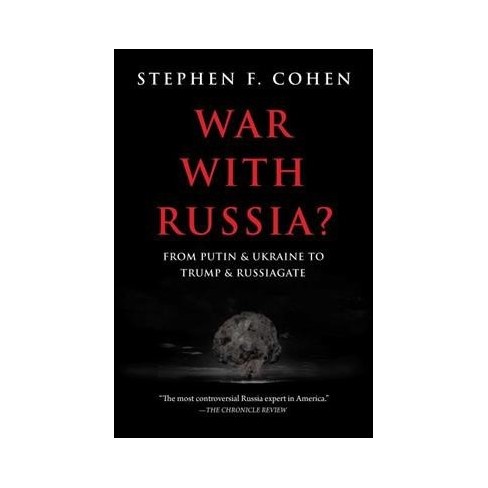
“If you’re trying to explain how the Washington establishment has dealt with Putin in a hateful and demonizing way, you have to go back to the 1990s before Putin,” said Cohen, whose new book is “War With Russia? From Putin & Ukraine to Trump & Russiagate.” The first post-Soviet leader is Boris Yeltsin. Clinton is president. And they have this fake, pseudo-partnership and friendship, whereas essentially the Clinton administration took advantage of the fact that Russia was in collapse. It almost lost its sovereignty. I lived there in the ’90s. Middle-class people lost their professions. Elderly people lost their pensions. I think it’s correct to say that industrial production fell more in the Russian 1990s than it did during our own Great Depression. It was the worst economic and social depression ever in peacetime. It was a catastrophe for Russia.”

In September 1993 Russians took to the streets to protest the collapse of the economy—the gross domestic product had fallen by 50% and the country was convulsed by hyperinflation—along with the rampant corruption that saw state enterprises sold for paltry fees to Russian oligarchs and foreign corporations in exchange for lavish kickbacks and bribes; food and fuel shortages; the nonpayment of wages and pensions; the lack of basic services, including medical services; falling life expectancy; the explosion of violent crime; and Yeltsin’s increasing authoritarianism and his unpopular war with Chechnya.

In October 1993 Yeltsin, after dissolving the parliament, ordered army tanks to shell the Russian parliament building, which was being occupied by democratic protesters. The assault left 2,000 dead. Yet during his presidency Yeltsin was effusively praised and supported by Washington. This included U.S. support for a $10.2 billion International Monetary Fund loan to Russia during his 1996 re-election campaign. The loan enabled the Yeltsin government to pay huge sums in back wages and pensions to millions of Russians, with checks often arriving on the eve of the election. Also, an estimated $1.5 billion from the loan was used to directly fund the Yeltsin presidential campaign. But by the time Yeltsin was forced out of office in December 1999 his approval rating had sunk to 2%. Washington, losing Yeltsin, went in search of another malleable Russian leader and, at first, thought it had found one in Putin.

“Putin went to Texas,” Cohen said. “He had a barbecue with Bush, second Bush. Bush said he ‘looked into his eyes and saw a good soul.’ There was this honeymoon. Why did they turn against Putin? He turned out not to be Yeltsin. We have a very interesting comment about this from Nicholas Kristof, the New York Times columnist, who wrote, I think in 2003, that his own disillusion with Putin was that he had turned out not to be ‘a sober Yeltsin.’ What Washington was hoping for was a submissive, supplicant, post-Soviet Russian leader, but one who was younger, healthier and not a drinker. They thought they had that in Putin. Yeltsin had put Putin in power, or at least the people around Yeltsin did.”

“When Putin began talking about Russia’s sovereignty, Russia’s independent course in world affairs, they’re aghast,” Cohen said of the Washington elites. “This is not what they expected. Since then, my own thinking is we were pretty lucky after the 1990s to get Putin because there were worst contenders in the wings. I knew some of them. I don’t want to name names. But some of these guys were really harsh people. Putin was kind of the right person for the right time, both for Russia and for Russian world affairs.”

“We have had three years of this,” Cohen said of Russiagate. “We lost sight of the essence of what this allegation is. The people who created Russiagate are literally saying, and have been for almost three years, that the president of the United States is a Russian agent, or he has been compromised by the Kremlin. We grin because it’s so fantastic. But the Washington establishment, mainly the Democrats but not only, have taken this seriously.”

“I don’t know if there has ever been anything like this in American history,” Cohen said. “That accusation does such damage to our own institutions, to the presidency, to our electoral system, to Congress, to the American mainstream media, not to mention the damage it’s done to American-Russian relations, the damage it has done to the way Russians, both elite Russians and young Russians, look at America today. This whole Russiagate has not only been fraudulent, it’s been a catastrophe.”

“There were three major episodes of détente in the 20th century,” Cohen said. “The first was after Stalin died, when the Cold War was very dangerous. That was carried out by Dwight Eisenhower, a Republican president. The second was by Richard Nixon, advised by Henry Kissinger—it was called ‘the Nixon détente with Brezhnev.’ The third, and we thought most successful, was Ronald Reagan with Mikhail Gorbachev. It was such a successful détente Reagan and Gorbachev, and Reagan’s successor, the first Bush, said the Cold War was over forever.”

“The wall had come down,” Cohen said of the 1989 collapse of East Germany and the fall of the Berlin Wall. “Germany was reunifying. The question became ‘where would a united Germany be?’ The West wanted Germany in NATO. For Gorbachev, this was an impossible sell. Twenty-seven point five million Soviet citizens had died in the war against Germany in the Second World War on the eastern front. Contrary to the bunk we’re told, the United States didn’t land on Normandy and defeat Nazi Germany. The defeat of Nazi Germany was done primarily by the Soviet army. How could Gorbachev go home and say, ‘Germany is reunited. Great. And it’s going to be in NATO.’ It was impossible. They told Gorbachev, ‘We promise if you agree to a reunited Germany in NATO, NATO will not move—this was Secretary of State James Baker—one inch to the east. In other words, NATO would not move from Germany toward Russia. And it did.”

“As we speak today, NATO is on Russia’s borders,” Cohen said. “From the Baltics to Ukraine to the former Soviet Republic of Georgia. So, what happened? Later, they said Gorbachev lied or he misunderstood. [That] the promise was never made. But the National Security Archive in Washington has produced all the documents of the discussion in 1990. It was not only [President George H.W.] Bush, it was the French leader François Mitterrand, it was Margaret Thatcher of England. Every Western leader promised Gorbachev NATO would not move eastward.”

“What do you end up with today?” he asked. “Betrayal. Any kind of discussion about Russian-American relations today, an informed Russian is going to say, ‘We worry you will betray us again.’… Putin said he had illusions about the West when he came to power.”

“Trump comes out of nowhere in 2016 and says, ‘I think we should cooperate with Russia,’ ” Cohen said. “This is a statement of détente. It’s what drew my attention to him. It’s then that this talk of Trump being an agent of the Kremlin begins. One has to wonder—I can’t prove it—but you have to think logically. Was this [allegation] begun somewhere high up in America by people who didn’t want a pro-détente president? And [they] thought that Trump, however small it seemed at the time that he could win—they really didn’t like this talk of cooperation with Russia. It set in motion these things we call Russiagate.”

“The forefathers of détente were Republicans,” Cohen said. “How the Democrats behaved during this period of détente was mixed. There was what used to be called the Henry Jackson wing. This was a very hard-line, ideological wing of the Democratic Party that didn’t believe in détente. Some Democrats did. I lived many years in Moscow, both Soviet and post-Soviet times. If you talk to Russian, Soviet policymakers, they generally prefer Republican candidates for the presidency.”

Democrats are perceived by Russian rulers as more ideological, Cohen said.

“Republicans tend to be businessmen who want to do business in Russia,” he said. “The most important pro-détente lobby group, created in the 1970s, was called the American Committee for East-West Accord. It was created by American CEOs who wanted to do business in Soviet Russia.”

“The single most important relationship the United States has is with Russia,” Cohen went on, “not only because of the nuclear weapons. It remains the largest territorial country in the world. It abuts every region we are concerned about. Détente with Russia—not friendship, not partnership, not alliance—but reducing conflict is essential. Yet something happened in 2016.”

The accusations made repeatedly by James Clapper, the former director of the National Security Agency, and John Brennan, the former director of the Central Intelligence Agency, concerning the Kremlin’s supposed control of Trump and Russia’s alleged theft of our elections are deeply disturbing, Cohen said. Clapper and Brennan have described Trump as a Kremlin “asset.” Brennan called Trump’s performance at a news conference with the Russian president in Finland “nothing short of treasonous.”

Clapper in his memoir, “Facts and Fears: Hard Truths From a Life in Intelligence,” claims Putin’s interference in the 2016 presidential election on behalf of Trump was “staggering.”

“Of course, the Russian efforts affected the outcome,” writes Clapper. “Surprising even themselves, they swung the election to a Trump win. To conclude otherwise stretches logic, common sense and credulity to the breaking point. Less than eighty thousand votes in three key states swung the election. I have no doubt that more votes than that were influenced by this massive effort by the Russians.”

Brennan and Clapper have on numerous occasions been caught lying to the public. Brennan, for example, denied, falsely, that the CIA was monitoring the computers that Senate staff members were using to prepare a report on torture. The chairwoman of the Senate Intelligence Committee, Dianne Feinstein, took to the Senate floor to accuse Brennan and the CIA of potentially violating the U.S. Constitution and of criminal activity in its attempts to spy on and thwart her committee’s investigations into the agency’s use of torture. She described the situation as a “defining moment” for political oversight. Brennan also claimed there was not a “single collateral death” in the drone assassination program, that Osama bin Laden used his wife as a human shield before being gunned down in a U.S. raid in Pakistan, and insisted that torture, or what is euphemistically called “enhanced interrogation,” has produced valuable intelligence. None of these statements are true.

Clapper, who at the time of the U.S. invasion of Iraq was the head of the National Geospatial-Intelligence Agency, the Pentagon unit responsible for interpreting spy-satellite photos and intelligence such as air particles and soil samples, concocted a story about Saddam Hussein spiriting his nonexistent weapons of mass destruction and the documents that verified his program to Syria on the eve of the invasion. He blatantly committed perjury before the Senate when being questioned about domestic surveillance programs of the American public. He was asked, “Does the NSA [National Security Agency] collect any type of data at all on millions, or hundreds of millions of Americans?” Clapper responded, “No, sir. … Not wittingly.” It was, as Clapper knew very well, a lie.

Our inability to oversee or control senior intelligence officials and their agencies, which fabricate information to push through agendas embraced by the shadow state, signals the death of democracy. Intelligence officials seemingly empowered to lie—Brennan and Clapper have been among them—ominously have in their hands instruments of surveillance, intimidation and coercion that effectively silence their critics, blunt investigations into their activities, even within the government, and make them and their agencies unaccountable.

“We have the Steele dossier that was spookily floating around American media,” Cohen said of the report compiled by Christopher Steele.

The report was commissioned by Fusion GPS and paid for by the Hillary Clinton presidential campaign and the Democratic National Committee. Bob Woodward reported that Brennan pushed to include the Steele dossier in the intelligence community assessment of Russian election interference.

“He [Steele] got it from newspapers,” Cohen said. “I don’t think he had a single source in Russia. Steele comes forward with this dossier and says, ‘I’ve got information from high-level sources.’ The Clinton campaign is funding this operation. But Steele is very important. He’s a former U.K. intelligence officer, if he’s really former, who had served in Russia and ran Russian cases. He says he has this information in the dossier about Trump frolicking with prostitutes. About Trump having been corrupted decades ago. He got it from ‘high-level’ Kremlin sources. This is preposterous. It’s illogical.”

“The theory is Putin desperately wanted to make Trump president,” Cohen said. “Yet, guys in the Kremlin, around Putin, were feeding Trump dirt to a guy called Steele. Even though the boss wants—does it make any sense to you?”

“Why is this important?” Cohen asked. “Right-wing American media outlets today, in particularly Fox News, are blaming Russia for this whole Russiagate thing. They’re saying that Russia provided this false information to Steele, who pumped it into our system, which led to Russiagate. This is untrue.”

“Who is behind all this? Including the Steele operation?” Cohen asked. “I prefer a good question to an orthodox answer. I’m not dogmatic. I don’t have the evidence. But all the surface information suggests that this originated with Brennan and the CIA. Long before it hit America—maybe as early as late 2015. One of the problems we have today is everybody is hitting on the FBI. Lovers who sent emails. But the FBI is a squishy organization, nobody is afraid of the FBI. It’s not what it used to be under J. Edgar Hoover. Look at James Comey, for God’s sake. He’s a patsy. Brennan and Clapper played Comey. They dumped this stuff on him. Comey couldn’t even handle Mrs. Clinton’s emails. He made a mess of everything. Who were the cunning guys? They were Brennan and Clapper. [Brennan,] the head of the CIA. Clapper, the head of the Office of [the Director of] National Intelligence, who is supposed to oversee these agencies.”

“Is there any reality to these Russiagate allegations against Trump and Putin?” he asked. “Was this dreamed up by our intelligence services? Today investigations are being promised, including by the attorney general of the United States. They all want to investigate the FBI. But they need to investigate what Brennan and the CIA did. This is the worst scandal in American history. It’s the worst, at least since the Civil War. We need to know how this began. If our intelligence services are way off the reservation, to the point that they can try to first destroy a presidential candidate and then a president, and I don’t care that it’s Trump, it may be Harry Smith next time, or a woman; if they can do this, we need to know it.”

“The second Bush left the Anti-Ballistic Missile Treaty in 2002,” Cohen said. “It was a very important treaty. It prevented the deployment of missile defense. If anybody got missile defense that worked, they might think they had a first strike [option]. Russia or the United States could strike the other without retaliation. Once Bush left the treaty, we began to deploy missile defense around Russia. It was very dangerous.”

“The Russians began a new missile program which we learned about last year,” he said. Hypersonic missiles. Russia now has nuclear missiles that can evade and elude any missile defense system. We are in a new and more perilous point in a 50-year nuclear arms race. Putin says, ‘We’ve developed these because of what you did. We can destroy each other.’ Now is the time for a serious, new arms control agreement. What do we get? Russiagate. Russiagate is one of the greatest threats to national security. I have five listed in the book. Russia and China aren’t on there. Russiagate is number one.”

 

Brazile Fallout: Hillary Privatized the DNC with Help from a Washington Law Firm

By Pam Martens and Russ Martens

Source: Wall Street On Parade

Secret side agreements are a common maneuver by corporate law firms. Here’s how they work. An agreement that is legal and passes the smell test is drafted and submitted to a court or a regulatory body for public consumption. Then, a separate, secret side agreement is written and signed by both sides and it contains all of the smelly, shady, ethically questionable hard details on how the original agreement will be carried out.

Donna Brazile, the former interim Chair of the Democratic National Committee (DNC) during the 2016 presidential campaign, has written a new book, “Hacks: The Inside Story of the Break-ins and Breakdowns that Put Donald Trump in the White House,” and has revealed the secret side agreement that the DNC had with Hillary Clinton’s campaign.

In 2015, Hillary Clinton’s campaign set up a joint fundraising committee called the Hillary Victory Fund (HVF) with the DNC and over 30 state democratic committees. The public portion of the agreement indicated that Hillary would raise funds for her own campaign while also allocating a portion to the DNC to help the overall Democratic Party as well as allocating funds to state democratic committees in order to support down-ballot candidates in their local elections. But the secret side agreement that effectively privatized the DNC, giving Hillary and her campaign lawyers control of the DNC and its money, had yet to see the light of day.

This is how Brazile describes the secret side agreement in her book:

“The agreement—signed by Amy Dacey, the former CEO of the DNC, and Robby Mook [Clinton’s campaign manager] with a copy to Marc Elias [lawyer at Perkins Coie]  — specified that in exchange for raising money and investing in the DNC, Hillary would control the party’s finances, strategy, and all the money raised. Her campaign had the right of refusal of who would be the party communications director, and it would make final decisions on all the other staff. The DNC also was required to consult with the campaign about all other staffing, budgeting, data, analytics, and mailings.”

The Clinton camp has now attempted to defend itself by saying these terms are standard because they were not going to kick in until the Democratic Party had chosen its official presidential nominee at its party convention in July 2016. But that’s not what the actual secret side agreement says. It indicates the following: “Beginning October 1, 2015,” the HVF would begin transferring $1.2 million to the DNC at the start of each month with that release “conditioned on” Hillary Clinton’s primary campaign personnel being consulted “and have joint authority over strategic decisions over the staffing, budget, expenditures, and general election related communications, data, technology, analytics, and research. The DNC will provide HFA advance opportunity to review on-line or mass email, communications that features a particular Democratic primary candidate.”

Additionally, the secret agreement states that “the DNC agrees that no later than September 11, 2015 it will hire one of two candidates previously identified as acceptable to HFA” (Hillary for America, the primary campaign fund for Clinton) as its Communications Director. All of this is occurring in the fall of 2015 with the official Democratic nominating convention not taking place until July 2016.

As Politico reported in May 2016, the Hillary Victory Fund was a sham in multiple other ways. First, Politico writes that less than 1 percent of the money raised stayed in the state’s coffers. The Treasurer of the Hillary Victory Fund actually had the power to move money in and out of state committee bank accounts. Politico reporters Ken Vogel and Isaac Arnsdorf cite the following example to show how things actually worked:

“…the Minnesota Democratic-Farmer-Labor Party received $43,500 from the victory fund on Nov. 2, only to transfer the same amount to the DNC that same day. The pattern repeated itself after the Minnesota party received transfers from the victory fund of $20,600 on Dec. 1 (the party sent the same amount to the DNC the next day) and $150,000 on Jan. 4 (it transferred the same amount to the DNC that day).

“That means that Minnesota’s net gain from its participation in the victory fund was precisely $0 through the end of March. Meanwhile, the DNC pocketed an extra $214,100 in cash routed through Minnesota — much of which the DNC wouldn’t have been able to accept directly, since it came from donors who had mostly had already maxed out to the national party committee.

“A similar pattern transpired with most of the participating state parties. As of March 31, only eight state parties (most of which were in battleground states such as Colorado, Florida, Nevada, New Hampshire and Virginia) had received more from the victory fund than was transferred from their accounts to the DNC.”

Brazile backs up this account in her book, writing that “the states kept less than half of 1 percent of the $82 million they had amassed from the extravagant fund-raisers Hillary’s campaign was holding….”

Brazile notes in her book that the lawyer, Marc Elias, of the politically-connected law firm, Perkins Coie, was copied on the secret side agreement. Elias has repeatedly come under scrutiny for his multi-faceted roles in the 2015-2016 presidential campaign. Most recently, he was exposed as the guy behind the hiring of Fusion GPS which compiled the scandalous Russian dossier on Donald Trump, using both Hillary campaign funds and DNC funds. The Washington Post reported that Elias was allowed to spend these funds “without oversight by campaign officials, according to a spokesperson for his law firm.”

Elias served as the General Counsel to Hillary’s primary campaign committee, Hillary for America, as well as serving as one of a team of lawyers from Perkins Coie that provided legal advice to the DNC. (Elias also provided legal advice to the Democratic Senatorial Campaign Committee, Democratic Congressional Campaign Committee, and Democratic Governors Associations, according to the Perkins Coie web site last year.)

As a legal adviser to the DNC, Elias should have known that its charter mandated fairness and impartiality to all primary candidates. But when WikiLeaks released emails last year that had been hacked at the DNC, Marc Elias was caught giving advice on how to tar Senator Bernie Sanders after his campaign suggested that the Hillary Victory Fund was skirting Federal election law. The email from Elias read:

“My suggestion is that the DNC put out a statement saying that the accusations the Sanders campaign are not true. The fact that CNN notes that you aren’t getting between the two campaigns is the problem. Here, Sanders is attacking the DNC and its current practice, its past practice with the POTUS and with Sec Kerry. Just as the RNC pushes back directly on Trump over ‘rigged system’, the DNC should push back DIRECTLY at Sanders and say that what he is saying is false and harmful the [sic] the Democratic party.”

Writing for Politico in 2014, Ken Vogel detailed how Elias and Perkins Coie have not only been the legal go-to guys for the Democratic party over the years but how they have also tinkered with Federal election law to shift more power to the 1 percent. Vogel writes:

“Perkins Coie’s political law practice, anchored by Elias and former White House Counsel Bob Bauer, has something of a stranglehold on the Democratic Party’s election law business, representing not only the party committees themselves but everyone from [Harry] Reid (whose various committees have paid $317,000 in legal fees to Perkins Coie over the years) to Obama ($7.4 million) to the major Democratic super PACs ($19 million).”

The thrust of the article, however, is that Elias played a central role in further opening the spigots for legal revenues his firm might be expected to collect in the future by tinkering with Federal legislation at the eleventh hour. Vogel writes:

“A powerful Democratic lawyer helped craft a provision that was slipped into a year-end spending bill allowing political parties to raise huge new pools of cash — including some for legal fees that are likely going to be collected by his own firm…

“The change has the potential to halt or at least slow the erosion of power of the political parties, since it would increase the maximum amount of cash that rich donors may give to the national Democratic and Republican party committees each year from $97,400 to $777,600 or more.”

The question that no one seems to be asking is who are the main beneficiaries of Perkins Coie’s heavy influence at the top of the Democratic Party. Despite Obama’s re-election for a second term, the Democratic Party shed nearly 1,000 seats from coast to coast. The Republicans now control both houses of Congress and the Executive Branch. A man with the lowest approval rating in modern history now occupies the Oval Office.

The primary beneficiaries of this hubris have been the 1 percent – Wall Street and hedge fund titans – and giant multi-national corporations that dominate the client roster at Perkins Coie.

Those within the Clinton camp and DNC who are suggesting to the American people that there is nothing to see here, time to move along, are dead wrong. Just because the Republican presidential campaign may have been corrupted by outside forces doesn’t mean that the Democratic campaign wasn’t also corrupted by its own outside forces. It’s time to follow the obscene political money trail wherever it leads.

Related Articles:

Are Hillary Clinton and the DNC Skirting Election Law?

DNC’s Direct Marketing Firm Shows Bias on Facebook Against Bernie Sanders

WikiLeaks Bombshell: Emails Show Citigroup Had Major Role in Shaping and Staffing Obama’s First Term

What Did Hillary Clinton Know?

By Robert Parry

Source: Consortium News

The revelation that Hillary Clinton’s campaign and the Democratic National Committee helped pay for the notorious “Steele Dossier” of hearsay claims about Donald Trump’s relations with Russia is not surprising but is noteworthy given how long the mystery about the funding was allowed to linger.

Another mild surprise is that the Clinton campaign would have had a direct hand in the financing rather than maintaining an arm’s length relationship to the dossier by having some “friend of the campaign” make the payments and giving Clinton more deniability.

Instead, the campaign appears to have relied on its lawyer, Marc E. Elias of Perkins Coie, and a confidentiality agreement to provide some insulation between Clinton and the dossier’s startling claims which presumably helped inform Clinton’s charge in the final presidential debate that Trump was Russian President Vladimir Putin’s “puppet.” Indeed, how much Clinton personally knew about the dossier and its financing remains an intriguing question for investigators.

Ultimately, the facts about who commissioned the dossier were forced out by a congressional Republican subpoena seeking the bank records of Fusion GPS, the opposition research firm that hired former British intelligence operative Christopher Steele to compile the opposition research, known as “oppo,” against Trump.

As part of the legal wrangling over that subpoena, the Clinton/DNC law firm, Perkins Coie, wrote a letter releasing Fusion GPS from its confidentiality agreement.

After that letter, The Washington Post reported on Tuesday night that the Clinton campaign and the DNC had helped fund the Steele effort with attorney Elias retaining Fusion GPS in April 2016 and with Fusion GPS then hiring Steele.

The Post reported that “people familiar with the matter” disclosed that outline of the arrangement but still would not divulge how much the Clinton campaign and the DNC paid to Fusion GPS. One source told me that the total amount came to about $1 million.

‘Trash for Cash’

An irony about Hillary Clinton’s role in funding allegations about Trump’s connection to the Russians, including claims that he cavorted with prostitutes in a five-star Moscow hotel while Russian intelligence operatives secretly filmed him, is that the Clinton camp bristled when Bill Clinton was the subject of Republican “oppo” that surfaced salacious charges against him. The Clintons dismissed such accusations as “cash for trash.”

Nevertheless, just as conspiratorial accusations about the Clintons gave rise to the Whitewater investigation and a rash of other alleged “scandals,” which bedeviled Bill Clinton’s presidency, the Steele Dossier provided a map that investigators have followed for the ongoing Russia-gate investigation into President Trump.

Much like those Clinton allegations, Steele’s accusations have had a dubious track record for accuracy, with U.S. government investigators unable to corroborate some key claims but, I’m told, believing that some are true nonetheless.

In the 1990s, even though the core allegations of wrongdoing about the Clintons and their Whitewater land deal collapsed, the drawn-out investigation eventually unearthed Bill Clinton’s sexual relationship with White House intern Monica Lewinsky and led to his impeachment in the House although he was acquitted in a Senate trial.

Some Democrats have openly hoped for the impeachment of President Trump, too, and they have hitched many of those hopes to the Russia-gate bandwagon.

There is also no doubt about the significance of the Steele Dossier in spurring the Russia-gate scandal forward.

When Rep. Adam Schiff, the ranking Democratic member of the House Intelligence Committee, offered what amounted to a prosecutor’s opening statement in March, his seamless 15-minute narrative of the Trump campaign’s alleged collaboration with Russia followed the trail blazed by Steele, who had worked for Britain’s MI-6 in Russia and tapped into ex-colleagues and unnamed sources inside Russia, including supposedly leadership figures in the Kremlin.

Steele’s Methods

Since Steele could not reenter Russia himself, he based his reports on multiple hearsay from these anonymous Russians who claim to have heard some information from their government contacts before passing it on to Steele’s associates who then gave it to Steele who compiled this mix of rumors and alleged inside dope into “raw” intelligence reports.

Besides the anonymous sourcing and the sources’ financial incentives to dig up dirt, Steele’s reports had other problems, including the inability of FBI investigators to confirm key elements, such as the claim that several years ago Russian intelligence operatives secretly videotaped Trump having prostitutes urinate on him while he lay in the same bed at Moscow’s Ritz-Carlton used by President Obama and First Lady Michelle Obama.

That tantalizing tidbit was included in Steele’s opening report to his new clients, dated June 20, 2016. Apparently, it proved irresistible in whetting the appetite of Clinton insiders. Also in that first report were the basic outlines of Russia-gate.

But Steele’s June report also reflected the telephone-tag aspects of these allegations: “Speaking to a trusted compatriot in June 2016 sources A and B, a senior Russian Foreign Ministry figure and a former top level Russian intelligence officer still active inside the Kremlin respectively, the Russian authorities had been cultivating and supporting US Republican presidential candidate, Donald TRUMP for a least 5 years.

“Source B asserted that the TRUMP operation was both supported and directed by Russian President Vladimir PUTIN. Its aim was to sow discord and disunity both within the US itself, but more especially within the Transatlantic alliance which was viewed as inimical to Russia’s interests. … In terms of specifics, Source A confided that the Kremlin had been feeding TRUMP and his team valuable intelligence on his opponents, including Democratic presidential candidate Hillary CLINTON, for several years. …

“The Kremlin’s cultivation operation on TRUMP also had comprised offering him various lucrative real estate development business deals in Russia, especially in relation to the ongoing 2018 World Cup soccer tournament. However, so far, for reasons unknown, TRUMP had not taken up any of these.”

Besides the anonymous and hearsay quality of the allegations, there are obvious logical problems, especially the point that five years before the 2016 campaign, virtually no one would have thought that Trump had any chance of becoming President of the United States.

There also may have been a more mundane reason why Trump’s hotel deal fell through. A source familiar with those negotiations told me that Trump had hoped to get a half interest in the $2 billion project but that Russian-Israeli investor Mikhail Fridman, a founder of Russia’s Alfa Bank, balked because Trump was unwilling to commit a significant investment beyond the branding value of the Trump name.

Yet, one would assume that if the supposedly all-powerful Putin wanted to give a $1 billion or so payoff to his golden boy, Donald Trump, whom Putin anticipated would become President in five years, the deal would have happened, but it didn’t.

Despite the dubious quality of Steele’s second- and third-hand information, the June 2016 report appears to have impressed Team Clinton. And once the bait was taken, Steele continued to produce his conspiracy-laden reports, totaling at least 17 through Dec. 13, 2016.

Framing the Investigation

The reports not only captivated the Clinton political operatives but influenced the assessments of President Obama’s appointees in the U.S. intelligence community regarding alleged Russian “meddling” in the presidential election.

Still, a careful analysis of Steele’s reports would have discovered not only apparent factual inaccuracies, such as putting Trump lawyer Michael Cohen at a meeting with a Russian official in Prague (when Cohen says he’s never been to Prague), but also the sort of broad conspiracy-mongering that the mainstream U.S. news media usually loves to ridicule.

For instance, Steele’s reports pin a range of U.S. political attitudes on Russian manipulation rather than the notion that Americans can reach reasonable conclusions on their own. In one report dated Sept. 14, 2016, Steele claimed that an unnamed senior official in Putin’s Presidential Administration (or PA) explained how Putin used the alleged Russian influence operation to generate opposition to Obama’s Pacific trade deals.

Steele wrote that Putin’s intention was “pushing candidate CLINTON away from President OBAMA’s policies. The best example of this was that both candidates [Clinton and Trump] now openly opposed the draft trade agreements, TPP and TTIP, which were assessed by Moscow as detrimental to Russian interests.”

In other words, the Russians supposedly intervened in the U.S. presidential campaign to turn the leading candidates against Obama’s trade deals. But how credible is that? Are we to believe that American politicians – running the gamut from Senators Bernie Sanders and Elizabeth Warren through former Secretary of State Hillary Clinton to President Donald Trump – have all been tricked by the Kremlin to oppose those controversial trade deals, which are also broadly unpopular with the American people who are sick and tired of trade agreements that cost them jobs?

Of course, the disclosure that the Clinton campaign and the DNC help pay for Steele’s opposition research doesn’t necessarily discredit the information, but it does suggest a possible financial incentive for Steele and his collaborators to sex-up the reports to keep Clinton’s camp coming back for more.


Investigative reporter Robert Parry broke many of the Iran-Contra stories for The Associated Press and Newsweek in the 1980s. You can buy his latest book, America’s Stolen Narrative, either in print here or as an e-book (from Amazonand barnesandnoble.com).