Another day, another traffic jam. A father, François (Romain Duris), chides his son Émile (Paul Kircher) for feeding the family dog potato chips. He tells his son to stay away from them as well since they’re probably not very good for him, and Émile rolls his eyes as any 16-years-old would. They argue. Émile gets out of their car in defiance since the traffic is at a standstill. Suddenly, an ambulance stuck in the opposite lane of traffic starts to wobble and out bursts a bird-like man. He escapes, and the son and the father run back to their car in shock. “Strange days!” a neighboring driver responds. It is an understatement.
In Thomas Cailley’s striking sci-fi fantasy “The Animal Kingdom,” the birdman is a sign of things to come. In this present-day world, some humans have started to genetically mutate into other species, morphing into winged, reptilian, beastly hybrids that the larger non-mutated society have decided to ostracize, keeping them in hospitals or zoo-like centers away from the rest of the population, even their loved ones, for the potential risk that they can hurt someone with their outsized claws, fangs, and wings.
This was the case for Émile’s mother, Lana, who is shown only briefly at first in the hospital with fur growing around her eyes. Soon, there are other creature sightings in the background and in the forest. This is their new normal. Running parallel to these fantastic beasts are problems of everyday life – of a son challenging his father’s authority, François starting a new job, and Émile struggling to fit into his new school. Then, Émile starts to have problems riding his bike, his mannerisms are changing beyond his control, his back feels different, and soon, fur and claws appear. He is also mutating.
“The Animal Kingdom” moves swiftly between its characters’ everyday problems and the story’s fantastical elements in a magical realist way that quickly captivates its viewer. Cailley, who co-wrote the film with Pauline Munier, uses the creatures as a metaphor for how the world responds to health crises. Because they are not understood and feared, they are locked away from the rest of this society, which recalls how some countries isolated the first wave of HIV/AIDS patients in the late ‘80s and early ‘90s. In the movie, characters spoke of other countries adapting to live side-by-side with the humanoid creatures and showed how politicized the issue became among Émile’s classmates and François’ boss, which mirrored the discussion around how other countries handled the recent COVID-19 epidemic and how politicized the discourse around public health and safety became around the issue. That life still continued during these “strange days” of masking, testing, periods of isolation, and family tragedy for some only makes “The Animal Kingdom” all the more relevant.
There’s so much to cope with that Émile nursing a crush on a fellow classmate and sparks forming between François and a disaffected cop named Julia (Adèle Exarchopoulos) only occasionally registers next to the mortification of mutating (another metaphor for coming-of-age) and grieving. It’s difficult to move on from something when you’re still going through it, even if it is in a setting as idyllic as the way Cailley’s brother and cinematographer David Cailley captures the sun-soaked French countryside and untamed forests. As a tired dad just trying to do the best for his son, Duris does an impeccable job carrying his character’s weariness of these events opposite Kircher, who meticulously embodies his character’s adolescent anxiety and animal impulses.
“The Animal Kingdom” is indeed a strange beast. Like “X-Men” minus the superpowers, it’s an analogy about the way people are ostracized for differences beyond their control. It’s a premise that could have suffered with bad CGI effects, but we see just enough of chimeras that blend feathers, scales, and fur onto human skin to understand what’s happening, to empathize with both the person mutating and the fear of the people around them trying desperately to return to normalcy. There is no going back, these “strange days” are the new normal. Dad still argues with his son for feeding chips to their Australian Shepherd while he lights up another cigarette, on and on it goes. The movie is effective in its ability to make us emphasize for the hunted “others” as well as observe how humanity becomes the very thing it fears: monstrous in its attempt to restore law and order. Life is complicated like that, and yet it continues to find a way forward.
With Les Miserables signalling Ladj Ly’s rise to recognition in contemporary French cinema, one simply cannot watch the director’s debut film without bringing to mind its predecessor — a film that not only broadened its examination of racial tensions in France, but would come (and continue to) define the country’s prevalence with race relations to this day.
La Haine is the film in question, as Mathieu Kassovitz’s 1995 debut became a nationwide success. The dialectics of Ladj Ly’s Cesar win for Best Film reflect this, given that Kassovitz achieved the same feat 25 years prior. The result would not only cement his debut in film history, but further accentuate the undoubted declaration of La Haine as one of the most prolific French films of all time.
While clearly drawing inspiration from the likes of Ernest Dickerson and Spike Lee, La Haine remains difficult to categorize, but also inseparable from its influences. This is due to Kassovitz’s work being deeply ingrained with its own share of sociopolitical messages, whose prevalence with current events keeps it closely linked to any discourse related to the film.
Unlike films of a similar nature, specifically Do The Right Thing, La Haine does not attempt to intertwine the stories of humans who function as several moving parts of Parisian banlieue (suburbs) as a whole. Rather, it focuses on Vinz (Vincent Cassel), Said (Said Taghmaoui), and Hubert (Hubert Kounde), three adolescent boys and residents of said setting who go about their day. Because of its near abandonment of plot, the film initially presents itself as a reflective lamenting of grievance. The actuality of Abdel’s death opens and looms over the majority of the film, quickly becoming the driving force of its characters’ intentions.
The lines between cause and effect constantly blur from one vignette to the next, as the film’s plot slowly races to its unexpected finishing crescendo, or should I say derescendo, given that the film’s actual standstill does not even come in the form of its mostly mundane happenings. Despite this, these happenings still manage to show us more than several glimpses of life in the banlieues. In fact, the only difference between the film’s depiction of police reinforcement to the present day is a jarring increase in police hostility (first shown in Wesh Wesh, Qu’est-ce qui c’est passe?, then rehashed in Les Mis).
As a result, the film’s plot moves towards its ending with no checkpoints in between. Its brilliant performances are briefly forgotten once the banlieues’ cultural equilibrium (despite the actual absence of unity due to class circumstance and police presence) is shattered. With this in mind, the best way to describe the chronicling of these events is as follows: the build-up doesn’t matter as much as the result itself.
Another element that this film brilliantly uses in executing a correlation between plot and character development is tension. Its simplistic premise is cemented in both the value of time and the counterproductive reality of choosing violence. Time punctures all minor wounds caused by each subsequent event, putting each character at a risk of surviving a long and winding evening — but especially Vinz.
Time’s transformative effect on La Haine’s scenes instills the stagnance of progression, as well as giving urgency to Vinz’s constantly violent tendencies in the midst of composing events. It can be likened to Tupac’s Bishop from Ernest Dickerson’s Juice, given that their intentions appear to be inherently violent and remain impassioned within violence as an objective solution. This projects their idea of violence as an act of reclaiming power and restoring justice. However, as a result of time being an all-encompassing element of the film, it poses the potential for these tendencies to seep into reality at any given moment.
The film manages a passage of time with the simple use of timestamps and the sound of a ticking clock, indicating that time is like a ticking bomb that only continues to pass with each inconsequential event. Oftentimes, we believe that time has run out whenever characters face consequences in this film, but it only adds to the fact that time can do no more than elapse. Time seems to stop when Said is arrested, but it continues even when he is released. Time seems to stop when Vinz begins seeing visions of a cow, but it continues even when Said pulls him away. They further accentuate the meaninglessness of scenes, dismissing the possibility of characters working against the worst imaginable circumstance, and ultimately coming to the somber realization that all these three boys have been doing was waste time.
An undoubtedly significant theme of this film is centered on cultural identity, given that three of France’s most marginalized backgrounds (Black, Jewish, and Arab) are represented through its trio of individual characters. Because France’s white predominance does not vindicate those groups as authentic representations of national identity, this manages to cause the most friction amongst two separate parts of French society. This also includes visible minorities in positions of authority serving to practically betray the safety of their own culture.
Much like housing projects in major American cities like New York, the culture of les banlieues is also in alignment with what isn’t considered as pure French. As a part of showcasing insignificant events, there remains the background significance of the banlieues’ cultural mosaic; a true passport to surroundings that are more otherworldly and intersectional than the iconoclastic capital housing the Eiffel Tower and the Louvre. This leaves a profound impact on the characters’ conversations and language, both of which only continue to return to a means of getting by. An emerging French identity is formed in front of us, and this fusion of cultures can be largely attested to its use of hip-hop music and its incorporation of hip-hop culture.
Hip-hop’s significance is especially given its due and proof on an international scale, and La Haine is this American genre’s earliest example. This is also proof of the benefit of arguing that a musical genre and culture made by and for minority communities is the most universal of its kind. To add onto this, the globalization of hip-hop would truly come to fruition by the late 90s, and France’s scene would eventually receive recognition through the likes of Assassin and Supreme NTM. No genre remains more fitting for Kassovitz’s debut, as these groups also share inherently sociopolitical themes within their music.
It comes as no surprise either that La Haine’s influence is inherently American despite still being ingrained in French culture. The likes of Brian de Palma, Gordon Parks, and Martin Scorsese also come to mind, given that New Hollywood cinema seems to stay more true to the middle-to-lower-class French experience than the works of Robert Bresson, Claude Sautet, and Francois Truffaut.
Perhaps the only exceptions to the rule would be the forerunners of the 80s cinema du look, whose stylistic influences also extended to American cinema. Then again, only a select few in les banlieues could truly relate to a Subway, or a Diva, or a Mauvais Sang. These filmic fantasies still remain largely out of reach to the experiences of those living on the fringes of the era’s sprawling city settings.
La Haine comfortably splits its plot in two, shifting from suburban homeliness to the uncanny city. This is also why the film’s second half reflects the indiscernible identity of Parisian life, which only seems to take on many faces (and phases) on screen. Here, Kassovitz shows Paris as bare and devoid of the ethnic intersectionalism of its suburban outskirts. There’s an increasing sense of discomfort once these characters step out of a melting pot and into a homogenous place of lifelessness. Paris’s identity is as conflicted as its hesitance to embrace its characters. One scene shows the trio loitering at an exhibit, only for its highbrow bourgeoisie to oust them from a gallery. Its reality only contradicts the seemingly welcoming feeling that defines Paris as a cityscape and hegemonic extension of movie magic.
Overall, La Haine does not merely grieve over the disturbing normalcy of police brutality, but stands as a grievance of French society’s oppression towards its increasingly minority population. Its end result is an eruption to the most gradual anticipation that dominates the film, and it proves that the most profound influence on our identities lies within our surroundings. Its loss of control does not happen through an individually caused circumstance, but the reaction of an external force towards its inhabitants that becomes the film’s penultimate decision, its ultimatum literally shrouded in the ambiguity that continues to paint a sombering portrait of an unchanged reality.
Its structure continues to pose the same questions to all of French society: Who controls our own lives if we do not? And even then, is this world truly ours to begin with?
I could ask the same question of every racially counterproductive society at the moment, but especially France’s, whose innovations in film do not necessarily account for the lack thereof in every other facet of society. Where their movies are more than four miles ahead, their definition of personal and political authority remains centuries back.
Hatred begets more hatred, as Hubert says in this film, and it is one’s hatred that begets the film’s destruction of temporary unity. The beginning reemerges, and all progress is forgotten. That how you fall doesn’t matter. It’s how you land. This is what makes La Haine a cinematic masterpiece.
It’s hard to believe that it has been twelve years since French filmmaker Michel Hazanavicius won his Best Director Academy Award for the Best Picture winning “The Artist”. While it has become somewhat fashionable in some circles to dismiss that brilliant 2011 film as unworthy, I still hold it in incredibly high regard as a delightful ode to a bygone cinematic era.
Hazanavicius’ latest film couldn’t be more different. “Final Cut” is a meta zombie comedy that is an open-armed tribute to cinema, a love letter to genre filmmaking, a celebration of creative collaboration, and just an all-around wacky piece of work. It’s a faithful remake of Shin’ichirô Ueda’s 2017 cult hit “One Cut of the Dead” but with its own French twist. It’s a consistently clever and routinely funny concoction that sees Hazanavicius and his all-in cast having the time of their lives.
Describing “Final Cut” to those who haven’t seen “One Cut of the Dead” is a bit of a challenge because the less you know going in the better. The film’s unorthodox structure plays a big part in making it such a fun experience. It’s a case of a filmmaker showing you one thing and then adding an entirely different perspective later on. I know that’s vague, but suffice it to say Hazanavicius has a field day playing with his audience’s expectations.
The spoiler-free gist of the story goes something like this. Romain Duris plays Rémi Bouillon, a frustrated filmmaker who signs on to direct a low-budget zombie short film for an upstart streaming platform that specializes in B-movies. But there’s a catch. The 30-minute single-take film is to be shot and streamed LIVE! It’s an unheard of undertaking but one the platform’s ownership has already pulled off in their home country of Japan. Now they want to do it in France.
Rémi is hesitant to take the job at first, seeing it as a doomed-to-fail project. But with the encouragement of his wife Nadia (Bérénice Bejo) and with hopes it will rekindle his relationship with his aspiring filmmaker daughter Romy (Simone Hazanavicius) he agrees.
Soon he’s on location dealing with a smug high-maintenance lead actor (Finnegan Oldfield), his inexperienced lead actress Ava (Matilda Lutz), a supporting actor who can’t stay off the bottle (Grégory Gadebois), and the demands of domineering producers who don’t prescribe to the notion of a director’s creative freedom.
As “Final Cut” shifts to the show’s production phase things get crazy and we gain an entirely new perspective on everything we’ve seen up to that point. Hazanavicius drenches his audience in blood, gore, and countless zombie horror tropes which is a big part of the fun. That said, it’s never the slightest bit tense or scary but neither does it try to be. It’s much more of a comedy, full of running gags, fun characters, an infectious B-movie charm, and a surprising level of warmth that I never expected.
As Hollywood increasingly relies on ever less entertaining parodies of whole cinematic genres to sate an apparently insatiable public appetite for seriously dumb humor, the comparatively sophisticated yuks of Airplane! and The Naked Gun have devolved into the lowest-common-denominator yucks of the Scary Movie franchise and the viciously unfunny gurgles of Not Another Teen Movie, et al. Truly great parody relies in equal measure on both finely calibrated nuance and audience familiarity with the object of comic ridicule and not on how many fart jokes you can jam into an already bloated 90-minute running time. Austin Powers, for example, succeeded as much on the merits of its hyper-detailed production and art design as it did on Mike Myers’ groovy, hirsute mugging. Its swinging, Bond-esque London looked, or at least felt, as real as its modern-day counterpart, and its subject of parody, the 007 films, was universally known. Leave it to the French to beat us at our own bizarrely self-reflexive comic shenanigans. OSS 117: Cairo, Nest of Spies is a model of smart, often very silly, but never, ever stupid comic perfection. Set in 1955, back when Cairo was bristling with anti-English antipathy over a looming Suez canal crisis and radical Islam was just getting warmed up, the French Office of Strategic Services sends its best man, Hubert Bonisseur de la Bath, aka OSS 117 (Dujardin), to Egypt to discover the whereabouts of vanished agent Jack Jefferson (Lefebvre). OSS 117 is, of course, a fatuous, self-involved, debonair jerk who attracts the leggiest ladies and trouble of every sort. But Cairo, Nest of Spies, is far more than a Clouseau-on-holiday knockoff. Simple, period touches like the frequent use of obvious rear-projection (a nod to Hitchcock and a wonderfully evocative gag in and of itself), an ongoing bit about OSS 117’s nicotine independency, and an unexpectedly hilarious undercurrent of homoeroticism among spies of all nations conspire to make this a consistently entertaining parody that never once makes you feel like an idiot for laughing out loud at its idiocy.
The Bear is an unusually involving story about animals that will give you a fresh perspective on their world. It is not a documentary nor is it the kind of cute children’s fare usually cranked out by Hollywood. This strange and affecting film is directed by Frenchman Jean-Jacques Annaud (Quest for Fire) based on a 1916 novel by James Oliver Curwood set in British Columbia in 1853.
When a young bear’s mother is killed by a rock slide while she is trying to extract honey from a beehive, he wanders off into the wilderness whimpering. After several misadventures, the cub finds a protector in a ferocious grizzly bear who has been shot in the shoulder. The cub licks his wounds and soon the two are partners. The giant bear introduces the little vulnerable one to a wider world — catching fish, tracking down and killing a caribou, and knocking down trees to demonstrate strength in a courtship ritual with a female bear. The cub must then square off against hunters and a menacing mountain lion.
The scramble for survival in this wilderness world is exhausting. The cub manages a few moments of reverie — seeing the moon’s reflection in a pond and swirling around after eating a mushroom. Watching him mimic the elder bear’s activities, it is difficult to remember that this is a story being directed rather than a glimpse of life in the wild. Philippe Rousselot’s photography is magical, and the musical score by Philippe Sarde adds emotional breadth to the story.
The Bear has all the marks of a classic. Lauded by animal rights groups for its respect for the integrity of all species, it manages to speak out eloquently against the senseless hunting of wildlife without having to depict killing to make its point. Instead, it emphasizes the ties that bind the human and animal worlds together.
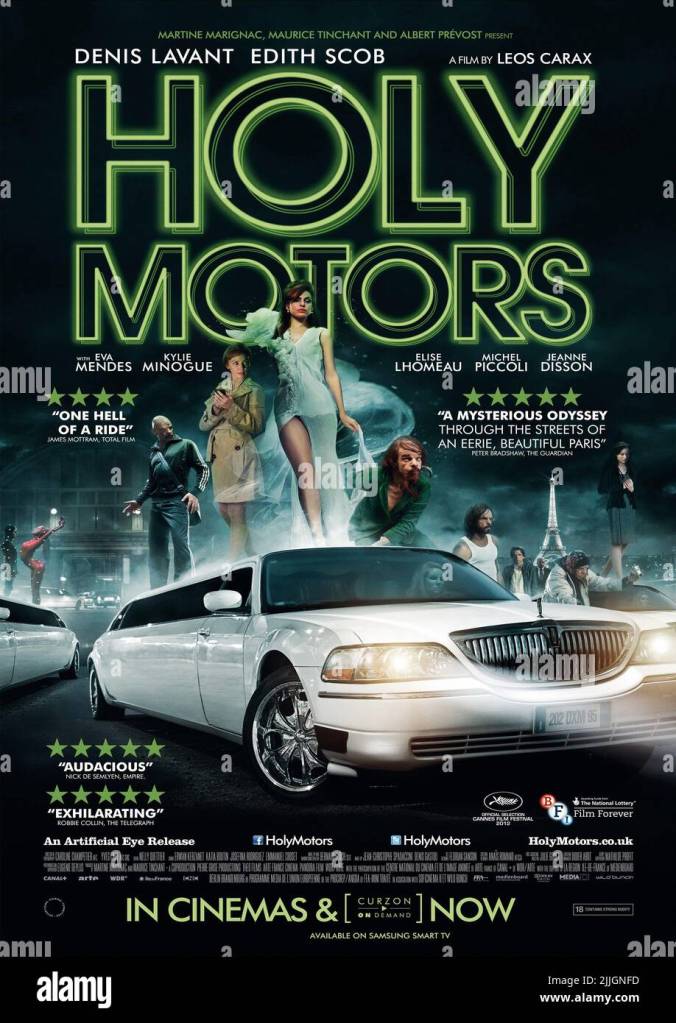
We know he lives in movies because we literally find him in one. Leos Carax’s much-debated “Holy Motors” begins with a man (Carax himself) asleep in bed, then waking and approaching a wall of the room that looks like a forest. Knowing just where to look among the trees, he unlocks a door using a key growing from his finger. Well, isn’t that what artists do? Unlock doors with their fingers?
Now this man is inside a cinema, and we meet Monsieur Oscar (Denis Lavant), who lives in a house that seems designed by the same architect employed in Jacques Tati’s “Mon Oncle.” He gets into the waiting limo, driven by a taciturn woman, and we see that the back of the limo, seemingly much larger inside than the outside, is a dressing room filled with costumes and props. When he gets out the first time, he has transformed himself into a wretched beggar woman. This will be the first of his many roles, or assignments, or embodiments. He performs in bizarre and mysterious ways, linked only by the desire of a mime or comedian to entertain and amaze us. His “appointments” take him into personas so diverse, it would be futile to try to link them, or find a thread of narrative or symbolism. If there is a message here, Walt Whitman once put it into words: “I am large. I contain multitudes.”
Here is M. Oscar as a madman wandering street markets and eating flowers or whatever else he can snatch up. M. Oscar in the most famous cemetery in Paris, Pere Lachaise, occupied by the dead and famous (Moliere, Chopin, Jim Morrison, Colette, Oscar Wilde). In “Holy Motors,” however, the cemetery’s tombstones carry no names, requesting us, to “visit my web site.”
Here is M. Oscar transforming a fashion model (Eva Mendes) into a Muslim woman concealed within her costume. And that’s not all that happens to her, although she adheres to the model’s code and never betrays emotions or opinions. Her job is to embody a beautiful object for the purposes of others. Their travels through the city lead to the roof of the Samaritaine department store, producing stunning vistas of Paris.Celine (Edith Scob), his reserved chauffeur, seems long accustomed to her role. Once she expresses concern that M. Oscar hasn’t eaten all day. Their day began at dawn and lasts far into the night, one “appointment” after another.This has been a year of leading roles for limousines. M. Oscar’s car upstages the limousine in David Cronenberg’s “Cosmopolis,” and the journeys of both cars seem to be odysseys through their cities, for purposes not very clear to the audience. “Holy Motors” is the more entertaining and funny of the two, although some parts are not funny at all, and many laughs are of disbelief or incredulity. Both end with their limousines going home for the night, answering a question asked in “Cosmopolis,” although when the limo in “Holy Motors” gets home, its day is far from over.Here is a film that is exasperating, frustrating, anarchic and in a constant state of renewal. It’s not tame. Some audience members are going to grow very restless. My notion is, few will be bored.
In Oliver Stone’s The Doors (1992) Ray Manzarek (Kyle MacLachlan) tells Jim Morrison (Val Kilmer) a story about his experiences working in the Hollywood of the late 1960s. He says he told a studio executive that he did not need a script to make a film. “Godard doesn’t use one,” Manzarek claimed. The executive replied, “That’s great… Who’s Godard?”
By the late ’60s, Jean-Luc Godard was a legend among young cinephiles. Beginning withBreathless in 1960 and ending with Weekend just eight years later, the caustic former Cahiers Du Cinema film critic made 15 films which can only be described as revolutionary. Both in terms of cinematic form as well as political and personal content, these films broke the old rules while inventing new ones. The use of handheld cameras, jump-cuts, natural light, and improvisation were both old and new things he popularized. Many of these ideas were used during the freewheeling days of silent cinema before filmmaking was industrialized and, in the mind of Godard and his “New Wave” colleagues, fossilized.
Godard wanted to provoke. But unlike some of his more didactic later work, these initial films are playfully provocative. Most of them are defined by their adversarial relationship to popular movie genres. Breathless is Godard’s deconstructed take on the crime film. A Woman is a Woman (1961) is his musical comedy.
Alphaville(une étrange aventure de Lemmy Caution) (1965)is two genres for the price of one: science fiction and noir. Maybe it’s even a third genre as well. It can be argued that the film is just another Eddie Constantine “Lemmy Caution” flick. “Lemmy Caution” flicks were big business in France since the ’50s, and Constantine played the role in over a dozen of them. Created by British pulp novelist Peter Cheyney, Caution is either an FBI agent or a private detective, depending on which novel you read, but it doesn’t really matter. He’s less a character than a genre archetype and it’s the archetype that Godard wanted. Especially one that was already lost in translation: British novels about an American detective adapted into French films starring an American actor speaking French.
Constantine was synonymous with the role, so Godard simply dropped him like a found object into his dystopian science fiction plot. The old fashioned tough guy Lemmy Caution does not belong here. His simple macho values and violent responses are hilarious when placed into this new context. In one scene, he shoots and kills a man then attempts to question him. Caution appears to have no idea what question to ask anyway, as his bizarre mission pits him against a fascist sentient computer called Alpha-60, which rules Alphaville and forbids any expression of emotion. Caution is deadpan but filled with primitive emotions both violent and romantic. It’s no surprise that Godard considered calling the film “Tarzan Versus IBM”.
By the end of the film, Caution gives up trying to understand the computer’s semantic games and resorts to his base instincts to bring Alphaville down. Along with using his fists and a .45 automatic, Caution expresses love for Natacha Von Braun (Anna Karina), the daughter of Professor Von Braun aka Leonard Nosferatu (Howard Vernon) — the man who built Alpha-60. Natacha grew up in Alphaville and does not know the meaning of words like “Love”. Caution challenges her to understand the meaning and challenges Alpha-60 by telling it a riddle that it cannot possibly comprehend.
From this description, the film may seem like a cold intellectual exercise. A film made by Alpha-60 itself. But this isn’t the case. I find Ridley Scott’s Blade Runner (1982), which is obviously inspired by this movie, to be a much colder experience. Alphaville is one of Godard’s wittiest and most emotionally moving. The pulpy sci-fi plot acts as a warm coat of familiarity as Godard slyly subverts one genre trope after another. Godard never really stopped being a film critic. His films were as much essays on how films worked as they were films themselves.
So Godard reveals the artificiality of B-movie fight scenes by presenting them as a series of posed comic book stills and gives Caution melodramatic theme music, which turns abruptly on and off at the most dramatically incorrect and hilarious moments. The excellent score by Paul Misraki shifts from this intentionally clichéd thriller music to beautiful and haunting pieces full of romantic longing.
This romantic theme is used most effectively at the end of the film, a scene which is a perfect example of what fellow French New Wave director Francois Truffaut called a “privileged moment”; brief moments in cinema when the film captures something intangible in a way no other art form could. As Misraki’s score builds, Godard holds on a lengthy closeup of Anna Karina, whose eyes are as hypnotic as any performer in film history. Karina’s expression slowly and subtly shifts from cold to warm and she ends the film by speaking the words she could not comprehend earlier: “Je vous aime…”
Film has always been a visual medium. In the days before sound, the image was all we had. It told our story, established our characters, and accentuated the drama or comedy. Visual flair is as old as movies themselves, and yet so few directors today seem to rely on and relish in the imaginative or outrageous. Since the early ’60s, Hollywood and its filmmakers have de-evolved style in a vicious cycle real world recreation for the hyper-stylized universe of the big screen, exploiting small events to find the hidden theatrics. Instead of broad canvases of color or rich, dense imagery, we witness the mundane or maudlin. Even those epic dreamscapes woven by complex computers and deranged art designers usually have one foot firmly planted in the easy to recognize and rationalize. But not The City of Lost Children. It harkens back to a more old-fashioned pictographic mindset. In many significant and indirect ways, the wild world of Marc Caro and Jean-Pierre Jeunet is art come to life. As in their previous film together, 1991’s Delicatessen, it is a fairy tale presentation of pure unbridled, wonderfully wicked imagination. It’s the Brothers Grimm as envisioned by Salvador Dali and filmed by Fritz Lang.
This is a lost classic, a film not often discussed when visionary works of imaginative cinema are mentioned. Part of this may be due to its foreign film roots. Or perhaps, for many, the film is too dark, not your typical sweet Saturday morning matinee. There are very disturbing subtexts to City that do not exist in other flights of fancy. The children here are indeed lost, either captured and tormented by a character known as Krank, or forced into a life of juvenile crime by the manipulative twins who run an orphanage. We do not see mothers or fathers. There are no caregivers or guardians, nor do we see orphans or outcasts longing for them. This lack of unconditional love creates youths who are vastly more mature, discussing subjects like love and fear with ferocious intensity and sly maturity. The strongman known as One is the closest we have to any type of parental figure, and even he is not really the older, bigger brother. “No parents” does not equal “no worries” in City. This is also a film that wallows in the subtle beauty of the grotesque, amplifying ugliness to illustrate unbridled absurdity. From Jean Paul Gautier’s Marquis de Sade meets Moby Dick fashion statements to the walleyed, demon-like faces of the child-napping zealot Cyclops, the film takes the long lost look of the circus sideshow and melds it to a nightmarish world of technological and emotional freaks.
Jean-Pierre and Marc are obviously obsessed with the carnival. The entire color scheme seems lifted from a tattooed man’s body illustrations. Like Fellini’s La Strada, which sought to tell a simple tale of love and the human spirit within the unreal realm of the circus, the filmmakers use the fantastical festival setting as a means of expressing their themes. Within its pandemonium pallet are the purity of youth, the pain of age, the wickedness of greed, and the comfort of love. There are also religious philosophies at play, battles with God both figuratively and literally. Krank and his army of clones fight and argue amongst themselves, all in the hope that, one day, the Creator will return to right his genetic missteps. The twins lord over their orphan charges like devils at the seat of Satan’s cloven hoof, waiting for instruction and brimstone beatitudes. Even the Cyclops proclaim their undying faith by blinding themselves, hoping that God will see that through both their devotion and their evangelism how truly gifted with sight (both internal and external) they are. Just like the wistful notion of running off to join the traveling show, The City of Lost Children is a chance not taken, a place where the oppression of maturity, of the stark reality of mortality and responsibility turn adults into monsters, and children into commodities.
The viewer can see many divergent ideals and inspirations at work here. But the most interesting influence to wind its way throughout the entire film is American cartoonist and inventor Rube Goldberg. Goldberg’s ingenious drawings illustrated incredibly complicated and multi-stepped procedures to achieve the most basic of results. Several set pieces in the film apply his principles and influences, and there is a giddy joy when their cause and effect logic draws to its ultimate conclusion. One sequence, involving the animal kingdom and a call to arms, is as beautiful as it is ridiculously complex. Like all other special, unnerving aspects of this movie, from the twisted fable at the core of its narrative, to the subtle pronouncements on love and family, The City of Lost Children is indeed like one of Goldberg’s wildest inventions. It’s a film that hitches its humor to the stinger of a flea, rides it on the heads of circus strongmen, and brings its heartfelt conclusion to rest in the bubbling tank of a talking, sarcastic brain. Yet the movie never gets lost itself. There is a perverse logic in its over symbolic and stylized storytelling.
No discussion of City would be complete without a word or two about the film’s music and its wonderful performances. As he has done in so many other films for auteurs like David Lynch and Paul Schrader, Angelo Badalamenti creates the perfect score, adding the clarion call of the calliope and the lonesome moan of the strings to underscore the strangeness and the sadness. This is a town under fire from within (the gangs of mercenary urchins) and without (the abductions), and Badalamenti creates a theme and an aural presence for every ideal. Sonically, The City of Lost Children is a near seamless matching of music to moving image. As for the actors, Ron Perlman has always seemed like a stunt waiting to be cast. Usually unrecognizable in face altering or obliterating make-up, he normally essays roles as unreal as the location in this film. But interestingly enough, he is the very human core of the film, a strong, faithful muscleman whose basic needs match his simpleton intellect. His is a perfectly modulated, understated performance. Among the child actors, little Judith Vittet stands out as Miette, a child who carries an incredible amount of adult soul and beauty within her delicate, French bisque features. And as usual, Jeunet regular Dominique Pinon applies his elastic facial features to the creation of six distinct characters, all out of minimal dialogue and elegant pantomime.
A movie like The City of Lost Children doesn’t really want to show us where the secrets of youth are hidden. It buries its message of adulthood and its perils in elaborate sets and visually arresting images. It symbolizes the dead end of avarice, the importance of familial bonds, and the painful loss of innocence through dreams in wonderful, paint box strokes. But it still leaves us wondering if such a place actually exists. For some, the manufactured wonders of Disney World or Universal Studios theme parks offer a glimpse into the sacred village of eternal childhood. Still others find it in the magic of their offspring at play, in their riotous laughter. Many see it in the eyes of their son or daughter as they light up in loving response. And there are those who, no matter how hard they try or how long they look, will never find the City. It will pass them by, or they will look over or through it in pursuit of a more complicated, unimportant goal. Jean-Pierre Jeunet and Marc Caro have at least provided a roadmap to the mythological place in their film La Cité des Enfants Perdus. Just turn right at your dreams, be on the lookout for your heartstrings, and ride your imagination all the way to where the sea meets the sky.