THE WILL TO PURPOSE – ACTIVATING OUR INNER DRIVE & INTENTIONALITY

By Kingsley L. Dennis

Source: Waking Times

‘A sincere reflection on human behavior is enough to convince us that the power of choice plays much less part in the life of man than we think.’ ~J.G. Bennett

We are familiar with the concept that a person has no real choice, and we generally regard this in relation to our commercial choices. That is, what we choose to buy is generally a decision based on a selection of limited choice. This has also been referred to as ‘curated needs.’ What we think or believe we want, or need, is conditioned into us – or ‘curated’ – so that we are merely responding to managed external stimuli to acquire certain goods. Whilst this is valid, and is indeed an operative modality, it remains within the material realm. In the opening citation, the thinker and author J.G. Bennett was referring to a form of choice beyond that of a material one. He was relating to the lack of choice within the inner world of the human being – that is, the presence of human will. Bennett was speaking and writing from the 1940s to the 1970s, yet what he said then is as relevant for today as he was not speaking about things that are relative to historical time or place but to an almost timeless situation – the human condition. The lack of genuine inner will of the human being has been made starker in modern times due to the lens of psychology and similar sciences.

Professor Mattias Desmet has recently popularised the concept of mass formation and false solidarity, which refer to how crowd psychology is established and sustained.[i] In his recent book (The Psychology of Totalitarianism), Desmet points out that what we call totalitarianism has only been with us for the past 120 years, since the beginning of the twentieth century. Two previous examples that he gives are the Stalinist regime that came to power on the back of the Russian Revolution, and the National Socialist (Nazi) regime in Germany. Most recently, he says, the world is experiencing the rise of a global form of totalitarianism under the guise, or ideology, of technocracy. The one thing that totalitarianism has in common is that it is based on ideology rather than brute power. Further, that the populace is persuaded (or programmed) into obeyance through propaganda and social-cultural conditioning, rather than forced through fear (as is the case with dictatorships). The mass formation of willing obedience is a symbol for our times. With the availability of global communications, a largely digitally ‘plugged-in’ world population, the widespread influence of controlled media, and the pervasive presence of mind-influencing technologies, the human species has never been in a more pressing moment in its collective history.

Modern day humanity may not only be suffering from a lack of genuine choice; more importantly, it may be experiencing the dilemma of a lack of connection with internal will power. It is this dominant state of the human psyche – we may even go so far as to call it a widespread psychosis – that lies at the root of much of our present ills with its sense of apathy and pessimism. Some readers will be familiar with German philosopher Friedrich Nietzsche’s concept of the will to power; lesser known is the English philosopher Colin Wilson and his notion of the will to perceive. For Wilson, the question of freedom and choice is not a social problem – it is an internal one for it requires an ‘intensity of will.’[ii] In other words, it is a personal struggle to achieve a form of self-awakening, or triggering, to arouse oneself from the torpidity and apathy of life. The issue is that for most people they don’t consider the fragility of life’s situation. The general masses, at least in the western world, consider themselves to be already free. They exist within the belief structure that they are protected and looked after by their governments and social institutions and that, give or take a few things, they have most essential needs provided for. Such people, I would posit, live on the outside of themselves – they are skin-dwellers. They live through their personalities and are most likely to adhere to mass consensus narratives. They are to be swayed by the rollercoaster ride of external events and react as anticipated by the governing elites who manipulate finances, food supply, energy supply, and more. This mass of people will only recognize the loss of freedom when it is threatened in relation to external events. It is a manufactured sense of freedom for once the threat has vanished – or seemingly made to vanish – then the meaning of freedom dissipates for the danger is no longer perceived. That is, it is an exterior crisis or danger that triggers people into action and as the perceived threat fades, they slip back once again into apathy and mass obedience. There is a lack of internal stimulation.

The stimulation of the human will requires that a person has the will to acquire insight. This they must choose for themselves, for no other agency shall give it to them. On the contrary, many social systems are designed to deteriorate a person’s will by compelling them to give away their dependency and authority onto external systems. Consistency, commitment, and the intention to will, are human aspects severely undermined by the deliberate constraint of material structures and social systems. Such critical observations and the power of intention are also being increasingly undermined by the rise of what I would call ‘lazy spirituality.’ This is the type of Instagram positive thinking or commercial well-beingness that online ‘spiritual celebrities’ are all too eager to promote (and sell). Behind such on-demand spiritual well-being-positive-thinking packages is a passivity or laziness to critically engage in inner work and to gain perceptive cognition to recognize the fallacy inherent within the material domain.

It is one thing to be positively-orientated and having ‘oneness’ for all creation; it is another matter to have the perceptive capacity to recognize that there are forces in play in the world that are active in nullifying metaphysical values and realities in order to replace them with an ever-deepening materialism. It would seem that there is an increasing form of cultural laziness and indecision, especially in this current time when people chiefly wish for things to be made easy for them. Instead of a person having faith and hope that they can change by making real effort, they are usually entertained with illusions that then take away from them the impulse to make any real change within themselves. In today’s world, a person who seeks to develop inner awareness and to raise their perceptive capacity often find themselves at odds with their cultural milieu. Those with ‘spiritual seriousness,’ so to say, are what Colin Wilson referred to as the Outsider.[iii] Such individuals have an intangible need to be more than just a ‘happy, well-fed animal.’ Again, Wilson referred to this state as being that of the robot; he said that we all have a robot within us that is eager to come out and take over all our daily duties for us. The Greek-Armenian mystic G.I. Gurdjieff called this the state of the ‘man machine.’ I have referred to this as the robosapien.[iv]

Within such automated states the individual experiences the world through a narrowed lens of awareness. Wilson, for example, recognized that such limited awareness almost lulled a person into a ‘state of permanent drowsiness, like being half-anesthetized’ so that a broader vision of life is restricted. And this is how what we call ordinary, everyday life affects us. Whether it be through external impacts, stimulants, distractions, information, technological entanglement, energetic haze, and more, the environment of everyday life pacifies us by closing down our perceptual horizons. In response to this, Colin Wilson noted that ‘it is as impossible to exercise freedom in an unreal world as it is to jump while you are falling.’[v] Freedom is not only related to physical mobility and access to human rights; it is also a question of an inner ‘intensity of mind’ that can pull a person out of the collective of mass formation (as Desmet would call it). The modern life can be regarded as a cause of spiritual decay because it seeks to demolish any recognition of a metaphysical reality. And through this, many people are unknowingly suffering a form of ‘reality deficiency.’ There have been people who, over the years, have strived to point this out to us, from wisdom teachers, mystics, and philosophers (like Colin Wilson). This deficiency prevents people from receiving inner nourishment; over time, this acts to deprive human cognition by literally starving it of nutrients (perception). We are in a time right now of great ‘reality deficiency’ as the dominant consensus narratives peddle their lies, manipulations, and programming.

Each age has its own form of reality and/or metaphysical suppression, from the physically overt (Spanish Inquisition) to the covert (technocracy). Within each specific era, there are calculated forces that act to impinge upon the individuals’ own evolutionary drive toward not only self-attainment but, more importantly, a connection with a transcendental impulse (what some may call as Source). The historian Arnold Toynbee believed that civilizations (and its individuals) progress by overcoming struggles; by moving through ‘challenge points,’ so to speak. If the crisis is too great, the civilization succumbs and collapses. If the challenge is not great enough, the civilization overcomes and becomes complacent, slides into greater decadence and eventually collapses. The challenge must be just right – the ‘Goldilocks’ zone, as Gary Lachman calls it. Challenges bring out the best in individuals too, yet they must be able to grow and develop through the crisis – and this is often down to an inner will or drive.  Toynbee believed that a civilization needs to produce a ‘creative minority’ to meet such a challenge of its time. It would seem that we are amidst such a ‘challenge point’ right now; and it is not only a physical crisis but also an existential one. I would go further and suggest that human civilization cannot survive indefinitely without some inborn sense of a transcendental purpose – otherwise it is like a hollow shell that becomes increasingly brittle over time. British philosopher and historian Nicholas Hagger, whose monumental work The Fire and the Stones examines the sacred impulse (the ‘Fire/Light’) within twenty-five civilizations, likewise has shown how civilizations are inspired by the transcendental impulse and decay when such an impulse is forgotten or dismissed.[vi]

What is required is for us, our communities and cultures, to become more conscious of our participation in reality. Further, that what we take to be reality is a merger between the physical and the metaphysical. As such, humanity is a being ‘of spirit’ that is manifesting through the intermediary of a physical body. To take this even further, we need to come to recognize that all existence is consciousness primarily, and that physical phenomena is an energetic state that manifests from a source of consciousness. What is required of humanity to survive beyond this existential crisis and challenge point is to become more conscious. Is this possible? Colin Wilson was not so sure. Wilson believed, and stated as such, that the majority of people cannot accept the burden of becoming more conscious. He felt that the ‘masses’ were both consciously and subconsciously choosing the more comfortable ‘mediocracy of life.’ I would even question what this term means any more – what is the ‘mediocracy of life’ when we can no longer be sure what reality is? Abstractions have now replaced realities to create an enveloping world of pseudo-reality and a ‘theatre of the absurd.’ As I talked about in my book Bardo Times,[vii] life has become a simulation – a simulacra as the French theorist Jean Baudrillard would say – and the notion of what is ‘real’ appears to have dissolved into what is the latest consensus narrative. What is important to acknowledge in these challenging times is that as the chaos whirls around us, humanity stands on the threshold of a higher form of life.

This is the other point that perceptive individuals have been attempting to point out to us (not least of them has been the Indian sage Sri Aurobindo). And this threshold becomes more apparent and urgent whenever a civilization begins either its decline or its necessary transition to a different epoch and modality. This is the challenge that civilization must face – either to raise/adjust its level of consciousness and perceptive capacity or stagnate and then collapse. Human civilization necessarily reflects the state of perception of its inhabitants. As that indwelling perception expands, so too does the physical environment develop in alignment. If perceptive capacity is restricted or even being deliberately reduced, as is the case right now, then entropic or atrophying forces begin to dominate. This is why we must resist, at great effort, to submit to a programming of conformity and perceptive limitation that is likely to come about through increased technocratic forms of social management and control. This is where Colin Wilson’s notion of the will to perceive comes in. Due to the external environment, human consciousness is generally conditioned into a dulled state so that higher insights or perceptions are not ‘allowed’ to get through. We need to seek to ‘widen’ (expand) our consciousness beyond such limiting influences so that greater perceptive insights can be achieved. Most people, however, are reflections of their surroundings and, as such, require external inputs to motivate or trigger them into action. Chaos and crises can function as such triggering impacts. The ‘will to perceive’ also activates a will to purpose. Behind the human developmental impulse there is a push, I would say, to increase our intentionality. Without the ‘will to purpose’ there is a lack of conscious participation. It is the will to purpose that distinguishes the human being from the machine – the ‘robosapien.’ Modern life, with its technocratic pull, is encouraging people not to think but to allow automation to take over duties and responsibilities. On the contrary, we need to be ‘pulling ourselves up by the bootstraps’ and intentionally driving ourselves across the threshold. What could this threshold be?

Humanity is moving towards a stage in its evolutionary path whereby it becomes cognizant of its role as a fusion (a bridge or merger) between spirit/consciousness and physicality/matter. We are, in these times, the forward ground crew sent ahead to prepare the groundwork. Sometime in the future – it could be ten, twenty, thirty years or more – human understanding and the sciences will come to recognize the primary role of consciousness behind all existence. And when this occurs, human life will alter drastically. We shall understand that human existence is a merging of non-physical intelligence with physical forces. The very notion of life and reality will be greatly expanded beyond current conceptions. We shall be propelled beyond the confines of the physical robot – the robosapien – and shall utilize presently unknown organs of perception. But we are not at that threshold yet. And this is partly why we are seeing a contestation of forces in play. There are forces that do not wish for humanity to reach, and pass, this threshold for we shall then no longer be their passive robots to manage and control. The present control hierarchies will be demolished. And there is a small contingency that wish to cut humanity off from this transcendental impulse, to isolate us from receiving such developmental forces, and to push us back into our perceptual prisons of the ‘everyday mundane.’ Such forces aim to increase the programming and technologies of cognitive influence to hypnotize the mass of humanity into accepting an ‘upside-down’ reality that the robosapien seems the most suited to. Our will to purpose now is about having the inner drive and intentionality to move us beyond this current predicament and modern state of alienation, and forward into a state of heightened cognition and expanded perceptual awareness.

It is my view that the ‘teething pains’ that we are presently experiencing represent the birthing, or arrival, of a new form of consciousness coming to manifestation through the human species. That is, a mergence with an expanded field of consciousness. And for this to emerge, the individual is called upon to ‘meet it’ halfway, so to speak. Social forces will attempt to continue to hold back the individual by mental, emotional, and physical/biological interventions. And yet, against these artificial constrictions, I am confident that if enough of us (we don’t need to be a majority) can strive for cognitive freedom, perceptive clarity, and inner awareness, we can become the early wave – the evolutionary outsider – to make the initial steps across the threshold. Just enough of us need to act as the ‘antennae of the race’[viii] to pass the baton onto our descendants. And that, I would say, gives us enough reason to activate our will to purpose.

About the Author

Kingsley L. Dennis is the author of The Phoenix Generation: A New Era of Connection, Compassion, and Consciousnessand The Sacred Revival: Magic, Mind & Meaning in a Technological Age, available at Amazon. Visit him on the web at http://www.kingsleydennis.com/.

[i] See my previous essay: ‘The Establishment of Mass Psychology & False Solidarity’ – https://kingsleydennis.com/the-establishment-of-mass-psychology-false-solidarity/

[ii] For an in-depth study of Wilson’s life and thought, I would recommend the excellent biography by Gary Lachman – Beyond the Robot: The Life and Work of Colin Wilson (2016)

[iii] See Colin Wilson’s book The Outsider (originally published in 1956)

[iv] See my book Hijacking Reality: The Reprogramming and Reorganization of Human Life (2021)

[v] Wilson, Colin (1982) The Outsider. Los Angeles: Jeremy P. Tarcher, p39

[vi] Hagger, Nicholas (1991) The Fire and the Stones. Dorset: Element Books.

[vii] Bardo Times: hyperreality, high-velocity, simulation, automation, mutation – a hoax? (2018)

[viii] A phrase coined by the poet Ezra Pound.

LA VOLUNTAD DE PROPÓSITO: Cruzar el umbral venidero de la humanidad
Virtual Beauty, Virtual Freedom, Virtual Love: Is the Metaverse Our Future?

By Robert J. Burrowes

When is the last time you were outside in the morning to experience a glorious dawn? Or sat watching the sun set across the ocean horizon?

How do you feel when you touch the skin of someone you love? A grandparent, parent, lover or child?

Have you ever seen a spider’s web full of morning dew, or after the rain, when the sun is shining through the droplets in the web to reveal the flashing diamonds, sapphires, rubies and emeralds hidden within?

Have you ever stood in a natural environment – a beach, desert, rainforest… – far from a city and noticed that strange and subtle feeling of freedom tremor through your body?

Have you ever marveled at the breath of wind that cools your face on a hot Summer’s day? Or been intoxicated by the smell of blossom in Spring?

Have you gaped in wonder at the birth of new life: a chick pecking out of its shell, a seed germinating or a baby being born?

Or paused to ponder the sheer magic of being alive yourself?

Or do you find life in the real physical world too constricting, painful, frightening and demanding: something from which you seek to escape, with some distraction or another (work, television, sport, a novel, a drug…), as often as you can?

Well, very soon now, we are promised, you will be able to escape reality far more effectively than those primitive means of distraction made possible previously. And far more effectively than even the outcomes promised in those dystopian novels.

So the fundamental questions we must ask ourselves are simple: Do you want real life, with all of the pains, sorrows, fear and fury that go along with beauty, freedom and love? Or do you believe what they tell us and want everything unpleasant to go away? Permanently. And to live in delusion thereafter, given synthetic versions of all of the pleasant feelings and experiences described above?

Remember the dialogue between the Savage and Mustapha Mond during the closing stages of Aldous Huxley’s dystopian novel Brave New World?

‘But I don’t want comfort. I want God, I want poetry, I want real danger, I want freedom, I want goodness. I want sin.’

‘In fact,’ said Mustapha Mond, ‘you’re claiming the right to be unhappy.’

‘All right then,’ said the Savage defiantly, ‘I’m claiming the right to be unhappy.’

‘Not to mention the right to grow old and ugly and impotent; the right to have syphilis and cancer; the right to have too little to eat; the right to be lousy; the right to live in constant apprehension of what may
happen to-morrow; the right to catch typhoid; the right to be tortured by unspeakable pains of every kind.’

There was a long silence.

‘I claim them all,’ said the Savage at last.

Well, after nearly one hundred years, the dystopian future described by Huxley is almost upon us and, if we are to defeat it, we need a lot more ‘savages’ willing to forego the promised ‘comforts’.

Because if those who see themselves as our global masters get their way, we are about to enter a virtual world that will become more complete by the day and from which there will be no escape.

The Metaverse

Based on many years of effort, the World Economic Forum (WEF) has recently launched its plan to create our new all-digital world, called the ‘metaverse’. See ‘Defining and Building the Metaverse’.

So if you find natural phenomena – ranging from rainforests, beaches and weather variations to ill-health, danger and unhappiness – annoying, you will soon be able to escape them, compliments of the metaverse. Or so we are promised. And you won’t be troubled by anything resembling what might be called ‘free will’ either. You will be content to do as you are told, even more than you are content to do already. See ‘Terrified of Freedom: Why Most Human Beings are Embracing the Global Elite’s Technotyranny’.

After all, your mind will no longer be your own. And while the usual descriptions, written by elite agents, fail to mention it, a quick flash of metaverse-induced fear will make sure that you comply, whatever you are required to do. The point is this: You won’t be escaping all of those unpleasant feelings after all. They can just be used to control you more directly, to fulfill an elite-determined purpose. But that is a fact they are not advertising.

In their iconic hit song ‘In the Year 2525’, written in 1964 by Rick Evans and later recorded by he and Denny Zager to become a No.1. hit around the world in 1969, Evans captured key elements of what is already upon us somewhat ahead of the schedule mapped out in the song.

[Chorus 2]
In the year 3535
Ain’t gonna need to tell the truth, tell no lies
Everything you think, do, and say
Is in the pills you took today

[Chorus 3]
In the year 4545
Ain’t gonna need your teeth, won’t need your eyes
You won’t find a thing to chew
Nobody’s gonna look at you

[Chorus 4]
In the year 5555
Your arms are hanging limp at your sides
Your legs got nothing to do
Some machine’s doing that for you

[Chorus 5]
In the year 6565
Ain’t gonna need no husband, won’t need no wife
You’ll pick your sons, pick your daughters too
From the bottom of a long glass tube
Whoa-oh-oh

So what is the Metaverse?

According to the WEF: ‘The metaverse is a future persistent and interconnected virtual environment where social and economic elements mirror reality. Users can interact with it and each other simultaneously across devices and immersive technologies while engaging with digital assets and property.’ See ‘Defining and Building the Metaverse’.

Moreover, ‘if technologists are right that 2022 will separate thinkers from builders, then last years’ technical advances will produce this year’s first steps towards making the metaverse a reality….

‘But from the perspective of the human experience, one development stands out above all others: extended reality (XR) technologies. These include virtual reality (VR), augmented reality (AR), and brain-computer interfaces (BCI), which together position themselves as the next computing platforms in their own right.’

Nevertheless, it is clear that a precise definition of the term ‘metaverse’ (for a start: is it a product, service, place or moment in time?), upon which there is broad agreement even among those who routinely use the term, is yet to emerge. See ‘3 technologies that will shape the future of the metaverse – and the human experience’.

Having written that, here is one definition elaborated in the article above that reveals just how far some of those heavily involved in this work have become disconnected from any sense of themselves and, hence, reality: ‘Specifically, the metaverse is the moment at which our digital lives – our online identities, experiences, relationships, and assets – become more meaningful to us than our physical lives.’ The original quotation can be read here: ‘Spheres of Self: Performativity and Parasociality in the Metaverse’.

And, as Cathy Li describes it, the metaverse is ‘most useful as a lens through which to view ongoing digital transformation. The belief is that virtual worlds, incorporating connected devices, blockchain and other tech, will be so commonplace that the metaverse will become an extension of reality itself.’ See ‘Who will govern the metaverse?

Let me reiterate two points from the paragraphs immediately above: ‘our digital lives… become more meaningful to us than our physical lives.’ And ‘the metaverse will become an extension of reality itself.’

Really?

While statements such as these reveal the breathtaking level of insanity that underpins this entire enterprise – see ‘The Global Elite is Insane Revisited’ – it does not mean that we are not under enormous threat. Just as vast arsenals of nuclear weapons, by some insane ‘logic’, are supposed to provide us with ‘security’ while actually threatening the existence of all life on Earth, the metaverse is part of a substantial package of measures that will reduce human life to one not worth living.

Why? Well, as noted by authors such as Tom Valovic: The metaverse is one element in the path to implementing technocratic governance over all of humanity.

‘As Planet Earth and our physical world continue to experience massive biospheric degradation and disruption, the elites that are now in many cases pulling the strings of governance at the country level are heading for the exit doors. Elon Musk and Jeff Bezos are exploring the realm of space and Musk has a Mars mission planned. Globally oriented elites… looked out for themselves which is what they do best….

‘Paralleling the notion of space flight as a form of existential escapism is the metaverse. So what if our cities are crumbling, infrastructures falling apart, and the biosphere is seriously degrading? So what if our wasteful consumer-driven lifestyle has created unprecedented levels of pollution so extensive that it’s now the number one cause of health problems globally? No problem… we’ll just kick back and don our Meta headsets (or worse get a brain implant) and escape into an artificially fabricated world that lets us turn our back on the massive ecological and environmental problems we now face.’ See ‘Why We Should Reject Mark Zuckerberg’s Dehumanizing Vision of a “Metaverse”’.

‘Education’ in the Metaverse

Of course, the metaverse is deeply interwoven with other components of their plan, such as those in relation to what they call ‘education’, which is more accurately described as the process by which young transhuman slaves are programmed to perform their function in the technocratic economy that is being imposed upon us. Of course, ‘education’ sounds better than ‘virtual programming of young transhuman slaves’ so, in the interests of not raising obvious concerns, the word ‘education’ has been used.

As noted by Dr. Michael Nevradakis, discussions on this subject at the recent gathering of the World Economic Forum emphasized the importance of virtual reality (VR) and artificial intelligence (AI) technologies with participants touting the purported educational and economic benefits that would derive from use of these technologies in the classroom by helping, according to Dr. Ali Saeed Bin Harmal Al Dhaheri & Dr. Mohamad Ali Hamade, to ‘increase accessibility, enhance quality and improve the affordability of education globally’. See ‘Experiential learning and VR will reshape the future of education’.

However, as Nevradakis also noted, these discussions had ‘little to say about the need to protect children’s data or digital identities – or, for that matter, providing the types of early-life experiences children require as part of their socialization.’ See ‘Future of Education? WEF’s Vision – Heavy on Virtual Reality and AI Technologies, Light on Privacy Concerns’.

Of course, there is no need for concern about the ‘early-life experiences’ of those young transhumans who are being programmed for decades of servitude prior to being terminated when they are no longer functional.

Beyond claimed educational and economic benefits, however, some authors argue that digitalizing education can play a role in easing pressures on the environment and climate. How so? Nevradakis again: ‘Indeed, the WEF said the use of “textbooks, notebooks and pencils as critical learning tools” is on the way out, due to “environmental pressures and COP26 goals (from the 2021 United Nations Climate Change Conference),” which “will drive the digitalizing of education streams.”’ See ‘Future of Education? WEF’s Vision – Heavy on Virtual Reality and AI Technologies, Light on Privacy Concerns’

But it is clearly delusional to suggest that the use of textbooks, notebooks and pencils has greater adverse impact on the environment and climate than the environmental cost and climate impact of producing sophisticated technology for each student. And despite claims of ‘improved affordability’ it is equally delusional to ignore the economic and social cost, for example, to the child ‘laborers’ in the Congo working in appalling conditions to extract strategic minerals to produce this technology. See ‘Humanity’s “Dirty Little Secret”: Starving, Enslaving, Raping, Torturing and Killing our Children’.

Besides, as touched on below, education is already a monstrous experience, destroying the Selfhood of the child so that they become submissively obedient. Removing the bulk of education’s remaining social component by technologizing it can only make it even worse.

Babies in the Metaverse

Then again, maybe ‘children’ will no longer be put through school. It simply won’t be necessary because children, for transhuman slaves at least, will no longer exist.

By 2070, the metaverse will offer you virtual babies, ‘environmentally-friendly digital children’, according to UK artificial intelligence (AI) expert Catriona Campbell. ‘Parents will see and interact with their offspring through next-generation AR [augmented reality] glasses and haptic gloves.’ The latter devices enable users to experience ‘a realistic sense of touch when handling virtual or holographic objects’. As a bonus, these children take up no space, cost nothing to feed and remain healthy, if that is what you want, for as long as they are programmed to ‘live’. A subscription might cost as little as $25 each month.

And if this seems like a monumental leap out of reality to you, Campbell also believes that ‘within 50 years technology will have advanced to such an extent that babies which exist in the metaverse are indistinct from those in the real world…. As the metaverse evolves, I can see virtual children becoming an accepted and fully embraced part of society in much of the developed world.’ See ‘“Virtual babies” who grow up in real time will be commonplace by 2070, expert predicts’.

That’s right, Campbell is claiming that ‘within 50 years… babies which exist in the metaverse are indistinct from those in the real world’! Pause a moment. How does that sound to you?

Just in case you cannot wait, you are welcome to start using early versions now. See, for example, Virtual Baby, Adopt a Virtual Baby and My Virtual Child.

Oh, and by the way, you won’t be having sex either, whether for reproductive purposes or otherwise. You will prefer virtual sex. See ‘Sex And Pornography Aim To Strike Gold In The Metaverse’.

Critiquing the Metaverse

Beyond the criticisms already noted above, there are a great many other criticisms of the metaverse and the role it will play in the overall elite program being implemented under what the WEF calls its ‘Great Reset’. This comprehensive program will transform human society and human life for those people left alive after the eugenics component has been fully implemented. See ‘The Final Battle for Humanity: It is “Now or Never” in the Long War Against Homo Sapiens’.

If you like, you can read a little more about what the masters of this metaverse intend for us, as well as critiques of it, by authors such as these.

Derrick Broze: While some people ‘may not intend for The Metaverse to become an all encompassing reality that supersedes physical reality, for the Zuckerbergs, Microsofts, and WEFs of the world, that is exactly what they intend for The Metaverse…. For the billionaire class and their puppet organizations, such as the WEF and the United Nations, the Metaverse offers up the potential to commandeer all life into digital prisons where the people can be charged for services and products in the digital realm…. With the people of the world safely tucked into their digital beds, the Technocrats could complete their total takeover of natural resources, the economy, and humanity itself.’ See ‘The Great Narrative And The Metaverse, Part 2: Will The Metaverse End Human Freedom?

Dr. Michael Nevradakis: ‘Who will govern the “metaverse”?… According to the WEF, “real-world governance models” represent one possible option for metaverse governance. However, far from referring to constitutionally defined institutions of governance, with checks and balances, the WEF cites Facebook’s “Oversight Board” as an example of such a “real-world governance model.”’ See ‘WEF Launches “Metaverse” Initiative, Predicts Digital Lives Will Become “More Meaningful to Us Than Our Physical Lives”’.

But an earlier World Economic Forum report from its Global Redesign Initiative was more blunt: ‘The report postulates that a globalized world is best managed by a coalition of multinational corporations, governments (including through the UN system) and select civil society organizations (CSOs).’ See Sustainable Development Goals and Human Rights p. 209, citing ‘Everybody’s Business: Strengthening International Cooperation in a More Interdependent World’.

So if you believe that you and I are destined to have a say in the metaverse that is unfolding, you would be wise to keep investigating. Elite proposals are invariably very distant from the type of governance models usually considered by ‘ordinary’ people in a multiplicity of contexts, where the emphasis is on facilitating widespread grassroots participation, not rule by technocrats.

You can read considerably more about what our technocratic overlords have in mind – including the existing trade in such things as virtual real estate, virtual clothing and virtual art – and what is wrong with it, in the articles on the metaverse published by Patrick Wood on ‘Technocracy News & Trends’: ‘Metaverse’. And there is more in articles such as these: ‘The Top 10 Creepiest and Most Dystopian Things Pushed by the World Economic Forum (WEF)’ and ‘How Our Lives Could Soon Look”: The World Economic Forum Posts An Insane Dystopian Video’.

And here’s another simple issue to ponder. Remember how I mentioned above that a quick flash of metaverse-induced fear would ensure that you complied with an elite-determined directive, how does the idea of eating bugs, processed sewage and human flesh appeal? Well, given that your mind will no longer be your own, what appeals now, or doesn’t, will be irrelevant once the metaverse is determining how you perceive things. See ‘Canadian Company Pledges To Produce TWO BILLION BUGS Per Year For Human Consumption’ and ‘Will You Eat Cultured Meat Grown From Human Cells?’

You will eat ‘Soylent Green’ because that is what the program tells you.

So why are people embracing the Metaverse?

In a recent article in which he described taking his son to watch a film through 3D glasses, Charles Eisenstein noted ‘The on-screen reality was so vivid, stimulating and intense that it made the real world seem boring by comparison.’ See ‘Transhumanism and the Metaverse’.

How can this happen?

Because we terrorize our children into submissive obedience, devoid of the unique and powerful individual Self they were gifted by evolution at birth. See ‘Why Violence?’,‘Fearless Psychology and Fearful Psychology: Principles and Practice’and ‘Do We Want School or Education?’ Why? Essentially to keep them performing tasks that bore them senseless throughout their school and working life.

Fundamentally, this terrorization works because it compels our children into suppressing awareness of how they feel. As a result, only the most intense experiences register emotionally: The capacity to experience a subtle feeling has been lost. And without this capacity, they cannot develop into the powerful, courageous Self-willed individuals that evolution intended. They are human relics. Ready and willing to be turned into a transhuman slave in the unconscious hope they will be finally able to experience, in the metaverse, what was taken from them in the real world as a child.

But they won’t get that experience, even in the metaverse. It is not what the elite has in mind for us.

Resisting the Metaverse

Of course, the metaverse is just one feature of the Global Elite agenda that is being imposed upon us. And it is not enough to resist individual features of the ‘Great Reset’ program. We must strategically resist its most fundamental elements so that the entire agenda is defeated.

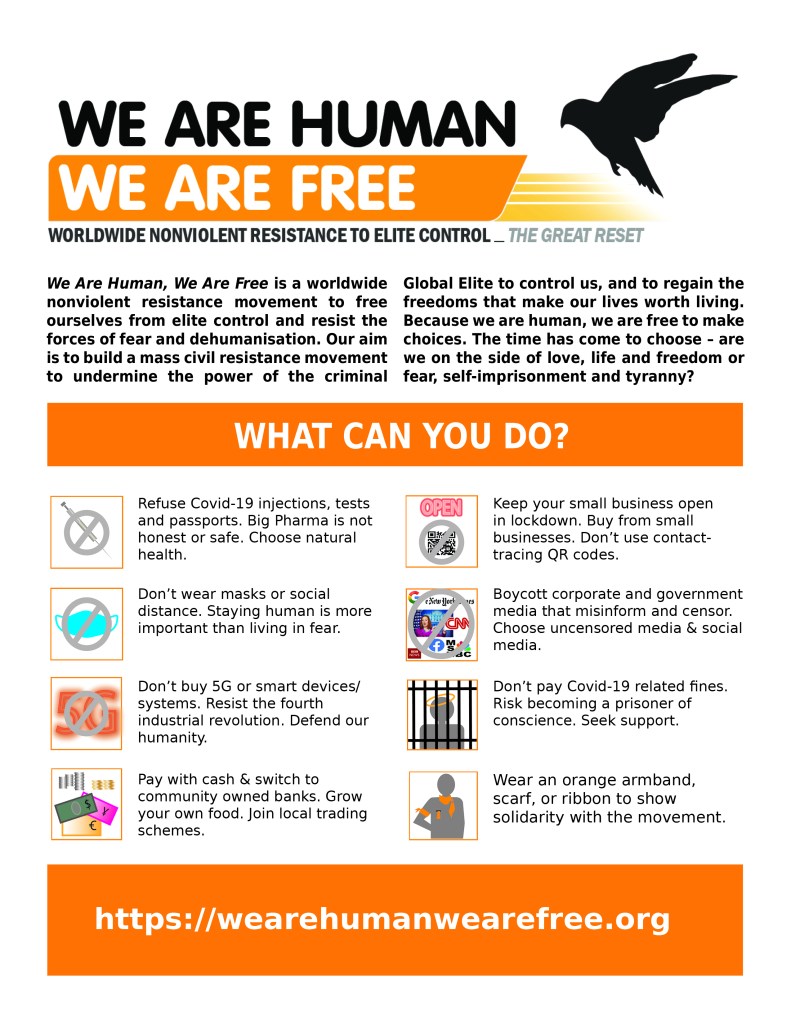
If you are inclined to join those strategically resisting the ‘Great Reset’ and its related agendas, you are welcome to participate in the ‘We Are Human, We Are Free’  campaign which identifies a list of 30 strategic goals for doing so.

In addition and more simply, you can download a one-page flyer that identifies a short series of crucial nonviolent actions that anyone can take. This flyer, now available in 17 languages (Czech, Danish, Dutch, English, Finnish, French, German, Greek, Hebrew, Hungarian, Italian, Polish, Romanian, Russian, Serbian, Spanish & Slovak) with more languages in the pipeline, can be downloaded from here: ‘The 7 Days Campaign to Resist the Great Reset’.

If strategically resisting the ‘Great Reset’ (and related agendas) appeals to you, consider joining the ‘We Are Human, We Are Free’ Telegram group (with a link accessible from the website).

And if you want a child who is powerfully able to perceive the dysfunctional lure of the metaverse, and is able to join you in resisting it, consider making ‘My Promise to Children’.

CONCLUSION

So, for just a little longer, the choice is yours.

You can live your life with all its challenges and problems, joys and achievements. Or you can live the virtual life that someone else programmed for you, including whatever comes with it that they didn’t tell you about.

In short, like Neo in the film ‘The Matrix’, you have a choice. You can choose the Blue Pill and proceed to live in a synthesized, fictional, computer-generated world. Or you take the Red Pill and, in this case, join the fight with those of us determined to defend the real world and avert descent into the metaverse.

But you must make that choice while you still have free will.

So you must make that choice soon.

Biodata: Robert J. Burrowes has a lifetime commitment to understanding and ending human violence. He has done extensive research since 1966 in an effort to understand why human beings are violent and has been a nonviolent activist since 1981. He is the author of ‘Why Violence?’ His email address is flametree@riseup.net and his website is here.

Open-Mindedness Is Intrinsic and Often Terrifying

By Equanimous Rex

Source: Modern Mythology

“If men define situations as real, they are real in their consequences.” — The Thomas Theorem, formulated in 1928 by William Isaac Thomas and Dorothy Swaine Thomas

The world of society appears a machine run off of the fuel of self-fulfilling prophecy. The word “prediction” gives us insight into the nature of prophecy: prediction. Speaking of a thing before it has happened. Prognostication, the half-rational half-intuitive art of looking at the mess around us and hazarding a guess at where it is going to go.

It would be easy to assume that this is a passive act, a matter of mere observation — as though it necessarily follows that when one perceives the present, they can perceive the future. But what about when the prediction alters the present, contributing to a future that without the prediction would not exist? Of course, since we do not have the capacities to create a universe exactly alike our own to test and experiment with, to play back and forth making slight alterations, we cannot know for certain. We can do our best to connect the branching causal links, however.

So when I first learned about the Thomas Theorem, something clicked immediately.

“If men define situations as real, they are real in their consequences.” — The child in America: Behavior problems and programs.

I had struggled for ages to explain to people how mental states and psychological abstractions are not merely ephemeral reactions to external stimuli, but aspects of feedback loops that in turn affect our behaviors. Our thoughts on events affect how we feel in reaction to our own interpretations of those events, our emotions subsequently affect our drives and aversions and alter our behaviors. Because we cannot directly observe thought, belief, or feelings, it is easy to believe that they have no real-world effect.

For many of us born in countries that have inherited the legacy of Christendom, we are told that by the merit of our very birth we are gifted with a metaphysical superpower known as free-will, which allows us continuous authorship and subsequently total responsibility for every action that we take, every decision we enact. It is then easy — with this presupposition firmly entrenched — to dismiss the effects of external stimuli on internal mentality, and visa-versa. To deny that we are open systems, and that there is an influx and egress between our environment and the core of our existence as perceiving-beings. (I have no desire to get into a debate on the metaphysics of free-will, but merely point to it as an example of a way of thinking that produces real-world change.)

If I think that everything I do is sourced originally from within myself, then there is no incentive to investigate the catalysts that prompt me to ponder in the first place, nor those which compel me to take action. No reason to reflect upon the framing and anchoring of news stories, blogs, or books. The unconscious is relegated to the status of urban myth, a spook to worry lesser beings who believe in such superstition. The assumption of free-will is necessarily the denial of non-conscious cognitive processes, of denial of bias, and the proposition that we are the masters of the entirety of our being.

This is a belief system which renders a person totally responsible for everything they do; the perfect grift. If you can convince people that psychic abstractions have no real-world effect, that thoughts and feelings are merely strange footnotes in human existence, wisps of our experience that follow only after our free-will based decisions, then you can convince people that the life they are currently perceiving is not merely a best-guess neurological prediction machine. You can convince them that new ideas and managed expectations, emotions, and visceral drives have no more than superficial impact on their lives. The doctrine of free-willism, the metaphysical presupposition tacitly assumed as true and inherited by our cultural ties to Abrahamism, is essentially an anti self-help system. If you assume all that you have to do is throw free-will at a problem to solve it, and the problem remains unsolved, it must be that you desire to be burdened and have chosen such a victimization. You are always at fault, or in denial. It declaws the idea of introspection, of conscious behavior modification and extensive practice and training, of therapies intended to guide a person into their more desired state, of art that sways and moves people or inspires them into action. It denies the effect of lies, of propaganda, of marketing. It is a myth that deceptively limits our sense of the power of myth.

If we assume that we are the ultimate source from which all of our opinions, actions and emotions arise, we will not search out how they were absorbed by osmosis from our environment, our parents, our peers, nor how old narratives prime us to select more of the same, and discard the rest. If we accept that we are neither source nor first cause, we are forced to face the unconscious head-on, to stare at it in its darkened visage despite the pain or unease it causes us.

We have to come to accept that not all of our interpretations of events are just or fair, and that the relationship between psyche and environment is an open one. That the things we see as passive — such as making an off-hand prediction about the future — can affect the external world and alter that which we strive to objectively assess. Consider such phenomena as the Pygmalion effect, in which higher expectations placed on a person leads to increases upon performance; and likewise the inverted Golem effect, in which lower expectations placed results in lowered performance. We deal with Mean-World syndrome, in which those who consume large amounts of violent media tend to believe that the world is a more violent and unforgiving place than people who do not consume such media, despite the statistics that seem to indicate that violence crime has been steadily decreasing in many parts of the world for an extended time. The placebo effect, far from meaning “nothing happens”, refers to substances administered as medicines that have no active therapeutic effect, which still cause changes in the experiential — even the physiological — state of the patient. Nocebo effect does the opposite, in which inert substances produce harmful effects on the individual.

I’m not trying to convince you free-will isn’t real or that there’s nothing you can do to affect your own behavior, or to accept that you are a bio-robotic automaton, a p-zombie devoid of agency or identity. My musing here is merely a sort of memorial to self-fulfilling prophecy, a reminder to myself and others that the unconscious is not accepted into our cultural narrative despite the near ubiquity of the term. If you want to see an alien world, merely think of humans as open systems subject to outside influence and go and talk to anyone about current events.

Freedom Begins Within: From the Authoritarian Self to the Liberated Self

8244838bdbdc236e5a0deac3cf5e1307-958x716x1-300x224

By Gary ‘Z’ McGee

Source: Waking Times

“If people base their identity on identifying with authority, freedom causes anxiety. They must then conceal the victim in themselves by resorting to violence against others.” ~Arno Gruen

Freedom is both the easiest thing to gain and the hardest thing to hold onto. We can courageously declare ourselves free in one breath, while in the next breath meekly kowtow to authority. It’s like an Orwellian doublespeak somersaulting through our heads: freedom is debt-slavery, freedom is obeying orders, freedom is paying taxes against our will, freedom is keeping our mouth shut when a cop speaks, freedom is forcing our will onto others, freedom is codependence on an unhealthy authoritarian state. Really?!

Cognitive dissonance is our ego’s saving grace. We convince ourselves we are free, even when we’re not, so that our pride isn’t harmed. We convince ourselves we are free so as to maintain our comfort zones. We convince ourselves we are free because if we’re not free then our existence is null. In the end, freedom becomes a cliché concept we toss around inside of the very box we’re trying so desperately to think outside of.

When it comes down to it, liberty begins within. It begins by first admitting that we must free ourselves from our inner tyrant before we can give birth to our inner liberator. It begins by digging deep and ousting the king trying to rule, decommissioning the commissioner trying to micromanage, and banishing the warden trying to keep order. It begins by not talking like rigid authoritarians to ourselves.

Let’s break it down…

Authoritarian Self-Speak

“None are more hopelessly enslaved than those who falsely believe they are free.” ~Johann Wolfgang von Goethe

We live in an age of hyper-conformity. It goes widely unrecognized because it has become the rigid “reality” that modern culture indoctrinates into its members. It’s even considered admirable somehow to be “well-adjusted to a sick society.” Of course, our cognitive dissonance usually prevents us from admitting that such is the case. This is because we are primarily psychosocial animals who create a pleasing-to-others false self in order to alleviate the deep-seeded fear of being hurt or abandoned by others. Which is fine if one lives in a healthy culture. Not so fine if one lives in a profoundly unhealthy, unsustainable, authoritarian culture such as the cultures dominating the world today.

So what does a psychosocial animal that’s raised in an authoritarian culture do? Well, they speak to themselves in an authoritarian voice for one. Their inner tyrant is constantly pushing its authoritarian agenda, keeping the rebellious liberator at bay, lest he rise up and ruin the comfort zone or cultural malaise that has kept the inner tyrant safe and secure within the social milieu for so long.

So even if self-liberation is the goal, the inner tyrant rises up and barks in its best drill sergeant voice, “Stop dreaming, there’s no such thing as freedom,” or “Shut up and obey like everybody else,” or “You’re not worthy of freedom, what makes you so special?” or “This is just the way things are, deal with it,” or “Don’t rock the boat, it’s easier that way.”

The problem with this is that the majority of us cannot distinguish the indoctrinated authoritarian voice from the voice of our own free will, and we then confuse it for our own free will. Out of confusion and fear, we give into the inculcation. We remain authoritarian unto ourselves. We go with the flow, even though the flow is clearly poisonous.

Ironically, the cure for authoritarianism is self-authority, or free will. The key to the cultural prison is realizing that we’re all at once our own prisoner as well as our own warden. Our inner conflict between indoctrinated authoritarian and rebellious liberator is precisely what keeps us unfree. But there is no conflict, really. We imprison ourselves with our own commanding words. We’re always free. Our free will has only to take authority back from our inner authoritarian, by using words infused with free choice, in order to turn the tables on the psychosocial dynamic.

Instead of listening to the commands and authoritarian orders dictated by our inner warden or king, we speak to ourselves in a way that the freedom of choice is clearly paramount. And suddenly we’re able to ask ourselves, as Rumi did, “Why do you stay in prison when the door is wide open?”

Liberated Self-Overcoming

“The revolution begins at home. If you overthrow yourself again and again, you might earn the right to overthrow the rest of us.” ~Rob Brezsny

So what happens when we begin to base our identity on self-authority rather than on identifying with an outside authority? What happens when freedom of choice becomes paramount, despite our inner authoritarian? Freedom no longer causes anxiety, in this case, because we have liberated ourselves into further freedom. Indeed, we have become Liberty itself. By simply changing our self-speak from a commanding (certain) voice to a voluntary (questioning) voice, we change the paradigm. We become less rigid and more flexible. We become less invulnerable and more vulnerable. We become less fearful and more courageous. We gain authority over authoritarianism, including our own. In short: we take back our own power.

Instead of commands, we issue options: “I can do whatever I want, like break the law or not break the law,” or “I don’t have to pay my taxes if I don’t think it’s necessary,” or “I can live whatever life I feel like living, as a statist or as an anarchist, but I choose to live like an anarchist,” or “I am free to do what I want, and I am choosing dangerous freedom over comfortable safety.” As Robert A. Heinlein said, “I am free, no matter what rules surround me. If I find them tolerable, I tolerate them; if I find them too obnoxious, I break them. I am free because I know that I alone am morally responsible for everything I do.”

Also, instead of getting all wrapped up in answers, we are more capable of surrendering to ruthless questioning: “Why do I think the state is immoral, or not?,” or “Would I really rather be slapped with the truth than kissed with a lie?,” or “How might I be suffering from cognitive dissonance or any number of cognitive biases and fallacies?,” or “How has my cultural conditioning affected the way I relate to the world?,” or “Do I have the courage to choose truth and speak out against deception?,” or “How can I take personal responsibility for becoming more ethical than the society I grew up in?,” The answers to these questions have the potential to launch our fledging liberation into further, more robust, liberation.

When we free ourselves into further freedom, we allow ourselves to grow. We allow our comfort zones to stretch. We become psychosocially, politically, and spiritually more flexible. We give ourselves permission to authentically live. In short: We blossom into a state of self-overcoming.

Self-overcoming is a Nietzschean concept of transcending ones given standards and values and creating something new out of the ashes of the old. It’s the constant adaptation and improvisation of the self in regards to the world. When we are self-overcoming, we’re too busy flourishing to be bothered with attaching ourselves to a particular state of being. We are shedding, and thus individuating, our “pleasing-to-others” skin. We’re surrendering to growth, to flexibility, to adaptability, and to moral plasticity. The result is a psychosocial animal becoming a freedom unto itself.

A liberated self-overcomer is truly a force to be reckoned with. No authority can command it, not even self-authority, because the liberated self-overcomer is constantly changing. It’s already adapting to, and overcoming, the slings and arrows of vicissitude, whether from the state, from others, or from the self. Indeed, a liberated self-overcomer is Transformation incarnate.

In the end, authoritarianism dissolves into futility under the crushing wave of the liberated self-overcomer. All authoritarian self-speak gets muted under the blaring harmony of self-overcoming. Commands melt into cartoons. Rigid certitude softens into flexible sincerity. Inner freedom becomes outer freedom. The inner voice of the liberated self-overcomer is both self-interrogating and voluntary, thus liberating the overcomer into further liberation, which ultimately leads to the liberation of others. For the liberated self-overcomer, the authoritarian culture has lost its stranglehold. Authentic reconditioning of the cultural conditioning is at hand. For, as Carl Jung declared, “I am not what happened to me, I am what I choose to become.”

The Begining is Near

the-begining-is-near_jason

Source: Zen Gardner

We have free will, a majestic gift of choice coupled with conscious awareness at a level that seems to be unique to creation. All of creation has its own vibrational attributes, but humanity has been gifted in a very special way. Whether we utilize this gift consciously or not appears to be the dilemma we’re faced with.

Yet we seek an escape from this life, a place of refuge. Ironic. Or is it a sense of knowing that something more real and wonderful exists?

There’s much talk about portals, energy vortices, jump locations and wormholes. Where we’re trying to go to is a fundamental issue. The point is, how and where do we find a place of transition to other circumstances? Is it activism? Is it our personal way of perceiving reality?

Or both?

Do we already have access to this other reality? Has escape always been the default position in this accosted world resulting in religion and sequestered lives driven by survival and an engineered sense of scarcity? Is this what has happened to the stand and fight mentality?

Does Humanity Get What It “Deserves”?

This is a huge question. Not just the karma issue, but the even deeper innate mechanics of the Universe. If Universe is perfect in every way, everything we’re experiencing is “justified”. Has humanity allowed itself, yes allowed itself, to be so degraded that its very decrepit condition invites and encourages predators?

To continue the analogy, are the parasites and viruses “going for the whole enchalada”?

Pretty serious stuff to consider, especially in the light of society being a reflection or reinforcement of anything imposed upon it. The question remains; does a dying body politic invite the very influences it eschews?

The Universe is Reflective

What we impose comes back. What we are willing to receive is another factor. But just imagine we’re abutted with a huge energetic field, ready to do our bidding. An extremely empowering notion. No matter what is living in this force field is considered fair game for such a Universal force. As an independent resource we should revel in such an idea.

Most profoundly, this “field” reflects our intentions and desires.

Now picture a human race that is enthralled with its own survival, under similarly subjected conditions. But they’re under attack. Where will they place themselves in the scheme of things? Will they realize their condition, or relinquish their autonomy for something that seems to save them?

Taking It Lying Down Is a Choice

A dead or dying organism invites parasites of all kinds. This is the current state of our world. As perverted, drugged down and immune deficient humanity glides into their brave new world of somatazation, we see the growth of the totalitarian police state.

We’re inviting it. By our acquiesced degradation.

A dead animal, or human, decays at an accelerating pace. Parasitic organisms move swiftly to devour and do away with the dead corpse. It’s natural. So the degradation of ethical and spiritual aspects of human culture. As we lay down, we accept the seemingly inevitable. A terrible vortex to find our collective selves, but we are there apparently, circling the drain.

This discourse may seem to meander, but it has its purpose.

Our Aliveness is the Key

An alive, resilient body is not a target for disease. The dead and dying are. The overall diseased “body politic”  today is  a sitting duck for control and manipulation. Ours is to keep alive and activating.

As synchronicity has it, as I was pondering these thoughts, I walked past a dead animal under a tree by the roadside. It was infested with hungry insects devouring the food. The next day all that was there was the fur. They work fast once the subject has succumbed.

Will humanity succumb? It doesn’t look good from a macro perspective. But I know individually the awakening is creating health and wellness at an enormous rate. Will it be in time?

It’s up to us.

Be alive. Be active.

You are in charge. Use your majesty of free will.

Love, Zen