Europe, more than Putin, must shoulder the blame for the energy crisis

The same arrogant, self-righteous posturing from the West that fuelled the Ukraine war is now plunging Europe into recession
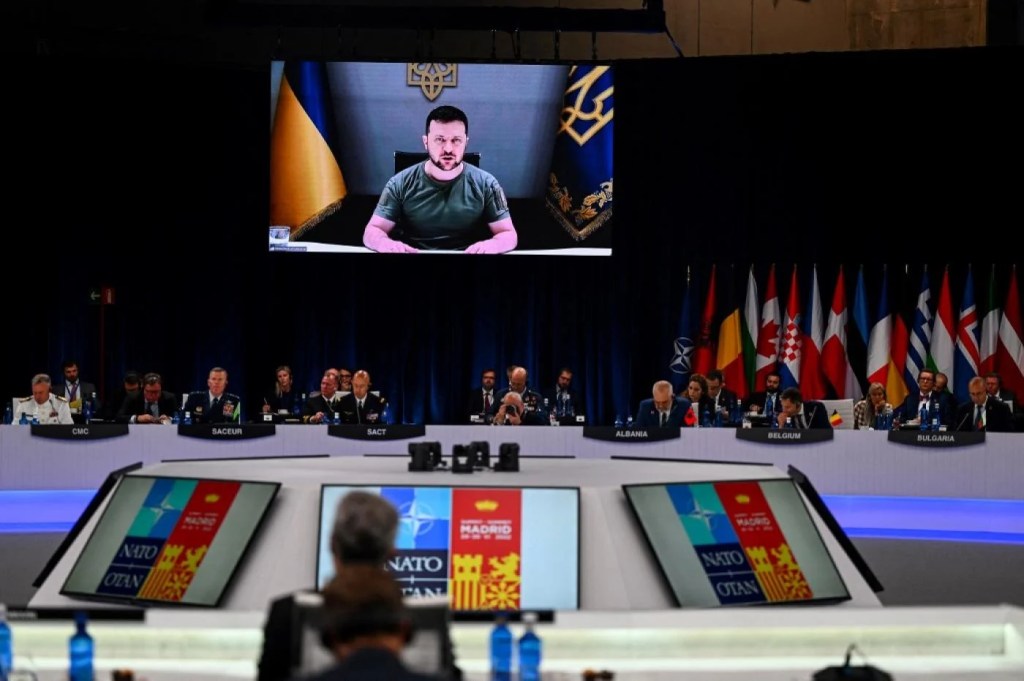
Ukraine’s President Volodymyr Zelensky appears on a giant screen as he addresses a Nato summit in Madrid, 29 June 2022 (AFP)

By Jonathan Cook

Source: Middle East Eye

Outraged western leaders are threatening a price cap on imports of Russian natural gas after Moscow cut supplies to Europe this month, deepening an already dire energy and cost-of-living crisis. In response, Russian President Vladimir Putin has warned that Europe will “freeze” this winter unless there is a change of tack.

In this back-and-forth, the West keeps stepping up the rhetoric. Putin is accused of using a mix of blackmail and economic terror against Europe. His actions supposedly prove once more that he is a monster who cannot be negotiated with, and a threat to world peace.

Denying fuel to Europe as winter approaches, in a bid to weaken the resolve of European states to support Kyiv and alienate European publics from their leaders, is Putin’s opening gambit in a plot to expand his territorial ambitions from Ukraine to the rest of Europe.

Or so runs the all-too-familiar narrative shared by western politicians and media.

In fact, Europe’s arrogant, self-righteous posturing over Russian gas supplies, divorced from any discernible geopolitical reality, reflects precisely the same foolhardy mindset that helped provoke Moscow’s invasion of Ukraine in the first place.

It is also the reason why there has been no exit ramp – a path to negotiations – even as Russia has taken vast swaths of Ukraine’s eastern and southern flanks – territory that cannot be reclaimed without a further massive loss of life on both sides, as the limited Ukrainian assault around Kharkiv has highlighted.

The western media has to carry a major share of the blame for these serial failures of diplomacy. Journalists have amplified only too loudly and uncritically what US and European leaders want their publics to believe is going on. But maybe it is time that Europeans heard a little of how things might look to Russian eyes.

Economic war

The media could start by dropping their indignation at “insolent” Moscow for refusing to supply Europe with gas. After all, Moscow has been only too clear about the reason for the shutdown of gas supplies: it is in retaliation for the West imposing economic sanctions – a form of collective punishment on the wider Russian population that risks violating the laws of war. 

The West is well practised in waging economic war on weak states, usually in a futile attempt to topple leaders they don’t like or as a softening-up exercise before it sends in troops or proxies.

Iran has faced decades of sanctions that have inflicted a devastating toll on its economy and population but done nothing to bring down the government.

Meanwhile, Washington is waging what amounts to its own form of economic terrorism on the Afghan people to punish the ruling Taliban for driving out US occupation forces last year in a humiliating fashion. The United Nations reported last month that sanctions had contributed to the risk of more than a million Afghan children dying from starvation.

There is nothing virtuous about the current economic sanctions on Russia either, any more than there is about the blackballing of Russian sportspeople and cultural icons. The sanctions are not intended to push Putin to the negotiating table. As US President Biden made clear in March, the West is planning for a long war and he wants to see Putin removed from power

Rather, the goal has been to weaken his authority and – in some fantasy scenario – encourage his subordinates to turn on him. The West’s game plan – if it can be dignified with that term – is to force Putin to over-extend Russian forces in Ukraine by flooding the battlefield with armaments, and then watch his government collapse under the weight of popular discontent at home.

But in practice, the reverse has been happening, just as it did through the 1990s when the West imposed sanctions on Iraq’s Saddam Hussein. Putin’s position has been bolstered, as it will continue to be whether Russia is triumphing or losing on the battlefield. 

The West’s economic sanctions against Russia have been doubly foolish. They have reinforced Putin’s message that the West seeks to destroy Russia, just as it previously did IraqAfghanistanLibyaSyria and Yemen. A strongman is all that stands between an independent Russia and servitude, Putin can plausibly argue.

And at the same time, the sanctions have demonstrated to Russians how truly artful their leader is. Economic pressure from the West has largely backfired: sanctions have barely made an impression on the value of the rouble, while Europe looks to be heading into recession as Putin turns off the gas spigot.

It will doubtless not only be Russians quietly rejoicing at seeing the West get a dose of the medicine it so regularly force-feeds others.

Western conceit

But there is a more troubling dimension to the West’s conceit. It was the same high-handed belief that the West would face no consequences for waging economic warfare on Russia, just as earlier assumed it would be pain-free for Nato to station missiles on Moscow’s doorstep. (Presumably, the effect on Ukrainians was not factored into the calculations.)

The decision to recruit ever-more east European states into the Nato fold over the past two decades not only broke promises made to Soviet and Russian leaders, but flew in the face of advice from the West’s most expert policy-makers.

Guided by the US, Nato countries closed the military noose around Russia year by year, all the while claiming that the noose was entirely defensive.

Nato flirted openly with Ukraine, suggesting that it too might be admitted to their anti-Russia alliance.

The US had a hand in the 2014 protests that overthrew Ukraine’s government, one elected to keep channels open with Moscow. 

With a new government installed, the Ukrainian army incorporated ultra-nationalist, anti-Russia militias that engaged in a devastating civil war with Russian communities in the country’s east.

And all the while, Nato secretly cooperated with and trained that same Ukrainian army.

At no point in the eight long years of Ukraine’s civil war did Europe or the US care to imagine how all these events unfolding in Russia’s backyard might look to ordinary Russians. Might they not fear the West just as much as western publics have been encouraged by their media to fear Moscow? Putin did not need to invent their concern. The West achieved that all by itself.

The encirclement of Russia by Nato was not a one-off error. Western meddling in the coup and support for a nationalist Ukrainian army increasingly hostile to Russia were not one-offs either. Nato’s decision to flood Ukraine with weapons rather than concentrate on diplomacy is no aberration. Nor is the decision to impose economic sanctions on ordinary Russians.

These are all of a piece, a pattern of pathological behaviour by the West towards Russia – and any other resource-rich state that does not utterly submit to western control. If the West were an individual, the patient would be diagnosed as suffering from a severe personality disorder, one with a strong impulse for self-destruction.

Bogeyman needed

Worse still, this impulse does not appear to be open to correction – not as things stand. The truth is that Nato and its US ringmaster have no interest in changing.

Their purpose is to have a credible bogeyman, one that justifies continuing the massive wealth redistribution from ordinary citizens to an elite of the already ultra-rich. A supposed threat to Europe’s safety justifies pouring money into the maw of an expanding war machine masquerading as the “defence industries” – the military, the arms manufacturers, and the ever-growing complex of the surveillance, intelligence and security industries. Both Nato and a US network of more than 800 military bases around the globe just keep growing.

A bogeyman also ensures western publics are unified in their fear and hatred of an external enemy, making them readier to defer to their leaders to protect them – and with it, the institutions of power those leaders uphold and the status quo they represent.

Anyone suggesting meaningful reform of that system can be rounded on as a threat to national security, a traitor or a fool, as Britain’s former Labour leader Jeremy Corbyn found out.

And a bogeyman distracts western publics from thinking about deeper threats, ones that our own leaders – rather than foreigners – are responsible for, such as the climate crisis they not only ignored but still fuel through the very military posturing and global confrontations they use to distract us. It is a perfect circle of self-harm.

Since the fall of the Berlin Wall, and the demise of the Soviet Union, the West has been casting around for a useful bogeyman to replace the Soviet Union, one that supposedly presents an existential threat to western civilisation.

Iraq’s weapons of mass distraction were only 45 minutes away – until we learned they did not, in fact, exist.

Afghanistan’s Taliban was harbouring al-Qaeda – until we learned that the Taliban had offered to hand Osama bin Laden over even before the 9/11 attacks.

There was the terrifying threat from the head-choppers of the Islamic State (IS) group – until we learned that they were the West’s arm’s-length allies in Syria and being supplied with weapons from Libya after it was liberated by the West from its dictator, Muammar Gadaffi.

And there is always Iran and its supposed nuclear weapons to worry about, even though Tehran signed an agreement in 2015 putting in place strict international oversight to prevent it from developing a bomb – until the US casually discarded the deal under pressure from Israel and chose not to replace it with anything else.

Braced for recession

Each of these threats was so grave it required an enormous expenditure of energy and treasure, until it had served its purpose of terrifying western publics into acquiescence. Invariably, the West’s meddling spawned a backlash that created another temporary enemy.

Now, like a predictable Hollywood sequel, the Cold War is back with a vengeance. Russia’s President Putin has a starring role. And the military-industrial complex is licking its lips with delight.

Ordinary people and small businesses are being told by European leaders to brace for a recession as energy companies once again clock up “eye-watering” profits.

Just as with the financial crash nearly 15 years ago, when the public was required to tighten its belt through austerity policies, a crisis is providing ideal conditions for wealth to be redistributed upwards.

Like other officials, Nato’s Secretary-General Jens Stoltenberg has sounded the alarm about “civil unrest” this winter as prices across Europe soar, even while demanding public money be used to send yet more weapons to Ukraine.

The question is whether western publics will keep buying the narrative of an existential threat that can only be dealt with if they, rather than their leaders, dig deep into their pockets. 

Escalation: Recent Events Suggest Mounting Economic Danger

By Brandon Smith

Source: Alt-Market.us

A common refrain from people who are critical of alternative economists is that we have been predicting crisis for so long that “eventually we will be right.” These are generally people who don’t understand the nature of economic decline – It’s like an avalanche that builds over time, then breaks and quickly escalates as it flows down the mountain. What they don’t grasp is that they are in the middle of an economic collapse RIGHT NOW, and they just can’t see it because they have been acclimated to the presence of the snow and cold.

Economic decline is a process that takes many years, and while you might get an event like the market crash of 1929 or the crash of 2008, these moments of panic are nothing more than the wreckage left behind by the great wave of tumbling ice that everyone should have seen coming far in advance, but they refused.

In 2022 the job of warning people is far easier than it used to be because we are well past the midpoint of the process of decline. But, believe it or not, I still get people today who claim that we analysts are “doom mongers.” The power of willful ignorance is truly amazing. It’s enough to make a person blind to stagflationary crisis, supply chain disruptions, quickly inflating prices, stock market carnage, bond market instability, record consumer debt, and international conflict.

At this point, I think if a person can’t see the dangers ahead they are probably a waste of time and space and are destined to be buried in the ice; there’s nothing that can be done for them. Yes, there are some people out there that don’t get exposed to the information and we have to take them into account, but my priority will be people that are awake and aware and try to give them a sense of what point in the collapse process we find ourselves.

In the past month there has been a considerable uptick in economic and geopolitical activity that suggests we are entering a new phase, and not surprisingly it’s all accumulating right before we hit October. Here are the events that I find most concerning:

The European Energy Crisis

This is an event that I have been predicting since the Russian invasion of Ukraine and now it is upon us. I wrote about it extensively in my recent article ‘Europe Is Facing Energy Disaster And It’s Going To Bleed Over Into The US’ so I won’t rehash all that information here. What I do want to point out is the complete lack of planning on the part of European officials to deal with the threat. It is as if they WANT a full spectrum disaster.

Russia has now completely cut off natural gas supplies to Europe, which represent around 40% of all EU energy resources. Europe’s benchmark natural gas prices spiked by 28% a week ago, on top of already existing inflation. Oil supplies are also in steep decline for Europe and the EU government has pledged to cut what’s left of Russian oil imports by sea at the end of the year. Sadly, they have offered very little in the way of solutions to the supply-side problem.

There has been talk of increasing imports of alternative resources from other nations, but the EU is already buying up around 75% of all liquid natural gas from the US. OPEC oil producers have indicated they will not be attempting to increase production anytime soon (probably because they can’t due to inflation in operation costs). There is NO backup energy resource for Europe; it doesn’t exist right now. They will try to buy up whatever coal, oil and gas they can find on the market while driving up prices even more for other countries. They will still come up short, which means people are going to freeze this winter.

Best case scenario is that there are mostly mild temps and people barely scrape buy with minimum heating. But EU industry is going to suffer and many manufacturers are going to cut production (which mean more stress on the global supply chain).

Core Inflation Is Still Rising

As I warned last week in my article ‘It’s A Fact That Needs Repeating: The Federal Reserve Is A Suicide Bomber,’ inflation is continuing to rise despite the Fed’s continued interest rate hikes, giving the central bank even more ammunition to justify higher rates into extreme economic weakness.

The latest CPI print showed an increase to 8.3% and was a shock to markets which universally expected a drop. This is the nature of stagflation – Even with falling demand prices continue to climb or remain high for extended periods. The stagflation event of the 1970s lasted for a decade until the Fed jacked rates to 21% and then employment crumbled in the early 1980s.

This doesn’t mean that rates will go to 21% this time; they don’t need to. All it would take is a Federal Funds Rate of around 4% – 5% to crash our current QE addicted system. A 75 bps rate hike is now widely expected at the next Fed meeting this month, with some predicting a 100 bps hike. This would put us close to crash territory for markets and for employment, though I think we still have well into 2023 before unemployment really starts to spike.

Putin’s Meeting With Xi

As I write this, Vladimir Putin is set to meet with China’s Xi Jinping and the nature of the conference is not clear. There are the obvious points of agreement such as China’s continued purchases of Russian oil and other commodities, as well as the ongoing plan to build a pipeline to China by 2025. There is also strategic cooperation which is evident in the recent naval exercises between the two nations around Japan and Taiwan.

The timing of the meeting is concerning to me, because the prime season for a potential Chinese invasion of Taiwan is fast approaching (October is the best month for naval movements to avoid typhoons). China would not necessarily need to commit to a ground invasion, either. They could simply cut off all import/export trade from any source other than China and starve Taiwan until they accept unification.

There is also the issue of Ukraine and arms sales. With the amount of propaganda coming from Ukrainian Intelligence and NATO, it’s hard to say what is actually happening, but I suspect Russia is changing strategies and repositioning to deploy missile and artillery bombardment of infrastructure, including power grids and water. This is a tactic that Russia has avoided for months (until this week), which is surprising because one of the first measures usually taken by the US during an invasion is to eliminate most key infrastructure (as we did in Iraq). You would think Russia would have done the same, but perhaps they were saving that scenario for winter when it is harder for Ukraine to cope.

This would make Ukraine essentially unlivable in the coming winter for most of the population. Putin may be seeking to ensure China remains a steady economic partner should geopolitical pressures increase. They may even be making a deal of mutual support: China takes Taiwan while Russia makes Ukraine a resource wasteland and they each support the other economically when NATO counties try to impose sanctions on China. We probably won’t know until October, but the timing of the meeting should raise eyebrows.

If the manure is about to hit the fan in Taiwan along with Ukraine, then diplomatic and economic ties will be severed and western access to China’s manufacturing will be cut. This is a problem for China’s economy, certainly, which may be why they have continued their mass covid lockdowns well after every other government has abandoned them. Could this be practice for civil controls in an impending war environment?

China’s global dominance in imports/exports gives them considerable economic leverage in trade, however. Many nations would not support sanctions against them. Also, their vast holdings of US dollars and Treasuries could be used as a weapon to damage or destroy the dollar’s world reserve status. If China invades Taiwan this year, then all bets are off – The economic decline will move swiftly from that point on.

There are many other trends which factor into the crash environment but the above factors are the most recent and hold the biggest potential for causing a domino effect globally. The question that always arises is “what can we do about it?” Not much in terms of prevention. What we can do, though, is prepare locally to weather the storm. This means stocking necessities before they rise even further in price or become non-existent. Become a producer and learn a valuable skill for survival in a depleted economy Organize with people locally who are on the same page to create security and alternative trade opportunities.

Hopefully, the aware citizenry will rise to the challenge and organization will be extensive, because the worst case scenario would be great masses of completely isolated people all vying against each other rather than working towards mutual security. Even in a slow collapse scenario this is a problem in terms of rising crime; so plan on working with others if you want to avoid inevitable third world conditions.

A Most Peculiar Recession

By Charles Hugh Smith

Source: Of Two Minds

So what are conventional pundits missing today? I would start with three dynamics.

Only old people experienced real recessions–those in 1973-74 and 1980-82. Recessions since then have been shorter and less systemic.

In the good old days, a recession laid waste to entire industries which never recovered their previous employment. People who were laid off couldn’t find another job. Major sectors of the economy dried up and blew away. Jobs were scarce and there was an oversupply of people looking for work.

We’re told consumer confidence is in the dumps and everyone expects the worst: recession! Oh Lordy. Interestingly, there isn’t much evidence of this near-panic behaviorally. Everyone’s tightening their belts and battening down the hatches, but it’s not the cliff-dive we see in a real recession.

There’s certainly a lot of froth to be scraped off the latte, but what I’m curious about are the armatures of the economy and what I’m seeing is the crowd ignoring key dynamics because they’re so busy pushing the Recessionary Play-Doh into the old playboard.

The entire notion that there is a hard and fast line indicating “recession” is not realistic or useful. The economy dropped 1% for two quarters in a row, quick hit the alarm, go to DefCon 1. Uh, OK, right.

The more useful approach is to look at data points as mostly signal noise that fail to reflect or illuminate the core dynamics of the economy. Here’s an example: the stagflation of the 1970s is a hot topic as the financial punditry compares then to now, seeking evidence of similarities strong enough to predict a Lost Decade ahead.

One key factor that’s rarely (if ever) mentioned was the staggering cost of cleaning up America’s industrial sector and polluted skies and waterways at the same time that the Cold War required the U.S. to strengthen its allies by allowing them unfettered access to the U.S. marketplace–exports to the U.S. that had a price advantage due to the dominance of the dollar and the relative weakness of allies’ currencies.

1972 exchange rates indicate that the Japanese yen was 302 to $1–an enormous advantage when compared to recent exchange rates of around 110 yen to the USD.

What few current pundits seem to grasp is the dominant dynamic of the entire era of 1945-1992 was the Cold War with the Soviet Union and its client states and allies. Strengthening allies’ economies was a core goal and so the costs to the domestic economy had to be absorbed: there was no choice.

The costs of cleaning up the nation and its vast industrial base was an enormous drag on the economy. The value of the trillions of dollars (in current dollars) invested was not in boosting profits, it was in restoring what had been heedlessly destroyed and damaged by rampant dumping of waste and pollutants and improving the health and well-being of the citizenry.

Check out the smog in early 1970s TV series filmed in Los Angeles for a taste of what was cleaned up.

But in a mind-boggling failure of conventional economics, our financial punditry is blind to the impact of the most consequential economic realities of the 1970s–the Cold War and the lengthy, painful, costly clean-up of the nation and its industrial base–on stagflation.

One reason for this abject failure is these dynamics were difficult to measure, so they weren’t measured.We only manage what we measure and so if we don’t measure it, it doesn’t exist. If we measure things in a no-longer-relevant manner, for example GDP, we continue to act as if this misguided measure is of supreme importance when the reality is it’s dangerously misleading.

So what are conventional pundits missing today? I would start with three dynamics:

1. For the first time in multiple generations, there is a structural scarcity of labor. For a variety of reasons, there are fewer people willing to do the work at the offered wage than there are jobs. This is not temporary, it is demographic and social, not simply economic. All the supposedly easy fixes– automate everything, etc.–are not that easy.

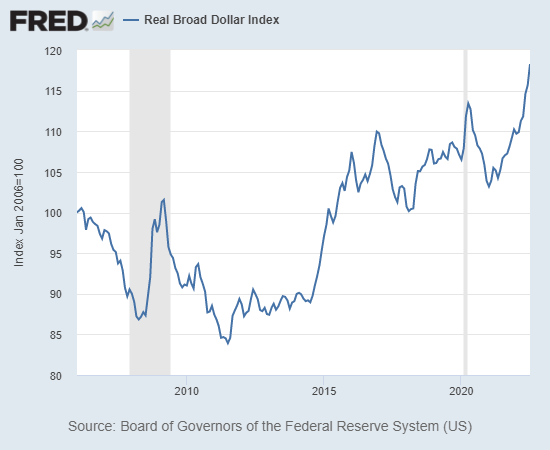
2. The strength of the U.S. dollar is exporting inflation, to the benefit of the domestic economy. After offshoring critical supply chains–a disaster that will take years to reverse–now the U.S. is offshoring inflation and the resulting demand destruction.

3. Global capital flows are reversing. capital flowed from the Core to the Periphery to reap the gains of globalization. Now the flow is reversing and capital is flowing from the Periphery to the Core to preserve capital and lock in lower-risk returns. What looks expensive to those earning U.S. dollars may look cheap and secure to those fleeing depreciating currencies and assets.

In my analysis, these are consequential dynamics that merit little attention in conventional financial analysis.

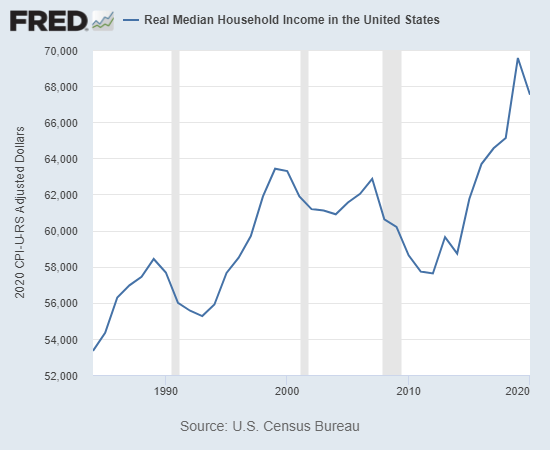
There is much more to say but glance at these two charts: real (i.e. adjusted for official inflation) median household income and real Broad U.S. Dollar Index.

If we’re not measuring or pondering the core structural dynamics of the economy, we’re not going to make sense of no-longer-relevant data. This is a most peculiar recession, and few seem to be asking if the reason is we’re missing what’s changed structurally.

Charts courtesy of St. Louis Federal Reserve Database (FRED))

The United States Does Not Have an Economy

By Paul Craig Roberts

Source: PaulCraigRoberts.org

The US financial sector has long looted other countries.  A number of participants have described the process.  First a country is enticed with bribes to the leaders to take out loans that cannot be serviced or repaid.  Then in comes the IMF. Austerity is imposed on the population.  Public services and employment are cut to free resources for debt service, and public assets are sold to repay the loan.  Living standards fall, and US corporations take over the country’s economy.

As foreign governments, having experienced or witnessed the economic carnage and fearing accountability, are less willing to be bribed into indebting their countries, American finance is now applying this technique to Americans. Contrary to the narrative in the financial press, the Federal Reserve is not raising interest rates in order to fight inflation.  It is ludicrous to think that a three-quarters of one percent rise in a very low interest rate is going to have any impact on a 9.1% rate of consumer inflation or that speculation that the Federal Reserve has in mind another three-quarters of one percent possibly followed by one half of one percent comprise an anti-inflation policy.  If all these increases occur, it still leaves the interest rate below the inflation rate.

Moreover, as I have previously explained, the inflation is not monetary.  The higher prices are the result of supply disruptions caused by Washington’s Covid lockdowns and Russian sanctions.  Production was stopped and supply chains are broken.  

The Federal Reserve’s rise in interest rates is just a continuation of its policy of concentrating income and wealth in the hands of the One Percent.  Quantitative Easing was the cloak for the Federal Reserve to print $8.2 trillion in new money which was directed or found its way into the prices of stocks and bonds, thus enriching the small number who own most of these financial instruments.  Having maxed out this avenue of wealth concentration, the Federal Reserve is now raising interest rates in order to drive up mortgage costs to aspiring home owners.  The Federal Reserve is driving individuals out of the housing market in order to free up properties for “private equity” firms to purchase homes for their rental values.  That private equity firms see rental income from the existing stock of houses as the best investment opportunity tells us that the US economy has played out.  When investment goes into existing assets, not into producing new assets, the economy ceases to grow.

The Obama regimes policy of bailing out the financial fraudsters responsible for the 2008 crash while foreclosing on their victims, reduced American homeownership from 70% to 63 percent. The Urban Institute predicts further declines. Today homeowners’ equity has declined from 85% after World War II to one-third, leaving two-thirds of homeowner equity in the hands of creditors.  This makes it completely clear that a financialized economy indebts the people for the sake of rentier income to the One Percent.  Indeed, the financialized economy created by the Federal Reserve has reimposed a class system akin to the landed British aristocracy that was overthrown.  Indeed, we have an economically far worst class system.  The landed British aristocrats produced food that fed the nation.  The American class system produces interest and fees for the financial system.

As Michael Hudson has shown us, a no-growth economy is the end result of a financialized economy.  A financialized economy is one in which consumer income is diverted by debt expansion away from the purchase of new goods and services into debt service and fees–interest on mortgages, car loans, credit card debt, student loan debt.  With such a large share of household income spent on debt service, little is left for driving the economy forward.

If American economists were capable of escaping from their neoliberal junk economics, they would realize that “the world’s largest economy” they attribute to the United States is total fiction.  The fact is that the United States does not have an economy.  Corporations driven by Wall Street located American manufacturing in Asia so that the One Percent could benefit from higher profits from lower labor costs, while the deserted city and states had to sell their income streams, such as Chicago’s parking meter revenues for 75 years, to foreigners for one lump sum payment to solve one year’s budget crisis.  

The offshoring of American production, carried out under the cloak of “globalism,” destroyed the American economy and the tax bases of cities and states.  While the real economy declines, the Democrat Party, seeking permanent power, has imposed a policy of open borders for immigrant-invaders.  How are these millions of peoples to support themselves in an economy whose manufacturing has been moved abroad?  How can a population, deserted by American corporations, that is experiencing debt deflation absorb the costs of support and social infrastructure for tens of millions of third world immigrant-invaders?

You will never hear it from the whores in the financial press, but the United States is on the precipice of economic and social collapse.  And what are the fools in Washington doing?  The idiots are ginning up wars with Russia, China, and Iran.  

Calm Before the Tempest?

By Charles Hugh Smith

Source: Of Two Minds

Let’s start by stipulating the obvious: no one knows the future, and most of the guesses–oops, I mean forecasts–will be wrong. Arguing about the forecasts now won’t make any difference as to which ones are correct and which ones are wrong. Time alone will tell.

That said, here’s a scenario that fits the dynamics I see as most consequential: Core-Periphery and the demise of the waste is growth / financialization / globalization model as the reigning model of how the global economy should work.

Core-periphery dynamics are pretty simple: unraveling starts on the periphery and seeps toward the core. The core actually strengthens in the process as capital and talent seek havens where they’re treated well, and the core became the core by treating capital and talent well.

The periphery responds to the unraveling of financialization / globalization by tightening its grip on whatever capital and talent is still available, incentivizing the flight of capital and talent to the core.

A great many people think there are many core economies. In my analysis, there is only one, due to the qualifying requirements: 1) issues a reserve currency, i.e. not pegged to another currency 2) liquid global markets for securities, debt, commodities, etc., i.e. anyone anywhere can trade in size in the core markets 3) transparent market and governance mechanisms, i.e. no overnight devaluations, expropriations, capital restrictions, etc. 4) diverse economy not dependent on exports or imports for its well-being and 5) ease of flow: capital, talent, enterprises and employees all have essentially unlimited freedom of movement within the core.

We can argue about which nations qualify as core but it won’t change the outcome. Capital and talent will make their own decisions about risk, safety, exposure to devaluation and expropriation and where the odds of being treated fairly are highest. It’s a good exercise to put yourself in the shoes of a manager of a $10 billion fund and go through the decision tree of where to put this $10 billion to preserve its purchasing power first and foremost, and secondarily generate a return.

Would you really gamble $10 billion on a 15% return on the bonds of Timbukthree, whose currency has fallen 20% against the U.S. dollar this year? Or Timbukfour, which is dependent on exports of commodities in a shrinking global economy? Or Timbukfive, which is dependent on imports of commodities and exports of consumer goods in a shrinking global economy?? If you answer “yes,” you’re not actually playing like you are responsible for $10 billion.

As the periphery unravels financially, it also unravels politically and socially. Bordering states are at risk of destabilizing, and any entity with large exposure to the unraveling debt or markets starts unraveling, too. The destabilization spreads to second-tier nations whose exposure to the dynamics of unraveling are structural.

As all these dominoes fall, eventually those closest to the core also crumble, and then core itself is finally destabilized.

Humans have an interesting talent for adjusting to new circumstances, i.e. habituating to new conditions. Those households consuming 14,000 gallons of fresh water a month may well scream that they can’t possibly get by on 12,000 gallons, but then if circumstances change and all the water we have is what we can carry in buckets a kilometer over rough terrain, we find that we can live on the few gallons we can carry a kilometer.

The amount of waste in developed economies is beyond easy measure. It’s estimated 40% of all food in the U.S. is wasted. Energy, food and fresh water have been treated as if low cost and abundance were birthrights rather than brief explosions of excess. While we’re screaming about energy costs, empty buildings are brightly lit, water taps are left running and one individual per idling vehicle in a traffic jam frets about rising costs.

When the 1989 Loma Prieta earthquake closed the Bay Bridge across San Francisco Bay, the main artery between San Francisco and the East Bay, economic doom was predictably predicted. Yet people quickly managed via extra BART (subway) trains that rain beneath the Bay and carpools with four people per vehicle rather than one occupant.

Is it possible that all the predictable predictions of economic doom are somewhat exaggerated by the thrill of sensationalism and projections of past trends, as if people can’t possibly make consequential adjustments to their behaviors and consumption?

Systems have constraints, and so there are limits on what adjustments can be made without altering the structure, but in many cases, we’re far from reaching limits on basic conservation work-arounds.

Is it possible that things will prove less dire than currently expected? It seems little credence is being given to the potential to adjust to new conditions.

Is it beyond conception that the core actually strengthens for a length of time before the unraveling reaches it? In my crystal ball, it seems not just possible but likely. This will be the calm before The Tempest, when the unraveling reaches the core and structural changes are finally required.

Global Planned Financial Tsunami Has Just Begun

By F. William Engdahl

Source: Global Research

Since the creation of the US Federal Reserve over a century ago, every major financial market collapse has been deliberately triggered for political motives by the central bank. The situation is no different today, as clearly the US Fed is acting with its interest rate weapon to crash what is the greatest speculative financial bubble in human history, a bubble it created. Global crash events always begin on the periphery, such as with the 1931 Austrian Creditanstalt or the Lehman Bros. failure in September 2008. The June 15 decision by the Fed to impose the largest single rate hike in almost 30 years as financial markets are already in a meltdown, now guarantees a global depression and worse.

The extent of the “cheap credit” bubble that the Fed, the ECB and Bank of Japan have engineered with buying up of bonds and maintaining unprecedented near-zero or even negative interest rates for now 14 years, is beyond imagination. Financial media cover it over with daily nonsense reporting , while the world economy is being readied, not for so-called “stagflation” or recession. What is coming now in the coming months, barring a dramatic policy reversal, is the worst economic depression in history to date. Thank you, globalization and Davos.

Globalization

The political pressures behind globalization and the creation of the World Trade Organization out of the Bretton Woods GATT trade rules with the 1994 Marrakesh Agreement, ensured that the advanced industrial manufacturing of the West, most especially the USA, could flee offshore, “outsource” to create production in extreme low wage countries. No country offered more benefit in the late 1990s than China. China joined WHO in 2001 and from then on the capital flows into China manufacture from the West have been staggering. So too has been the buildup of China dollar debt. Now that global world financial structure based on record debt is all beginning to come apart.

When Washington deliberately allowed the September 2008 Lehman Bros financial collapse, the Chinese leadership responded with panic and commissioned unprecedented credit to local governments to build infrastructure. Some of it was partly useful, such as a network of high-speed railways. Some of it was plainly wasteful, such as construction of empty “ghost cities.” For the rest of the world, the unprecedented China demand for construction steel, coal, oil, copper and such was welcome, as fears of a global depression receded. But the actions by the US Fed and ECB after 2008, and of their respective governments, did nothing to address the systemic financial abuse of the world’s major private banks on Wall Street and Europe , as well as Hong Kong.

The August 1971 Nixon decision to decouple the US dollar, the world reserve currency, from gold, opened the floodgates to global money flows. Ever more permissive laws favoring uncontrolled financial speculation in the US and abroad were imposed at every turn, from Clinton’s repeal of Glass-Steagall at the behest of Wall Street in November 1999. That allowed creation of mega-banks so large that the government declared them “too big to fail.” That was a hoax, but the population believed it and bailed them out with hundreds of billions in taxpayer money.

Since the crisis of 2008 the Fed and other major global central banks have created unprecedented credit, so-called “helicopter money,” to bailout the major financial institutions. The health of the real economy was not a goal. In the case of the Fed, Bank of Japan, ECB and Bank of England, a combined $25 trillion was injected into the banking system via “quantitative easing” purchase of bonds, as well as dodgy assets like mortgage-backed securities over the past 14 years.

Quantitative madness

Here is where it began to go really bad. The largest Wall Street banks such as JP MorganChase, Wells Fargo, Citigroup or in London HSBC or Barclays, lent billions to their major corporate clients. The borrowers in turn used the liquidity, not to invest in new manufacturing or mining technology, but rather to inflate the value of their company stocks, so-called stock buy-backs, termed “maximizing shareholder value.”

BlackRock, Fidelity, banks and other investors loved the free ride. From the onset of Fed easing in 2008 to July 2020, some $5 trillions had been invested in such stock buybacks, creating the greatest stock market rally in history. Everything became financialized in the process. Corporations paid out $3.8 trillion in dividends in the period from 2010 to 2019. Companies like Tesla which had never earned a profit, became more valuable than Ford and GM combined. Cryptocurrencies such as Bitcoin reached market cap valuation over $1 trillion by late 2021. With Fed money flowing freely, banks and investment funds invested in high-risk, high profit areas like junk bonds or emerging market debt in places like Turkey, Indonesia or, yes, China.

The post-2008 era of Quantitative Easing and zero Fed interest rates led to absurd US Government debt expansion. Since January 2020 the Fed, Bank of England, European Central Bank and Bank of Japan have injected a combined $9 trillion in near zero rate credit into the world banking system. Since a Fed policy change in September 2019, it enabled Washington to increase public debt by a staggering $10 trillion in less than 3 years. Then the Fed again covertly bailed out Wall Street by buying $120 billion per month of US Treasury bonds and Mortgage-Backed Securities creating a huge bond bubble.

A reckless Biden Administration began doling out trillions in so-called stimulus money to combat needless lockdowns of the economy. US Federal debt went from a manageable 35% of GDP in 1980 to more than 129% of GDP today. Only the Fed Quantitative Easing, buying of trillions of US government and mortgage debt and the near zero rates made that possible. Now the Fed has begun to unwind that and withdraw liquidity from the economy with QT or tightening, plus rate hikes. This is deliberate. It is not about a stumbling Fed mis-judging inflation.

Energy drives the collapse

Sadly, the Fed and other central bankers lie. Raising interest rates is not to cure inflation. It is to force a global reset in control over the world’s assets, it’s wealth, whether real estate, farmland, commodity production, industry, even water. The Fed knows very well that Inflation is only beginning to rip across the global economy. What is unique is that now Green Energy mandates across the industrial world are driving this inflation crisis for the first time, something deliberately ignored by Washington or Brussels or Berlin.

The global shortages of fertilizers, soaring prices of natural gas, and grain supply losses from global draught or exploding costs of fertilizers and fuel or the war in Ukraine, guarantee that, at latest this September-October harvest time, we will undergo a global additional food and energy price explosion. Those shortages all are a result of deliberate policies.

Moreover, far worse inflation is certain, due to the pathological insistence of the world’s leading industrial economies led by the Biden Administration’s anti-hydrocarbon agenda. That agenda is typified by the astonishing nonsense of the US Energy Secretary stating, “buy E-autos instead” as the answer to exploding gasoline prices.

Similarly, the European Union has decided to phase out Russian oil and gas with no viable substitute as its leading economy, Germany, moves to shut its last nuclear reactor and close more coal plants. Germany and other EU economies as a result will see power blackouts this winter and natural gas prices will continue to soar. In the second week of June in Germany gas prices rose another 60% alone. Both the Green-controlled German government and the Green Agenda “Fit for 55” by the EU Commission continue to push unreliable and costly wind and solar at the expense of far cheaper and reliable hydrocarbons, insuring an unprecedented energy-led inflation.

Fed has pulled the plug

With the 0.75% Fed rate hike, largest in almost 30 years, and promise of more to come, the US central bank has now guaranteed a collapse of not merely the US debt bubble, but also much of the post-2008 global debt of $303 trillion. Rising interest rates after almost 15 years mean collapsing bond values. Bonds, not stocks, are the heart of the global financial system.

US mortgage rates have now doubled in just 5 months to above 6%and home sales were already plunging before the latest rate hike. US corporations took on record debt owing to the years of ultra-low rates. Some 70% of that debt is rated just above “junk” status. That corporate non-financial debt totaled $9 trillion in 2006. Today it exceeds $18 trillion. Now a large number of those marginal companies will not be able to rollover the old debt with new, and bankruptcies will follow in coming months. The cosmetics giant Revlon just declared bankruptcy.

The highly-speculative, unregulated Crypto market, led by Bitcoin, is collapsing as investors realize there is no bailout there. Last November the Crypto world had a $3 trillion valuation. Today it is less than half, and with more collapse underway. Even before the latest Fed rate hike the stock value of the US megabanks had lost some $300 billion. Now with stock market further panic selling guaranteed as a global economic collapse grows, those banks are pre-programmed for a new severe bank crisis over the coming months.

As US economist Doug Noland recently noted, “Today, there’s a massive “periphery” loaded with “subprime” junk bonds, leveraged loans, buy-now-pay-later, auto, credit card, housing, and solar securitizations, franchise loans, private Credit, crypto Credit, DeFi, and on and on. A massive infrastructure has evolved over this long cycle to spur consumption for tens of millions, while financing thousands of uneconomic enterprises. The “periphery” has become systemic like never before. And things have started to Break.”

The Federal Government will now find its interest cost of carrying a record $30 trillion in Federal debt far more costly. Unlike the 1930s Great Depression when Federal debt was near nothing, today the Government, especially since the Biden budget measures, is at the limits. The US is becoming a Third World economy. If the Fed no longer buys trillions of US debt, who will? China? Japan? Not likely.

Deleveraging the bubble

With the Fed now imposing a Quantitative Tightening, withdrawing tens of billions in bonds and other assets monthly, as well as raising key interest rates, financial markets have begun a deleveraging. It will likely be jerky, as key players like BlackRock and Fidelity seek to control the meltdown for their purposes. But the direction is clear.

By late last year investors had borrowed almost $1 trillion in margin debt to buy stocks. That was in a rising market. Now the opposite holds, and margin borrowers are forced to give more collateral or sell their stocks to avoid default. That feeds the coming meltdown. With collapse of both stocks and bonds in coming months, go the private retirement savings of tens of millions of Americans in programs like 401-k. Credit card auto loans and other consumer debt in the USA has ballooned in the past decade to a record $4.3 trillion at end of 2021. Now interest rates on that debt, especially credit card, will jump from an already high 16%. Defaults on those credit loans will skyrocket.

Outside the US what we will see now, as the Swiss National Bank, Bank of England and even ECB are forced to follow the Fed raising rates, is the global snowballing of defaults, bankruptcies, amid a soaring inflation which the central bank interest rates have no power to control. About 27% of global nonfinancial corporate debt is held by Chinese companies, estimated at $23 trillion. Another $32 trillion corporate debt is held by US and EU companies. Now China is in the midst of its worst economic crisis since 30 years and little sign of recovery. With the USA, China’s largest customer, going into an economic depression, China’s crisis can only worsen. That will not be good for the world economy.

Italy, with a national debt of $3.2 trillion, has a debt-to-GDP of 150%. Only ECB negative interest rates have kept that from exploding in a new banking crisis. Now that explosion is pre-programmed despite soothing words from Lagarde of the ECB. Japan, with a 260% debt level is the worst of all industrial nations, and is in a trap of zero rates with more than $7.5 trillion public debt. The yen is now falling seriously, and destabilizing all of Asia.

The heart of the world financial system, contrary to popular belief, is not stock markets. It is bond markets—government, corporate and agency bonds. This bond market has been losing value as inflation has soared and interest rates have risen since 2021 in the USA and EU. Globally this comprises some $250 trillion in asset value a sum that, with every fed interest rise , loses more value. The last time we had such a major reverse in bond values was forty years ago in the Paul Volcker era with 20% interest rates to “squeeze out inflation.”

As bond prices fall, the value of bank capital falls. The most exposed to such a loss of value are major French banks along with Deutsche Bank in the EU, along with the largest Japanese banks. US banks like JP MorganChase are believed to be only slightly less exposed to a major bond crash. Much of their risk is hidden in off-balance sheet derivatives and such. However, unlike in 2008, today central banks can’t rerun another decade of zero interest rates and QE. This time, as insiders like ex-Bank of England head Mark Carney noted three years ago, the crisis will be used to force the world to accept a new Central Bank Digital Currency, a world where all money will be centrally issued and controlled. This is also what Davos WEF people mean by their Great Reset. It will not be good. A Global Planned Financial Tsunami Has Just Begun.

Thanks To The Rapidly Imploding U.S. Economy, Joe Biden’s Poll Numbers Have Plunged To Unprecedented Levels

By Michael Snyder

Source: Economic Collapse Blog

These are not good times for Joe Biden.  When the U.S. economy is performing well whoever is in the White House is going to get most of the credit.  Likewise, when the U.S. economy is performing poorly whoever is in the White House is going to get most of the blame.  That is just the way that it is, and that is one of the primary reasons why most Americans are quite displeased with Joe Biden right now.  Things are not going well at all, and the outlook for the months ahead is even worse.  The American people are becoming increasingly frustrated, and a new Gallup poll that was just released discovered that “confidence” in the presidency has fallen to the lowest level ever recorded

President Joe Biden has pushed the presidency to a place it hasn’t been in nearly 50 years.

In the latest Gallup poll, less than a quarter of those surveyed have “confidence” in the presidency, worse than during the Trump presidency and nearly as bad as the end of the George W. Bush presidency.

Going back to 1975, Gallup has never recorded a confidence reading as low as Biden’s 23%.

Other polls have come up with similarly stunning results.  For example, a different survey that was just released discovered that a whopping 88 percent of all Americans believe that the nation is heading in the wrong direction…

The White House was faced with another dire poll Tuesday that found that 54 percent of Americans believe the middle class hasn’t benefited ‘at all’ from President Joe Biden’s policies.

On top of that, the new Monmouth University Poll found that 88 percent of Americans surveyed said the country was headed in the wrong direction – with just 10 percent saying it’s headed the right way – a record low.

Just think about that.

88 percent.

In this day and age, it is difficult to get 88 percent of Americans to agree on anything.

But almost all of us seem to agree that the country is going downhill, and according to that same survey Americans are currently more concerned about economic matters than anything else

Nearly half those surveyed said inflation and gas were the biggest concerns currently facing their families, with 33 percent saying inflation and 15 percent pointing to fuel costs.

A lot of people out there don’t really care much about what is going on in the world until it starts affecting their personal finances.

And these days the American people are feeling a tremendous amount of pain.

In fact, the consumer confidence index that is put out by the University of Michigan just fell to an all-time record low

The University of Michigan’s gauge of consumer sentiment fell sharply to a record-low reading of 50.2, down from a May reading of 58.4. Economists polled by the Wall Street Journal had expected an June reading of 59.

The level is comparable to the low point reached in the middle of the 1980 recession, the university said.

The American people have never been more pessimistic about the economy.

Ever.

And we have a guy in the White House that has a really difficult time even putting a coherent sentence together at this point.

Of course the team around Biden is not exactly competent either.

Time after time, the Biden administration has made colossal blunders.  This week, we learned that someone in the Biden administration apparently thought that it would be a good idea to send oil from our strategic petroleum reserve to China

Because he hates Americans, President Joe Biden is shipping much-needed American oil to foreign countries, including… China.

The whole idea of the Strategic Petroleum Reserve (SPR), which is owned by the U.S. government, specifically the U.S. Department of Energy, is to hold on to about 700 million barrels of oil in the event of an emergency or disruption.

I was floored when I first read that.

Who would be stupid enough to do such a thing?

Someday we are going to need the oil in the strategic petroleum reserve, and hopefully there will be some left when that moment finally arrives.

This week we have also been getting more numbers that indicate that the economic slowdown in the United States appears to be picking up speed.

According to LinkedIn, hiring in the U.S. is really starting to fall off

LinkedIn, a unit of Microsoft, saw its hiring rate fall 5.4% month over month in June on a seasonally adjusted basis, the lowest level since December 2021, according to new data released on Friday. On an annual basis, the employment platform’s hiring rate tumbled 11.9% in June.

LinkedIn’s hiring rate is calculated based on the percentage of the platform’s members who added a new employer to their profile in the same month the new job began divided by the total number of LinkedIn members in the United States.

And we just learned that new vehicle sales during the month of June were depressingly low

Automakers have now reported their June new vehicle sales, or their Q2 new vehicle sales, for the US, except Tesla, which doesn’t report US sales but only global sales. All automakers, even Toyota, and now even Tesla, are struggling with the ongoing semiconductor shortages, and they started the month of June with desperately low inventories on dealer lots and in transit.

And so new vehicle sales in June plunged by 13.5% from the already horribly beaten-down June 2021, to 1.127 million vehicles, and collapsed by 25% from June 2019, the last decent year in the industry, according to data released by the Bureau of Economic Analysis today

It appears that a recession is already here, and the months ahead are going to be really tough.

So I would encourage you to get out of debt.

And I would also encourage you to build up your emergency fund.

This is not a time to fritter away your money on unnecessary things.  You want to put yourself in the best position possible to weather the “perfect storm” that is ahead, because things certainly aren’t going to be getting easier from here.

As the economy deteriorates, the frustration of the American people is going to get deeper and deeper.

Needless to say, that isn’t good news for Joe Biden.

What Was Covid Really About? Triggering A Multi-Trillion Dollar Global Debt Crisis. “Ramping up an Imperialist Strategy”?

Covid, Capitalism, Friedrich Engels and Boris Johnson

By Colin Todhunter

Source: Global Research

“And thus it renders more and more evident the great central fact that the cause of the miserable condition of the working class is to be sought, not in these minor grievances, but in the capitalistic system itself.” Friedrich Engels, The Condition of the Working Class in England (1845) (preface to the English Edition, p.36)  

The IMF and World Bank have for decades pushed a policy agenda based on cuts to public services, increases in taxes paid by the poorest and moves to undermine labour rights and protections.

IMF ‘structural adjustment’ policies have resulted in 52% of Africans lacking access to healthcare and 83% having no safety nets to fall back on if they lose their job or become sick. Even the IMF has shown that neoliberal policies fuel poverty and inequality.

In 2021, an Oxfam review of IMF COVID-19 loans showed that 33 African countries were encouraged to pursue austerity policies. The world’s poorest countries are due to pay $43 billion in debt repayments in 2022, which could otherwise cover the costs of their food imports.

Oxfam and Development Finance International (DFI) have also revealed that 43 out of 55 African Union member states face public expenditure cuts totalling $183 billion over the next five years.

According to Prof Michel Chossudovsky of the Centre for Research on Globalization, the closure of the world economy (March 11, 2020 Lockdown imposed on more than 190 countries) has triggered an unprecedented process of global indebtedness. Governments are now under the control of global creditors in the post-COVID era.

What we are seeing is a de facto privatisation of the state as governments capitulate to the needs of Western financial institutions.

Moreover, these debts are largely dollar-denominated, helping to strengthen the US dollar and US leverage over countries.

It raises the question: what was COVID really about?

Millions have been asking that question since lockdowns and restrictions began in early 2020. If it was indeed about public health, why close down the bulk of health services and the global economy knowing full well what the massive health, economic and debt implications would be?

Why mount a military-style propaganda campaign to censor world-renowned scientists and terrorise entire populations and use the full force and brutality of the police to ensure compliance?

These actions were wholly disproportionate to any risk posed to public health, especially when considering the way ‘COVID death’ definitions and data were often massaged and how PCR tests were misused to scare populations into submission.

Prof Fabio Vighi of Cardiff University implies we should have been suspicious from the start when the usually “unscrupulous ruling elites” froze the global economy in the face of a pathogen that targets almost exclusively the unproductive (the over 80s).

COVID was a crisis of capitalism masquerading as a public health emergency.

Capitalism  

Capitalism needs to keep expanding into or creating new markets to ensure the accumulation of capital to offset the tendency for the general rate of profit to fall. The capitalist needs to accumulate capital (wealth) to be able to reinvest it and make further profits. By placing downward pressure on workers’ wages, the capitalist extracts sufficient surplus value to be able to do this.

But when the capitalist is unable to sufficiently reinvest (due to declining demand for commodities, a lack of investment opportunities and markets, etc), wealth (capital) over accumulates, devalues and the system goes into crisis. To avoid crisis, capitalism requires constant growth, markets and sufficient demand.

According to writer Ted Reese, the capitalist rate of profit has trended downwards from an estimated 43% in the 1870s to 17% in the 2000s. Although wages and corporate taxes have been slashed, the exploitability of labour was increasingly insufficient to meet the demands of capital accumulation.

By late 2019, many companies could not generate sufficient profit. Falling turnover, limited cashflows and highly leveraged balance sheets were prevalent.

Economic growth was weakening in the run up to the massive stock market crash in February 2020, which saw trillions more pumped into the system in the guise of ‘COVID relief’.

To stave off crisis up until that point, various tactics had been employed.

Credit markets were expanded and personal debt increased to maintain consumer demand as workers’ wages were squeezed. Financial deregulation occurred and speculative capital was allowed to exploit new areas and investment opportunities. At the same time, stock buy backs, the student debt economy, quantitative easing and massive bail outs and subsidies and an expansion of militarism helped to maintain economic growth.

There was also a ramping up of an imperialist strategy that has seen indigenous systems of production abroad being displaced by global corporations and states pressurised to withdraw from areas of economic activity, leaving transnational players to occupy the space left open.

While these strategies produced speculative bubbles and led to an overevaluation of assets and increased both personal and government debt, they helped to continue to secure viable profits and returns on investment.

But come 2019, former governor of the Bank of England Mervyn King warned that the world was sleepwalking towards a fresh economic and financial crisis that would have devastating consequences. He argued that the global economy was stuck in a low growth trap and recovery from the crisis of 2008 was weaker than that after the Great Depression.

King concluded that it was time for the Federal Reserve and other central banks to begin talks behind closed doors with politicians.

That is precisely what happened as key players, including BlackRock, the world’s most powerful investment fund, got together to work out a strategy going forward. This took place in the lead up to COVID.

Aside from deepening the dependency of poorer countries on Western capital, Fabio Vighi says lockdowns and the global suspension of economic transactions allowed the US Fed to flood the ailing financial markets (under the guise of COVID) with freshly printed money while shutting down the real economy to avoid hyperinflation. Lockdowns suspended business transactions, which drained the demand for credit and stopped the contagion.

COVID provided cover for a multi-trillion-dollar bailout for the capitalist economy that was in meltdown prior to COVID. Despite a decade or more of ‘quantitative easing’, this new bailout came in the form of trillions of dollars pumped into financial markets by the US Fed (in the months prior to March 2020) and subsequent ‘COVID relief’.

The IMF, World bank and global leaders knew full well what the impact on the world’s poor would be of closing down the world economy through COVID-related lockdowns.

Yet they sanctioned it and there is now the prospect that in excess of a quarter of a billion more people worldwide will fall into extreme levels of poverty in 2022 alone.

In April 2020, the Wall Street Journal stated the IMF and World Bank faced a deluge of aid requests from scores of poorer countries seeking bailouts and loans from financial institutions with $1.2 trillion to lend.

In addition to helping to reboot the financial system, closing down the global economy deliberately deepened poorer countries’ dependency on Western global conglomerates and financial interests.

Lockdowns also helped accelerate the restructuring of capitalism that involves smaller enterprises being driven to bankruptcy or bought up by monopolies and global chains, thereby ensuring continued viable profits for Big Tech, the digital payments giants and global online corporations like Meta and Amazon and the eradication of millions of jobs.

Although the effects of the conflict in Ukraine cannot be dismissed, with the global economy now open again, inflation is rising and causing a ‘cost of living’ crisis. With a debt-ridden economy, there is limited scope for rising interest rates to control inflation.

But this crisis is not inevitable: current inflation is not only induced by the liquidity injected into the financial system but also being fuelled by speculation in food commodity markets and corporate greed as energy and food corporations continue to rake in vast profits at the expense of ordinary people.

Resistance  

However, resistance is fertile.

Aside from the many anti-restriction/pro-freedom rallies during COVID, we are now seeing a more strident trade unionism coming to the fore – in Britain at least – led by media savvy leaders like Mick Lynch, general secretary of the National Union of Rail, Maritime and Transport Workers (RMT), who know how to appeal to the public and tap into widely held resentment against soaring cost of living rises.

Teachers, health workers and others could follow the RMT into taking strike action.

Lynch says that millions of people in Britain face lower living standards and the stripping out of occupational pensions. He adds:

“COVID has been a smokescreen for the rich and powerful in this country to drive down wages as far as they can.”

Just like a decade of imposed ‘austerity’ was used to achieve similar results in the lead up to COVID.

The trade union movement should now be taking a leading role in resisting the attack on living standards and further attempts to run-down state-provided welfare and privatise what remains.

The strategy to wholly dismantle and privatise health and welfare services seems increasingly likely given the need to rein in (COVID-related) public debt and the trend towards AI, workplace automisation and worklessness.

This is a real concern because, following the logic of capitalism, work is a condition for the existence of the labouring classes. So, if a mass labour force is no longer deemed necessary, there is no need for mass education, welfare and healthcare provision and systems that have traditionally served to reproduce and maintain labour that capitalist economic activity has required.

In 2019, Philip Alston, the UN rapporteur on extreme poverty, accused British government ministers of the “systematic immiseration of a significant part of the British population” in the decade following the 2008 financial crash.

Alston stated:

“As Thomas Hobbes observed long ago, such an approach condemns the least well off to lives that are ‘solitary, poor, nasty, brutish, and short’. As the British social contract slowly evaporates, Hobbes’ prediction risks becoming the new reality.”

Post-COVID, Alston’s words carry even more weight.

As this article draws to a close, news is breaking that Boris Johnson has resigned as prime minister. A remarkable PM if only for his criminality, lack of moral foundation and double standards – also applicable to many of his cronies in government.

With this in mind, let’s finish where we began.

“I have never seen a class so deeply demoralised, so incurably debased by selfishness, so corroded within, so incapable of progress, as the English bourgeoisie…

For it nothing exists in this world, except for the sake of money, itself not excluded. It knows no bliss save that of rapid gain, no pain save that of losing gold.

In the presence of this avarice and lust of gain, it is not possible for a single human sentiment or opinion to remain untainted.” Friedrich EngelsThe Condition of the Working Class in England (1845), p.275