Twenty Years Later: Facts About the OKC Bombing That Go Unreported

mcveigh601

By Kevin Ryan

Source: Washington’s Blog

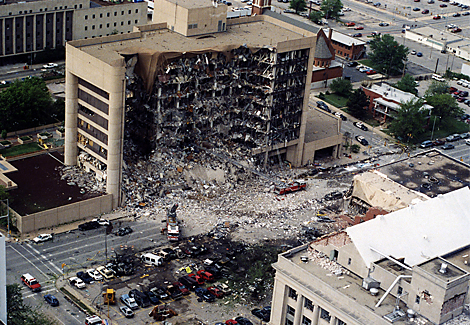
Next week will mark the 20th anniversary of the terrorist bombing of the Murrah Federal Building in Oklahoma City, which killed 168 people including 19 children. The mainstream media will undoubtedly focus its attention on Timothy McVeigh, who was put to death in June 2001 for his part in the crime. They might also mention Terry Nichols, who was convicted of helping McVeigh plan the bombing and is serving a life sentence without parole.

There will be less discussion about how the FBI spent years hunting for a man who witnesses say accompanied McVeigh on the day of the bombing. They called this accomplice John Doe #2 and theories about his identity range from an Iraqi named Hussain Al-Hussaini, to a German national described below, to a neo-nazi bank robber named Richard Guthrie. The Justice Department finally gave up its search and said it was all a mistake— that there was never any credible evidence of a John Doe #2 being involved.

That reversal demonstrates a pattern of cover-up by authorities and limited media coverage in the years since the crime. This week, accounts will not repeat early reports of secondary devices in the building, or reports of the involvement of unknown middle-eastern characters. There will also be little if any mention of the extensive independent investigation into the crime that was conducted by leading members of the OKC community. Here are seven more facts that will probably not see much coverage on the 20th anniversary.

  1. Attorney Jesse Trentadue began investigating the case after his brother Kenney was killed in prison, apparently having been tortured to death by the FBI in its search for John Doe #2. Trentadue’s investigation led to a federal judge nearly finding the FBI in contempt of court for tampering with a key witness. Trentadue now says, “There’s no doubt in my mind, and it’s proven beyond any doubt, that the FBI knew that the bombing was going to take place months before it happened, and they didn’t stop it.”
  1. Judge Clark Waddoups, who presided over the case brought by Jesse Trentadue, ruled in 2010 that CIA documents associated with the case must be held secret. These documents show that the CIA was involved in the OKC bombing investigation and the prosecution of McVeigh. This means that foreign parties were involved because the CIA is prohibited from interfering in purely domestic investigations.
  1. Andreas Strassmeir, a former German military officer, was suspected of being John Doe #2. Strassmeir became close friends with McVeigh and they were both associated with a neo-nazi organization located in Elohim City, OK. A retired U.S. intelligence official claimed that Strassmeir was “working for the German government and the FBI” while at Elohim City. Mainstream reports about the OKC bombing typically avoid reference to Strassmeir.
  1. Larry Potts was the FBI supervisor who was responsible for the tragedies at Ruby Ridge in 1992, and Waco in 1993. Potts was then given responsibility for investigating the OKC bombing. Terry Nichols claimed that McVeigh—who allegedly had been recruited as an undercover intelligence asset while in the Army—had been working under the supervision of Potts.
  1. Terry Yeakey, an officer of the OKC Police Department, was among the first to reach the scene and he was heralded as a hero for rescuing many victims. Yeakey was also an eyewitness to conversations and physical evidence that convinced him that there was a cover-up of the bombing by federal agents. Yeakey was committed to getting to the truth about what happened but a year after the bombing he was found dead off the side of a rural road. His death was ruled a suicide despite overwhelming evidence that he was murdered. Authorities reported that Yeakey, “slit his wrists and neck… then miraculously climbed over a barbed wire fence… walked over a mile’s distance, through a nearby field, and eventually shot himself in the side of the head at an unusual angle.” No weapon was found, no investigation was conducted, no fingerprints were taken, and no interviews were conducted. His family continues to fight for the truth about his death.
  1. Gene Corley, the engineer who was hired by the government to support its claims about the structural fire at the Branch Davidian complex in Waco, was brought in to investigate the destruction of the Murrah Building. Corley brought along three other engineers: Charles Thornton, Mete Sozen, and Paul Mlakar. Their investigation was conducted from half a block away—where they could not observe any of the damage directly—yet their conclusions supported the pre-existing official account. A few years later, within 72 hours of the 9/11 attacks, these same four men were on site leading the investigations at the Word Trade Center and the Pentagon.
  1. There are many other links between OKC and 9/11. For example, the alleged hijackers visited the OKC area many times and even stayed in the same motel that was frequented by McVeigh and Nichols. After both the OKC bombing and 9/11, building monitoring videos went missing, FBI harassment of witnesses was seen, and officials ignored evidence that did not support the political story. Additionally, numerous oddities link the OKC area to al Qaeda. In 2002, OKC resident Nick Berg was interrogated by the FBI for lending his laptop and internet password to alleged “20th hijacker” Zacarias Moussoui. Two years after this interrogation, Berg became world famous as a victim of beheading in Iraq. Investigators looking for clues about these connections will be particularly interested in two airports in OKC, the president of the University of Oklahoma, and the CIA leader who both monitored the alleged hijackers in Germany and was hired at the university just before 9/11.

On April 19, 2015, at the 20th anniversary of one of the worst terrorist attacks in history, citizens should be reminded that we don’t know what happened that day. We don’t know because officials have covered-up the crime for unknown reasons and most media sources will not challenge that cover-up.

The Curtain Rises on Another Act in the Continual Global War on Terror Play

hebdo-shooters

By Wayne Madsen

Source: Strategic Culture Foundation

The attacks in Paris on the editorial offices of the weekly satirical journal Charlie Hebdo and a kosher supermarket have, once again, conveniently turned the attention of the world away from the economic turmoil in the European Union and the extreme unpopularity of its major leaders to the seemingly never-ending «global war on terror».

French President Francois Hollande announced that on January 11, he would march in solidarity on the streets of Paris along with German Chancellor Angela Merkel, British Prime Minister David Cameron, Italian Prime Minister Matteo Renzi, Spanish Prime Minister Mariano Rajoy, Belgian Prime Minister Charles Michel, Ukrainian President Pyotr Poroshenko, Irish Prime Minister Enda Kenny, and the ISIL-enabling Turkish Prime Minister, Ahmet Davitoglu. All of these leaders, facing huge popularity problems at home, were able to use the terrorist attacks in Paris to bolster their own flagging electoral profiles. In addition to the unpopular leaders, NATO Secretary General Jens Stoltenberg, European Council President Donald Tusk, and European Commission chief Jean-Claude Juncker were also scheduled to march in Paris in the grandiose «photo op» to help honor a magazine staff that often lampooned many of these leaders with cartoons that were almost always of a sexual nature.

Once again, the alleged perpetrators of the recent attacks, Franco-Algerian brothers Said and Cherif Kouachi, who were said to have murdered 12 people, including the editor-in-chief of Charlie Hebdo, and Franco-Senegalese Amedy Coulibaly, said to have killed hostages at the supermarket, were well-known to the French police and intelligence services. It was claimed by one of the supermarket customers that Coulibaly said proclaimed that he was from Mali and that he supported ISIL and Palestine. The Kouachis’ names were even included on the American «no-fly list».

The fact that the Kouachis had been involved in recruiting and training jihadist volunteers to fight for the Islamic State of Iraq and the Levant (ISIL) in Syria and had earlier been involved in recruitment efforts for jihadist armies in Iraq and Yemen should have placed a surveillance net over the two brothers. But, as in a previous case in France involving an alleged jihadist terrorist who allegedly killed people at random, the Kouachi brothers, as well as Coulibaly, who was also well-known to the police, were permitted to obtain weapons and other materials without tipping off law enforcement. Coulibaly actually met with French President Nicolas Sarkozy in 2009. Coulibaly worked at a Coca Cola plant in the poor «banlieue» of Grigny, outside of Paris. Coulibaly was one of ten workers selected to meet personally with Sarkozy at the Elysee Palace to discuss youth employment issues. As with the U.S. Secret Service and the American president, French security thoroughly vets those who meet with the French head of state, which makes Coulibaly’s selection to meet Sarkozy even more perplexing. «Le Parisien» quoted Coulibaly as being excited over his meeting with Sarkozy and hoped the French president might help him find him a good job. Coulibaly is said to have first met Cherif Kouachi in 2010. However, Coulibaly supposedly converted to radical Islam while serving time in prison in 2005 for armed robbery. It was in prison that Coulibaly became an adherent of Djamel Beghal, said to be a Franco-Algerian member of Al Qaeda who, in 2001, tried to blow up the U.S. embassy in Paris. Out of all the unemployed and under-employed youth in France, the French president’s security team decided to vet a known follower of an Al Qaeda member to enter the Elysee Palace to meet with Sarkozy. As the French say, «incroyable!»

Pre-attack knowledge by the authorities of an alleged perpetrator was certainly the case in the Merah affair in March 2012 when Mohammed Merah, a French national, was killed by French police. Merah was accused of killing three French paratroopers in Montauban and three students and a teacher at a Jewish school in Toulouse. It was later discovered that not only did the French Central Directorate of Internal Intelligence (DCRI) maintain a thick dossier on Merah, but that French intelligence tried to recruit him as an agent. Merah traveled with ease to Afghanistan and Pakistan with the foreknowledge of French intelligence. The then-governing conservatives of President Nicolas Sarkozy and the opposition, now ruling, Socialist Party conspired to cover up Merah’s links to French intelligence.

The Kouachi brothers are said to have returned from Syria this past summer, where the CIA and French intelligence have been backing Islamist guerrilla groups battling the government of President Bashar al-Assad. The similarities of the Kouachis and Coulibaly to Merah are amazing. All were known to French intelligence before they allegedly carried out their terrorist attacks and all had connections with Al Qaeda groups and affiliates.

Ever since the 1980 time-bombing of the Bologna train station that killed 85 and injured over 200, Western European «false flag» operations have become fairly standardized «boiler plate» operations. This was certainly the case with the three-man professional military assault carried out in a precision manner by the alleged Islamist terrorists on the Paris editorial offices of the satirical journal Charlie Hebdo. Although the two Kouachi brothers, killed by police at a warehouse north of Paris, are said to have carried out the attacks on the newspaper, there is still no explanation of what happened to the third gunman. A third suspect in that attack, a brother-in-law of the Kouachis named Mourad Hamyd, voluntarily turned himself in to the police after he heard his name broadcast by the media. However, Hamyd, 18, was in school at the time of the attack on Charlie Hebdo.

The attack on the Bologna train station began the age of modern false flag attacks. Although in 1980 the Italian government and media originally blamed the bombing on leftist radical Italian guerrillas, it was, in fact, carried out by an underground fascist cell that obtained the bomb materials from hidden caches belonging to the secret NATO «stay behind» paramilitary network known as «Gladio».

Gladio was intended to mobilize guerrilla forces to fight the Soviets in the event of a ground war in Europe. Weapons and materials were hidden underground and in caves throughout Western Europe for future guerrilla assaults on occupying Soviet troops. However, Italian rightists and Zionists attempted to use the discredited Mitrokhin Dossier, allegedly obtained from KGB files, to pin the blame for the Bologna attack on the Soviets acting in concert with radical Arabs, including Palestinian groups. It was later discovered that it was the CIA that funded such news stories in a psychological warfare operation against the Soviets and the Arab countries. From his Paris jail cell in 2005, Ilich Ramirez Sanchez, the famed terrorist known as «Carlos,» revealed that it was the CIA and Mossad that carried out the Bologna bombing and that the Mitrokhin Dossier was being used to «falsify history». Other independent accounts have proven Carlos’s allegation.

Ever since Bologna, the tell-tale signs of Western intelligence false flag operations are extremely evident in attack after attack. By sticking to the same doctrine for over 40 years, Western intelligence fingerprints are becoming as clear as day.

One such tell-tale sign of a false flag operation is the convenient discovery by police of evidence linking attacks to the perpetrators, be they unknowing double agents or patsies who believe in whatever cause has been dangled before them.

One sign of a false flag operation is that «evidence» linking the intended perpetrators to the crime scene is always discovered. French police claim they were able to pin the attack on Kouachis, because Said, the eldest brother, left his French identification card in a black Citroen used as a getaway car. Police would not say whose identification card they found. Some French security experts warned that the ID card may have been purposely planted in the car to confuse the police. Police also conveniently found Molotov cocktails and Islamist jihadist flags inside the getaway car. Alleged 9/11 hijacker Mohammed Atta’s passport was supposedly found in pristine condition in the rubble of the World Trade Center.

Often, the true perpetrators of false flag attacks are masked. This was the case with the three reported gunmen who killed the Charlie Hebdo staff.

There are always other attacks in the region to confuse police. For example, while French police were concentrating their search for the gunmen from northern Paris to the Belgian border, a French police woman was shot and killed in Montrouge, south of Paris. French authorities were quick to say the events south of Paris and at Charlie Hebdo were not linked. Later, it was announced that the two events were linked. Some witnesses at the warehouse and at the newspaper office were convinced that the masked men who turned out to be terrorists were actually counter-terrorism special troops. One man at the warehouse who escaped injury said he shook hands with one of the masked terrorists who he believed was a special policeman. At the same time French police launched their hostage-freeing operations at the warehouse and kosher supermarket, a hostage situation at a jewelry store in Montpellier, in the south of France, was being reported. Police soon said that situation was not connected to the events in the Paris region. Nevertheless, the Montpellier situation conveniently added to the fear factor.

The events in France have given a boost to anti-Islam immigration movements throughout Europe, from the PEGIDA movement and Alternative for Germany (AFD) party in Germany, to the National Front in France, and the UK Independence Party in Britain. Coming so soon after France’s UN Security Council vote to recognize Palestine as a state and the rising political fortunes of the pro-Israel National Front, a «price tag» attack on France, masked as a jihadist terrorist operation, cannot be ruled out.


Related Articles:

Paris Shooting Suspects Under French Radar for YEARS

Who Ordered the Attacks Against Charlie Hedbo?

Deep Politics of the Sony Hack

interview-cancelled-theatres-not-showing-sony-hack-movie-seth-rogen-james-franco

When news of the Sony hack first broke in late November it seemed of relatively little importance. Stories about hacking and stolen data are increasingly common these days and Sony wasn’t a particularly sympathetic victim in light of their DRM rootkit CD scandal a few years ago. I have mixed feelings about Sony as I do with most tech/entertainment conglomerates. On one hand I appreciate the media storage innovations they’ve helped develop over the years, but with rare exceptions (eg. Starship Troopers and Attack the Block), I’ve been less fond of the content they’ve produced. Some of the worst U.S. propaganda films have been from Sony/TriStar, such as Airforce One, Black Hawk Down and Zero Dark Thirty, indicating at least some filmmakers within the studio have strong government ties. Though I’ve yet to see “The Interview”, it would be no surprise if the comedy contained elements of propaganda as well.

It wasn’t initially clear if the hacks were directly related to The Interview (and still isn’t in terms of hard evidence) but the story did serve as a reminder of the importance of internet privacy and security. Leaked information also provided an interesting glimpse into the arrogant and racist culture of the upper echelons of typical multinational corporations. About a week ago after threats allegedly from the hackers began escalating (soon after the CIA torture report story started to gain momentum), a number of theater chains announced they wouldn’t screen The Interview and a few days later Sony shelved the film completely. The decision received widespread condemnation (including harsh words from Obama), but since Sony is dealing with three class action lawsuits related to leaked personal information from the hacking, they’re probably reasonably worried about further litigation due to larger leaks and possible terrorist attacks (whether “real” or hoaxed). But the most alarming aspect of the hacking story is the reaction from the U.S. government, especially last Friday’s official press release from the FBI blaming North Korea.

Typical of U.S. government agencies, they provided zero hard evidence yet attempt to justify the absence by claiming “the need to protect sensitive sources and methods precludes us from sharing all of this information…“. So what did they provide to support their conclusion? From the press release:

  • Technical analysis of the data deletion malware used in this attack revealed links to other malware that the FBI knows North Korean actors previously developed. For example, there were similarities in specific lines of code, encryption algorithms, data deletion methods, and compromised networks.
  • The FBI also observed significant overlap between the infrastructure used in this attack and other malicious cyber activity the U.S. government has previously linked directly to North Korea. For example, the FBI discovered that several Internet protocol (IP) addresses associated with known North Korean infrastructure communicated with IP addresses that were hardcoded into the data deletion malware used in this attack.
  • Separately, the tools used in the SPE attack have similarities to a cyber attack in March of last year against South Korean banks and media outlets, which was carried out by North Korea.

None of this qualifies as a smoking gun because tools and codes used by hackers are not unique identifiers (it’s not uncommon for them to share or duplicate hacking techniques). It doesn’t matter if there’s similarities with previous alleged North Korean hacking attempts or links to North Korean infrastructure because such incriminating data can be fabricated by true hackers. But the FBI tips their hand with the following paragraph where they state: “North Korea’s attack on SPE reaffirms that cyber threats pose one of the gravest national security dangers to the United States.” In other words, they’re pushing a “cyber terror” scenario which could possibly lead to a “cyber Patriot Act” and increased geopolitical aggression. The national security state wants the Sony hack to be a “cyber 9/11” though they may also exploit larger attacks in the future (whether “genuine” or false-flag).

In the same paragraph the FBI states with absolutely no self-awareness or shame of hypocrisy:  “North Korea’s actions were intended to inflict significant harm on a U.S. business and suppress the right of American citizens to express themselves. Such acts of intimidation fall outside the bounds of acceptable state behavior. The FBI takes seriously any attempt—whether through cyber-enabled means, threats of violence, or otherwise—to undermine the economic and social prosperity of our citizens.

It’s obviously not considered a crime by the FBI when the U.S. government and collaborators in the private sector spy on us, suppress our freedom of speech, and/or threaten our livelihoods, and where were they when the big banks wrecked the economy? From a government that has inflicted horrific torture and countless other crimes, who are they to determine what falls outside the bounds of “acceptable state behavior”?

On the day before the release of the FBI statement, White House press secretary Josh Earnest ominously announced “[members of the national security team] would be mindful of the fact that we need a proportional response, and also mindful of the fact that sophisticated actors, when they carry out actions like this, are oftentimes — they’re not always but often seeking to provoke a response from the United States of America. They may believe that a response from us in one fashion or another would be advantageous to them.

When pressed on how provoking a response might be advantageous, Earnest argues “it’s not hard to imagine that there may be some organizations or individuals who would perceive a specific response from the United States as something that might enhance their standing, either among their cohorts or colleagues, or even on the international stage.” Translation: shouldn’t all brainwashed Americans realize that being sabotaged, embargoed, and/or bombed by the U.S. is considered a badge of honor and prestige among the Axis of Evil?

As for what exactly the White House considers a “proportional response”, Earnest tenaciously sticks to his talking points: “I wouldn’t speculate at this point about the range of options that are currently under consideration.  I also wouldn’t commit at this point to being entirely transparent about what that response is… I don’t anticipate that we’ll be in a position where we’re going to be able to be completely forthcoming about every single element of the response that has been decided upon… it would be inappropriate to get ahead of that investigation to start publicly discussing what our response is going to be, particularly in light of the fact that I’m confident that at least some of the measures that will be considered as a response are the kinds of things we wouldn’t want to telegraph in advance… I think I’ve been pretty candid about the fact that I’m not talking in a lot of detail about what our response is going to be.” etc…

As usual, the government is only interested in advancing a narrative that can further their agenda in secrecy (whether or not they were directly involved in setting up the crime). As with 9/11, it will be up to independent researchers and critical thinkers to ask “who truly benefits?” Who has the greatest means, motive and opportunity?

Surprise: The Drug War Isn’t About Drugs

Drug-War1By Kevin Carson

Source: Center for a Stateless Society

On the morning of November 6 the US Federal Bureau of Investigation trumpeted its takedown of the Silk Road 2.0 website and the arrest of  alleged operator Blake Benthall.

In so doing the FBI demonstrated, once again, that the War on Drugs has nothing to do with anything its propagandists claim it’s about. If drug criminalization is a public safety issue — about fighting violent crime and gangs, or preventing overdoses and poisoning — shutting down Silk Road is one of the dumbest things the feds can do. Silk Road was a secure, anonymous marketplace in which buyers and sellers could do business without the risk of violence associated with street trade. And the seller reputational system meant that drugs sold on Silk Road were far purer and safer than their street counterparts.

This is true of all the other selling points for the Drug War. Hillary Clinton, in possibly one of the stupidest remarks ever uttered by a human being, says legalizing narcotics is a bad idea “because there’s too much money in it” — referring, presumably, to the lucrative drug trade and the cartels fighting over it.

But there’s so much money in it, and the cartels fight to control it, only because it’s illegal. That’s what happens when you criminalize stuff people want to buy: You create black markets with much higher prices, which organized crime gangs fight to control. Alcohol prohibition created the gangster culture of the 1920s. It’s been with us ever since. When Prohibition was repealed, organized crime just shifted to fighting over other illegal markets. The more consensual, non-violent activities are made illegal, the larger the portion of the economy that’s turned into black markets for gangs to fight over.

In related news, the Mexican drug cartels are reportedly making less money since the legalization or decriminalization of pot in several American states. I wonder why.

Perhaps the biggest joke is that the War on Drugs is fought to reduce drug use. No doubt many people involved in the domestic enforcement side of the Drug War actually believe this, but the left hand doesn’t know what the right hand’s doing. The narcotics trade is an enormous source of money for the criminal gangs that control it, and guess what? The US intelligence community is one of the biggest criminal drug gangs in the world, and the global drug trade is a great way for it to raise money to do morally repugnant stuff it can’t get openly funded by Congress. It’s been twenty years since journalist Gary Webb revealed the Reagan cabinet’s collusion with drug cartels in marketing cocaine inside the United States, to raise money for the right-wing Contra death squads in Nicaragua — a revelation he was gaslighted and driven to suicide for by the US intelligence community and mainstream press.

Now we hear that the US is “losing the drug war in Afghanistan.” Well, obviously — it’s a war that’s designed to be lost. The Taliban were so easy to overthrown in the fall of 2001 because they really did try to stamp out opium poppy cultivation, and with a fair degree of success. This didn’t sit well with the Afghan populace, which traditionally makes a lot of money growing poppies. But the Northern Alliance — which the United States turned into the national government of Afghanistan — was quite friendly to poppy cultivation in its territory. When the Taliban was overthrown, poppy and heroin cultivation resumed normal levels. Putting the US in charge of a “war on drugs in Afghanistan” is like putting Al Capone in charge of alcohol prohibition.

Besides, actually “winning” the drug war would mean ending it. And who in US domestic law enforcement wants to cut off the source of billions in federal aid and military equipment, militarized SWAT teams and unprecedented surveillance and civil forfeiture powers? This is a war meant to go on forever, just like the so-called War on Terror.

The state always encourages moral panic and “wars” on one thing or another in order to keep us afraid, so we’ll give it more power over our lives. Don’t believe its lies.


At the Stuff They Don’t Want You to Know podcast Ben and Matt share their views on the War on Drugs.

mp3 link: http://podcasts.howstuffworks.com/hsw/podcasts/stdwytk-audio/2014-11-14-stdwytk-war-on-drugs.mp3

BOSTON UPDATE: FBI War on Marathon Bombing Witnesses Continues

fbi-foils-fbi-plot

By James Henry

Source: WhoWhatWhy

The Boston Marathon bombing is much more important than has been acknowledged, principally because it is the major domestic national security event since 9-11 and has played a major role in expanding the power of the security state. For that reason, WhoWhatWhy is continuing to investigate troubling aspects of this story and the establishment media treatment of it. So even as it slips from the headlines, we will be exploring new elements of the story regularly as the trial of Dzhokhar Tsarnaev approaches. 

***

Since the Boston Marathon bombing a year and a half ago, the FBI appears to be intimidating, harassing, and silencing friends and acquaintances of the Tsarnaev brothers. Dzhokhar Tsarnaev’s lawyers have noticed it too—they’re having trouble getting anyone to talk to them, recent court papers reveal.

In what WhoWhatWhy previously described as the FBI’s “war on witnesses”, the Bureau seems to be employing a scorched earth strategy of destroying anything that might be of use to the “enemy.”

On August 29, Tsarnaev’s lawyers filed a motion requesting a continuance for more time to prepare their defense, noting the fact that they were given only half the median preparation time that federal courts have allowed over the past decade for defendants on trial for their lives. (The judge did grant a two-month delay while refusing the defense request to move the trial out of Boston.)

The lawyers cited “outpaced requirements” in building a proper defense for their client: (1) the international nature of the investigation—including language and geographic barriers, (2) the large amount of evidence that has to be scrutinized, and most tellingly, (3) the climate of intimidation and fear created by the FBI’s investigative efforts since the bombing. They write:

Domestic defense mitigation investigation has been conducted amid a growing atmosphere of anxiety and agitation generated by highly-publicized arrests, indictments, prosecutions, deportations (and, in one instance, the FBI killing) of members of Dzhokhar and Tamerlan Tsarnaev’s peer groups.

Most news reports brush over that last part. As if shooting to death an unarmed man involved in this case—as an FBI agent did to Tamerlan’s friend Ibragim Todashev—is not relevant to the difficulties the defense team has had in getting witnesses to talk to them. But even less extreme events are enough to silence potential witnesses, such as the mysterious closing of their bank accounts.

Prosecutors resisted this and an earlier attempt to have the trial delayed. The victims have a right to see justice done—swiftly, the thinking goes.

The victims and their families certainly deserve justice for this horrible atrocity. True justice should include a full accounting—something a hurried, one-sided investigation is not likely to produce. And of course Boston and the American public deserve, and need, the truth, whatever it may be.

Yet a close read of the motion document reveals FBI activities that seem more of an effort to conceal than to illuminate.

The FBI’s March to the Sea

Tsarnaev’s defense team makes reference to the most troubling—and most anxiety-producing—action by the FBI since the bombing: the shooting to death of Tamerlan’s friend, Todashev. (See our earlier story on the head-scratching circumstances surrounding that shooting, including the questionable history of the agent who pulled the trigger.)

Some of the FBI’s aggressive tactics described in the defense document look like outright intimidation. For instance, individuals “with lawful immigration status have been detained for hours and required to surrender their electronic devices upon re-entry to the United States.”

And take a look at this excerpt:

“The investigation has been further hampered by aggressive FBI follow-up tracking and questioning of potential witnesses, as well as by the unrelenting attention of the news media.”

It is one thing to be aggressively tracking and questioning individuals suspected of committing crimes, but to be doing this to presumably innocent witnesses reeks of intimidation. Witness intimidation is a tactic ordinarily associated with mafia or drug cartel defendants.

Notably, this “tracking” must have been brought to the attention of defense lawyers by witnesses themselves, indicating overt surveillance: “We’re watching you.”

Then, farther down in the document:

“These difficult circumstances are compounded by a continuing pattern of aggressive FBI re-interviewing of potential witnesses — on occasion within hours of an attempted contact by defense investigator [emphasis added].”

Within hours of an attempted contact by defense investigator? Is the defense team being watched too? (We reached out to Tsarnaev’s defense team hoping they could expand on that, but have not yet had a response.)

It wouldn’t be the first time the FBI was caught spying on defense lawyers in a high-profile terrorism case. Lawyers for accused 9/11 mastermind Khalid Shaikh Mohammed allege that the FBI has been surveilling  them.

Whether legal counsel are being watched directly or simply getting caught up in the surveillance of Tsarnaev’s acquaintances, the effect is the same: the feds know who is talking to whom, and when.

That’s a Nice Immigration Status You Got There…

Witnesses who are not U.S. citizens—which describes the majority of Tsarnaev’s friends, family, and many in the local Muslim community—are particularly vulnerable to law enforcement manipulation. The threat of deportation is a clear and present danger to these individuals, “regardless of whether criminal charges are ever brought or proven against them,” Tsarnaev’s lawyers wrote.

Indeed, a handful of people loosely connected to the Tsarnaevs have already been deported, or had deportation proceedings initiated against them, despite having nothing to do with the Boston Marathon bombing. These include:

–   Konstantin Morozov: friend of Tamerlan, arrested and jailed pending deportation reportedly after refusing to wear a wire for the FBI as the Bureau sought information on one of Tamerlan’s Chechen friends.

–   Tatiana Gruzdeva: girlfriend of Ibragim Todashev, deported after speaking with Boston Magazine about the circumstances surrounding her boyfriend’s death.

–   Ashurmamad Miraliev: friend of Ibragim Todashev, was reportedly denied a request for an attorney while interrogated by FBI for over six hours, and transferred to an immigration detention center where deportation proceedings were initiated.

–   Khusen Taramov: friend of Ibragim Todashev, denied reentry to the United States after visiting Chechnya, despite having a Green Card.

Why hasn’t Boston’s “liberal” media made more noise about this? Arguably, the most newsworthy portion of Tsarnaev’s motion for continuance—potential witness intimidation—has been glossed over or ignored in most mainstream media accounts.

The Florida chapter of the Council on American-Islamic Relations reached out to the media and the public to expose the intimidation and harassment of Todashev’s friends and associates—and got a fair amount press coverage by their local media. The same cannot be said for the Boston area press.

Have they, albeit indirectly, been intimidated, too? The Boston media has historically had a close relationship with law enforcement, and when it ever so slightly challenged the police, found its usual (and needed) sources shut down.

However, if ever there was a moment for the local press to do the right thing, this is surely it.

Saturday Matinee: Panther

220px-Panther1995_movie_poster

“Panther” (1995) is an excellent yet underrated historical drama directed by Mario Van Peebles and written by his father Melvin Van Peebles. The film traces the founding of the organization and backlash from the FBI’s COINTELPRO program. Unlike many historical dramas, Panther is engaging, entertaining, and stays close to historical facts. It also features excellent performances from a great cast including Kadeem Hardison, Bokeem Woodbine, Marcus Chong, Angela Bassett, Chris Rock, Joe Don Baker and M. Emmet Walsh.

The Untold Story Behind Why I Am a Narco News Journalist

GaryWebb2003SAJ

By Bill Conroy

Source: Narco News

“Authenticity Is Not the Easiest Path … But It’s The Only Path That Leads Forward” — Al Giordano

Narco News on July 9 will celebrate its fourteenth anniversary at a bash in the Big Apple. For me, it also will be a tenth anniversary fiesta. I started reporting and writing for Narco News in 2004.

Until now, though, I have never been able to tell fully the story of why I hooked up with Al Giordano and Narco News in the first place, because I was employed by a company that I felt would not appreciate the story being told in real time, as it really happened.

Recently, I stepped down from my position as editor-in-chief for one of the business newspapers owned by that company, American City Business Journals, for reasons I outlined in a past story I penned for Narco News, which can be found here.

Given I no longer work for ACBJ, and am no longer dependent on a paycheck from them to help feed young children — since my four kids now ten years later are adults — I am finally at liberty to tell the story without fear of job-ending retaliation from an employer.

And it’s an important story, I feel, one that needs to be in the public record for journalists who might decide to pursue an authentic path and need to understand the consequences — and the far more substantial benefits.

It all started with a story about an FBI agent who went undercover, posing as a “businessman” in a successful effort to infiltrate Chinese crime syndicates. Those criminal organizations, as it turns out, can be a path into the highest reaches of government power. In this case, they gave the FBI spy access to China’s intelligence apparatus, allowing him to gather intel and cultivate human assets for U.S. intelligence agencies.

It was an extremely dangerous, deep-cover assignment for the FBI agent, named Lok Lau, who was required to exist inside the criminal underworld for years.

Once Lau had completed his mission, however, the US government ignored his resulting Post Traumatic Stress Disorder [PTSD] and difficulty in re-entering normal society. Consequently, the FBI eventually fired Lau for poor performance, prompting him to file a lawsuit in federal court in California alleging wrongful termination and discrimination.

From a declaration filed by Lau in his civil rights case:

The assignment was extraordinarily dangerous and stressful. I was cut off from my family and friends, and the [FBI] “handlers” did not remain constant. I later learned I was not treated as other undercover agents were treated and should have been provided support, emotional, financial and human to ease my stress and anxiety. I was literally on guard 24 hours a day, and I knew my death could come at anytime. The outside world, including my family, knew nothing of what I did or how. In fact, even though I was an FBI Agent, my badge was kept at the field office and I could not even see it or my FBI credentials.

From an amicus curiae brief filed in Lau’s case:

… From a reading of the record, it is not difficult to discern that Lau was involved in espionage activities, kidnappings, trading in human slavery, illegal immigration, murder, torture, kidnapping, extortion, hostage taking and any number of other criminal activities that involved crimes against humanity, then and now, in his undercover work. Lau “penetrated” the Chinese Triads, the Tong and other Chinese Organized Crime Organizations that trade in all of these things as a way of life. There is no way that Lau could have performed his undercover so well that he received awards and other forms of recognition were that not so.

As part of that lawsuit, Lau put into the public record in 2003 certain pleadings that the US government — then controlled by President George W. Bush and Attorney General John Ashcroft — deemed not fit for public consumption, because they revealed too much detail about Lau’s spying mission on China, which remains to this day a highly classified operation.

Unfortunately for me, I had already obtained and made public the details of Lau’s court pleadings in a newspaper article for the San Antonio Business Journal. The US government attorneys handling Lau’s lawsuit found out about my story, and what I knew, because I did the proper journalistic thing and called them for comment.

And so, on the Friday that my Texas-based newspaper was published (after going to press two days earlier, on Wednesday), the Assistant US Attorney defending the Department of Justice against Lau’s charges of discrimination and wrongful termination filed pleadings with a federal court in California asking the judge in the case to retroactively classify portions of Lau’s pleadings. The government attorney in her motion also asked the judge to order that all copies of those pleadings in existence be returned to the FBI — going so far as to demand that “an FBI computer specialist be permitted to remove the specific files containing classified information from [any] unauthorized computer.”

Needless to say, ACBJ (the parent company of my San Antonio newspaper) was not happy about that, since if the judge issued the requested order, then the government could have seized not only my computer, but also any computer in ACBJ’s 40-newspaper chain that they thought might be housing the documents — potentially shutting down the company for a time. That wouldn’t be good for business, nor is crossing the Department of Justice and FBI, in general, good for career security in corporate America, even in the journalism world.

So I was about to get thrown under the bus by my employer, and likely the Bush administration, as I saw it, and the lawyering around the matter behind the scenes led me to believe that would be the result as well.

So I turned to two people I respected to help me out: Gary Webb, author of the Dark Alliance newspaper series that exposed US-sponsored drug-trafficking; and Al Giordano, whose Narco News online investigative publication, then only a bit more than three years old, had exposed the executive of a major bank as a drug trafficker — and emerged victorious in the resulting legal challenge waged by his bank to suppress that information.

I figured these two authentic journalists — whom I had only to that point corresponded with via email (and an occasional phone call in Webb’s case) — would have a trick or two up their sleeves when confronted with a challenge from corrupt power.

And they did.

Each asked me to email to them the court pleadings the US government attorneys and FBI were seeking to classify and remove from my computer. At that point, the documents were still technically in the public record because the judge had not yet ruled on the DOJ attorney’s motion to classify and purge Lok Lau’s pleadings.

I complied with Webb and Giordano’s requests, and within hours of me sending them the court documents via email, the pleadings were spread around the world via the Internet.

As a result, the judge in the case, in an Oct. 15, 2003, ruling, determined that he did not have the power to seize all copies of Lok Lau’s pleadings existing outside of the “court’s possession” (which included the copies on my computers, and now thousands of computers worldwide). In other words, the judge knew, to paraphrase an old nursery rhyme, that “Humpty Dumpty had a great fall”, via the Internet, and his court did not have the power to put “Humpty Dumpty back together again.”

So, in the end, authentic journalism won — well, sort of that is.

After the dust had settled, I received word through my boss that ACBJ’s corporate brass wanted me to cease and desist all investigative reporting at the San Antonio Business Journal.

Following is an excerpt from an email I sent to Webb and Giordano in early December 2003 — a few weeks after publishing what turned out to be the final investigative story in the Business Journal on the Lok Lau case:

My corporate office in Charlotte came calling. They’ve shut me down — from the highest level of the company.

I’m to do no more investigative reporting on the feds. I can only speculate on the real reason, but the one put forward is that the stories aren’t business reporting, in essence. (This is curious as I’ve been writing these stories — Customs, FBI, DEA, Homeland Security — for 4 years now and have won numerous “that ‘a boy” awards, including two from my own company.)

… I suspect the recent Lau FBI spy stuff, and the threat to take our computers, put the corporate blue bloods over the top.

… I expect I’ll be down for a bit, but will resurface somehow, somewhere. So keep in touch.

As it turned out, I did find a loophole. I still had the option of pursuing stories on a freelance basis, something allowed for in company policy. But my investigative-reporting days for the San Antonio Business Journal were done — if I wanted to keep my job and feed my four kids, still all in grade school or high school at that point.

In response to my email, Webb wrote the following:

Fuck. I’m sorry. Wish I could say this is unheard of, but you and I both know it’s not. It’s sad that investigative journalism is the only field whose practitioners are routinely punished for doing their jobs too well. You, obviously, were doing it exceptionally well to draw the attentions of the pinheads in chief.

… Believe me, I know this doesn’t help much when something like this happens but there is a certain honor in being ordered not to write about something. It’s like a dueling scar or a Purple Heart. You’ve been wounded in combat. Many reporters go through an entire career without getting near enough to the power structure to get a scratch. (Plus, you got away with punching the feds in the eye for four years.)

… So you can’t write about this topic any longer (at least not while you’re at your current esteemed organ). Any orders against freelancing future fed whistleblower stories?

… It’s not the end of the world. Who knows, this might set you off on a trail you never would have gone down before. Happened to me.

Giordano, in an email response to me at the time, wrote the following:

Welcome to the club. You can wear that shutdown like a badge of pride… Like Jim Morrison who, after singing censored lyrics was told “You’ll never do the Ed Sullivan show again,” replied: “Man, I just DID the Ed Sullivan show!”

Authenticity is not the easiest path, Bill… but it’s the only path that leads forward. If I can help you in any way, and I’m sure Gary [Webb] feels the same way, let me know. Ya done good.

And so, that’s how I came to Narco News. Giordano opened that door for me some 10 years ago, and I continued to live a double life since that time — serving as editor of a conservative, even stuffy, business weekly during the day; and by night pursuing investigative reporting on the drug war, pro bono, for Narco News.

That double life ended this past May, when I stepped down from my editor position at the Business Journal.

With this story, comes the proof, including the US government’s motion and judge’s order, which I’m putting online for the first time for everyone to see.

Enjoy the reading, and if you’re in the neighborhood next week, make sure to stop by Narco News’ fourteenth anniversary celebration at MV Studios in Long Island City, Queens, on Wednesday, July 9, starting at 7 pm. Directions and other details can be found at this link to the Facebook page for the event.

Gary Webb (1953-2004), who’s David vs. Goliath story will be told in the major motion picture Killing the Messenger, played by Jeremy Renner this October, sadly, isn’t alive to attend. But Giordano will be there, I’ll be there, and more than a few of the younger journalists who have come out of the School of Authentic Journalism’s eleven sessions since 2003 will also be there. We all hope to meet you there, too.

Proof of Authenticity

The US government’s motion that called for seizing Lau’s pleadings, which was broad enough to include my computer

The judge’s ruling in response to the government’s motion

FBI agent Lok Lau’s uncensored pleadings

• My San Antonio Business Journal series on Lok Lau

Lawyers, civil rights group claim government turning up the heat in Lau spy case

Media’s computers are on FBI’s radar screen in Lau spy case

Judge orders previously public court records sealed in case of former FBI agent

Former federal agents’ spy story opens Pandora’s box for FBI

• An investigative story advancing the Lok Lau saga further, written for the Asian Times by Gary Webb

The spy who was left out in the cold
Processing Distortion with Peter B. Collins: Big Data Shows Only 5% of FBI Domestic Terrorism Cases Are Untainted

TerronoiaUSA

By Peter B. Collins

Source: Boiling Frogs

Peter B. Collins Presents Attorney Stephen Downs

As a retired lawyer, Steve Downs volunteered to represent a local Muslim who was entrapped in an FBI sting. From that, he learned of other similar cases, and he co-founded Project Salam. Their new report, Inventing Terrorists: The Lawfare of Preemptive Prosecution, analyzes about 400 domestic terrorism prosecutions since 2001 and finds that 72% of the cases involved preemptive investigations that included paid informants and provocateurs who often supplied the idea and the means for plots that were then exposed to fawning media outlets. Another 22% of the cases involved minor, non-terrorist crimes that were manipulated and amplified by the FBI. The numbers show a clear pattern of abuse, mostly of Muslim suspects.

*Stephen Downs spent most of his career as an attorney for New York State’s judicial oversight commission. You can read the report and browse the database here

Listen to the Preview Clip Here

http://www.boilingfrogspost.com/wp-content/uploads/PD.clip.0039.Downs.mp3