There is now an unprecedented spike in housing costs while COVID-19 has driven down the wealth of the average American.
Let’s begin our discussion of the next Housing Crisis with a relevant personal anecdote, that is a microcosm of what is happening all over the United States right now.
Some of my relatives made the wise decision to live within their means and build a smaller (by American standards) house in the early 2000s. They live in the Midwest which means there is generally plenty of space for a big house even within city limits. Mortgages and loans were super easy to get for even fantastically large sums of money at that time. So my kin were definitely in the minority in terms of choosing something smaller and affordable rather than a giant debt pit with a huge kitchen. In a region of America known for having a shockingly low average income of $20,000-$30,000 per year in the 2020s, the banks two decades ago were just throwing $300,000 worth of credit for McMansions to all-comers with seemingly little discretion.
When the 2008 Financial Crisis hit it was the McMansions that got seized first and foremost, whereas my relatives got through it relatively unscathed. It looks like across America some 10,000,000 homes were lost (or perhaps it would be better to say “transferred” to the banks) due to this crisis. Again, because of choosing to have low square footage my family members did just fine with their more reasonable payments, however something recently happened that should sound some alarm bells that a second crisis is nigh.
Image: It costs over a quarter of a million dollars to live in a relatively small stick-frame house in the absolutely most dangerous neighborhood in a city with no significant employment opportunities. Something is not right here.
My relatives were given an offer from a neighbor to buy their home at its value (the last time it was appraised before the Covid Pandemic) plus more than $100,000 on top of that. The explanation was that the offering party wanted to have their son or daughter move closer to them and they were willing to pay big bucks for any house on that particular street. My family members thought they had won the lottery. They ecstatically looked for smaller homes to buy, so they could sell theirs, pay off their current mortgage early and keep a hefty percentage of this seemingly massive overpayment living the rest of their lives debt free.
But to their surprise, besides double-wide trailers they couldn’t find anything to buy. Now even the price of a home, smaller than their already modest home, in the impoverished Rust Belt, now sells for the prices that the McMansions demanded before the 2008 Crisis. To be clear, a house at Pre-Covid value + $100,000 in that region, now cannot even buy a sanitary home that is one half its size.
Again, for foreign readers, the house in question is not a piece of real estate in Silicon Valley or Manhattan where insane sounding prices could be justified by elite salaries and the presence of successful entrepreneurs. No, this is in the part of America where making $15 an hour to sling pizzas is considered a “good” job, but this price hike is not isolated to my state of birth, this madness is happening across all of America, just take a look at the graph below.
It does not take an elite degree in economics to see that there is now an unprecedented spike in housing costs while at the same time, paradoxically, COVID-19 has driven down the wealth of the average American. It is true that building materials have become artificially expensive and that would reflect on housing prices, but in a nation that has so many homes, including abandoned ones, it is hard to believe that America is in a desperate shortage of housing, furiously building to catch up like the Soviets after WWII, who had all their villages bombed into the dirt by the Germans.
Panic is driving housing prices up in a few different ways. Americans are flipping out because of the supposed…
Lack of building materials, which means there must be a housing “shortage” because construction is mostly off the table, so they must buy now or be left outdoors.
Prices, that are just going to keep going up so they must buy now before the affordability train leaves the station forever.
“Historically low mortgage rates”, which are probably the most dangerous aspect of this situation that will turn it into the next economic fiasco.
One of the key reasons that the 2008 Financial Crisis happened was because of the low interest rates on mortgages and inflated values of homes in connection with a lack of regulation over the financial world as a whole – and these exact same things are happening again right now in front of our faces. Just look at these interest rates.
It is not hyperbolic to say that they are “historically low”, because they are. The only difference is that in the past people were suckered into a McMansion while making $20,000 a year, now they will be suckered into a tiny house, trailer or grungy hellhole for the same price, that they will probably end up losing anyways when the crisis hits. Ranch-style homes in Texas far from major cities are starting to reach the $600,000-$700,000 mark which is simply unsustainable unless there are vastly more cattle and oil tycoons down there than we are aware of.
It simply does not require a genius financial mind or the word “Harvard” on your resume to see where this is going. We are again heading towards a housing crisis, only this time the bar is lower as the average American is getting less house and is paying more for it. Of course, the banks will “win” because whenever homes are lost they do not vanish out of existence, but get transferred to them the real lords of the realm so this won’t be bad for everyone, just almost everyone. The normies are doomed.
In a political context this repeating madness seems only to underline my belief that the arguments for small government are correct, but the problem is when government is both small and weak. This situation would not happen if those we elect were completely in charge of how America works systemically as a reflection of the will of the masses. The power that banks have may at times be overexaggerated by the conspiratorial types, but as we can see the nation is again being pushed down the wrong path and no one can stop it, meaning the benefactors of the coming crisis, the bankers, must have vastly more influence and power over Washington than anyone else, who would not benefit from this housing catastrophe.
Just in time for the UN’s policy push for “30 x 30” – 30% of the earth to be “conserved” by 2030 – a new Wall Street asset class puts up for sale the processes underpinning all life.
A month before the 2021 United Nations Climate Change Conference (known as COP26) kicked off in Scotland, a new asset class was launched by the New York Stock Exchange that will “open up a new feeding ground for predatory Wall Street banks and financial institutions that will allow them to dominate not just the human economy, but the entire natural world.” So writes Whitney Webb in an article titled “Wall Street’s Takeover of Nature Advances with Launch of New Asset Class”:
Called a natural asset company, or NAC, the vehicle will allow for the formation of specialized corporations “that hold the rights to the ecosystem services produced on a given chunk of land, services like carbon sequestration or clean water.” These NACs will then maintain, manage and grow the natural assets they commodify, with the end goal of maximizing the aspects of that natural asset that are deemed by the company to be profitable.
The vehicle is allegedly designed to preserve and restore Nature’s assets; but when Wall Street gets involved, profit and exploitation are not far behind. Webb writes:
[E]ven the creators of NACs admit that the ultimate goal is to extract near-infinite profits from the natural processes they seek to quantify and then monetize….
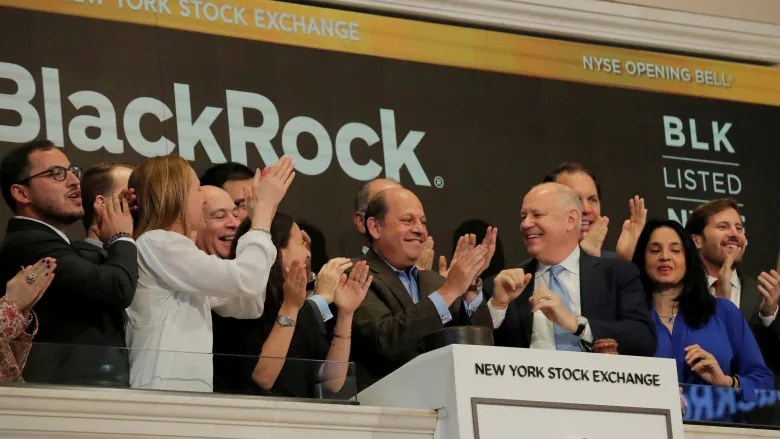
Framed with the lofty talk of “sustainability” and “conservation”, media reports on the move in outlets like Fortune couldn’t avoid noting that NACs open the doors to “a new form of sustainable investment” which “has enthralled the likes of BlackRock CEO Larry Fink over the past several years even though there remain big, unanswered questions about it.”
BlackRock is the world’s largest asset manager, with nearly $9.5 trillion under management. That is more than the gross domestic product of every country in the world except the U.S. and China. BlackRock also runs a massive technology platform that oversees at least $21.6 trillion in assets. It and two other megalithic asset managers, State Street and Vanguard (BlackRock’s largest shareholder), already effectively own much of the world. Adding “natural asset companies” to their portfolios could make them owners of the foundations of all life.
A $4 Quadrillion Asset — The Earth Itself
Partnering with the New York Stock Exchange team launching the NAC is the Intrinsic Exchange Group (IEG), major investors in which are the Rockefeller Foundation and the Inter-American Development Bank, notorious for imposing neo-colonialist agendas through debt entrapment. According to IEG’s website:
We are pioneering a new asset class based on natural assets and the mechanism to convert them to financial capital. These assets are essential, making life on Earth possible and enjoyable. They include biological systems that provide clean air, water, foods, medicines, a stable climate, human health and societal potential.
The potential of this asset class is immense. Nature’s economy is larger than our current industrial economy ….
The immense potential of “Nature’s Economy” is estimated by IEG at $4,000 trillion ($4 quadrillion).
Webb cites researcher and journalist Cory Morningstar, who maintains that one of the aims of creating “Nature’s Economy” and packaging it via NACs is to drastically advance massive land grab efforts made by Wall Street and the oligarch class in recent years, including those made by Wall Street firms and billionaires like Bill Gates during the COVID crisis. The land grabs facilitated through the development of NACs, however, will largely target indigenous communities in the developing world. Morningstar observes:
The public launch of NACs strategically preceded the fifteenth meeting of the Conference of the Parties to the Convention on Biological Diversity, the biggest biodiversity conference in a decade. Under the pretext of turning 30% of the globe into “protected areas”, the largest global land grab in history is underway. Built on a foundation of white supremacy, this proposal will displace hundreds of millions, furthering the ongoing genocide of Indigenous peoples.
The UN’s “30 x 30”
The land grab of which Morningstar speaks is embodied in a draft agreement called the “Post-2020 Global Biodiversity Framework,” currently being negotiated among the 186 governments that are signatories to the Convention for Biological Diversity. Part I of its 15th meeting (COP15) closed on October 15, just ahead of COP26 (the 26th UN Climate Change Conference of the Parties) hosted in Glasgow from October 31 through November 12. COP26 focuses on climate change, while COP 15 focuses on preserving diversity. Part II of COP15 will be held in 2022. The draft text for the COP 15 nature pact includes a core pledge to protect at least 30% of the planet’s land and oceans by 2030.
In September 2020, 128 environmental and human rights NGOs and experts warned that the 30 x 30 plan could result in severe human rights violations and irreversible social harm for some of the world’s poorest people. Based on figures from a paper published in the academic journal Nature, they argued that the new target could displace or dispossess as many as 300 million people. Stephen Corry of Survival International contended:
The call to make 30% of the globe into “Protected Areas” is really a colossal land grab as big as Europe’s colonial era, and it’ll bring as much suffering and death. Let’s not be fooled by the hype from the conservation NGOs and their UN and government funders. This has nothing to do with climate change, protecting biodiversity or avoiding pandemics – in fact it’s more likely to make all of them worse. It’s really all about money, land and resource control, and an all out assault on human diversity. This planned dispossession of hundreds of millions of people risks eradicating human diversity and self-sufficiency – the real keys to our being able to slow climate change and protect biodiversity.
How that is to be done is not clearly specified, but proponents insist it is not a “land grab.” Critics, however, contend there is no other way to pull it off. Only about 12% of land and water in the U.S. is now considered to be “in conservation,” including wilderness lands, national parks, national wildlife refuges, state parks, national monuments, and private lands with permanent conservation easements (contracts to surrender a portion of property rights to a land trust or the federal government). According to environmental expert Dr. Bonner Cohen, raising that figure to 30%, adding 600 million acres to the total, “means putting this land and water (mostly land) off limits to any productive use in perpetuity. To accomplish this goal, the federal government will have to buy up – through eminent domain or other pressures on landowners making them ‘willing sellers’ of their property – millions of acres of private land.”
This requires restricting a land area the size of the State of Nebraska every year, each year, for the next nine years, or in other words a landmass twice the size of Texas by 2030.
This goal is especially radical given that the President has no constitutional authority to take action to conserve 30% of the land and water.
The Real Threat to Mother Nature
The federal government may have no constitutional authority to take the land, but a megalithic private firm such as BlackRock could do it simply by making farmers and local residents an offer they can’t refuse. This ploy has already been demonstrated in the housing market.
According to a survey reported in The Guardian on October 12, 2021, nearly 40% of U.S. households are facing serious financial problems, including struggling to afford medical care and food; and 30% of lower income households (those earning under $50,000 per year) said they had lost all their savings during the coronavirus pandemic. In the first quarter of 2021, 15% of U.S. home sales went to large corporate investors including BlackRock, which beat out families in search of homes just by offering substantially more than the asking price. Sometimes whole neighborhoods were bought up at once for conversion into rental properties.
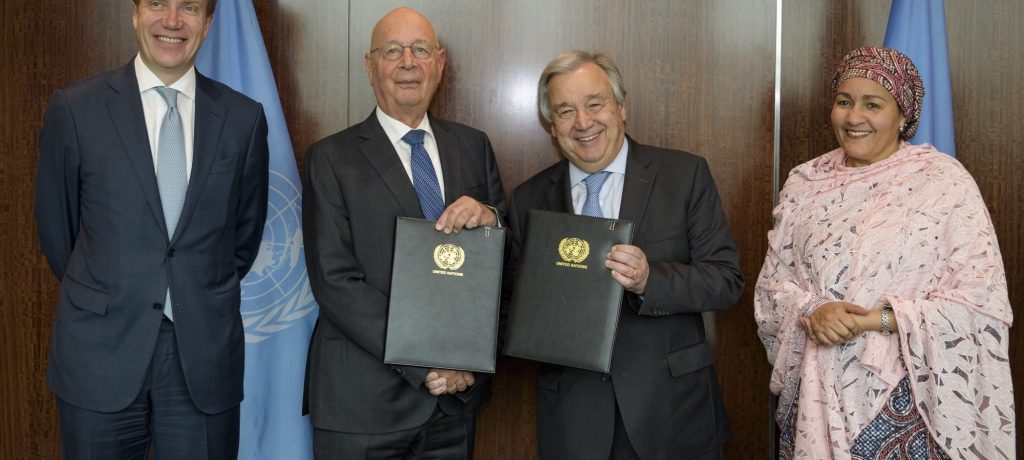
BlackRock’s chairman Larry Fink is on the board of the World Economic Forum, which until recently featured a controversial promotional video declaring “You will own nothing, and you’ll be happy.”
We all want a clean environment, and we want to preserve species biodiversity. But that includes human biodiversity – acknowledging the rights of rural landowners and Indigenous peoples, the land’s natural stewards. The greatest threat to the land is not the people living on it but those well-heeled investors who swoop in to buy up the rights to it, financializing the earth for profit.
Not just private property but those public lands and infrastructure once known as “the commons” are now under threat. We face an existential moment in our economic history, in which accumulated private wealth is acquiring carte blanche control of the essentials of life. Whether that juggernaut can be stopped remains to be seen, but the first step in any defensive action is to be aware of the threat at our doorsteps.
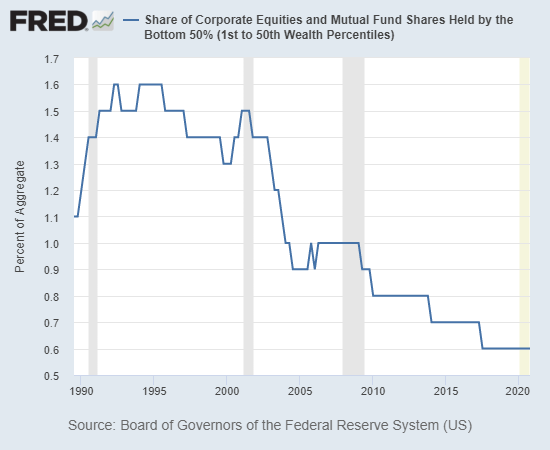
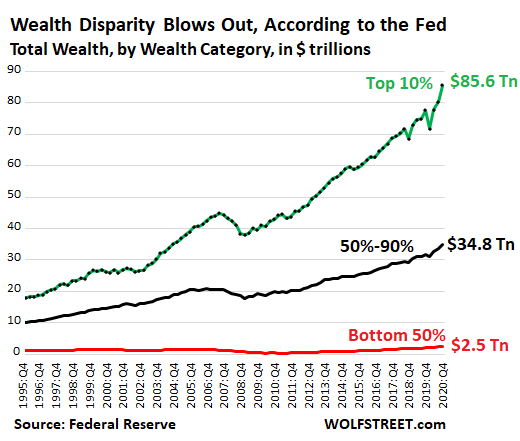
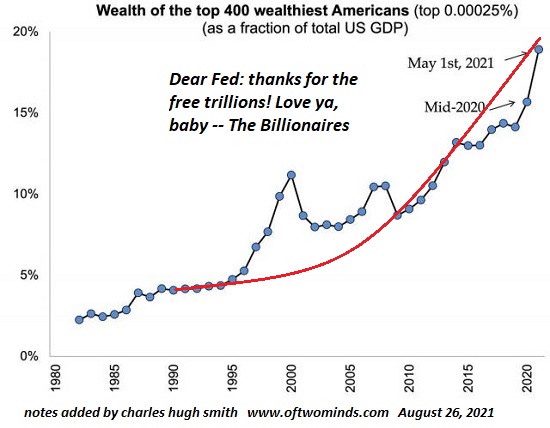
One might anticipate that the bottom 50%’s meager share of the nation’s exploding wealth would have increased as smartly as the wealth of the billionaires, but alas, no.
America’s economy has changed in ways few of the winners seem to notice, as they’re too busy cheerleading their own brilliance and success. In the view of the winners, who just so happen to occupy all the seats at the media-punditry-Federal Reserve, etc. table–the rising tide of stock, bond and real estate bubbles are raising all boats. What’s left unsaid is except for the 50% of boats with gaping holes below the waterline, i.e. stagnant wages and a fast-rising cost of living.
The truth the self-satisfied winners don’t include in their self-congratulatory rah-rah is there’s no place for the bottom 50% of American households to go but down. All the winnings flow to those who already owned assets back when they were affordable– the already-wealthy–whose wealth has soared as assets have shot to the moon while the the burdens of inflation and debt service hit the bottom 50% the hardest.
Meanwhile, the Federal Reserve is whining that inflation isn’t high enough yet for their refined tastes. Boo-hoo, how sad for the Fed–inflation isn’t yet high enough. Oh wait–didn’t they each mint millions by front-running their own policies? No wonder they’re not worried about inflation.
The reality few acknowledge is that globalization and financialization have stripped the American economy of low-skilled jobs that don’t demand much of the employee. The reality is that a great many people don’t have what it takes to learn high-level skills and work at a demanding pace under constant pressure–the description of the average job in America.
There were once millions of low-skill, low-pay jobs for people who for whatever mix of reasons were unable to muster the wherewithal to fulfill the fantasy of working extra hard, going to night school, soaking up high-level skills, moving quickly up the ladder to higher pay, buying the starter home and then moving up the food chain to middle class security from there.
The cost of living was low enough that those working these low-skill, low-pay jobs could still have an independent life. There were still low-cost rentals, often derided by the wealthy, in nooks and crannies of even the costliest cities. (I once lived in a room stuffed with old tax records in a poolside shack in an upscale neighborhood. The room had been cleared for a single bed and a path to the decrepit bathroom. Its most important attribute was that I could afford it on my low earnings.)
Affordable housing has vanished, eliminated by the financialization of America’s economy. Once landlords pay double the price for the property, rents have to double to pay their higher expenses. The apartment didn’t double in size or amenities–the rent doubled without any increase in utility to the renter. You get nothing more for double the price–nice.
Yes, people could make better choices, and some do. The point here is the game is rigged against those in the lower tier of the economy who can no longer afford a house or other stake in the only winning game in town–speculative asset bubbles. Go ahead and work a second job and go to night school–you’ll still be left behind the already-rich.
Globalization opened every job in America to global competition via offshoring or the influx of undocumented workers so desperate to support their families back home that no pay was too low and no working condition too wretched to refuse.
Many overindulged pundits who never worked an honest day in their lives sneer about burger flippers without realizing how hard those burger flippers have to work. I doubt the well-dressed pundits, snobbish about their university degrees and general brilliance, could manage to work a single day in a demanding fast-food job.
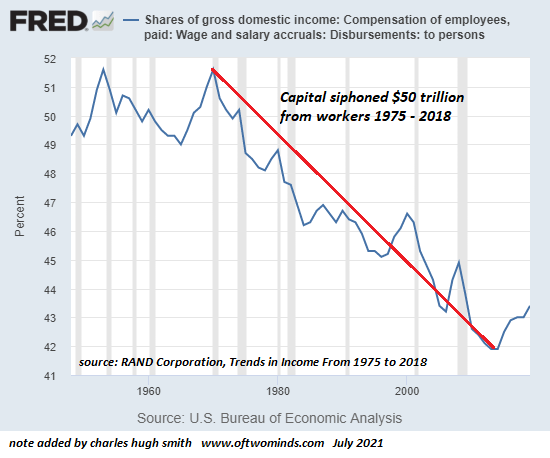
As the price of housing and other assets have soared, enriching the already rich, they’re out of reach for the bottom 50% who struggle to pay their bills as wages have stagnated and the costs of essentials have skyrocketed.
The rising cost of parking tickets, junk fees, user fees, utilities and food don’t impact the well-paid top 5% technocrat class, whose stake in the Everything Bubble keeps expanding by tens or hundreds of thousands of dollars. But for the bottom 50%, those incremental increases are, when added to higher rents, absolutely crushing.
As for getting high-quality healthcare that includes mental health support–those are reserved for the rich. But no worries, self-medication is always a “choice.”
Getting a boost in pay from $12 an hour to $15 an hour is welcome, but that doesn’t put the worker any closer to affording a house or equivalent stake in the Everything Bubble.
The new feudalism is masked by the glossy SillyCon Valley PR of a gig economy where (per the PR fantasy) bright, shiny and totally independent workers freely choose to serve the winners in the rigged sweepstakes for low pay and zero benefits.
In the SillyCon Valley PR, serfs freely choose to serve their noble masters for nothing but survival because they love the “freedom” and “choice” of kissing the nobility’s plump derrieres. (After all, there were “choices” even back in the good old days of feudalism–one could join the brigands in the forest, or enlist in a poorly paid mercenary army where the odds of dying were high–you know, “choices” of “gigs.”)
One might anticipate that the bottom 50%’s meager share of the nation’s exploding wealth would have increased as smartly as the wealth of the billionaires, but alas, no–the bottom 50%’s share of stocks (equities) actually plummeted in the the glorious decades of Federal Reserve free money for financiers, stock buy-backs and asset bubbles.
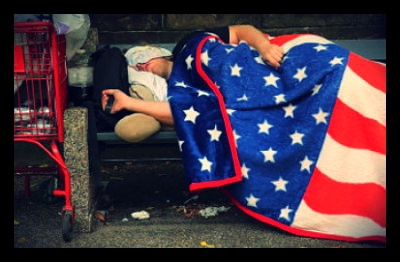
All this suits the billionaires and those collecting the crumbs of the Everything Bubble just fine. So what if the bottom 50% have nowhere to go but down? There’s plenty of room in the homeless encampment for another broken down station wagon or an old camper. There’s lots of “choices.”
And no consequences for the winners, of course, because The Fed has our backs.
I’ve coined a new portmanteau word to describe America’s descent: kleptocrapocracy, a union of kleptocracy (a nation ruled by kleptocrats) and crapocracy, a nation drowning in a moral sewer of rampant self-interest in which the focus is cloaking all the skims, scams, rackets and bezzles in some virtuous-sounding garb, a nation choking on low-quality junk ceaselessly hawked by robocalls, spam, phishing and Big Tech manipulation.
It’s little wonder trust has collapsed in America: the only thing we can trust is whatever’s being pitched is deceptively packaged to mask the self-interest and profiteering of the perps.
The stench from the decomposing carcasses of once-trusted institutions is everywhere. Insiders and the marketers they pay to cloak their grifting are banking bennies at the expense of hapless debt-serfs who fell for the scam. You need these three costly medications, and then when the side-effects kick in, you need six more to counteract the first three, and so on. But trust us; your “health” (heh) is our only concern. Uh, sure.
Why do state universities need to market themselves like a roto-rooter service? Maybe because they’re both working the sewers: state universities are exploiting the student loan sewers, desperate to recruit another batch of debt-serfs who fell for the 3-card monte game in which a lifetime of debt is exchanged for a credential of dubious value.
The competition for the remaining pool of debt-serfs is heating up, so like everything else in America, the game is now all about marketing, virtue-signaling, exploiting Big Tech manipulation, and so on.
Doing something useful is now for chumps. The opportunities in America are all about getting rich by doing, well, nothing: skimming 20% “guaranteed” returns in DeFi, mining cryptos, trading stablecoins, selling volatility, etc.–getting rich and then living large on the sweat of the chumps who are still working (poor deluded fools!).
The obvious goal here is for everyone to get in on trading stablecoins, buying rentals with DeFi, churning meme stocks, etc. Why should anyone lower themselves to doing something useful anymore? Why bother?
Labor has been degraded for decades in speculative-frenzy America. Why work when the Fed has our backs and all those newly issued trillions are up for grabs? Doing something useful is for chumps.
Nobody seems to ask what happens when we’re all minting fortunes off speculative churn and there’s nobody filling potholes, stocking shelves or carrying bags of QuikCrete to customers’ trucks.
And while we’re on the subject of sewage: if America’s security services and Big Tech oligarchies track everything and everyone, why are we drowning in robocalls, spam, SMS-spam (smishing), etc.? Couldn’t the NSA/CIA track the spammers and robo-callers down and rendition them (warrantlessly, of course) to a hellhole camp in an unnamed country?
Of course they could. But the ruination of everyday life is of no concern to the kleptocrats (fly with me to the stars!) or our dysfunctional government, which has become nothing more than an invitation-only auction of favors that elevates the relentless pursuit of self-interest and profiteering to new kleptocratic heights.
Please don’t make the mistake of expecting anything to work properly in America. The components are garbage, the parts are on back-order, the people who knew how to make the kludgy mess function just quit in disgust, and we’ll have to get back to you about your request, as our service staff just left to launch an OnlyFans site.
I don’t want to work, I’m minting money speculating, but gol-darn it, I want everyone else to wait on me and meet my needs for low, low quality goods and services at not-so-low prices, and if I’m not treated well enough by everyone earning chump-change, then I’ll freak out, and if that doesn’t pan out, I’ll blame it all on my meds. Accountability is like work–only for chumps.
Trust me, everything’s going great and we’re all going to get wealthier and wealthier until we won’t be able to take it any more, it will be so great. I hope everyone here is hungry because the banquet of consequences is being served.
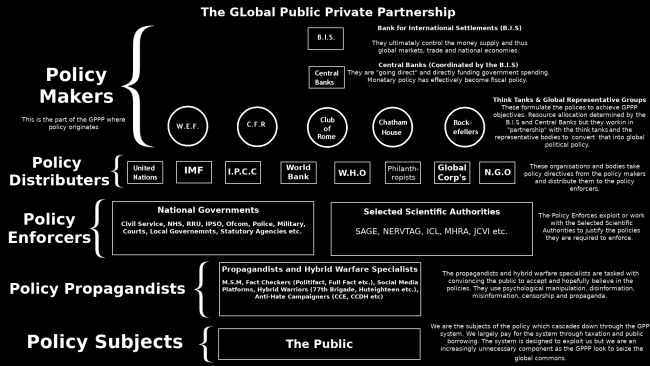
The Global Public-Private Partnership (GPPP) is a world-wide network of stakeholder capitalists and their partners.
This collective of stakeholders (the capitalists and their partners) comprises global corporations (including central banks), philanthropic foundations (multi-billionaire philanthropists), policy think-tanks, governments (and their agencies), non-governmental organisations, selected academic & scientific institutions, global charities, the labour unions and other chosen “thought leaders.”
The GPPP controls global finance and the world’s economy. It sets world, national and local policy (via global governance) and then promotes those policies using the mainstream media (MSM) corporations who are also “partners” within the GPPP.
Often those policies are devised by the think-tanks before being adopted by governments, who are also GPPP partners. Government is the process of transforming GPPP global governance into hard policy, legislation and law.
Under our current model of Westphalian national sovereignty, the government of one nation cannot make legislation or law in another. However, through global governance, the GPPP create policy initiatives at the global level which then cascade down to people in every nation. This typically occurs via an intermediary policy distributor, such as the IMF or IPCC, and national government then enact the recommended policies.
The policy trajectory is set internationally by the authorised definition of problems and their prescribed solutions. Once the GPPP enforce the consensus internationally, the policy framework is set. The GPPP stakeholder partners then collaborate to ensure the desired policies are developed, implemented and enforced. This is the oft quoted “international rules based system.”
In this way the GPPP control many nations at once without having to resort to legislation. This has the added advantage of making any legal challenge to the decisions made by the most senior partners in the GPPP (it is an authoritarian hierarchy) extremely difficult.
The GPPP has traditionally been referenced in the context of public health and specifically in a number of United Nation’s (UN) documents, including those from their agencies such as the World Health Organisation (WHO).
In their 2005 document Connecting For Health, the WHO, in noting what the Millennium Development Goals meant for global health, revealed the emerging GPPP:
These changes occurred in a world of revised expectations about the role of government: that the public sector has neither the financial nor the institutional resources to meet their challenges, and that a mix of public and private resources is required……Building a global culture of security and cooperation is vital….The beginnings of a global health infrastructure are already in place. Information and communication technologies have opened opportunities for change in health, with or without policy-makers leading the way…….Governments can create an enabling environment, and invest in equity, access and innovation.”
The revised role of governments meant that they were no longer leading the way. The traditional policymakers weren’t making policy anymore, other GPPP partners were. National government had been relegated to creating the GPPP’s enabling environment by taxing the public and increasing government borrowing debt.
This is a debt owed to the senior partners in the GPPP. They are also the beneficiaries of the loans and use this comically misnamed “public investment” to create markets for themselves and the wider the GPPP.
The researchers Buse & Walt 2000 offers a good official history of the development of the GPPP concept. They suggest it was a response to the growing disillusionment in the UN project as a whole and the emerging realisation that global corporations were increasingly key to policy implementation. This correlates to the development of the stakeholder capitalism concept, first popularised in the 1970s.
Buse & Walt outlined how GPPP’s were designed to facilitate the participation of new breed of corporations. These entities had recognised the folly of their previously destructive business practices. They were ready to own their mistakes and make amends. They decided they would achieve this by partnering with government to solve global problems. These existential threats were defined by the GPPP and the selected scientists, academics and economists they funded.
The two researchers identified a key Davos address, delivered by then UN Secretary General Kofi Annan to the WEF in 1998, as marking the transition to a GPPP based global governance model:
The United Nations has been transformed since we last met here in Davos. The Organization has undergone a complete overhaul that I have described as a ‘quiet revolution’…A fundamental shift has occurred. The United Nations once dealt only with governments. By now we know that peace and prosperity cannot be achieved without partnerships involving governments, international organizations, the business community and civil society…The business of the United Nations involves the businesses of the world.”
Buse & Walt claimed that this signified the arrival of a new type of responsible global capitalism. As we shall see, that is not how the corporations viewed this arrangement. Indeed, Buse and Walt acknowledged why the GPPP was such an enticing prospect for the global giants of banking, industry, finance and commerce:
Shifting ideologies and trends in globalization have highlighted the need for closer global governance, an issue for both private and public sectors. We suggest that at least some of the support for GPPPs stems from this recognition, and a desire on the part of the private sector to be part of global regulatory decision-making processes.”
The conflict of interest is obvious. We are simply expected to accept, without question, that global corporations are committed to putting humanitarian and environmental causes before profit. Supposedly, a GPPP led system of global governance is somehow beneficial for us.
Believing this requires a considerable degree of naivety. Many of the stakeholder corporations have been convicted, or publicly held accountable, for the crimes they have commited. These include war crimes. The apparent passive agreement of the political class that these “partners” should effectively set global policy, regulations and spending priorities seems like infantile credulity.
This naivety is, in itself, a charade. As many academics, economists, historians and researchers have pointed out, corporate influence, even dominance of the political system had been increasing for generations. Elected politicians have long-been the junior partners in this arrangement.
With the arrival of GPPP’s we were witnessing the birth of the process to formalise this relationship, the creation of a cohesive world order. The politicians have simply stuck to the script ever since. They didn’t write it.
It is important to understand the difference between government and governance in the global context. Government claims the right, perhaps through a quasi-democratic mandate, to set policy and decree legislation (law.)
The alleged western representative democracies, which aren’t democracies at all, are a model of national government where elected representatives form the executive who enact legislation. For example, in the UK this is achieved through the parliamentary process.
Perhaps the closest thing to this form of national government on an international scale is the United Nations General Assembly. It has a tenuous claim to democratic accountability and can pass resolutions which, while they don’t bind member states, can create “new principles” which may become international law when later applied by the International Court of Justice.
However, this isn’t really world “government.” The UN lacks the authority to decree legislation and form law. The only way its “principles” can become law is via judicial ruling. The non-judicial power to create law is reserved for governments and their legislative reach only extends to their own national borders.
Due to the often fraught relationships between national governments, world government starts to become impractical. With both the non-binding nature of UN resolutions and the international jockeying for geopolitical and economic advantage, there isn’t currently anything we could call a world government.
There is the additional problem of national and cultural identity. Most populations aren’t ready for a distant, unelected world government. People generally want the political class to have more democratic accountability, not less.
The GPPP would certainly like to run a world government, but imposition by overt force is beyond their capability. Therefore, they have employed other means, such as deception and propaganda, to promote the notion of global governance.
Former Carter administration advisor and Trilateral Commission founder Zbigniew Brzezinski recognised how this approach would be easier to implement. In his 1970 book Between Two Ages: Americas Role In The Technetronic Era, he wrote:
Though the objective of shaping a community of the developed nations is less ambitious than the goal of world government, it is more attainable.”
The last 30 years have seen numerous GPPP’s form as the concept of global governance has evolved. A major turning point was the WEF’s conspectus of multistakeholder governance. With their 2010 publication of Everybody’s Business: Strengthening International Cooperation in a More Interdependent World, the WEF outlined the elements of GPPP stakeholder’s form of global governance.
They established their Global Agenda Councils to deliberate and suggest policy covering practically every aspect of our existence. The WEF created a corresponding global governance body for every aspect of our society. From our values and economy, through to our security and public health, our welfare systems, consumption, access to water, food security, crime, our rights, sustainable development and the global financial and monetary system, nothing was left untouched.
The executive chairman of the WEF, Klaus Schwab, spelled out what the objective of global governance was:
Our purpose has been to stimulate a strategic thought process among all stakeholders about ways in which international institutions and arrangements should be adapted to contemporary challenges…the world’s leading authorities have been working in interdisciplinary, multistakeholder Global Agenda Councils to identify gaps and deficiencies in international cooperation and to formulate specific proposals for improvement…
These discussions have run through the Forum’s Regional Summits during 2009 as well as the Forum’s recent Annual Meeting 2010 in Davos-Klosters, where many of the emerging proposals were tested with ministers, CEOs, heads of NGOs and trade unions, leading academics and other members of the Davos community…
The Global Redesign process has provided an informal working laboratory or marketplace for a number of good policy ideas and partnership opportunities…We have sought to expand international governance discussions…to take more pre-emptive and coordinated action on the full range of risks that have been accumulating in the international system.
By 2010 the WEF had taken it upon themselves to begin the Global Redesign process. They defined the international challenges and they proposed the solutions. Fortunately for the GPPP, their proposals meant more control and partnership opportunities for them. The WEF sought to spearhead the expansion of this international governance.
In just one example, in 2019 the UK Government announced its partnership with the WEF to develop future business, economic and industrial regulations. The UK government were committed to supporting a regulatory environment created by the global corporations who would then be regulated by the same regulations they had designed.
The WEF do not have an electoral mandate of any kind. None of us have any opportunity to influence or even question their judgments and yet they are working in partnership with our supposedly democratically elected governments, and other GPPP stakeholders, to redesign the planet we all live on.
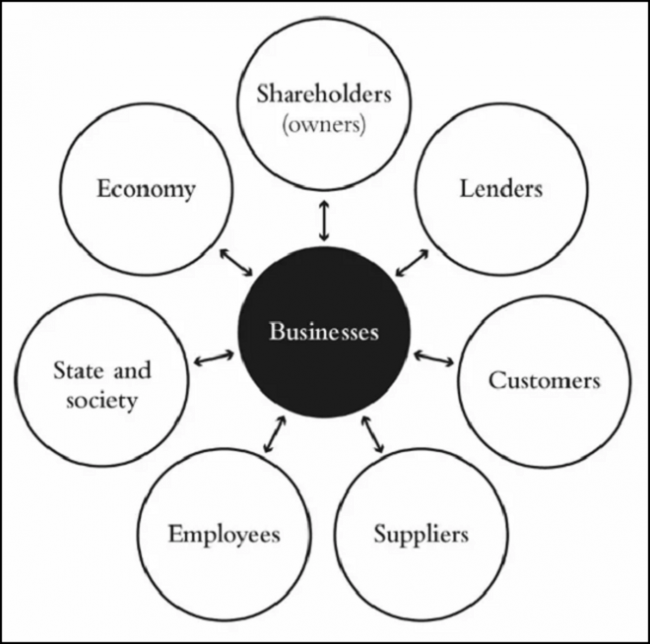
Stakeholder capitalism lies at the heart of the GPPP. Essentially it usurps democratic government (or indeed government of any kind) by placing global corporations at the centre of decision making. Despite deriving authority from no one but themselves, the leaders of the GPPP assume their own modern interpretation of the “divine right of kings” and rule absolutely.
The most important characteristic of the stakeholder model today is that the stakes of our system are now more clearly global.. What was once seen as externalities in national economic policy making and individual corporate decision making will now need to be incorporated or internalized in the operations of every government, company, community, and individual. The planet is.. the center of the global economic system, and its health should be optimized in the decisions made by all other stakeholders.”
The GPPP will oversee everything. Every government, all business, our so-called communities (where we live) and each of us individually. We are not the priority. The priority is the planet. Or so the WEF claim.
Centralised control of the entire planet, all its resources and everyone that lives on it is the core ethos of the GPPP. There is no need to interpret GPPP intentions, we don’t have to read between the lines. It is stated plainly in the introduction to the WEF’s Great Reset initiative:
To improve the state of the world, the World Economic Forum is starting The Great Reset initiative.. The Covid-19 crisis.. is fundamentally changing the traditional context for decision-making. The inconsistencies, inadequacies and contradictions of multiple systems –from health and financial to energy and education – are more exposed than ever.. Leaders find themselves at a historic crossroads.. As we enter a unique window of opportunity to shape the recovery, this initiative will offer insights to help inform all those determining the future state of global relations, the direction of national economies, the priorities of societies, the nature of business models and the management of a global commons.”
It should be noted that the WEF are just one partner organisation among many in the GPPP. However, they have been perhaps the most influential in terms of public relations throughout the pseudopandemic. Contrary to the hopes of Buse & Walt, we see an emergent global, corporate dictatorship, not caring stewardship of the planet.
The GPPP will determine the future state of global relations, the direction of national economies, the priorities of societies, the nature of business models and the management of a global commons. There is no opportunity for any of us to participate in either their project or the subsequent formation of policy.
While, in theory, governments do not have to implement GPPP policy, the reality is that they do. Global policies have been an increasing facet of our lives in the post WW2 era. The mechanism of translating GPPP policy initiatives, first into national and then regional and eventually local policy, can be clearly identified by looking at sustainable development.
In 1972 the privately funded, independent policy think-tank the Club of Rome (CoR) published the Limits of Growth. As we saw with the roll-out out of the pseudopandemic, the CoR used computer models to predict what they decreed were the complex problems faced by the entire planet: the “world problematique.”
Their offered opinions derived from the commissioned work of the Massachusetts Institute of Technology’s (MIT’s) system dynamic “World3 model.” This assumed global population would deplete natural resources and pollute the environment to the point where “overshoot and collapse” would inevitably occur.
This is not a scientific “fact” but rather a suggested scenario. So far, none of the predictions made have come to pass.
The scientific and statistical to-and-fro on the claims made in the Limits to Growth has been prolific. However, ignoring all doubts, the World3 model was firmly planted at the centre of the sustainable development policy environment.
In 1983 the Brundtland Commission was convened by former Norwegian Prime Minister Gro Harland Brundlandt and then Secretary General of the UN Javier Pérez de Cuéllar. Both were Club of Rome members. Based upon the highly questionable assumptions in the World3 model, they set about uniting governments from around the world to pursue sustainable development policies.
In 1987 the Commission published the Brundtland Report, also known as Our Common Future. Central to the idea of sustainable development, outlined in the report, was population control (reduction.) This policy decision, to get rid of people, won international acclaim and awards for the authors.
The underlying assumptions for these policy proposals weren’t publicly challenged at all. The academic and scientific debate raged but remained almost completely unreported. As far as the public knew, scientific assumption and speculation was a proven fact. It is now impossible to question these unproven assumptions and obviously inaccurate models without being accused of “climate denial.”
This resulted in the Millenium Development Goals and eventually, in 2015, they gave way to the United Nation’s full adoption of Sustainable Development Goals (SDGs), In turn, these have been translated into government policy. For example, the UK government proudly announced their Net Zero policy commitment to sustainable development goals in 2019.
SDGs were already making an impact at the regional and local level in counties, cities, towns and boroughs across the UK. Nearly every council across the country has a “sustainable development plan.”
Regardless of what you think about the global threats we may or may not face, the origin and the distribution pathway of the resultant policy is clear. A privately funded, globalist think-tank was the driver of a policy agenda which led to the creation of a global policy framework, adopted by governments the world over, which has impacted communities in nearly every corner of the Earth.
SDGs are just one among numerous examples of GPPP global governance in action. The elected politician’s role in this process is negligible. They merely serve to implement and sell the policy to the public.
It doesn’t matter who you elect, the policy trajectory is set at the global governance level. This is the dictatorial nature of the GPPP and nothing could be less democratic.
Halloween is an odd holiday. The ostensible concept — as it has evolved to become — is to shock, startle, frighten, petrify, horrify, and/or terrify… all while consuming enough high fructose corn syrup to keep the American Dental Association content for another century or two. Every year, as October 31 nears, loyal consumers squander a small fortune to adorn their soon-to-be-foreclosed-upon abodes with Made-in-China images of tombstones, skulls, ghouls, goblins, monsters, zombies, and even the occasional bloody severed limb or two. But let’s face it, none of these cardboard depictions remotely compare to the real-life horrors we passively accept as normal.
Who needs Dracula when we’ve got ruling class vampires sucking us dry — stealing not only our blood but also our jobs, homes, health, autonomy, sovereignty, and future? Why bother with Michael Myers when legions of Y chromosome ghouls unleash far worse cruelty — every minute of every day — via male pattern violence? Never forget:
No zombie is more frightening than those stumbling around in masks and chanting “trust the science.”
Never mind Jason and his hockey mask when you’ve got “Brandon” playing left wing.
Bats, pumpkins, and skeletons vs. pornographers, pimps, and pedophiles? No contest.
Elm Street’s Freddie ain’t got nothing on corporations transformed into “persons” — set free to pillage the ecosystem and co-opt our minds.
And I’ll take Godzilla’s side over pesticide, genocide, and ecocide.
Here’s one more 24/7 real-life nightmare far more dreadful than anything the Halloween-Industrial Complex can conjure up: When all those kids come knocking on your door, expecting brightly colored toxins called “candy,” you might wish to remind yourself that across the globe, an estimated 10,000 extra children are dying each month thanks to unnecessary lockdowns and restrictions.
Cue the ominous music: 10,000 dead. Every single month. From preventable causes. Because most of the world bought into the Covid lies. The next time you’re at a sporting event or a concert (for the vaccinated-only, of course), take a good, slow look around you and get a feel for what 10,000 looks like. It’s a whole lot more terrifying than the whir of a chainsaw echoing down a desolate Texas highway. Remember: “We’re all in this together.”
Everyone pretty much agrees that we have a major problem with crime in this nation. But when we talk about “crime”, are we all talking about the same thing? Normally, when most of us think about “crime” what comes to mind is the rampant violence in our city streets. As I discussed a couple of weeks ago, the FBI just released the final numbers for 2020, and they showed that the murder rate was up about 29 percent. That was the largest one year increase in U.S. history by a very wide margin, and law enforcement authorities are warning that the numbers for this year will show another huge jump. With so much violence in our streets, it is only natural that when we think of “crime” that we tend to think of young men recklessly firing guns in the core urban areas of our major cites. Here is one example that I just came across…
An intense wild west gunfight that played out on the streets of the Bronx was caught on camera in incredible new footage released by New York police.
The video begins by showing what appears to be seven gang members brandishing pistols, firing at an unidentified target across the street.
This is the latest in a string of high-profile incidents of violent crime that have become more common throughout the five boroughs in the last 18 months, during which New York City has seen a rise in the number of shootings, felony assaults, and hate crimes.
But do they represent the worst that our society has to offer?
Of course not.
Even worse are the people that choose to take guns into our schools and start shooting. Sadly, we had another such incident on Wednesday…
An 18-year-old suspect was taken into custody Wednesday after four people were injured in a shooting at a Texas high school, authorities said. Three of the victims were hospitalized, with at least one requiring surgery.
Around 9:15 a.m., police responded to a call about a shooting on the second floor of Timberview High School in Arlington, according to Kevin Kolbye, the city’s assistant police chief. Two of the victims were shot but were expected to survive, Kolbye said.
There is no place for such violence in our society, and I don’t want to minimize the evil of such a crime one bit.
But there are even worse criminals.
You see, the truth is that the biggest criminals in our society can be found in corporate boardrooms and in our halls of power. The wicked decisions that very powerful men and women make behind closed doors can result in the deaths of thousands or even millions of people.
Let me give you a few examples. Merck just announced a new COVID “wonder drug”, and those running the company have decided to charge $712 for a treatment that only costs $17.74 to produce…
Merck’s new ‘not Ivermectin’ Covid-19 treatment, molnupiravir, costs $17.74 to produce – yet the company is charging the US government $712 for the treatment– a 40x markup, according to The Intercept, citing a report issued last week by the Harvard School of Public Health and King’s College Hospital in London.
The pill, originally developed using US government funds as a possible treatment for Venezuelan equine encephalitis, cut the risk of hospitalization and death in half in a randomized trial of 775 adults with mild/moderate Covid who were considered at high risk for disease due to comorbidities such as obesity, diabetes and heart disease. The trial was stopped early so the company could apply for and emergency use authorization (EUA). The drug did not benefit patients who were already hospitalized with severe disease.
Theoretically, this “wonder drug” could help millions upon millions of COVID victims all over the globe in the coming years if it was priced fairly.
But the vast majority of those potential patients will never see it because they simply will not be able to afford it.
Meanwhile, how many other inexpensive alternative treatments are being suppressed so that big pharma can rake in billions of dollars in profits?
A Colorado woman suffering from stage five renal failure was denied a new kidney because both she and her prospective donor were unvaccinated.
The University of Colorado Health hospital sent a letter to Leilani Lutali, 56, who was set to receive a kidney from Jaimee Fougner, 45, informing her that the procedure could not be done until both women were vaccinated against COVID-19.
‘I feel coerced. I feel like my life is being held in their hands in exchange for a shot, and the attitude is just take the shot,’ Lutali told Denver7.
They are fully prepared to let her die if she won’t get the shot.
You have to be a special kind of evil to be so absolutely heartless.
In our society, the level of wickedness tends to rise the higher up the food chain that you go. And so it shouldn’t surprise anyone that Washington D.C. is absolutely seething with evil. When I worked there over a decade ago, you could literally feel it in the air.
Of course things have only gotten worse since that time, and right now the current resident of the White House is seeing his approval rating absolutely plummet because of all the nightmarish decisions that he has been making…
As his agenda flounders on Capitol Hill, President Joe Biden’s popularity among everyday Americans is taking a beating.
Biden’s approval rating has dropped to 38%, according to a Quinnipiac University poll released Wednesday. That’s down from 42% three weeks ago and from a high of 50% in mid-February.
Sadly, the truth is that the politicians in Washington D.C. are simply a reflection of who we have become as a nation.
And if the full extent of our national misdeeds is ever brought to light, we will become the most hated country on the entire planet and the rest of the world will turn on us with tremendous fury.
There is so much going on behind the scenes that most people don’t know about. For example, a whistleblower just came forward and revealed some staggering information to Project Veritas. If you have not seen that video yet, you can view it right here.
Of course the mainstream media will never report on this because they are evil too and this story would hurt the agendas that they are trying to push.
The biggest criminals get up in the morning and put on very expensive suits. They are paid lots of money and they love fame and recognition.
Unlike many of the violent criminals in our streets, most of the criminals in our boardrooms and in our halls of power will never go to prison for what they have done.
Instead, they will just keep laughing all the way to the bank as millions suffer and die.
In October 2019, in a speech at an International Monetary Fund conference, former Bank of England governor Mervyn King warned that the world was sleepwalking towards a fresh economic and financial crisis that would have devastating consequences for what he called the “democratic market system”.
According to King, the global economy was stuck in a low growth trap and recovery from the crisis of 2008 was weaker than that after the Great Depression. He concluded that it was time for the Federal Reserve and other central banks to begin talks behind closed doors with politicians.
In the repurchase agreement (repo) market, interest rates soared on 16 September. The Federal Reserve stepped in by intervening to the tune of $75 billion per day over four days, a sum not seen since the 2008 crisis.
At that time, according to Fabio Vighi, professor of critical theory at Cardiff University, the Fed began an emergency monetary programme that saw hundreds of billions of dollars per week pumped into Wall Street.
Over the last 18 months or so, under the guise of a ‘pandemic’, we have seen economies closed down, small businesses being crushed, workers being made unemployed and people’s rights being destroyed. Lockdowns and restrictions have facilitated this process. The purpose of these so-called ‘public health measures’ has little to do with public health and much to do with managing a crisis of capitalism and ultimately the restructuring of the economy.
Neoliberalism has squeezed workers income and benefits, offshored key sectors of economies and has used every tool at its disposal to maintain demand and create financial Ponzi schemes in which the rich can still invest in and profit from. The bailouts to the banking sector following the 2008 crash provided only temporary respite. The crash returned with a much bigger bang pre-Covid along with multi-billion-dollar bailouts.
The dystopian ‘great reset’ that we are currently witnessing is a response to this crisis. This reset envisages a transformation of capitalism.
Fabio Vighi sheds light on the role of the ‘pandemic’ in all of this:
“… some may have started wondering why the usually unscrupulous ruling elites decided to freeze the global profit-making machine in the face of a pathogen that targets almost exclusively the unproductive (over 80s).”
Vighi describes how, in pre-Covid times, the world economy was on the verge of another colossal meltdown and chronicles how the Swiss Bank of International Settlements, BlackRock (the world’s most powerful investment fund), G7 central bankers and others worked to avert a massive impending financial meltdown.
The world economy was suffocating under an unsustainable mountain of debt. Many companies could not generate enough profit to cover interest payments on their own debts and were staying afloat only by taking on new loans. Falling turnover, squeezed margins, limited cashflows and highly leveraged balance sheets were rising everywhere.
Lockdowns and the global suspension of economic transactions were intended to allow the Fed to flood the ailing financial markets (under the guise of COVID) with freshly printed money while shutting down the real economy to avoid hyperinflation.
Vighi says:
“… the stock market did not collapse (in March 2020) because lockdowns had to be imposed; rather, lockdowns had to be imposed because financial markets were collapsing. With lockdowns came the suspension of business transactions, which drained the demand for credit and stopped the contagion. In other words, restructuring the financial architecture through extraordinary monetary policy was contingent on the economy’s engine being turned off.”
It all amounted to a multi-trillion bailout for Wall Street under the guise of COVID ‘relief’ followed by an ongoing plan to fundamentally restructure capitalism that involves smaller enterprises being driven to bankruptcy or bought up by monopolies and global chains, thereby ensuring continued viable profits for these predatory corporations, and the eradication of millions of jobs resulting from lockdowns and accelerated automation.
“It retains all the cruelties of the free market for those who live and work in the real world, but turns the paper economy into a state protectorate, surrounded by a kind of Trumpian Money Wall that is designed to keep the investor class safe from fear of loss. This financial economy is a fantasy casino, where the winnings are real but free chips cover the losses. For a rarefied segment of society, failure is being written out of the capitalist bargain.”
The World Economic Forum says that by 2030 the public will ‘rent’ everything they require. This means undermining the right of ownership (or possibly seizing personal assets) and restricting consumer choice underpinned by the rhetoric of reducing public debt or ‘sustainable consumption’, which will be used to legitimise impending austerity as a result of the economic meltdown. Ordinary people will foot the bill for the ‘COVID relief’ packages.
If the financial bailouts do not go according to plan, we could see further lockdowns imposed, perhaps justified under the pretext of ‘the virus’ but also ‘climate emergency’.
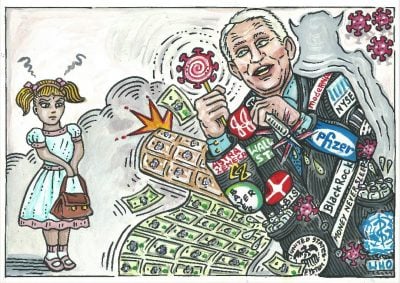
It is not only Big Finance that has been saved. A previously ailing pharmaceuticals industry has also received a massive bailout (public funds to develop and purchase the vaccines) and lifeline thanks to the money-making COVID jabs.
The lockdowns and restrictions we have seen since March 2020 have helped boost the bottom line of global chains and the e-commerce giants as well and have cemented their dominance. At the same time, fundamental rights have been eradicated under COVID government measures.
Capitalism and labour
Essential to this ‘new normal’ is the compulsion to remove individual liberties and personal freedoms. A significant part of the working class has long been deemed ‘surplus to requirements’ – such people were sacrificed on the altar of neo-liberalism. They lost their jobs due to automation and offshoring. Since then, this section of the population has had to rely on meagre state welfare and run-down public services or, if ‘lucky’, insecure low-paid service sector jobs.
What we saw following the 2008 crash was ordinary people being pushed further to the edge. After a decade of ‘austerity’ in the UK – a neoliberal assault on the living conditions of ordinary people carried out under the guise of reining in public debt following the bank bail outs – a leading UN poverty expert compared Conservative welfare policies to the creation of 19th-century workhouses and warned that, unless austerity is ended, the UK’s poorest people face lives that are “solitary, poor, nasty, brutish, and short”.
Philip Alston, the UN rapporteur on extreme poverty, accused ministers of being in a state of denial about the impact of policies. He accused them of the “systematic immiseration of a significant part of the British population”.
In another 2019 report, the Institute for Public Policy Research think tank laid the blame for more than 130,000 deaths in the UK since 2012 at the door of government policies. It claimed that these deaths could have been prevented if improvements in public health policy had not stalled as a direct result of austerity cuts.
Over the past 10 years in the UK, according to the Trussell Group, there has been rising food poverty and increasing reliance on food banks.
And in a damning report on poverty in the UK by Professor David Gordon of the University of Bristol, it was found that almost 18 million cannot afford adequate housing conditions, 12 million are too poor to engage in common social activities, one in three cannot afford to heat their homes adequately in winter and four million children and adults are not properly fed (Britain’s population is estimated at around 66 million).
Moreover, a 2015 report by the New Policy Institute noted that the total number of people in poverty in the UK had increased by 800,000, from 13.2 to 14.0 million in just two to three years.
Meanwhile, The Equality Trust in 2018 reported that the ‘austerity’ years were anything but austere for the richest 1,000 people in the UK. They had increased their wealth by £66 billion in one year alone (2017-2018), by £274 billion in five years (2013-2018) and had increased their total wealth to £724 billion – significantly more than the poorest 40% of households combined (£567 billion).
Just some of the cruelties of the ‘free market’ for those who live and work in the real world. And all of this hardship prior to lockdowns that have subsequently devastated lives, livelihoods and health, with cancer diagnoses and treatments and other conditions having been neglected due to the shutdown of health services.
During the current economic crisis, what we are seeing is many millions around the world being robbed of their livelihoods. With AI and advanced automation of production, distribution and service provision on the immediate horizon, a mass labour force will no longer be required.
It raises fundamental questions about the need for and the future of mass education, welfare and healthcare provision and systems that have traditionally served to reproduce and maintain labour that capitalist economic activity has required.
As the economic is restructured, labour’s relationship to capital is being transformed. If work is a condition of the existence of the labouring classes, then, in the eyes of capitalists, why maintain a pool of (surplus) labour that is no longer needed?
A concentration of wealth power and ownership is taking place as a result of COVID-related policies: according to research by Oxfam, the world’s billionaires gained $3.9 trillion while working people lost $3.7 trillion in 2020. At the same time, as large sections of the population head into a state of permanent unemployment, the rulers are weary of mass dissent and resistance. We are witnessing an emerging biosecurity surveillance state designed to curtail liberties ranging from freedom of movement and assembly to political protest and free speech.
In 2020, World Bank Group President David Malpass stated that poorer countries will be ‘helped’ to get back on their feet after the various lockdowns but such ‘help’ would be on condition that neoliberal reforms become further embedded. In other words, the de facto privatisation of states (affecting all nations, rich and poor alike), the (complete) erosion of national sovereignty and dollar-denominated debt leading to a further strengthening of US leverage and power.
In a system of top-down surveillance capitalism with an increasing section of the population deemed ‘unproductive’ and ‘useless eaters’, notions of individualism, liberal democracy and the ideology of free choice and consumerism are regarded by the elite as ‘unnecessary luxuries’ along with political and civil rights and freedoms.
We need only look at the ongoing tyranny in Australia to see where other countries could be heading. How quickly Australia was transformed from a ‘liberal democracy’ to a brutal totalitarian police state of endless lockdowns where gathering and protests are not to be tolerated.
Being beaten and thrown to the ground and fired at with rubber bullets in the name of protecting health makes as much sense as devastating entire societies through socially and economically destructive lockdowns to ‘save lives’.
It makes as much sense as mask-wearing and social-distancing mandates unsupported by science, misused and flawed PCR tests, perfectly healthy people being labelled as ‘cases’, deliberately inflated COVID death figures, pushing dangerous experimental vaccines in the name of health, ramping up fear, relying on Neil Ferguson’s bogus modelling, censoring debate about any of this and the WHO declaring a worldwide ‘pandemic’ based on a very low number of global ‘cases’ back in early 2020 (44,279 ‘cases’ and 1,440 supposed COVID deaths outside China out of a population of 6.4 billion).
There is little if any logic to this. But of course, If we view what is happening in terms of a crisis of capitalism, it might begin to make a lot more sense.
The austerity measures that followed the 2008 crash were bad enough for ordinary people who were still reeling from the impacts when the first lockdown was imposed.
The authorities are aware that deeper, harsher impacts as well as much more wide-ranging changes will be experienced this time around and seem adamant that the masses must become more tightly controlled and conditioned to their coming servitude.





 After the Crash