
Orwellian Lockstep and a Loaded Syringe

By Colin Todhunter

Source: Dissident Voice

Some years ago, the then vice-president of Monsanto Robert T Fraley asked, “Why do people doubt science”. He posed the question partly because he had difficulty in believing that some people had valid concerns about the use of genetically modified organisms (GMOs) in agriculture.

Critics were questioning the science behind GM technology and the impacts of GMOs because they could see how science is used, corrupted and manipulated by powerful corporations to serve their own ends. And it was also because they regard these conglomerates as largely unaccountable and unregulated.

We need look no further than the current coronavirus issue to understand how vested interests are set to profit by spinning the crisis a certain way and how questionable science is being used to pursue policies that are essentially illogical or ‘unscientific’. Politicians refer to ‘science’ and expect the public to defer to the authority of science without questioning the legitimacy of scientific modelling or data.

Although this legitimacy is being questioned on various levels, arguments challenging the official line are being sidelined. Governments, the police and the corporate media have become the arbiters of truth even if ‘the truth’ does not correspond with expert opinion or rational thought which challenges the mainstream narrative.

For instance, testing for coronavirus could be flawed (producing a majority of ‘false positives’) and the processes involved in determining death rates could be inflating the numbers: for example, dying ‘with’ coronavirus’ is different to dying ‘due to’ coronavirus: a serious distinction given that up to 98 per cent of people (according to official sources) who may be dying with it have at least one serious life-threatening condition. Moreover, the case-fatality ratio could be so low as to make the lockdown response appear wholly disproportionate. Yet we are asked to accept statistics at face value – and by implication, the policies based on them.

Indeed, documentary maker and author David Cayley addresses this last point by saying that modern society is hyper-scientific but radically unscientific as it has no standard against which it can measure or assess what it has done: that we must at all costs ‘save lives’ is not questioned, but this makes it very easy to start a stampede. Making an entire country go home and stay home has immense, incalculable costs in terms of well-being and livelihoods. Cayley argues that this itself has created a pervasive sense of panic and crisis and is largely a result of the measures taken against the pandemic and not of the pandemic itself.

He argues that the declaration by the World Health Organization that a pandemic (at the time based on a suspected 150 deaths globally) was now officially in progress did not change anyone’s health status, but it dramatically changed the public atmosphere. Moreover, the measures mandated have involved a remarkable curtailing of civil liberty.

One of the hallmarks of the current situation, he stresses, is that some think that ‘science’ knows more than it does and therefore they – especially politicians – know more than they do. Although certain epidemiologists may say frankly that there is very little sturdy evidence to base policies on, this has not prevented politicians from acting as if everything they say or do is based on solid science.

The current paradigm – with its rhetoric of physical distancing, flattening the curve and saving lives – could be difficult to escape from. Cayley says either we call it off soon and face the possibility that it was all misguided (referring to the policies adopted in Sweden to make his point), or we extend it and create harms that may be worse than the casualties we may have averted.

The lockdown may not be merited if we were to genuinely adopt a knowledge-based approach. For instance, if we look at early projections by Neil Ferguson of Imperial College in the UK, he had grossly overstated the number of possible deaths resulting from the coronavirus and has now backtracked substantially. Ferguson has a chequered track record, which led UK newspaper The Telegraph to run a piece entitled ‘How accurate was the science that led to lockdown?’ The article outlines Ferguson’s previous flawed predictions about infectious diseases and a number of experts raise serious questions about the modelling that led to lockdown in the UK.

It is worth noting that the lockdown policies we now see are remarkably similar to the disturbing Orwellian ‘Lock Step’ future scenario that was set out in 2010 by the Rockefeller Foundation report ‘Scenarios for the Future of Technology and International Development’. The report foresaw a future situation where freedoms are curtailed and draconian high-tech surveillance measures are rolled out under the ongoing pretexts of impending pandemics. Is this the type of technology use we can expect to see as hundreds of millions are marginalized and pushed into joblessness?

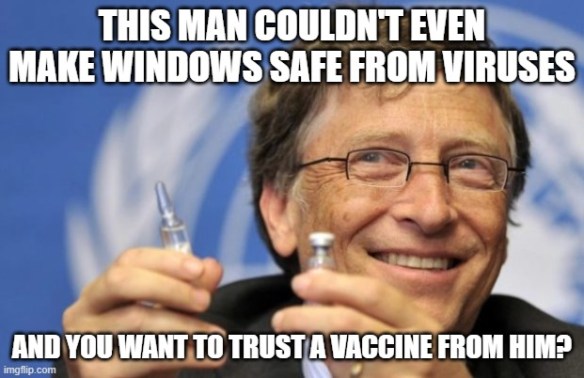
Instead of encouraging more diverse, informed and objective opinions in the mainstream, we too often see money and power forcing the issue, not least in the form of Bill Gates who tells the world ‘normality’ may not return for another 18 months – until he and his close associates in the pharmaceuticals industry find a vaccine and we are all vaccinated.

US attorney Robert F Kennedy Jr says that top Trump advisor Stephen Fauci has made the reckless choice to fast track vaccines, partially funded by Gates, without critical animal studies. Gates is so worried about the danger of adverse events that he says vaccines shouldn’t be distributed until governments agree to indemnity against lawsuits.

But this should come as little surprise. Kennedy notes that the Gates Foundation and its global vaccine agenda already has much to answer for. For example, Indian doctors blame the Gates Foundation for paralysing 490,000 children. And in 2009, the Gates Foundation funded tests of experimental vaccines, developed by Glaxo Smith Kline (GSK) and Merck, on 23,000 girls. About 1,200 suffered severe side effects and seven died. Indian government investigations charged that Gates-funded researchers committed pervasive ethical violations.

Kennedy adds that in 2010 the Gates Foundation funded a trial of GSK’s experimental malaria vaccine, killing 151 African infants and causing serious adverse effects to 1,048 of the 5,949 children. In 2002, Gates’ operatives forcibly vaccinated thousands of African children against meningitis. Approximately 50 of the 500 children vaccinated developed paralysis.

Bill Gates committed $10 billion to the WHO in 2010. In 2014, Kenya’s Catholic Doctors Association accused the WHO of chemically sterilising millions of unwilling Kenyan women with a  ‘tetanus’ vaccine campaign. Independent labs found a sterility formula in every vaccine tested.

Instead of prioritising projects that are proven to curb infectious diseases and improve health — clean water, hygiene, nutrition and economic development — the Gates Foundation spends only about $650 million of its $5 billion budget on these areas.

Despite all of this, Gates appears on prime-time TV news shows in the US and the UK pushing his undemocratic and unaccountable pro-big pharma vaccination and surveillance agendas and is afforded deference by presenters who dare not mention any of what Kennedy outlines. Quite the opposite – he is treated like royalty.

In the meantime, an open Letter from Dr. Sucharit Bhakdi, emeritus professor of medical microbiology at the Johannes Gutenberg University Mainz, to Angela Merkel has called for an urgent reassessment of Germany’s lockdown. Dr Ioannidis, a professor of medicine and professor of epidemiology and population health at Stanford University, argues that we have made such decisions on the basis of unreliable data. In addition, numerous articles have recently appeared online which present the views of dozens of experts who question policies and the data being cited about the coronavirus.

While it is not the intention to dismiss the dangers of Covid-19, responses to those dangers must be proportionate to actual risks. And perspective is everything.

Millions die each year due to unnecessary conflicts, malnutrition and hunger, a range of preventative diseases (often far outweighing the apparent impact of Covid-19), environmental pollution and economic plunder which deprives poor countries of their natural wealth. Neoliberal reforms have pushed millions of farmers and poor people in India and elsewhere to the brink of joblessness and despair, while our food is being contaminated with toxic chemicals and the global ecosystem faces an apocalyptic breakdown.

Much of the above is being driven by an inherently predatory economic system and facilitated by those who now say they want to ‘save lives’ by implementing devastating lockdowns. Yet, for the media and the political class, the public’s attention should not be allowed to dwell on such things.

And that has easily been taken care of.

In the UK, the population is constantly subjected via their TV screens to clap for NHS workers, support the NHS and to stay home and save lives on the basis of questionable data and policies. It’s emotive stuff taking place under a ruling Conservative Party that has cut thousands of hospital beds, frozen staff pay and demonised junior doctors.

As people passively accept the stripping of their fundamental rights, Lionel Shriver, writing in The Spectator, says that the supine capitulation to a de facto police state has been one of the most depressing spectacles he has ever witnessed.

It’s a point of view that will resonate with many.

In the meantime, Bill Gates awaits as the saviour of humanity — with a loaded syringe.
Locked Down and Locking in the New Global Order

By Colin Todhunter

Source: CounterPunch

On 12 March, British PM Boris Johnson informed the public that families would continue to “lose loved ones before their time” as the coronavirus outbreak worsens. He added:

“We’ve all got to be clear, this is the worst public health crisis for a generation.”

In a report, the Imperial College had warned of modelling that suggested over 500,000 would die from the virus in the UK. The lead author of the report, epidemiologist Neil Ferguson, has since revised the estimate downward to a maximum of 20,000 if current ‘lockdown’ measures work. Johnson seems to have based his statement on Ferguson’s original figures.

Before addressing the belief that a lockdown will help the UK, it might be useful to turn to an ongoing public health crisis that receives scant media and government attention – because context is everything and responses that are proportionate to crises are important.

The silent public health crisis

In a new 29-page open letter to Fiona Godlee, editor-in-chief of the British Medical Journal, environmentalist Dr Rosemary Mason spends 11 pages documenting the spiralling rates of disease that she says (supported by numerous research studies cited) are largely the result of exposure to health-damaging agrochemicals, not least the world’s most widely used weedkiller – glyphosate.

The amount of glyphosate-based herbicides sprayed by UK farmers on crops has gone from 226,762 kg in 1990 to 2,240,408 kg in 2016, a 10-fold increase. Mason discusses links between multiple pesticide residues (including glyphosate) in food and steady increases in the number of cancers both in the UK and worldwide as well as allergic diseases, chronic kidney disease, Alzheimer’s, Parkinson’s, obesity and many other conditions.

Mason is at pains to stress that agrochemicals are a major contributory factor (or actual cause) for the spikes in these diseases and conditions. She says this is the real public health crisis affecting the UK (and the US). Each year, she argues, there are steady increases in the numbers of new cancers in the UK and increases in deaths from the same cancers, with no treatments making any difference to the numbers.

Of course, it would be unwise to lay all the blame at the door of the agrochemicals sector: we are subjected each day to a cocktail of toxic chemicals via household goods, food processing practices and food additives and environmental pollution. Yet there seems to be a serious lack of action to interfere with corporate practices and profits on the part of public bodies, so much so that a report by the Corporate Europe Observatory said in 2014 that the then outgoing European Commission had become a willing servant of a corporate agenda.

In a 2017 report, Hilal Elver, UN Special rapporteur on the right to food, and UN Special Rapporteur on human rights and hazardous substances and wastes Baskut Tuncak were severely critical of the global corporations that manufacture pesticides, accusing them of the “systematic denial of harms”, “aggressive, unethical marketing tactics” and heavy lobbying of governments which has “obstructed reforms and paralysed global pesticide restrictions”.

The authors said that pesticides have catastrophic impacts on the environment, human health and society as a whole, including an estimated 200,000 deaths a year from acute poisoning.  They concluded that it is time to create a global process to transition toward safer and healthier food and agricultural production.

At the time, Elver said that, in order to tackle this issue, the power of the corporations must be addressed.

While there is currently much talk of the coronavirus placing immense strain on the NHS, Mason highlights that the health service is already creaking and that due to weakened immune systems brought about by the contaminated food we eat, any new virus could spell disaster for public health.

But do we see a ‘lockdown’ on the activities of the global agrochemical conglomerates? Not at all. As Mason has highlighted in her numerous reports, we see governments and public health bodies working hand in glove with the agrochemicals and pharmaceuticals manufacturers to ensure ‘business as usual’. So, it might seem strange to many that the UK government is seemingly going out of its way (by stripping people of their freedoms) under the guise of a public health crisis but is all too willing to oversee a massive, ongoing one caused by the chemical pollution of our bodies.

Mason’s emphasis on an ongoing public health crisis brought about by poisoned crops and food is but part of a wider story. And it must be stated that it is a ‘silent’ crisis because the mainstream media and various official reports in the UK have consistently ignored or downplayed the role of pesticides in fuelling this situation.

Systemic immiseration

Another part of the health crisis story involves ongoing austerity measures.

The current Conservative administration in the UK is carrying out policies that it says will protect the general population and older people in particular. This is in stark contrast to its record over the previous decade which demonstrates contempt for the most vulnerable in society.

In 2019, a leading UN poverty expert compared Conservative welfare policies to the creation of 19th-century workhouses and warned that unless austerity is ended, the UK’s poorest people face lives that are “solitary, poor, nasty, brutish, and short”. Philip Alston, the UN rapporteur on extreme poverty, accused ministers of being in a state of denial about the impact of policies. He accused them of the “systematic immiseration of a significant part of the British population”.

In another 2019 report, it was claimed that more than 130,000 deaths in the UK since 2012 could have been prevented if improvements in public health policy had not stalled as a direct result of austerity cuts.

Over the past 10 years in the UK, there has been rising food poverty and increasing reliance on food banks, while the five richest families are now worth more than the poorest 20% and about a third of Britain’s population lives in poverty.

Almost 18 million cannot afford adequate housing conditions; 12 million are too poor to engage in common social activities; one in three cannot afford to heat their homes adequately in winter; and four million children and adults are not properly fed (Britain’s population is estimated at 63 to 64 million). Welfare cuts have pushed hundreds of thousands below the poverty line since 2012, including more than 300,000 children.

In the wake of a lockdown, we can only speculate about how a devastated economy might be exploited to further this ‘austerity’ agenda. With bailouts being promised to companies and many workers receiving public money to see them through the current crisis, this will need to be clawed back from somewhere. Will that be the excuse for defunding the NHS and handing it over to private healthcare companies with health insurance firms in tow? Are we to see a further deepening of the austerity agenda, let alone an extension of the surveillance state given the current lockdown measures which may not be fully rolled back?

The need for the current lockdown and the eradication of our freedoms has been questioned by some, not least Lord J. Sumption, former Supreme Court Justice. He has questioned the legitimacy of Boris Johnson’s press conference/statement to deprive people of their liberty and has said:

“There is a difference between law and official instructions. It is the difference between a democracy and a police state”.

Journalist Peter Hitchens says a newspaper headline for what Sumption says might be – ‘Former Supreme Court justice says Johnson measures lead towards police state’ or ‘TOP JUDGE WARNS OF POLICE STATE’.

But, as Hitchens implies, such headlines do not appear. Indeed, where is the questioning in the mainstream media or among politicians about any of this? To date, there have been a few isolated voices, with Hitchens himself being one.

In his recent articles, Hitchens has questioned the need for the stripping of the public’s rights and freedoms under the pretext of a perceived coronavirus pandemic. He has referred to esteemed scientists who question the need for and efficacy of ‘social distancing’ and keeping the public under virtual ‘house arrest’.

An open Letter from Dr. Sucharit Bhakdi, emeritus professor of medical microbiology at the Johannes Gutenberg University Mainz, to Angela Merkel calls for an urgent reassessment of Germany’s lockdown response to Covid-19. Then there is Dr Ioannidis, a professor of medicine and professor of epidemiology and population health at Stanford University. He argues that we have made such decisions on the basis of unreliable data. These two scientists are not alone. On the OffGuardian website, two articles have appeared which present the views of 22 experts who question policies and/or the data that is being cited about the coronavirus.

Shift in balance of power

Professor Michel Chossudovsky has looked at who could ultimately benefit from current events and concludes that certain pharmaceutical companies could be (are already) major beneficiaries as they receive lavish funding to develop vaccines. He asks whether we can trust the main actors behind what could amount to a multibillion dollar global (compulsory) vaccination (surveillance) project.

The issue of increased government surveillance has also been prominent in various analyses of the ongoing situation, not least in pushing the world further towards cashless societies (under the pretext that cash passes on viruses) whereby our every transaction is digitally monitored and a person’s virtual money could be declared null and void if a government so decides. Many discussions have implicated the Bill and Melinda Gates Foundation in this – an entity that for some time has been promoting the roll-out of global vaccine programmes and a global ‘war on cash’.

For instance, financial journalist Norbert Haring notes that the Gates Foundation and US state-financial interests had an early pivotal role in pushing for the 2016 demonestisation policy with the aim of pushing India further towards a cashless society. However, the policy caused immense damage to the economy and the lives and livelihoods of hundreds of millions in India who rely on cash in their everyday activities.

But that does not matter to those who roll out such policies. What matters is securing control over global payments and the ability to monitor and block them. Control food you control people. Control digital payments (and remove cash), you can control and monitor everything a country and its citizens do and pay for.

India has now also implemented a lockdown on its population and tens of millions of migrant workers have been returning to their villages. If there is a risk of corona virus infection, masses of people congregating in close proximity then returning to the countryside does not bode well.

Indeed, the impact of lockdowns and social isolation could have more harm than the effects of the coronavirus itself in terms of hunger, depression, suicides and the overall deterioration of the health of older people who are having operations delayed and who are stuck indoors with little social interaction or physical movement.

If current events show us anything, it is that fear is a powerful weapon for securing hegemony. Any government can manipulate fear about certain things while conveniently ignoring real dangers that a population faces. In a recent article, author and researcher Robert J Burrowes says:

“… if we were seriously concerned about our world, the gravest and longest-standing health crisis on the planet is the one that starves to death 100,000 people each day. No panic about that, of course. And no action either.”

And, of course, each day we live with the very real danger of dying a horrific death because of the thousands of nuclear missiles that hang over our heads. But this is not up for discussion. The media and politicians say nothing. Fear perception can be deliberately managed, while Walter Lippmann’s concept of the ‘bewildered herd’ cowers on cue and demands the government to further strip its rights under the guise of safety.

Does the discussion thus far mean that those who question the mainstream narrative surrounding the coronavirus are in denial of potential dangers and deaths that have been attributed to the virus? Not at all. But perspective and proportionate responses are everything and healthy debate should still take place, especially when our fundamental freedoms are at stake.

Unfortunately, many of those who would ordinarily question power and authority have meekly fallen into line: those in the UK who would not usually accept anything at face value that Boris Johnson or his ministers say, are now all too easily willing to accept the data and the government narrative. This is perplexing as both the government and the mainstream media have serious trust deficits (putting it mildly) if we look at their false narratives in numerous areas, including chemical attacks in Syria, ‘Russian aggression’, baseless smear campaigns directed at Jeremy Corbyn and WMDs in Iraq.

What will emerge from current events is anyone’s guess. Some authors like economist and geopolitical analyst Peter Koenig have presented disturbing scenarios for a future authoritarian world order under the control of powerful state-corporate partners. Whatever the eventual outcome, financial institutions, pharmaceuticals companies and large corporations will capitalise on current events to extend their profits, control and influence.

Major corporations are already in line for massive bailouts despite them having kept workers’ wages low and lining the pockets of top executives and shareholders by spending zero-interest money on stock buy backs. And World Bank Group President David Malpass has stated that poorer countries will be ‘helped’ to get back on their feet – on the condition that further neoliberal reforms and the undermining of public services are implemented and become further embedded:

“Countries will need to implement structural reforms to help shorten the time to recovery and create confidence that the recovery can be strong.  For those countries that have excessive regulations, subsidies, licensing regimes, trade protection or litigiousness as obstacles, we will work with them to foster markets, choice and faster growth prospects during the recovery.”

In the face of economic crisis and stagnation at home, this seems like an ideal opportunity for Western capital to further open up and loot economies abroad. In effect, the coronavirus provides cover for the further entrenchment of dependency and dispossession. Global conglomerates will be able to hollow out the remnants of nation state sovereignty, while ordinary people’s rights and ability to organise and challenge the corporate hijack of economies and livelihoods will be undermined by the intensified, globalised system of surveillance that beckons.