
Saturday Matinee: Land of the Blind

By Ms Mary Lou

Source: The News Blender

“A stale piece of bread is better than nothing.”

LAND OF THE BLIND is a 2006 film directed by Robert Edwards, and written by Edwards five years before. Its message about political corruption and complacency is so resonant that, even though it takes cues from historical figures throughout the centuries, we can still see our current climate reflected in it .

The film starts “Five Years Before” during the reign of President-For-Life Maximilian II (Tom Hollander). Having inherited the position from his father, Maximilian is equal parts politically clueless and personally gluttonous. He doesn’t understand why his constituents aren’t grateful when he commutes those sentenced to the gallows…by sending them to firing squads instead. Unable to stand any critique of himself, he murders his opponents when he can get away with it and sends them to the not-so-secret prisons when he can’t.

One of these prisoners is the de facto leader of the resistance, playwright turned political prisoner Thorne (Donald Sutherland). He’s been imprisoned for years for the crime of being critical of Maximilian. Despite having nearly all communication with the outside world cut off, his followers “The Citizens for Justice and Democracy” continue the movement he inspired. While they wage wars against the administration outside, Thorne is left to write his manifesto on the walls of his cell using any means available.

One of the guards assigned to him, Joe (Ralph Fiennes), serves as our everyman narrator. In the beginning he doesn’t consider himself political, just a man doing his job. The more he has conversations with Thorne, however, the more he sees the corruption in Maximiliam’s regime and becomes determined to help achieve change. From his cell Thorne runs for–and is elected to–parliament and is thus released to serve his term. Now that their leader is accessible the Citizens for Justice and Democracy spring into action.

Quickly Joe helps Thorne and his followers get into Maximilian’s castle. Within minutes Thorne puts Maximilian and his wife through a two minute trial in their bedroom, convicts, and executes them. The Maximilian II regime is over.

“Nothing is better than a big, juicy steak.”

With Thorne in the position of President-For-Life, change definitely happens. Maximilian’s indulgences are replaced with a strict moral code. All females are now forced to wear hijabs when outside the house. Re-education camps are opened to make sure everyone is in line with the nation’s moral code. This includes teachers, doctors, people who insist on wearing glasses, and anyone else not in line with the new morality. Children are separated from their parents in order to “fight the narcissism of family.” The revolution has occurred. Long live the revolution.

Joe is retired from the military and held up as a hero for his part in the revolution. He isn’t as thrilled with Thorne’s changes. When pressured to sign a loyalty oath, Joe refuses out of principle. He points out to Thorne that “before the revolution man exploited man. Since the revolution it’s the other way around.” That is enough to get Joe sent to the re-education camps.

What happens in the camps would be unfathomable if I didn’t know how much of this movie was based on historical events. There is physical torture, psychological torture, relentless pressure to accept anything and everything he’s told to believe. Can Joe survive with himself intact and is it worth it if he does?

“Therefore, a stale piece of bread is better than a big, juicy steak.”

LAND OF THE BLIND is not a movie for everyone. There are a lot of questions left unanswered. We don’t learn the characters’ histories. In the end there is no comfortable resolution. The movie will be fascinating for those who know history; they’ll be able to recognize the patterns that have happened and even recognize some that are still going on. Even those who can’t see when Idi Amin or the Khmer Rouge are referenced can still appreciate the movie on its own. The actors are all well cast in their roles and their journeys are completely believable. The music, composed by Guy Farley, is appropriately unsettling and comes in at just the right moments to keep the viewer on edge. Robert Edwards is a master at balancing actual history with a compelling story. I like to watch this movie whenever I find myself getting politically complacent. It’s a reminder that it’s not enough to stand against something; you have to also know what you’re standing for.

Watch Land of the Blind on Hoopla here: https://www.hoopladigital.com/title/14779187
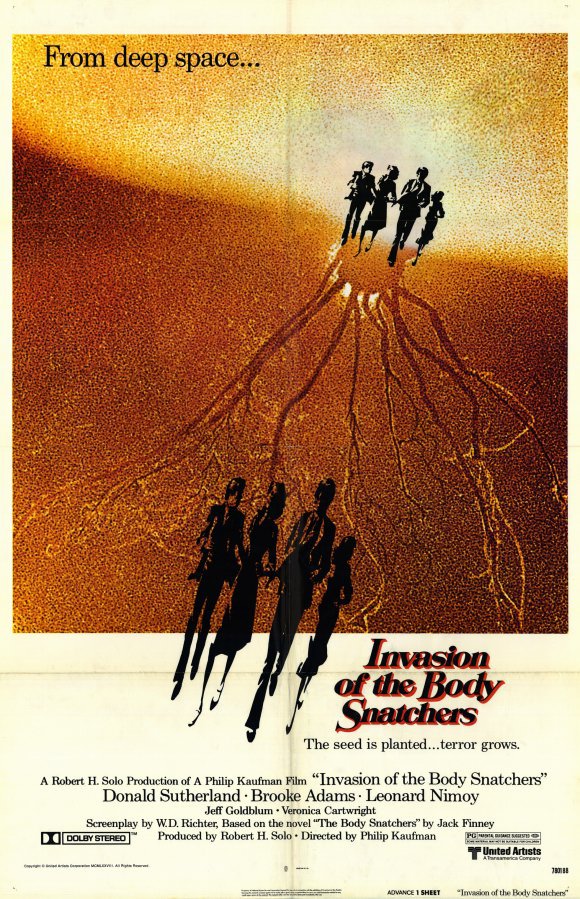
Saturday Matinee: Invasion of the Body Snatchers (1978)

“Invasion of the Body Snatchers” (1978) is a science fiction horror film directed by Philip Kaufman (The Wanderers), with a screenplay by W.D. Richter (dir. Buckaroo Banzai) and starring Donald Sutherland, Brooke Adams, Veronica Cartwright, Jeff Goldblum and Leonard Nimoy. It is a remake of the 1956 film of the same name, also based on the 1955 novel “The Body Snatchers” by Jack Finney. The plot involves a San Francisco health inspector and his colleague who discover that humans are being replaced by physically identical alien clones devoid of emotion.

Saturday Matinee: Land of the Blind

“Land of the Blind” (2006) is a British-American political satire directed by Robert Edwards and starring Ralph Fiennes, Donald Sutherland, Tom Hollander and Lara Flynn Boyle. The story is set in an unnamed place and time where an idealistic soldier named Joe strikes up an illicit friendship with a political prisoner who involves him in a coup d’etat. But in the post-revolutionary world, Joe and his former friend have a bitter feud which escalates until Joe’s co-conspirators conclude they must erase him from history.

Little Murders in Retrospect

LittleMurders_blood2

By John R. Hall

Source: Dissident Voice

After their wildly successful anti-war classic Mash, actors Elliott Gould and Donald Sutherland ventured out on a very weak limb and made a film version of a hit and miss Broadway production.  Alan Arkin directed the film and played the part of mentally disturbed Lieutenant Practice of the NYPD.  The year was 1971.  My beautiful baby daughter had just entered the world.  I’d recently been convicted of twice refusing induction into the U.S. Army, and was awaiting my court date for sentencing.  Somehow, amid the mix of joy, sadness, and confusion, my wife and I managed to slip out and take in a movie.  Little Murders would haunt me for the rest of my life.

If you’re like virtually everyone I’ve ever quizzed about Little Murders, you not only missed seeing it, you’ve never even heard of it.  It is also likely that, if you happen to be among the few who actually saw it, you’d really like to forget it.  But, of course, you can’t.  44 years later I don’t remember all the gory details of the flick, but I do remember apathetic Alfred Chamberlain (Elliott Gould), focusing his camera on a newly deposited bowel movement in a toilet, and on a steaming pile of dog crap in a park.  He was a photographer and poop was his forte.  His subject matter of choice also reflected his world view.  If Alfred could have possibly cared less about anything, he would have.  Alfred’s world was shit.

Then one day while he was being beaten to a bloody pulp by street thugs, and not even bothering to defend himself, Alfred was saved by feisty, optimistic Patsy Newquist (Marcia Rodd).  Apathist that he was, Alfred tried to walk away without even thanking his heroine.  But Patsy fell for him, and decided to show him that the world wasn’t such a bad place after all.  It was no easy task, but she eventually married Alfred, put a hesitant smile on his glum face, taught him to fight for himself,  and convinced him that life was worth living.  Then she took a random bullet, splattering her husband with blood, and dying.

Little Murders took place in a somewhat exaggerated version of New York City, or Anytown, U.S.A.  Civil society had spiraled out of control and degenerated into a cesspool of fear, loathing, and random violence.  In spite of the raging nightmare of The Vietnam War, few Americans in 1971 would have believed that their country 44 years later would become such an accurate replica of the social wasteland of “Little Murders”.  But that is exactly where we are today, and then some; living in a world so violent and cold that there is nothing left which can shock us.  Mass murders, school shootings, infanticide, beheadings, immolation, cops run amok, manufactured terrorism, the Airport Gestapo, black sites and torture, endless wars for corporate profit, daily specter of nuclear annihilation.

But here in the U.S.A. we like to look on the bright side.  No sense in focusing on the negative when there’s so much positive energy in the world.  We’ve got Kim Kardashian’s ass to obsess about.  A spectacular spectators’ array of gladiator sports:  NFL, NBA, MLB, NHL, NCAA FB, Cage Fighting, NASCAR, Pro golf & tennis.  Black Friday deals on electronics, reality television, celebrity weddings, divorces, and sex changes, Dancing with the Stars, The Voice.  The upcoming Presidential Coronation Circus and Candy Crush.  Did I mention Kim Kardashian’s ass?  Thank God for Pollyanna’s Glad Game.  If not for such an array of inane, petty distractions, Americans would all end up like apathetic Alfred Chamberlain, or worse yet like angry, infuriated me.

Any American with his head screwed on straight should have suffered an extended and incurable case of righteous indignation by now.  While the National Rifle Association has succeeded in enshrining The Second Amendment alongside mom, home, and apple pie, little murders on the domestic front have been on the rise to the point that they’re as common as bedbugs in cheap motels.  But my countrymen do love their portable WMDs, apparently more than life itself.  It’s not just gun violence defining the nightmare which is America.  What has finally emerged is a complete lack of respect.  Respect for self and others, for all life forms, for Mother Earth itself.  Anyone paying attention can see it in their actions.  They litter the streets with their garbage, litter their skin with ill-conceived epidermal etchings, litter their bodies with poisonous food-like substances and soul-killing drugs, litter maternity wards with litters of unwanted children.  Alfred Chamberlain’s world has grown to fruition.

Of course, Americans have had plenty of inspiration as they’ve sacrificed their souls upon the alter of American Exceptionalism.  Their government has waged a nearly non-stop series of wars for corporate profit since Vietnam, Laos, and Cambodia.  Anyone paying a lick of attention knows that every one of these wars were waged for the benefit of Ronald McDonald and Mickey Mouse, and that official government explanations are only believed by fools.  At least our heroes in the White House, the Halls of Congress, and the Pentagon learned something during the Vietnam fiasco:  The new definition of winning a war is that you slaughter as many civilians as possible, bomb cities, destroy infrastructure, burn crops, and create enough chaos that the U.S. Military is forced to open permanent bases and swing wide the doors for corporate plunder.  Conveniently under armed protection.

This is exactly what happened in Afghanistan and Iraq, what went on in Libya recently, and what is now happening in Syria and elsewhere.  The American agenda is being rammed down the throats of unwilling participants wherever there are valuable resources to be plundered by Wall Street pirates.  Migrations of refugees from U.S. bombings seek asylum elsewhere, while foolish, careless Americans pay little heed.  A few hoorays for the red, white, and blue, thanks to our brave fighting men for slaughtering innocent foreigners, and back to watching Kim Kardashian’s ass over a can of Coca-Cola.  Things go better with Coke.

In 1971, I was shocked by the last scene of Little Murders, in which Alfred (still wearing his shirt splattered with his wife’s blood), and the father and brother of his recently deceased bride finally have a few moments of sheer joy.  Taking turns with a loaded rifle, they join in with their fellow New York citizens, becoming snipers from their apartment window,  Finding fun and laughter with each kill.  I’d no longer be shocked by the scene.  Now I get it.  It’s what species do in the final death throes of extinction.


Related Articles

“One of Those Little Things You Learn to Live with”:  On the Politics of Violence in Jules Feiffer’s Little Murders

Saturday Matinee: Little Murders

Saturday Matinee: Little Murders

little-murders-poster

“Little Murders” (1971) is a dark comedy based on a play written by Jules Feiffer and was the first feature film directed by Alan Arkin. The plot centers on vivacious interior designer Patsy who falls in love with photographer Alfred after saving him from a beating, despite (or because of) his physical and emotional passivity. The film’s comedic elements stem from Patty’s attempts to break Alfred out of his shell and their opposite approaches in dealing with the insanity of the world around them. Little Murders is memorable for its over-the-top nihilistic conclusion and great performances by Elliot Gould, Marcia Rodd, Alan Arkin and Donald Sutherland (as a hippy priest officiating one of cinema’s funniest wedding scenes).