LONDON CALLING! The DNC in England on ‘hols’

By Daniel Hopsicker

Source: MadCowNews

Primaries polished off, the Democratic National Committee has apparently decided to pop over to swinging London on holiday.  Because what’s happening right now in Great Britain explains how Bernie Sanders somehow “lost” the California Democratic primary to a candidate who couldn’t fill a high school auditorium there without trucking in busloads of middle-aged white women wearing boxy pantsuits and smug smiles.

What’s happening in London puts what happened in California in the context of globalization.

hols

Voting in the “Brisket” Referendum

They were voting on “Brisket,” the surprisingly highly-contested election about choosing the Best BBQ in the UK.

In the end, newspaper columnists were shocked by the voter’s bad taste. Members of the commentariat were said to be absolutely appalled, especially at a few sneers and dirty looks conflated into a rise in racist and anti-immigrant hate crimes, like the non-existent chairs that weren’t thrown after the Nevada Democratic convention.

Disinformation acknowledges no borders, knows no terrestrial bounds!

“The Brexit vote has precipitated the deepest political crisis in Britain in a generation. The nation is divided and the climate is lurching dangerously towards the far right. At this critical moment for the future of the country, the Blairites have opportunistically mounted an anti-Corbyn coup. They have been incubating this coup from day one despite Corbyn’s overwhelming mandate.”

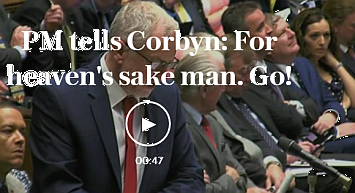
Some guy Americans have never heard of—or if they’ve heard of him don’t know how to pronounce his name— named Jeremy Corbyn, head of the Labor Party (only they spell it “Labour,” like teen-aged girls spelling their names cute: “That Cyndy! She’s special!”

Dozens of Labour Members of Parliament (confusing, don’t they know “MP’” stands for Military Police?) want this Corbyn guy to resign.

It seems they never liked him from the get-go, and would have shrugged him off long before now, except he won a massive victory from the Party’s rank-and-file in an election.

And now he won’t go!

mod

I thought, OMG! He’s just like Bernie!

And that’s when everything began to make sense.

The ‘objective correlative’ 

Remember how just after the California primary everything looked very “Through the Looking Glass? Remember? Bernie Sanders drawing monster crowds all up and down California… and then going on to “defeat” in the Democratic Presidential primary?

Losing to a candidate who couldn’t fill a third-grade classroom without sprinkling the crowd with California Democratic officials?

hill

Sure ya do, mate.


“Mister Peabody Almost Goes to Washington”

We’ve all seen the movie. A candidate barnstorms across the state. Draws multitudes. Enthusiastic slogans chanted all around.

11

Election night is always the next scene in the montage. Basking in the approval of an excited crowd at a victory party roaring in celebration. The candidate waves for quiet (who are they kidding? Everyone knows they don’t mean it.)

But not this time. Not in California. Lucy picked up the football, took it home. It was DEFLATE-GATE  writ large.


Romeo wakes up, sees Juliet dead, tears all around. 

Many thought, “I must be dreamin’. This can’t be real.” Because there was no “objective correlative” to help bring sense to the experience. No recognizable human moment, as in “Romeo wakes up, sees Juliet dead, tears all around.”

bb

On Youtube, a baby struggles to stand; we all smile. Watch a toddler stumble across a room, swaying side to side like a drunk on a gambling cruise unexpectedly caught in high seas.

We silently urge the drooling little thing on. “Trust your tiny gyroscope, diapered one. In your forehead. Behind your Third Eye.”

There was no recognizable human moment in California, nor many of the other Democratic primaries.

Just a sinking feeling that—once again—we’ve been had.


Hey! That sinking feeling! Stay outta London 

But the jury’s still out on London.

“A massive show of support for Jeremy Corbyn has left the coup coalition of media pundits and disgruntled MPs with their jaws to the floor. With only 24 hours notice, over 10,000 people marched on parliament square to reinforce the Labour leader’s unprecedented democratic mandate.”

sup

Being Britain, things quickly got snarky.

gotime


We wish them well. They’re a plucky bunch. Some have even had their lips surgically removed, which must be a pretty painful procedure.

lip

Hacker Leaks Secret DNC Master Files on Hillary Clinton & Foundation

shutterstock_251313145-650

Long before Clinton declared candidacy, the DNC researched her “vulnerabilities”—including speaking fees, private jets, and high-rolling Clinton Foundation donors

By Nika Knight

Source: CommonDreams.org

The anonymous hacker calling themselves Guccifer 2.0 released a second trove of internal documents from Democratic National Committee (DNC) servers on Tuesday, including a hefty 113-page file titled “Hillary Clinton Master Doc” that includes research the party performed on behalf of Clinton’s candidacy—months before she declared an intention to run.

The documents reveal that the DNC was particularly worried about Clinton’s speaking fees, her book advance, and her somewhat exacting luxury travel requirements for appearances.

As the Daily Beast summarized:

Several documents leaked […] show that DNC researchers, whose annotated notes can still be seen in the electronic files, looked for the tiniest potential infraction or questionable item in Clinton’s travel expenses, for instance, asking why one trip from New York to Washington, D.C., aboard a Bank of America jet cost just $45.75, an amount that a researcher called “weirdly low.”

A whole section in the “Master Doc” is devoted to questions and criticism about the money Clinton made from her book advance, book tour, and her public speeches, which generally ran around $250,000 per appearance and required the host to provide first-class travel and accommodations. In Clinton’s defense, the DNC cites articles stressing that fees went to the Clinton Foundation, and characterizing the work that the former secretary did in her private life not as an attempt to enrich herself, but to benefit her and her husband’s charitable work.

Also in the dossier were documents gathered by the DNC related to Clinton’s sky-high speaking fees, including an email from her booking agency that contradicts Clinton’s defense that she merely accepted “what they offered” when she was paid over $200,000 per speech—a claim that reporters have previously critiqued.

As journalist Shaun King observed on Twitter:

[tweet https://twitter.com/ShaunKing/status/745444019556081664 ]

The Smoking Gun notes the other amenities Clinton required in her speaking contracts:

In addition to a “standard” $225,000 fee, Clinton required a “chartered roundtrip private jet” that needed to be a Gulfstream 450 or a larger aircraft. Depending on its outfitting, the Gulfstream jet, which costs upwards of $40 million, can seat 19 passengers and “sleeps up to six.” Clinton’s contract also stipulated that speech hosts had to pay for separate first class or business airfare for three of her aides.

As for lodging, Clinton required “a presidential suite” and up to “three (3) adjoining or contiguous rooms for her travel aides” and up to two extra rooms for advance staff. The host was also responsible for the Clinton travel party’s ground transportation, meals, and “phone charges/cell phones.”

Additionally, the host also had to pay “a flat fee of $1000” for a stenographer to create “an immediate transcript of Secretary Clinton’s remarks.” The contract adds, however, “We will be unable to share a copy of the transcript following the event.”

Moreover, the DNC appeared particularly worried about the “vulnerabilities” of the Clinton Foundation, such as its acceptance of million-dollar plus donations from private corporations and foreign governments, its veiled finances, and its record in Haiti.

One file (pdf) titled “Clinton Foundation Donors $25K+” documents the high-rolling donors to the Clinton Foundation, including the Kingdom of Saudi Arabia (in the $10-$25 million column), the Saudi Arabian construction magnate Sheikh Mohammed H. Al-Amoudi ($5-$10 million), Barclays Capital ($1-$5 million), ExxonMobil ($1-$5 million), and Chevron ($500,000-$1 million), among many other private corporations—including healthcare, oil and gas, and media giants—and foreign governments.

In a master file called “Clinton Foundation Master Doc,” DNC researchers appear to have gathered reporting spanning years on the “vulnerabilities” of the Clinton Foundation’s record and finances, revealing a particular point of anxiety for the party:

The documents, most of which appear to be dated from the spring of 2015, reveal a party entirely focused on propping up its establishment candidate, critics contend, while failing to support or even predict the success of outsider candidate Bernie Sanders.

Indeed, much of the “opposition research” on other Democratic candidates focused on Lincoln Chafee, Martin O’Malley, Jim Webb, and even Vice President Joe Biden, who never declared an intention to run.

Some argue that these leaks lend more weight to accusations that the primary was “rigged” in favor of the former secretary of state.

And whoever Guccifer 2.0 may be, they appear to be taking a more active role in the leaks—saying they’re now willing to speak to the press via Twitter—supporting whistleblower Edward Snowden’s statement that such hacktivists are “now demonstrating intent—and capability—to influence elections.”

Related Article: Judicial Watch: New Clinton Emails Produced by State Department; Clinton Email Shows She Was Concerned About Records (6.27.16)

A ‘Brexit’ Blow to the Establishment

Brexit_Run_620x350

By Robert Parry

Source: Consortium News

The United Kingdom’s “Brexit” vote may cause short-term economic pain and present long-term geopolitical risks, but it is a splash of ice water in the face of the West’s Establishment, which has grown more and more insular, elitist and unaccountable over recent decades.

The West’s powers-that-be, in both the United States and the European Union, too often display contempt for real democracy, maintaining only the façade of respecting the popular will, manipulating voters at election time with red-meat politics and empty promises – before getting back to the business of comforting the comfortable and letting the comfortable afflict the afflicted.

That has been the grim and tiresome reality with America’s two parties and with the E.U.’s bureaucrats. The average American and the average European have every reason to see themselves as a lesser concern to the politicians and the pundits than the special interests which pay the money and call the tune.

In the stunning “Brexit” vote – with 52 percent wanting to abandon the 28-nation European Union – U.K. voters rejected the West’s politics-as-usual despite dire warnings about the downsides of leaving. They voted, in effect, to assert their own nationalistic needs and aspirations over a commitment to continental unity and its more universal goals.

But, in the vote, there was also a recognition that the West’s Establishment has grown corrupt and arrogant, routinely imposing on the people “experts” who claim to be neutral technocrats or objective scholars but whose pockets are lined with fat pay checks from “prestigious” think tanks funded by the Military-Industrial Complex or by lucrative revolving-door trips to investment banks on Wall Street or The City.

Despite the Establishment’s self-image as a “meritocracy,” its corrupted experts and haughty bureaucrats don’t even demonstrate basic competence anymore. They have led Europe and the United States into catastrophe after catastrophe, both economically and geopolitically. And, there is another troubling feature of this Establishment: its lack of accountability.

In the United States, the rewards and punishments have been turned upside-down, with the benighted politicians and pundits who pushed for the Iraq War in 2003 still dominating the government and the media, from Hillary Clinton’s impending Democratic presidential nomination to the editorial pages of The New York Times and The Washington Post.

And, the Iraq War disaster was not a one-off affair. The neocons and their liberal interventionist sidekicks have their fingerprints on other “regime change” messes, from Libya to Ukraine to Syria (still in the works), with their predictable recommendations for more violence and more belligerence. Yet, they have impunity for their crimes and incompetence. They fail up.

Establishment Doesn’t Know Best

So, the West’s Establishment can’t even argue that it knows best anymore, which always had been its ace in the hole. The various insurgents could be painted as the dangerous option – and that is sometimes true as we’ve seen with Donald Trump – but it is arguably a toss-up as to whether Clinton or Trump would be the bigger risk to the world’s future.

Trump may be a blustering buffoon but he challenges the neocon “group thinks” about the wisdom of expanding the West’s war in Syria and launching a costly and existentially risky New Cold War against nuclear-armed Russia and China. Clinton surrounds herself with neocons and liberal hawks and shares their obsession with overthrowing the government of Syria and provoking Russia and China with military operations near their borders.

Trump and “Brexit” advocates also reject the Establishment’s neoliberal consensus on “free trade,” which has depressed (or eliminated) the wages of American and European workers while the benefits accrue mostly to financial and political elites. The Establishment’s embrace of the “winners” and its disdain for the “losers” have further enflamed today’s populism.

Yet, there are undeniably ugly features in the populist sentiment sweeping the U.S. and Europe. Some of it is driven by bigotry toward non-whites, especially immigrants. Some is inspired by wild conspiracy theories from a population that has understandably lost all faith in what it hears from Washington, Brussels and other capitals. Trump has espoused the scary know-nothing notion that the scientific evidence of global warming is “a hoax.”

There is always something unsettling when an incipient revolution takes shape and starts tearing down the old order. What follows is not always better.

In the end, the American election – like the “Brexit” referendum – may come down to whether voters feel more comfortable sticking with the status quo at least for a while longer or whether they want to blow up the Establishment and gamble on the consequences.

Right now, Clinton and the Democrats are carrying the banner of the Establishment, while Trump and his Republican insurgents fly the Jolly Roger. In a political year when the anti-establishment wave seems to be cresting, the Democrats may regret their choice of a legacy, status-quo candidate.


[For more on this topic, see Consortiumnews.com’s “Two Corrupt Establishments”; “Democrats – Too Clever by Half on Clinton”; “The Coming Democratic Crack-up”; “Neocons and Neolibs: How Dead Ideas Kill“; and “The State Department’s Collective Madness.”]

Investigative reporter Robert Parry broke many of the Iran-Contra stories for The Associated Press and Newsweek in the 1980s. You can buy his latest book, America’s Stolen Narrative, either in print here or as an e-book (from Amazon and barnesandnoble.com).

Related Articles:

¡Basta Ya, Brussels! British Voters Reject EU Corporate Slavestate

Global Elite Makes Good on Threats to “Make All of You Poorer” After Britain Independence

Where is the UK Heading Now Due to Cameron’s Policies?

Related Videos:


Hillary Clinton and American Empire

1015636467

By

Source: CounterPunch

Despite the lack of evidence linking Orlando mass murderer Omar Mateen to Daesh (ISIS) in any operational (direct) sense, the first inclination of U.S. Presidential hopeful Hillary Clinton was to renew American bombing of Syria, Iraq and Libya— the very nations that were destroyed by U.S. bombs directed by Mrs. Clinton and from whence Daesh arose. In so doing Mrs. Clinton made it evident that she is an unrepentant militarist whose bloodlust, combined with her longstanding interest in promoting American business interests, ties her to the U.S. imperial project of the last century and one-half. The precise moral difference between mass murders for personal and state reasons depends on a theory of the state at odds with this imperial project.

The company that employed Omar Mateen, G4S, is a British-based ‘security’ company that operates in 120 countries and as a ‘private’ supplier of public services to the Department of Homeland Security, the U.S. Army and to the very same State Department that Mrs. Clinton led as Secretary of State. The company advertises itself capable of ‘mitigating liability’ for the U.S. government— the ruse used by the CIA and other clandestine and quasi-clandestine government agencies to circumvent civil prohibitions on their activities by employing ‘private’ companies to carry them out. The NSA’s domestic surveillance programs tie to those of the FBI, DEA and CIA through this legalistic dodge. And ‘private contractors’ were behind some of the more grotesque slaughters in recent American wars.

The classical liberal separation of economic from political interests used to legitimate state violence is one that the Clintons have spent their ‘public’ careers undermining. As leading proponents of neoliberalism, the Clintons have spent three decades conflating ‘private’ interests with the public interest. In history this tie of U.S. business interests to U.S. military incursions runs from residual European imperialism, including genocide against the indigenous population and slavery, to direct wars, proxy wars, coups, assassinations, murders and particularly odious ‘wars of attrition.’ What is corruption in the liberal worldview is the nature of the capitalist-state acting in / on imperial interests in a Marxian frame. If this corruption is ‘solvable,’ such has yet to be demonstrated in the U.S.

Hillary Clinton’s use of the horrific crime in Orlando to instigate further crimes against untold innocents abroad is hidden behind manufactured fears of a lunatic and craven enemy (ISIS) that is in fact both a product of earlier U.S. atrocities across the Middle East and but a pale ghost of the savagery of combined U.S. actions in the region. The American leadership’s practice of creating crises that it must then ‘respond’ to led the way to the sequential slaughters, disruptions and dislocations that now finds substantial portions of the Middle East in ruins and millions of refugees flooding an increasingly xenophobic Europe. That this leadership never seems to learn from its ‘mistakes’ suggests motivations at work other than those presented at press conferences.

Where G4S, Omar Mateen’s employer, fits in is that Mr. Mateen was in many respects the perfect mercenary— ‘our psychopath’ if we were paying for his services. Murdering 49 people and wounding 50 more is, in addition to being an atrocity, a crime and a moral calamity, a complicated logistical feat. In 2004 U.S. Colonel James Steele was brought to Iraq, in a war that Bill Clinton publicly supported and Hillary Clinton voted for, to engineer like atrocities. Mr. Mateen’s crimes would have been business-as-usual in U.S. led slaughters of innocent civilians in Nicaragua and El Salvador in the 1980s and in Iraq in the 2000s. And G4S is precisely the type of ‘public-private partnership’ favored by the Clintons to ‘mitigate liability’ behind a veil of ‘private’ actions.

This isn’t to suggest that Hillary Clinton had any part in the murders carried out by Mr. Mateen. It is to suggest that in any human and / or moral sense she is congenitally unfit for public office. The most generous explanation of her support for George W. Bush’s criminal slaughter in Iraq is that she was misled by the manufactured evidence proffered by the Bush administration. That the war tied through history to the Clinton’s own sanctions against Iraq that resulted in half a million innocents dying from privation and to eight years of bombing that left much of the country in ruins suggests that Mrs. Clinton probably well understood that Iraq posed no threat to the U.S. in 2001. That the war was coincidentally a boon to Western business interests was / is as grotesque as it was predictable.

If conceptual clarity around these issues seems wanting here— that is the point. Neoliberalism as some unified theory of political economy ties through history to the Washington Consensus that in turn ties to American imperial history. Western imperialism— state-corporatism as division of the global economic spoils through insertion / assertion of ‘national’ interests, has five centuries of reasonably well defined history behind it. In this regard Donald Trump’s relative rhetorical reticence to use military force as a first choice is a threat to this imperial order whereas Hillary Clinton’s willingness to destroy an entire region of the world on a whim to benefit Exxon Mobil and Goldman Sachs makes her the ‘safe’ choice from the institutional perspective.

Washington Consensus precepts are:

*Fiscal discipline

*A redirection of public expenditure priorities toward fields offering both high economic returns and the potential to improve income distribution, such as primary health care, primary education, and infrastructure

*Tax reform (to lower marginal rates and broaden the tax base)

*Interest rate liberalization

*A competitive exchange rate

*Trade liberalization

*Liberalization of inflows of foreign direct investment

*Privatization

*Deregulation (to abolish barriers to entry and exit)

*Secure property rights

Against this imperial history the U.S. view that national elections are an internal matter places U.S. voters as the nominal ‘choosers’ of political economy for much of the world. In political terms, the 800+ military bases that the U.S. keeps around the globe serve as quasi-private security forces to assure repatriation of ‘profits’ for multi-national corporations in the form of resources, plentiful, cheap labor and the broader economy of imperial conquest. In fact, as opposed to theory, these profits are the reciprocal of the death, misery, subjugation and immiseration inevitably put forward by Western economists and politicians as the result of ‘free-choice’ by those on the losing end of American imperial fortune. That increasing numbers of Americans are on this losing end helps explain current (and heretofore slight) political unrest and its reciprocal in establishment support for Mrs. Clinton.

Hillary Clinton’s toxic jargon that “America never stopped being great” poses a seeming conundrum for her supporters who aren’t dedicated sociopaths. If U.S. wars in Southeast Asia, Central America, the Middle East and Northern Africa are evidence of this greatness, then what are the moral and political bases of such a judgment? Mrs. Clinton’s nostalgia for the days of alleged national unity following the attacks of September 11, 2001 is apparently for the erasure of the history that led to the attacks and not for unity per se. Conversely, given the absence of any operational link to Daesh, Omar Mateen could just as well have claimed that his crimes were motivated by Napoleon Bonaparte or Jesus Christ were ISIS not such a well-implanted foe.

Externally, and in contradiction of to the exceptionalists, the democratists and Western neoliberals, the U.S. is broadly considered the greatest threat to world peace on the planet. Brought to the fore in the current Presidential election cycle is that Western elites— inherited wealth, bailout-dependent bankers, the corporate lootocracy dependent on wildly goosed (by the Federal Reserve) asset prices and various and sundry agents, functionaries and court pleaders, are now well-understood to have interests diametrically opposed to those of the vast majority of Americans. The conceptual leap not yet taken by the American electorate is the international nature of this class divide.

bipartychart

Chart: the bi-Party system of electoral control in the U.S. is put forward as representing majority political views when combined it represents less than one-third of voting-age political affiliation. In terms of global political reach, the American political leadership represents such a small minority’s interests that even relatively minor rebellions could quickly overwhelm it. Source: Gallup, Pew Research.

This international ‘footprint’ is fact regardless of whether or not Americans consider it when voting. Internal economic dislocations, such as jobs lost and stagnant wages from trade agreements, find their reciprocals in indigenous economies destroyed, in ‘developing market’ industries shut out through subsidized ‘competition,’ in IMF ‘workouts’ that place ownership of developing industries in Western hands and through commodification and expropriation of millennia of accumulated knowledge to be put back as alien product against the peoples and cultures that developed it. In this respect, the ‘Clinton model’ of sweatshop labor as economic development joins the ‘Obama model’ of subverting civil law in the interests of corporate-state plutocrats.

Calls to unify behind Hillary Clinton in her bid to become President pose the heavily engineered outcome of the Democratic primaries as the popular will. In this sense they are roughly analogous to the calls to unite behind George W. Bush following the Bush v. Gore Supreme Court decision in 2000. The Clintons paved the way for Mr. Bush’s brutal militarism much as Barack Obama maintained the institutional infrastructure of the ‘unitary Presidency’ and the capacity for launching criminal wars of opportunity. Between Hillary Clinton and Donald Trump, it is Mrs. Clinton who has the proven record as guardian of empire and imperial prerogative. Her unbridled militarism is an expression of this prerogative.

The question for Democrats is how evil can someone be to still be worthy of voting for? Alleged stark differences between Hillary Clinton and George W. Bush find very high degrees of synchronicity between their actual policies (and those of Barack Obama). And lest this be unclear, it is the Democratic establishment that chose Mrs. Clinton as its candidate (chart above), and not the politically and economically dispossessed electorate. The grift that American elections reflect the popular will, and therefore confer political legitimacy, contrasts with the facts that the dominant Parties are largely and increasingly unpopular and that the popular will bears no relation to the policies decided upon and enacted by the American political establishment.

Rob Urie is an artist and political economist. His book Zen Economics is published by CounterPunch Books.

Sanders Supporters Vindicated: Proof DNC Used Media to Rig Election for Hillary


Hillary-Clinton-shadows-Getty

By Claire Bernish

(AntiMedia)

While Bernie Sanders’ supporters and independent media outlets have exhaustively pointed out that corporate media’s fatuous prattling over Hillary Clinton likely tipped the elections in her favor, we now have solid proof — leaked emails show the DNC colluded with mainstream outlets to heavily favor Clinton.

“Our goals in the coming months will be to frame the Republican field and the eventual nominee early and to provide a contrast between the GOP field and HRC,” reads an email dated May 26, 2015, referencing the former secretary of state by her initials, posted by “Guccifer 2.0” — after the Romanian hacker who allegedly accessed Clinton’s private email server multiple times.

One of the strategies listed for “positioning and public messaging” states, “Use specific hits to muddy the waters around ethics, transparency and campaign finance attacks on HRC.”

https://twitter.com/MatthewKick/status/743418063937220608

As the mainstream largely directed attention to the hack of the Democratic National Committee’s strategy to oppose Donald Trump, this collusion to steer the narrative in Hillary’s favor appears to have gone unnoticed, as US Uncut reported. But this series of leaked emails show a meticulously plotted coordination between DNC narratives touting Clinton, rather than Sanders, as if she had been the presumptive nominee from the outset — precisely as activists and fair elections advocates had suspected.

Under the heading “Tactics,” the document states, “Working with the DNC and allied groups, we will use several different methods to land these attacks” — including, under the subheading, “Reporter Outreach”:

“Working through the DNC and others, we should use background briefings, prep with reporters for interviews with GOP candidates, off-the-record conversations and oppo pitches to help pitch stories with no fingerprints and utilize reporters to drive a message.” And under “Bracketing Events,” the email states: “Both the DNC and outside groups are looking to do events and press surrounding Republican events to insert our messaging into their press and to force them to answer questions around key issues.”

https://twitter.com/WNC4Bernie/status/743420416295763968

Most revealing in this particular document is its conclusion, which reads, in part, “Our goal is to use this conversation to answer the questions who do we want to run against and how best to leverage other candidates to maneuver them into the right place.

Guccifer 2.0 also leaked a two-page list titled “HRC election plans,” which, as US Uncut noted, includes a talking point that later appeared word for word in Clinton’s video announcement of her bid to run for president:

“Americans have fought their way back from tough economic times but the deck is still stacked for those at the top.”

Not only does this show a carefully-orchestrated spoonfeeding of vapid Clinton-isms to the ostensibly unsuspecting public, the irony of the former First Lady pontificating on ‘stacked decks’ for the elite bears a startling degree of hypocrisy in this context.

Prior to the release of these hacked documents, an analysis of election coverage by Neal Gabler, published in Truthout, evidenced startling favoritism for Clinton by the mainstream media throughout the 2016 election season thus far. While not entirely overt, the media’s fondness for Hillary often comprised propagandic semantic gymnastics to avoid showing Sanders in a rosy light.

Even as Sanders experienced growing success, the media downplayed its extent through comparisons with Trump — characterizing the two as ‘outsider’ candidates — thus creating a psychological parallel between the Vermont senator’s popularity and the demagoguery of the contentious billionaire.

Eventually, as Sanders continued to experience success despite a veritable media blackout, a few mainstream outlets resorted to outright hostility to achieve a pro-Clinton message. As Anti-Media previously reported, Newsweek’s Kurt Eichenwald published a scathing hit piece on not only Sanders, but his supporters, titled “Get Control, Senator Sanders, or Get Out.

“So, Senator Sanders,” Eichenwald patronizingly penned, “either get control of what is becoming your increasingly unhinged cult, or get out of the race.”

To say the corporate, mainstream media has been complicit in a coordinated effort to grant Hillary the nomination would be an egregious understatement of reality. Though irate voters and journalists with actual integrity across the country immediately called out the Associated Press’ premature announcement Clinton had won the nomination as farce, it’s clear — particularly with these leaked emails — that had been the end game from the outset.

US Uncut reported neither the DNC nor the Clinton campaign returned request for comment.

DNC chair Debbie Wasserman Schultz’ even rebuffed claims Sanders had not received fair treatment in the press during an April interview with the Daily Show’s Trevor Noah:

“You know, as powerful as that makes me feel, I’m not doing a very good job of rigging the outcome, or … blocking anyone from being able to get their message out.”

Evidence, however, would beg to differ.


Leaked list of Clinton Donors (h/t to Zero Hedge):

hillary donors 1_0

hillary donors 2_0

Related Video:

Wasserman Schultz Has a Change of Heart, but Too Little, Too Late

debbie-wasserman-schultz

Just follow the money on this one.

By Bill Moyers and Michael Winship

Source: Alternet

Return with us now to the saga of Debbie Wasserman Schultz and the soul of the Democratic Party.

First, a quick recap: Rep. Wasserman Schultz (D-FL), chair of the Democratic National Committee, also has been an advocate for the payday loan industry. The website Think Progress even described her as the “top Democratic ally” of “predatory payday lenders.” You know — the bottom-feeding bloodsuckers of the working poor. Yes, them.

Low-income workers living from paycheck to paycheck, especially women and minorities, are the payday lenders’ prime targets — easy pickings because they’re often desperate. Twelve million Americans reportedly borrow nearly $50 billion a year through payday loans, at rates that can soar above 300 percent, sometimes even beyond 500 percent. Bethany McLean at The Atlantic recently reported that the government’s Consumer Financial Protection Bureau (CFPB) studied millions of payday loans and found that “67 percent went to borrowers with seven or more transactions a year and that a majority of those borrowers paid more in fees than the amount of their initial loan.”

Yet when the CFPB was drawing up new rules to make it harder for payday predators to feast on the poor, Rep. Wasserman Schultz co-sponsored a bill to delay those new rules by two years. How, you ask, could the head of the party’s national committee embrace such an appalling exploitation of working people?

Just follow the money. Last year, the payday loan industry spent $3.5 million lobbying; and as we wrote two weeks ago, in Wasserman Schultz’s home state, since 2009, payday lenders have bought protection from Democrats and Republicans alike by contributing $2.5 million or so to candidates from both parties, including her. That’s how “Representative” Wasserman Schultz, among others, wound up representing the predators instead of the poor.

That position became a major issue in her campaign for reelection to the House this year — she has a primary opponent for the first time since she entered Congress — and was even threatening the prospect of her continuing as DNC chair and presiding over the Democratic National Convention next month in Philadelphia. More than 40,000 have signed a petition calling for her removal from that post.

She had become a symbol of the failure of Democratic elites to understand that there is an uprising in the land. Millions of Americans are rebelling against the leadership of both parties. They are fed up with inside-the-Beltway politicians who pay only lip service to the deep needs of everyday people and the country; fed up with incumbents who ask for their votes, are given them in good faith, and then return to Washington to do the bidding of the donor class and its lobbyists.

Donald Trump gets it. He has roiled and humiliated and conquered an out-of-touch Republican establishment in Washington that also ignored the popular uprising against corporate domination and crony capitalism, and now GOP titans such as Senate Majority Leader Mitch McConnell and Speaker of the House Paul Ryan, spear carriers for Big Money, are being hauled around the talk-show circuit in Trump’s tumbrel, eating crow and swearing fealty to the misogynistic, bigoted and pathologically lying brute who bestrides their party.

Democratic insiders like Wasserman Schultz, however, continued to whistle past the graveyard, believing that the well-funded and well-connected Clinton machine — and general fear of a Trump regime — were enough to carry them to victory in November, despite the grass-roots disgust with a party that reeks of rot from the top. Once the champions of people who came home from work with hands dirty from toil and sweat, too many establishment Democrats went over to the dark side, taking up the cause of the well-manicured executives (think: Goldman Sachs) who write the checks and the mercenaries who deliver them (for a substantial cut, of course).

The lust for loot, which now defines the Democratic establishment, became pronounced in the Bill Clinton years, when the Clinton-friendly Democratic Leadership Council (DLC) abandoned its liberal roots and embraced “market-based solutions” that led to deregulation, tax breaks, and subsidies for the 1 percent. Seeking to fill coffers emptied by the loss of support from a declining labor movement, Democrats rushed into the arms of big business and crony capitalists.

Another case in point (and, alas, there are many): the Democratic governor of Connecticut, Dan Malloy, who seems to treat his state’s corporate residents far better than the 1 in 10 of his citizens who live at or below the poverty line.

At International Business Times last week, investigative reporter David Sirota analyzed the proposed merger of Cigna and Anthem Blue Cross Blue Shield, a deal that would create the biggest health insurance company in the country. Cigna is based in Connecticut and Katharine Wade, the state’s insurance commissioner, appointed by Governor Malloy, is a former Cigna lobbyist with deep family ties to the company.

Sirota reported, “Malloy’s decision to appoint Wade to such a powerful regulatory post on the eve of the merger was not made in a vacuum,” Sirota reported. “It came after employees of Cigna, its lobbying firm Robinson & Cole and Anthem delivered more than $1.3 million to national and state political groups affiliated with Malloy, including the Democratic Governors Association (DGA), the Connecticut Democratic Party, Malloy’s own gubernatorial campaign and a political action committee supporting Connecticut Democrats [our italics].

“Since Malloy’s first successful run for governor in the 2010 election cycle, donors from the insurance companies and the lobbying firm have given more than $2 million to Malloy-linked groups, according to the figures compiled by PoliticalMoneyLine and the National Institute on Money In State Politics. Almost half that cash has come in since 2015, the year the merger was announced.”

Sirota now reports that since his investigation first was published, the state has “formally denied open records requests for information about their meetings with Cigna and Anthem, and declared that ‘any’ documents about the health insurance companies’ proposed merger that haven’t already been made public will be kept secret.” His FOIA request was turned down “one day after Anthem requested [state insurance commissioner] Wade approve an average 26 percent increase in health insurance premiums for individual plans.” So much for transparency.

And while we’re in Connecticut, let’s also take a look at what Malloy is doing for the world’s biggest hedge fund — Bridgewater Associates, based in his state, with an estimated worth of $150 billion. The founder of the firm, Ray Dalio, is the richest man in Connecticut, by one estimate weighing in at $14.3 billion.

Dalio made $1.4 billion in 2015 alone, according to Institutional Investor’s Alpha magazine. That same year, his top two executives pulled in $250 million each. Yet as part of Connecticut’s campaign to keep companies from leaving the state, Malloy is taking $22 million of the public’s money and giving it to Dalio to stay put.

You might think a Democratic governor would have thrown down the gauntlet and told Bridgewater’s top three, “Get outta here! You guys made almost $2 billion among yourselves. Shake your piggy bank or look under your sofa cushions for the $22 million; we’re not milking the public for it.”

But no, Malloy and his fellow Democrats buckled. Buckled to the one-tenth of the one-tenth of the one-hundredth percent of the rich. Ordinary taxpayers will now ante up.

So given all of that, guess who’s the chairman of the platform committee for the upcoming Democratic National Convention? Right: Dan Malloy, governor of Connecticut, subsidizer of billionaires. Guess who named him? Right again: Wasserman Schultz, “top Democratic ally” of “predatory payday lenders.” We’re not making this up.

Not only will Malloy be presiding over the priorities of the Democratic platform at the convention next month, he doubtless will be making the rounds with Wasserman Schultz and other party elites as they genuflect before the corporate sponsors and lobbyists she has invited to pay for the lavish fun-and-games that will surround the coronation. Many of those corporate sponsors and lobbyists have actively lobbied against progressive policies like health-care reform and a Wall Street cleanup and even contributed large sums to Republicans. Yes, we know, shocking.

So take the planks in the platform and the platitudes and promises in the speeches with a grain of salt. It’s all about the money.

Except when it’s not. Except for those moments when ordinary people rise up and declare: “Not this time!”

Which brings us back to predatory lenders and their buddy, Debbie Wasserman Schultz.

Look around: There’s an uprising in the land, remember, and it isn’t going away after Hillary Clinton, now the presumptive nominee, is crowned. This year even Wasserman Schultz couldn’t ignore the decibel level of an aroused public. Unaccustomed to a challenge in the Democratic “wealth primary” where money usually favors incumbents, she now finds herself called to account by an articulate opponent who champions working people, Tim Canova. Across the country tens of thousands of consumer advocates — and tens of thousands of other progressives angry at her perceived favoritism toward Hillary Clinton — have been demanding that Wasserman Schultz resign as the party’s chair or be dumped before the convention opens Philadelphia.

So last week the previously tone-deaf Wasserman Schultz perked up, did an about-face and announced she will go along with the proposed new rules on payday lending after all. At first blush, that’s good; the rules are a step in the right direction. But all that lobbying cash must have had some effect, because the new rules only go so far. A New York Times editorial calls them “a lame response” to predatory loans and says the final version of the new regulations “will need stronger, more explicit consumer protections for the new regulatory system to be effective.”

Nick Bourke, director of small-dollar loans for the Pew Charitable Trusts, is a man who closely follows these things and got to the heart of the matter: Not only do the proposed new rules “fall short,” they will allow payday lenders to lock out attempts at lower-cost bank loans.

His judgment is stark: “As drafted, the CFPB rule would allow lenders to continue to make high-cost loans, such as a line of credit with a 15-percent transaction fee and 299-percent interest rate, or a $1,250 loan on which the borrower would repay a total of $3,700 in fees, interest and principal,” Bourke wrote. “These and many other high-cost payday installment loans are already on the market in most states, and they will thrive if the regulation takes effect without change.”

Nonetheless, the new rules were improvement enough for Allied Progress, an organization that has taken on Wasserman Schultz in Florida’s late August primary, to declare victory. And they were enough for Wasserman Schultz to do a 180-degree turn which she clearly hopes will not too dramatically reveal her hypocrisy. “It is clear to me,” she said, “that the CFPB strikes the right balance and I look forward to working with my constituents and consumer groups as the CFPB works toward a final rule.”

All well and good, but if she survives her primary to return to Washington, be sure to keep the lights on in those rooms where the final version of the rules are negotiated. A powerful member of Congress with support from a Democrat in the White House could seriously weaken a law or a rule when the outcome is decided behind closed doors and money whispers in the ear of a politician supplicant: “I’m still here. Remember. Or else.”

But the times, they really may be a-changing, as the saga of Wasserman Schultz reveals. You can be deaf to the public’s shouts for only so long. The insurgency of popular discontent that has upended politics this year will continue no matter the results in November. For much too long now it’s been clear that money doesn’t just rule democracy, it is democracy.

Until we prove it isn’t.

The Man Who Bought the Clintons: the Political Business of Terry McAuliffe

1081055032

(Editor’s note: In light of yesterday’s announcement that Hillary Clinton’s former campaign chairman Terry McAuliffe is being investigated by federal prosecutors for illegal foreign campaign donations made directly to him and through the Clinton Foundation, it’s worth revisiting this article from 10/15 to learn more about his shady history.)

By

Source: CounterPunch

In May 1999, the Labor Department brought suit against Jack Moore and John Grau, charging the two men with mismanaging the pension fund for the International Brotherhood of Electrical Workers. Moore was the longtime secretary of the union, while Grau was the vice-president of the National Electrical Contractor’s Association, which was partner in the fund. At issue was a series of sweetheart real estate deals in central Florida, which regulators labeled “imprudent”, and cost the fund money. Moore and Grau eventually settled the case for more than six figures. The union was forced to kick in another $5 million to cover the losses to the pension fund. The person at the center of the scandal, however, made out in the deal very well, indeed. His name: Terry McAuliffe, former head of the DNC, now governor of Virginia.

McAuliffe met Moore in 1988, when both were raising money for the doomed presidential bid of Dick Gephardt. They became close friends, allies in a campaign to redesign the Democratic Party into a more moderate political vessel, along the lines of the pre-Reagan Republicans. Moore controlled the $6 billion IBEW pension fund and had a reputation for investing money in businesses run by friends and political cronies.

So it was that in November 1990, McAuliffe approached Moore and his friend Grau with a proposal for a real estate partnership in central Florida with an investment company called American Capital Management, which McAuliffe owned with his wife Dorothy. The deal involved the purchase of the Woodland Square Shopping Center and five apartment complexes outside Orlando, Florida. It was a lopsided partnership. The pension fund put up $39 million to purchase the property. McAuliffe shelled out $100, yet he and his wife enjoyed 50 percent ownership in the project. He eventually parlayed his $100 investment into a $2.45 million profit.

Fresh from this triumph, McAuliffe approached Moore with a new proposal. He asked Moore to dip into the pension fund one more time for $6 million so that he could purchase a parcel of land south of Orlando called Country Run, which McAuliffe planned to subdivide into 500 single-family homes. Moore obliged and loaned McAuliffe the money. The development soon proved to be a bust. Only half the homes were built and many of them didn’t sell. Years passed, but McAuliffe never bothered to make a single payment to the pension fund on the loan. According to Labor Department records, McAuliffe was in default from December 1992 through October 1997. The managers of the pension fund never demanded payment or called in the loan. The only collateral they had required was the nearly worthless Country Run property itself.

Eventually, McAuliffe found a buyer for the property and repaid the loan. But the aroma of the deals attracted the attention of the Labor Department, which had been looking into the looting of worker pension funds. In May of 1999, the agency brought a suit against Moore and Grau for mismanagement of the fund. Both eventually settled, agreeing to six figure fines, and resigned their positions. The IBEW was compelled to reimburse the pension fund to the tune of five million dollars. The Labor Department didn’t have any authority to go after McAuliffe. That was up to the Clinton Justice Department and they took a pass. He wasn’t sued or otherwise inconvenienced. So a labor fund got looted and Terry McAuliffe got very rich.

This wasn’t the only time McAuliffe steered a labor union toward dangerous legal and financial shoals. In 1996, McAuliffe helped devise a political money-cycling scheme that led to the downfall of several leaders of the Teamster’s Union, including the union’s reform-minded president Ron Carey and his political director William Hamilton. At Hamilton’s trial on corruption charges, Richard Sullivan, the former director of finance for the Democratic National Committee, testified that McAuliffe asked Sullivan and other top DNC fundraisers to approach big Democratic donors who could make a contribution of at least $50,000 to the re-election campaign of Ron Carey, then in a pitched battle with James Hoffa, Jr. Under McAuliffe’s scheme, Sullivan testified, the Teamster’s Union would later recycle that $50,000 back into various Democratic Party accounts. Once again, McAuliffe was never charged with wrongdoing and his lawyer, Richard Ben-Veniste, repeatedly said there’s was nothing illegal in his client’s plan. He lives a charmed life.

* * *

Terry McAuliffe was born in 1957 in Syracuse, New York. His father was a longtime Democratic powerbroker in upper state New York and a top fundraiser for the party. Terry got into politics at a young age. But as anyone can tell there’s not much evidence that he was ever excited about policy issues. The environment, abortion rights, civil rights, peace. These great issues didn’t turn Terry on. Instead, he was entranced by the mechanics of political fundraising, party planning and schmoozing with business elites and Hollywood celebrities.

He made a beeline for the Beltway, attending Catholic University. Through his father’s influence, he got a position as a fundraiser for Jimmy Carter. And then he was off and running, renting his financial services to House and senate races and gubernatorial elections.

In the meantime, McAuliffe managed to earn the obligatory law degree from Georgetown University. Then in 1984, he began to fine-tune his craft under the wing of Tony Coelho, the longtime House whip and master fundraiser from California. At the time, Coelho was heading up the Democratic Congressional Campaign Committee, the main DNC fundraising apparatus for House races.

More than anyone, Coelho laid the foundations for the Democratic Party’s open courting of big business. And Terry McAuliffe, working from the master’s Rolodex, served as Coelho’s chief apprentice, sprinting from one Beltway lobby shop to the next offering prime access to Democratic powerbrokers for political cash, hard and soft money, the new coin of the realm.

The young fundraiser learned an early lesson. No enterprise was off-limits, no matter how tarnished the reputation of the company: weapons-makers, oil companies, chemical manufacturers, banks, sweatshop tycoons. Indeed, McAuliffe made his mark by targeting corporations with festering problems, ranging from liability suits to environmental and worker safety restraints to bothersome federal regulators. The more desperate these enterprises were for political intervention, the more money McAuliffe knew he could seduce into DNC coffers. What about environmental groups? Big labor? The traditional core of the Democratic Party? Not only didn’t their objections (assuming they voiced any) matter, they actually made McAuliffe’s pitch more appealing to the corporadoes. After all, the Republicans didn’t have any sway over these organizations. Triangulation, the backstabbing political playbook of Clintontime, originated as a fundraising gimmick. A very lucrative one.

In the early 90s, really big money began to pour into the DNC. McAuliffe recruited robust donations from Arco and Chevron, Entergy and Enron, Phillip Morris and Monsanto, Boeing and Lockheed, Citibank and Weyerhaeuser. Many of these corporations had all but abandoned the Democrats during the Reagan era. McAuliffe lured them back with promises of favorable treatment by a new generation of anti-regulatory Democrats attuned to the special needs of multinational corporations. This was the mulch bed from which the Clinton presidency took root.

By 1994, Clinton himself had aligned himself to McAuliffe’s magic touch. He tapped him as the chief fundraiser for the 1996 reelection campaign. In this capacity, McAuliffe masterminded some of the more risqué political fundraising operations since the Kennedy era. There were the fundraisers at Buddhist temples in California. There were the notorious coffee klatches, where for a six-figure contribution to the DNC, corporate executives were brought to the White House for some face-time with Bill and Hillary, Al and Tipper, and a retinue of cabinet secretaries, with pen in hand ready to address any nagging problem. McAuliffe also devised the plan to rent out the Lincoln Bedroom to top contributors for slumber parties with the president.

Over the course of the next six years, McAuliffe was personally responsible for raising, largely from corporate sources, more than $300 million for the DNC.

* * *

The scene: the MCI Center in Washington, D.C. The date: May 14, 2000. The Event: “BBQ and Blue Jeans Gala.” It’s Terry McAuliffe’s biggest party yet. A star-studded gathering of DC lobbyists, corporate executives and Hollywood liberals, all in dressed in blue jeans, eating BBQ and listening to the blues and country music. It was also the single biggest fundraiser in history. More than $25 million was raised for the DNC in a single night.

Toward the end of the evening, Al Gore lumbered his way onto the stage and seized the microphone. He directed the spotlight turned on McAuliffe, the real star of the evening. “Terry”, Gore said, “You are the greatest fundraiser in the history of the universe.” The crowd thundered with applause for the man who had just lightened their wallets of several thousands of dollars.

Gore would soon come to rue those fervent words. While most Democrats blamed Katherine Harris or the Supreme Court for the loss of the White House to George W. Bush, McAuliffe pointed the finger at Gore. The fundraiser believed that Gore ran an inept campaign, misspending the precious millions he had worked so diligently to raise. McAuliffe detested the way that Gore distanced himself from the Clintons and refused to allow the president to campaign for him even in key southern states. Even worse from McAuliffe’s perspective, Gore had subtly dissed Clinton on the campaign trail, suggesting that he himself was a man of firmer moral sinew than the embattled president.

When Gore lost, the party fell back into the control of the Clintons and their chief emissary, Terry McAuliffe. The fundraiser swiftly took his revenge out on Gore. In late January, as the moving vans where pulling away from the White House, McAuliffe planned a major send off for the Clintons at Andrews Air Base. All the top Democrats were there; many were invited to give tributes to the first couple in front of the national TV cameras. Al Gore, naturally, expected to give the keynote farewell address. But McAuliffe refused to allow Gore even near a microphone. Gore wasn’t permitted to speak a single word. “McAuliffe didn’t want Gore to speak”, a top aide at the DNC told the Washington Post. “McAuliffe didn’t even want Gore there. The send off was about good memories, success stories. And the VP wasn’t either.”

McAuliffe’s implacable loyalty to Clinton was soon rewarded. Later in 2001, Bill Clinton engineered the ouster of Joe Andrew as head of the DNC and installed McAuliffe, who only months earlier had offered to purchase the Clintons a house in Chappaqua, New York for $1.3 million, as the chief of the party. As the head of the DNC, McAuliffe was now in a position to protect the Clintons’ legacy, reward loyalists, punish party dissidents and select the next presidential nominee.

When Gore began to flirt with the notion of challenging Bush in 2004, McAuliffe went to work to kill off his campaign before it even started. He went straight to Gore’s top political sponsors and advised them to withhold funds from the Gore campaign chest. He was tremendously persuasive, convincing even some of Gore’s most loyal backers, such as financier James Tisch, to deny money to their old friend.

The sabotage of the nascent Gore 2004 campaign was just a run-up for demolition job McAuliffe directed against the unauthorized campaign of Vermont governor Howard Dean. The Dean threat had almost nothing to do with any perceived ideological heresy from the Vermonter. After all Dean was a run-of-the-mill neoliberal who pretty much aped the centrist economic policies of Clinton. The real threat posed by Dean came from his determination to raise millions in campaign contributions outside of the precincts of the DNC. McAuliffe’s control over the party stemmed from his role as the prime dispenser of campaign cash, the elixir necessary to keep political recipients loyal to the party leadership and its policies. Dean showed another way was possible and he had to be put down.

But after the Dean juggernaut was scuttled, McAuliffe reached out a helping hand to the defeated candidate. As usual, the hand proffered money. The Dean campaign was in debt, the legions of Deaniacs seething with rage over the demolition of their hero. McAuliffe offered to help pay off Dean’s debts and set up his new institute, Democracy for America. In return, Dean worked to calm his troops, imploring them not to abandon the party for the independent campaign of Ralph Nader.

* * *

Terry McAuliffe didn’t just use his business contacts to fatten the accounts of the Democratic National Committee; he also deftly exploited them to inflate his own fortune, which now nudges toward nine figures. A similar fruitful intimacy with corporate cronies led to Tony Coelho’s stunning fall from grace, but McAuliffe never looked back. His trajectory has been decidedly prosperous and, to this point, utterly immune to the slumping fortunes of the economy outside the confines of the Beltway. These days McAuliffe says he wants to resurrect the Misery Index, but he’s not acquainted with any of the numbers.

In 1996, McAuliffe met a young corporate tycoon named Gary Winnick, who had once referred to himself as the richest man in Los Angeles. Winnick ran Global Crossing, a fiber-optics company chartered in the tax-friendly haven of Bermuda. At the time McAuliffe met Winnick, Global Crossing was a privately held company, poised to cash in on the deregulation of the telecom industry and the new opportunities in China. In 1997, Winnick offered McAuliffe the opportunity to purchase $100,000 worth of Global Crossing stock.

When Global Crossing shares went public in 1998, the value of the stock soared. Operating with an acute sensitivity to the fluctuations of the market bordering on ESP, McAuliffe sold his shares at the precise moment the stock peaked. McAuliffe told the New York Times he pocketed $18 million in the deal. Within a few months, Global Crossing’s stock collapsed, the company plunged into bankruptcy and more than a third of its workforce were tossed into the ranks of the unemployed.

McAuliffe also served as an on-call DC fixer for Winnick in those optimistic days following the Clinton reelection. In early 1997, McAuliffe set up shop in an office in downtown DC owned by a Winnick company called Pacific Capital Group. According to a boastful McAuliffe, Winnick hired him as a consultant to “help work some deals” with the federal government. “Gary was looking for some political action”, McAuliffe told Worth magazine. “He wanted a stable of people around him with great contacts.”

Few people inside the Beltway enjoyed better contacts than McAuliffe, as Winnick would soon discover. At an appearance in Los Angeles later that year, Bill Clinton lavished on Winnick his personal endorsement. “Gary Winnick has been a friend of mine for some time now and I’m thrilled by the success that Global Crossing has had.”

There’s no evidence that Winnick and Clinton had even met each other before that evening. But the endorsement proved fruitful. It signaled not only Clinton’s faith in the company, but also sent a message to federal agencies that Global Crossing was a firm that they should do business with. It soon paid off. A few months later Global Crossing won a $400 million contract from the Pentagon after repeated prodding from the White House.

After the contract was awarded, McAuliffe arranged for Winnick to play a round of golf with Clinton. Shortly after the afternoon on the links, Winnick donated $1 million to the Clinton presidential library.

Winnick’s joy was short lived, however. In the winter of 2001, the Pentagon rescinded the Global Crossing deal following an investigation by the Inspector General of the Defense Department, which raised questions over how the contract was awarded and Global Crossing’s ability to fulfill its obligations. Later, the company fell into the financial death noted above.

The attack dogs in the Bush White House never really made much of McAuliffe’s ripe ties to Global Crossing. Why? Global Crossing had been almost equally generous to the Bush family.

In 1997, Global Crossing invited former President George H.W. Bush to address company executives in Tokyo, Japan. At the time, Bush’s standard speaking fee was $80,000. The morning after the speech, Bush had breakfast with Winnick. Winnick advised Bush that it would prove much more profitable for the former president to accept payment in Global Crossing stock, then privately held, than cash. Bush agreed. Soon the company went public and the value of Bush’s stock swelled to more than $14 million. Not a bad pay-off for an hour’s speech. To complete the symmetry, one of Winnick’s top executives also serves as a trustee of the G.H.W. Presidential Library Fund.

Winnick tried to cover all of his bases. Yet as with Enron and Tyco, even the most judicious dispensation of money across the political spectrum couldn’t save a company that had been looted from the inside out. Global Crossing went down and so did Winnick. But the politicians who made it all possible remain indemnified from any liability for the carnage, protected by a mutually advantageous non-aggression pact.

Never bite the hands that feed the system.


This essay will appear in “An Orgy of Thieves: Scenes from the Counter-Revolution” coming in 2016 from CounterPunch Books.

Jeffrey St. Clair is editor of CounterPunch. His new book is Killing Trayvons: an Anthology of American Violence (with JoAnn Wypijewski and Kevin Alexander Gray). He can be reached at: sitka@comcast.net.