
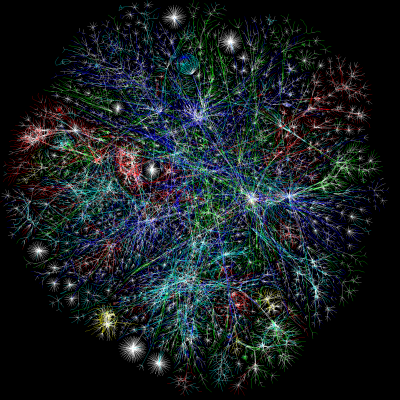
The Internet Doesn’t Exist

history

By Jacob Silverman

Source: The Baffler

The Internet has been very busy. In just the last week, Caitlyn Jenner broke the Internet, but she also united it. The FCC made war on the Internet. The Internet shamed a couple. The Internet had a dark side, Nikki Finke was barred from the Internet, the Supreme Court made the Internet less safe for women, the Internet named a famous fetus, the Internet did stuff with a superhero movie, and the Internet changed. A girl also won the Internet, Jack White had a difficult history with the Internet, and the Internet “shafted” a Canadian journalist.

“The Internet” is the universal straw man, a hero or villain for every occasion. The Internet, the Internet, the Internet—this decentralized communications network has long been granted a proper noun and practically a degree of sentience. Yet few people talk about “the Telephone” as if it were some person or place, though perhaps they once did. This eagerness to grant the Internet some degree of autonomy—to make it into an actor, an entity—stems in part from its apparent abstraction. Where does all this information come from? As Ray Bradbury famously said, “To hell with you and to hell with the Internet. It’s distracting. It’s meaningless; it’s not real. It’s in the air somewhere.”

Bradbury wasn’t just slipping into kneejerk techno-fear. He was also guilty of the same fallacy that crops up again and again in digital journalism: the assumption that the Internet is some monolithic mass, a discrete population or interest group. “It’s distracting,” Bradbury said, without specifying what “it” was.

But in another, more important way, Bradbury was absolutely right: the Internet doesn’t exist.

A couple years ago, Rachel Law, a grad student at Parsons at the time, had this to say: “The ‘Internet’ does not exist. Instead, it is many overlapping filter bubbles which selectively curate us into data objects to be consumed and purchased by advertisers.” As she also said, a bit less academically, “Browsing is now determined by your consumer profile and what you see, hear and the feeds you receive are tailored from your friends’ lists, emails, online purchases, etc.”

What we call the Internet—and what web writers so lazily draw on for their work—is less a hive mind or a throng or a gathering place and more a personalized set of online maneuvers guided by algorithmic recommendations. When we look at our browser windows, we see our own particular interests, social networks, and purchasing histories scrambled up to stare back at us. But because we haven’t found a shared discourse to talk about this complex arrangement of competing influences and relationships, we reach for a term to contain it all. Enter “the Internet.”

The Internet is a linguistic trope but also an ideology and even a business plan. If your job is to create content out of (mostly) nothing, then you can always turn to something/someone that “the Internet” is mad or excited about. And you don’t have to worry about alienating readers because “the Internet” is so general, so vast and all-encompassing, that it always has room. This form of writing is widely adaptable. Now it’s common to see stories where “Facebook” or “Twitter” stands in for the Internet, offering approval or judgment on the latest viral schlock. Choose your (anec)data carefully, and Twitter can tell any story you want.

We fall back on “the Internet” because it gives us a rhetorical life raft to hang onto amidst an overwhelming tide of information or a piece of sardonic shorthand to utter with a wink and a grimace, much like “never read the comments.” It also reflects a strange irony about today’s culture: despite being highly distributed, and despite offering an outlet for every subculture and niche interest and political quirk, what we think of the Internet often does feel rather uniform and monolithic.

This impression is partly based in fact; the tech and media industries are currently undergoing a kind of recentralization, exemplified by the rise of massive platforms like Facebook and recent mega-deals, such as Verizon buying AOL or Charter Communications (who?) snapping up Time Warner Cable. Attention is increasingly being manipulated and auctioned off by a handful of big conglomerates. The relegation of Twitter to also-ran in the social media sweepstakes—the loser to Facebook in the rush to industry monopoly—also reflects this centralization. That a company with hundreds of millions of users can seem like a failure only shows how bad the market is at apportioning value. (But there I go falling into abstractions again—as if there is anything called “the market.”)

“The Internet” is easy, a convenient reference point and an essential concept for web journalists tasked with surfacing monetizable content from this great informational morass. Digital culture, or writing about “what people are talking about on the Internet,” is considered its own beat now. But in the same way that someone born in the 1980s might not think of himself as a millennial—an arbitrary distinction crafted by demographers and marketers—a user of an online service is not necessarily from, or part of, the Internet. Even some of the subcultures often held up as part of the Internet are mostly notional. Is “Black Twitter” a specific, homogenous entity, as it’s so often described in news coverage? Or is it more something that people do, a set of social relations acted out by varying groups of mostly black Twitter users?

The more we write about what takes place online as if it occurred in some other world, the more we fail to relate this communication system, and everything that happens through it, to the society around us. To understand the Internet, we have to destroy it as an idea.


Franco Berardi on the Digital Colonization of Human Experience

rupertmurdock-digital-immigrant

By Franco Berardi

Source: Adbusters

The Spanish colonization of Mesoamerica was essentially a process of symbolic and cultural submission.

The “superiority” 
of the colonizers lay on the operational effectiveness of their technical production. The colonization destroyed the cultural environment in which indigenous communities had been living for centuries: the alphabetic technology, the power of the written word overwhelmed, jeopardized and finally superseded the indigenous cultures. The conquistadors re-coded the cultural universe of nowadays Mexico and Central America.

Before the arrival of the Spanish invaders Malinche (Malinalli in Nahuatl language, Marina for the Spaniards), the daughter
 of a noble Aztec family, was given away as 
a slave to passing traders after her father died and her mother remarried. By the time Cortés arrived, she had learned the Mayan dialects spoken in the Yucatan while still understanding Nahuatl, the language of the Aztecs. As a youth she was given as tribute again, this time to the invaders.

She became the lover of Cortés and accompanied him as interpreter. She translated the words exchanged by Cortés and Moctezuma, king of the Aztec population of Tenochtitlan, and she translated the conqueror’s words when he met crowds of indigenous persons. She translated for Nahuatl-speaking people the words of Christian conquerors and of Christian priests. The Christian message melted with pre-colonisation mythologies, and the modern Mexican culture emerged. She and Cortés had a child, Martín, the first Mexican. She betrayed her own people by linking with the invaders. By the moral point of view, however, she owed nothing to her own people who had sold her into slavery, and treated her as a servant. She betrayed the conquerors, too, though they did not realize it as such.

Malinche is the ultimate symbol of the end of a world, and also the symbol of the formation of a new semiotic and symbolic space. Only when you are able to see the collapse as the end of a world, can a new world be imagined. Only when you are free from hope (which is the worst enemy of intelligence) can you start seeing a new horizon of possibility. This is the lesson that Malinche is teaching us.

DEMOCRACY

On 31 October 2011, George Papandreou announced his government’s intentions to hold a referendum for the acceptance of the terms of a Eurozone bailout deal. He wanted the Greek people to decide if the diktat of the financial class that was strangling Greek society would be accepted or rejected. Overnight, the elected Prime Minister of Greece was obliged to resign. In the very place where it was invented and named twenty-five centuries ago, democracy was finally cancelled. It will never again come to life. Financial abstraction has swallowed the destiny of billions of people. European workers’ salaries have been halved in the last ten years and unemployment and precariousness are on the rise. Meanwhile, profits skyrocket.

WAR

The Eurasian continent is heading toward a proliferation of fragmentary conflict. At the same time, the infinite war launched by Cheney and Bush has paved the way to the establishment of the Caliphate. In Japan, the Prime Minister travels the world looking for allies against China. In India, a racist mass murderer (neoliberal of course) has been elected Prime Minister. In Europe, a Euro-Russian war is in the making at the Ukrainian border. In Ferguson, Missouri, another racialized killing reveals the American police state and the poverty industrial complex — two million homeless in the US and counting. In Gaza, Israel bombards the world’s largest open air prison and blames the victims, most of them children, for dying while the world looks on. In Northern Africa, Western powers prepare for the next season of Gaddafi blowback. In Liberia, Ebola fans the flames of civil and regional war, one bleeding eyeball at a time. In Mexico, a momentary silence shrouds the bloodiest drug war humanity has ever known, with cartels ranking among the wealthiest corporations.

While capitalism will continue to thrive thanks to massive slavery and eco-catastrophe, the next 20 years will be marked by the clash between financial abstraction and biofascism. A social, cognitive breakdown is estranging the masses from the body, so the decerebrated body is taking the form of aggression. Those who have been lost in the competition react under the banners of aggressive identification. We can even see fascism revived by the vengeful spirit of the dispossessed.

BIO-FINANCIAL POWER

Nation states are over, stripped by the global machine
 of finance, computation and all-pervading behavioral Big Data algorithms. Global corporations are replacing nation states as holders of power. We now embrace the first stages of the automation of mind, language and emotions … the architecture of bio-financial power. Power, in fact, is no longer political or military. It is based more and more on the penetration of techno-linguistic automatisms into the sphere of language. Soon, life will be based on the automation of cognitive activity. Who cares if the US military machine is running on empty because of Bush’s self-defeating strategy — it’s a remnant of geopolitical thinking now dead.

THE CIRCLE

Mediocre as it is, Dave Eggers’s novel 
The Circle is a metaphor for the relation between technology, communication, emotion and power. “The Circle” is the name of the most powerful corporation 
in the world, a sort of conglomerate of Google, Facebook, Paypal and YouTube. Three men lead the company: Stockton 
is a financial shark, Bayley is a utopian and Ty Gospodinov is the project’s hidden mastermind.

The main character of the book is Mae, a young woman hired by The Circle during “the Completion,” the final phase in the implementation of TrueYou, a program intended to enforce the recording of every instant of life for pervasive, ceaseless sharing. Mae becomes the corporation’s spokesperson, the face that appears every day on the infinite channels of The Circle’s television network — the ambassador of the new credo.

The Circle is all about the utter
 capture of human attention: ceaseless communication, mandatory friendliness and creation of a new neediness — the obsessive need to express and share. One may remark that Eggers is simply re-enacting Orwell more than 60 years after the publishing of 1984. That’s true, but in the final pages of the novel, Eggers goes further than Orwell, when Ty exposes the transhuman potency of the totalitarian nightmare.

In the last scene of the novel, the inventor and founder of The Circle manages to covertly meet Mae, the newbie seducing
 the global audience. He has lost control of his own creature, the project he originally conceived, and is deprived of all power in its unstoppable self–deployment.

“I did not intend any of this to happen. And it’s moving so fast. I didn’t picture a world where Circle membership was mandatory, where all government and all life was channeled through one network … there used to be the option of opting out. But now that’s over. Completion is the end. We are closing the circle around everyone. It’s a totalitarian nightmare.”

The automaton cannot be stopped, as even the creator himself becomes overpowered by his own invention: the circle of continuous attention, the circle of perfect transparence of everybody to everybody, the circle of total power and of total impotence.

PLEASURE, AFFECTION AND EMPATHY

At the beginning of the 21st century we are in a position that is similar to the position of Malinche: the conqueror is here, peaceful or aggressive, functionally superior, unattainable, incomprehensible. The bio-info automaton is taking shape from the connection between electronic machines, digital languages and minds formatted in such a way to comply with the code. The automaton’s flow of enunciation emanates a connective world that the conjunctive codes cannot interpret, a world that is symbolically incompatible with the social civilization that was the outcome of five centuries of Humanism, Enlightenment and Socialism.

The automaton is the reification of the networked cognitive activity of millions of semio-workers around the globe. Only if they become compatible with the code, the program, can semio-workers enter in the process of networking.

This implies the de-activation of old, subconsciously engrained, modes of communication and perception (compassion, empathy, solidarity, ambiguousness and irony), paving the way to the assimilation of the conscious organism with the digital automaton.

Will the general intellect be able to disentangle itself from the automaton? Can consciousness act on neural evolution? Will pleasure, affection, empathy find a way to re-emerge? Will we translate into human language the connective language of the automated meaning-making machine buzzing and buzzing in our heads?

These are questions that only 
Malinche can answer, opening to the incomprehensible other, betraying her people and reinventing language in order to express what can not be said.

—Franco “Bifo” Berardi is an Italian Marxist theorist and activist in the autonomist tradition. He writes about the condition of media, mental breakdown
 and information technology within post-industrial capitalism. His next book, Heroes, dedicated to the suicidal wave provoked by financial nihilism, will be out in the first months of 2015.

Treading water in the stream

yun_2729

By Chris Arkenberg

Source: URBEINGRECORDED

I haven’t posted much here in a while and, honestly, I don’t know if I have an audience anymore. You gotta feed the beast or it’ll just go gorge elsewhere at the unlimited trough of spankulation that is the Internet. It’s easier to tweet, and now there’s Ello which hasn’t yet found its center of gravity or true genus locii to root down a thriving community. But it’s refreshing to post more than 140 char without the expectation of serious long-form journeys. And I don’t use Facebook so Ello at least offers some potential to have an intellectual cohort that won’t rat-hole into that heady blend of extremism and uncritical non-thinking that seems to be coded directly into the DNA of Disgracebook. So consider this post my sort of Fakebook personal rant…

But then, I’m not sure I have a lot to say these days. Partly, I do so much of this sort of thing at work where the audience is internal. The content is fairly narrow but still insightful. Not the broad random walks through techno-behaviorology that I’m inclined to pursue here. Partly, on another axis, the Twitters and the constant streams of the technoverse and geopolity have got me a bit swirly, like the inertia of information is too great to adequately slow down and process into some sort of theory. The fascination with the stream is at the expense of any fascination with the particulars of life, like it’s all moving too fast and I’m being entrained to be little more than a relay node in the network. Click, retweet, copy-past, post. A servant to the memes, like apes collared to silicon just to grind out more 1’s and 0’s.

So much of the stream seams meaningless – fleeting glimpses, spikes of outrage, stories about things and events that will be wiped from the collective memory within a week. And maybe that’s the point, to bring all the mundane details to light, to share the bits with each other, to fully become the eyes of the world, in witness of it all. But then, if I really think about it, it’s appalling how many resources, how much energy, how much labor born on the backs of the impoverished, how much of this all goes to keeping the platters spinning and the switches switching and the rare earth’s rare-earthing, across global data centers sucking down megawatts to make sure we archive every random bleating of the global mind. To a post-psychedelic techno-futurist like myself, it’s a bit confusing to feel at odds with the marvel of it all.

I can’t remember the source but this phrase about digital transformation really stuck with me: that it’s emulsifying entire industries. Which underlines that there’s very real import to the network spankulation, that we have some obligation to roll the dung ball of modernity around and around beneath the Sun, to check it for deformations that might drive truly dangerous emulsifications. We can snicker at the death of old industries but what about the demise of comfort or wellness or nutrition or the oft-anticipated end of the state… Are we really ready for this degree of transformation? So I’m left with a crutch of faith that the stream is, on balance, a positive tool to keep us all engaged with the Great Work of unfolding the possible with some integrity, without destroying more than we create. That the relentless bleating of sheep is what keeps the shepherds attentive and considerate, and that the global mind helps us better evolve the animal within towards something more tenable than base self-preservation, something much holier than religion, something much more wise than science.

It’s a lot to put on a stream, I know, but maybe having a degree of faith is what keeps us swimming, lest we give in to the rushing depths and fall like stones, inert and silent.