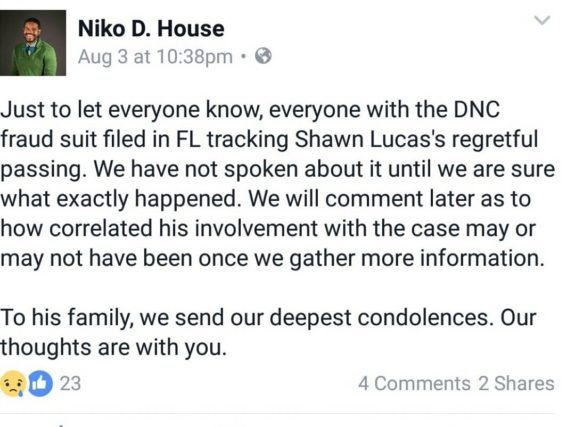
ANOTHER MYSTERIOUS DEATH – Activist and Sanders Supporter Who Served Papers to DNC on Fraud Case Found Dead

shawn-lucas

By Jim Hoft

Source: Gateway Pundit

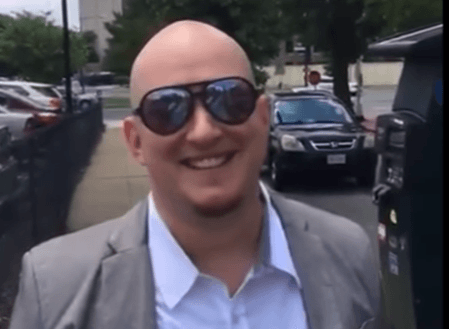
On July 3, 2016, Shawn Lucas and filmmaker Ricardo Villaba served the DNC Services Corp. and Chairperson Debbie Wasserman Schultz at DNC’s headquarters in Washington, D.C., in the fraud class action suit against the Democrat Party on behalf of Bernie Sanders supporters.

Shawn Lucas was thrilled about serving the papers to the DNC before Independence Day.

** This was before Wikileaks released documents proving the DNC was working against the Sanders campaign during the 2016 primary.

Shawn Lucas was found dead this week.

shawn-lucas-dead-575x427

According to Snopes Lucas was found dead on his bathroom floor.

We contacted Lucas’ employer on 4 August 2016 to ask whether there was any truth to the rumor. According to an individual with whom we spoke at that company, Shawn Lucas died on 2 August 2016. The audibly and understandably shaken employee stated that interest in the circumstances of Lucas’ death had prompted a number of phone calls and other queries, but the company had not yet ascertained any details about Lucas’ cause of death and were unable to confirm anything more than the fact he had passed away.

An unconfirmed report holds that Lucas was found lying on the bathroom floor by his girlfriend when she returned home on the evening of 2 August 2016. Paramedics responding to her 911 call found no signs of life.

This follows the death of 27 year-old Democratic staffer Seth Conrad Rich who was murdered in Washington DC on July 8. The killer or killers appear to have taken nothing from their victim, leaving behind his wallet, watch and phone. Shortly after the killing, Redditors and social media users were pursuing a “lead” saying that Rich was en route to the FBI the morning of his murder, apparently intending to speak to special agents about an “ongoing court case” possibly involving the Clinton family.

seth-rich-bloomingdale_02

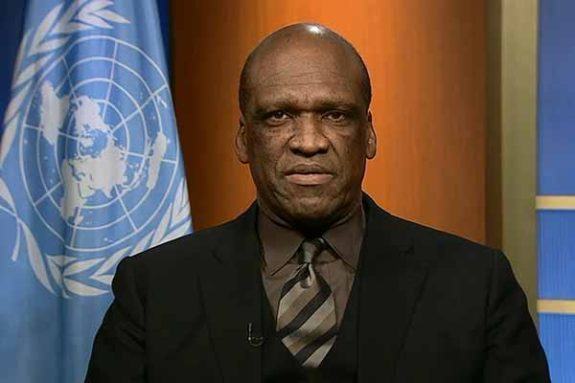
And on June 22, 2016, former UN official John Ashe “accidentally” crushed his own throat and died a week before he was scheduled to testify against the Clintons and Democrat Party.

john-ashe-un-575x383

John Ashes died before his court appearance.


Related Podcast:

The Opperman Report – 08.07.16 Niko House; DNC Infiltration, Rigging, Deaths


Proving She Can Do Anything She Wants, Clinton Hires Disgraced DNC Chair for Own Campaign

1107afterforum1

By Clair Bernish

Source: The Free Thought Project

A spectacular implosion has beset the Democratic Party following the Wikileaks release of memos and emails proving, well, just about every accusation from independent media and Sanders supporters made throughout the past year — many of which had been mocked publicly as conspiracies by party insiders.

In the latest jaw-dropper over the nearly 20,000-document leak deserving of the title, DNC-Gate, already-loathed Democratic National Committee Chair Debbie Wasserman Schultz — shamed into resignation from decisive evidence of party collusion with corporate presstitutes against Sanders, among multiple other once-conspiracies — has been dutifully scooped up in an act of mordant hubris by none other than her teflon idol, Hillary Clinton.

“There’s simply no one better at taking the fight to the Republicans than Debbie,” Clinton pontificated on her loyal lackey, “which is why I am glad that she has agreed to serve as honorary chair of my campaign’s 50-state program to gain ground and elect Democrats Robby Mooin every part of the country, and will continue to serve as a surrogate for my campaign nationally, in Florida, and in other states.”

Yes, the former secretary of state did, in fact, say exactly what Sanders’ adherents, Republicans, and responsible journalists have been screaming about for months — Wasserman Schultz will continue to serve as a Clinton campaign proxy.

At least one thing is too patently obvious to warrant Clinton-esque deception.

As the daytime drama cum reality show now masquerading as the Democratic Party kicks off its convention in Philadelphia today, complete with tens of thousands of protesters of every stripe, Bernie Sanders issued a statement praising Wasserman Schultz’ scandal-tinged resignation.

“Debbie Wasserman Schultz has made the right decision for the future of the Democratic Party,” the Guardian quoted Sanders, adding party leaders must “always remain impartial in the presidential nominating process, something which did not occur in the 2016 race.”

Such moralizing, however, glistens only with a gilded glint given Sanders’ refusal to withdraw support for the establishment monarch, Hillary Clinton — in fact, the choice to remain loyal in the face of staggering coordination against his own campaign only lends credence to widely-held suspicions he’d been sheepdogging for Hillary for the duration. For Sanders to continue to plead fealty to the party whose insiders secretly denigrated his faith, derided his ardent supporters, and unscrupulously plotted his downfall either betrays his surreptitious role as longstanding Hillary shill, or denotes an ethically-void capitulation to the manufacturers of his demise.

Rendered effectively moot by both the DNC-Clinton alliance and his own lackluster lack of retort, Sanders’ affirmation of Wasserman Schultz’ rightful, humiliating self-removal from the helm merited little more than a footnote in the party’s bizarre damage-control scramble on the eve of its quadrennial main event.

In an apparent attempt to besmirch the legitimacy of the massive document drop — and distract from the telling contents — DNC officials proffered a ridiculous Russian red herring.

“Mrs. Clinton’s campaign manager, Robby Mook, argued on ABC’s ‘This Week’ that the emails were leaked ‘by the Russians for the purpose of helping Donald Trump’ citing ‘experts’ but offering no other evidence,” the New York Times reported. “Mr. Mook also suggested that the Russians might have good reason to support Mr. Trump: The Republican nominee indicated in an interview with The New York Times last week that he might not back NATO nations if they came under attack from Russia — unless he was first convinced that the countries had made sufficient contributions to the Atlantic alliance.”

Mook only slightly elaborated on this gelastic allegation for CNN, stating:

“What’s disturbing to us is that experts are telling us Russian state actors broke into the DNC, stole these emails, and other experts are now saying that the Russians are releasing these emails for the purpose of actually helping Donald Trump.”

He added, “I don’t think it’s coincidental that these emails are being released on the eve of our convention here” in Philadelphia.

Though Mook unsurprisingly failed to provide even a smidgen of evidence — much less names — to back up his claim, apparently the public should rest assured, because, he promised humorlessly:

“This isn’t my assertion. This is what experts are telling us.”

In echo-chamber support of this theoretical Russian plot — which the Trump camp and others have written off to absurd musings of an unraveling party — the Clinton campaign attested in a statement cited by the Guardian:

“This is further evidence the Russian government is trying to influence the outcome of the election.”

A similar accusation of Russian infiltration, dutifully parroted by corporate media in June, cited nameless, unverified DNC and U.S. ‘officials’ and anonymous ‘security experts’ claiming “Russian government hackers” penetrated the DNC’s network and, reported the Washington Post, had “so thoroughly compromised the DNC’s system that they were able to read all email and chat traffic.”

Of course, Russian officials wholly denied the claim, offering a far more sound explanation for the breach:

“Usually these kinds of leaks take place not because hackers broke in, but, as any professional will tell you, because someone simply forgot the password or set the simple password 123456,” mused President Putin’s top Internet advisor, German Kimeko, according to RIA Novosti state news agency cited by the Post. “Well, it’s always simpler to explain this away as the intrigues of enemies, rather than one’s own incompetence.”

Floundering under the weight of leaks revealing its slavish devotion to Clinton and inability to remain neutral while mendaciously claiming the contrary throughout the election season, the DNC might have effectively swindled a rift so broad as to be insurmountable.

As the convention gets underway, Sanders delegates and protesters might be sufficiently enraged to splinter from the Democratic Party so blatantly servile to its establishment darling against the conspicuous will of the people — with or without support from their populist hero, Bernie Sanders, himself.

Hillary and Tim Kaine: a Match Made on Wall Street

Hillary-Clinton-likely-to-pick-Virginia-Sen-Tim-Kaine-for-VP

B

Source: CounterPunch

Earlier this week, Bernie Sanders warned that Hillary Clinton’s eventual vice presidential pick must not be someone from the milieu of Wall Street and Corporate America. And while Sanders is still fighting to win the Democratic Party nomination in what many have argued is a rigged system with a foregone conclusion, it appears that Sanders is also intent on influencing the course of the Clinton campaign and the party itself.

In a thinly veiled demand that Clinton embrace the core principles of the Sanders campaign in order to secure the support of Sanders’s political base, the insurgent Democratic candidate hoped aloud “that the vice-presidential candidate will not be from Wall Street, will be somebody who has a history of standing up and fighting for working families, taking on the drug companies…taking on Wall Street, taking on corporate America, and fighting for a government that works for all of us, not just the 1%.”

And while that description may sound positive for its sheer idealism, it does not seem to account for the fact that banks and corporations effectively own both major parties, and that nearly every top Democrat is in various ways connected to the very same entities. In any event, it is useful still to examine a few of the potential Clinton running mates in order to assess just what sort of forces are going to be put in motion to help deliver a Clinton presidency.

The Actors on the Playbill

Beltway pundits are fond of remarking that Tim Kaine, the underwhelming centrist Democrat senator (and former Governor) from Virginia, is at the top of the list for Clinton. He’s safe. He’s experienced. He’s safe. He’s a Democratic Party loyalist with experience fundraising. Oh, and did I mention that he’s safe? Such is the general tenor of the conversation around Kaine, a politician with a long track record and a mostly forgettable personality known more to DC insiders than to the general voting public.

What could be better for Hillary Clinton, perhaps the least liked Democratic (presumptive) nominee in decades, than to have a party establishment insider who represents the status quo as her running mate in an election year that will undoubtedly be remembered for the ostensibly anti-establishment candidates and rhetoric on display throughout?

To be fair, Kaine does represent Virginia, a swing state that is crucial for Donald Trump, and which could spell victory for Clinton should she carry it.  And of course, Kaine can also posture as “tough on Wall Street” from his days as DNC Chairman and party mouthpiece during the passage of the so-called “Wall Street reform” bill.  Despite nothing substantive coming out of the bill, Kaine is still able to cash in the political currency derived from that bill, and perhaps meekly shield Clinton from continued attacks vis-à-vis her connections to Wall Street.

Of course Kaine also comes with his own baggage, including his anti-abortion stance which earned him the ire of many pro-choice activists in Virginia when he was Governor.  Considering the shameless droning from Clinton and her backers about being “the first woman president,” it would certainly raise serious questions – and open up an obvious angle of attack for Trump – were she to sport her feminism and focus on women’s reproductive rights by selecting a man with an anti-abortion record.

A look down the list of other potential choices reveals that Clinton truly has very little to choose from.  Both Housing and Urban Development (HUD) Secretary Julian Castro, as well as Labor Secretary Tom Perez, have both had their names bandied around as Clinton seeks to solidify the Latino vote in an election where the Republican candidate has worked tirelessly to alienate that all-important demographic as much as possible.  But of course, the obvious question to be asked in response to either of these potential selections would be “Who?” Neither Castro nor Perez is well known nationally, nor have either of them won major elections or really done anything of note in their tenure in Obama’s cabinet.  Despite being Latinos, they are utterly forgettable, and unlikely to bring significant returns to Clinton.

While other names such as New Jersey junior senator Cory Booker, as well as Ohio senator Sherrod Brown, have been discussed, both men hail from states with Republican governors, meaning that were they to accept a VP slot, their senate vacancies would be likely filled by Republicans, a scenario that Senate Minority Leader Harry Reid has already said “Hell no!” to, vowing to “yell and scream to stop that.”

Who Else Is “Ready for Hillary”?

So that then leaves the two most interesting potential running mates: Elizabeth Warren and Bernie Sanders himself. Warren, who conspicuously refused to endorse Clinton over Sanders, has tremendous upside for Clinton as she has been perhaps the Democratic Party’s most vehement opponent of Wall Street, having led many high profile attacks on the major banks in her tenure in the Senate.  From a public relations branding perspective, she is essentially the female Bernie Sanders, a progressive Democrat who presents herself as an ally of working people and an enemy of bankers. For Clinton, Warren would also round out the “First Woman…” card, allowing the Clinton campaign to quite literally become a campaign about breaking the glass ceiling in US politics. The stump speeches almost write themselves.

Finally, there’s Mr. #FeelTheBern himself. His latest comments (mentioned above) certainly do have a subtext that implies his willingness to accept a running mate slot.  Having fashioned himself as the champion of the middle class and threat to the Washington establishment, Bernie would provide much in the way of credibility to a lackluster Clinton campaign which has failed to excite even many ardent Democrats.  Sanders would also guarantee a unified Democratic Party ticket, and provide much needed defense of Clinton’s left flank.  In short, Sanders, like Warren, would give anti-Clinton progressives the pretext many of them need to justify their voting for the much-hated Clinton.

Never mind the fact that neither Sanders nor Warren would actually do anything to combat Wall Street finance capital as Vice President.  Never mind the fact that no one on Wall Street is particularly scared of either politician being given the ceremonial power that comes with the Vice Presidency.  These are just the kind of uncomfortable, but inescapable, facts that progressives must choose to ignore.

The difficulty for either Sanders or Warren is the marketing of their decision to left progressives, some of whom would see collaboration with Clinton and the Clinton political machine as a betrayal and a complete sell-out.  However, aside from driving a some relatively small number of progressives to vote for Jill Stein and the Green Party (or stay home entirely), it is unlikely that the negative impact in the progressive base would amount to anything more than some hurt feelings followed by the usual acquiescence to the Democratic Party line.

If such an analysis sounds cynical and jaded, that’s because it is. Perhaps a better descriptor would be disdainful.  Indeed, as someone who watched with bemused melancholy as progressives lined up to support Al Gore in 2000, John Kerry in 2004, and Barack Obama in 2008 and 2012, my position on support for ANY Democrat is the same as Harry Reid’s position on swing state senator VP picks: Hell no!

Indeed, the very notion of collaboration with a war criminal and Wall Street puppet such as Clinton is anathema to everything the left and “progressives” are supposed to stand for.

Of course, there is also the elephant (and donkey) in the room: both major parties are wholly owned subsidiaries of finance capital and the corporations that rule over us. This is the realization that millions of Americans have already made, and which millions more are making.  This is the realization that keeps Democratic and Republican apparatchiks up at night.  And this critical revelation is what Bernie, Liz, & Co. are there to suppress.

Eric Draitser is the founder of StopImperialism.org and host of CounterPunch Radio. He is an independent geopolitical analyst based in New York City. You can reach him at ericdraitser@gmail.com.

New Hillary leak: Wikileaks releases 20K DNC emails; reveals anti-Sanders bias, pro-Clinton collusion among top officials

110505_hillary_clinton_situation_room_522_regular

Source: RT

A WikiLeaks dump of nearly 20,000 Democratic National Committee (DNC) emails, the supposedly neutral governing organization of the Democratic Party, indicates that the committee strategized with the Clinton campaign and plotted against Bernie Sanders.

Collusion with Clinton and the media

communication from late May laid out the pros and cons of DNC Chairwoman Debbie Wasserman Schultz accepting an invitation to CBS’s ‘Face the Nation’, and indicated that the DNC was plotting its moves based on what would be amenable to Hillary Clinton’s presidential campaign.

“Clinton campaign is a mess, they’re afraid of their own shadow and didn’t like that we engaged,” DNC communications director Luis Miranda wrote. “But they’ll be unhappy regardless, so better to get out there and do some strong pivots and land good punches on Trump. They can’t tell us NOT to do TV right now, we shouldn’t pull ourselves out until they actually do.”

“It’s clear that Bernie messed up and that we’re on the right side of history,” Miranda wrote in another bullet point, referring to the Nevada convention.

“Let’s take this offline,” Wasserman Schultz said in response. “I basically agree with you.”

Wasserman Schultz and Miranda brainstormed ideas to attack Sanders’ position on the Israel/Palestine conflict with her communications team in one thread, with Wasserman Schultz saying that “the Israel stuff is disturbing” in reference to Sanders’ platform committee appointees attempts to include language denouncing the occupation of Palestinian territory in the Democratic platform.

The chairwoman says that the idea “HFA,” or Hillary For America, originally proposed the idea of using Israel/Palestine as “an ideal issue to marginalize Sanders on,” suggesting that the DNC were exchanging communications about anti-Sanders strategies with the Clinton campaign.

The DNC also appears to have made a secret “agreement” with Kenneth Vogel, an influential report for Politico.

An email from late April with the subject line “per agreement… any thoughts appreciated” shows that Vogel sent an advanced copy of a story about Hillary Clinton’s fundraising to the DNC even before his editor even saw it.

“Vogel gave me his story ahead of time/before it goes to his editors as long as I didn’t share it,” DNC press secretary Mark Paustenbach wrote to  Miranda. “Let me know if you see anything that’s missing and I’ll push back.”

The published version of the story did not appear to have any significant edits from and was not favorable to the Clinton campaign, but the sending of a full, advanced copy to the subject of a story is considered to be a violation of journalistic ethics.

A source with familiar with the interaction between Politico and the DNC told RT America that the message was sent to officials to ensure accuracy in the story, and that it would have been difficult to ask for piecemeal clarifications due to its complexity. The “agreement,” in fact, referred to the DNC promising not to pass the story to a more favorable news outlet who might publish before  Politco.

Another email released in the Friday leak indicates that the DNC was in close contact with news websites on articles related to the Democratic Party.

A Real Clear Politics article said that Sanders supporters were causing a lack of unity at the Nevada Democratic Convention.

“This headline needs to be changed,”  Wasserman Schultz wrote to Miranda.

“We need to push back… Patrice, what happened, DNC had nothing to do with this, right?” Miranda replied, referring to DNC Director of Party Affairs Patrice Taylor.

Taylor responded saying that the article should be changed the event was run by the state party and the disorder “sounds like internal issues amount [sic] Sanders supporters.”

“Walter, please connect with Stewart and get him to push back,” Miranda wrote. The last email on the thread says: “Done. Article has been updated.”

Plotting against Sanders

In a May 5 email, two top DNC executives plotted a smear against Sanders by drawing his Jewish faith into question and painting him as an atheist in strongly religious states.

READ MORE: New Hillary leak: Wikileaks releases 20K DNC emails

“It might may no difference, but for KY and WVA can we get someone to ask his belief,” DNC Chief Financial Officer Brad Marshall wrote. “Does he believe in a God. He had skated on saying he has a Jewish heritage. I think I read he is an atheist. This could make several points difference with my peeps. My Southern Baptist peeps would draw a big difference between a Jew and an atheist.”

“AMEN,” DNC Chief Executive Officer Amy K. Dacey replied.

In an email that concerned Sanders out-polling Clinton in Rhode Island, where the state reportedly only had a fraction of voting stations open, one staffer took a contemptuous tone of Sanders’ supporters,  speaking about them more as a nuisance than an arm of the party.

“If she outperforms this polling, the Bernie camp will go nuts and allege misconduct,” the staffer writes, “They’ll probably complain regardless, actually.”

Another email shows similar ‘us and them’ language being directed at Sanders supporters.

“We have the Sanders folks admitting that they lost fair and square, not because we ‘rigged’ anything,” the email said. “Clinton likely to win the state convention with a slim margin and we’ll send a release with final delegate numbers.”

An email titled ‘Bernie narrative’ sent by DNC National Press Secretary Mark Paustenbach to Miranda indicates that top officials in the party were trying to find an angle to disparage the Vermont senator in the media.

“Wondering if there’s a good Bernie narrative for a story, which is that Bernie never ever had his act together, that his campaign was a mess,” Paustenbach wrote in the May 21 message. “Specifically, [Debbie Wasserman Schultz] had to call Bernie directly in order to get the campaign to do things because they’d either ignored or forgotten to something critical.”

“It’s not a DNC conspiracy, it’s because they never had their act together,” Paustenbach suggested.

Writing off Bernie

Wasserman Schultz seemed to have already counted Sanders out of the race in a May 21 email, when there were still nine primaries to go.

“This is a silly story,” the chairwoman said. “He isn’t going to be president.”

In another email, Paustenbach informed her that Sanders campaign manager Jeff Weaver said the candidate should continue to the convention, Wasserman Shultz said: “He is an ASS,” referring to Weaver.

The chairwoman made her opinion clear about Sanders in an message concerning the candidate alleging that the party hadn’t been fair to him.

“Spoken like someone who has never been a member of the Democratic Party and has no understanding of what we do,” she said.

Search the DNC Email Database: https://wikileaks.org/dnc-emails/

The Corporate Liberal in America

hillary-clinton-winking-AP-640x480

By Jason Hirthler

Source: CounterPunch

“I have almost reached the regrettable conclusion that the Negro’s greatest stumbling block in his stride toward freedom is not the White Citizen’s Counciler or the Ku Klux Klanner, but the white moderate, who is more devoted to ‘order’ than to justice.”

— Martin Luther King, Jr., Letter from a Birmingham Jail

Whether seated in Congress or exiting a voting booth, a corporate liberal is someone who supports anything progressive that does not challenge corporate power. In practice, this means corporate liberals will fight for progressive identity politics. If it has to do with race, sexual orientation, and gender, it generally doesn’t challenge corporate power. Major corporations support progressive positions on those issues, too. Corporate liberals march for gay rights and the larger LGBTQ community itself. They support feminism. They support reproductive rights. They support African-American protests against police brutality—up to the point where they become threatening to the establishment. (Bill Clinton did initiate the prison industrial complex that unduly incarcerates huge numbers of minorities.)

This support is all to the good. Tremendous progress has been made by popular protest of the devastating prejudices that have for years denied individual rights. But when their elected Democrats undermine economic justice, promote imperial warfare, and refuse to seriously address climate change, corporate liberals just look the other way. As Joe Clifford noted in his piece on Bernie Sanders, being a corporate liberal also means rejecting, “…a ban on fracking, a proposal to oppose TPP, the $15 per hour minimum wage proposal, a call for single-payer health care, and a statement of opposition to the illegal Israeli occupation.” These proposals, courageously put forward by James Zogby, Bill Mckibben, Cornell West and the rest of the Sanders contingent at the recent Democratic Platform Committee meeting in Washington, were all struck down. In a beautiful expression of moral courage, West refused to back the platform in its final iteration, saying,

“[If] we can’t say a word about [Trans-Pacific Partnership], if we can’t talk about Medicare for all explicitly, if the greatest prophetic voice dealing with impending ecological catastrophe can hardly win a vote and if we can’t even acknowledge occupation as something that’s real in the lives of a slice of humanity … it just seems to me there’s no way in good conscience I can say take it to the next stage.”

Yada Yada Yada

Words like these have no effect on the corporate liberal. If there’s a centimeter’s difference between their Democratic platform and the diseased corpus of Republican anarchism, the corporate conscience is salved. A corporate liberal is the one that puts “occupation” in quotes. A corporate liberal never makes the perfect the enemy of the good. A corporate liberal believes in reform, in humanitarian warfare, in the responsibility to protect, and in The New York Times front page. A corporate liberal supports all of this, though reform may be glacial, though good wars may slay millions, though interventions may undermine sovereignty, and though The Times may be rife with half-truth. It makes no difference, so long as reform is better than rollback, Barack’s slaughter is numerically less than Dubya’s, and The Washington Post is marginally more truthful than FOX News. As long as you can trust Erin Burnett more than Bill O’Reilly, it makes no difference that we will move further and further to the right, picking up steam until we barrel straight into corporate fascism. So long as the corporate liberal sits to the left of the patrician publican, he has some claim on the progressive mandate. Or so he says. Yet the best way to repel fascism, and realize that progressive mandate, is by joining a movement headed left, rather than a party moving right.

Nothing Forbidden

As Alan Nasser elucidates, there is nothing intolerable in the lesser evilism of the corporate liberal. He will endure—or more likely, watch others endure—intolerable realities while maintaining the unblinking rectitude of the blind ideologue. Author Chris Hedges writes that capitalism is “plunging us into a state of neo-feudalism, perpetual war, ecological disaster, and a dystopian nightmare.” But this, too, is not intolerable. We must accept it in order to ensure that the real nightmare—whomever happens to be running on the Republican ticket—is barred from the White House forever.

We must tolerate whatever Democrats do because they are better than Republicans. Even if that means, as it surely has and surely will, for all the identity groups corporate liberals support, a deteriorating quality of life. Lower incomes, higher unemployment. Bigger debts, bullshit jobs. Higher infant mortality, higher heart disease. More inequality, less social support. Less social support, more incarceration. More suicide, more alcoholism, more drug abuse, more debt, more stress, more unhappiness. And, if one is aware enough, the consciousness of having—perhaps unwittingly at the time—for more slaughter of brown people abroad, and the deliberate aggression against nuclear powers that will raise the prospect of nuclear extermination for millions. The Democrats have no such mandate, but the corporate liberal gives them the power to pretend they do. These are the wages of neoliberalism and imperialism, enabled by the logic of the lesser evil.

Like Dr. King, Karl Marx understood the major threat was not the fanatic on the fringe, but the moderate in the middle. The real threat is not the extremist, who will burn out by necessity if not already burned down by the moderate herd. It is the moderate herd that threatens to permit the intolerable through gradualism. Incremental genocide. Slow-motion regime change. The soft coup. The generational heist of millions of working class jobs. The decade-long liquidation of working class home equity. The century-long evisceration of labor rights. The hidden decades of disinformation campaigns that conflate freedom with free markets. Marx said, “Our task is that of ruthless criticism, and much more against ostensible friends than against open enemies.” He understood what King did, which is part of the reason why they are two of the most revolutionary figures of the last couple of centuries of Western civilization.

Too Much to Lose

Corporate liberals rehearse Manichean pieties about good and evil locked in a dualistic embrace, fighting to the death. There are no third parties in this vision. It is a necessary dualism. Hence the occasional need to undermine democracy to save it, as Hillary’s campaign demonstrated through repeated voting irregularities and financial chicanery engineered through her DNC front. It’s just simpler that way. For a political party of millionaires backed by billionaires, it just doesn’t do to disturb the status quo, rock the boat, upset the apple cart, shake the foundations, incite protest, disturb our creature comforts, move us out of our comfort zone, spark rebellion, overthrow the system, or change the world.

Is lesser evilism an elaborate rationale for preserving the status quo? Lenin said you can’t make a revolution in white gloves, and there are plenty of corporate liberals paying lip service to progress while glad-handing its well-heeled antagonists. That is why, in the end, corporate liberals are anti-revolutionaries. They would rather save capitalism than endure a potentially messy transition to socialism. Leave the revolution to Universal Studios and stubble-cheeked Third World rebels in hand-knitted berets. Social reforms in capitalist countries seem to happen like they did in South Africa, where identity politics achieve astounding successes, and calls for economic justice are swallowed up in the celebratory din. This is because corporate power cares deeply about economic power, but couldn’t care less about your sexual identity. For corporations—even if the executive board morally supports it—the gay community is ultimately another target market, a rich source of disposable income to be mined.

The least oppressed in any electorate always seem to be the greatest obstacle to change. Always willing to put justice on layaway. Always arguing for incrementalism, which strikes me as a luxury of the leisure class. Social progress will have little impact on them anyway, but paying lip service to its values will burnish their reputation. The discomfiting appearance of Bernie Sanders disturbed the polished script rehearsed by the Hillary camp for years. It was her turn, the first female president, upholding the rights of the vulnerable and achieving hard-won incremental gains through patience, hard work, and political acumen. For a moment, the Hillary faithful looked harried, wrong-footed, and exposed to the will of the mob. But now that the dodgy primaries are done, and Bernie has scampered back to the warmth of the herd, we can return to the language of compromise and the lesser evil. Had Bernie broke with the party he refused to technically join for 40 years, joined Jill Stein on the Green ticket, garnered support from voices like Kshama Sawant and movements like Socialist Alternative and Black Lives Matter, he could have founded a serious alternative to the mercenary duopoly. But he fell for the ruse of internal reform. But not everyone does. King continued in his Birmingham letter to discuss the white moderate, saying he was the one,

“… who prefers a negative peace which is the absence of tension to a positive peace which is the presence of justice; who constantly says: “I agree with you in the goal you seek, but I cannot agree with your methods of direct action”; who paternalistically believes he can set the timetable for another man’s freedom; who lives by a mythical concept of time and who constantly advises the Negro to wait for a “more convenient season.” Shallow understanding from people of good will is more frustrating than absolute misunderstanding from people of ill will. Lukewarm acceptance is much more bewildering than outright rejection.”

Sound familiar? King’s white moderate and Marx’s ostensible friend is our corporate liberal. Same spin, different decade. The corporate liberal is an embodiment of the idea that political parties are the graveyards of movements. Hedges himself wrote a book called, “Death of the Liberal Class” five years ago. It should’ve been the elegy before the interment of the Democratic Party as a serious option in electoral politics. Yet here we are, about to anoint another corporate liberal to the highest seat in the land. In that case, consider this article yet another epitaph awaiting its headstone. Let’s hope it’s not a long wait. Voices like Sawant’s and the momentum of movements like BLM give us reason to think it won’t be.

Jason Hirthler is a veteran of the communications industry and author of The Sins of Empire: Unmasking American Imperialism. He lives in New York City and can be reached at jasonhirthler@gmail.com.

Latest Guccifer 2.0 Leak Reaffirms Primaries Were Rigged for Clinton

 DEM_2016_Clinton.JPEG-19e1f_c0-266-3500-2306_s885x516

And, of course, a dodgy DNC blames Russian hackers

By Michael Sainato

Source: Observer

On July 18, hacker Guccifer 2.0 released a new batch of documents obtained from DNC servers. Among the files given exclusively to The Hill is a DNC memo to Clinton political operatives on March 24, 2015—before she formally announced her candidacy—outlining how to legally solicit pro-Clinton super-PACs. “The memo was sent to political consultant John Podesta, now Clinton’s campaign chairman; Clinton fundraising guru Dennis Cheng; and campaign manager Robby Mook,” reported The Hill.

The memo is just one of several documents released by Guccifer 2.0 proving the Democratic National Committee rigged the system for Clinton. Before the primaries began, DNC strategies were developed with Clinton in mind as the presidential nominee. The leak affirms claims by Bernie Sanders’ supporters that the Democratic primaries were not an election, but rather a coronation for Hillary Clinton.

Because many of the documents implicate mainstream media outlets in their complacency to adhere to the DNC’s strategy, the Guccifer 2.0 hacks have gone largely unreported. Some of the documents even unveil how the Clinton campaign fed specific stories to the media in order to boost their political agenda.In May 2015, The Intercept alluded to similar strategies, when it discovered that a CNN op-ed published under Atlanta Mayor Kasim Reed’s name had actually been written by a Clinton lobbyist, edited by a Clinton super-PAC, and sent directly to CNN from the super-PAC. In June, Daily Beast reporter Olivia Nuzzi tweeted that she might lend some credence to the Bernie Bros narrative if the Clinton Campaign hadn’t pitched her Bernie Bros stories to write. In refusing to cover how the DNC and the Clinton campaign united, mainstream media has rewarded corruption.

Instead of confirming or denying the validity of the documents, the DNC has reverberated the same tired excuse, claiming Russian hackers are responsible: “Our experts are confident in their assessment that the Russian government hackers were the actors responsible for the breach detected in April and we believe that the subsequent release and the claims around it may be a part of a disinformation campaign by the Russians. We’ve deployed the recommended.”

While the DNC and Clinton campaign have called for party unityClinton has continued the politically-expedient tactic of adopting several of Sanders’ popular ideas. Even though Clinton claimed to support a constitutional amendment to overturn Citizen’s United, she has profited off of the decision in the past—receiving millions of dollars from super-PACs and wealthy billionaires, including George Soros, James Simons and Haim Saban. Her highly-publicized support to overturn Citizens United comes shortly after Sanders’ formal endorsement for Clinton resulted in a wave of backlash and resentment against Clinton—rather than the increase in favorability her campaign had hoped to generate.

Although Hillary Clinton’s coronation may have widespread Establishment support, the Democratic Party has disenfranchised millions of voters—hurting Democrats’ chances not only in the upcoming general election, but for years to come.

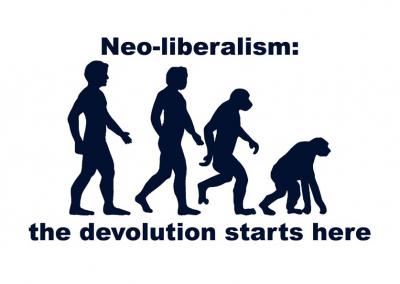
This Is Our Neoliberal Nightmare: Hillary Clinton, Donald Trump, and Why the Market and the Wealthy Win Every Time

neo_liberalism_devolution_via_permanentculturenow.com_

The rage driving our politics stems from cruelty of capitalism. So why do we vote for those who worship the market?

By Anis Shivani

Source: AlterNet

Over the last fifteen years, editors often asked me not to mention the word “neoliberalism,” because I was told readers wouldn’t comprehend the “jargon.” This has begun to change recently, as the terminology has come into wider usage, though it remains shrouded in great mystery.

People throw the term around loosely, as they do with “fascism,” with the same confounding results. Imagine living under fascism or communism, or earlier, classical liberalism, and not being allowed to acknowledge that particular frame of reference to understand economic and social issues. Imagine living under Stalin and never using the communist framework but focusing only on personality clashes between his lieutenants, or likewise for Hitler or Mussolini or Mao or Franco and their ideological systems! But this curious silence, this looking away from ideology, is exactly what has been happening for a quarter century, since neoliberalism, already under way since the early 1970s, got turbocharged by the Democratic party under the Democratic Leadership Council (DLC) and Bill Clinton. We live under an ideology that has not been widely named or defined!

Absent the neoliberal framework, we simply cannot grasp what is good or bad for citizens under Cruz versus Trump, or Clinton versus Sanders, or Clinton versus Trump, away from the distraction of personalities. To what extent does each of them agree or disagree with neoliberalism? Are there important differences? How much is Sanders a deviation? Can we still rely on conventional distinctions like liberal versus conservative, or Democrat versus Republican, to understand what is going on? How do we grasp movements like the Tea Party, Occupy, and now the Trump and Sanders insurgencies?

Neoliberalism has been more successful than most past ideologies in redefining subjectivity, in making people alter their sense of themselves, their personhood, their identities, their hopes and expectations and dreams and idealizations. Classical liberalism was successful too, for two and a half centuries, in people’s self-definition, although communism and fascism succeeded less well in realizing the “new man.”

It cannot be emphasized enough that neoliberalism is not classical liberalism, or a return to a purer version of it, as is commonly misunderstood; it is a new thing, because the market, for one thing, is not at all free and untethered and dynamic in the sense that classical liberalism idealized it. Neoliberalism presumes a strong state, working only for the benefit of the wealthy, and as such it has little pretence to neutrality and universality, unlike the classical liberal state.

I would go so far as to say that neoliberalism is the final completion of capitalism’s long-nascent project, in that the desire to transform everything—every object, every living thing, every fact on the planet—in its image had not been realized to the same extent by any preceding ideology. Neoliberalism happens to be the ideology—unlike the three major forerunners in the last 250 years—that has the fortune of coinciding with technological change on a scale that makes its complete penetration into every realm of being a possibility for the first time in human history.

From the early 1930s, when the Great Depression threatened the classical liberal consensus (the idea that markets were self-regulating, and the state should play no more than a night-watchman role), until the early 1970s, when global instability including currency chaos unraveled it, the democratic world lived under the Keynesian paradigm: markets were understood to be inherently unstable, and the interventionist hand of government, in the form of countercyclical policy, was necessary to make capitalism work, otherwise the economy had a tendency to get out of whack and crash.

It’s an interesting question if it was the stagflation of the 1970s, following the unhitching of the United States from the gold standard and the arrival of the oil embargo, that brought on the neoliberal revolution, with Milton Friedman discrediting fiscal policy and advocating a by-the-numbers monetarist policy, or if it was neoliberalism itself, in the form of Friedmanite ideas that the Nixon administration was already pursuing, that made stagflation and the end of Keynesianism inevitable.

It should be said that neoliberalism thrives on prompting crisis after crisis, and has proven more adept than previous ideologies at exploiting these crises to its benefit, which then makes the situation worse, so that each succeeding crisis only erodes the power of the working class and makes the wealthy wealthier. There is a certain self-fulfilling aura to neoliberalism, couched in the jargon of economic orthodoxy, that has remained immune from political criticism, because of the dogma that was perpetuated—by Margaret Thatcher and her acolytes—that There Is No Alternative (TINA).

Neoliberalism is excused for the crises it repeatedly brings on—one can think of a regular cycle of debt and speculation-fueled emergencies in the last forty years, such as the developing country debt overhang of the 1970s, the savings and loan crisis of the 1980s, the Asian currency crisis of the 1990s, and the subprime mortgage crisis of the 2000s—better than any ideology I know of. This is partly because its very existence as ruling ideology is not even noted by the population at large, which continues to derive some residual benefits from the welfare state inaugurated by Keynesianism but has been led to believe by neoliberal ideologues to think of their reliance on government as worthy of provoking guilt, shame, and melancholy, rather than something to which they have legitimate claim.

It is not surprising to find neoliberal multiculturalists—comfortably established in the academy—likewise demonizing, or othering, not Muslims, Mexicans, or African Americans, but working-class whites (the quintessential Trump proletariat) who have a difficult time accepting the fluidity of self-definition that goes well with neoliberalism, something that we might call the market capitalization of the self.

George W. Bush’s useful function was to introduce necessary crisis into a system that had grown too stable for its own good; he injected desirable panic, which served as fuel to the fire of the neoliberal revolution. Trump is an apostate—at least until now—in desiring chaos on terms that do not sound neoliberal, which is unacceptable; hence Jeb Bush’s characterization of him as the “candidate of chaos.” Neoliberalism loves chaos, that has been its modus operandi since the early 1970s, but only the kind of chaos it can direct and control.

To go back to origins, the Great Depression only ended conclusively with the onset of the second world war, after which Keynesianism had the upper hand for thirty-five years. But just as the global institutions of Keynesianism, specifically the IMF and the World Bank, were being founded at the New Hampshire resort of Bretton Woods in 1944, the founders of the neoliberal revolution, namely Friedrich Hayek, Ludwig von Mises, Milton Friedman, and others were forming the Mount Pelerin Society (MPS) at the eponymous Swiss resort in 1947, creating the ideology which eventually defeated Keynesianism and gained the upper hand during the 1970s.

So what exactly is neoliberalism, and how is it different from classical liberalism, whose final manifestation came under Keynesianism?

Neoliberalism believes that markets are self-sufficient unto themselves, that they do not need regulation, and that they are the best guarantors of human welfare. Everything that promotes the market, i.e., privatization, deregulation, mobility of finance and capital, abandonment of government-provided social welfare, and the reconception of human beings as human capital, needs to be encouraged, while everything that supposedly diminishes the market, i.e., government services, regulation, restrictions on finance and capital, and conceptualization of human beings in transcendent terms, is to be discouraged.

When Hillary Clinton frequently retorts—in response to demands for reregulation of finance, for instance—that we have to abide by “the rule of law,” this reflects a particular understanding of the law, the law as embodying the sense of the market, the law after it has undergone a revolution of reinterpretation in purely economic terms. In this revolution of the law persons have no status compared to corporations, nation-states are on their way out, and everything in turn dissolves before the abstraction called the market.

One way to sum up neoliberalism is to say that everything—everything—is to be made over in the image of the market, including the state, civil society, and of course human beings. Democracy becomes reinterpreted as the market, and politics succumbs to neoliberal economic theory, so we are speaking of the end of democratic politics as we have known it for two and a half centuries. As the market becomes an abstraction, so does democracy, but the real playing field is somewhere else, in the realm of actual economic exchange—which isnot, however, the market. We may say that all exchange takes place on the neoliberal surface.

Neoliberalism is often described—and this creates a lot of confusion—as “market fundamentalism,” and while this may be true for neoliberal’s self-promotion and self-presentation, i.e., the market as the ultimate and only myth, as were the gods of the past, I would argue that in neoliberalism there is no such thing as the market as we have understood it from previous ideologies.

The neoliberal state—actually, to utter the word state seems insufficient here, I would claim that a new entity is being created, which is not the state as we have known it, but an existence that incorporates potentially all the states in the world and is something that exceeds their sum—is all-powerful, it seeks to leave no space for individual self-conception in the way that classical liberalism, and even communism and fascism to some degree, were willing to allow.

There are competing understandings of neoliberal globalization, when it comes to the question of whether the state is strong or weak compared to the primary agent of globalization, i.e., the corporation, but I am taking this logic further, I am suggesting that the issue is not how strong the state is in the service of neoliberalism, but whether there is anything left over beyond the new definition of the state. Another way to say it is that the state has become the market, the market has become the state, and therefore both have ceased to exist in the form we have classically understood them.

Of course the word hasn’t gotten around to the people yet, hence all the confusion about whether Hillary Clinton is more neoliberal than Barack Obama, or whether Donald Trump will be less neoliberal than Hillary Clinton. The project of neoliberalism—i.e., the redefinition of the state, the institutions of society, and the self—has come so far along that neoliberalism is almost beyond the need of individual entities to make or break its case. Its penetration has gone too deep, and none of the democratic figureheads that come forward can fundamentally question its efficacy.

I said almost. The reason why Bernie Sanders, self-declared democratic socialist, is so threatening to neoliberalism is that he has articulated a conception of the state, civil society, and the self that is not founded in the efficacy and rationality of the market. He does not believe—unlike Hillary Clinton—that the market can tackle climate change or income inequality or unfair health and education outcomes or racial injustice, all of which Clinton propagates. Clinton’s impending “victory” (whatever machinations were involved in engineering it) will only strengthen neoliberalism, as the force that couldn’t be defeated even when the movement was as large and transcendent as Sanders’s. Although Sanders doesn’t specify “neoliberalism” as the antagonist, his entire discourse presumes it.

Likewise, while Trump supporters want to take their rebellion in a fascist direction, their discomfort with the logic of the market is as pervasive as the Sanders camp, and is an advance, I believe, over the debt and unemployment melancholy of the Tea Party, the shame that was associated with that movement’s loss of identity as bourgeois capitalists in an age of neoliberal globalization. The Trump supporters, I believe, are no longer driven by shame, as was true of the Tea Party, and as has been true of the various dissenting movements within the Republican party, evangelical or otherwise, in the recent past. Rather, they have taken the shackles off and are ready for a no-holds barred “politically incorrect” fight with all others: they want to be “winners,” even at the cost of exterminating others, and that is not the neoliberal way, which doesn’t acknowledge that there can be winners and losers in the neoliberal hyperspace.

In the current election campaign, Hillary Clinton has been the most perfect embodiment of neoliberalism among all the candidates, she is almost its all-time ideal avatar, and I believe this explains, even if not articulated this way, the widespread discomfort among the populace toward her ascendancy. People can perceive that her ideology is founded on a conception of human beings striving relentlessly to become human capital (as her opening campaign commercialso overtly depicted), which means that those who fail to come within the purview of neoliberalism should be rigorously ostracized, punished, and excluded.

This is the dark side of neoliberalism’s ideological arm (a multiculturalism founded on human beings as capital), which is why this project has become increasingly associated with suppression of free speech and intolerance of those who refuse to go along with the kind of identity politics neoliberalism promotes.

And this explains why the 1990s saw the simultaneous and absolutely parallel rise, under the Clintons, of both neoliberal globalization and various regimes of neoliberal disciplining, such as the shaming and exclusion of former welfare recipients (every able-bodied person should be able to find work, therefore under TANF welfare was converted to a performance management system designed to enroll everyone in the workforce, even if it meant below-subsistence wages or the loss of parental responsibilities, all of it couched in the jargon of marketplace incentives).

The actual cost to the state of the AFDC program was minimal, but its symbolism was incalculable. The end of welfare went hand in hand with the disciplinary “crime bill” pushed by the Clintons, leading to an epidemic of mass incarceration. Neoliberalism, unlike classical liberalism, does not permit a fluidity of self-expression as an occasional participant in the market, and posits prison as the only available alternative for anyone not willing to conceive of themselves as being present fully and always in the market.

I believe that the generation of people—in their forties or older—supporting Hillary have already internalized neoliberal subjectivity, which they like to frame as realism or pragmatism, refusing for instance to accept that free college or health care are even theoretical possibilities. After all, they have maintained a measure of success in the past three or four decades after conceptualizing themselves as marketplace agents. Just as the Tea Party supporters found it intolerable that government should help irresponsible homeowners by bailing them out of unsustainable debt, the Clinton supporters hold essentially the same set of beliefs toward those who dare to think of themselves outside the discipline of the market.

I spoke of the myth of the market, as something that has no existence in reality, because none of the elements that would have to exist for a market to work are actually in place; this is even more true for neoliberalism than it was for the self-conscious annihilation of the market by communism, because at least in that system the market, surreptitiously, as in various Eastern European countries, kept making an appearance. But when the market takes neoliberal shape, i.e., the classical conceptions of the buyer and seller as free agents are gone, then radical inequality is the natural outcome. And inequality in the last four decades, as statistics for the U.S. and everywhere neoliberalism has made inroads prove beyond a doubt, has exploded, thereby invalidating neoliberalism’s greatest claim to legitimacy, that it brings about a general increase in welfare. So neoliberalism, to the extent that the inequality discourse has made itself manifest recently, must insist all the more vocally on forms of social recognition, what Clinton, for example, likes to call the “fall of barriers.”

Neoliberalism likes to focus on public debt—in the Clinton years debt reduction became a mania, though George W. Bush promptly spent all the accumulated surpluses on tax cuts for the wealthy and on wars of choice—rather than inequality, because the only way to address inequality is through a different understanding of public debt; inequality can only be addressed through higher taxation, which has by now been excluded from the realm of acceptable discourse—except when Sanders, Trump, or Jeremy Corbyn in England go off script.

So to recapitulate neoliberalism’s comprehensive success, let us note that we have gone from a liberal, Keynesian, welfare state to a neoliberal, market-compliant, disciplinary state.

Neoliberalism expects—and education at every level has been redesigned to promote this—that economic decision-making will be applied to all areas of life (parenthood, intimacy, sexuality, and identity in any of its forms), and that those who do not do so will be subject to discipline. Everyone must invest in their own future, and not pose a burden to the state or anyone else, otherwise they will be refused recognition as human beings.

This supposed economic “rationality” (though it is the greatest form of irrationality) applies to civil society as much as the state, so that none of the ideals of classical liberalism, or previous ideologies rooted in humanism, are valid any longer, the only value is the iteration of the market (as myth, not reality); in other words, neoliberalism, unlike the elevation of the individual in classical liberalism or the state in fascism or the collectivity in communism, has erected something, the market, that has no real existence, as the only god to serve! And it is just like a god, with an ethereal, unchallengeable, irrefutable, ubiquitous presence. Whatever in state policy does not serve market-conformity is to be banned and banished from memory (the secular scriptures are to be rewritten), which explains neoliberalism’s radical narrowing of public discourse, including the severance of identity politics from any class foundation.

Neoliberalism will continue to perpetuate reduced opportunity, because one of its characteristics—as in any system that wants to thrive on the world stage—is to constantly refine the field upon which the human subject can operate.

As such, those displaced workers who have suffered the most from the erosion of the old industries in the former manufacturing centers of the world are not even factors to contend with, they are invisible and cannot be part of the policy equation. To the extent that their actual presence is reckoned with, the economy can be said to have crashed; but the problem doesn’t arise because of the management of unemployment or underemployment statistics, unlike a housing crash which is palpable and cannot escape statistical definition.

The danger for neoliberalism—as is clear from the support of millions of displaced human beings for Trump—is that with each crisis neoliberalism sheds more workers, makes individuals and firms more “disciplined,” narrows the scope of opportunity even further. At times, the disciplining of the non-neoliberal other—as with the killing of Michael Brown or Eric Garner—explodes to surface consciousness in an unsavory way, so an expert manager like Clinton or Obama is required to tamp down the emotions of such unruly entities as Black Lives Matter which arise in response. If climate change, according to Clinton and her cohort, can and should have market solutions, then surely racial disparity, or police violence, should also have market solutions and no others; it is here that neoliberal multiculturalism, operating in the academy, is so insidious, because at the elite level it functions to validate market discourse, it does not step outside it.

The present breakdown of both major political parties can be explained by the frustration that has built up in the body politic over the past decade, because after the crash there was no sustained intellectual movement to question the myth of the market. The substitution of economic justice with identity politics is something Ralph Nader, Howard Dean, and now Bernie Sanders have contested in a humane manner, while the same process is at work, admittedly in an inhumane way, in the Trump phenomenon.

Thus, also, Hillary Clinton’s animus against free college education; that form of expansion of opportunity, which was a reality from the 1950s to the 1980s, cannot be allowed to return, human beings are supposed to invest in their own future earnings potential, they are not entitled to a transcendent experience without barriers manifesting in discipline and self-correction. Education, like everything else, including one’s own health, becomes an expensive consumer good, not a right, no longer an experience that might lead to a consciousness beyond the market but something that should be fully encapsulated by the market. If one is a capable market player, education as we have classically understood it becomes redundant.

Unlike the interregnum between 1945-1973, the rising tide—no matter the befuddlements Arthur Laffer and his fellow Reaganite ideologues proffered—does not lift all boats today, it is outside the logic of neoliberalism that it do so, so the idea of reforming neoliberalism, or what is often called “globalization with a human face,” is a rhetorical distraction. All of the policy innovations—interpreted as “socialism” by the Tea Partiers—offered by Barack Obama fall within the purview of neoliberalism, above all the Affordable Care Act, whose genesis was hatched in neoliberal think tanks decades ago.

It is important to note that neoliberal economic restructuring necessarily means social restructuring, i.e., a movement toward disciplinarity and away from liberalism; the disciplinarity can take a Bushian, Clintonian, or Trumpian form, but these are manifestations of the same tendency.

When wage growth is decoupled from economic growth (as it has been since Friedman and others inaugurated the revolution in the early 1970s), this means that the human subject is ripe for discipline. Furthermore, wage fairness cannot be rationally discussed (hence the obfuscation surrounding the $15 minimum wage orchestrated by Clinton and others) because the concept of the market has been disembedded from society; the market as abstraction, not a concrete reality, makes any notion of reform or restructuring impossible. Like the minimum wage, something like free child care also remains outside the bounds of discourse, because public policy cannot accommodate discussions that do not take the self-regulating market as unassailable myth.

What neoliberalism can accommodate is relentless tax cuts (Trump has already offered his huge tax cut plan, as Bush did as his first order of business), which only exacerbate the problem, leading to increasing concentrations of wealth. It has to be said, though, that Ted Cruz more comfortably fit the neoliberal paradigm, with his familiar calls for lower taxes along with reduced regulation and further limits on social welfare, whereas Trump shows, for now, some elements of apostasy. If neoliberalism were to get a Cruz, it would have no problem working with him, or rather, Cruz would have had no problem executing neoliberalism, beyond the surface dissimilarities from Hillary Clinton.

As Sanders has consistently noted, economic inequality leads to political inequality, which means that democracy, after a certain point, becomes only theoretical (viz. Citizens United and the electoral influence of such powerful entities as the Koch brothers). Both processes—economic inequality and political inequality—have accelerated after each downturn in the forty-five-year history of neoliberalism, therefore a downturn is always exciting, and even preordained, for a Bush, a Trump, or a Clinton. Again, economic inequality and political polarity (polarity is simply a manifestation of democracy having become dysfunctional) strongly correlate, and both have come to a head in this election.

Neoliberalism’s task, from this point on, is to mask and manage the increasing inequalities that are likely to befall humanity, especially as the planet reaches a crisis point in its health. In a way, George W. Bush threw a wrench—he was a perverted Keynesian in a way, believing in war to prime the pump, or inflating unsustainable bubbles, or spending exorbitantly on grandiose gestures—into the process of neoliberal globalization that was going very smoothly indeed under Bill Clinton and would likely have flourished under Al Gore as well. With Hillary Clinton, the movement will be toward further privatization of social welfare, “reforming” it along market principles, as has been true of every neoliberal avatar, whether it was Bill Clinton’s incentives to work in the performance management makeover of welfare, George Bush’s proposed private social security accounts, Mitt Romney’s proposed private health care accounts, or the school vouchers that tempt all of them from time to time.

What remains to be seen is the extent to which the millennial generation might be capable of thinking outside the neoliberal paradigm, i.e., they don’t just want more of what neoliberal promises to give them yet fails to deliver, but want things that neoliberalism does not or cannot promise. On this rests the near-term future of the neoliberal project.

Beyond Sanders himself, the key question is the ability of the millennial generation to conceive of themselves outside the neoliberal subjectivity they have been pushed to internalize. They have been encouraged to think of themselves as capital producers, turning their intellectuality into social media popularity for the benefit of capital, in the service of the same abstract market that has no place, no role, no definition beyond the fallen liberal calculus. Does the millennial generation believe, even about its most intimate core, that everything has been privatized?

I am not necessarily making a pessimistic prediction. I am merely outlining the strength of an opponent that has refused to be named for forty-five years, although it has been the ruling ideology that long! In defining neoliberalism, I have sought to distance myself from the distraction of personalities, and tried to expose the dark side of our politics which we can only see when we name and understand the ideology as such. We are up against a system that is so strong that it has survived, for the most part, the last crash, as citizens couldn’t get their heads around the idea of nationalizing banks or health care.

It is existentially imperative to ponder what happens beyond Sanders, because neoliberalism has its end-game in sight, letting inequality continue to escalate past the crash point (meaning the point where the economy works for most people), past any tolerable degradation of the planet (which is being reconceptualized in the shape of the market).

What, indeed, does happen beyond Sanders, because as we have seen Hillary Clinton is one of the founders of neoliberal globalization, one of its central historical figures (having accelerated the warehousing of the poor, the attack on trade unions, and the end of welfare and of regulatory prowess), while Trump is an authoritarian figure whose conceptions of the state and of human beings within the state are inconsistent with the surface frictionlessness neoliberalism desires? To go back to Hillary Clinton’s opening campaign commercial, to what extent will Americans continue to believe that the self must be entrepreneurially leveraged toward maximum market gains, molded into mobile human capital ever ready to serve the highest bidder?

As to whether a non-neoliberal globalization is possible and what that might look like on the international stage after a quarter-century of Clinton, Bush, and Obama—which is essentially the frustration Trump is tapping into—I’ll take that up in a follow-up essay, which will further clarify the differences between Sanders versus Clinton, and Trump versus Clinton.

I would suggest that it is not that globalization causes or has caused neoliberalism, but that neoliberalism has pushed a certain form of globalization that suits its interests. This is a crucial distinction, on which everything else hinges. The neoliberal market doesn’t actually exist; at the moment it is pure abstraction; what is actually filling up economic and political space can only be discussed when we step away from this abstraction, as Sanders has so ably done, and as the Occupy and Black Lives Matter movements tentatively set in motion.

 

Anis Shivani is the author of several books of fiction, poetry, and criticism, including, most recently, My Tranquil War and Other Poems. His novel Karachi Raj (HarperCollins/Fourth Estate) was released this summer. His next book is the poetry collection Whatever Speaks on Behalf of Hashish, out in October.

Wasserman Schultz Has a Change of Heart, but Too Little, Too Late

debbie-wasserman-schultz

Just follow the money on this one.

By Bill Moyers and Michael Winship

Source: Alternet

Return with us now to the saga of Debbie Wasserman Schultz and the soul of the Democratic Party.

First, a quick recap: Rep. Wasserman Schultz (D-FL), chair of the Democratic National Committee, also has been an advocate for the payday loan industry. The website Think Progress even described her as the “top Democratic ally” of “predatory payday lenders.” You know — the bottom-feeding bloodsuckers of the working poor. Yes, them.

Low-income workers living from paycheck to paycheck, especially women and minorities, are the payday lenders’ prime targets — easy pickings because they’re often desperate. Twelve million Americans reportedly borrow nearly $50 billion a year through payday loans, at rates that can soar above 300 percent, sometimes even beyond 500 percent. Bethany McLean at The Atlantic recently reported that the government’s Consumer Financial Protection Bureau (CFPB) studied millions of payday loans and found that “67 percent went to borrowers with seven or more transactions a year and that a majority of those borrowers paid more in fees than the amount of their initial loan.”

Yet when the CFPB was drawing up new rules to make it harder for payday predators to feast on the poor, Rep. Wasserman Schultz co-sponsored a bill to delay those new rules by two years. How, you ask, could the head of the party’s national committee embrace such an appalling exploitation of working people?

Just follow the money. Last year, the payday loan industry spent $3.5 million lobbying; and as we wrote two weeks ago, in Wasserman Schultz’s home state, since 2009, payday lenders have bought protection from Democrats and Republicans alike by contributing $2.5 million or so to candidates from both parties, including her. That’s how “Representative” Wasserman Schultz, among others, wound up representing the predators instead of the poor.

That position became a major issue in her campaign for reelection to the House this year — she has a primary opponent for the first time since she entered Congress — and was even threatening the prospect of her continuing as DNC chair and presiding over the Democratic National Convention next month in Philadelphia. More than 40,000 have signed a petition calling for her removal from that post.

She had become a symbol of the failure of Democratic elites to understand that there is an uprising in the land. Millions of Americans are rebelling against the leadership of both parties. They are fed up with inside-the-Beltway politicians who pay only lip service to the deep needs of everyday people and the country; fed up with incumbents who ask for their votes, are given them in good faith, and then return to Washington to do the bidding of the donor class and its lobbyists.

Donald Trump gets it. He has roiled and humiliated and conquered an out-of-touch Republican establishment in Washington that also ignored the popular uprising against corporate domination and crony capitalism, and now GOP titans such as Senate Majority Leader Mitch McConnell and Speaker of the House Paul Ryan, spear carriers for Big Money, are being hauled around the talk-show circuit in Trump’s tumbrel, eating crow and swearing fealty to the misogynistic, bigoted and pathologically lying brute who bestrides their party.

Democratic insiders like Wasserman Schultz, however, continued to whistle past the graveyard, believing that the well-funded and well-connected Clinton machine — and general fear of a Trump regime — were enough to carry them to victory in November, despite the grass-roots disgust with a party that reeks of rot from the top. Once the champions of people who came home from work with hands dirty from toil and sweat, too many establishment Democrats went over to the dark side, taking up the cause of the well-manicured executives (think: Goldman Sachs) who write the checks and the mercenaries who deliver them (for a substantial cut, of course).

The lust for loot, which now defines the Democratic establishment, became pronounced in the Bill Clinton years, when the Clinton-friendly Democratic Leadership Council (DLC) abandoned its liberal roots and embraced “market-based solutions” that led to deregulation, tax breaks, and subsidies for the 1 percent. Seeking to fill coffers emptied by the loss of support from a declining labor movement, Democrats rushed into the arms of big business and crony capitalists.

Another case in point (and, alas, there are many): the Democratic governor of Connecticut, Dan Malloy, who seems to treat his state’s corporate residents far better than the 1 in 10 of his citizens who live at or below the poverty line.

At International Business Times last week, investigative reporter David Sirota analyzed the proposed merger of Cigna and Anthem Blue Cross Blue Shield, a deal that would create the biggest health insurance company in the country. Cigna is based in Connecticut and Katharine Wade, the state’s insurance commissioner, appointed by Governor Malloy, is a former Cigna lobbyist with deep family ties to the company.

Sirota reported, “Malloy’s decision to appoint Wade to such a powerful regulatory post on the eve of the merger was not made in a vacuum,” Sirota reported. “It came after employees of Cigna, its lobbying firm Robinson & Cole and Anthem delivered more than $1.3 million to national and state political groups affiliated with Malloy, including the Democratic Governors Association (DGA), the Connecticut Democratic Party, Malloy’s own gubernatorial campaign and a political action committee supporting Connecticut Democrats [our italics].

“Since Malloy’s first successful run for governor in the 2010 election cycle, donors from the insurance companies and the lobbying firm have given more than $2 million to Malloy-linked groups, according to the figures compiled by PoliticalMoneyLine and the National Institute on Money In State Politics. Almost half that cash has come in since 2015, the year the merger was announced.”

Sirota now reports that since his investigation first was published, the state has “formally denied open records requests for information about their meetings with Cigna and Anthem, and declared that ‘any’ documents about the health insurance companies’ proposed merger that haven’t already been made public will be kept secret.” His FOIA request was turned down “one day after Anthem requested [state insurance commissioner] Wade approve an average 26 percent increase in health insurance premiums for individual plans.” So much for transparency.

And while we’re in Connecticut, let’s also take a look at what Malloy is doing for the world’s biggest hedge fund — Bridgewater Associates, based in his state, with an estimated worth of $150 billion. The founder of the firm, Ray Dalio, is the richest man in Connecticut, by one estimate weighing in at $14.3 billion.

Dalio made $1.4 billion in 2015 alone, according to Institutional Investor’s Alpha magazine. That same year, his top two executives pulled in $250 million each. Yet as part of Connecticut’s campaign to keep companies from leaving the state, Malloy is taking $22 million of the public’s money and giving it to Dalio to stay put.

You might think a Democratic governor would have thrown down the gauntlet and told Bridgewater’s top three, “Get outta here! You guys made almost $2 billion among yourselves. Shake your piggy bank or look under your sofa cushions for the $22 million; we’re not milking the public for it.”

But no, Malloy and his fellow Democrats buckled. Buckled to the one-tenth of the one-tenth of the one-hundredth percent of the rich. Ordinary taxpayers will now ante up.

So given all of that, guess who’s the chairman of the platform committee for the upcoming Democratic National Convention? Right: Dan Malloy, governor of Connecticut, subsidizer of billionaires. Guess who named him? Right again: Wasserman Schultz, “top Democratic ally” of “predatory payday lenders.” We’re not making this up.

Not only will Malloy be presiding over the priorities of the Democratic platform at the convention next month, he doubtless will be making the rounds with Wasserman Schultz and other party elites as they genuflect before the corporate sponsors and lobbyists she has invited to pay for the lavish fun-and-games that will surround the coronation. Many of those corporate sponsors and lobbyists have actively lobbied against progressive policies like health-care reform and a Wall Street cleanup and even contributed large sums to Republicans. Yes, we know, shocking.

So take the planks in the platform and the platitudes and promises in the speeches with a grain of salt. It’s all about the money.

Except when it’s not. Except for those moments when ordinary people rise up and declare: “Not this time!”

Which brings us back to predatory lenders and their buddy, Debbie Wasserman Schultz.

Look around: There’s an uprising in the land, remember, and it isn’t going away after Hillary Clinton, now the presumptive nominee, is crowned. This year even Wasserman Schultz couldn’t ignore the decibel level of an aroused public. Unaccustomed to a challenge in the Democratic “wealth primary” where money usually favors incumbents, she now finds herself called to account by an articulate opponent who champions working people, Tim Canova. Across the country tens of thousands of consumer advocates — and tens of thousands of other progressives angry at her perceived favoritism toward Hillary Clinton — have been demanding that Wasserman Schultz resign as the party’s chair or be dumped before the convention opens Philadelphia.

So last week the previously tone-deaf Wasserman Schultz perked up, did an about-face and announced she will go along with the proposed new rules on payday lending after all. At first blush, that’s good; the rules are a step in the right direction. But all that lobbying cash must have had some effect, because the new rules only go so far. A New York Times editorial calls them “a lame response” to predatory loans and says the final version of the new regulations “will need stronger, more explicit consumer protections for the new regulatory system to be effective.”

Nick Bourke, director of small-dollar loans for the Pew Charitable Trusts, is a man who closely follows these things and got to the heart of the matter: Not only do the proposed new rules “fall short,” they will allow payday lenders to lock out attempts at lower-cost bank loans.

His judgment is stark: “As drafted, the CFPB rule would allow lenders to continue to make high-cost loans, such as a line of credit with a 15-percent transaction fee and 299-percent interest rate, or a $1,250 loan on which the borrower would repay a total of $3,700 in fees, interest and principal,” Bourke wrote. “These and many other high-cost payday installment loans are already on the market in most states, and they will thrive if the regulation takes effect without change.”

Nonetheless, the new rules were improvement enough for Allied Progress, an organization that has taken on Wasserman Schultz in Florida’s late August primary, to declare victory. And they were enough for Wasserman Schultz to do a 180-degree turn which she clearly hopes will not too dramatically reveal her hypocrisy. “It is clear to me,” she said, “that the CFPB strikes the right balance and I look forward to working with my constituents and consumer groups as the CFPB works toward a final rule.”

All well and good, but if she survives her primary to return to Washington, be sure to keep the lights on in those rooms where the final version of the rules are negotiated. A powerful member of Congress with support from a Democrat in the White House could seriously weaken a law or a rule when the outcome is decided behind closed doors and money whispers in the ear of a politician supplicant: “I’m still here. Remember. Or else.”

But the times, they really may be a-changing, as the saga of Wasserman Schultz reveals. You can be deaf to the public’s shouts for only so long. The insurgency of popular discontent that has upended politics this year will continue no matter the results in November. For much too long now it’s been clear that money doesn’t just rule democracy, it is democracy.

Until we prove it isn’t.