
By Ajamu Baraka
Source: Dissident Voice
“The nightmare in Gaza is more than a humanitarian crisis. It is a crisis of humanity,” UN Secretary-General António Guterres told reporters in New York, adding that the need for a ceasefire is becoming “more urgent with every passing hour.”
Hundreds of thousands of people are demonstrating across the planet in opposition to the outrage of being forced to witness the barbaric state terror and collective punishment of the occupied and oppressed people of Palestine by the illegitimate settler-colonial state of Israel.
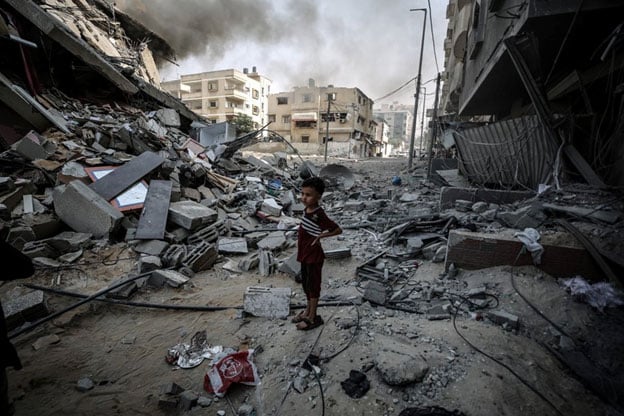
The flood of images of dead Palestinian children and even the audio of Palestinian women screaming in between the sounds of bombs being dropped on buildings in the pitched black darkness of Gaza that house the 2.2 million displaced Palestinians sparked a moral outrage that politically is being expressed by the call for a ceasefire. It’s believed that a ceasefire would at least stop the carnage. And it probably would, but that is the problem. While a ceasefire would temporarily stop the mindless slaughter of innocent Palestinians, the ongoing agony of Palestinians forced to live under the inhumane conditions of occupation in the Gaza concentration camp and the rest of occupied Palestine would continue until the next escalation of resistance or attacks by the settlers.
Why?
Like all European settler projects since 1492 when Europeans spilled out of what became Europe first into the “Americas” where they grew fat and powerful off of the stolen land and most vicious form of slavery humanity has ever known and then through the industrial fueled global colonial/capitalist expansion, the Jewish European settlers have one objective – the expansion of Israeli colonial power and control over all of the lands currently occupied by the Indigenous Palestinians. Unlike other settler projects where the indigenous peoples were subjected to genocide, the Israeli bourgeoisie has the problem that they have not been able to murder and/or displace all of the Palestinian peoples.
The incessant expansion of Israeli settlements, the apartheid wall, checkpoints meant to make live miserable for Palestinians, the neighborhood raids, impunity for the violence of the settlers, thief of houses, massive incarceration, assassinations of Palestinians leaders, peaceful demonstrations met with live fire, the inhumane siege of Gaza and periodic attacks (mowing the lawn as the Israeli govt calls it) in Gaza – all expose the extreme violence of the Israeli settler project that will persist until the colonial relationship is altered.
This means quite clearly that without ending the Israeli settler project with its apartheid laws, racialization of Palestinians and normalized violence, it will be ceasefire today and war tomorrow, because opposition by Palestinians will continue until they are all murdered and/or expelled, and even then, opposition will continue from the displaced Palestinians joining the other displaced Palestinians from the last 75 years of Palestinian dispersal.
The only solution is authentic decolonization. But that solution must be imposed on the Israeli colonists in a similar fashion as the wars for national liberation that took place in Algeria, Vietnam, Kenya, Zimbabwe, and South Africa. Israelis understand that the success of European settler projects only occurred where the settlers were able to murder most of the indigenous population and then subject the survivors to permanent internal colonization such as the current situations in the U.S., Canada, New Zealand, and Australia. Elements of the Israeli ruling class represented by the fascist coalition of forces currently in power under Netanyahu, are quite clear that they are prepared to impose a “final solution” to the Palestinian problem.
Genocide has been the handmaiden of the European Settler Projects
No electricity, no food, no water, no fuel…We are fighting human animals, and we act accordingly.” (Yoav Gallant, Israeli Defense Minister)
The Convention on the Prevention and Punishment of the Crime of Genocide (CPPCG), or the Genocide Convention, defines genocide as the intentional destruction of a national, ethnic, racial or religious group in whole, or in part. A genocide is accepted to be represented by any of five acts:
- Killing members of the group
2. Causing serious bodily or mental harm to members of the group
3. Deliberately inflicting on the group conditions of life calculated to bring about its physical destruction in whole or in part
4. Imposing measures intended to prevent births within the group
5. Forcibly transferring children of the group to another group
It should not be necessary to systematically chronicle Israeli policies from the murder of Palestinian resisters to the gruesome stories of Palestinian women dying in the process of giving birth at Israeli checkpoints, to the current murder of thousands of Palestinian children in Gaza and the West Bank, to conclude that the colonial policies of Israel fit the classic definition of genocide.
The horrific violence deployed by the colonial powers to establish the parasitic colonial relationship pales in comparison to the violence needed to impose a settler colonial project where the intent to permanently settle the conquered land with the population from the “mother-country” or other territories that requires eliminating or severely reducing the physical presence of the indigenous peoples.
This understanding of the genocidal nature of settler-colonialism should be more developed in the U.S. as a result of it being the most developed settler state with its history of violent conquest, slavery, and internal colonization. However, the framing of the U.S. as a settler state with a practice of systematic genocide that continues up to this day has only started to penetrate the theoretical frameworks of left and radical discourse in a meaningful way over the last two decades.
Yet for those of us struggling against this colonial criminal state, its nature is clear, and as a consequence, the historic task – turning imperialist/colonial wars into wars against colonialism it all its various forms.
Therefore, as necessary as it is to demand that the Israeli stop the slaughter, a ceasefire is not enough. The genocidal Israeli project must be completely dismantled and the officials directly responsible for its implementation along with their enablers in the successive U.S. regimes must be brought to justice.
There must not be any hesitation in calling for justice in this form. Gaza has revealed the true nature of European colonialism to a public that had not given much thought to the subject. Establishing the connection between colonialism and capitalist exploitation must be the next step to take advantage of this incipient new consciousness among the public in the West. Today it is going to be a little easier to do that as a consequence of Gaza. The gap between the “collective West” and the global humanity beyond the 10% that represents the U.S. and Europe, a population that the collective West refers to as the “world,” is hardening. But the gap between the elite policymakers and the people in the West and Europe is also expanding and hardening – that is a positive development.
The demands that must serve as the foundation of for a realistic resolution of the colonial relationship in Israel/Palestine must also be demands that serve as basis for the global movement to finally identify and defeat what the Black Alliance for Peace calls the U.S./EU/NATO Axis of Domination.

 After the Crash