
Thinking Beyond Exceptionalism

By David Swanson

Source: Let’s Try Democracy

Excepted from Curing Exceptionalism: What’s wrong with how we think about the United States? What can we do about it? (April, 2018).

Try this experiment: Imagine that space aliens really come to earth and really have, as I think is very unlikely, developed the ability to travel to earth while simultaneously remaining so primitive as to violently attack the places they visit. In contrast to the space aliens, could you identify as an earthling to such an extent as to diminish your other senses of identity? “Earthlings — F— Yeah!” “We’re Number 1!” “Greatest Earthlings on Earth!” And can you hold that thought, in the absence of the space aliens, and rid yourself of any notion of opposing any other or foreign group, while still holding that earthling thought? Alternatively, can you cast climate change and environmental collapse in the role of the evil alien Hollywood monster against whom humanity must unite?

Or try this one: Imagine that various species of humans survived to the current day, so that we Sapiens share the earth with the Neanderthals, the Erectus, the tiny little Floresiensis, etc.[i] Could you form your identity in your mind as a Sapiens? And then, can you hold that thought while either imagining the other species back out of existence or imagining learning to be as respectful and kind to the other species of humans as we should perhaps actually be attempting to be to other types of living human and non-human earthlings right now?

Perhaps the most powerful tool for altering habits of thought about groups of people is role reversal. Let’s imagine that for whatever reasons, beginning some seventy years ago North Korea drew a line through the United States, from sea to shining sea, and divided it, and educated and trained and armed a brutal dictator in the South United States, and destroyed 80 percent of the cities in the North United States, and killed millions of North USians. Then North Korea refused to allow any U.S. reunification or official end to the war, maintained wartime control of the South United States military, built major North Korean military bases in the South United States, placed missiles just south of the U.S. demilitarized zone that ran through the middle of the country, and imposed brutal economic sanctions on the North United States for decades. As a resident of the North United States, what might you think when the president of North Korea threatened your country with “fire and fury”?[ii] Your own government might have gazillions of current and historical crimes and shortcomings to its credit, but what would you think of threats coming from the country that killed your grandparents and walled you off from your cousins? Or would you be too scared to think rationally?

This experiment is possible in hundreds of variations, and I recommend trying it repeatedly in your own mind and in groups, so that people’s creativity can feed into the imagination of others. Imagine that you’re from the Marshall Islands seeking restitution for nuclear testing and/or the rising seas.[iii] Imagine you’re from Niger and less than amused that Americans first hear about your country when their government pretends that Iraq purchased uranium in your country, and that Americans only learn about their own military’s actions in your country when the U.S. president is rude to the mother of a deceased U.S. soldier.[iv] Imagine you’re my friends from Vicenza, Italy, who found local and national majority support for blocking the proposed construction of a U.S. Army base but couldn’t stop it — or similar people in Okinawa or Jeju Island or elsewhere around the globe.

And don’t just imagine you’re the other people. Learn and then re-tell the stories with all the details inverted. It’s not Okinawa. It’s Alabama. Japan is filling Alabama with Japanese military bases. The towns and state are opposed, but craven politicians in Washington, D.C., are going along. The military airplane crashes happen in Alabama. The spread of prostitution and drugs happens in Alabama. The local girls raped and murdered are Alabaman. The Japanese troops say it’s for your own good whether you think so or not, and they don’t really care what you think. You get the idea. This can be done with wealth distribution, with environmental impact, with militarism, with any issue under the sun. The danger of over-simplification should be resisted. The idea is not to stupidly convince yourself that all Americans are 100% evil while all Japanese are some sort of angels. The idea is to reverse some key facts and see whether anything happens to your attitudes. If not, then perhaps your attitudes were fair and respectful to begin with.

Another nominee for most powerful tool for altering habits of thought about groups of people is what goes by the very odd name “humanization.” This is the process wherein you supposedly take a human being or group of human beings, and by learning their names and facial expressions and little idiosyncrasies, you “humanize” them, and you come to the conclusion that these humans are . . . wait for it . . . wait for it . . . humans. Now, I’m 100 percent in favor of this to whatever extent it is needed and works. I think Americans (and probably most people) should read more foreign books, learn more foreign languages, watch more foreign films, and travel more in ways that truly involve them in foreign cultures. I think students should be required to spend a year as exchange students in foreign families and schools. I think a key test of childhood education in the United States should be: What have these children learned about all of humanity, including the 96% outside the United States?

I am hopeful that at some point we can jump the humanization and arrive squarely on the understanding that, in fact, humans are all humans, whether we know anything about them or not! It might help to pretend that all Hollywood movies have been made about and starring Syrians (or any other nationality). If that were so, if every favorite character from every film and TV show were Syrian, would anyone in the world have any doubt that Syrians were human beings? And what effect would that have on our perception of the reported Israeli government position, seemingly abetted by U.S. government policy, that the best outcome in Syria is for nobody to win but the war to continue forever?[v]

David Swanson’s forthcoming book from which this is excerpted is called Curing Exceptionalism: What’s wrong with how we think about the United States? What can we do about it? (April, 2018).


[i] This scenarios was suggested to me by this book: Yuval Noah Harari, Sapiens: A Brief History of Humankind Paperback (Harper Perennial, 2018).

[ii] https://www.nytimes.com/2017/08/08/world/asia/north-korea-un-sanctions-nuclear-missile-united-nations.html (January 16, 2018).

[iii] Marlise Simons, “Marshall Islands Can’t Sue the World’s Nuclear Powers, U.N. Court Rules,” New York Times, https://www.nytimes.com/2016/10/06/world/asia/marshall-islands-un-court-nuclear-disarmament.html (October 5, 2016).

[iv] David Caplan, Katherine Faulders, “Trump denies telling widow of fallen soldier, ‘He knew what he signed up for’,” ABC News, http://abcnews.go.com/Politics/trump-denies-telling-widow-fallen-soldier-knew-signed/story?id=50549664 (October 18, 2017).

[v] Jodi Rudoren, “Israel Backs Limited Strike Against Syria,” New York Times, http://www.nytimes.com/2013/09/06/world/middleeast/israel-backs-limited-strike-against-syria.html?pagewanted=all (September 5, 2013).
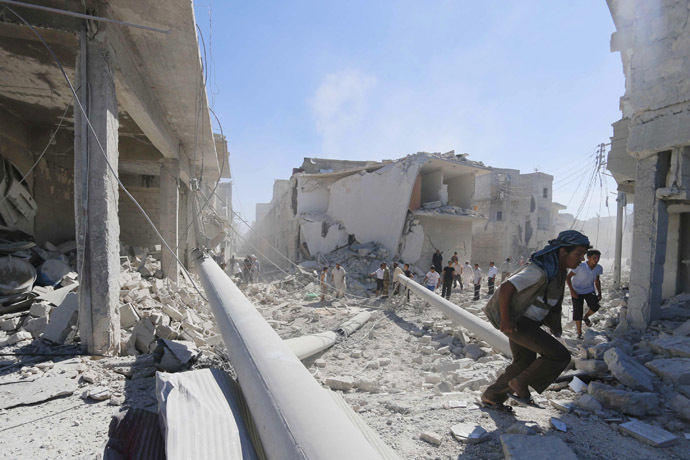
ISIS, Weapons Makers, Thugs Benefit from Bombing

Residents inspect damage at a site hit by what activists said were barrel bombs dropped by forces of Syria's President Assad in Aleppo

By David Swanson

Source: Washington’s Blog

President Obama is bombing the opposite side in Syria from the side he swore we needed to attack one year ago, and those pleased by this declare that he is “doing something.”

U.S. polls suggest that the same people recognize that this something will make the U.S. more likely to be attacked and nonetheless favor this action. This is unthinking fear produced by slick beheading videos for audiences too distracted to notice that the Iraqi government, Saudi government and numerous other U.S. friends and allies behead. And are we to imagine that when Obama kills a 16 year old American and the 6 kids near him his head remains intact? Should we pretend that the people being killed by U.S. missiles right now aren’t losing their heads?

This action is illegal under the UN Charter, Kellogg-Briand Pact, and U.S. Constitution. This action is immoral as it fuels violence that needs to be reduced. This action is knowingly, maddeningly counterproductive, guaranteed to build hostility to the United States, which is already so hated that ISIS openly advocates for a U.S. attack on it. This action by this White House is what ISIS wants and what weapons makers want. It is not what the people of Syria or Iraq or the world want. It further shreds the rule of law while dumping gasoline on a fire of U.S. creation.

What’s needed is, contrary to what your television suggests, not to “do nothing” or love beheadings. What’s needed is an arms embargo. The U.S. ships 79% of the weapons shipped to the Middle East, not counting the weapons of the U.S. military. An arms embargo could be 79% successful with just one country participating, and others could certainly be brought to do so.

What’s needed is actual aid on a massive scale, restitution to the people of the region for the crimes of the U.S. government. An aid program sufficient to make the United States beloved rather than hated would cost a lot less money than the missiles and bombs for which price seems to be no concern at all.

What’s needed is diplomacy. The U.S. government is happy to talk with Syria or Iran or Russia when the object is war. Why can it not talk to them when the object is peace?

Our Constitutional scholar Nobel peace laureate no-dumb-wars end-the-mindset president will be protested today at the White House and at his appearance in New York, and should be protested everywhere he goes.

Congress members should not know a moment’s peace, but should be taught that cowardice is not a campaign strategy. None who voted for weapons to Syria should be returned to Washington next year.

War as a first resort, as our biggest public program, as the be all and end all of U.S. foreign policy is a form of insanity that has no redeeming feature. War is our top destroyer of the natural environment, of the economy, of civil liberties, of self-governance, and of morality. This is a case of a doctor trying to cure the world while suffering from a deadly and highly infectious disease that in his own mind is the epitome of health.

You can’t cure war fever with more war. You can only get to peace through peace.

Stop the bombing.

The War Activists

By David Swanson

Originally posted at ConsortiumNews.com

War activists, like peace activists, push for an agenda.  We don’t think of war activists as “activists” because they rotate in and out of government positions, receive huge amounts of funding, have access to big media, and get meetings with top officials just by asking — without having to generate a protest first.

They also display great contempt for the public and openly discuss ways to manipulate people through fear and nationalism — further shifting their image away from that of popular organizers. But war activists are not journalists, not researchers, not academics. They don’t inform or educate. They advocate. They just advocate for something that most of the time, and increasingly, nobody wants.

William Kristol and Robert Kagan and their organization, the Foreign Policy Initiative, stand out as exemplary war activists. They’ve modified their tone slightly since the days of the Project for the New American Century, an earlier war activist organization. They talk less about oil and more about human rights. But they insist on U.S. domination of the world. They find any success by anyone else in the world a threat to the United States.

And they demand an ever larger and more frequently used military, even if world domination can be achieved without it. War, for these war activists, is an end in itself. As was much more common in the 19th century, these agitators believe war brings strength and glory, builds character, and makes a nation a Super Power.

Kristol recently lamented U.S. public opposition to war. He does have cause for concern. The U.S. public is sick of wars, outraged by those in Iraq and Afghanistan, and insistent that new ones not be begun. In September, missile strikes into Syria were successfully opposed by public resistance. In February, a new bill to impose sanctions on Iran and commit the United States to joining in any Israeli-Iranian war was blocked by public pressure. The country and the world are turning against the drone wars.

The next logical step after ending wars and preventing wars would be to begin dismantling the infrastructure that generates pressure for wars. This hasn’t happened yet. During every NCAA basketball game the announcers thank U.S. troops for watching from 175 nations. Weapons sales are soaring. New nukes are being developed. NATO has expanded to the edge of Russia. But the possibility of change is in the air. A new peace activist group at WorldBeyondWar.org has begun pushing for war’s abolition.

Here’s Kristol panicking:

“A war-weary public can be awakened and rallied. Indeed, events are right now doing the awakening. All that’s needed is the rallying. And the turnaround can be fast. Only 5 years after the end of the Vietnam war, and 15 years after our involvement there began in a big way, Ronald Reagan ran against both Democratic dovishness and Republican détente. He proposed confronting the Soviet Union and rebuilding our military. It was said that the country was too war-weary, that it was too soon after Vietnam, for Reagan’s stern and challenging message. Yet Reagan won the election in 1980. And by 1990 an awakened America had won the Cold War.”

Here’s Kagan, who has worked for Hillary Clinton and whose wife Victoria Nuland has just been stirring up trouble in Ukraine as Assistant Secretary of State. This is from an article by Kagan much admired by President Barack Obama:

“As Yan Xuetong recently noted, ‘military strength underpins hegemony.’ Here the United States remains unmatched. It is far and away the most powerful nation the world has ever known, and there has been no decline in America’s relative military capacity — at least not yet.”

This pair is something of a good-cop/bad-cop team. Kristol bashes Obama for being a wimp and not fighting enough wars. Kagan reassures Obama that he can be master of the universe if he’ll only build up the military a bit more and maybe fight a couple more wars here and there.

The response from some Obama supporters has been to point out that their hero has been fighting lots of wars and killing lots of people, thank you very much. The response from some peace activists is to play to people’s selfishness with cries to bring the war dollars home. But humanitarian warriors are right to care about the world, even if they’re only pretending or badly misguided about how to help.

It’s OK to oppose wars both because they kill huge numbers of poor people far from our shores and because we could have used the money for schools and trains. But it’s important to add that for a small fraction of U.S. military spending we could ensure that the whole world had food and clean water and medicine. We could be the most beloved nation. I know that’s not the status the war activists are after. In fact, when people begin to grasp that possibility, war activism will be finished for good.

David Swanson is a peace pundit, antiwar author and talk radio host. He is syndicated by PeaceVoice. His books include War No More. He hosts Talk Nation Radio.

More about the Foreign Policy Initiative from Abby Martin, who was recently a target of their attacks: