Biden and the Democrats will Sow Chaos in Latin America

By Timothy Alexander Guzman

Source: Silent Crow News

Election Interference, Regime Change and a Possible Humanitarian Intervention is on Washington’s Agenda 

US President Joseph Biden, a relic from Washington’s old political establishment will continue the same imperialist policies in Latin America as did his predecessors including that of Donald Trump.  There is a clear indication that Washington’s hostilities towards Venezuela’s President Nicolas Maduro will continue under a Biden administration.  The day before Biden’s inauguration, Reuters’ had published a report on what we can expect from the new administration when it comes to Venezuela, ‘Biden will recognize Guaido as Venezuela’s leader, top diplomat says.’ which means that Washington will continue to support the opposition leader, Juan Guaido as Venezuela’s “legitimate” president.  According to the report, Anthony Blinken said “U.S. President-elect Joe Biden’s administration will continue to recognize Venezuelan opposition leader Juan Guaido as the South American country’s president.” Not only Washington would recognize a political figure who was selected by Washington, it would continue to use targeted sanctions on the Latin American country coinciding with humanitarian aid:

Blinken told members of the U.S. Senate that Biden would seek to “more effectively target” sanctions on the country, which aim to oust President Nicolas Maduro – who retains control of the country. Blinken said the new administration would look at more humanitarian assistance to the country

US hostilities towards Venezuela did not start with Trump, there were tensions between Washington and Caracas with the Obama and Bush regimes.  An article from the Associated Press (AP) in 2015 ‘Venezuela’s President Accuses Vice President Biden of Plotting to Overthrow Him’ said that Washington had imposed “new visa restrictions on Venezuelan officials and their families.”  The former White House Communications Director under Obama, Jen Psaki who is now on Biden’s team as the White House Press Secretary said that “the U.S. was showing clearly that human rights violators and their families “are not welcome in the United States.” Washington’s actions earned condemnation from Maduro who said that “he would write a letter to Obama over what he called an attempt to violate Venezuela’s national sovereignty” and that Washington’s long-time policies which are basically strong-arm tactics used on Venezuela and its close allies in the region will lead to failure “U.S. policy toward Venezuela has been kidnapped by “irresponsible, imperial forces that are putting the United States on a dead-end.”  Maduro’s response towards Washington’s sanctions at the time was on a televised national address which he criticized Obama’s Vice-President, Joe Biden:

In a televised address over the weekend, Maduro claimed that Biden sought to foment the overthrow of his socialist government during a Caribbean energy summit Biden hosted last month in Washington. According to Maduro, Biden told Caribbean heads of state that the Venezuelan government’s days were numbered and it was time they abandon their support.  “What Vice President Jose Biden did is unspeakable,” Maduro said

And of course, Washington dismissed Maduro’s claims as “ludicrous.”  With Joe Biden in charge, expect more of the same bi-partisanship actions including more sanctions, regime change operations and even the possibility of an assassination attempt on  Maduro’s life.  With a number of war hawks appointed under this new administration including humanitarian interventionist, Samantha Power who will lead the United States Agency for International Development (USAID) tweeted “What’s happening in Venezuela is flying under the radar in the US, but it is incredibly serious” shows what direction Washington will move towards.  “In the past week, the opposition banned from competing in April presidential elections, UNICEF warns of child malnutrition crisis, IMF predicts 13,000% inflation in 2018” meaning that Power will push for a humanitarian intervention in some form or another.  Power has supported military interventions in Syria and was a cheerleader for the war in Afghanistan and Libya.  There will be bi-partisan support from both the democrats and republicans for regime change in Venezuela.  But a war against Venezuela under Biden is also quite possible since they have the world’s largest oil reserves on the planet.  Tensions between Washington and Caracas will only escalate in the upcoming months.

Nicaragua will be also on Washington’s radar as they are scheduled to have Presidential elections in November.  Expect some sort of election interference to oust long-time enemy of Washington, Nicaraguan President, Daniel Ortega.  In a September 5th tweet, Biden said “Nicaraguan asylum seekers fleeing oppression deserve to have their cases heard.  Instead, they’re being deported back into the tyrannical grip of Daniel Ortega without a chance to pursue their claims.  President Trump’s cruelty truly knows no bounds.”  Venezuela and Nicaragua will experience hostilities from the Biden team, a continuation of policies from previous US regimes is assured.

Obama’s 2009 Coup in Honduras is a Warning to Anti-Imperialists in Latin America 

Joe Biden’s history with Latin America as vice-President to Obama should be considered a warning sign of things to come.  As soon as Obama was selected for office, they went to work on their backyard with a shovel in hand and set their sights on the small nation of Honduras.  Before, the US approved the coup against its Democratic leader, Manuel Zelaya because he wanted to rewrite the constitution. Zelaya administered an opinion poll for a referendum so that a constitutional assembly can legally reform the constitution that would allow Honduran citizens to have a legitimate voice in the political process.  Honduran officials, members of the Supreme Court and even members of his own party who are under Washington’s control declared Zelaya’s plans as unconstitutional.  Officials from the Obama regime including Hillary Clinton who was the Secretary of State at the time, all agreed Zelaya had to be removed from power.  Zelaya was also too friendly with Washington’s enemies in the region including Bolivia, Ecuador, Nicaragua and Venezuela.  Zelaya had also helped people in need as he raised the hourly minimum-wage, funded scholarships for students, authorized the distribution of milk and basic food necessities for children and even helped distribute energy-saving light bulbs among others for the Honduran people. Washington also considered Zelaya a threat to its interests concerning the Central American Free Trade Agreement (CAFTA) and its US troops stationed at the Palmerola military base if Zelaya decided to cancel the CAFTA deal or stop US troops from entering Honduras.  For decades, Washington has trained soldiers and officers in the Honduran military through the former U.S. Army School of the Americas (SOA) which is now called the Western Hemisphere Institute for Security Cooperation (WHINSEC).

On June 28th, 2009, with permission from the Supreme Court of Honduras issued an order for the military to arrest and detain President Zelaya  who was taken to the Hernan Acosta Mejia Air Base located in Tegucigalpa, Honduras and was exiled to Costa Rica.  The aftermath of the coup resulted in Honduras becoming one of the most dangerous countries on the planet with one of the highest murder-rates in Central America. Roberto Micheletti became the interim-president following the coup.  Under his leadership, the Honduras government became a repressive force that lead to an increase of Hondurans deciding to immigrate to the US.  Human rights groups and activists lives were threatened.  In 2016, one of the death threats became a reality for a well-known Indigenous rights and environmental activist by the name of Bertha Caceres who was assassinated in her home.  Caceres was known for preventing one of the world’s largest corporations that builds dams from completing the Agua Zarca Dam at the Río Gualcarque.  Life in Honduras became worst after Washington’s intervention to oust a democratically elected leader who wanted to make things a little better for his people which constitutes a criminal act under Washington’s political establishment.

What Does An Imperialist Power Under Joseph Biden Mean for Latin America?

The gloves will come off.  Joe Biden wants to get the job done for the Military-Industrial Complex.  The Biden regime will be more aggressive and dangerous to left-wing Latin American leaders who have disobeyed Washington’s political establishment.  That’s why they are all on the hit-list to be removed from power so that Washington’s preferred candidates can regain control to benefit their corporate and military interests that has plunged Latin America into a cycle of civil wars, debt and poverty since the end of the Spanish-American war.  Biden and the Democrats will try to prove to the Republicans who can be more “tough” on Latin American leaders and others around the world who defy Washington’s policies.  Biden’s presidency might prove that his administration will be more hawkish than the Republicans on Venezuela and the rest of Latin America’s anti-imperialist governments.

Era of US Domination of Latin America Coming to an End

Marcha en Venezuela contra las sanciones de Trump (Reuters)

By Kevin Zeese and Margaret Flowers

Source: Dissident Voice

Despite its failings at home, the United States intervenes in countries across multiple continents seeking to control their governments and resources.

This week, we look at the US’ latest efforts in Nicaragua, Venezuela, and Bolivia to undermine their independence and force them to serve the interests of the US government and transnational corporations.

In all three countries, the US has displayed a lack of understanding of the people and their support for their revolutionary processes, and as a result, is failing. As US empire fades, so might the Monroe Doctrine come to an end.

Sandanista- FSLN rally in Nicaragua

Nicaragua: USAID Multi-Year Destabilization Plan Exposed

A US Agency for International Development (USAID) document revealed by reporter William Grigsby describes covert plans to overthrow the democratically-elected Nicaraguan government in the next two years. USAID seeks to hire mercenaries “to take charge of the plan . . . to disrupt public order and carry out other [violent] actions before, during, and/or after the 2021 elections.”

USAID is creating Responsive Assistance In Nicaragua (RAIN), allotting $540,000 in grants to remove the Sandinista government in what it calls “Nicaragua’s transition to democracy.” Daniel Ortega won the 2016 election with 72 percent of the vote in what election observers from the Organization of American States (OAS), a US tool, described as taking “place in a calm, smooth and pacific manner, with no large incidents.”

Brian Willson, who has opposed US efforts to dominate Nicaragua since the 1980s Contra war, concludes the US realizes Ortega will win the 2021 election. In fact, this week, a poll showed support for Ortega’s party, FSLN, at 50% and for the opposition at 10%. One of USAID plans, as they tried in Venezuela in 2018, is for the opposition to boycott the election since they know they will lose, then call it illegitimate and create a political and economic crisis.

The real goal is not a democracy but domination so US transnational corporations can profit from the second poorest country in the hemisphere by putting in place a neoliberal economy to privatize public services, cut social services, and purge all traces of the Sandinistas. USAID also plans to “reestablish” the police and military to enforce their rule. Another goal is to stop Nicaragua from being the “threat of a good example” for its economic growth, reduction of inequality, poverty, illiteracy and crime.

Ben Norton points out in the Grayzone that “the 14-page USAID document employed the word ‘transition’ 102 times” making clear the intent is regime change.  A “sudden transition without elections,” a euphemism for a coup, is one of three possible regime change scenarios.

John Perry writes about “US interference in Nicaragua, going back at least as far as William Walker’s assault on its capital and usurpation of the presidency in 1856.” Since the 1979 Sandinista Revolution, the US has sought to take back control of Nicaragua.

USAID and its National Endowment for Democracy (NED) have been funding the opposition. NED financed 54 projects from 2014-17 to lay the groundwork for a 2018 coup attempt, which  also involved USAIDWiston Lopez writes the US has provided “more than 31 million dollars between the end of 2017 and May 1, 2020.” When the attempted coup in 2018 failed, the US also put in place illegal unilateral coercive measures, known as economic sanctions, supported by both Democrats and Republicans, to try to weaken the country.

The USAID’s RAIN program outlines the usual regime change steps; e.g., remake the police and military as enforcers of the new neoliberal order, move “quickly to dismantle parallel institutions”; i.e., the Sandinista Front, the Sandinista Youth, and other grassroots institutions, and implement “transitional justice measures”; i.e., the prosecution of current government officials and movement leaders.

A new area of attack is a disinformation campaign against Nicaragua’s handling of COVID-19. The opposition misrepresents the government’s response and puts forward false death statistics in an attempt to create chaos. As Wiston López points out, “Since March the US-directed opposition has focused 95% of their actions on attempting to discredit Nicaragua’s prevention, contention, and Covid treatment. However, this only had some success in the international media and is now backfiring since Nicaragua is the country with one of the lowest mortality rates in the continent.”

The US media fails to report on the success of Nicaragua in combating the virus using a community-based health system. Nicaragua has been building its health system for the last 12 years and took rapid action to prepare for the virus. Nicaragua did not impose a lock down because it is a poor country where 80 percent of people are in the informal economy and 40 percent live in rural areas. People must work in order to eat.

Stephen Sefton puts the failure of the United States so far in context. At its root, the US does not understand the people of Nicaragua, their history of fighting US domination, and their ability to overcome right-wing puppets. It also misunderstands what the Sandinista government is doing to better the lives of the people in every sector of the economy. Sefton concludes, “The US government has failed notoriously to meet the needs of its own people during the current pandemic but can still find money to try and destroy a small country whose success makes US social, economic and environmental policy look arbitrary, negligent and criminal.”

Nicolas Maduro kicks out Donald Trump (Photo by Ben Norton

Venezuela: Bipartisan Failed Regime Change

Ever since the 1998 election of Hugo Chavez, successive US administrations have tried and failed to dominate Venezuela. The bipartisan nature of this policy was on display on August 4, when Elliot Abrams, the notorious coup-monger for multiple presidents, testified in Congress. Not a single Senator criticized the attempt to illegally overthrow a democratically-elected government.

Abrams was criticized by both Democrats and Republicans for his inability to remove President Maduro from power. Senator Chris Murphy (D-CT) was most open about the coup attempt describing it as “a case study in diplomatic malpractice” and claiming Trump botched a winning play in a comedy of errors that strengthened Maduro. After the hearing, Murphy posted a series of Tweets admitting the coup and how it could have been done better.

clip from Murphy’s embarrassing comments was shared widely including by the Venezuelan Vice President Delcy Rodríguez and Foreign Minister Jorge Arreaza. When Vijay Prashad asked Arreaza his reaction, he described the US openly admitting crimes and said the “confessions” of Murphy, Gen. John Kelly, John Bolton, and Elliot Abrams “are priceless evidence for the complaint we raised at the International Criminal Court.”

Elliot Abrams testified that he would continue to work very hard to remove Maduro hopefully by the end of the year.  This echoed a statement by President Trump at SouthCom headquarters in Florida. Sen. Murphy’s comments are consistent with those made by Joe Biden who says he would be more effective at removing Maduro than Trump. Biden described Trump as soft on Maduro because he considered talking to him.

Elliot Abrams announced the US will be starting a media war against Venezuela. The reality is the US has been conducting a media war against Venezuela for more than 20 years.

Venezuela is moving ahead with elections for the National Assembly on December 6, 2020. Unlike 2018, more parties are agreeing to participate including the larger Democratic Action and Justice First parties, as well as a new Communist Party alliance and the hard-right Popular Will party, which was US puppet Juan Guaidó’s former party. There will be 105 political parties contesting for 277 National Assembly seats, 110 more than the current term. Venezuela uses a combination of majority winners and proportional representation. Venezuela also requires half the candidates to be female, and they use electronic voting confirmed by paper ballots with a public citizen audit on Election Day.

Juan Guaidó and others allied with the United States said they would boycott the election. Guaidó cannot risk running because he is likely to be defeated. The US is encouraging a boycott and then will claim the election was not legitimate as it did in the last presidential election. After December, Guaidó will not hold any elected office making his fraudulent claim to the presidency even weaker.

These events come after two major embarrassments for the US in Venezuela. Operation Gideonan attempt by mercenaries to invade Venezuela was foiled on May 4, leading to their arrests and the arrests of their co-conspirators. The State Department abandoned the mercenaries, and this week two former Green Berets were sentenced to 20 years in prison after admitting their guilt. It was evident that Guaidó was heavily involved in this failure adding to his failed presidential takeover and tainting him beyond repair.

The second defeat was Iran and Venezuela working together to deliver oil and equipment for Venezuelan refineries. Five Iranian oil tankers passed by the largest US armada in the Caribbean since the invasion of Panama. Southcom has been repeatedly sending warships into Venezuelan waters. The solidarity of Iran and Venezuela overcame the naval blockade, undermined US sanctions, and sent a shudder through the US by showing other nations they can defy the United States.

Venezuela has a strong history of struggle against imperialism but the US’ economic war is costing their economy hundreds of billions of dollars and leading to the premature death of Venezuelans. In addition, the United Kingdom is refusing to release more than a billion dollars of Venezuelan gold held in the Bank of England that was to be used for food and medicine. The UK court ruled against Venezuela but they are appealing the decision.

Bolivians protest the postponement of the election

Bolivia: US Dictator Fears Democratic Vote

On November 12 2019, a US-backed coup in Bolivia removed President Evo Morales who had just won re-election. The self-proclaimed President Jeanine Añez, a right-wing Christian, leads a de facto government involved in massacres, persecution and imprisonment of political leaders. It is destroying the social and economic model and achievements of the Movement Towards Socialism (MAS Party) led by Morales.

The OAS played a crucial role in the coup with their false analysis of Morales’ re-election. The western media reported the false OAS analysis without criticism. Now, studies by MIT and the Center for Economic and Policy Analysis have shown that Morales clearly won the election and should have remained in power. For months the Washington Post claimed Morales’ re-election was a fraud, but finally, in March, it acknowledged the election was legitimate. Similarly, the New York Times admitted in July that Morales won the election.

Many have called this a lithium coup because the element is plentiful in Bolivia and critical for batteries. This was made evident when Elon Musk, the head of Tesla, said on Twitter “We will coup whoever we want! Deal with it.” Tesla would benefit from cheap and plentiful lithium for electric car batteries.

The people of Bolivia are struggling to restore democracy. The fraudulent report by the OAS led to a three-week conflict between right-wing Bolivians protesting alleged fraud and pro-government, mostly indigenous, demonstrators defending Morales. The military and police sided with the right-wing coup. The coup government threatened legislators and their families while repressing the people. There were racist attacks against the majority Indigenous population and the Wiphala, the indigenous flag, was burned in the streets. When she took power, Áñez, surrounded by right-wing legislators, held up a large leather bible and declared, “The Bible has returned to the palace.”

The US recognized the coup government, similar to its recognition of the failed coup leader, Juan Guaidó in Venezuela. Añez claimed she’d be transitory until the next election, but at the direction of the US, she is putting in place deep roots and has delayed elections.

The repression has galvanized the MAS party, as well as peasant unions and grassroots organizations who continue their struggle to restore Bolivian democracy. The pressure led to elections being scheduled. Initially, Áñez said she would not run but reversed herself and is now a candidate while she is trying to outlaw the MAS party and its candidates.

Elections were scheduled for May 3, but have been postponed twice allegedly due to the pandemic, but really because this is an ongoing coup.

It is true that the COVID-19 pandemic is hitting Bolivia hard with horror stories about people unable to get medical treatment. Immediately after the coup, the Añez government expelled the Cuban doctors. The coup-government is unable to manage the health system. Corruption is rampant in the purchase of medical equipment. The health ministry has had three ministers during the crisis. The situation is dire with overcrowded hospitals, lack of basic supplies, and corpses in the streets and in their homes with nowhere to be buried.

The coup-government is using the virus to try to delay elections because polls show the MAS candidate, Luis Arce, is far ahead and likely to win in the first round of elections with Áñez coming in a distant third. Áñez has sought to prosecute Arce to keep him from running, so far unsuccessfully.  On July 6, the Attorney General of Bolivia charged Evo Morales with terrorism and financing of terrorism from exile and is seeking preventive detention.

Since mid-July, thousands of Bolivians have been protesting the postponement of elections. They are holding sustained protests throughout the country and blocking many roads. Indigenous and peasant groups, agricultural groups, along with women and unions are joining together calling for elections.  Morales, Arce, and the MAS Party have denounced the delay.

Domination Will Not Reverse Decline

Evo Morales said in a recent interview:

The United States is trying to make Latin America its backyard forever. We know about the hard resistance of the peoples of Cuba, Venezuela, Nicaragua. The struggle of our peoples is very important. The United States wants to divide us in order to plunder our natural resources. The peoples no longer accept domination and plunder. The United States is in decline, and yet it lashes out.

The US is weakening as a global power and its failures in Latin America are both a symptom of this and are causing further decline. The US’ violations of international law are obvious and are being challenged. But the US is an empire and it will not give up the Monroe Doctrine easily.

As citizens of Empire, we have a particular responsibility to demand the US stop its sanctions and illegal interference in Latin America and elsewhere around the world. In this time of multiple global crises, we must demand the US become a cooperative member of the world community and work peacefully to address the pandemic, recession and climate crisis.

Structures to do this exist to help with this such as the global ceasefire and the Paris Climate agreement. And on the anniversary of the US bombing of Hiroshima and Nagasaki, Japan, we must add the Nuclear Ban Treaty as another effort the US must join.

The Triumph of Evil

(Museum of the Revolution, León, Nicaragua)

By Paul Craig Roberts

Source: PaulCraigRoberts.org

Today (April 17) I heard a NPR “news” report that described the democratically elected president of Venezuela as “the Venezuelan dictator Maduro.” By repeating over and over that a democratically elected president is a dictator, the presstitutes create that image of Maduro in the minds of vast numbers of peoples who know nothing about Venezuela and had never heard of Maduro until he is dropped on them as “dictator.”

Nicolas Maduro Moros was elected president of Venezuela in 2013 and again in 2018. Previously he served as vice president and foreign minister, and he was elected to the National Assembly in 2000. Despite Washington’s propaganda campaign against him and Washington’s attempt to instigate violent street protests and Maduro’s overthrow by the Venezuelan military, whose leaders have been offered large sums of money, Maduro has the overwhelming support of the people, and the military has not moved against him.

What is going on is that American oil companies want to recover their control over the revenue streams from Venezuela’s vast oil reserves. Under the Bolivarian Revolution of Chavez, continued by Maduro, the oil revenues instead of departing the country have been used to reduce poverty and raise literacy inside Venezuela.

The opposition to Maduro inside Venezuela comes from the elites who have been traditionally allied with Washington in the looting of the country. These corrupt elites, with the CIA’s help, temporarily overthrew Chavez, but the people and the Venezuelan military secured his release and return to the presidency.

Washington has a long record of refusing to accept any reformist governments in Latin America. Reformers get in the way of North America’s exploitation of Latin American countries and are overthrown.

With the exceptions of Venezuela, Bolivia, Cuba, and Nicaragua, Latin America consists of Washington’s vassal states. In recent years Washington destroyed reform governments in Honduras, Argentina and Brazil and put gangsters in charge.

According to US national security adviser John Bolton, a neoconservative war monger, the governments in Venezuela, Cuba, and Nicaragua will soon be overthrown. New sanctions have now been placed on the three countries. Washington in the typical display of its pettiness targeted sanctions against the son of the Nicaraguan president Daniel Ortega. https://www.rt.com/news/456841-bolton-russia-venezuela-threat/

Ortega has been the leader of Nicaragua since for 40 years. He was president 1985-1990 and has been elected and reelected as president since 2006.

Ortega was the opponent of Somoza, Washington’s dictator in Nicaragua. Consequently he and his movement were attacked by the neoconservative operation known as Iran-Contra during the Reagan years. Ortega was a reformer. His government focused on literacy, land reform, and nationalization, which was at the expense of the wealthy ruling class. He was labeled a “Marxist-Leninist,” and Washington attempted to discredit his reforms as controversial leftist policies.

Somehow Castro and Ortega survived Washington’s plots against them. By the skin of his teeth so did Chavez unless you believe it was the CIA that gave him cancer. Castro and Chavez are dead. Ortega is 74. Maduro is in trouble, because Washington has stolen Venezuela’s bank deposits and cut Venezuela off the international financial system, and the British have stolen Venezuela’s gold. This makes it hard for Venezuela to pay its debts.

The Trump regime has branded the democratically twice-elected Maduro an “illegitimate” president. Washington has found a willing puppet, Juan Guaido, to take Maduro’s place and has announced that the puppet is now the president of Venezuela. No one among the Western presstitutes or among the vassals of Washington’s empire finds it strange that an elected president is illegitimate but one picked by Washington is not.

Russia and China have given Maduro diplomatic support. Both have substantial investments in Venezuela that would be lost if Washington seizes the country. Russia’s support for Maduro was declared by Bolton today to be a provocation that is a threat to international peace and security. Bolton said his sanctions should be seen by Russia as a warning against providing any help for the Venezuelan government.

Secretary of state Mike Pompeo and vice president Pence have added their big mouths to the propaganda against the few independent governments in Latin America. Where is the shame when the highest American government officials stand up in front of the world and openly proclaim that it is official US government policy to overthrow democratically elected governments simply because those governments don’t let Americans plunder their countries?

How is it possible that Pompeo can announce that the “days are numbered” of the elected president of Nicaragua, who has been elected president 3 or 4 times, and the world not see the US as a rogue state that must be isolated and shunned? How can Pompeo describe Washington’s overthrow of an elected government as “setting the Nicaraguan people free?”

The top officials of the US government have announced that they intend to overthrow the governments of 3 countries and this is not seen as “a threat to international peace and security?”

How much peace and security did Washington’s overthrow of governments in Iraq, Libya, Ukraine, and the attempted overthrow of Syria bring?

Washington is once again openly violating international law and the rest of the world has nothing to say?

There is only one way to describe this: The Triumph of Evil.

“The blood-dimmed tide is loosed, and everywhere the ceremony of innocence is drowned; the best lack all conviction, while the worst are full of passionate intensity.” — William Butler Yeats

The Troika of Tyranny: The Imperialist Project in Latin America and Its Epigones

By Roger Harris

Source: CounterPunch

Cuba, Nicaragua, and Venezuela are today threatened by US imperialism. The first salvo of the modern Age of Imperialism started back in 1898 when the US seized Cuba along with Puerto Rico and the Philippines in the Spanish-American War.

The Age of Imperialism, as Lenin observed, is characterized by the competition of the various imperial powers for dominance. That inter-imperialist rivalry led to World War I. Lenin called those putative socialists who supported their own national imperialist projects “social imperialists.” Social imperialism is a tendency that is socialist in name and imperialist in deed. Imperialism and its social imperialist minions are still with us today.

US Emerges as the World’s Hegemon

The United States emerged after World War II as the leading imperialist power. With the implosion of the Socialist Bloc around 1991, US hegemony became even more consolidated. Today the US is the undisputed world’s hegemon.

Hegemony means to rule but even more so to dominate. As the world’s hegemon, the US will not tolerate neutral parties, let alone hostile ones. As articulated in the Bush Doctrine, the US will try to asphyxiate any nascent counter-hegemonic project, no matter how insignificant.

In the Caribbean, for instance, the US snuffed out the leftist government of Grenada in 1983 in what was code named Operation Urgent Fury. Grenada has a population smaller than Vacaville, California.

The only powers that the world’s hegemon will tolerate are junior partners such as Colombia in Latin America. The junior partner must accept a neoliberal economic regime designed to serve the interests of capital. Structural adjustment of the economy is demanded such that the neoliberal “reforms” become irreversible; so that you can’t put the toothpaste back in the tube.

Colombia recently joined NATO, putting that junior partner’s military under direct interaction with the Pentagon bypassing its civilian government. The US has seven military bases in Colombia in order to project – in the words of the US government – “full spectrum” military dominance in the Latin American theatre.

Needless-to-say, no Colombian military bases are in the US. Nor does any other country have military bases on US soil. The world’s hegemon has some 1000 foreign military bases. Even the most sycophantic of the US’s junior partners, Great Britain, is militarily occupied by 10,000 US troops.

The US is clear on its enemies list. On November 1, US National Security Advisor John Bolton, speaking in Miami, labelled Venezuela, Nicaragua, and Cuba the “troika of tyranny.” He described a “triangle of terror stretching from Havana to Caracas to Managua.”

Venezuela, Nicaragua, and Cuba are targeted by US imperialism because they pose what might be called the “threat of a good example;” that is, an alternative to the neoliberal world order.

These countries are suffering attacks from the imperialists because of the things they have done right, not for their flaws. They are attempting to make a more inclusive society for women, people of color, and the poor; to have a state that, instead of serving the rich and powerful, has a special option for working people, because these are the people most in need of social assistance.

Sanctions: The Economic War against Venezuela, Nicaragua, and Cuba

The US imperialist rhetoric is backed with action. In 2015, US President Obama declared Venezuela an “extraordinary threat to US security” and imposed sanctions. These sanctions have been extended and deepened by the Trump administration. The US has likewise subjected Cuba to sanctions in a seamless bipartisan policy of both Republicans and Democrats for over half a century. Now the US is the process of imposing sanctions on Nicaragua.

Unilateral sanctions, such as those imposed by the US, are illegal under the charters of both the UN and the Organization of American States, because they are a form of collective punishment targeting the people.

The US sanctions are designed to make life so miserable for the masses of people that they will reject their democratically elected government. Yet in Venezuela, those most adversely affected by the sanctions are the most militantly in support of their President Nicolás Maduro.

Consequently, the Trump administration is also floating the option of military intervention against Venezuela. The recently elected rightwing leaders Bolsonaro in Brazil and Duque in Colombia, representing the two powerful states on the western and southern borders of Venezuela, are colluding with the hegemon of the north.

The inside-the-beltway human rights organizations, such as Human Rights Watch, fail to condemn these illegal and immoral sanctions. They lament the human suffering caused by the sanctions, all the while supporting the imposition of the sanctions. Nor do they raise their voices against military intervention, perhaps the gravest of all crimes against humanity.

Liberal establishments such as the advocacy group Washington Office on Latin America (WOLA) try to distinguish themselves from hardline imperialists by opposing a military invasion in Venezuela while calling for yet more effective and punishing sanctions. In effect, they play the role of the good cop, providing a liberal cover for interference in the internal affairs of Latin American nations.

These billionaire-funded NGOs have a revolving-door staffing arrangement with the US government. So it is not surprising that they will reflect Washington’s foreign policies initiatives.

But why do some organizations claiming to be leftist so unerringly echo the imperialists, taking such umbrage over Venezuela, Cuba, and Nicaragua while ignoring far greater problems in, say, Mexico, Colombia, and Honduras, which are US client states?

Most Progressive Country in Central America Targeted

Let’s take Nicaragua. A year ago, the polling organization Latinobarómetro, found the approval rating of Nicaraguans for their democracy to be the highest in Central America and second highest in Latin America.

Daniel Ortega had won the Nicaraguan presidency in 2006 with a 38% plurality, in 2011 with 63%, and 72.5% in 2016. The Organization of American States officially observed and certified the vote. Polls indicated Ortega was perhaps the most popular head of state in the entire western hemisphere. As longtime Nicaraguan solidarity activist Chuck Kaufman noted, “Dictators don’t win fair elections by growing margins.”

Nicaragua is a member of theanti-imperialist Bolivarian Alliance for the Peoples of Our America with Cuba, Venezuela, Bolivia, and some Caribbean states. Speaking at the UN, the Nicaraguan foreign minister had the temerity to catalogue the many transgressions of what Martin Luther King called “the greatest purveyor of violence in the world” and express Nicaragua’s opposition.

These are reasons enough for a progressive alternative such as Nicaragua to curry the enmity of the US. The enigma is why those claiming to be leftists would target a country that had:

+ Second highest economic growth rates and the most stable economy in Central America.

+ Only country in the region producing 90% of the food it consumes.

+ Poverty and extreme poverty halved; country with the greatest reduction of extreme poverty.

+ Reached the UN Millennium Development Goal of cutting malnutrition by half.

+ Nicaraguans enjoyed free basic healthcare and education.

+ Illiteracy had been virtually eliminated, down from 36% in 2006 when Ortega took office.

+ Average economic growth of 5.2% for the past 5 years (IMF and the World Bank).

+ Safest country in Central America (UN Development Program) with one of the lowest crime rates in Latin America.

+ Highest level of gender equality in the Americas (World Economic Forum Global Gender Gap Report 2017).

+ Did not contribute to the migrant exodus to the US, unlike neighboring Honduras, El Salvador, and Guatemala.

+ Unlike its neighbors, kept out the drug cartels and pioneered community policing.

In April of this year, all of this was threatened. The US had poured millions of dollars into “democracy promotion” programs, a euphemism for regime change operations. Suddenly and unexpectedly, a cabal of the reactionary Catholic Church hierarchy, conservative business associations, remnants of the US-sponsored Contras, and students from private universities attempted a coup.

Former members of Ortega’s Sandinista Party, who had long ago splintered off into political oblivion and drifted to the right, became effective propogandists for the opposition. Through inciting violence and the skillful use of disinformation in a concerted social media barrage, they attempted to achieve by extra-legal means what they could not achieve democratically.

Imperialism with a Happy Face

We who live in the “belly of the beast” are constantly bombarded by the corporate media, framing the issues (e.g., “humanitarian bombing). Some leftish groups and individuals pick up these signals, amplify, and rebroadcast them. While they may genuinely believe what they are promulgating, there are also rewards such as funding,media coverage, hobnobbing with prominent US politicians, and winning awards for abhorring the excesses of imperialism while accepting its premises.

Today’s organizations that are socialist in name and imperialist in deed echo the imperial demand that the state leaders of the progressive movements in Latin America “must go” and legitimize the rationale that such leaders must be “dictators.”

They try to differentiate their position from the imperialists by proffering a mythic movement, which will create a triumphant socialist alternative that fits their particular sect’s line: chavismo without Maduro in Venezuela, sandinismo without Ortega in Nicaragua, and the Cuban Revolution without the Cuban Communist Party in Cuba.

The political reality in Latin America is that a rightwing offensive is attacking standing left-leaning governments. President George W. Bush was right: “Either you are with us, or you are with the terrorists.” There is no utopian third way. Each of us has to determine who are the real terrorists, as the juggernaut of US imperialism rolls out a neoliberal world order.

Chaos: The New Imperialist Game Plan

For now, the coup in Nicaragua has been averted. Had it succeeded, chaos would have reigned. As even the most ardent apologists for the opposition admit, the only organized force in the opposition was the US-sponsored rightwing which would have instigated a reign of terror against the Sandinista base.

The US would prefer to install stable rightwing client states or even military dictatorships. But if neither can be achieved, chaos is the preferred alternative. Libya, where rival warlords contest for power and slaves are openly bartered on the street, is the model coming to Latin America.

Chaos is the new imperialist game plan, especially for Bolton’s so-called troika of tyranny. The imperialists understand that the progressive social movements in Venezuela, Nicaragua, and Cuba are too popular and entrenched to be eradicated by a mere change of personnel in the presidential palace. Much more drastic means are envisioned; means that would make the bloody aftermath of the US-backed Pinochet coup in 1973 in Chile pale by comparison.

In Venezuela, for example, the opposition might well have won the May 2018 presidential election given the dire economic situation caused in large part by the US sanctions. The opposition split between a moderate wing that was willing to engage in electoral struggle and a hard-right wing that advocated a violent takeover and jailing the chavistas.

When Venezuelan President Maduro rejected the US demand to call off the elections and resign, he was labelled a dictator by Washington. And when moderate Henri Falcon ran in the Venezuelan presidential race on a platform of a complete neoliberal transition, Washington, instead of rejoicing, threatened sanctions against him for running. The US belligerently floated a military option for Venezuela, stiffened the suffocating sanctions, and tipped the balance within the Venezuelan opposition to the radical right.

The US is not about to allow Venezuela a soft landing. Their intent is to exterminate the contagion of progressive social programs and international policy that has been the legacy of nearly two decades chavismo. Likewise, for Cuba and Nicaragua. We should also add Bolivia in the crosshairs of the empire.

We’ve seen what Pax Americana has meant for the Middle East. The same imperial playbook is being implemented in Latin America. Solidarity with the progressive social movements and their governments in Latin America is needed, especially when their defeat would mean chaos.

Nicaragua Defeats The Not-So-Soft Coup

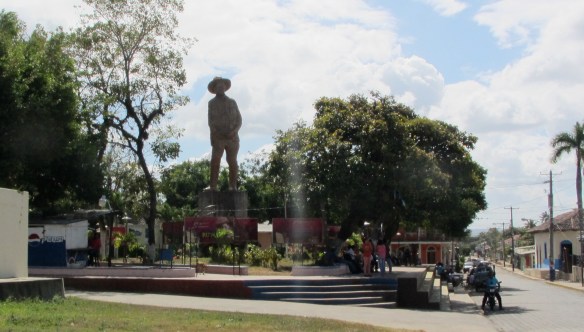
Statue of national hero Augusto Sandino at the central park of his hometown, Niquinohomo.

By Stephen Sefton

Source: Popular Resistance

The author, Stephen Sefton, is a writer from the Tortilla Con Sal Collective in Nicaragua. Sefton was the guest on Clearing The FOG Radio this week where we discussed What’s Really Happening In Nicaragua. The show examined the groups behind the violent coup that is occurring, and according to the report below, failing in Nicaragua. It also examines some of the many false stories about what is going on in Nicaragua, e.g. that the coup is nonviolent, that it is student-led, that Ortega is in league with the capitalist class, that the US is not behind the coup attempt. Sefton describes how reality has been turned on its head and reports in the US corporate media and the Nicaraguan media which is controlled by oligarchs and funded by the US National Endowment for Democracy. We hope Sefton is right that the coup is being defeated in time for the July 19th celebration of the 39th anniversary of their historic 1979 defeat of the Somoza dictatorship. KZ and MF

July 19 will be a massive celebration of the coup’s defeat and a categorical vindication of President Daniel Ortega’s Sandinista government’s efforts for peace in Nicaragua.

On July 19, hundreds of thousands of people from across Nicaragua will converge on the capital Managua to celebrate the 39th anniversary of their historic 1979 defeat of the Somoza dictatorship. The event takes place as the authorities continue to liberate communities blockaded by roadblocks operated by armed opposition activists whose not-so-soft coup attempt against the Sandinista government, begun on April 18, has failed. Ever since April 21, when President Daniel Ortega called for a process of National Dialogue to peacefully resolve opposition demands, Nicaragua’s political opposition and their allies have worked to sabotage talks for a negotiated solution. They have regularly staged extremely violent provocations falsely seeking to portray the government as being wholly responsible for the crisis and demanding President Ortega’s resignation.

Early in July, the opposition reneged on an agreement to dismantle the roadblocks their armed supporters have used since late April to try to destroy the country’s economy and intimidate the general population. On July 9, the government declared it would no longer permit the opposition to abuse the population’s basic rights to peace and security, stating: “Faced with the daily suffering imposed on Nicaragua’s families, who since April 18 have suffered violence from terrorists who have murdered, tortured and kidnapped hundreds of citizens, the same terrorists that have burned and destroyed hundreds of families’ homes, public buildings, small- and medium-sized businesses, such that the state is bound to act in accordance with the law to guarantee the right of its citizens to live in peace, with security and respect for the human rights enshrined in our political constitution, in the charters of international organizations and in human rights conventions.”

Opposition Violence

Subsequently, Nicaragua’s national police have worked with local communities around the country to clear the opposition roadblocks. In Jinotepe, they set free hundreds of trucks and their drivers held hostage by opposition gangs for over a month. In many places, it has been possible to negotiate agreements to remove the roadblocks peacefully. Elsewhere, the process has involved violence and casualties provoked by very well-armed activists and associated paid criminals resisting the authorities’ efforts to restore freedom of movement. On July 13 in Managua, two opposition activists were killed during the clearance of blockades in and around the National Autonomous University.

Elsewhere, on July 12, opposition activists from roadblocks operated by Francisca Ramirez and Medardo Mairena’s anti-Canal movement infiltrated an opposition peace march in the town of Morrito, on the eastern shore of Lake Nicaragua, on the highway to the Rio San Juan. They attacked a police post and the local municipal office, murdering four police officers and a primary school teacher, wounding four municipal workers and kidnapping nine police officers. Subsequently, that evening the police officers were set free, six of them with injuries.

Tortured & Murdered

In Masaya, opposition activists tortured, murdered and burned police officer Gabriel Vado Ruiz and would have done the same to another police officer, Rodrigo Barrios Flores, had he not escaped from his captors after enduring two days of torture and abuse. Although the extreme violence of the armed opposition activists has been responsible directly and indirectly for almost all the loss of life and injuries during the crisis, international news media and human rights organizations continue to falsely blame the government for virtually all the deaths and people injured. Amnesty International and fellow coup apologists such as Bianca Jagger and SOS Nicaragua, along with their allies in corporate media such as the Guardian, Telegraph, Washington Post, New York Times, Al Jazeera, CNN,  BBC, all cover up very serious human rights violations by the opposition activists during the failed attempted coup against Nicaragua’s legitimate government.

However, abundant audiovisual and photographic material exists providing irrefutable evidence of systematic human rights violations practiced by Nicaragua’s political opposition. From the the start, on April 18, the armed opposition offensive has manipulated legitimate peaceful protest so as to give cover to a very deliberate campaign of violence and deceit, promoting a climate of fear and casting blame on the government so as to create a psychosis of hatred, polarizing Nicaraguan society. The campaign’s objective is to make impossible a negotiated solution to the crisis provoked by the political opposition. Over the weekend of July 13-15, events in Nicaragua showed how refined the techniques of psychological warfare have become.

Misrepresenting & Exaggerating

The political opposition have used social media to misrepresent and exaggerate events, create incidents that never happened and obliterate their own criminal terrorist attacks. For example, the crisis in Nicaragua began with a fake ‘student massacre’ that never took place. Now Nicaragua’s opposition have faked attacks on a church in Managua, exaggerated casualties during the clearance of opposition thugs from the national university and covered up their own deliberate murders of police in Morrito and Masaya, as well as their gratuitous attacks on peaceful Sandinista demonstrators. In the national university, the opposition gangs also set fire to a classroom module and destroyed a preschool facility on the university campus.

Right from the start of the crisis, the opposition have expertly staged phony scenes of students taking cover from gunfire and used those images to justify their own savage attacks, like those in which they burned down pro-government Nuevo Radio Ya and CARUNA, the rural cooperatives’ savings and loan institution. Photographs show opposition journalists and photographers filming opposition activists pretending to be attacked, but despite the obvious fakery, those false stories get published uncritically in international corporate and alternative media. Nicaragua provides a textbook case study bearing out the work of analysts such as Cuba’s Randy Falcon, who has emphasized how new technologies exponentially multiply the digital reproduction of longstanding conventional propaganda motifs.

Propaganda Ploys

In Nicaragua, the government has in several cases negotiated agreements to clear armed opposition roadblocks, only to find that the opposition refuse to honor the agreements. The extremist political opposition are desperate to keep up their violence so as to sabotage efforts at National Dialogue and project the false image of a repressive government without popular support. Large demonstrations across the country supporting the government’s efforts for peace show exactly the reverse is true. Majority national opinion in Nicaragua is well aware of the opposition’s propaganda ploys and false claims.

Within Nicaragua, the opposition hardly bother to conceal their invention and artifice because their false political theater is staged almost entirely to impress overseas opinion. Their sinister cynical theater aims to set the scene for the Organization of American States to change its previously moderate position on Nicaragua and give the U.S. government an institutional pretext on which to intensify sanctions against Nicaragua’s government and its people. Even so, despite probable opposition attempts to sabotage it, July 19 will be a massive celebration of the coup’s defeat and a categorical vindication of President Daniel Ortega’s Sandinista government’s efforts for peace in Nicaragua.

A Brief History of Nicaragua

IMG_4398

To have even a basic understanding of Nicaraguan culture it’s important to first know a little about the land’s history. In the Pre-Columbian era, the region now called Nicaragua was inhabited by several tribes culturally related to Aztec and Maya civilizations. Not long after Christopher Columbus first reached Nicaragua in 1502, an attempt was made to conquer the region by Gil González Dávila in the 1520s. On April 17, 1523, Dávila first met with Cacique Diriangen, leader of the Dirian peoples. Dávila gave the tribe a three day deadline to become Christians but rather than comply Diriangen led an attack, making him the first known resistance fighter of Nicaragua.

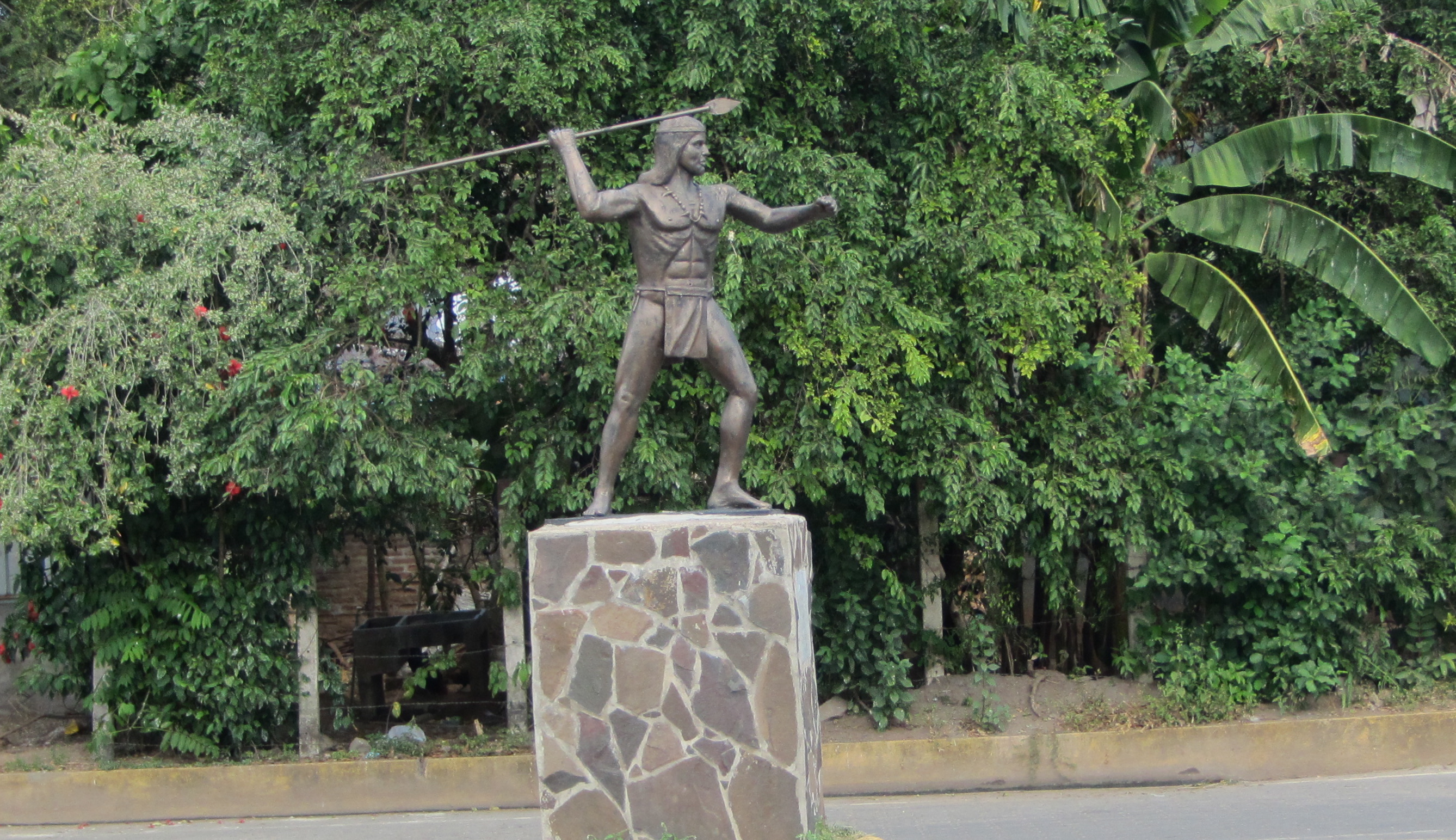
A statue of Diriangen at the entrance to the town of Diria.

A statue of Diriangen at the entrance to the town of Diria.

During over 300 years of colonization, countless indigenous people died of diseases, rival conquistadors waged war on each other, Caribbean pirates raided cities along Lake Nicaragua, British forces fought the Spanish in Nicaragua during a sub-conflict of the the Seven Years’ War, and in 1610 Momotombo volcano erupted, destroying the old capital city of León. In 1838, Nicaragua became an independent republic. Within a few decades, during a power struggle between León and Granada, filibusterer William Walker was hired by the government of León to fight on their side but he exploited the region’s instability and briefly established himself as President of Nicaragua before being forced out of the country a few years later. Three decades of conservative rule followed, during which the U.S. began formulating plans to build a canal across Nicaragua (which may soon become a reality with funding from Chinese corporations). However, when the U.S. shifted their plans to Panama, President Jose Santos Zelaya attempted to negotiate with European partners. Because of the potential threat Zelaya posed to U.S. hegemony and his ambitions to unite the Central American nations, the U.S. government compelled him to resign with the threat of military force and funding of conservative opposition groups, replacing him with a series of puppet regimes. Attempting to prevent insurrection, Nicaragua was occupied by U.S. Marines from 1912 to 1933. From 1927 (the start of Somoza’s rise to power though the National Guard), national hero Augusto César Sandino led a guerrilla war against the conservative government and the U.S. Marines. Shortly after a peace agreement was reached with a newly elected Sacasa administration, the Marines left Nicaragua and the head of the National Guard, Anastasio Somoza García ordered Sandino’s assassination. Sandino was killed by National Guard troops on February 21, 1934. His body was hidden and never found. In 1937 Somoza ousted the Sacasa government in a rigged election.

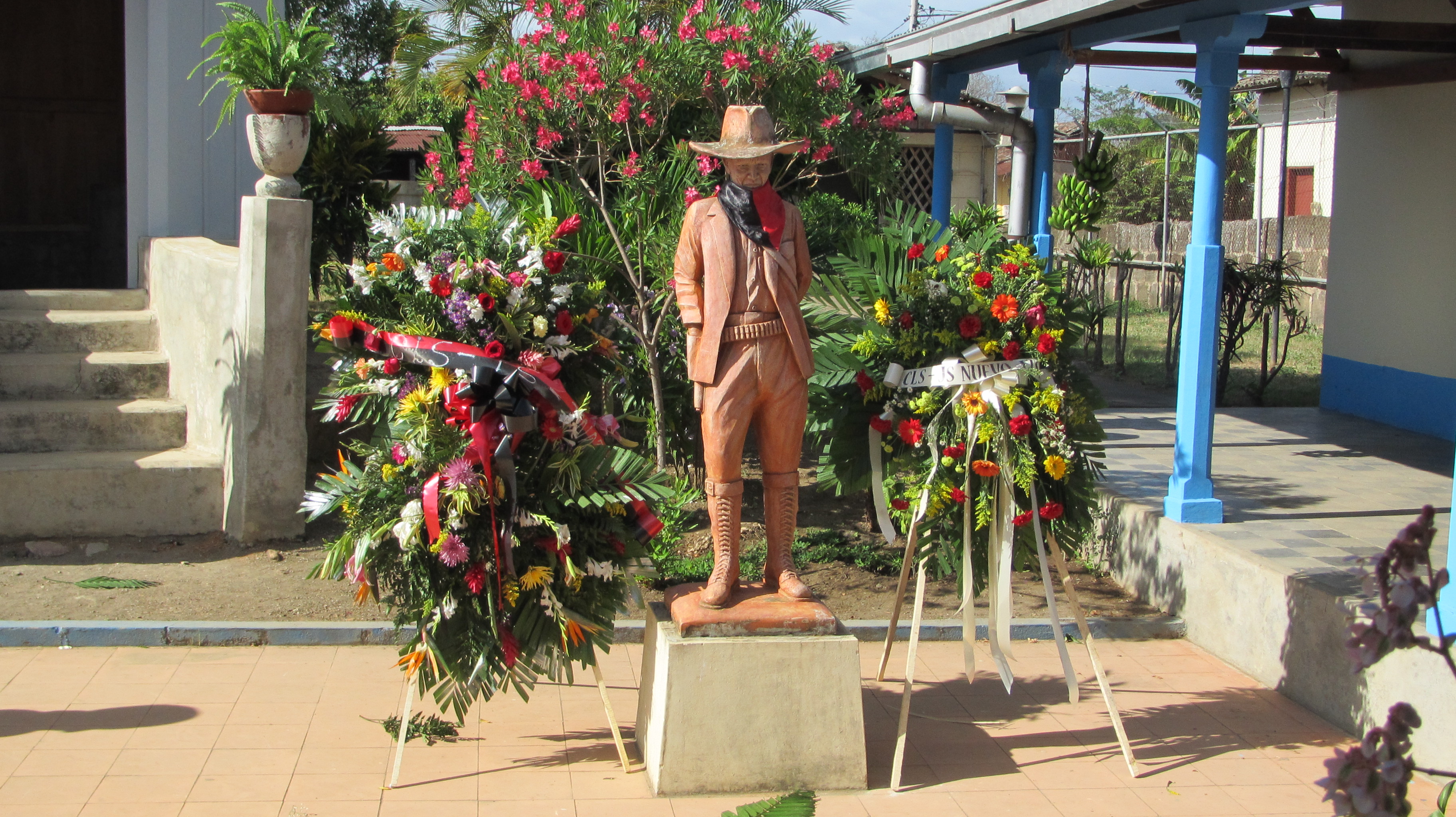
A statue of Sandino at the Augusto C. Sandino Library, a museum located in the house where he grew up in the town of Niquinohomo (Valley of the Warriors).

A statue of Sandino at the Augusto C. Sandino Library, a museum located in the house where he grew up in the town of Niquinohomo (Valley of the Warriors).

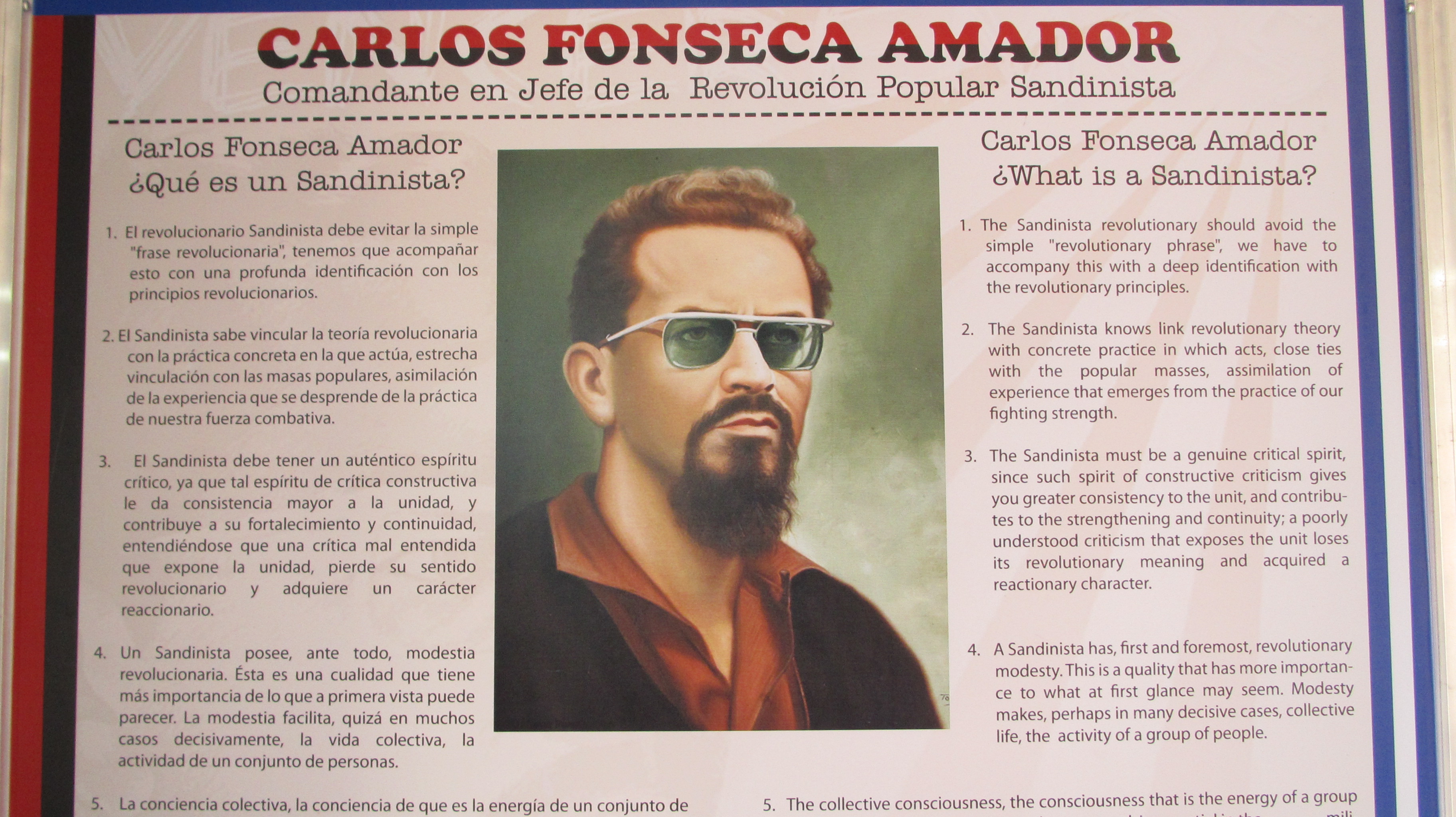
The Somoza regime was Nicaragua’s longest lasting hereditary military dictatorship, having ruled for 43 years. The father of the dynasty, Anastasio Somoza García, was famously called “our son of a bitch” by FDR and was assassinated by 27 year old poet Rigoberto López Pérez in León in 1956. In response to increasingly corrupt and reactionary policies of the Somoza government, Carlos Fonseca, Silvio Mayorga, and Tomás Borge led the formation of the Sandinista National Liberation Front (Frente Sandinista de Liberación Nacional or FSLN, named after and inspired by Augusto Sandino) in 1961. In 1972 a major earthquake hit Managua killing 6000 people, injuring tens of thousands and leaving hundreds of thousands homeless. President Anastasio Somoza Debayle mishandled the situation by failing to distribute essential aid and supplies. When it was later revealed that the government was siphoning relief money for personal gain, popularity and membership of the FSLN greatly increased. Hundreds of Chilean refugees also joined their ranks after a CIA-backed coup assassinated Chilean president Salvador Allende in 1973 and installed the dictator Augusto Pinochet the following year.

A display at the Carlos Fonseca Museum in Matagalpa.

A display at the Carlos Fonseca Museum in Matagalpa.

When Pedro Joaquin Chamorro, editor of the national newspaper and critic of Somoza, was assassinated by the government on January 10, 1978, a mass insurrection was triggered. By the end of Summer, armed youths took over Matagalpa while factions of the FSLN and civilian recruits had the National Guard under siege in Managua, Masaya, León, Chinandega and Estelí. On July 19, 1979, FSLN forces entered the capital and officially assumed power. Just two days before, Anastasio Somoza Debayle resigned and fled to Miami. He was killed a year later by a rocket attack from members of the Argentinian Revolutionary Workers Party while in exile in Paraguay.

Though the Sandinista government inherited a country in ruins and over a billion dollars in debt, they had an ambitious platform which included:

  • nationalization of property owned by the Somozas and their supporters
  • improved rural and urban working conditions
  • free unionization for all workers, both urban and rural
  • price fixing for commodities of basic necessity
  • improved public services, housing conditions, education
  • abolition of torture, political assassination and the death penalty
  • protection of democratic liberties
  • equality for women
  • non-aligned foreign policy

The Sandinistas had early successes with their education and literacy programs but were soon hindered by emerging conflicts with counter-revolutionary Contra forces heavily financed, armed and trained by the CIA. Investigations into the Iran-Contra scandal revealed some of the funding was acquired through arms sales to Iran and drug shipments to U.S. inner cities (read Gary Webb’s Dark Alliance for more about this). Despite strong support for the opposition by the U.S., the FSLN’s Daniel Ortega won the 1984 elections. Less than a year later the Reagan administration implemented a complete embargo on U.S. trade with Nicaragua that would last five years. By the late 80s, the continuing Contra campaign was notorious for human rights violations, corruption and terrorism. In August 1987, Costa Rican president Oscar Arias Sanchez created a peace accord which led to a ceasefire signed by Contra and Sandinista representatives a year later. Disillusioned by conflict and economic strife (made worse by Reagan’s embargo), Nicaraguan voters elected conservative administrations throughout the 1990s and early 2000s but seeing little improvement and much corruption, they reelected FSLN member Daniel Ortega in 2006 and 2011. So far, there has not yet been radical reforms that corporate investors feared and that more radical liberals hoped for, but Ortega has maintained a skepticism towards capitalism while simultaneously maintaining relations with the U.S. and rivals such as Iran, Libya and Venezuela.

As for how the average Nicaraguan feels about their current situation, opinions seem to vary but I plan to share some of the impressions I got in a future post.