Saturday Matinee: Battle Royale

battleroyale_spotlight-e1293591661834

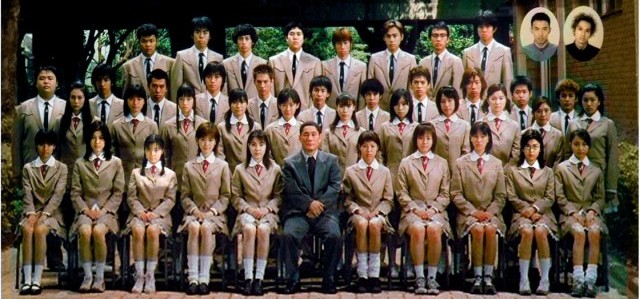
With the recent release of the Hunger Games sequel, it seems fitting to feature a cult classic that may have been the inspiration for that series: “Battle Royale”. Released in 2000, it was Kinji Fukasaku’s final film, a director previously best known for his “Battles Without Honor and Humanity” series of Yakuza films. Kinji died of cancer shortly after filming the first scene of the sequel, “Battle Royale 2: Requiem”, which was completed by his son Kenta in 2003. Battle Royale takes place in a dystopian society whose government regularly forces a class of high school students to participate in a deathmatch on a small island until just one survivor is left.  Each student is given a bag containing food, water, a compass, a map of the island, and a randomly selected weapon. The students are also outfitted with surveillance collars that can track their movements and detonate if they wander into “danger zones” or refuse to cooperate.

Though the film is at times physically and emotionally brutal, it works effectively as a parable for the way youth are cynically manipulated by society and the different approaches people take dealing with tyranny. When Kinji Fukasaku first read the novel his film was based on, it resonated with him because of traumatic personal experiences. As he related in a Director’s statement for Battle Royale:

I immediately identified with the 9th graders in the novel, Battle Royale. I was fifteen when World War II came to an end. By then, my class had been drafted and was working in a munitions factory.

In July 1945, we were caught up in artillery fire. Up until then, the attacks had been air raids and you had a chance of escaping from those. But with artillery, there was no way out. It was impossible to run or hide from the shells that rained down. We survived by diving for cover under our friends.

After the attacks, my class had to dispose of the corpses. It was the first time in my life I’d seen so many dead bodies. As I lifted severed arms and legs, I had a fundamental awakening … everything we’d been taught in school about how Japan was fighting the war to win world peace, was a pack of lies. Adults could not be trusted.

The emotions I experienced then–an irrational hatred for the unseen forces that drove us into those circumstances, a poisonous hostility towards adults, and a gentle sentimentality for my friends–were a starting point for everything since. This is why, when I hear reports about recent outbreaks of teenage violence and crimes, I cannot easily judge or dismiss them.

This is the point of departure for all my films. Lots of people die in my films. They die terrible deaths. But I make them this way because I don’t believe anyone would ever love or trust the films I make, any other way.

BATTLE ROYALE, my 60th film, returns irrevocably to my own adolescence. I had a great deal of fun working with the 42 teenagers making this film, even though it recalled my own teenage battleground.

Watch the full film here.

Saturday Matinee: Gridlock’d

627

“Gridlock’d” (1997) is a film most people remember for featuring one of Tupac Shakur’s last starring roles (he was murdered in a shooting just two months after its completion). While Tupac’s performance as Spoon, a level-headed but drug-addicted jazz musician, is impressive and possibly his best, often overlooked are contributions of co-star Tim Roth and actor/writer/first-time director Vondie Curtis Hall. Roth stars as Stretch, Spoon’s impulsive and slightly deranged partner in addiction and music. Both Shakur and Roth inhabit their roles with a sense of authenticity, humanity, and charisma, giving their potentially pathetic characters believable chemistry and a likeable comic edge. The film kicks off when the third member of their jazz combo, Cookie, played by Thandie Newton, has an overdose, compelling the others to go on a quixotic quest seeking treatment for their addiction. Unfortunately for our protagonists the Detroit healthcare system is a bureaucratic maze seemingly designed to thwart their efforts. Odds of their success are decreased further when they’re targeted by cops and gangsters.

Detroit-born Vondie Curtis Hall does an excellent job balancing the script’s gritty realism and dark outlook with comedy and wit. Visually, the film is stylish without looking too glamorous or grim, and he keeps moments of humor and suspense well-paced. Hall is also suitably menacing as gangster D-Reper. Director John Sayles, who previously worked with Hall on the film “Passion Fish”, makes a cameo appearance as one of the cops. Hall hasn’t yet made another film on par with the quality of Gridlock’d, but he continues to do much acting and directing work for television.

As strong as Hall’s directorial debut is, it wouldn’t be as emotionally involving and memorable were it not for Tupac Shakur’s presence. Like his character in Gridlock’d, Tupac was at the time seeking a new beginning; a new creative direction. The fact that his life was tragically cut short can’t help but add a sense of poignancy and dramatic weight to his role and the entire film.

Saturday Matinee: The Blade

qt7-blade

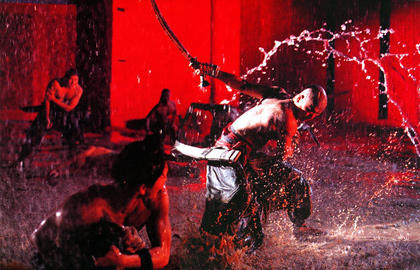
Director Tsui Hark is truly a visionary pioneer of Hong Kong cinema. He was one of the first in the Hong Kong film industry to use Hollywood-style special effects in “Zu Warriors From the Magic Mountain” (1983) and pushed the envelope again with extensive CGI effects for the sequel “The Legend of Zu” (2001). He helped launch Jet Li’s career with his “Once Upon a Time in China” trilogy and was the producer of one of director John Woo’s earliest blockbusters “A Better Tomorrow” (1986). However, for most of the 90s Tsui Hark’s career was in a slump because of a series of failed attempts to break into the U.S. market and an economic downturn of the Hong Kong film industry. One of the films Hark released during this period was “The Blade” (1995). Though it bombed at the box-office, it’s now widely recognized as one of his greatest achievements (so far).

Like many idiosyncratic cult films, The Blade wasn’t palatable to general audiences and was dismissed as a failure upon release. Such films are usually ahead of their time, needing more time to be discovered by fans or for cultural sensibilities to change. The Blade’s unremittingly grim setting and pessimistic tone may have frightened off film-goers who in the mid 90s were drawn more towards lighthearted fare but it’s a quality that makes it stand out today and gives it an oddly contemporary feel. Feudal China has never seemed so brutal and forbidding (yet exotic and multicultural). It’s a fully realized world full of tribalism, hedonism, feral creatures, small pockets of civilization, crude weapons and an unforgiving social and natural environment, not unlike the post-apocalyptic scenario of The Road Warrior.

Other characteristics that contribute to The Blade’s cult status are its archetypal characters, highly stylized art direction, impressionistic photography reminiscent of Wong Kar Wai films, and unforgettable scenes (including one of cinema’s most frenzied and viscerally powerful showdowns). Though its storyline is pretty standard for a wuxia martial arts film, its subtext contains an abundance of philosophical questions about the nature of morality, violence, religion, sex, commerce, disability, pedagogy and memory among other things. The Blade has never had an official DVD release in the U.S. but fortunately this subtitled version was uploaded to YouTube last year: