Warriors… come out to play! Warriors… come out to play!
One of the most well-known movie chants in cinematic history has passed the 30-year mark.
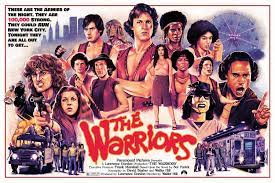
When The Warriors, starring a bunch unknown actors at the time, made its debut in ‘79, No one could have predicted it would be considered one of the greatest “cult classics” in film history… but here we are.
And if you were to ask any fan of The Warriors why this film has stood the test of time in cult fandom, most will never be able to give you a solid reason other than: “It’s just f*****g cool, man!” But that’s the magic of this movie!
The concept was simple enough. Street gangs from all over New York would come to a truce and unite under the highly respected urban messiah, Cyrus (Roger Hill), Leader of the Grammercy Riffs. A meeting was called in Central Park where they would all hear his message of strength in numbers against the cops. Except, everything goes wrong when Luthor (David Patrick Kelly), leader of Rogues, for no apparent reason other than he was bored, pulls his gun and kills Cyrus from the crowd.
But instead of getting caught, he immediately blamed one of The Warriors, the gang from Coney Island, for the assassination. After violently beating their leader, Cleon (Dorsey Wright), the gangs turned their attention to rest of The Warriors: Swan (Michael Beck), Ajax (James Remar), Rembrandt (Marcelino Sanchez), Vermin (Terry Michos), Cochise (David Harris), Snow (Bryan Tyler), and Cowboy (Tom McKitterick). And from here on out, they have every gang in New York after their a*s as they try to make it back home to Coney.
During this time in cinema (the mid to late 70s), there was an influx of genre movies that were becoming more and more popular. Blaxploitation, gritty cop dramas, and of course, kung fu.
What set The Warriors apart from most films (at the time) was how stylized it was. Starting with how very eccentric and themed all the different gangs were:
The Grammercy Riffs: The biggest and most feared gang made up of Black Kung Fu artist.
The Lizzies: The punk, all-girl gang.
The Boppers: The Harlem crew who looked like 1920s gangsters.
The Turnball AC’s: The skinhead, rabid, “Mad-Max” psychopaths.
The Baseball Furies: The gang dressed like the New York Yankees with facepaint and big bats!
This is just a few of the 20 or more gangs featured in this film. But it was enough to have every 10-year-old boy’s imagination working overtime!
Though there wasn’t a ton of dialogue in the film, the performances were strong all the way through. Especially that of Lynne Thigpen, who plays “The Voice,” a radio DJ who gave the other gangs sightings of The Warriors so they could continue their hunt. And though you never see her entire face in the whole film except for her lips, she brings the much-needed weight that makes the film feel legit.
Deborah Van Valkenburgh, who played the mouthy, tough-girl Mercy who helps The Warriors navigate through the dangerous city, was a stand-out! You go from wanting her to get pushed into ongoing traffic, to loving her by the end. Valkenburgh, though not a household name, has been consistently working in Hollywood even to this day. But her role as Mercy is still the one she gets the most recognition for!
James Remar, who is noted bad-a*s in every movie he’s in, makes Ajax the one Warrior that we all gravitate towards. Even to the point of stealing scenes away from Michael Beck who at this point in the movie, is the actual lead. Ajax’s rumble with The Baseball Furies is still the most memorable fight in the movie!
Another performance that should not go unnoticed is that of Hollywood’s favorite bad guy, David Patrick Kelly who plays Luthor, Leader of The Rogues. From the moment he kills Cyrus, until the end of the film, he delivers on being the scumbag we love to hate. And of course, he’ll always be remembered for his legendary scene in the car as The Rogues have The Warriors cornered at the beach and taunts them by clinking three bottles together on his fingers over and over chanting: “Warriors… Come out to play!” And rumor has it, this scene was completely improvised by Kelly, which makes it even more classic.
The Warriors saw a resurgence in the early 2000s. With not only a video game from developer Rockstar Studios but also with an updated re-release of the film with added footage. People at comic conventions were now cosplaying as The Warriors and all of the different gangs from the film. There have been several reunions with the cast (that are still living), and talks of a reboot.
For many guys in my generation (Gen X), The Warriors has been a constant on most “Best of” list. And for me personally, It’s one film that can’t be redone for the simple fact, there isn’t a living director that can capture what made this movie work!
If you’ve never seen this film, I can’t recommend it highly enough. It’s definitely in my TOP 5 of “All time greatest movies.”
*Pro-Tip: It’s best watched late at night, completely in the dark, with some beer and popcorn*
One of John Carpenter’s more endearing traits is his aversion to self-effacing clowning. This is not at all to suggest that Carpenter’s films aren’t funny — rather, it’s that the living genre legend often opts to play familiar B-movie scenarios completely straight, whether it be a terse gangland standoff rendered as a modern-day Western showdown (Assault On Precinct 13, one of the most influential films of the 20th century) or a masked killer, bereft of any overwrought psychological motive, terrorizing the inhabitants of a sleepy all-American suburb (Halloween, of course). While Carpenter has dabbled in satire (They Live) and high-concept fantasy (Big Trouble In Little China) over the course of his now decades-spanning career, the grounded nature of his approach is often its own reward. The Escape From New York director has all but perfected an economical, tough-minded creative ethos that has gone on to influence an entire generation of filmmakers dabbling in sci-fi, horror, and beyond.
Going Meta Before It Was Cool
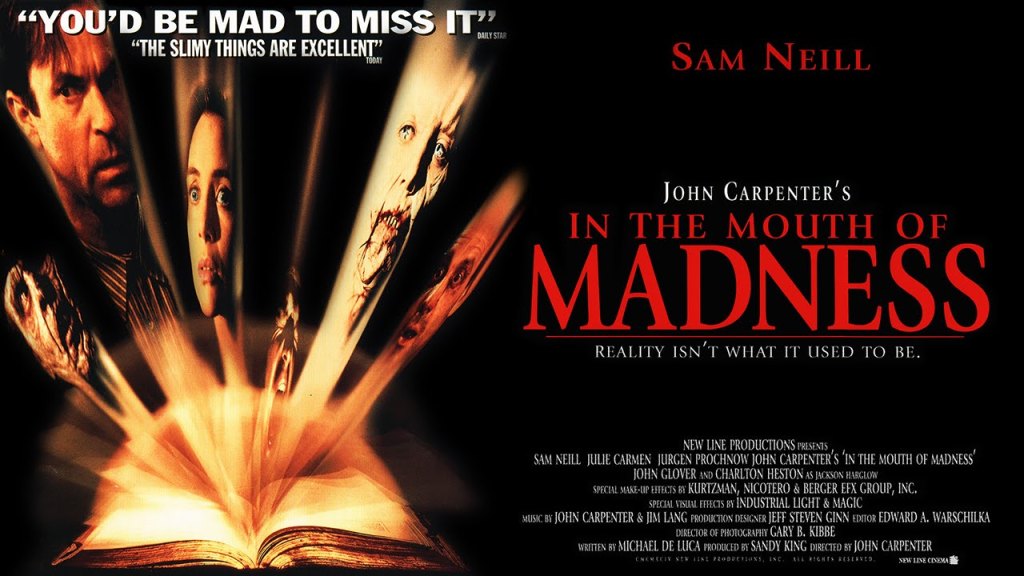
In the Mouth of Madness, Carpenter’s glorious 1994 cult masterpiece, might be the most conspicuous exception to this rule. The story of an insurance investigator who begins losing his grip on reality while probing the mysterious disappearance of a lucratively popular horror author named Sutter Cane, In the Mouth of Madness is an unabashedly meta exploration of the creative act as a form of hypnosis. It is not only a film whose central plot conceit is unique to the moral panic that defined so much of the decade in which it was released (the idea that exposure to certain “corrupt” media could warp one’s brain and possibly even compel one to commit violent acts, etc.), it’s also a cutting cautionary tale about surrendering to artifice and fantasy, and a clever-but-never-obnoxious social lampoon about what it means to be considered the master of a low trade.
Of course, John Carpenter knows a thing or two about being unfairly labeled as the master of a low trade. Carpenter, who is known for his tell-it-like-it-is demeanor, once quipped: “In England, I’m a horror director. In Germany, I’m a filmmaker. In the U.S., I’m a bum.” Films like the Jeff Bridges-starring Starman and the memorably nasty high school bloodbath Christine might be considered totemic cult items today, but many of Carpenter’s more beloved works were initially decried as trash in their time. As such, Carpenter and screenwriter Michael De Luca (yes, that Michael De Luca) turn In the Mouth of Madness’ most important character, Sutter Cane, into the Ernest Hemingway of airport novels. Clearly, the obvious allusion with Cane is Stephen King (or perhaps, to a lesser extent, Clive Barker), right down to the fact that Mouth of Madness eventually makes a narrative detour to Hobb’s End: a kind of bastardized stand-in for King’s own sleepy, creepy fictional borough, Castle Rock.
Third Film of the Apocalypse Trilogy
In The Mouth Of Madness opens with Sam Neil’s John Trent being admitted to a psychiatric hospital. He appears to have gone stark-raving mad, as evidenced by the demented look in his eyes, and the vaguely occult-looking marks he’s scrawled onto his face. In a gesture that feels borrowed from a tale by H.P. Lovecraft (Carpenter’s reverence for Lovecraft is well-documented at this point), Trent begins to recall the tale of how exactly he went mad. We learn that when Trent worked in insurance, his employer (Charlton Heston) tasked him with looking into the matter of Sutter Cane. For all intents and purposes, Cane appears to have vanished off the face of the earth. After its ghoulish prologue, Mouth of Madness settles into a more deliberately routine rhythm, only to disappear further and further down the proverbial rabbit hole as Trent and a colleague, Cane’s editor (memorably played by Julie Carmen), find themselves lost among the otherworldly horrors of Hobb’s End.
In The Mouth Of Madness is the third and final film in John Carpenter’s “Apocalypse Trilogy,” which also includes The Thing and the criminally underappreciated Prince of Darkness. In all three films, evil manifests as a primarily unseen, invisible force, often contorting familiar things like dogs, books, and human bodies into horrifying and hitherto-unseen new shapes. In The Thing, Kurt Russell and his motley crew of researchers hole up in icy Arctic seclusion, fending off the malevolent energy of a shapeshifting, violently hostile alien parasite. In Prince Of Darkness, a group of college students occupy an incredibly menacing old church, where they proceed to unearth a tube of neon-green liquid that, if mishandled, could unleash the very literal fury of the devil. Both movies are steeped in Lovecraftian imagery and primordial terror, and both amplify the built-in claustrophobia of their settings to phantasmagoric degrees.
In The Mouth Of Madness is a funnier, sillier, more stylistically gonzo effort than its two predecessors in the trilogy, mostly because it purports to stand outside the nuts and bolts of its superficial narrative, to some degree, and actually comment on the art of what it means to scare people for a living. There is something wickedly ingenious about the idea of a popular novel whose contents are so unholy that reading it would cause one to spiral into a kind of monstrous abyss. If that idea alone were all the movie were interested in, In the Mouth of Madness would still rank as one of Carpenter’s more enjoyable late-career works. And yet, as always, the director is keen to dig deeper into the subtextual resonance of his story, turning what might otherwise be a spooky ’90s chiller — the type of thing you might have caught a rerun of on TBS sometime back in the 2000s — into a cheeky, compelling commentary on the horror pantheon itself, and Carpenter’s place in it.
We live in an era where people willingly and enthusiastically sign themselves over to fictional “universes.” Whether it’s Marvel, Star Wars, Game of Thrones, or perhaps something more obscure, we now inhabit an epoch in which individuals willingly give themselves up to elaborate forms of corporate mythology. In some cases, this sort of fanboy devotion can swallow you whole. In the Mouth of Madness is concerned with this very subject. It is no wonder the film was greeted with such indifferent critical notices upon its release: as always, Carpenter was light years ahead of his time. The scariest thing about In the Mouth of Madness is that, in the world Carpenter hath created, Sutter Cane himself isn’t even seen as a mere writer of trash books — when he’s finally revealed, he is tellingly and literally depicted as a prophet.
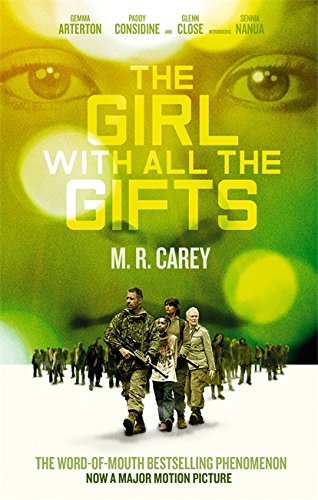
In many ways, Melanie (Sennia Nanua) is just another ordinary girl. She goes to school every day, where she’s grown affection for her teacher Ms. Justineau (Gemma Arterton). And she’s at that age where she’s figuring out what’s important to her, and how to navigate through the world of adults around her. But Melanie is not an ordinary girl. She will soon be a mindless, soulless zombie, a braindead creature who responds only to a desire to kill and eat people around her. In fact, with the right triggers—like if the adults around her forget to wear their scent-disguising lotion—she could become that right now. Just when you thought the zombie genre was out of ideas, along comes Colm McCarthy’s smart and engaging “The Girl with All the Gifts,” a film with echoes of George A. Romero, Danny Boyle, and Robert Kirkman but one that also feels confidently its own creation, a unique take on responsibility, adulthood, and a new chapter in evolution.
Melanie isn’t alone. She lives with a number of other zombie-children like her in a bunker beneath a military facility, where she’s being studied and experimented on by Dr. Caroline Caldwell (Glenn Close), in the hope that they could provide the antidote for what has essentially ended normal human existence. Melanie is one of several second-generation flesh-eaters called “hungries,” babies who literally ate their way out of their parents but are not behaving in precisely the same way as the brain-dead speedsters that have destroyed humanity. Whenever a child is found in the wild, they’re taken to this facility, where Dr. Caldwell can experiment on them and Sgt. Eddie Parks (Paddy Considine) can work to control them. Said control involves leg, arm and head restraints whenever the children are anywhere near that oh-so-enticing human flesh.
But Melanie seems so normal and is clearly learning empathy. The good doctor sees that as well, and even starts to loosen some of the restraints keeping Melanie more of an object than a person. Then one day Dr. Caldwell comes for Melanie, ready to dissect her and see exactly what she can learn from this unique child the hard way. Before Dr. Justineau can save her, all hell breaks loose and the facility is overrun. A small group of survivors is forced to travel to another sanctuary city in the hope that it’s still being run by people who don’t eat flesh. Melanie goes with them, and proves to be pretty useful.
One of the major strengths of “The Girl with All the Gifts” is evident early in McCarthy’s tactile, believable world-building. Much as Romero paid close attention to such details, the set design, costumes, and the world of “Gifts” feels lived-in and genuine. And it’s a nature-based aesthetic (dirt on walls, costumes that look worn, etc.) that continues and even strengthens once this ragtag crew is forced from safety and into the dangerous world. There’s a visceral, emotional impact to the horror and action of “The Girl with All the Gifts” that resonates because the characters and the world they live in feels real to us. It’s hard to overstate how important this to a horror movie, especially one set in a post-apocalyptic world. If we don’t believe the world is genuine, we won’t care what happens in it.
Of course, performance goes a long way to amplify this believability as well, and it’s not often you see a horror film with a cast this strong. Close could have gone showy with her doctor with a heart of ice but she plays it straight, again conveying the believability of the moment more than the B-movie archetype this character could have become. Considine and Arterton perfectly convey authority and warmth, respectively, although they’re good enough to make these people into more than mere plot devices. And Nanua is a find, again never giving her performance with a knowing wink. So she’s a zombie child who could be the evolutionary key to the future—this just happens to be her reality.
The traveling band aspect of “The Walking Dead,” the cities and landscapes empty of human existence of “28 Days Later,” the military aspect of “Day of the Dead”—it’s easy to pick apart the influences of “The Girl with All the Gifts.” But just as Melanie marks something altogether new in this world—a zombie with a conscience—the film about her feels inspired by what came before but also good enough to inspire those that come after.
In Oliver Stone’s The Doors (1992) Ray Manzarek (Kyle MacLachlan) tells Jim Morrison (Val Kilmer) a story about his experiences working in the Hollywood of the late 1960s. He says he told a studio executive that he did not need a script to make a film. “Godard doesn’t use one,” Manzarek claimed. The executive replied, “That’s great… Who’s Godard?”
By the late ’60s, Jean-Luc Godard was a legend among young cinephiles. Beginning withBreathless in 1960 and ending with Weekend just eight years later, the caustic former Cahiers Du Cinema film critic made 15 films which can only be described as revolutionary. Both in terms of cinematic form as well as political and personal content, these films broke the old rules while inventing new ones. The use of handheld cameras, jump-cuts, natural light, and improvisation were both old and new things he popularized. Many of these ideas were used during the freewheeling days of silent cinema before filmmaking was industrialized and, in the mind of Godard and his “New Wave” colleagues, fossilized.
Godard wanted to provoke. But unlike some of his more didactic later work, these initial films are playfully provocative. Most of them are defined by their adversarial relationship to popular movie genres. Breathless is Godard’s deconstructed take on the crime film. A Woman is a Woman (1961) is his musical comedy.
Alphaville(une étrange aventure de Lemmy Caution) (1965)is two genres for the price of one: science fiction and noir. Maybe it’s even a third genre as well. It can be argued that the film is just another Eddie Constantine “Lemmy Caution” flick. “Lemmy Caution” flicks were big business in France since the ’50s, and Constantine played the role in over a dozen of them. Created by British pulp novelist Peter Cheyney, Caution is either an FBI agent or a private detective, depending on which novel you read, but it doesn’t really matter. He’s less a character than a genre archetype and it’s the archetype that Godard wanted. Especially one that was already lost in translation: British novels about an American detective adapted into French films starring an American actor speaking French.
Constantine was synonymous with the role, so Godard simply dropped him like a found object into his dystopian science fiction plot. The old fashioned tough guy Lemmy Caution does not belong here. His simple macho values and violent responses are hilarious when placed into this new context. In one scene, he shoots and kills a man then attempts to question him. Caution appears to have no idea what question to ask anyway, as his bizarre mission pits him against a fascist sentient computer called Alpha-60, which rules Alphaville and forbids any expression of emotion. Caution is deadpan but filled with primitive emotions both violent and romantic. It’s no surprise that Godard considered calling the film “Tarzan Versus IBM”.
By the end of the film, Caution gives up trying to understand the computer’s semantic games and resorts to his base instincts to bring Alphaville down. Along with using his fists and a .45 automatic, Caution expresses love for Natacha Von Braun (Anna Karina), the daughter of Professor Von Braun aka Leonard Nosferatu (Howard Vernon) — the man who built Alpha-60. Natacha grew up in Alphaville and does not know the meaning of words like “Love”. Caution challenges her to understand the meaning and challenges Alpha-60 by telling it a riddle that it cannot possibly comprehend.
From this description, the film may seem like a cold intellectual exercise. A film made by Alpha-60 itself. But this isn’t the case. I find Ridley Scott’s Blade Runner (1982), which is obviously inspired by this movie, to be a much colder experience. Alphaville is one of Godard’s wittiest and most emotionally moving. The pulpy sci-fi plot acts as a warm coat of familiarity as Godard slyly subverts one genre trope after another. Godard never really stopped being a film critic. His films were as much essays on how films worked as they were films themselves.
So Godard reveals the artificiality of B-movie fight scenes by presenting them as a series of posed comic book stills and gives Caution melodramatic theme music, which turns abruptly on and off at the most dramatically incorrect and hilarious moments. The excellent score by Paul Misraki shifts from this intentionally clichéd thriller music to beautiful and haunting pieces full of romantic longing.
This romantic theme is used most effectively at the end of the film, a scene which is a perfect example of what fellow French New Wave director Francois Truffaut called a “privileged moment”; brief moments in cinema when the film captures something intangible in a way no other art form could. As Misraki’s score builds, Godard holds on a lengthy closeup of Anna Karina, whose eyes are as hypnotic as any performer in film history. Karina’s expression slowly and subtly shifts from cold to warm and she ends the film by speaking the words she could not comprehend earlier: “Je vous aime…”
A cult film originally released in 1973, Belladonna of Sadness can be read as a second-wave feminist work. However, in order to understand the film as feminist, it is important to emphasize that the film’s plot is based on Jules Michelet’s La Sorcière(translated as Satanism and Witchcraft or The Witch of the Middle Ages in English), originally published in 1862. In his book Michelet discusses his conception of the Witch’s way of life and the persecution the Witch faced by feudal Christian societies in the Middle Ages. Michelet defends the Witch in his book as a champion of love and healing and defends witchcraft as a prelude to science: “…we shall mark the beginning of the professional man as juggler, astrologer, or prophet, necromancer, priest, physician. But at first the woman is everything”. Belladonna of Sadness follows Michelet’s same view, combining this 19th century vision of the liberated witch with second-wave feminist ideology to create a flawed but fascinating work that invites revisiting even all these years later.
To those unfamiliar with the film, Belladonna of Sadness is the story of Jeanne and the persecution she faces as a woman in a feudal society. The story begins when newlywed Jeanne is gang-raped by the local baron and his attendants under the justification of “prima nocta”. When her husband falls ill, Jeanne becomes desperate and a clitoral/phallic demon appears to her and gives Jeanne wealth and influence as the village money-lender. She holds this role and this power until she is stripped of it–literally–and chased out of town. She ultimately “sells her soul to the devil”, which is the grown version of the initial phallic creature, and becomes a witch who lives apart from the village. Plague breaks out in the feudal society, and the villagers eventually join Jeanne, who builds a society that celebrates herbal medication and sexuality. Having lost power over the villagers, the baron offers her power as a means to control her knowledge; when she refuses to tell him, she is burnt at the stake.
This is a film written and directed by men (Yamamoto Eiichi and Fukuda Yoshiyuki) and is considered a Japanese “pink film”’ as it is includes graphic depictions of sex and nudity. Belladonna of Sadness uses its “pink film” attributes in order to demonstrate the plight of the main character Jeanne as an example of Michelet’s Witch. Jeanne’s sexuality is the focal point of her journey and the catalyst for the social changes that occur throughout the story.
Created during the Japanese feminist movement of the early 1970s, Belladonna of Sadness is a second-wave feminist film, and it’s impossible to talk about Japan’s women’s liberation without discussing the ideas of Tanaka Mitsu, arguably its most prominent leader. Tanaka fought against the popular notion of the woman as either a housewife or an object for male sexual pleasure. Instead, she advocated for the woman to be seen as an individual with agency over her own sexuality and shared her own life experiences with sexual assault, including rape and harassment, to inspire other women to support women’s liberation, a.k.a. uuman libu.
This seems to pair nicely with Jeanne:she’s initially (and presumably) destined to fulfill a wifely role in marrying her lover Jean but instead is forced into the role of sex object when brutally raped by the baron and his cronies, and gains agency as an individual through the awakening of her own sexuality. After this awakening she does not fall into the housewife/male-sex-object binary but gains power and instead assumes a leadership role in the village. However, the phallic nature of Jeanne’s sexual awakening complicates this viewpoint. To explore this, it’s crucial to look at Jeanne’s initial encounter with the little creature who awakens her sexuality before “it” becomes “him”– the devil/phallus character.
When she first meets the devil/phallus character, Jeanne is in a desperate position. Not only is she emotionally scarred from being raped, but she lives in poverty with her ill husband who, despite telling her they would move on from her assault, later attempted to strangle her. One night while her husband is asleep, a small clitoral-esque creature appears.
The clitoral creature states that it is her. It does not deny being “the devil”, but it is born of her desire. Her sexual awakening has begun. The clitoral creature then tickles her all over her body, making her laugh, and she questions how this small thing could give her power. Then it “teaches” her how to make it grow by rubbing itself in her hand, which turns “it” into a phallic creature that gives her sexual pleasure as she lays next to her sleeping husband. This is Jeanne’s first experience with masturbation, initiated by a clitoral-to-phallic creature, a personification of her individual sexuality—“I am you”—and summoned by her “screaming soul”. The agency of the “soul” is another important aspect of 1970s Japanese feminism, as Tanaka stated, “I want to have a stronger soul with which I can burn myself out either in heartlessness or in tenderness. Yes, I want a stronger soul.” Tanaka’s soul calls out for strength as Jeanne’s does for power, both qualities that were specifically reserved for men.
Jeanne’s individual sexual agency is exactly the kind of liberation Japanese feminists of the early 1970s envisioned, and in the film, it sets in motion Jeanne’s success within feudal society. Her sexual awakening was triggered not by the horrific rape she experienced beforehand but by her own, albeit guided, exploration of sexual pleasure without another person. However, it must be noted that this devil creature is gendered with a distinct male voice and phallic appearance.To discuss this, it’s helpful to bring in another element of the 1970s: the psychoanalytic female subject. This idea comes from Jacques Lacan’s theory of sexuation, conceived in 1972-1973. While Belladonna was in production as this theory was being published, it’s a useful way to boil down 1970s psychoanalysis to one analytical lens for the purpose of this essay.
Why use psychoanalysis and, of all psychoanalytic theorists, why Lacan, a man who once said that his brand of psychoanalysis wasn’t applicable to the Japanese? Both psychoanalysis and second-wave feminism were popular ways of thinking in the early 1970s that sometimes overlapped and often-times butted heads. Jeanne may be a feminist character, but she is also one created by men. Jeanne may be a character in a Japanese film, but she is also one based on a French man’s story of a witch in the European Middle Ages within a European social structure. And while Lacan might be thoroughly outdated in real life, his influential work still makes for a compelling tool of literary analysis.
Sexuation, to be dangerously brief, is Lacan’s theory of how a subject becomes a desiring subject through his/her sexuality. This theory relies on a binary, and there are different roles for male and female subjects. The female subject in sexuation fits one of three roles, two of which are to cater to the male subject and one that seeks what the male subject seeks: the “phallus”, otherwise known as power. Jeanne is the latter of the three. The phallus manifests when her sexuality is awakened; the phallus gives her power; when she is destitute and chased from the village, she seeks the phallus; again, the phallus gives her power. Jeanne fits the mold almost too perfectly… but does she?
If Jeanne were to truly fit Lacan’s mold as female-subject-who-seeks-the-phallus/power, then she would not be able to dismantle the patriarchal social structure once she becomes the leader of the village. Why? Because she would then be playing into a patriarchal structure herself, adhering to an identity constructed by men for a woman in power. When she first gains power and wealth in the feudal system, she continues to lead in accordance with it. She still pays and collects taxes—in fact, her husband becomes the tax collector—and she still meets with her superiors in the feudal system. Nothing systemic really changes except that she becomes the leader of the villagers and brings them wealth.
Jeanne is exposed to the violence and greed of those men for which the system was created once they deem her a threat to their power, and so she is eventually chased out of the village and away from the system completely. This is the moment when she “sells her soul to the devil”. It is a desperate moment, as was the very first time the clitoral-phallic creature appeared to her. This time, though, the creature is entirely phallic, monstrously large and referred to as the devil, but there is one very important detail to remember: “I am you.”
This phallic character, once a small creature on a spool of thread, is a manifestation of her sexuality. Yes, it is exceedingly heterosexual, and a product of male writers and animators, but Joanne still has agency to engage with the manifestation of sexual desire and independence she herself has cultivated. Albeit clearly depicted as masculine, the devil phallus does not adhere to the feudal social structure but rather an invitation to the possibility of something new, born of embodiment rather than socially constructed.
Bodily knowledge, although depicted heteronormatively, is what creates Jeanne’s new society. The beautifully animated scene of Jeanne’s sexual experience with the devil is also full of Yonic imagery. When the devil appears to her, he parts the clouds by flying down in a circular motion, revealing a clear sky without a sun. Just before the devil lands, however, he shoots out of a shape in this clear blue sky: vaginally-shaped pink, red and purple oval. This vaginal space appears to stand in for the sun and allows the devil to manifest on the earth. This phallus originates from the vaginal.
Once Jeanne and the devil’s intercourse climaxes, images of modern—okay, 1973-modern—entertainment, technology and everyday life flash before the viewer’s eyes, signifying that she made it happen. This is in accordance with Michelet’s message that it is the woman who was first to create and resonates with 1970s Japanese feminist Raicho Hiratsuka’s sentiment that “in the beginning woman was the sun”, evidence of the importance of the aforementioned Yonic imagery in the film. Jeanne’s embodied sexuality sparks the possibility for all that will be created, even that which is phallic.
Jeanne gets another chance at dismantling the feudal patriarchal social structure when the black death, better known as the Plague, destroys the village. One of the not-dead-yet villagers finds himself near her, and she cures him with what he refers to as “poison,” telling him “poison is medicine.” He goes back to tell the others, who spread rumors that she is a witch but run to join her because of her healing powers, sympathy toward others, and rejection of social hierarchies and sexual norms. On these foundations she builds her own society, one that is inclusive, even to those who have wronged her and come to her for help. She builds a society based on liberation, kindness, and open-mindedness.
She provides antidotes specifically related to female reproduction such as labor pain medication and birth control, access to which was a large part of the Japanese women’s liberation movement in the 1970s (and remains an issue there as it does abroad). People are free to have sex as often as they wish without worrying about the potential financial burden of having children. People are free to experiment sexually, shown in the orgy scene in Jeanne’s hair. Her new society is not a patriarchal one, but she also did not have to dismantle the previous patriarchal society to create her own. The Plague provides the conditions to build her feminist society separate from the existing feudal structure. Her society is not a rebellion or antithesis of the feudal structure but a revolutionary system of its own making.
Jeanne and her sexuality—from “selling her soul” to the devil/phallus, who is also a part of herself—demonstrate that a feminist society is possible, though its conception of what that might encompass is limited due in part to the restrictions of Michelet’s source material. The sexual symbolism in the villager’s activities are heterosexually binary, and the villagers all form man/woman pairs when they first engage with Jeanne’s society. The bodies of the villagers continue to be drawn as either clearly heteronormatively male or female as well.
The major exception is the non-heteronormative sexuality depicted in Jeanne’s alternative society during the long orgy scene in Jeanne’s hair, where the villagers are all connected in sexual positions and occasionally break out to showcase various other non-hetero sexual scenarios.There are moments of bisexuality seen in the orgy and one flash of two men together, but anytime a person strays from being either cis male or female, they are merged with an animal and meant to be comical. This lack of tender, intimate queerness even under liberation becomes the biggest failing of the film’s vision.
Ultimately, however, Jeanne and the villagers are forced to go back to feudal society. Jeanne’s husband comes to her, telling her she will be forgiven by the lord if she returns. She isn’t fooled by the lord’s blatant lie, but she knows that if she doesn’t go back, the lord will send troops to capture and kill her. She is in a lose-lose situation. The patriarchal structure proves its all-powerful authority, and that her separatism is impossible without dismantling the oppressive structures she fled. When she goes back, the lord does, in fact, offer her land in exchange for her knowledge.
He not only wants her power—the lord wants to indoctrinate her power into a patriarchal system, taking the feminine healer’s “witchcraft” and rebranding it as “science”. The lord desperately tries to get her to reveal her healing power by offering her more and more power in the feudal system, but Jeanne is not interested in being a part of his patriarchal hierarchy. She’s experienced the possibility of a feminist society and desires revolution over anything she could obtain in the existing structure.
During the film’s final moments, when Jeanne is burned at the stake, the faces of the women villagers watching her begin to change one by one to resemble her face, symbolizing the perpetuation of Jeanne’s influence. These villagers’ faces reflecting Jeanne’s face is a sign of Jeanne’s legacy. It is revolutionary in its admission that it’s possible to envision a society outside of the existing oppressive structure.
Watching the film in 2022 through an intersectional lens informed by evolving feminist and queer theories, Belladonna of Sadness may no longer seem progressive. The “girl power” message its male writers were trying to get across may be lost in its overwhelmingly graphic heterosexuality, and Michelet’s vision of The Witch may not resonate or hold the same power for contemporary viewers.
The homogeneity of the womens’ faces at the end of the film demonstrate that the “girl power” Jeanne had put in motion is homogenous. It suggests that there is only one type of woman that can grasp and perpetuate Jeanne’s vision. Through a lens of queer and critical race theory, the womens’ faces merely play into existing power structures, as the faces are all the same and, most importantly, all white with feminine traits such as big eyes, dark eyelashes, full pink lips. A truly radical depiction of Jeanne’s society in these face changes to push against patriarchal power structures would include a wide array of faces.
Through hindsight it may not hold up today in some regards, but I firmly believe that it is still revolutionary in that it depicts the possibility of a society based in the power of sexual freedom, healing, and care, rather than one that merely reconfigures existing patriarchal structures. The society Jeanne creates outside the feudal land is radical. Her society is necessarily birthed of the female body; even the phallus cannot come into being without her sexuality. Belladonna of Sadness is a historically important film that deserves to be revisited and reconsidered. It helps us better understand current feminist thought by knowing where we’ve come from and, in analyzing its flaws as well as its more deeply embedded subversions, allows us to push current critical theory even further.
I remember reading about the case at the time. A high school kid killed his girlfriend and left her body lying on the ground. Over the next few days, he brought some of his friends out to look at her body, and gradually word of the crime spread through his circle of friends. But for a long time, nobody called the cops.
A lot of op-ed articles were written to analyze this event, which was seen as symptomatic of a wider moral breakdown in our society. “River’s Edge,” which is a horrifying fiction inspired by the case, offers no explanation and no message; it regards the crime in much the same way the kid’s friends stood around looking at the body. The difference is that the film feels a horror that the teenagers apparently did not.
This is the best analytical film about a crime since “The Onion Field” and “In Cold Blood.” Like those films, it poses these questions: Why do we need to be told this story? How is it useful to see limited and brutish people doing cruel and stupid things? I suppose there are two answers. One, because such things exist in the world and some of us are curious about them as we are curious in general about human nature. Two, because an artist is never merely a reporter and by seeing the tragedy through his eyes, he helps us to see it through ours.
“River’s Edge” was directed by Tim Hunter, who made “Tex,” about ordinary teenagers who found themselves faced with the choice of dealing drugs. In “River’s Edge,” that choice has long since been made. These teenagers are alcoholics and drug abusers, including one whose mother is afraid he is stealing her marijuana and a 12-year-old who blackmails the older kids for six-packs.
The central figure in the film is not the murderer, Sampson (Daniel Roebuck), a large, stolid youth who seems perpetually puzzled about why he does anything. It is Layne (Crispin Glover), a strung-out, mercurial rebel who always seems to be on speed and who takes it upon himself to help conceal the crime. When his girlfriend asks him, like, well, gee, she was our friend and all, so shouldn’t we feel bad, or something, his answer is that the murderer “had his reasons.” What were they? The victim was talking back.
Glover’s performance is electric. He’s like a young Eric Roberts, and he carries around a constant sense of danger. Eventually, we realize the danger is born of paranoia; he is reflecting it at us with his fear.
These kids form a clique that exists outside the mainstream in their high school. They hang around outside, smoking and sneering. In town, they have a friend named Feck (Dennis Hopper), a drug dealer who lives inside a locked house and once killed a woman himself, so he has something in common with the kid, you see? It is another of Hopper’s possessed performances, done with sweat and the whites of his eyes.
“River’s Edge” is not a film I will forget very soon. Its portrait of these adolescents is an exercise in despair. Not even old enough to legally order a beer, they already are destroyed by alcohol and drugs, abandoned by parents who also have lost hope. When the story of the dead girl first appeared in the papers, it seemed like a freak show, an aberration. “River’s Edge” sets it in an ordinary town and makes it seem like just what the op-ed philosophers said: an emblem of breakdown. The girl’s body eventually was discovered and buried. If you seek her monument, look around you.
Based on the acclaimed novel by Philip K. Dick, Richard Linklater’s 2006 film of A Scanner Darkly presents a cautionary tale on drugs, surveillance, and perception in a unique formal arrangement. Set “seven years from now,” the film considers a tyrannical post-9/11 world oppressed by an ever-watchful government, widespread paranoia, corporate subjection, and pervasive pharmaceutical addiction—all elements further fuelled by the obsessive fear that governments, corporations, and even your friends conspire against you. Linklater’s decision to produce his film with rotoscoped animation turns his adaptation into one of the most visually and thematically original motion pictures in decades, and the most faithful of all Dick adaptations. The film’s world contains several Dickian existential and metaphysical dilemmas and paradoxes, from the notion of spying on oneself to becoming willing participants in one’s drug addiction. This unsettling and tragic world becomes deliciously skewed from the excessive filtering of surveillance technology and a crazed dystopian culture, so much so that it remains impossible to see anyone for who or what they really are. A Scanner Darkly beautifully, and chillingly, considers Dick’s persistent theme that our culture has destroyed its own ability to perceive objective reality.
Philip K. Dick was born in 1928 and became interested in science fiction at an early age. He attended the Berkeley, California, high school and graduated in 1947, alongside another future science fiction author, Ursula K. Le Guin, and briefly attended the University of California, Berkeley. He published his first science fiction story in 1951. From there on out, he would become one of the most prolific authors in his genre, publishing some 44 novels and more than 100 short stories until his death in 1982, just before the release of his first book-to-film adaptation, Blade Runner, based on his 1966 novel Do Androids Dream of Electric Sheep? Though science fiction was typically considered unsophisticated and a lower form of fiction, Dick’s caustic wit and social satires elevated sci-fi to the level of art. His self-proclaimed title was not that of an author but rather a truth-teller. He wrote his truth, and it consisted of a vast fictionalized philosophy, which some might argue was—and is—not necessarily fiction. His most enthusiastic followers might say his work is visionary, if not prophetic. Dick claimed his work spoke, and still speaks, to disturbed, troubled, and “off” members of society. His writing is for those who cannot rationalize society or reality: for those who need a satire, base, or frame of reference to rely on as coping mechanisms. Science fiction creates the desired satirical reality for readers, just as his characters in A Scanner Darkly see drugs as the only sane choice to escape the insane world.
Written in 1977, A Scanner Darkly stands as an ode to the drug counter-culture of Dick’s own Berkeley underground. But it’s also a thoughtful exploration of the metaphysical existence of drug users, as well as a mournful commentary on the government’s involvement in drug culture. Standing against the blatantly autocratic Nixon administration, marked by a reputation for undue suspicion and conspicuous surveillance, his Berkeley group purveyed conspiracy theories and widespread mistrust. And yet, this counter-culture also included a vast set of respected thinkers, unafraid to speak out—not just mindless stoners. According to an interview with French TV, Dick claims the group’s paranoia was not unjustified. During the interview, Dick speaks of secret CIA and FBI files on him, covert operations to get at his personal documents, and rampant spying led by the heads of various government organizations. To Nixon and his administration, the Berkeley group was an unknown element—a misunderstood collection of hippies seen through a distorted set of the administration’s famously paranoid views and political mechanisms. Fuelling this conflict between the two factions of Nixon’s administration and the Berkeley group, the author had a lifetime’s worth of experience with drugs, psychosis, and a slight case of schizophrenia. But in no way should those characteristics hinder the author’s message. Instead, Dick’s distinctiveness within the Berkeley group should reinforce that A Scanner Darkly may be more autobiographical than his other novels.
The story’s main character is Bob Arctor (Keanu Reeves), an addict of a drug called Substance D, also known as Slow Death. But Bob is also Fred, an undercover narc spying on Arctor’s group of Substance D-using friends. Arctor has lost sight of his identity because of Substance D, which chemically separates brain functions in the hemispheres; after prolonged use, the left and right sides of his brain are unaware of each other. Furthermore, the Fred portion of the main character must conceal his identity from his supervisors for his own safety. No one knows who Fred is; no one knows who Bob is—including himself. The sole man representing both the narc and the addict does not realize he is spying on himself, and in a way, informing on himself. This self-betrayal is tantamount to suicide, rendering him prey to both Substance D and the totalitarian police state that employs him. According to the novel, the drug is made from a flower called “mors ontological”—Latin for ontological death. To be sure, Dick saw first-hand the damage substance abuse caused his friends. He was not entirely unaffected himself; he relied on methamphetamines and psychedelics for much of his early career. But he weaned himself off drugs before writing this book. And at the very end of his novel, Dick dedicates his fiction to several friends who died or retained permanent physical and mental dysfunction due to excessive drug use (a dedication abbreviated at the end of Linklater’s film). He writes that users are punished excessively and even unknowingly for attempting to “play” with something dangerous.
So often, society deems drug users worthless or mindless junkies for their habits, but A Scanner Darkly—the story and the title itself—asks that we do not pass judgment until we can see, in its entirety, the role of users. However, because of the elaborate system of filters between our eyes and that which we wish to see, how can we ever trust that we see reality and not some malformed version of reality skewed through surveillance tools? These filters exist in the form of monitoring equipment such as cameras and scanners, but also the mind-altering Substance D. Drugs are the obscuring mechanism by which the narrative challenges audiences to accept and ultimately forgive the characters within. Throughout the film, viewers must accept drug use as a fact of the story rather than a downfall of the characters. The book’s title refers to a verse from the bible, namely 1 Corinthians 13: 11-12, a verse that is paradoxically read both at weddings and funerals:
For we know in part, and we prophesy in part. But when that which is perfect is come, then that which is in part shall be done away. When I was a child, I spake as a child, I understood as a child, I thought as a child: but when I became a man, I put away childish things. For now, we see through a glass, darkly; but then face to face: now I know in part; but then shall I know even as also I am known.
A pattern of dualism exists in this passage, particularly after its application to popular culture. Both in the novel and the film of A Scanner Darkly (not to mention Swedish director Ingmar Bergman’s film Through a Glass Darkly), the idea of childhood versus adulthood, known and knowing, and parts versus the whole, are circumscribed so that the reader or audience cannot reconcile metonym from metaphor.
Dick’s writing often tells of worlds that are not what they seem. With A Scanner Darkly, the world remains undefined, distorted through a complicated filtration process. Linklater magnificently captures that undercurrent through his use of rotoscoped animation. Throughout the narrative, we remain unsure about Reeves’ character’s identity—in part due to the setting’s massive use of surveillance technology. The protagonist is not altogether Bob, nor is he altogether Fred; he comprises several constructs that never assemble into a single, understandable symbol. Agent Fred watches Bob on numerous holo-scanners, located everywhere; scanners see every moment of every day in every location. Someone is always watching (or that is what they want you to think). Undoubtedly, there was a time when Fred realized he was Bob, but Substance D has destroyed his understanding of his dual roles. Now, Fred cannot fully understand or see Bob. Who is this mysterious figure? Fred wonders. Is he the mastermind behind the whole thing? When Fred looks, he watches through a filter: the scanner. He cannot see clearly because his mind has been altered. At the same time, Bob has an unsettling sensation that he’s being watched. Though Bob and Fred are the same person, they cannot fully understand themselves. Meanwhile, the overwhelming network of observational devices only puts the truth at a greater distance.
The main character questions his culture’s scoptophilia-driven ways of looking and its authenticity: “What does a scanner see?” he asks himself. “Into the head? Down into the heart? Does it see into me? Into us? Clearly or darkly? I hope it sees clearly because I can’t any longer see into myself. I see only murk. I hope for everyone’s sake the scanners do better, because if the scanner sees only darkly the way I do, then I’m cursed and cursed again, too.” The protagonist’s hopes are in vain, as scanners prevent authorities from seeing their suspects clearly. Drugs debatably prevent the film’s main characters from seeing reality clearly, just as Linklater’s innovative use of animation in the film prevents audiences from seeing clearly. All these devices—scanners, drugs, animation—are filtering devices within the film. They distance the viewer or the subject from the truth, for which knowledge thereof is impossible, thus brilliantly placing us on the same disjointed plane of existence as the protagonist. We see through these filters as if a sfumato haze lingered between our eyes, and what we see is a distortion that impedes an accurate understanding.
With the film’s animation, the distortion does not take away from the audience’s understanding of the story’s message. It adds to it. The rotoscoping technique postponed the film’s scheduled release yet made the lengthy, nearly two-year production worth every moment to waiting audiences. A Scanner Darkly’s journey to the screen actually struggled for well over a decade with interested directors and forgotten scripts. In the 1990s, filmmakers ranging from Terry Gilliam to David Cronenberg attempted but failed to get their proposed adaptation before cameras. Charlie Kaufman, the writer of Being John Malkovich and the very Philip K. Dick-esque Eternal Sunshine of the Spotless Mind, also wrote a screenplay for Dick’s much-praised drug novel, although the script was never produced. Eventually, writer and director Richard Linklater wrote an adaptation. He had previously wanted to adapt Dick’s fast-paced Ubik, but settled on A Scanner Darkly for its metaphysical pondering and sense of paranoia, both themes which Linklater had explored before. George Clooney and Steven Soderbergh’s production company Section Eight agreed to produce. And eventually, the film was sanctioned by the Philip K. Dick Trust.
Based in Austin, Texas, Linklater helped launch a movement in American independent cinema with his 1991 debut, Slacker, an ultra-low-budget film that follows a group of college-age thinkers and vagabonds in loosely connected conversational vignettes. Before that, Linklater demonstrated his love of cinema when he founded The Austin Film Society in 1985, a non-profit group devoted to rare and important filmic works, which today has an Advisory Board consisting of filmmakers such as Steven Soderbergh, Quentin Tarantino, Robert Rodriguez, Tobe Hooper, and Les Blank. After Slacker, Linklater released Dazed and Confused (1993), a box-office flop that has since become a cult favorite, along with launching the careers of Ben Affleck, Matthew McConaughey, and Parker Posey. He continued with films rooted in thoughtful conversations, such as Before Sunrise (1995), the first chapter in the transcendent Before trilogy, and subUrbia (1997), adapted from Eric Bogosian’s acidic play. Eventually, Linklater experimented with commercial work, such as The Newton Boys (1998), an underwhelming Prohibition-era bank robber story, and the underrated Jack Black comedy School of Rock (2003). But the writer-director’s real talents flourish in artistic films with a sly commercial appeal—such as the highly praised sequels to Before Sunrise, 2004’s Before Sunset and 2013’s Before Midnight; his part-documentary, part-dramatized real-life murder story Bernie(2011); or his ambitious 12-year project Boyhood (2014).
Outwardly, A Scanner Darkly remains most closely tied to Linklater’s 2001 release, Waking Life, a most meandering and philosophizing work that uses rotoscoped animation to follow an ongoing series of thought-provoking conversations. The process was originally used in 1914 by cartoonist Max Fleischer, and then next by Walt Disney, to help cartoonists simulate natural movement. By painting or inking on live-action footage, the characters in a film such as Sleeping Beauty (1959) were given more realistic bodily actions and facial expressions. But A Scanner Darkly would use the method for much more than merely painting over photography; the film uses animation to establish both reality and create hallucinatory images. As a result, the original plan scheduled nine months’ worth of post-production animation, but the process took eighteen months to allow for the detail and imagination Linklater wanted in his animation. The outcome, even in seemingly insignificant scenes, is breathtaking. The flawless animation appears to be a comic book with a pulse. Combine that with the bravado performances of the film’s actors, and the animation becomes just another piece of the apparatus that disappears in the glory of a great story. Some may hold reservations towards the technique, believing that the animation takes away from the actors’ performances or the narrative. Still, the approach helps rather than hinders the actors’ places in A Scanner Darkly’s bizarre, paranoid reality, aligning perfectly with Dick’s themes of reality distortion.
The most impressive piece of animation in the picture is Fred’s ever-shifting “scramble suit,” which prevents Fred’s supervisors from identifying him, maximizing the security of his cover. Fred’s boss wears a similar suit, and neither Fred nor his boss knows who is behind the other’s suit. The “scramble suit” projects false identities via constantly shifting characteristics so that no surveillance mechanism can pinpoint the wearer’s identity, therein eliminating any possibility of exposure. Animating the suit consists of creating hundreds, if not thousands, of facial and bodily fragments that dizzily rotate at random. But each momentary identity has to maintain an overall silhouette and still project the actor underneath. When Keanu Reeves’ Fred moves, even from under the continually changing scramble suit, the audience can still recognize Reeves’ movements and body language. The performances themselves were given by actors chosen not only for their sheer talent but, seemingly, for their off-screen reputation with drugs. Keanu Reeves, Robert Downey Jr., Woody Harrelson, Winona Ryder, and Rory Cochrane have all had or even lived similar roles to theirs in A Scanner Darkly. Somehow rotoscoping wipes away that stigma, compiling a new face literally painted over the actor’s old one. The performers are made whole again, permitting the audience to forget about Downey Jr.’s reoccurring drug problems or Harrelson’s history with pot. They are no longer actors but rather characters given free-range because of the innovative medium. Their off-screen reputations linger in our subconscious, to be remembered later upon reflecting on the film’s artistry.
The most notable performance of the group is Robert Downey Jr. as Barris—a suspicious character so burnt out from the drugs and constant onslaught of paranoia that he’s become sadistically mistrusting, if only internally, of his friends. Downey Jr. plays Barris as a fast-talking, often brilliant individual that can turn at any moment. Downey’s maniacal rapid-flow speech and brazen waving of the arms bring Barris—the most conniving, intelligent, humorous, sadistic, and strangely most likable character from the novel—to life. Reeves and Cochrane’s performances deserve acknowledgment as well, as each actor completely embodies their respective role. Reeves takes Bob (or is it Fred, or later Bruce?) to the ambiguous level demanded. While Reeves has taken his share of guff for his inexpressive acting, he seems at ease and perfectly cast here. Looking back, no other actor could have given Bob-Fred-Bruce the same ambivalence to the world and himself without making it appear too unintentional (or too intentional, for that matter). Cochrane plays Freck, an overdosing Substance D fiend and one of Arctor’s group of stoner friends. The first scenes in the film involve Freck attempting to wash and kill hallucinatory aphids from his body and out of his hair. Cochrane gives Freck the perfect helpless-yet-fearful twitch of a user who knows he has gone too far. Freck is pitiable in how prey is pitiable: although aware of his deteriorating state, he is too far gone to change the situation and helpless to prevent his eventual collapse.
This could be said for any of the characters in the film. Each floats like a moth on a calm pond—having landed on the water, they are now helpless to escape. They wait for some hideous predator from the murky bottom to float up and gulp them down. Both the film and Dick’s novel share a potent message—particularly in the story’s climax, which reveals that the foundation set up to cure people of Substance D addiction is the very organization creating it, a corporation called New Path. This turn speaks against the type of suspicious world where people have no choice but to escape. Neither the film nor the book condones drug use, but they understand it. They do not blame users for attempting to distract themselves from the ever-encroaching watchful eye of society and the government looming in. Or as Dick writes in his Author’s Note at the end of his novel:
Like children playing in the street; they could see one after another of them being killed—run over, maimed, destroyed—but they continued to play anyway. We really all were very happy for a while, sitting around not toiling but just bullshitting and playing, but it was for such a terrible brief time, and then the punishment was beyond belief; even when we could see it, we could not believe it.
Indeed, through A Scanner Darkly, Dick seems to indirectly remark on the allegations that the CIA participated in the Secret War in Laos, which in turn moved commercial opiates, including heroin, into the United States. Those who wished to “play” could do so thanks to their government, and in turn, they were destroyed for it. Surely Dick’s story would anticipate accusations of CIA cocaine trafficking, specifically during the Reagan and Clinton administrations: there are questions about how closely the government has worked alongside the Mexican Cartels; how the CIA has allowed drop points at the Mena Intermountain Municipal Airport; if the CIA collaborated to import cocaine and marijuana as part of the Contra war in Nicaragua; or how the CIA targeted certain Black neighborhoods during the 1980s crack epidemic. But, as with Freck and eventually Bob, we do not judge the users in A Scanner Darkly; instead, we see them as the product of ignorance, corruption, and an irresponsible government. Dick and his Berkeley group, which one can imagine were not dissimilar from Arctor’s group, were neither victims nor criminals for their usage.
Even today, several decades after his death, Dick’s work remains futurist and visionary, yet also reflective of our society. Since Blade Runner‘s release in 1982, Dick has become one of the most adapted-to-film authors, from Paul Verhoeven’s ruthless actioner Total Recall (1990, based on Dick’s short story “We Can Remember It For You Wholesale”) to Steven Spielberg’s breathless thriller Minority Report (2002, based on the short story of the same name). More recently, Amazon has turned Dick’s Hugo Award-winning book The Man in the High Castle into a triumphant series. But where other adaptations often abandon the author’s insights on the nature and illusion of existence in favor of sci-fi genre fun, Linklater’s A Scanner Darkly fully embraces Dick’s penchant for damaged souls and their metaphysical line of questioning. Linklater’s film has been praised, even by Philip K. Dick’s daughter Isa, as an accurate, generous, and artistic adaptation. Unfortunately, Dick’s work has a notorious reputation for being slaughtered by screenwriters, as viewers of Paycheck (2003) and Next (2007) can attest. The few good adaptations out there still stray from the writer’s original text, though in spirit, they remain faithful. But Linklater captured the plot, spirit, and most importantly, the questions of Dick’s original work. Instead of losing himself in science-fiction, he used the book to emphasize further the story’s focus on a particular subculture and what races through their minds.
Wondrous and curious sights are shown in this film—so wondrous that, quite intentionally, we begin to mistrust our eyes. When we cannot trust what we see and how we feel, when we suspect our senses, and when a world like the one depicted in A Scanner Darkly succeeds so well in drawing us in and making us as paranoid as its characters, we find ourselves involved in the story more so than we realized. Therein lies the subtle genius of A Scanner Darkly. Like the characters in the film, we’re involved in the long, drug-fueled conversations and skewed perceptions of reality, forgetting about the inherent dangers until all at once, we realize that Freck, Arctor, and eventually the rest, will succumb to a slow death. The film’s last shots are at once melancholy and hopeful. They find Arctor inside one of New Path’s many farms that produce the flower behind Substance D, though his brain has been fried beyond help. Perhaps, somehow, his presence and police work will lead to New Path’s end. Or perhaps not. Linklater superbly captures the sobering theme of Dick’s novel—how people are forced to rely on escape, either from their own psychosis or the world around them. Ultimately, they become willing casualties of their own addiction and complicit in their own demise; through their attempt to escape, they turn themselves into slaves of the very system they hoped to avoid.
Midnight Cowboy is one of those movies that is so famous that even though this was the first time I’d ever actually watched it, I already felt familiar with it. I mean everybody knows the line, “I’m walking here!” by Dustin Hoffman. The AFI named that line the 27th greatest movie quote of all time (The movie itself is also on the AFI’s 100 greatest movies list). Most film fans also know that it is the only X-Rated film to ever win the Best Picture Oscar. Ratso Rizzo and Joe Buck are iconic cinematic characters. And yet, despite all that I’d never actually watched it until now.
Although Hoffman is top billed, Jon Voight stars as Joe Buck; a young, not very bright Texan who decides to head to New York where he thinks he’ll be able earn money as a male escort to rich New York women. Buck has a troubled past that is revealed through stream-of-consciousness flashbacks. Voight is good as the naive cowboy and his performance not only brought him to stardom, but also earned him an Oscar nomination.
As good as Voight is though, Hoffman steals the film as Enrico “Ratso” Rizzo; the streetwise, hustling New Yorker. His accent, his limp and his mannerisms form a character for the ages. His nickname is an apt one because he is very rat like as he crawls the streets of the city. Like Voight, Hoffman was also nominated for an Oscar for his role.
Together Buck and Rizzo form an unlikely friendship after a rough start when Rizzo cons Buck. As a pair they prove that the protagonists of a film don’t have to be likable for a movie to be good. You wouldn’t want to hang out with either of these two guys but at the same time you want to see what happens to them. Despite being fairly unlikable, you can empathize with their feelings of isolation, loneliness and the need to cling to another person for companionship no matter how unlikely the pairing.
The third main character in the story is New York City, but not the Disneyfied New York of today. This was a time when Times Square wasn’t a place you took the family to see. It was filled with adult theaters and male and female prostitutes on the prowl. Abandoned buildings had yet to be torn down and replaced by Condos, McDonalds and Baby Gaps. Director Schlesinger does a great job of capturing the gritty essence of that bygone city.
While the central characters are interesting and the acting is superb, the plot isn’t a cohesive whole. A series of events happen that aren’t always connected rather than a true story being told. The real story of the movie is the friendship between Joe and Ratso, but too often that is obscured by different episodes. It’s a platonic love story between two men essentially.
The fact that this movie was rated X at one time now seems quite quaint. The nudity is incredibly brief and the language is mild. Sex is talked about a great deal but only shown in a way that you could now practically get away with showing on network television. I imagine the biggest reason for the X might have been the scene when Joe gets a blow job from a strange man in a Times Square theater, although nothing is really shown of it. It has since been re-rated and now stands at the more sensible R rating.
Not every classic film lives up to its fame and I’m not sure as a whole if I’d say Midnight Cowboy does. Pieces of it though are brilliant, especially the performances of its two leads. They are the real reason this movie is remembered so well and they are the reason to watch it again or for the first time.