Detroit Cronies Sucking Money out of City to build Red Wings’ Stadium

Source: Collapse.com and Reason

Though I am usually not a fan of infographics/datagraphics, Reason just published the below graphic which details the horrible deal that the city of Detroit is getting by building this new arena. We see these kinds of deals being struck all around the country as politicians think that any sports team will be a boom to the local economy. What really ends up happening is that the owners of the teams get richer at the expense of the taxpayer.

These programs rarely net a positive result to the local economy. Most economists recognize research that has been done that shows that teams and new arenas do not increase entertainment spending in the region but just divert it from elsewhere that it would be spent. Ultimately, Detroit, a city that is dying already, stands to lose jobs and lose money on this investment and it just might be the straw that breaks the Detroit camel’s back.

Detroit Redwings Stadium Infographic

Sources

The Risky Economics of Sports Stadiums

Pro Sports Stadiums Don’t Bolster Local Economies, Scholars Say

General information about the Stadium proposal

Debunking the Economic Case for Sports Stadiums

WikiLeaks Cables Reveal U.S. Gov’t Planned To “Retaliate and Cause Pain” On Countries Refusing GMOs

monsanto

By Arjun Walia

Source: Collective Evolution

Studies that link Genetically Modified (GM) food to multiple human health ailments are not the only thing that has millions of people questioning the production of GM food. The fact that previously classified secret government documents show how the Bush administration developed ways to retaliate against countries that were refusing to use GM seeds is another. If documents regarding our food are required to be concealed from the public domain, something is not right, and it’s great to have an organization like WikiLeaks shed some light into the world that’s been hidden from us for so many years.

Targeting Certain Countries

The cables reveal that the State Department was lobbying all over the world for Monsanto, and other major biotech corporations. They reveal that American diplomats requested funding to send lobbyists for the biotech industry to meet with politicians and agricultural officials in “target countries.” These included countries in Africa, Latin America and some European countries.

A non-profit consumer protection group called Food & Water Watch published a report showing the details of the partnership between the federal government and a number of biotech companies who have pushed their GMO products on multiple countries for a number of years.

“The United States has aggressively pursued foreign policies in food and agriculture that benefit the largest seed companies. The U.S. State department has launched a concerted strategy to promote agricultural biotechnology, often over the opposition of the public and government, to the near exclusion of other more sustainable, more appropriate agricultural policy alternatives. The U.S. State department has also lobbied foreign governments to adopt pro-agricultural biotechnology politics and laws, operated a rigorous public relations campaign to improve the image of biotechnology and challenged common sense biotechnology safeguards and rules – even including opposing laws requiring the labeling of genetically engineered (GE) foods.” (source) 

HERE is one cable (out of many) from Morocco.

HERE Is a 2008 cable that summarizes a French documentary called “The World According to Monsanto which attacks the U.S. biotech industry and the fact that Monsanto and the U.S. Government constantly swap employees and positions, below is a excerpt from the cable:

Corporations Dictate Government Policy

“The film argues that Monsanto exerted undue influence on the USG. Former Secretary of Agriculture Dan Glickman is interviewed saying he had felt that he was under pressure and that more tests should have been conducted on biotech products before they were approved. Jeffrey Smith, Director, Institute for Responsible Technology, who is interviewed says that a number of Bush Administration officers were close to Monsanto, either having obtained campaign contributions from the company or having worked directly for it: John Ashcroft, Secretary of Justice, received contributions from Monsanto when he was re-elected, as did Tommy Thompson, Secretary of Health; Ann Veneman, Secretary of Agriculture, was director of Calgene which belonged to Monsanto; and Donald Rumsfeld, Secretary of Defense, was CEO of Searle, a Monsanto subsidiary; and Justice Clarence Thomas was a former lawyer for Monsanto.”

This is one example (out of many) that clearly show how giant corporations pretty much dictate government policy. When it comes to these food corporations, they are responsible for forcing independent agriculturists to go out of business, controlling the world’s seed supply and forcing farmers to become dependent on their seed. Monsanto and corporations like them have created this seed, and have prevented farmers from seed saving and sharing, which results in a dependence on Monsanto’s patented GMO seeds.

“The state department sent annual cables to ‘encourage the use of agricultural biotechnology,’ encouraging every diplomatic post worldwide to ‘pursue an active biotech agenda’ that promotes agricultural biotechnology, encourages the export of biotech crops and foods and advocated for pro-biotech policies and laws.” (source)

“The US Department of State is selling seeds instead of democracy. This report provides a chilling snapshot of how a handful of giant biotechnology companies are unduly influencing US foreign policy and undermining our diplomatic efforts to promote security, international development and transparency worldwide. This report is a call to action for Americans because public policy should not be for sale to the highest bidder.” – Wenonah Hauter, Food & Water Watch Executive (source)

One of the most revealing cables is from 2007, with regards to French efforts to ban a Monsanto GM corn variety. HERE is a cable that shows Craig Stapleton, former ambassador to France under the Bush administration, asking Washington to punish the EU countries that did not support the use of GM crops:

“Country team Paris recommends that we calibrate a target retaliation list that causes some pain across the EU since this is a collective responsibility, but that also focuses in part on the worst culprits. Moving to retaliation will make clear that the current path has real costs to EU interests and could help strengthen European pro-biotech voices.” (see source in above paragraph)

The U.S. government was not only working for the biotech industry, they were also threatening other governments who did not comply. Think about that for a moment. Over the years the United States government and Monsanto have collectively pushed their GMO agenda upon the rest of the world. Why? Do you really think it is to help feed the world? This could easily be done if we came together and pooled our resources. The entire planet could easily be fed organic food, and it could be done for free.

The World’s Resistance To GMOs

The past two years alone has seen millions of people from across the globe gather to show their opposition towards Monsanto and similar corporations. The “March Against Monsanto” is clear evidence of this. The people of the world are starting to see through the veil that’s been blinding the masses for years, and our food industry is one small, but large and important area where the veil is being lifted.

Activism and awareness has contributed to the banning of GMO products and the pesticides that go with them in multiple countries across the planet, it’s time for North America to follow suit.

Related CE articles:

New Study Links GMOs To Cancer, Liver/Kidney Damage & Severe Hormonal Disruption.

10 Scientific Studies Proving That GMOs Can Be Harmful To Human Health

For more CE articles on this subject please click HERE


Sources:

http://wikileaks.org/cable/2010/01/10RABAT14.html

http://www.cablegatesearch.net/cable.php?id=08PARIS614&q=monsanto

http://www.cablegatesearch.net/cable.php?id=07PARIS4723&q=france%20gm

http://rt.com/usa/wikileaks-monsanto-cables-report-273/

http://www.foodandwaterwatch.org/reports/biotech-ambassadors/


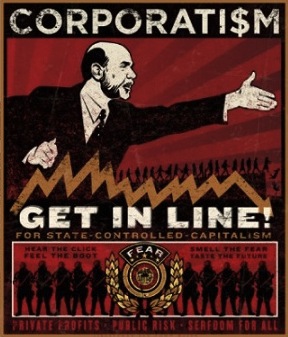
Corporatism Stifles Innovation

Corporatism-630-360

By James Hall

Source: BATR.org

For an economy to grow and create actual wealth, innovation is a bedrock component in the development of enhanced prosperity. Prosperity is an intriguing concept. Simply making and accumulating money falls short of establishing a successful economic model. This recent report illustrates a prime example. Facebook stock soars, as company briefly passes IBM in market value. “By most measures, Facebook is dwarfed by IBM: With about 7,000 employees, ten-year-old Facebook is on track to garner $12 billion in sales this year. The 103-year-old IBM has more than 400,000 workers and sold almost $100 billion of computer hardware and software in 2013.”

Is Facebook a shining star of innovation? Or is it the product of a society, which has given up on working towards a successful economy, whereby a prosperous middle class partakes in the engine of continued and shared affluence? Conversely, is IBM an innovated inventor, or is it a dinosaur of a previous era?

However, you answer such questions, Edmund Phelps in an opinion article, Corporatism not capitalism is to blame for inequality argues that tangible innovation is in decline.

“Innovation tailed off between 1940 and about 1970, while the top decile’s share of wealth and income began rising in the 1970s.

The causation runs the other way: losses of dynamism have tended to sharpen wealth inequality because it hits workers of modest means more than it hurts the wealthy. Developing new products is labour-intensive. So is producing the capital goods needed to make them. These jobs disappear when innovation stalls.”

An explanation of The Rise and Fall of Western Innovation, addresses the plight of economic reality. “It is undeniable that the U.S. economy is not delivering the steadily improving wages and living standards the nation’s residents expect.”

Mass Flourishing is meant to be Edmund Phelps’s chef d’oeuvre, the capstone to a half century of research into the sources of national wealth.

A decline in the pace of innovation threatens prosperity, in the U.S. and everywhere else.

The main cause of this decline, according to Phelps, is corporatism—the inevitable tendency of businesses, workers, and other interests to band together to protect what they have. In modern economies, he says, corporations, unions, and other interests turn government into an agency for forestalling change and preserving the status quo.”

The noted economic expert and academic Robert J. Shiller, in his article, Why Innovation Is Still Capitalism’s Star, provides a critique of “Mass Flourishing: How Grassroots Innovation Created Jobs, Challenge and Change”.

“Professor Phelps discerns a troubling trend in many countries, however, even the United States. He is worried about corporatism, a political philosophy in which economic activity is controlled by large interest groups or the government. Once corporatism takes hold in a society, he says, people don’t adequately appreciate the contributions and the travails of individuals who create and innovate. An economy with a corporatist culture can copy and even outgrow others for a while, he says, but, in the end, it will always be left behind. Only an entrepreneurial culture can lead.”

Jared Bernstein does not agree as stated in a response to Professor Shiller in ‘Does the Government Stifle Innovation? I Don’t See It (To the Contrary…)’. “My points are that a) many important innovations have involved government support somewhere along the way, and b) while one could and should worry about waste in this area, I’ve not seen evidence, nor does Shiller provide any, of stifling. …”.

Well, that viewpoint sure sound like Obama’s infamous endorsement of a government corporatism model, “If you’ve got a business — you didn’t build that. Somebody else made that happen.”

When examining the way corporate transnational businesses operate in the real world, their lack of internal in-house innovation is notorious. These gigantic corporatist carnivores excel at mergers and accusations in the quest of monopolization of markets. In these endeavors, their best friend is government cronyism and favoritism.

The essay, Blaming Capitalism for Corporatism, makes an important point.

“In various ways, corporatism chokes off the dynamism that makes for engaging work, faster economic growth, and greater opportunity and inclusiveness. It maintains lethargic, wasteful, unproductive, and well-connected firms at the expense of dynamic newcomers and outsiders, and favors declared goals such as industrialization, economic development, and national greatness over individuals’ economic freedom and responsibility. Today, airlines, auto manufacturers, agricultural companies, media, investment banks, hedge funds, and much more has at some point been deemed too important to weather the free market on its own, receiving a helping hand from government in the name of the “public good.”

Here within dwells the essential dilemma, defining the genuine “Public Good“. Government often acts according to Mr. Bernstein’s idea of progress, especially in technological terms. Focus on the notion – “economically important” – and the language filter that translates into a benefit for the Corporatocracy matrix.

“While “entrepreneurial culture” will always be essential, many innovations that turned out to be economically important in the US have government fingerprints all over them. From machine tools, to railroads, transistors, radar, lasers, computing, the internet, GPS, fracking, biotech, nanotech—from the days of the Revolutionary War to today—the federal government has supported innovation often well before private capital would risk the investment.”

Corporatism invents methods of greater control and market dominance for select elitist beneficiaries. When government provides seed money to fund research projects, pure science is seldom the objective. As examined in the essay, How Government Did (and Didn’t) Invent the Internet, Harry McCracken writes: (I’m even prepared to believe that if the Internet hadn’t been invented at DARPA, the private sector would have stepped in and done the job. But we’ll never know for sure, since it was invented at DARPA.)

Thus, the paradox most people are unable to see beyond the guise of “so called” progress. Is government involvement or outright development of transhumanist futuristic technology a valid form of innovation or is it the terminal scourge of central planning and a controlled economy? Surely, under such a system, the “Mass Flourishing” of sharing the wealth, will no longer be an issue among the “useless eaters”, designated for extinction.

– See more at: http://www.batr.org/corporatocracy/073014.html#sthash.RFUeioGh.dpuf

The Conflation Trap

By Roderick Long

Source: Bleeding Heart Libertarians

Left-libertarians differ from the (current) libertarian mainstream both in terms of what outcomes they regard as desirable, and in terms of what outcomes they think a freed market is likely to produce.

With regard to the latter issue, left-libertarians regard the current domination of the economic landscape by large hierarchical firms as the product not of free competition but of government intervention – including not only direct subsidies, grants of monopoly privilege, and barriers to entry, but also a regulatory framework that enables firms to socialise the scale costs associated with growth and the informational costs associated with hierarchy, while pocketing the benefits – and leaving employees and consumers with a straitened range of options. In the absence of government intervention, we maintain, firms could be expected to be smaller, flatter, and more numerous, with greater worker empowerment.

Thus we tend to wince when libertarians (or many of them, to varying degrees) rush to the defense of elite corporations and prevailing business models and practices as though these were free-market phenomena. First, we think this is factually inaccurate; and second, we think it’s strategically suicidal. Ordinary people generally know firsthand the petty tyranny and bureaucratic incompetence that all too often characterise the world of business; libertarians who try to glamourise that world as an arena of economic rationality and managerial heroism risk coming across as clueless at best, and shills for the ruling class at worse.

This is also why we tend to be less than enthusiastic about the word “capitalism” as the term for free-market society; as Friedrich Hayek notes, the term is“misleading,” since it “suggests a system which mainly benefits the capitalists,” whereas a genuine free market is “a system which imposes upon enterprise a discipline under which the managers chafe and which each endeavours to escape.” (Law, Legislation, and Liberty, vol.1, p. 62.)

But it is not only mainstream libertarians (and of course, to a far greater extent, conservatives) that tend to conflate the results of crony corporatism with those of free markets; such conflationism is all too common on the traditional left as well. The difference is that the evaluations are reversed; where the right-wing version of conflationism treats the virtues of free markets as reason to defend the fruits of corporatism , the left-wing version of conflationism treats the objectionable fruits of corporatism as reason to condemn free markets.

Central to both forms of conflationism is the myth that big business and big government are fundamentally at odds. As is often the case, the myth sustains itself by containing a kernel of truth; while big business and big government are partners, each serving to prop up the other, each side would like to be the dominant partner (as with church and state in the Middle Ages, or Dooku and Palpatine in the Star Wars prequels), so much – though not, I think, most – of the conflict between them is genuine. But we should not allow these squabbles between different wings of the ruling class, essentially over how to divide up the loot, to obscure the far greater extent to which the political elite and the corporate elite work together. Conservative politicians, largely agents of the corporate wing, wrap their policies in anti-big-government rhetoric, while liberal politicians, largely agents of the political wing, wrap their policies in anti-big-business rhetoric; the differences in policy often involve nudging the balance of power slightly in one direction or the other (will healthcare be mainly controlled by government directly, or instead by the private beneficiaries of government-granted privilege like insurance companies and the AMA?), but both wings systematically benefit from most of the policies propounded by each side. FDR’s presidency, for example, with its cartelising policies, gave a massive boost to corporate power, while the three chief indices of state power – taxes, spending, and debt – all skyrocketed under Reagan’s presidency.

But conflationism isn’t just a mistake about the prevailing system; it’s also a means by which that system perpetuates itself. People who are attracted to the idea of free markets are hoodwinked by conflationism into supporting big business, and thus becoming foot soldiers of the corporate wing of the ruling class; people who are repelled by the reality of corporatism on the ground are hoodwinked into supporting big government, and thus becoming foot soldiers of the political wing of the ruling class. Thus, thanks to the pincer-movement of right-conflationism and left-conflationism, those who seek to oppose the prevailing system end up in the ranks of its supporters – and the possibility of a radical challenge to the system as a whole is rendered effectively invisible. This is how conflationism functions.

My talk of “functioning” is not meant to imply that conflationism is deliberately propagated in order to divert potential enemies of the system into the ranks of its supporters (though of course it sometimes is).

In a broader sense, whenever some feature A of a system B tends reliably to produce a certain result C, and A’s being such as to produce C helps to explain the existence and/or persistence of B, and thereby of A, then we may say that the function of A is to produce C. Thus the fact that thorns tend to protect roses from being eaten explains why roses, with their thorns, exist and persist. It’s in that sense that I say that the function of conflationism within the prevailing state/corporate system is to bewilder its foes into becoming supporters, and to render alternatives invisible. Conflationism is an instance of malign spontaneous order.

Philosopher of science Thomas Kuhn describes an intriguing experiment:

Bruner and Postman asked experimental subjects to identify on short and controlled exposure a series of playing cards. Many of the cards were normal, but some were made anomalous, e.g., a red six of spades and a black four of hearts. … For the normal cards these identifications were usually correct, but the anomalous cards were almost always identified, without apparent hesitation or puzzlement, as normal. The black four of hearts might, for example, be identified as the four of either spades or hearts. Without any awareness of trouble, it was immediately fitted to one of the conceptual categories prepared by prior experience. … With a further increase of exposure to the anomalous cards, subjects did begin to hesitate and to display awareness of anomaly. Exposed, for example to the red six of spades, some would say: That’s the six of spades, but there’s something wrong with it – the black has a red border. … A few subjects … were never able to make the requisite adjustment of their categories. (Structure of Scientific Revolutions, pp. 62-63)

In short, people tend to have not only difficulty with, but even aversion to, recognising something that doesn’t fit their established categories. This creates a problem for libertarians generally; for many in the political mainstream, the first impulse is to assimilate libertarians to a more familiar “anti-government” category, namely conservatives. When, after longer exposure, mainstreamers realise that libertarians aren’t quite conservatives after all, then they begin to see libertarians as the equivalent of “black spades with red borders” – conventionally conservative on some issues, conventionally liberal on others, rather than representing a radical alternative to existing ideologies. (Libertarians’ use of the Nolan Chart as an outreach tool may contribute to this tendency.)

What holds true for libertarians generally, holds to a still greater extent in the case of left-libertarians. The prevalence of conflationism tends to reinforce the impression that anyone who attacks (what we consider) the fruits of corporatism must be anti-free-market, and that anyone who defends free markets must be undertaking a defense of (what we consider) the fruits of corporatism. Thus nonlibertarian leftists tend to see us as corporate apologists in leftist camouflage, while nonleftist libertarians tend to see us as commies in libertarian guise.

Even when mainstream libertarians acknowledge the existence (and badness) of corporatism, as most do, communication with left-libertarians still tends to come to grief. Left-libertarians are baffled when mainstream libertarians acknowledge cronyism in one breath, only to slide back in the next breath to into treating criticisms of big business as criticisms of free markets. More mainstream libertarians, for their part, are baffled as to why left-libertarians keep raising the issue of corporatism when the mainstream libertarians have already acknowledged its existence and badness.

Kuhn is helpful here too:

Since remote antiquity most people have seen one or another heavy body swinging back and forth on a string or chain until it finally comes to rest. To the Aristotelians, who believed that a heavy body is moved by its own nature from a higher position to a state of natural rest at a lower one, the swinging body was simply falling with difficulty. Constrained by the chain, it could achieve rest at its low point only after a tortuous motion and a considerable time. Galileo, on the other hand, looking at the swinging body, saw a pendulum, a body that almost succeeded in repeating the same motion over and over again ad infinitum. … [W]hen Aristotle and Galileo looked at swinging stones, the first saw constrained fall, the second a pendulum …. (Ibid., pp. 118-121)

Aristotle and Galileo were observing the same two facts: the stone keeps swinging back and forth for a while, and then it eventually hangs straight down. But for Galileo the swinging was essential and the eventual cessation accidental, a “friction” phenomenon; whereas for Aristotle, progress toward a state of rest was, and the sideways perturbations accidental.

Likewise, for those operating within a conceptual framework that sees conservative opposition to big government and liberal opposition to big business as essential and deviations from these norms as accidental, evidence that conservative policies promote big government or that liberal policies promote will be dismissed as inessential or anomalous or an excusable. (See, for example, this video in which Obama supporters condemn right-wing-sounding policies when they think they’re Romney’s, but either excuse them or go into denial when told that the policies are actually Obama’s.)

Similarly, for many mainstream libertarians, free exchange is what essentially characterises the existing economy, while the corporatist policies are so much friction; and just as there’s no need for constant references to friction when talking about how a mechanism works, such mainstream libertarians don’t constantly bring up corporatism when discussing the working of the existing economy. For left-libertarians, by contrast, corporatism is a far more central feature of the existing economy, and leaving it out radically distorts our understanding. In such cases left-libertarians and more conventional libertarians are arguing from opposite sides of a Gestalt shift, where what looks essential to one side looks accidental to the other.

I don’t mean to suggest that these disputes are rationally irresoluble, however. In the playing-card experiments, subjects did eventually come to see the suits correctly after sufficiently long exposure. And sufficient exposure to the evidence marshaled by left-libertarians can prompt the relevant Gestalt shift, as indeed it frequently does; most left-libertarians once started out either less leftist or less libertarian or both. But the prevailing conceptual framework, through which so many (both libertarian and not) look at the economy without seeing what we see, is, I think, no accident; it’s part of the means by which the big-government/big-business partnership maintains itself.