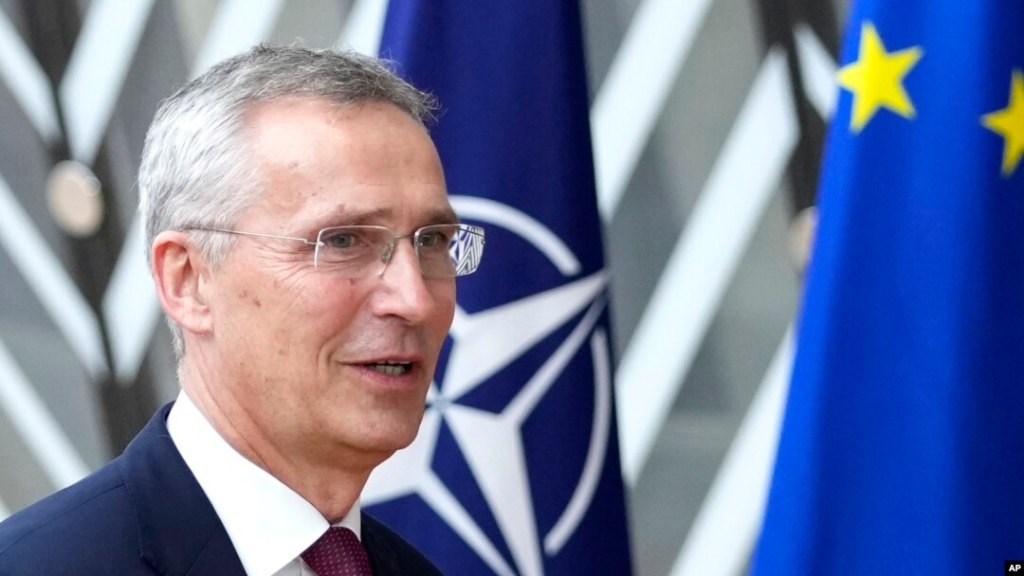
On September 7th, NATO’s Secretary General, Jens Stoltenberg, acknowledged that the war in Ukraine did not start on 24 February 2022 when Russia invaded Ukraine, like Western ‘news’-media say, but much earlier, in 2014, and that Russia’s invasion in 2022 resulted from NATO’s efforts to bring Ukraine into NATO and to bring NATO’s military forces closer to Russia’s borders: “He [Putin] went to war to prevent NATO, more NATO, close to his borders.” In other words: Russia’s invasion actually was defensive, not aggressive, on Russia’s side. And Stoltenberg proudly proclaimed that Russia has been defeated in that defensive objective, because instead both Sweden and especially Finland (one of the nearest nations to The Kremlin, other than the nearest of all, which is Ukraine) rushed to join NATO as a direct result of Russia’s invasion of Ukraine. Stoltenberg was so proud of having turned to dust Putin’s goal of making Russia safer, that Stoltenberg repeated many times NATO having done the exact opposite of what Putin was urging. Stoltenberg was clearly proud to have overseen the frustration of Russia’s need for a defense against a possible blitz-nuclear attack by NATO.
Furthermore: Stoltenberg acknowledged that this war is and has been good for NATO because it’s forcing NATO member countries to increase their expenditures on military weapons, and is thereby forcing down these countries’ expenditures on other matters that voters usually care more about.
The war didn’t start in February last year. It started in 2014. The full-fledged invasion happened last year, but the war, the illegal annexation of Crimea, Russia went into eastern Donbas in 2014.
Since then, NATO has implemented the biggest adaptation on this Alliance in modern history, in decades. And part of that is to invest more in defence. I think I’ve told you before that I know it’s hard to allocate money for defence, because most politicians want to spend money on health, on education, on infrastructure instead of defence. …
The background was that President Putin declared in the autumn of 2021, and actually sent a draft treaty, that they wanted NATO to sign, to promise no more NATO enlargement. That was what he sent us. And was a pre-condition for not invade Ukraine. Of course we didn’t sign that.
The opposite happened. He wanted us to sign that promise, never to enlarge NATO. He wanted us to remove our military infrastructure in all Allies that have joined NATO since 1997, meaning half of NATO, all the Central and Eastern Europe, we should remove NATO from that part of our Alliance, introducing some kind of B, or second class membership. We rejected that.
So he went to war to prevent NATO, more NATO, close to his borders. He has got the exact opposite. He has got more NATO presence in eastern part of the Alliance and he has also seen that Finland has already joined the Alliance and Sweden will soon be a full member.
Stoltenberg’s speech on September 7th ignored America’s coup, and he even ignored that the coup was quickly followed by the breakaway of Crimea because a plebiscite was held there on 16 March 2014, which produced a 90%+ vote for Crimea to again be a part of Russia, of which Crimea had been a part from 1783 to 1954. And he ignored that the breakaway of Donbass resulted after the Obama-installed Ukrainian government started in April 2014 an ethic-cleansing invasion of Donbass because over 90% of the voters there had voted for the Ukrainian President whom Obama’s coup had replaced, and Obama didn’t want those voters ever again to vote in a Ukrainian election.
So, although what Stoltenberg said there was true, it was very incomplete, because it failed to mention the coup, and the coup-regime’s ethnic-cleansing campaign, though those American initiatives were actually the things that started the war in Ukraine.
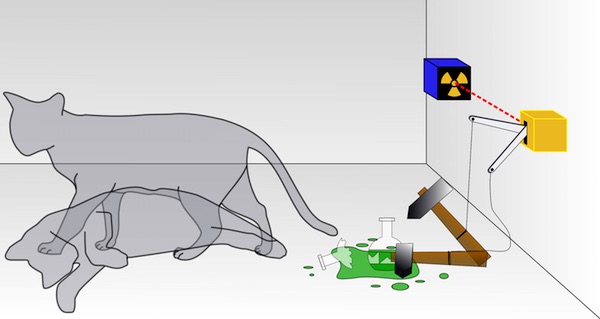
Physicist Erwin Schrödinger in 1935 tried to explain the (consequences of the) uncertainty principle, defined by Werner Heisenberg as a core theme of Albert Einstein’s view of quantum mechanics, to … Albert Einstein. The latter must have been thrilled. Even though he did not like the uncertainty principle (God does not play dice). The thought experiment became known as “Schrödinger’s cat”. Since you cannot know both a particle’s position and its speed -and that’s just one example-, you have to assume all possible outcomes are valid (superposition). Only when you “look” does one particular outcome become the “reality”. It’s all part of the subatomic “world”
Wikipedia: “In Schrödinger’s original formulation, a cat, a flask of poison, and a radioactive source are placed in a sealed box. If an internal monitor (e.g. a Geiger counter) detects radioactivity (i.e. a single atom decaying), the flask is shattered, releasing the poison, which kills the cat. The Copenhagen interpretation implies that, after a while, the cat is simultaneously alive and dead. Yet, when one looks in the box, one sees the cat either alive or dead, not both alive and dead. This poses the question of when exactly quantum superposition ends and reality resolves into one possibility or the other.”
As I’m trying to explain this, I very much have to wonder if I get it right. And I always thought that follows the uncertainty principle too: I can understand it and not understand it both at the same time. A physicist might fare a bit better, but it won’t come easy.
This is what I was thinking of with regards to the war in Ukraine. Before the fighting started, all possible outcomes seemed equally possible. If you did not look too closely at numbers of soldiers and weaponry, that is. But once it did start (when Schrödinger’s box was opened), it became clear very rapidly that Ukraine had no chance of winning. So why are we still acting as if the box remains closed? Because that way we get to spend billions more on armory, and we get western people to support Zelensky and his neo-nazis as those same people suffer from high prices for everything. Any outcome is still possible!
Take the Kakhovka dam narrative, or Nord Stream or any of the numerous other examples. When both sides accuse each other of perpetrating a certain event, Schrödinger’s box remains closed. Which is exactly what our politicians and arms makers desire. They don’t want us to know that they’ve been beaten by Russia, because you would no longer support their policies and their arms purchases. They want “superposition”. They can’t very well declare victory -though they try-, but they don’t need to either. They need uncertainty. Politicians, arms makers and media. They all profit from keeping you in the dark.
The best comment on Kakhovka I’ve seen perhaps comes from @CheburekiMan on Twitter: “Restoring water flow to the North Crimean Canal was top priority for Russia, the very first act of the SMO. Before Kiev shut off the flow in 2014, the canal was supplying 85% of Crimea’s water. So much depended on it, from crops to industry to drinking water, that’s how important it is. Now the pro-Ukraine bleating sheep want people to believe that Russia would wreck the dam, empty the reservoir and cause serious harm to its own people by running the canal dry. It’s so bonkers that one has to seriously consider such ideas are the result of brain damage, or perhaps fetal alcohol syndrome.”
Where Orwell comes in is in the terminology. Where “War equals Peace”. The EU pays its member states for the second hand weapons they “donate” to Kiev, through something called the European Peace Fund (aka Facility). Mass weapons deliveries that get huge numbers of people killed, are labeled “Peace”. Zelensky touts a plan labeled a Peace Plan, which demands Russia give back all territories, pay war reparations, deliver Putin et al to some international criminal court etc. The chance of that happening is of course zero, but as long as Schrödinger’s box remains closed, anything is possible. Still, it is a War Plan, not a Peace Plan.
Similarly, Zelensky and his international backers are organizing a Peace Summit, where everybody is invited except Russia. That makes it a War Summit. The suggestion made to westerners is that this is a globally supported initiative, but it is only a small part of the world population (10%?) that supports it. NATO+Japan+Australia. Did I leave anyone out? New Zealand? Ha ha ha, I read that Jacinda Ardern was made a dame. If you know a better illustration of how deep we’ve sunk, I’m game.
All the rest of the world is much more interested in the economic developments that involve BRICS+. 31 and counting nations have expressed interest in joining. And they’re not going to risk their potential role in that over a local fight far away that they know is long decided. US/NATO, in provoking this war, have lost not only the fight, but much more importantly, their economic power. Recently, the G7 were talking about what they were going to do in Central Asia. Which is basically all the “-Stans” left over after the Soviet Union dissolved. But the G7 is not going to do anything, it has no power there anymore. All these countries want to join the BRICS+. Why would you join a waning power if you have a shot at joining a power in its ascendancy, that all your neighbors are also joining?
The same attitude is prevalent in Africa, South America, East Asia, etc. Full of countries that remember how they were treated through the years by first Europe and then the US. The world has changed beyond recognition since the start of Russia’s SMO, and the “globalist west” is the only “region” that doesn’t recognize this. The USD won’t be replaced tomorrow as the reserve currency, but it doesn’t have to be. The process goes step by step, and is unstoppable. Hemingway’s famous words about how you go bankrupt (first gradually, then suddenly) have us on the wrong foot here. We only look at the “suddenly” part when it comes to the reserve currency, and ignore all the “gradually” steps. And then one day we will wake up and everything’s changed.
The rest of the world sees Schrödinger’s box as open. Only the west thinks that it’s still closed, and all possible outcomes are still viable.
It’s not the Russians who are perverse and barbaric. It’s the Western regimes and their Nazi terrorist front in Ukraine.
Western media would have its consumers believe that Russians are the most devious, perverse, and self-destructive people on Earth. Following a flood of jaw-dropping, biblical proportions in the Russian-controlled Kherson region this week, the Western media amplified the Kiev regime’s talking points, which is to say, the Kiev regime’s Western sponsors’ talking points.
The Russians are destroying themselves for propaganda gain, according to those talking points.
The giant Kakhovka Hydroelectric Power Plant was spectacularly blown up by an explosion or explosions and its vast reservoir began flooding hundreds of cities and villages in the surrounding Kherson countryside. The nearby city of Nova Kakhovka with a population of 45,000 is being evacuated. Aerial images of the deluge show an unprecedented disaster with huge environmental, economic and social repercussions.
The damage from the dam’s collapse is catastrophic. The impact of displacement and destroyed livelihoods, businesses and industries will affect millions of Russian citizens. Kherson is one of the four former Ukrainian territories that voted to join the Russian Federation in referenda last year following Moscow’s military intervention in Ukraine to neutralize what was then ongoing aggression from the Kiev regime towards ethnic Russians.
Of the countless consequences from the dam’s destruction, there are two main specific impacts of priority concern. The Kakhovka power plant serves to supply water for the upstream Zaporozhye Nuclear Power Plant – Europe’s largest civilian nuclear power station. Disruption of the water supply could adversely impact the cooling systems at the nuclear plant, causing its reactors to blow up thereby creating a radiation disaster. The Zaporozhye nuclear station is in Russian-controlled territory and has been under Russian military protection since the beginning of Russia’s military intervention on February 24, 2022.
A second consequence from the dam’s collapse is the threat to cut off supply of drinking water to Russia’s Crimea Peninsula where some 3 million people live.
It is obvious who gains and who loses from the blowing up of the Kakhovka hydro facility. The NATO-backed Kiev regime has inflicted massive damage to Russian infrastructure in the Kherson region and beyond.
Yet, in spite of the patently obvious conclusion, Western media and governments are trying to tell the world that the dam was sabotaged by Russian “terrorists”. British foreign minister James (Not-So) Cleverly and the European Union’s Charles Michel were among the Western politicians who were immediately trying to cast the Kremlin as the villain.
It takes an inestimable capacity for double-think and debilitating Russophobia for such logic to be articulated with a straight face.
This a repeat of the same stultifying nonsense that followed the destruction of the Nord Stream gas pipelines last September. When the Russian-owned pipelines under the Baltic Sea were blown up, the Western governments and their dutiful media immediately blamed Russia for sabotaging its own infrastructure. It transpired later that the gas pipes were mined by the U.S. military, an act of terrorism that was ordered by President Joe Biden, according to respected veteran investigative journalist Seymour Hersh. Months later, the Western media ignored or censored out this most plausible cause as a means to delete European-Russian energy trade for America’s strategic interests.
The same double-think by Western governments and media has been deployed over the constant artillery attacks on the Zaporozhye nuclear plant. For months, the plant has been bombarded by the Kiev regime with U.S.-supplied HIMARS rockets. The unspeakable nefarious objective is to cause a nuclear catastrophe in Europe. The Russians are guarding the nuclear facility and have presented documentary evidence to the United Nations Security Council and the International Atomic Energy Agency of who is doing the shelling. Yet, the UN and IAEA as well as the Western media feign a cynical agnosticism about who the nuclear terrorists are, trying to leave question marks that Russia may be somehow inflicting self-sabotage.
The same shelling tactics have been used to hit the Kakhovka dam over many months by Kiev regime forces. It was Russia that has repeatedly warned of the imminent danger of flooding if the hydro plant was crippled. That warning has come to reality, though the Western media are defying cause, motive and past record to invert the accusations.
The Kiev regime has claimed that Russia bombed the Kakhovka dam in order to hamper its planned counteroffensive. This week saw intensified efforts along the 1000-kilometer front line between Ukrainian forces and Russian-held territory. Moscow said it repelled the attacks with heavy losses incurred by the Ukrainian side. Those battles occurred much further to the north from the Kherson region on the Black Sea where the dam was blown.
Adding two and two and getting five is the usual Western media formula because, more than ever, this media system is shown to be a propaganda service, both private and state-owned.
The shamelessness of such media’s double-think is breathtaking to any rational observer. What’s more, the Western public can more and more see through the lies and preposterous pretensions of “independent journalism”. The Western media is a war ministry aiming to demonize Russia as barbarians whose level of sub-humanity, it is implied, is deserving of war and destruction.
In case you didn’t notice, such a mindset is consistent with Nazi ideology.
It’s not the Russians who are perverse and barbaric. It’s the Western regimes and their Nazi terrorist front in Ukraine.
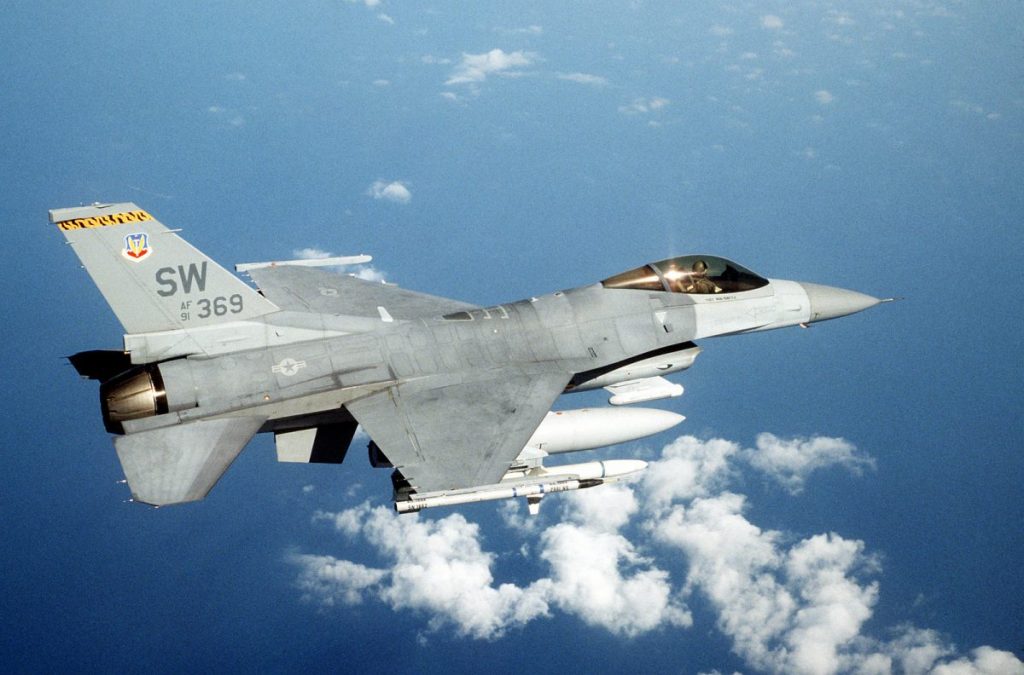
“Ukraine will now push for Western fourth generation fighter jets such as the U.S. F-16 after securing supplies of main battle tanks, an adviser to Ukraine’s defence minister said on Wednesday.
Ukraine won a huge boost for its troops as Germany announced plans to provide heavy tanks for Kyiv on Wednesday, ending weeks of diplomatic deadlock on the issue. The United States is poised to make a similar announcement.
Just in time for the good news, Lockheed Martin has announced that the arms manufacturing giant happens to be all set to ramp up production of F-16s should they be needed for shipment to Ukraine.
“Lockheed Martin has said that it’s ready to meet demands for F-16 fighter jets if the US and its allies choose to ship them to Ukraine,” Antiwar’s Dave DeCamp reports. “So far, the US and its allies have been hesitant to send fighter jets to Ukraine due to concerns that they could be used to target Russian territory. But the Western powers seem less and less concerned about escalation as the US and Germany have now pledged to send their main battle tanks.”
The New York Times has a new article out titled “How Biden Reluctantly Agreed to Send Tanks to Ukraine,” subtitled “The decision unlocked a flow of heavy arms from Europe and inched the United States and its NATO allies closer to direct conflict with Russia.” It’s authors David E. Sanger, Eric Schmitt and Helene Cooper write:
President Biden’s announcement Wednesday that he would send M1 Abrams tanks to Ukraine came after weeks of tense back-channel negotiations with the chancellor of Germany and other European leaders, who insisted that the only way to unlock a flow of heavy European arms was for the United States to send tanks of its own.
His decision, however reluctant, now paves the way for German-made Leopard 2 tanks to be delivered to Ukraine in two or three months, provided by several European nations. While it is unclear whether it will make a decisive difference in the spring offensive that President Volodymyr Zelensky is now planning to take back territory seized by Russia, it is the latest in a series of gradual escalations that has inched the United States and its NATO allies closer to direct conflict with Russia.
When even the myopic empire simps at The New York Times are acknowledging that western powers are escalating aggressions in a very dangerous direction, you should probably sit up and pay attention.
In a recent article for Responsible Statecraft titled “Mission Creep? How the US role in Ukraine has slowly escalated,” Branko Marcetic outlines the ways the US empire has “serially blown past their own self-imposed lines over arms transfers,” over and over again relenting to war hawks and requests from Ukrainian officials to supply weapons which it had previously refrained from supplying for fear that they would be too escalatory and lead to hot warfare between nuclear superpowers. Marcetic notes the way previously unthinkable aggressions like NATO spy agencies conducting sabotage operations on Russian infrastructure are now accepted, with more escalations being called for as soon as the previous one was made.
"…NATO arms transfers have now escalated well beyond what governments had worried just months ago could draw the alliance into direct war with Russia…" https://t.co/NKbMdVuxnY
Toward the end of his article, Marcetic drives home a very important point which needs more attention: that the western alliance has established a policy of continually escalating every time Russia doesn’t react forcefully to a previous western escalation, which necessarily means Russia is being actively incentivized to react forcefully to those escalations.
“By escalating their support for Ukraine’s military, the U.S. and NATO have created an incentive structure for Moscow to take a drastic, aggressive step to show the seriousness of its own red lines,” Marcetic writes. “This would be dangerous at the best of times, but particularly so when Russian officials are making clear they increasinglyview the war as one against NATO as a whole, not merely Ukraine, while threatening nuclear response to the alliance’s escalation in weapons deliveries.”
“Moscow keeps saying escalatory arms transfers are unacceptable and could mean wider war; US officials say since Moscow hasn’t acted on those threats, they can freely escalate. Russia is effectively told it has to escalate to show it’s serious about lines,” Marcetic added on Twitter.
A good recent example of this dynamic is the recent New York Times report that the Biden administration is considering backing a Ukrainian offensive on Crimea, which many experts agree is one of the most likely ways this conflict could lead to nuclear warfare. The article reports that the Biden administration has assessed that Russia is unlikely to reciprocate an escalatory aggression, but the basis for that assessment apparently comes from nothing other than the fact that Russia hasn’t done so yet.
“Crimea has already been hit many times without a massive escalation from the Kremlin,” the Times quotes a RAND Corporation think tanker as saying in explanation for the Biden administration’s belief that it can get away with backing a Crimea offensive. But as Dave DeCamp explained at the time, that’s not even true; Russia did significantly escalate its aggressions in response to strikes on Crimea, beginning to target critical Ukrainian infrastructure in ways it previously had not.
In this article about how the US is “warming” to the idea of helping Ukraine strike Crimea, RAND lady says Russia didn’t massively escalate in response to other attacks on Crimea. But the major strikes on Ukrainian infrastructure didn’t start until after the Kerch bridge bombing! pic.twitter.com/p4pHxs6xFB
So Russia has in fact been escalating its aggressions in response to attacks on Crimea; it just hasn’t been escalating them against NATO powers. As long as Russia is only escalating in ways that hurt Ukrainians, the US-centralized power structure does not regard them as real escalations. The take-home message to Moscow being that they’re going to get squeezed harder and harder until they attack NATO itself.
And of course that won’t de-escalate things either; it will be seized on and spun as evidence that Putin is a reckless madman who is attacking the free world completely unprovoked and must be stopped at all cost, even if it means risking nuclear armageddon. Russia would of course be aware of this obvious reality, so the only way it takes the bait is if the pain of not reacting gets to a point where it is perceived as outweighing the pain of reacting. But judging by its actions the empire seems determined to push them to that point.
It really is spooky how much de-escalation and detente have been disappeared from public discourse about Russia. People genuinely don’t seem to know it’s an option. They really do think the only option is continually escalating nuclear brinkmanship, and that anything else is obsequious appeasement. They think that because that’s the message they are being fed by the imperial propaganda machine, and they’re being fed that message because that is the empire’s actual position.
I’ve been warning about the increasing risk of nuclear armageddon for as long as I’ve been publicly engaged in political commentary, and people have been calling me a hysterical idiot and a Putin puppet the entire time even as we’ve moved closer and closer to the exact point I’ve been screaming about at the top of my lungs all these years. Now there’s not a whole lot closer it can get without being directly upon us. I deeply, deeply hope we turn this thing around before it’s too late.
Question 1—You think that Putin should have acted more forcefully from the beginning in order to end the war quickly. Is that an accurate assessment of your view on the war? And—if it is—then what do you think is the downside of allowing the conflict to drag on with no end in sight?
Paul Craig Roberts—Yes, you have correctly stated my position. But as my position can seem “unAmerican” to the indoctrinated and brainwashed many, those who watch CNN, listen to NPR, and read the New York Times, I am going to provide some of my background before going on with my answer.
I was involved in the 20th century Cold War in many ways: As a Wall Street Journal editor; as an appointee to an endowed chair in the Center for Strategic and International Studies, part of Georgetown University at the time of my appointment, where my colleagues were Henry Kissinger, National Security Advisor and Secretary of State, Zbigniew Brzezinski, National Security Advisor, and James Schlesinger, a Secretary of Defense and CIA director who was one of my professors in graduate school at the University of Virginia; as a member of the Cold War Committee on the Present Danger; and as a member of a secret presidential committee with power to investigate the CIA’s opposition to President Reagan’s plan to end the Cold War.
With a history such as mine, I was surprised when I took an objective position on Russian President Putin’s disavowal of US hegemony, and found myself labeled a “Russian dupe/agent” on a website, “PropOrNot,” which may have been financed by the US Department of State, the National Endowment for Democracy, or the CIA itself, still harboring old resentments against me for helping President Reagan end the Cold War, which had the potential of reducing the CIA’s budget and power. I still wonder what the CIA might do to me, despite the agency inviting me to address the agency, which I did, and explain why they went wrong in their reasoning.
I will also say that in my articles I am defending truth, not Putin, although Putin is, in my considered opinion, the most honest player, and perhaps the most naive, in the current game that could end in nuclear Armageddon. My purpose is to prevent nuclear Armageddon, not to take sides. I remember well President Reagan’s hatred of “those godawful nuclear weapons” and his directive that the purpose was not to win the Cold War but to end it.
Now to Mike’s question, which is to the point. Perhaps to understand Putin we need to remember life, or how it was presented by the West to the Soviet Union and the American broadcasts into the Soviet Union of the freedom of life in the West where streets were paved with gold and food markets had every conceivable delicacy. Possibly this created in the minds of many Soviets, not all, that life in the Western world was heavenly compared to the hell in which Russians existed. I still remember being on a bus in Uzbekistan in 1961 when a meat delivery truck appeared on the street. All traffic followed the truck to the delivery store where a several block long line already waited. When you compare this life with a visit to an American supermarket, Western superiority stands out. Russian hankerings toward the West have little doubt constrained Putin, but Putin himself has been affected by the differences in life between the US in those times and the Soviet Union.
Putin is a good leader, a human person, perhaps too human for the evil he faces. One way to look at my position that Putin does too little instead of too much is to remember the World War II era when British Prime Minister Chamberlin was accused of encouraging Hitler by accepting provocation after provocation. My own view of this history is that it is false, but it remains widely believed. Putin accepts provocations despite having declared red lines that he does not enforce. Consequently, his red lines are not believed. Here is one report:
RT reported on December 10 that “The US has quietly given Ukraine the go-ahead to launch long-range strikes against targets inside Russian territory, the Times reported on Friday, citing sources. The Pentagon has apparently changed its stance on the matter as it has become less concerned that such attacks could escalate the conflict.”
In other words, by his inaction Putin has convinced Washington and its European puppet states that he doesn’t mean what he says and will endlessly accept ever worsening provocations, which have gone from sanctions to Western financial help to Ukraine, weapons supply, training and targeting information, provision of missiles capable of attacking internal Russia, attack on the Crimea bridge, destruction of the Nord Stream pipelines, torture of Russian POWs, attacks on Russian parts of Ukraine reincorporated into the Russian Federation, and attacks on internal Russia.
At some point there will be a provocation that is too much. That’s when the SHTF.
Putin’s goal has been to avoid war. Thus, his limited military objective in Ukraine to throw the Ukrainian forces out of Donbass meant a limited operation that left Ukrainian war infrastructure intact, able to receive and deploy advanced weapons from the West, and to force Russian withdrawals to lines more defensible with the very limited forces Putin committed to the conflict. The Ukrainian offensives convinced the West that Russia could be defeated, thus making the war a primary way of undermining Russia as an obstacle to Washington’s hegemony. The British press proclaimed that the Ukrainian Army would be in Crimea by Christmas.
What Putin needed was a quick victory that made it completely clear that Russia had enforceable red lines that Ukraine had violated. A show of Russian military force would have stopped all provocations. The decadent West would have learned that it must leave the bear alone. Instead the Kremlin, misreading the West, wasted eight years on the Minsk Agreement that former German Chancellor Merket said was a deception to keep Russia from acting when Russia could have easily succeeded. Putin now agrees with me that it was his mistake not to have intervened in Donbass before the US created a Ukrainian army.
My last word to Mike’s question is that Putin has misread the West. He still thinks the West has in its “leadership” reasonable people, who no doubt act the role for Putin’s benefit, with whom he can have negotiations. Putin should go read the Wolfowitz Doctrine. If Putin doesn’t soon wake up, Armageddon is upon us, unless Russia surrenders.
Question 2—I agree with much of what you say here, particularly this: “Putin’s inaction has convinced Washington… that he doesn’t mean what he says and will endlessly accept ever worsening provocations.”
You’re right, this is a problem. But I’m not sure what Putin can do about it. Take, for example, the drone attacks on airfields on Russian territory. Should Putin have responded tit-for-tat by bombing supplylines in Poland? That seems like a fair response but it also risks NATO retaliation and a broader war which is definitely not in Russia’s interests.
Now, perhaps, Putin would not have faced these flashpoints had he deployed 500,000 combat troops to begin and leveled a number of cities on his way to Kiev, but keep in mind, Russian public opinion about the war was mixed at the beginning, and only grew more supportive as it became apparent that Washington was determined to defeat Russia, topple its government, and weaken it to the point where it could not project power beyond its borders. The vast majority of the Russian people now understand what the US is up-to which explains why Putin’s public approval ratings are presently at 79.4% while support for the war is nearly universal. In my opinion, Putin needs this level of support to sustain the war effort; so, postponing the mobilization of additional troops has actually worked to his benefit.
More importantly, Putin must be perceived to be the rational player in this conflict. This is absolutely essential. He must be seen as a cautious and reasonable actor who operates with restraint and within the confines of international law. This is the only way he will be able to win the continued support of China, India etc. We must not forget that the effort to build a multipolar world order requires coalition building which is undermined by impulsive, violent behavior. In short, I think Putin’s “go-slow” approach (your words) is actually the correct course of action. I think if he had run roughshod across Ukraine like Sherman on his way to the sea, he would have lost critical allies that will help him establish the institutions and economic infrastructure he needs to create a new order.
So, my question to you is this: What does a Russian victory look like? Is it just a matter of pushing the Ukrainian army out of the Donbas or should Russian forces clear the entire region east of the Dnieper River? And what about the west of Ukraine? What if the western region is reduced to rubble but the US and NATO continue to use it as a launching pad for their war against Russia?
I can imagine many scenarios in which the fighting continues for years to come, but hardly any that end in either a diplomatic settlement or an armistice. Your thoughts?
Paul Craig Roberts—I think, Mike, that you have identified the reasoning that explains Putin’s approach to the conflict in Ukraine. But I think Putin is losing confidence in his approach. Caution about approaching war is imperative. But when war begins it must be won quickly, especially if the enemy has prospects of gaining allies and their support. Putin’s caution delayed Russia’s rescue of Donbass for eight years, during which Washington created and equipped an Ukrainian army that turned what would have been an easy rescue in 2014 like Crimea into the current war approaching a year in duration. Putin’s caution in waging the war has given Washington and the Western media plenty of time to create and control the narrative, which is unfavorable to Putin, and to widen the war with US and NATO direct participation, now admitted by Foreign Minister Lavrov. The war has widened into direct attacks on Russia herself.
These attacks on Russia might bring the pro-Western Russian liberals into alignment with Putin, but the ability of a corrupt third world US puppet state to attack Russia is anathema to Russian patriots. The Russians who will do the fighting see in the ability of Ukraine to attack Mother Russia the failure of the Putin government.
As for China and India, the two countries with the largest populations, they have witnessed Washington’s indiscriminate use of force without domestic or international consequence to Washington. They don’t want to ally with a week-kneed Russia.
I will also say that as Washington and NATO were not constrained by public opinion in their two decades of wars in the Middle East and North Africa, based entirely on lies and secret agendas, what reason does Putin have to fear a lack of Russian public support for rescuing Donbass, formerly a part of Russia, from neo-Nazi persecution? If Putin must fear this, it shows his mistake in tolerating US-financed NGOs at work in Russia brainwashing Russians.
No, Putin should not engage in tit-for-tat. There is no need for him to send missiles into Poland, Germany, the UK, or the US. All Putin needs to do is to close down Ukrainian infrastructure so that Ukraine, despite Western help, cannot carry on the war. Putin is starting to do this, but not on a total basis.
The fact of the matter is that Putin never needed to send any troops to the rescue of Donbass. All he needed to do was to send the American puppet, Zelensky, a one hour ultimatum and if surrender was not forthcoming shut down with conventional precision missiles, and air attacks if necessary, the entirety of the power, water, and transportation infrastructure of Ukraine, and send special forces into Kiev to make a public hanging of Zelensky and the US puppet government.
The effect on the degenerate Woke West, which teaches in its own universities and public schools hatred of itself, would have been electric. The cost of messing with Russia would have been clear to all the morons who talk about Ukraine being in Crimea by Christmas. NATO would have dissolved. Washington would have removed all sanctions and shut up the stupid, war-crazy neoconservatives. The world would be at peace.
The question you have asked is, after all of Putin’s mistakes, what does a Russian victory look like? First of all, we don’t know if there is going to be a Russian victory. The cautious way that Putin reasons and acts, as you explained, is likely to deny Russia a victory. Instead, there could be a negotiated demilitarized zone and the conflict will be set on simmer, like the unresolved conflict in Korea.
On the other hand, if Putin is waiting the full deployment of Russia’s hypersonic nuclear missiles that no defense system can intercept and, following Washington, moves to first use of nuclear weapons, Putin will have the power to put the West on notice and be able to use the power of Russian military force to instantly end the conflict.
Question 3—You make some very good points, but I still think that Putin’s slower approach has helped to build public support at home and abroad. But, of course, I could be wrong. I do disagree strongly with your assertion that China and India “don’t want to ally with weak-kneed Russia”. In my opinion, both leaders see Putin as a bright and reliable statesman who is perhaps the greatest defender of sovereign rights in the last century. Both India and China are all-too-familiar with Washington’s coercive diplomacy and I’m sure they appreciate the efforts of a leader who has become the world’s biggest proponent of self-determination and independence. I’m sure the last thing they want, is to become cowering houseboys like the leaders in Europe who are, apparently, unable to decide anything without a ‘nod’ from Washington. (Note: Earlier today Putin said that EU leaders were allowing themselves to be treated like a doormat. Putin: “Today, the EU’s main partner, the US, is pursuing policies leading directly to the de-industrialization of Europe. They even try to complain about that to their American overlord. Sometimes even with resentment they ask ‘Why are you doing this to us?’ I want to ask: ‘What did you expect?’ What else happens to those who allow feet to be wiped on them?”)
Paul Craig Roberts—Mike, I agree that Russia for the reasons you provide is the choice partner of China and India. What I meant is that China and India want to see a powerful Russia that shields them from Washington’s interference. China and India are not reassured by what at times seems to be Putin’s irresolution and hesitancy. The rules that Putin plays by are no longer respected in the West.
Putin is correct that all European, and the Canadian, Australian, Japanese, and New Zealand governments, are doormats for Washington. What escapes Putin is that Washington’s puppets are comfortable in this role. Therefore, how much chance does he have in scolding them for their subservience and promising them independence? A reader recently reminded me about the Asch experiment in the 1950s, which found that people tended to conform to the prevalent narratives, and of the use to which Edward Bernays analysis of propaganda is put. And there is the information given me in the 1970s by a high government official that European governments do what we want because we “give the leaders bags of money. We own them. They report to us.”
In other words, our puppets live in a comfort zone. Putin will have a hard time breaking into this with merely exemplary behavior.
Question 4—For my final question, I’d like to tap into your broader knowledge of the US economy and how economic weakness might be a factor in Washington’s decision to provoke Russia. Over the last 10 months, we’ve heard numerous pundits say that NATO’s expansion to Ukraine creates an “existential crisis” for Russia. I just wonder if the same could be said about the United States? It seems like everyone from Jamie Diamond to Nouriel Roubini has been predicting a bigger financial cataclysm than the full-system meltdown of 2008. In your opinion, is this the reason why the media and virtually the entire political establishment are pushing so hard for a confrontation with Russia? Do they see war as the only way the US can preserve its exalted position in the global order?
Paul Craig Roberts—The idea that governments turn to war to focus attention away from a failing economy is popular, but my answer to your question is that the operating motive is US hegemony. The Wolfowitz Doctrine states it clearly. The doctrine says the principal goal of US foreign policy is to prevent the rise of any country that could serve as a constraint on US unilateralism. At the 2007 Munich security conference Putin made it clear that Russia will not subordinate its interest to the interest of the US.
There are some crazed neoconservatives in Washington who believe nuclear war can be won and who have shaped US nuclear weapons policy into a pre-emptive attack mode focused on reducing the ability of the recipient of a first strike to retaliate. The US is not seeking a war with Russia, but might blunder into one. The operative neoconservative policy is to cause problems for Russia that can cause internal problems, distract the Kremlin from Washington’s power moves, isolate Russia with propaganda, and even possibly pull off a color revolution inside Russia or in a former Russian province, such as Belarus, as was done in Georgia and Ukraine. People have forgot the US-instigated invasion of South Ossetia by the Georgian army that Putin sent in Russian forces to stop, and they have forgot the recent disturbances in Kazakhstan that were calmed by the arrival of Russian troops. The plan is to keep picking away at the Kremlin. Even if Washington doesn’t meet in every case with the success enjoyed in the Maidan Revolution in Ukraine, the incidents succeed as distractions that use up Kremlin time and energy, result in dissenting opinions within the government, and that require military contingency planning. As Washington controls the narratives, the incidents also serve to blacken Russia as an aggressor and portray Putin as “the new Hitler.” The propaganda successes are considerable–the exclusion of Russian athletes from competitions, refusals of orchestras to play music of Russian composers, exclusion of Russian literature, and a general refusal to cooperate with Russia in any way. This has a humiliating effect on Russians and might be corrosive of public support for the government. It has to be highly frustrating for Russian athletes, ice skaters, entertainers, and their fans.
Nevertheless, the conflict in Ukraine can turn into a general war intended or not. This is my concern and is the reason I think the Kremlin’s limited go-slow operation is a mistake. It offers too many opportunities for Washington’s provocations to go too far.
There is an economic element. Washington is determined to prevent its European empire from being drawn into closer relations with Russia from energy dependence and business relationships. Indeed, some explain the economic sanctions as de-industrializing Europe in behalf of Washington’s economic and financial hegemony. See: https://www.unz.com/mhudson/german-interview/
One year after the astounding US humiliation in Kabul – and on the verge of another serious comeuppance in Donbass – there is reason to believe Moscow is wary of Washington seeking vengeance: in the form of the ‘Afghanization’ of Ukraine.
With no end in sight to western weapons and finance flowing into Kiev, it must be recognized that the Ukrainian battle is likely to disintegrate into yet another endless war. Like the Afghan jihad in the 1980s which employed US-armed and funded guerrillas to drag Russia into its depths, Ukraine’s backers will employ those war-tested methods to run a protracted battle that can spill into bordering Russian lands.
Yet this US attempt at crypto-Afghanization will at best accelerate the completion of what Russia’s Defense Minister Sergei Shoigu describes as the “tasks” of its Special Military Operation (SMO) in Ukraine. For Moscow right now, that road leads all the way to Odessa.
It didn’t have to be this way. Until the recent assassination of Darya Dugina at Moscow’s gates, the battlefield in Ukraine was in fact under a ‘Syrianization’ process.
Like the foreign proxy war in Syria this past decade, frontlines around significant Ukrainian cities had roughly stabilized. Losing on the larger battlefields, Kiev had increasingly moved to employ terrorist tactics. Neither side could completely master the immense war theater at hand. So the Russian military opted to keep minimal forces in battle – contrary to the strategy it employed in 1980s Afghanistan.
Let’s remind ourselves of a few Syrian facts: Palmyra was liberated in March 2016, then lost and retaken in 2017. Aleppo was liberated only in December 2016. Deir Ezzor in September 2017. A slice of northern Hama in December and January 2018. The outskirts of Damascus in the Spring of 2018. Idlib – and significantly, over 25 percent of Syrian territory – are still not liberated. That tells a lot about rhythm in a war theater.
The Russian military never made a conscious decision to interrupt the multi-channel flow of western weapons to Kiev. Methodically destroying those weapons once they’re in Ukrainian territory – with plenty of success – is another matter. The same applies to smashing mercenary networks.
Moscow is well aware that any negotiation with those pulling the strings in Washington – and dictating all terms to puppets in Brussels and Kiev – is futile. The fight in Donbass and beyond is a do or die affair.
So the battle will go on, destroying what’s left of Ukraine, just as it destroyed much of Syria. The difference is that economically, much more than in Syria, what’s left of Ukraine will plunge into a black void. Only territory under Russian control will be rebuilt, and that includes, significantly, the bulk of Ukraine’s industrial infrastructure.
What’s left – rump Ukraine – has already been plundered anyway, as Monsanto, Cargill and Dupont have already bagged 17 million hectares of prime, fertile arable land – over half of what Ukraine still possesses. That translates de facto as BlackRock, Blackstone and Vanguard, top agro-business shareholders, owning whatever lands that really matter in non-sovereign Ukraine.
Going forward, by next year the Russians will be applying themselves to cutting off Kiev from NATO weapons supplies. As that unfolds, the Anglo-Americans will eventually move whatever puppet regime remains to Lviv. And Kiev terrorism – conducted by Bandera worshippers – will continue to be the new normal in the capital.
The Kazakh double game
By now it’s abundantly clear this is not a mere war of territorial conquest. It’s certainly part of a War of Economic Corridors – as the US spares no effort to sabotage and smash the multiple connectivity channels of Eurasia’s integration projects, be they Chinese-led (Belt and Road Initiative, BRI) or Russian-led (Eurasian Economic Union, EAEU).
Just like the proxy war in Syria remade large swathes of West Asia (witness, for instance, Erdogan about to meet Assad), the fight in Ukraine, in a microcosm, is a war for the reconfiguration of the current world order, where Europe is a mere self-inflicted victim in a minor subplot. The Big Picture is the emergence of multipolarity.
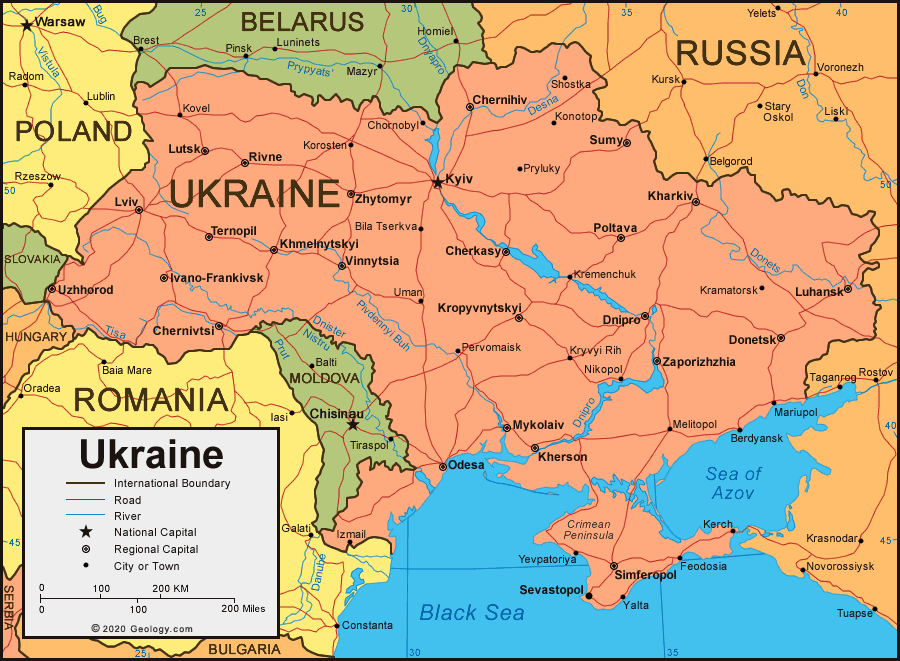
The proxy war in Syria lasted a decade, and it’s not over yet. The same may happen to the proxy war in Ukraine. As it stands, Russia has taken an area that is roughly equivalent to Hungary and Slovakia combined. That’s still far from “task” fulfillment – and it’s bound to go on until Russia has taken all the land right up to the Dnieper as well as Odessa, connecting it to the breakaway Republic of Transnistria.
It’s enlightening to see how important Eurasian actors are reacting to such geopolitical turbulence. And that brings us to the cases of Kazakhstan and Turkey.
The Telegram channel Rybar (with over 640k followers) and hacker group Beregini revealed in an investigation that Kazakhstan was selling weapons to Ukraine, which translates as de facto treason against their own Russian allies in the Collective Security Treaty Organization (CSTO). Consider too that Kazakhstan is also part of the Shanghai Cooperation Organization (SCO) and the EAEU, the two hubs of the Eurasian-led multipolar order.
As a consequence of the scandal, Kazakhstan was forced to officially announce the suspension of all weapons exports until the end of 2023.
It began with hackers unveiling how Technoexport – a Kazakh company – was selling armed personnel carriers, anti-tank systems and munitions to Kiev via Jordanian intermediaries, under the orders of the United Kingdom. The deal itself was supervised by the British military attaché in Nur-Sultan, the Kazakh capital.
Nur-Sultan predictably tried to dismiss the allegations, arguing that Technoexport had not asked for export licenses. That was essentially false: the Rybar team discovered that Technoexport instead used Blue Water Supplies, a Jordanian firm, for those. And the story gets even juicier. All the contract documents ended up being found in the computers of Ukrainian intel.
Moreover, the hackers found out about another deal involving Kazspetsexport, via a Bulgarian buyer, for the sale of Kazakh Su-27s, airplane turbines and Mi-24 helicopters. These would have been delivered to the US, but their final destination was Ukraine.
The icing on this Central Asian cake is that Kazakhstan also sells significant amounts of Russian – not Kazakh – oil to Kiev.
So it seems that Nur-Sultan, perhaps unofficially, somehow contributes to the ‘Afghanization’ in the war in Ukraine. No diplomatic leaks confirm it, of course, but bets can be made Putin had a few things to say about that to President Kassym-Jomart Tokayev in their recent – cordial – meeting.
The Sultan’s balancing act
Turkey is a way more complex case. Ankara is not a member of the SCO, the CSTO or the EAEU. It is still hedging its bets, calculating on which terms it will join the high-speed rail of Eurasian integration. And yet, via several schemes, Ankara allows Moscow to evade the avalanche of western sanctions and embargoes.
Turkish businesses – literally all of them with close connections to President Recep Tayyip Erdogan and his Justice and Development Party (AKP) – are making a killing, and relishing their new role as crossroads warehouse between Russia and the west. It’s an open boast in Istanbul that what Russia cannot buy from Germany or France they buy “from us.” And in fact several EU companies are in on it.
Ankara’s balancing act is as sweet as a good baklava. It gathers economic support from a very important partner right in the middle of the endless, very serious Turkish economic debacle. They agree on nearly everything: Russian gas, S-400 missile systems, the building of the Russian nuclear power plant, tourism – Istanbul is crammed with Russians – Turkish fruits and vegetables.
Ankara-Moscow employ sound textbook geopolitics. They play it openly, in full transparence. That does not mean they are allies. It’s just pragmatic business between states. For instance, an economic response may alleviate a geopolitical problem, and vice-versa.
Obviously the collective west has completely forgotten how that normal state-to-state behavior works. It’s pathetic. Turkey gets “denounced” by the west as traitorous – as much as China.
Of course Erdogan also needs to play to the galleries, so every once in a while he says that Crimea should be retaken by Kiev. After all, his companies also do business with Ukraine – Bayraktar drones and otherwise.
And then there’s proselytizing: Crimea remains theoretically ripe for Turkish influence, where Ankara may exploit the notions of pan-Islamism and mostly pan-Turkism, capitalizing on the historical relations between the peninsula and the Ottoman Empire.
Is Moscow worried? Not really. As for those Bayraktar TB2s sold to Kiev, they will continue to be relentlessly reduced to ashes. Nothing personal. Just business.
US Senator Joe Manchin said at the World Economic Forum on Monday that he opposes any kind of peace agreement between Ukraine and Russia.
Manchin, who at the moment is one of the most powerful elected officials in Washington, added that only the complete forcible ejection of Russia from all of Ukraine is acceptable, that the war should ideally be used to remove Putin from power, and that he and the strategists he talks to see this war as an “opportunity”.
“I am totally committed, as one person, to seeing Ukraine to the end with a win, not basically with some kind of a treaty; I don’t think that is where we are and where we should be,” Manchin said.
“I mean basically moving Putin back to Russia and hopefully getting rid of Putin,” Manchin added when asked what he meant by a win for Ukraine.
Joe Manchin, speaking today at the World Economic Forum, rejects the idea that the Ukraine war should ever be resolved with "some type of a treaty." Instead demands fighting "to the end," until total victory — which includes "getting rid of Putin" pic.twitter.com/wPj8qfsF1P
Manchin clarified that he did not mean pushing Putin back to “pre-February”, ostensibly meaning with Russia still controlling the largely Moscow–loyal Crimea and supporting separatist territories in the Donbass, but with Kyiv fully reclaiming all parts of the nation.
“Oh no, I think Ukraine is determined to take their country back,” Manchin said when asked to clarify, further clarifying that he wants his call for regime change in Russia to be carried out by “the Russian people.”
“I believe strongly that I have never seen, and the people I talk strategically have never seen, an opportunity more than this, to do what needs to be done,” Manchin later added. “And Ukraine has the determination to do it. We should have the commitment to support it.”
Joe Manchin, one of the most powerful elected officials in Washington, tells the WEF that he opposes any kind of peace agreement in Ukraine and only wants total victory with the ultimate goal of regime change in Russia. In the next clip, he calls this war an "opportunity". 1/2 pic.twitter.com/gsgCUzA0TF
Manchin’s comments fit in perfectly with what we know about the US-centralized empire’s real agendas in Ukraine.
Earlier this month Ukrainian media reported that UK Prime Minister Boris Johnson told the nation’s president Volodymyr Zelensky on behalf of NATO powers that “even if Ukraine is ready to sign some agreements on guarantees with Putin, they are not.”
Last month US Secretary of “Defense” Lloyd Austin acknowledged that the goal in this war is not peace in Ukraine or the mere military defeat of Russia but to actually weaken Russia as a nation, saying “We want to see Russia weakened to the degree that it can’t do the kinds of things that it has done in invading Ukraine.”
Last week The New York Times reported that the Biden administration is developing plans to “further choke Russia’s oil revenues with the long-term goal of destroying the country’s central role in the global energy economy.”
Just the other day Ukraine’s military intelligence chief announced that the mission has already creeped forward from the goal of defeating the Russian invaders to reclaiming the Crimean territory which was annexed by the Russian Federation in 2014.
Two months ago Biden himself acknowledged what the real game is here with an open call for regime change, saying of Putin, “For God’s sake, this man cannot remain in power.”
Statements from the Biden administration in fact indicate that they expect this war to drag on for a long time, making it abundantly clear that a swift end to minimize the death and destruction is not just uninteresting but undesirable for the US empire.
This is not a proxy war with peace as an option anywhere within sight. It’s not about saving Ukrainian lives. It’s not even about beating Russia in Ukraine. It’s about achieving regime change in Moscow, no matter how many lives need to be destroyed in the process.
Peace is not on the menu.
Yes, The Ukraine War Could Have Been Prevented
An agreement in which Ukraine promised to remain a neutral country and the fulfilment of the Minsk accords could have stopped Putin’s invasion, @I_Katchanovski explains.https://t.co/iZjTYxNaA8
This war could easily have been prevented with a little diplomacy and reasonable compromise. As the University of Ottawa’s Ivan Katchanovski recently explained to The Maple, “an agreement in which Ukraine promised to remain a neutral country and the fulfilment of the Minsk accords could have stopped Putin’s invasion.”
We know now that the US intelligence cartel had good visibility into what the Kremlin had planned for Ukraine, so they would have known exactly what could have been done to prevent the invasion. They knowingly chose to do none of those things, because the goal was to provoke this war the entire time and then weaponize it against Moscow.
That’s why the Biden administration has been hindering diplomatic efforts to negotiate an end to this war, why it has refused to provide Ukraine with any kind of diplomatic negotiating power regarding the possible rollback of sanctions and other US measures to help secure peace, and why Washington’s top diplomats have consistently been conspicuously absent from any kind of dialogue with their counterparts in Moscow.
Empire spinmeisters and their propagandized victims like to claim that Ukrainian forces are fighting for “peace” in Ukraine. The other day Kyiv Independent’s Illia Ponomarenko, who has called the neo-Nazi Azov Battalion his “brothers in arms,” tweeted this:
Good god, I want peace in Ukraine by Christmas time. Fireworks and joy in the snowy streets of Kyiv. Patriotic music, strangers hugging each other at the Maidan, “merry Christmas, war is over.” That would be just awesome, don’t you guys think so?
— Illia Ponomarenko 🇺🇦 (@IAPonomarenko) May 21, 2022
But anyone who understands this war knows this is ridiculous. Peace is not the goal in Ukraine. Most of the Ukrainians doing the fighting surely believe they are fighting for peace in their homeland, and peace is surely their intention, but that’s not something the empire will allow if the empire gets any say in the matter.
Even if Ukraine does somehow avoid being used as cannon fodder to draw Moscow into a long and costly slog as US officials have admitted was done in both Afghanistan and in Syria, and even if they do somehow manage to deliver a crushing and conclusive defeat to Moscow in the near term (which is far less probable than the western media would have you believe), that wouldn’t be the end of the war. The war would just change shape as the empire and its proxies go on the offensive against Moscow.
This war does not end with Russia being driven from Ukraine, it ends with regime change and the balkanization of the Russian Federation. Really it doesn’t end until the rise of China has been stopped and US unipolar hegemony secured. Or when the empire collapses. Or when we all die in a nuclear holocaust.
All forward motion in this war has nothing but violence as far as the eye can see on its trajectory into the future. No matter how much wealth and war machinery you pour into this conflict, that trajectory of death and destruction will just keep stretching out to the horizon. As Chris Hedges recently explained, war is the only path the empire has left open to itself.
I’ve seen some cute kids in my time, but nobody’s as adorable as people who think the US pours weapons into foreign nations in order to achieve peace.
North Dakota’s Governor ordered the state’s National Guard to clear the protest encampment of Lakota Sioux water protectors and their supporters during the 2016-17 protests against a pipeline through tribal lands. Click on image to play video (video courtesy RT television)
Sometimes the hypocrisy of the US government, especially when it comes to foreign affairs, it just too much to let pass.
The latest example of this is the Ukraine crisis, where the US pretty much stands all alone (unless you count Britain’s embattled and embarrassed Prime Minister Boris Johnson, who parrots US policy like a trained bird), accusing Russia not just of preparing for an “imminent invasion’ of Ukraine, but of violating international law and “rules-based international order,” as Secretary of State Antony Blinken likes to put it.
The Biden administration’s top diplomat has made repeatedly blasted both Russia for threatening Ukraine with an invasion by moving troops and equipment to its border and to the border between Ukraine and Belarus, Russia’s ally to the west, and China for its threats to Taiwan and for a rights crackdown in Hong Kong, a Chinese Special Administrative Region that had been promised 30 years or “no change” but was put under new stricter national security laws following violent student protests and university occupations in 2019-20.
But how can the US make such accusations against the Russians and the Chinese governments when the US for nearly eight years, has been bombing, launching rocket and drone attacks, and sending troops, under both CIA and Pentagon control, against both ISIS and Syrian government troops and aircraft — even attacking and killing Russian mercenary troops at one point, who, unlike the US, were in Syria at the request of the Syrian government.
US military actions in Syria are completely outside of any “rules based international order.”
International rules, when it comes to warfare, are crystal clear, enshrined in the United Nations Charter, which is an international treaty signed and ratified by the US government along with most other nations of the world and incorporating all the laws of war. The primary law, violation of which is described as the gravest war crime of all “because it contains with in it all other war crimes.” Called a Crime Against Peace, it states that no nation may attack another except if that nation faces an “imminent threat” of attack.
There are no codicils expanding on or getting around that proscription.
The US has committed that Crime Against Peace countless times, in Vietnam, in Laos, in Cambodia, in Yemen, in Iraq, in Lebanon, in Syria, in Somalia, in Sudan, in Haiti, in the Dominican Republic, in Nicaragua, in El Salvador, in Cuba, in Niger, in the Congo, in Panama, in Grenada — indeed in so many places I’m sure I’m not remembering them all. Suffice to say that my whole life (I was born in 1949), my country has been a violator of the UN Charter’s ban on launching illegal wars.
Rules-based order? What the F**k is Blinken talking about? The US makes its own rules. In fact, whenever the US launches some illegal invasion or air attack against a country, the biggest complaint we hear in the US is that the president has ordered up and launched a war “without Congressional approval”
The implication is that if Congressional approves an illegal war or act of war, that makes it legit. It doesn’t.
What makes it worse when the US makes such accusations against Russia and China is that it is accusing two countries which, as objectionable as their actions or threats might be, at least have a better argument for their legality than does the US.
Let’s start with China. The government in Beijing stands accused by Blinken and the US government under a series of presidents, with threatening Taiwan, an island that historically was a part of China, but became functionally independent in 1949 when the Chinese Communist Party won its revolution on the mainland, founding the People’s Republic of China, and the remnants of the Nationalist Party and its army fled to Taiwan, murdering tens of thousands of local Taiwanese and Hakka Chinese people, and establishing a brutal dictatorship under Nationalist leader and major domo Chiang Kai-Shek. China has never acknowledged the independence of Taiwan, which for 50 years prior to the end of World War II had been a colony of Japan, a spoil of victory in the China-Japan War won by Japan against the Ching dynasty in 1895.
The US initially recognized Taiwan, after the Chinese Communist revolutionary victory in 1949, as an independent country, but Richard Nixon, in a slick realpolitik maneuver masterminded by his National Security Advisor and later Secretary of State Henry Kissinger, in order to recognize China and drive a wedge between that country and the Soviet Union, agreed to cease recognizing Taiwan as an independent nation, removed the US embassy from the island, and set one up in Beijing. In other words, at that point, from the US point of view at least, Taiwan’s status became an internal affair of China’s, not an international affair.
The same applies to the Chinese crackdown on rights in Hong Kong. Since July 1997, Hong Kong ceased to be a British colony, and reverted to being part of China. Now it’s true there were negotiations between the Beijing government and departing British government. During those years of transition, Hong Kong’s appointed colonial Governor Chris Patten, former head of the British Conservative Party, carefully avoided allowing Hong Kongers to obtain long-sought universal suffrage to elect all members of the territory’s legislative council, Legco, before the British departure (a move which would at least have left the Beijing facing a local government that actually represented all the people of Hong Kong, instead of Legco representatives representing various business sectors like banking, the legal profession, the retail industry, property owners, etc).
China agreed during those negotiations to gradually increase the number of Legco members elected from geographic constituencies, and to leave basic freedoms of speech, press, etc. untouched “for 30 years.” But when students rose up to protest the arrests of Hong Kong residents and their deportation to face trials in China, it set in motion a confrontation between democracy advocates in Hong Kong and authoritarians in Beijing, and ultimately to a new Beijing-imposed national security law for Hong Kong that has turned the city into essentially just another bit of China. But again, while it was certainly a draconian over-reaction to legitimate local protests, that action by China is not a violation of international law — just violation of an agreement between a departing (and loathed) colonial power, a legacy of the European Opium War against China, and a new vastly more powerful China. It’s a bit like the US’s brutal crackdown on immigrants at the Mexican border or on Native defenders of water rights in North Dakota. Disgusting, and perhaps criminal under US law, but hardly a violation of some kind of “rules-based international order.”
As for Russia, even the plebiscite in Crimea, some 97% of the population there voted that they wanted to leave Ukraine and return to being part of Russia, as the peninsula had been until 1954, when new Soviet Premier Nikita Khrushchev, as a gift to the region he had grown up in, transferred Crimea from the Russian Soviet to the Ukrainian Soviet, which the US has criticized as somehow fraudulent (Crimea is about 85% ethnic Russian). With 85% of eligible people voting, that plebiscite provided Russia with the justification for reclaiming jurisdiction over Crimea. Russia’s action, criticized by the US as “aggression,” is less of a violation of democratic norms though than the massive disenfranchisement of blacks and other people of color in Republican-run “red” states of the US — a process that is now being accelerated to warp speed with the approach of the 2022 off-year Congressional elections. If the Biden administration really cared about justice and democracy it would be laser-focused on defending voter rights, not on shipping deadly weapons to Ukraine.
If the US government cared about following a “rules-based international order,” the it would pull all US military forces out of Syria, pull the US Navy out of the Persian Gulf, stop using drones to kill people in Yemen, Somalia, and elsewhere, stop sending US Special Forces wherever the president wants to send them, and rejoin the World Court and respect its adjudication of violations of international rules and laws.
Then we wouldn’t have to listen to all the hypocritical crap uttered by Biden, Blinken and their ilk.
Someday, I’m sure there will come a reckoning, when US leaders will finally be held to account for their long record of crimes against humanity. Until then, we will have to endure all this epic hypocrisy.



 After the Crash