Trump proposes huge hike in military and police spending

discretionary_spending_pie_2015_enacted

By Patrick Martin

Source: WSWS.org

The Trump administration sent instructions to federal agencies Monday proposing a $54 billion increase in spending for the Pentagon, the intelligence agencies and the Department of Homeland Security, to be offset by $54 billion in cuts for other agencies, mainly those involved in domestic social services and regulation of business.

Trump’s budget outline sets the stage for his first address to Congress on Tuesday. It provides further evidence that the Trump administration will be dedicated to radically rolling back social spending to finance a dramatic escalation of military operations, both in the neo-colonial wars in the Middle East and against the United States’ ‘great power’ rivals: China and Russia.

Federal departments are being told to file budget requests for the fiscal year that begins October 1, 2017 based on the numbers they were given by the Office of Management and Budget. Each agency will be responsible for working out the cuts required to meet proposed reductions, while the Pentagon, CIA and DHS will propose expanded operations with the additional funds they are to be awarded.

There were no details made public about the exact budget ceilings given to each federal department, but White House officials made it clear that foreign aid programs in the State Department and anti-pollution regulation through the Environmental Protection Agency (EPA) would suffer some of the largest cuts.

The total budget of the EPA is only $9 billion, so many other domestic programs are certain to be hard-hit, involving such departments as Education, Labor, Transportation, Agriculture (which includes food stamps), Housing and Urban Development and Health and Human Services.

The biggest federal social programs, Social Security, Medicare and Medicaid, are not affected by the budget order, which involves only funding for so-called discretionary programs, those financed through annual congressional appropriations. Entitlement programs, where benefits are paid out automatically to those who establish their eligibility, are covered by a separate budget process.

OMB Director Mick Mulvaney appeared at the White House press briefing Monday afternoon to explain the action taken by the Trump administration. He emphasized that setting what he called the “top-line budget number” for each department was only the start of a protracted process.

The OMB will use the figures from each department and agency to prepare a budget outline to be submitted to Congress on March 16. A full budget will not be ready until sometime in May, Mulvaney said. He also indicated that while spending on Social Security, Medicare and Medicaid were not addressed in the action taken Monday, “entitlement reform”—i.e., cuts in these critical programs—would be a subject of discussion with congressional leaders later in the budget process.

Press reports identified the three White House officials who have played the main roles in the initial budgeting: Mulvaney, who was confirmed on February 16 as budget director; National Economic Council Director Gary Cohn, the former president of Goldman Sachs, the huge investment bank; and Stephen K. Bannon, Trump’s chief strategist, the former chief executive of the fascistic Breitbart News site, who exercises increasingly broad sway over all White House policy decisions.

While no details have yet been released of what the $54 billion increase in military-police spending will pay for, the scale of the increase, in and of itself, shows the real character of the Trump administration. This is to be a government of war abroad and mass repression at home.

Trump himself touched on this theme in typically rambling and unfocused remarks to a meeting of the National Governors Association Monday. “We never win a war,” he said. “We never win. And we don’t fight to win. We don’t fight to win. So we either got to win, or don’t fight at all.”

He continued, telling the governors, “My first budget will be submitted to the Congress next month. This budget will be a public safety and national security budget, very much based on those two with plenty of other things, but very strong. And it will include a historic increase in defense spending to rebuild the depleted military of the United States of America at a time we most need it.”

Additional money for the Pentagon is likely to go to a dramatically increased tempo of operations in Iraq and Syria. Defense Secretary James Mattis delivered proposals to the White House Monday for an offensive against Islamic State in Iraq and Syria (ISIS), as required by an executive order issued by Trump last month. No details are available yet, but any acceleration of the bombing campaign, let alone the deployment of significant numbers of the US ground troops, would increase the cost of that war by many billions.

The $54 billion increase would also presumably include funds for the construction of Trump’s planned wall on the US-Mexico border, as well as a massive increase in spending on detention facilities for the hundreds of thousands of immigrants to be rounded up under the executive orders already issued by the White House.

The federal budget is operating under the constraints imposed by the 2011 Budget Control Act, the bipartisan legislation negotiated by the Obama White House, the Republican-controlled House of Representatives, and a Democratic-controlled Senate. This set up the so-called sequester process, under which all discretionary spending is subject to a budget freeze, for both domestic and military programs.

Each year, increased spending for programs under the sequester has been worked out on the basis of roughly equal increases for domestic and military programs. Last year, for fiscal year 2016, Congress approved $543 billion for domestic discretionary programs and $607 billion for the military. The Trump White House plan would thus represent a cut of about 10 percent for domestic programs, and an increase of nearly that amount for the military.

Any significant change in the sequester process would require support from congressional Democrats, particularly in the Senate, where the Republican party holds only a narrow 52-48 edge, and any major legislation would require a 60-vote majority to pass.

Several congressional Republican leaders criticized the White House plan as insufficiently skewed to the military. House Armed Services Committee Chairman Mac Thornberry of Texas issued a statement criticizing the “low budget number” and adding, “The administration will have to make clear which problems facing our military they are choosing not to fix.”

Senator John McCain of Arizona, chairman of the Senate Armed Services Committee, declared that the Trump plan is “a mere 3 percent above President Obama’s defense budget, which has left our military underfunded, undersized and unready.”

For all the statements by Trump and the Republicans bemoaning the supposedly “depleted” state of the US military, the United States spends more on its armed forces than the next 15 countries in the world combined. The military budget is only inadequate if the mission of the US military is assumed to be the conquest of the entire planet and the subduing of all armed resistance from any quarter—which is actually the perspective of the American ruling elite.

Either Reverse All the Perverse Incentives or the System Will Implode

By Charles Hugh Smith

Source: Of Two Minds

Every perverse incentive is the cash cow for a vested interest or cartel.

I hope it’s not a great shock to discover all the incentives in our status quo are perverse: those who rig the financial system while creating zero real value, jobs, goods or services reap all the big profits; those who take near-zero responsibility for their own health are subsidized by those who take responsibility for their own health; those who try to start enterprises and hire workers are saddled with endless regulations, junk fees and taxes while those who game the system to get welfare (household or corporate) skim the cream for doing nothing for their community or for the nation.

Systems in which all the incentives are perverse implode under their own weight. Those who struggle to pay the mounting costs of Imperial Over-Reach, crony-capitalism and all the skimmers and scammers eventually go bankrupt or quit in disgust, while the army of state dependents and cronies explodes higher.

It has taken decades for the incentives to become so perverse, so we no longer notice the perversity or the pathological consequences.

High-frequency traders and financiers with the ready ear of well-paid political lackeys, stooges, toadies and sycophants run never-lose skimming operations and pay lower tax rates than self-employed and small business owners.

Corporations have increased their share prices not by earning more money by producing more goods and services but by borrowing cheap money from the Federal Reserve and buying back outstanding shares.

Corporations pay less tax if they move production overseas and keep their profits in other countries.

If I wreck one vehicle after another due to reckless irresponsibility, what happens to my insurance premiums? They skyrocket, of course, reflecting the higher risks that result from my behavior and poor choices. Nobody thinks safe drivers should subsidize irresponsible drivers.

But if I wreck my health by recklessly pursuing risky behaviors, I pay the same as people who are careful “drivers” of their health. What sort of incentives does this system generate?

If I want to buy an over-priced home, the system is loaded with incentives to encourage that potentially poor financial decision. But if I want to launch a small enterprise, the incentives are all perverse: steep upfront fees, taxes from the first dollar, and in many cases, fees and taxes on revenues, regardless of whether I am making a profit or losing my shirt.

Corporate profits have soared as financialization and rigging the system have paid much higher returns than risking capital in new goods and services.

corp-profits3-16d

The incentives for home ownership have turned the bottom 90% into debt-serfs in servitude to banks while the top 5% own income-producing assets and businesses.

ownership-assets2-16

Larded with the most perverse incentives possible, the U.S. healthcare system in the final stages of maximum costs, just before it implodes:

US-healthcare4

It’s not hard to design positive incentives. For example:

1. Make preventative care essentially free to everyone ($5 co-pay) but weight the risks and costs created by irresponsible behaviors that ruin health. Reward those who take responsibility for their health by reducing the premiums they pay.

2. Tax all profits on securities held less than a day at 95%. Raise corporate taxes generated by financial activities to 50%, and lower the corporate tax rate on profits earned from producing domestic goods and services to zero.

3. Lower the tax for the first $25,000 earned by small enterprises to zero. Limit total government fees to 5% of revenues for all businesses up to $10 million in annual revenues.

4. Phase out the mortgage interest deduction. Limit mortgage interest deductions to the first $100,000 of mortgage debt.

5. Eliminate the personal income tax (and the need to file a return) for every household with income of $100,000 or less.

6. Automatically sunset every government regulation. Make city, county, state and federal governments renew every regulation every few years via a majority vote or it vanishes from the law books.

7. Make every politician wear a NASCAR-style jacket plastered with the names and logos of their corporate, union and financier contributors. The California Initiative to make this a reality is seeking signatures of registered California voters. Since politicians are owned, let’s make the ownership transparent.

8. Treat drug abuse and addiction as medical conditions rather than crimes.

9. Eliminate the Federal Reserve and its free-money for financiers perverse incentives for debt-serfdom and financial plundering.

10. Eliminate all student loans and debts. Make colleges compete for students on a cash-only basis.

As you no doubt noticed, every perverse incentive is the cash cow for a vested interest or cartel. That’s why the perverse incentives will endure until the system implodes under their pathological weight.

Should Taxpayers Be Subsidizing Obscene Salaries?

72efdbfbf79eafb3db4fe161bf2fcc7c

By Adnan Al-Daini

Source: Dissident Voice

An article in the Guardian on bosses’ pay by the director of the High Pay Centre, Deborah Hargreaves, presents the disparity between bosses’ pay and the average wage in the UK thus:

“Chief executives in the FTSE 100 companies took home £4.96m in 2014 compared with average wages of £27,645. And, if anything, the pay gap is getting wider. A typical incentive award for a top boss increased by 50% of salary compared with the previous year, while workforce wages were up by £445. Bosses’ remuneration has risen from around 47 times average wages in the 1990s to around 180 times today.”

The pay gap shown by the above figures will be even wider if the salaries of bosses are expressed as a multiple of the median wage instead of the average wage. The average wage is skewed towards the top, thus most workers will earn below the average. The median wage is a better measure as it means half of the workers will earn below it and the other half above it.

Free-market ideologues would argue that salaries are fixed by market forces, and questioning such a disparity in income is tantamount to the politics of envy and interference in the freedom of markets. Such an argument is not really sustainable.

A company is a joint enterprise, and for it to be successful all its employees need to feel valued and justly rewarded. Such a disparity in income sends the wrong message to the many people who are working hard to make the company successful. It will lead to dissatisfaction and low morale amongst the workforce, and will eventually negatively impact the success of the company. A good boss will not accept such an obscene disparity in income between himself and his employees. Such salaries have become a virility symbol for bosses to compete with each other. It shouts – I am more important than you; just look at the size of my package!

If the wages paid by a company to its poorest employees are so low that it requires the state to top up their wages to provide them with the basics of life, then inflated salaries paid to the bosses are effectively being subsidized by the taxes we pay. It is a transfer of wealth from the many to the very few at the top. How can that be right? Where is the free-market in such practices?

If the income distribution is more equitable, the subsidy by the state to the low paid will be reduced, leaving more money for the government to spend on the NHS, infrastructure, police etc., things that are necessary for a civilized, functioning society.

Surely, then, that gives our elected government the right to enact laws and regulations to fix maximum salaries of bosses as a multiple of the lowest wage in that particular company. This will incentivize the bosses to increase the pay of their poorest employees to increase their own pay. The multiple should be certainly much lower than the figures quoted above.

Our taxation system needs to be overhauled to reflect the huge disparity in incomes; it is too narrowly set. Currently, we have a tax-free allowance of £10,600 and then a jump to 20% up to £42,385 then 40% up to income of £150,000, and a tax rate of 45% on income above £150,000.

A more progressive taxation system would start at a much lower rate and continue to rise incrementally well beyond the 45%. I am not a tax expert, so I leave it to those with the expertise to set the rates in such a way that we as a society ensure that the wealth of the nation is more equitably distributed.

Fairness and justice are the pillars on which successful, happy societies are built. The present system that siphons so much wealth to the top 1% to the impoverishment of the rest is neither fair, nor just. Failure to take action will result in the whole of society becoming the poorer; we will all suffer rich and poor.


Adnan Al-Daini (PhD, Birmingham University, UK) is a retired University Engineering lecturer. He is a British citizen born in Iraq. He writes regularly on issues of social justice and the Middle East. Read other articles by Adnan.


Detroit Cronies Sucking Money out of City to build Red Wings’ Stadium

Source: Collapse.com and Reason

Though I am usually not a fan of infographics/datagraphics, Reason just published the below graphic which details the horrible deal that the city of Detroit is getting by building this new arena. We see these kinds of deals being struck all around the country as politicians think that any sports team will be a boom to the local economy. What really ends up happening is that the owners of the teams get richer at the expense of the taxpayer.

These programs rarely net a positive result to the local economy. Most economists recognize research that has been done that shows that teams and new arenas do not increase entertainment spending in the region but just divert it from elsewhere that it would be spent. Ultimately, Detroit, a city that is dying already, stands to lose jobs and lose money on this investment and it just might be the straw that breaks the Detroit camel’s back.

Detroit Redwings Stadium Infographic

Sources

The Risky Economics of Sports Stadiums

Pro Sports Stadiums Don’t Bolster Local Economies, Scholars Say

General information about the Stadium proposal

Debunking the Economic Case for Sports Stadiums

The “Makers” and “Takers” — Not Who You Think

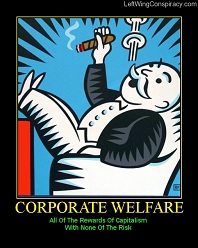
corporate_welfare_medium

By Kevin Carson

Source: Center for a Stateless Society

The old “53% vs. 47%” meme that got so much attention in the 2012 election resurfaced this week when it came out that Colorado gubernatorial candidate Bob Beauprez apparently first coined it at a 2010 Rotary Club speech. The 47% who pay no income tax, he said back then, are “dependent on the largesse of government” and “perfectly happy that someone else is paying the bill.” The talking point got traction with the Tea Party and was soon picked up by politicians like Paul Ryan (who warned we were approaching “a net majority of takers vs. makers”) and Mitt Romney.

Of course this is pure buncombe.  It presupposes that high taxable incomes result primarily from being “makers,” when the truth is just the opposite. The higher your income, in fact, the more likely you’re a taker who’s — all together now! — dependent on government.

It’s possible to get moderately wealthy — say, an income that qualifies you for the “top 1%,” which is somewhere under $400,000, or assets in the low millions — through genuine entrepreneurship. Even at this level, of course, it’s more likely you have an income heavily inflated by membership in a licensing cartel, or help manage a highly authoritarian, statist corporation where your “productivity” — and bonuses — are defined by how effectively you shaft the people whose skills, relationships and other human capital are actually responsible for the organization’s productivity. But it’s at least possible to get this rich by being a maker of sorts, by being more adept than others at anticipating and meeting real human needs.

But you don’t get to be super-rich — to the tune of hundreds of millions or billions of dollars — by making stuff. You get that filthy rich only through crime of one sort or another (even if it’s technically perfectly legal in this society). You get the really big-time money not by making stuff or doing stuff, but by controlling the conditions under which other people are allowed to make stuff and do stuff. You get super-rich by getting into a position where you can fence off opportunities to produce, enclosing those natural opportunities as a source of rent. You do it by collecting tolls and tribute from those who actually make stuff, as a condition of not preventing them from doing so. In other words you get super-rich by being a parasite and extorting protection money from productive members of society, with the help of government.

So don’t be fooled by the fact that some of us aren’t paying any income taxes. We pay lots of taxes — to rich takers who live off our largesse. The portion of your rent or mortgage that results from the enormous tracts of vacant and unimproved land held out of use through artificial property rights is a tax to the landlord. The 95% of the price of drugs under patent, or Bill Gates’s software, is a tax you pay to the owners of “intellectual property” monopolies. So is the portion of the price you pay for manufactured goods, over and above actual materials and labor, that results from embedded rents on patents and enormous brand-name markups on (for example) Nike sneakers over and above the few bucks a pair the sweatshops contract to make them for. So is the estimated 20% oligopoly price markup for industries where a few corporations control half or more of output. If by chance you do pay federal income tax, half of it goes to support the current military establishment or pay off debt from past wars — wars fought for the sake of giant corporations.

The “takers,” in short, are the people Romney spoke to at $1000/plate fundraisers, who pay Hillary Clinton several hundred grand for a speech reassuring them Wall Street’s not to blame. The entire Fortune 500, the entire billionaire plutocracy, depends on largesse from us makers — and they can only do it with government help.

Swiss Voters Reject Multibillion Dollar Boondoggle

index

In a vote last Sunday, 53.7% of Swiss voters rejected a government plan to fund the procurement of 22 Gripen fighter jets which would have cost at least $3.5 billion. In a public statement, Susanne Leutenegger Oberholzer, a Social Democrat member of parliament said: “The people have spoken. We surely don’t have the money for such unnecessary acquisitions.” Supporters of the plan such as Federal Councilor and defense minister, Ueli Maurer argued “This decision has the effect of creating security gaps” but a majority of voters expressed their belief that money spent to procure the planes could be better be spent on other things.

This story should be especially striking to U.S. citizens, who are constantly told they live in a Democracy yet don’t have a chance in hell of voting down similar military spending proposals or ones much worse like the F-35 Joint Strike Fighter project. According to a Bloomberg article quoting Pentagon officials, the program’s life-cycle cost including development and decades of support is projected to top $1.5 trillion. The manufacture of the F-35 funnels business to a global network of contractors including 1,300 suppliers in 45 states, making it the defense project “too big to kill”. Despite a number of high profile technical problems and numerous delays the F-35 remains in development and is expected to go into full production in 2019, seven years later than planned. By that time other countries are likely to have cheaper unmanned drone fighters with superior performance and capabilities. How does this colossal waste of money and time make us safer?

Walmart Admits: ‘Our Profits’ Depend on ‘Their Poverty’

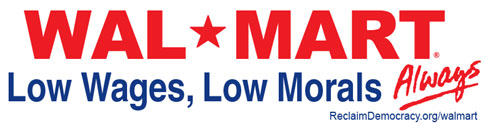
walmart_low_morals_alt

By Lauren McCauley

Originally posted at CommonDreams.org

Although a notorious recipient of “corporate welfare,” Walmart has now admitted that their massive profits also depend on the funding of food stamps and other public assistance programs.

In their annual report, filed with the Security and Exchange Commission last week, the retail giant lists factors that could potentially harm future profitability. Listed among items such as “economic conditions” and “consumer confidence,” the company writes that changes in taxpayer-funded public assistance programs are also a major threat to their bottom line.

The company writes:

Our business operations are subject to numerous risks, factors and uncertainties, domestically and internationally, which are outside our control … These factors include … changes in the amount of payments made under the Supplement[al] Nutrition Assistance Plan and other public assistance plans, changes in the eligibility requirements of public assistance plans …

Walmart, the nation’s largest private employer, is notorious for paying poverty wages and coaching employees to take advantage of social programs. In many states, Walmart employees are the largest group of Medicaid recipients.

However, this report is the first public acknowledgement of the chain’s reliance on the funding of these programs to sustain a profit.

According to Stacy Mitchell, senior researcher with the Institute for Local Self-Reliance, the irony of their admission is that Walmart “is the company that has done, perhaps, more than any other corporation to push people into poverty.”

Citing a Penn State study, Mitchell told Common Dreams that research has proven that “when Walmart opens a store, poverty rates are negatively impacted” and that the more stores that have opened in a particular county, the worse it is. “This is a company that everywhere it goes it creates poverty.”

In addition to their own worker’s low wages, Mitchell explains that Walmart, because of their enormous size and market power, have “held down wages for the whole sector.”

As a retailer that specifically targets a low-income demographic, Mitchell adds that the “insidious genius” of their business model is that “they have so squeezed American workers […] many feel that their only choice is to shop at Walmart.”

The International Business Times reports:

Prior to the earnings report, Walmart Chief Financial Officer Charles Holley said the company didn’t anticipate how much the end to such programs as the unemployment benefits extension would affect it. Specifically, reductions to the Supplemental Nutrition Assistance Program that went into effect on Nov. 1, the first day of the company’s fourth quarter, pose a potential concern. The cuts led to a between $1 and $36 reduction in SNAP benefits per household, or up to $460 a year. Congress is debating reinstating the extension to the program and making the benefits retroactive to Nov. 1, something Walmart would clearly consider beneficial to its growth.

Previously, Walmart has joined forces with Big Food labels such as Coca Cola and Kelloggs to lobby the United States Department of Agriculture and Congress against any measures that would restrict SNAP use to healthy food choices. According to an earlier study by Michele Simon at Eat Drink Politics, in just one year, nine Walmart Supercenters in Massachusetts received more than $33 million in SNAP revenues.