The missing context for what’s happening in Gaza is that Israel has been working night and day to ethnically cleanse the Palestinian people from their homeland since even before Israel become a state – when it was known as the Zionist movement.
Israel didn’t just cleanse Palestinians in 1948, when it was founded as a Western colonial project, and again under cover of a regional war in 1967. It also worked to ethnically cleanse Palestinians every day between those dates and afterwards. The aim was to move them off their historic lands, and either expel them beyond Israel’s new, expanded borders or concentrate them into small ghettoes inside those borders – as a holding measure until they could be expelled outside the borders.
The ‘settler’ project, as we call it, is a misnomer. It’s really Israel’s ethnic cleansing programme. Israel even has a special word for it in Hebrew: ‘Judaisation’, or making the land Jewish. It is official government policy.
Gaza was the largest of the Palestinian reservations created by Israel’s ethnic cleansing programme, and the most overcrowded. To stop the inhabitants spilling out, Israel built a fence-barrier in the early 1990s to pen them in. Then when policing became too hard from within the prison, Israel pulled back in 2005 to the outer perimeter barrier.
New technology allowed Israel to besiege Gaza remotely by land, sea and air in 2007, limiting the entry of food and vital items like medicine and cement for construction. Automated gun towers shot anyone who came near the fence. The navy patrolled the sea, stopping boats straying more than a kilometre or two off shore. And drones watched 24 hours a day from the sky.
The people of Gaza were sealed in and largely forgotten, except when they lobbed a few rockets over the fence – to international indignation. If they fired too many rockets, Israel bombed them mercilessly and occasionally launched a ground invasion. The rocket threat was increasingly neutralised by a rocket interception system, paid for by the US, called Iron Dome.
Palestinians tried to be more inventive in finding ways to break out of their prison. They built tunnels. But Israel found ways to identify those that ran close to the fence and destroyed them.
Palestinians tried to get attention by protesting en masse at the fence. Israeli snipers were ordered to shoot them in the legs, leading to thousands of amputees.
The ‘deterrence’ seemed to work. Israel could once again sit back and let the Palestinians rot in Gaza. ‘Quiet’ had been restored.
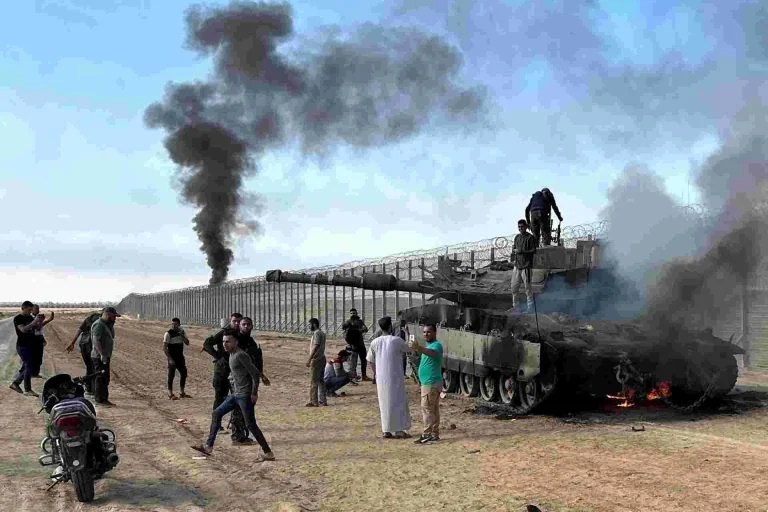
Until, that is, last weekend when Hamas broke out briefly and ran amok, killing civilians and soldiers alike.
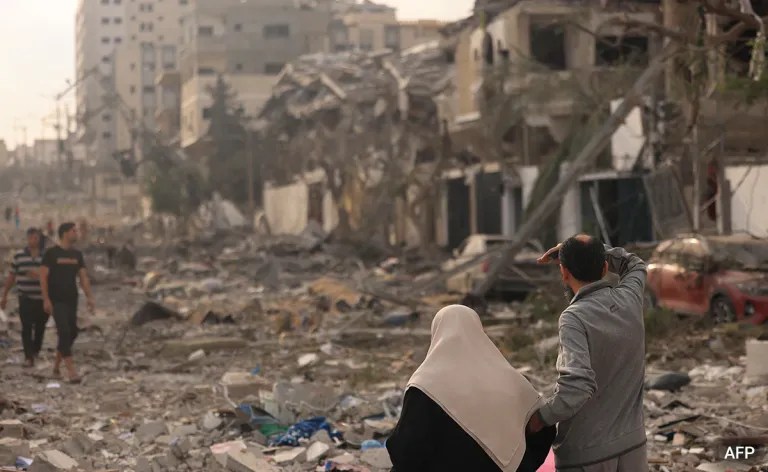
So Israel now needs a new policy. It looks like the ethnic cleansing programme is being applied to Gaza anew. The half of the population in the enclave’s north is being herded south, where there are not the resources to cope with them. And even if there were, Israel has cut off food, water and power to everyone in Gaza.
The enclave is quickly becoming a pressure cooker. The pressure is meant to build on Egypt to allow the Palestinians entry into Sinai on ‘humanitarian’ grounds.
Whatever the media are telling you, the ‘conflict’ – that is, Israel’s ethnic cleansing programme – started long before Hamas appeared on the scene. In fact, Hamas emerged very late, as the predictable response to Israel’s violent colonisation project.
And no turning point was reached a week ago. This has all been playing out in slow motion for more than 100 years.
Ignore the fake news. Israel isn’t defending itself. It’s enforcing its right to continue ethnically cleansing Palestinians.
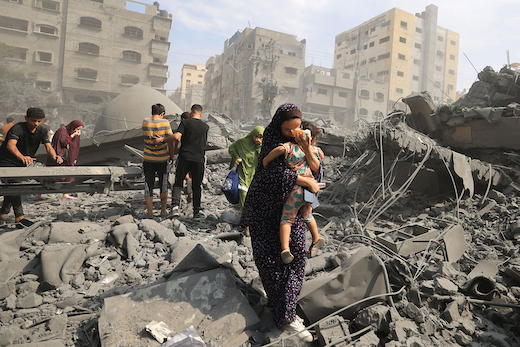
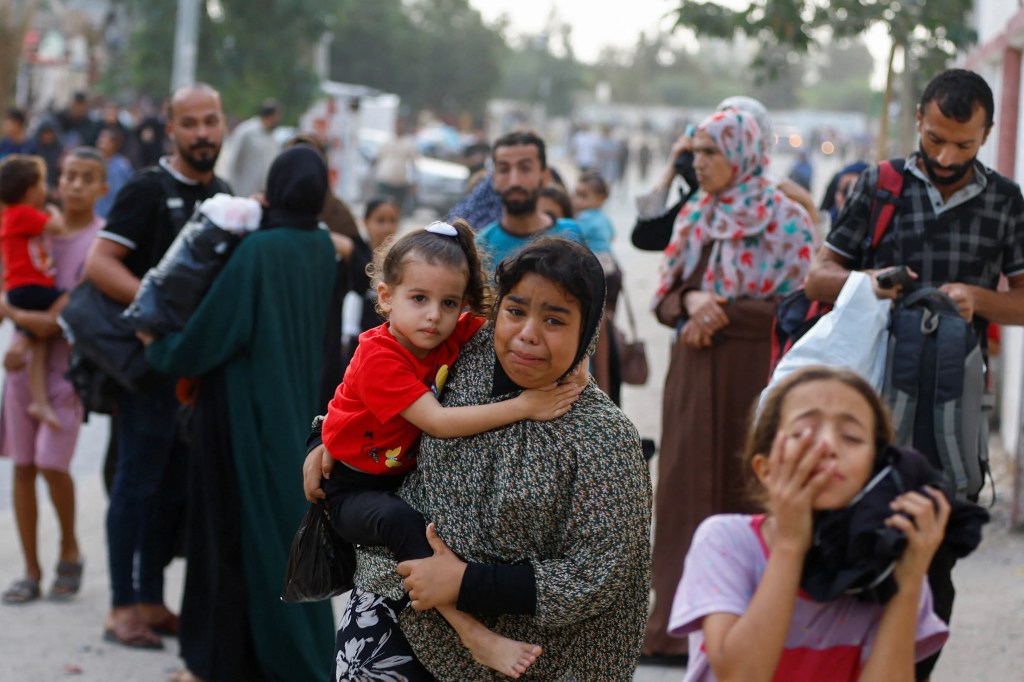
A young child sits on his mother’s hip as she and others flee through the streets of the Gaza Strip amid Israeli strikes on October 9, 2023 [Ibraheem Abu Mustafa/Reuters]
Israel has waged war on Palestinians for decades.
That fact may come, I suspect, as a surprise to many people whose grasp of the world is shaped by their exclusive consumption of Western media.
The deep and lasting human consequences of Israel’s terrifying, perpetual war on Palestinians – prosecuted with indiscriminate cruelty by an occupying army and its de facto proxies, fanatical settler militias – have been plain for anyone willing or inclined to see, for generations.
Countless lives lost and maimed in body and spirit. Land and homes stolen. Livelihoods and ancient traditions destroyed. The exhausting cycle of having to rebuild, then watching all the promise and possibility turn, in an instant, to dust. The wholesale imprisonment of a people penned like cattle behind walls and barbed wire fences, where water and electricity, food and fuel, are switched on and off on a colonial power’s whim.
But, of course, much of the Western media won’t acknowledge these facts and outrages. That’s because many of the reporters and columnists now gripped by the latest eruption of murderous madness in Palestine and Israel have always interpreted events through a prism chiefly dictated by Israel – whether they are prepared to admit it or not.
In this myopic calculus, Israel is always the victim, never the perpetrator. Israel’s understanding of history matters; Palestinians’ reading not only of the past but of the present and the future too, does not count. And, perhaps most indecent of all, Israeli lives and deaths matter; Palestinian lives and deaths don’t.
Riyad Mansour, the Palestinian ambassador to the United Nations, made this point in a quiet, but persuasive address he delivered on Sunday to that apparently powerless body.
“History,” he said, “begins for some media and politicians when Israelis are killed. Our people have endured one deadly year after another”.
Mansour recounted the repeated warnings he and other exasperated Palestinians have issued – time and again – of the potential “consequences of Israeli impunity and international inaction”.
He was not alone.
Human rights groups based in Jerusalem, London and New York have published report after report that establishes, as a matter of international law, that Israel has, for a long time, been guilty of apartheid – a state-sanctioned, systemic policy to impose ethnic supremacy over besieged Palestinians with brutal, grinding efficiency.
Implicit in those dense, meticulously chronicled studies was what amounted to a blazing flare intended to seize finally the flighty attention of complicit Western governments and media. Israel’s deliberate, organised oppression is not only unsustainable, it disfigures both the oppressor and the oppressed. Ultimately, violence begets violence in round after round of horrific vengeance by both sides.
Predictably, the cautions were not heeded.
Instead, many Western news outlets either dismissed outright or used the familiar vocabulary of denial to obscure the blatant truth.
Others opted for wilful malpractice, preferring to devote time and resources to the death of a celebrity dog over the documented theft, deprivations and indignities endured by Palestinians – young and old.
At the core of this blindness is a shared doctrine that holds that a Palestinian is a disposable non-entity, an expendable by-product of Israel’s right to exist and to defend itself.
In this perverse construct, Palestinian civilians are not considered innocent casualties of war but remain largely responsible for their own deaths and desperate fates.
The result: Western columnists will defend Israel – without so much as a hint of doubt or equivocation – despite its demonstrable record of erasing Palestinians whenever it wants, wherever it wants, for whatever reason it wants.
The sad, human evidence abounds.
Mahmoud al-Saadi, an 18-year-old student, was erased by Israel while walking to school in the Jenin refugee camp last November.
Mohammad al-Tamimi, a two-and-a-half-year-old toddler was erased by Israel while he was sitting in his father’s car parked outside their home in Nabi Saleh, a village northwest of Ramallah in the occupied West Bank, as he waited to go to a birthday party in June 2023.
Shireen Abu Akleh, a 51-year-old Palestinian-American journalist was erased by Israel while she was preparing to report on yet another raid in Jenin in May 2022.
Dr Izzeldin Abuelaish, a 67-year-old Palestinian-Canadian physician, scholar and humanitarian, witnessed three of his daughters – Bessan, 21, Mayar, 15, Aya, 13 – and a niece, Noor, 17, being erased when Israeli tank shells shattered the family home in the Gaza Strip in January 2009.
Omar Abdulmajeed Asaad, a 78-year-old Palestinian-American retiree was erased by Israel while en route home to Jiljilya, a town a little northeast of Ramallah in the West Bank, after an evening playing cards with friends in January 2022. Soldiers marched Asaad to a nearby construction site and dumped him onto cold stone pavers. That’s where he died of a “stress-induced heart attack”. Alone.
Twelve-year-old Hassan Abu al-Neil was erased by Israel on August 21, 2021 while standing on what remains of Palestinian soil in Gaza in defiance of the occupation.
The lethal ledger goes on and on and on.
In the awful days, weeks and potentially months ahead, a gallery of writers will, no doubt, stand rhetorically shoulder-to-shoulder with Israel’s Prime Minister Benjamin Netanyahu and his appalling calls to impose a total blockade on Gaza and bludgeon it into a “deserted island” in the wake of Hamas’s ruthless onslaught.
Netanyahu’s chilling vow to, in effect, obliterate Gaza and his warning to the 2 million Palestinians who live in that thin strip of land to “get out” is the inevitable expression of apartheid, which is predicated on the dehumanisation of an entire people.
As Palestinian-American writer, Ra’fat Al-Dajani, has explained, the dehumanisation of Palestinians is based on two tenets widely held among Western media: “Palestinians are violent because of who they are – because of something intrinsic in their very nature and culture,” Dajani wrote, rather than “because of the oppression and violence of the Israeli occupation”. As a corollary to this, “since Palestinians lack basic standards of morality… the only way to interact with them is through the use of force, whether state-sponsored force by the Israeli security forces or non-state actors such as Israeli settlers. Force is the only language they understand.”
Both of these blasphemies have already been on display on Western cable news channels’ 24/7 loop and in opinion pages featuring the usual parade of Israeli-aligned officials and pundits.
In rebuttal, Mansour was obliged, remarkably, to state the obvious: “We [Palestinians] are not sub-humans. Let me repeat: We are not sub-humans. We will never accept a rhetoric that denigrates our humanity and reneges our rights. A rhetoric that ignores the occupation of our land and oppression of our people.”
Mansour defended the resistance as an understandable response to Israel’s longstanding war on Palestinians, saying: “Israel cannot wage a full-scale war on a nation, its people, its land, its holy sites and expect peace in exchange.”
In the end, the ambassador said, Palestinians, and Palestinians alone, will decide their destiny. “The Palestinian people will be free one day or another, one way or another,” Mansour said.
When the U.S. was bombing levees and hospitals in North Vietnam, peasants in Laos and burning villages in South Vietnam, herding those not killed in the process into “strategic hamlets,” Americans took to the streets en masse, occupied the Pentagon mall, brought central Washington D.C. to a standstill, and broke into an FBI office stealing the records of Cointelpro disruption and spying and into a draft ward destroying the records of potential draftees.
When U.S. military “trainers” helped massacre and slaughter peasant guerrillas and their urban supporters fighting a brutal dictatorship in El Salvador, and the Pentagon was running a proxy war against the revolutionary government in Nicaragua, masses of Americans, even in the absence of a draft and of US deaths, rose to the occasion to massively oppose U.S. intervention in those countries’ internal conflicts. Even in 2003 when America was preparing to invade Iraq, claiming it was making or hiding weapons of mass destruction, chemical or even nuclear, Americans in record numbers turnout out in Washington to oppose going to war. (It didn’t work, but at least they turned out to protest war.)
Now when America is basically bankrolling and arming Israel as it prepares to commit a massive war crime, collectively punishing and killing ordinary Palestinians trapped in the open-air prison of Gaza. When the Israeli ‘Defense’ Force (IDF) is giving the 1.1 million Palestinians living in the northern 12-mile-long and 7-mile-wide half of the walled-off enclave 24 hours to relocate themselves to the southern half of the strip or face the full destructive force of an all-out IDF air and ground attack and invasion of the north—an impossible challenge. When Israel has cut off all supplies of food, medicine, water (in a desert!), electricity, and oil for the enclaves on rickety power plant, already for a week, the protests by Americans have been anemic, and have largely been by specifically pro-Palestinian groups, not by what is left of the once large and broad peace movement.
It is a shameful moment. While a few left-leaning progressive Democratic members of Congress like Reps AOC and Ilhan Omar have denounced Israel’s war crime of collective punishment and U.S. support for it, there is actually more criticism of Israel and of U.S. military aid to that country coming from Republicans than Democrats, (though they aren’t talking about the war crimes, since Republicans favor those tactics in other circumstances). The truth is, one of the arguments being used by Democrats to convince House Republicans to get their shit together and elect a House speaker is so they can pass legislation in that chamber to allow the U.S. to give Israel (and Ukraine) even more military aid.
And still, no burgeoning, blooming peace movement.
The U.S. may not be technically at war, but the U.S. war machine is everywhere, on every continent, in every ocean, its military budget, way over $1 trillion a year when everything is counted, bigger than it was in constant dollars than at the height of the Vietnam War when 500.000 U.S. troops were in that country fighting, dying (and losing) a hot war. But its special forces, its arms merchants of death, and its military “trainers” are busy stirring up and supporting local conflicts and pouring oil on fires like those blazing in Ukraine, Yemen, Gaza, Syria, Niger, Haiti, and elsewhere, while also making trouble off the coast of China, on the Korean peninsula (where it still has troops based and has had since 1950, and in Eastern Europe and the Baltic Sea.
Where is the public anger? Where is the organized protest against this warmongering permanent government in Washington, D.C.?
Americans are mad at Washington to be sure, correctly perceiving that it is corrupt and rotten to the core They know it ignores popular calls for taxes on the rich, for a well funded Social Security system that will pay livable retirement benefits as promised to all retirees into the foreseeable future, instead of facing drastic cuts in a decade or sooner, a medical system that doesn’t drive us into bankruptcy when we get sick, that gives everyone access to care they can afford and doesn’t give mega profits to private insurers and hospital executives, good public schools for our kids, affordable public colleges, an end to debt enslavement, police who are social servants not fear-inspiring centurions, clean air and water, and action of preventing a climate emergency. But too many of us don’t grasp that none of those things that huge majorities of us want will happen as long as the leaders in Washington, almost all of them bought and owned by large corporate and financial interests and the rich, are enamored of weapons, wars and militarism.
We need a focused campaign to use all available means to educate the American public to a common-sense reality: you cannot have guns and butter. And you can’t eat guns.
As a Vietnam War Era war resister and protester I’m disgusted. How can we U.S. Americans be accepting that almost all the income tax we pay each year (including income taxes on our Social Security benefits for gods’ sakes!) goes straight to funding the Pentagon and America’s endless wars and proxy wars, with the rest of federal government operations being funded using borrowed money– loans that we the taxpayers have to then pay five percent or more in interest on every year. In the end it’s all because of the military budgets.
Get it?
It’s time to take that to the streets.
A good place to start would be demanding that the U.S. stop propping up the intransigent, apartheid, fake democracy of Israel and demand that it stop its collective punishment of 2.3 million Gazan Palestinians. For once, the U.S. should try to solve an international crisis by taking action to de-escalate conflict instead of pouring oil on the fire by mindlessly offering more weapons and ammunition.
If that approach works there, our troglodyte leaders should try the same thing with the Ukraine/Russia conflict.
A major conflict is beginning in Palestine. On October 7, Hamas launched a military operation against the Israeli occupation forces. Using missiles, drones and paragliders, Palestinian soldiers managed to surprisingly attack Israeli troops and advance through occupied territory, liberating many areas. Tel Aviv responded with a declaration of war and several brutal attacks on civilian areas in Gaza, however, the Jewish State’s forces still appear unable to expel Palestinian soldiers from their occupied territory, with Hamas advancing rapidly.
In addition to territorial disputes, the attack seems to have direct religious reasons. Palestinians call the assault “Al-Aqsa Storm Operation“, referring to the famous Al-Aqsa Mosque, an important Islamic holy site. Jewish militants have frequently attacked the site and extremist religious groups have pressured the state to demolish the Mosque and build a Jewish temple in the region. The constant desecration of Al-Aqsa appears to have been a red line for Palestinian Muslims.
The surprise effect of the Hamas attack shocked Israeli authorities and Tel Aviv’s supporters around the world. Hamas’ ability to destroy the illegal siege imposed by Zionist forces was seen as a historic defeat for Israel. Furthermore, many experts are criticizing the intelligence capabilities of the Jewish State after the start of the battle, as the country’s spy forces were inefficient in predicting Palestinian moves and taking preventive measures against Hamas, which is a militia, not a regular national army, therefore having much more limited resources than Israeli Defense Forces.
Immediately after the start of hostilities, many videos and images began to be shared on social media showing the violence of the clashes. Many of these images are spread out of context, mainly by the Western pro-Zionist propaganda machine. Anti-Palestine activists accuse Hamas of murdering civilians, while anti-Zionists claim [erronously] that all those killed are military targets – even though some of them are unarmed. It is important to remember that in Israel military service is mandatory for almost all citizens (including women), with most of the Gaza borders’ settlers being actually military, even if they were eventually killed or captured while off duty.
Israel’s reactions were harsh. Netanyahu declared a state of war and ordered a series of bombings against the Gaza Strip.
Hundreds of Palestinian civilians died, non-military facilities were destroyed, and a severe blockade is being imposed on any type of food, energy or water supply. The retaliation, did not prevent Hamas’ advance into the occupation zone. There is still a strong presence of Palestinian troops and an absolute Israeli inability to expel them. Furthermore, thousands of Israeli citizens are leaving the country, creating an unprecedented crisis.
Around the world, reactions to the escalation were as expected. Most Arab and Islamic countries have expressed support for the Palestinian resistance, but without committing to direct military cooperation. The Collective West has voiced support for Israel, with the US, EU, UK and their allies harshly criticizing Hamas, which they consider a “terrorist group”. On the other hand, Russia and China called for an immediate ceasefire and emphasized the importance of recognizing a Palestinian State as an existential condition for peace in the Middle East.
Washington is moving significant extra military aid to Tel Aviv. The Jewish State already receives 3 billion dollars in military assistance annually from the US, but with the escalation of hostilities, the tendency is for this assistance to increase substantially. Obviously, this will have a severe impact on the proxy war against Russia, as it will be impossible for the US to continue backing two high-intensity conflicts at the same time. The pro-Israel agenda is unanimous among American politicians, bringing together Republicans and Democrats much more cohesively than Ukraine, which many conservative politicians dislike. So, it is most likely that Kiev will be progressively “abandoned” by Washington as the crisis in Palestine worsens.
However, it is unlikely that American aid will automatically be a “game-changer” for Israel. There will be many local reprisals as Iran will certainly exponentially boost its participation in the conflict and send weapons and irregular troops to help the Palestinians. Furthermore, Hezbollah from Lebanon and some Syrian military units are also on combat readiness and could openly enter the conflict if it escalates. Iran also controls Houthi dissidents in Yemen, who could also take part in hostilities. So, instead of an “easy” military effort, with systematic killing of civilians and territorial expansionism (as seen on other occasions), this time, Israel may be facing a serious security crisis, putting its very existence at risk.
To avoid this disastrous scenario, the right thing to do for Tel Aviv is to stop territorial expansionism and the illegal occupation of Palestinian territories. The Jewish State needs to respect international law and start thinking seriously about returning its borders to the limits of the 1948 UN plan – with possible changes, as long as they are negotiated with the Arabs under mutually beneficial circumstances. Aggressive policies of apartheid and territorial annexation, as well as desecration of Islamic religious sites, will only result in more conflicts.
However, Tel Aviv seems not only committed to the most extreme wings of Zionism but also shows a willingness to act as an American proxy against Iran in the Middle East, which brings very negative expectations. If Israel chooses the path of war, it could become a “new Ukraine”.
Three interesting facets of news over Niger appear to be doing the rounds. Firstly, that a terrorist group in Nigeria has openly appealed to the Nigerian President – who also happens to be the ECOWAS leader – to avoid at all costs a military intervention in Niger; secondly, that Joe Biden took the initiative to meet the same gentleman Bola Ahmed Tinubu in the corridors of the United Nations, hinting that huge amounts of U.S. investment could be directed towards Nigeria if Tinubu played ball; and thirdly, that just recently, the stakes were raised in Niger when its junta announced that it had invited the armies of both Mali and Burkina Faso onto its soil to help defend themselves against an “intervention” which ECOWAS has threatened was on the cards only days earlier.
But Biden’s little chat with Tinubu says a lot about the realities of what is going to happen and what can happen on the ground as clearly his administration does not want another proxy war between East and West on its hands before the re-election run up next year. The question of whether the U.S. would support ECOWAS militarily has been answered by Biden’s bribe to the Nigerian president. It’s not going to happen.
Tinubu, who is certainly the man at the centre of events, gives the impression in interviews that he is under great pressure from ECOWAS members to intervene, but he is the one cooling tempers and looking for a diplomatic solution. And yet, his comments to the press seem to have been written by the U.S. state department such is the proximity of his office and the U.S. administration – debunking the myth of how much ECOWAS is influenced by France (given that the majority of the countries are former French colonies). The Nigerian president’s role as ECOWAS chief is under the spotlight.
What does he really want? Are his objectives focussed more on Nigeria rather than the bloc?
Joe Biden’s offer of a fresh injection of investment from U.S. firms hasn’t seemed to hit the mark. It seems that Tinubu is after even faster and even easier cash.
Tinubu said that African democracies are “currently under assault by anti-democratic forces within and outside the continent”, which is really state department jargon for “the Russians are coming”.
He then called on the “American-backed development finance and multilateral institutions, which were designed to support war-torn Europe after World War II, to adopt a swift and comprehensive reform to meet the developmental requirements of young democracies in Africa”.
The translation isn’t too cryptic. Can the U.S. intervene and, also, while they’re at it, pump our central bank full of never-never-pay soft loans from IMF and World bank? Cheers!
Neither Biden nor Tinubu though seem to be bothered about the possibility of a fourth francophone African country falling into the hands of Mother Russia. Mali and Burkina Faso, who both can be assumed to be vassals of Russia have shown great solidarity with Niger which has lost no time kicking the French out and becoming a major pain in the arse for western elites who are confused about the events and want to oversimplify the nuances. “We lost Niger to the Russians” may be the well worn cliché although the facts on the ground and more complicated. There certainly seems in Niger to be an endearment towards the new junta’s government but Russia’s role so far is unclear.
About the only thing that Putin and Biden agree on is they don’t want a war in Niger.
It’s easy to forget though that Niger was a key player in ECOWAS and that many of its members placed great importance on Niger’s front line assault on Islamic groups in the region – which, if given more freedoms, could cause havoc right across West Africa but in particular in neighbouring Nigeria.
For the moment though, the so-called pressure from ECOWAS is unlikely to manifest itself beyond chest beating. ECOWAS members may have the hunger for intervention but they don’t have the guts for a war, which neither the U.S. or Russia will bankroll, so sobriety is likely to take over the narrative in the coming days. The war in Ukraine, the abysmal foreign policy blunders of Biden, the deluded arrogance of Macron and the emergence of BRICS have all contributed to the current crisis in Africa as the old relationship with the West is put to the test, with disastrous consequences. The only thing left of Obama’s “soft power” idea he conjured up in 2015 after his humiliation in Syria is a suitcase full of cash for a corrupt West African leader to share with his cabal. Pretty pathetic.
Berlin Conference of 1884-1885 was undeniably one of the biggest evil summits in modern history. Greedy and racist European colonialists sat down in the German city and divided Africans as if they were sharing bread on a breakfast table.
The conference was organized by Otto von Bismarck, the first chancellor of Germany at the request of King Leopold II of Belgium, the Western genocidal barbarian that murdered more than 10 million innocent Africans in Congo.
Most Africans are not even aware of this genocide in Congo perpetrated by the Belgium colonialists because it is not in our history books written by the white colonialists.
European colonialism in Africa lasted more than a century with only the ancient Kingdom of Ethiopia spared because they defeated the Italian colonialists on the battlefield.
Trillions and trillions of dollars were stolen from Africa, millions of Africans were murdered by the European colonialists and Africans were massively brainwashed that they had no history before European colonialism.
The wave of ‘independence’ in Africa from the 1950s and 1960s did not represent true independence. What actually happened was that colonialism was cleverly replaced with neocolonialism by the genocidal imperialist barbarians of the West.
The massive looting of rich resources in Africa continued under Western puppet leadership. The courageous African leaders who refused to dance to the tune of the European colonialists were eliminated.
This was what happened to African heroes, Patrick Lumumba of Congo and Thomas Sankara of Burkina Faso. Congo has all mineral resources except for crude oil.
The uranium used by the US regime to make the atomic bombs unleashed on Hiroshima and Nagasaki was mined in Congo.
French greed in Africa
Among the European colonialists, French colonialism was more brutal and exploitative.
France killed more than 1.5 million civilians in Algeria alone. They murdered tens of thousands of civilians in other African countries.
One of the Modus Operandi of the French colonialists was to assemble Islamic scholars in a hall and exterminate all of them. They did this in Algeria, Chad, Mali and Senegal.
And the greed of their neocolonialism is extreme. Even after independence, France is still controlling the wealth of its former colonies in Africa.
The rich resources of French nations are still controlled by France and they continue to pay colonial tax to France.
French goods and services dominate their markets. The domineering presence of France in these countries has been excruciating and devastating for local populations.
Niger Republic does not know the quantity of uranium France was taking from there, which is worst than slavery.
No evil lasts forever
There is a popular saying that “No evil lasts forever”.
France’s neocolonialism in Africa will not last forever. Popular military coups against puppets of France imperialism have started and are gathering momentum.
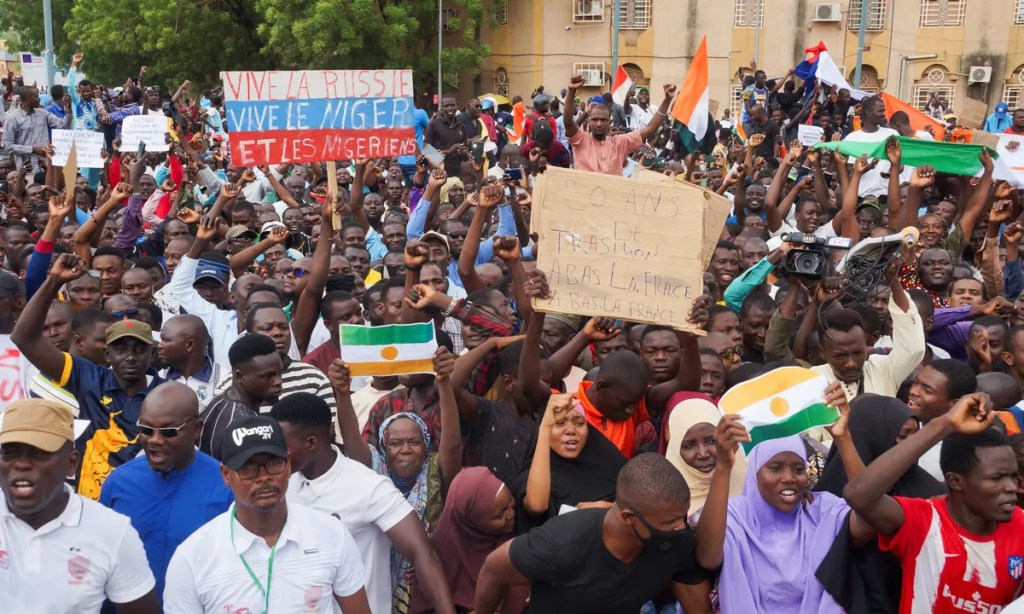
The recent military coup in the West African state of Niger Republic does not stand in isolation but follows similar upheavals in the neighboring countries of Mali, Burkina Faso, and Guinea in recent years.
Mali is facing insurgency that is backed by Western hegemony. Mali expelled French troops because they were actively aiding the insurgents to justify its military presence in the African country.
Now, on Wednesday, we woke up with the news of another puppet of the Western hegemonic barbarians in Gabon overthrown by the military. Ali Bango inherited the Gabon presidency from his corrupt Father, Omar Bongo.
Early on Wednesday, some military personnel appeared on state TV and announced that they were seizing power and dislodging a family that has ruled the country for 56 years.
The military officers introduced themselves as members of the Committee of Transition and the Restoration of Institutions.
“Today the country is undergoing a severe institutional, political, economic, and social crisis,” the officers said in a statement, dubbing the recent election illegitimate.
“In the name of the Gabonese people … we have decided to defend the peace by putting an end to the current regime.”
Pertinently, Gabon’s former president had 70 bank accounts, 39 apartments, 2 Ferraris, 6 Mercedes Benz cars, 3 Porsches and a Bugatti in France. He ruled for 42 years (from 1967 to 2009). French leaders loved Bongo because he was loyal to them.
His son, Ali Bongo has been the president for 14 years (2009 – 2023). He has just been overthrown in a coup.
The fact is that the Western liberal democracy has not only failed in Africa but has failed woefully.
Democracy in Africa has become a tool for the corrupt ruling elites to steal the wealth of their respective countries and transfer it to Western financial institutions while the populations remain in abject poverty and hunger.
Democracy is just another system of government hijacked by the Western hegemonic barbarians, the biggest enemies of the human race. Democracy is now an imperialist tool of Western hegemony in Africa. This is a bitter and undeniable fact.
The people of Gabon will definitely celebrate this military coup as it marks the end of French interference and looting in their country. Another setback for the French leaders.
Africa must rise again
The most noticeable current in Mali, Burkina Faso, Guinea, Niger Republic and Gabon is that the change of governments all have popular support as the people of those countries are tired of France’s imperialism, arrogance and terrorism.
Today France has the 4th largest gold reserves in the world and there is no single gold mine in France.
These gold mines are all in Mali, Niger Republic and other African countries. The France neocolonialism in Africa must end. Its time has come.
As developments in West Africa demonstrate, the francophone countries are no longer willing to accept French neo-colonialism. With the fear factor finally removed, Africa’s quest for genuine independence is steadily coming to fruition.
The 26 July coup in the West African nation of Niger, which threatens to undermine French and US military presence in the region, has shed light on the historical exploitation and continued practices of Francafrique – the term used to describe the persistent exploitation by the former French Empire in Africa.
France heavily relies on nuclear energy, with 68 percent of its power coming from nuclear plants. It obtains 19 percent of the uranium required to run these plants from Niger. Despite this significant contribution toward France’s energy needs, only 14.3 percent of Nigeriens have access to a power grid, and even that is often unreliable. This stark contrast highlights the disparities and ongoing exploitation by rapine foreign powers throughout the African continent.
The Legacy of Francafrique
Francafrique has been known for its exploitative systems designed to profit from African resources, using pressure, capital, and frequently outright force to maintain control over its former empire. As a result, many African states, including Niger, continue to face poverty and underdevelopment.
Burkina Faso’s young, charismatic leader Ibrahim Traore recently spoke at the Russia-Africa summit in St. Petersburg and decried the fact that Africa is resource-rich, but its people are poor, and criticized African leaders seeking hand-outs from the west, as they perpetuate dependency and poverty. He also described what is being imposed on Africa as a form of slavery, stating:
“As far as what concerns Burkina Faso today, for more than eight years we’ve been confronted with the most barbaric, the most violent form of imperialist neo-colonialism. Slavery continues to impose itself on us. Our predecessors taught us one thing: a slave who cannot assume his own revolt does not deserve to be pitied. We do not feel sorry for ourselves, we do not ask anyone to feel sorry for us.”
France’s inability to justify its presence in Africa with a coherent narrative further complicates the situation. Paris cannot openly confess its greed, feign a “civilizing mission,” or admit to any responsibility due to its past crimes. This lack of purpose weakens French power on the continent, leading to violence and poverty in its wake.
West Africa’s drive for further independence has left Atlanticists concerned about the opening this leaves for Eurasian powers like Russia and China to increase their influence in Africa. The west’s reaction reflects a lack of respect for the sovereignty of African countries, viewing the continent merely as a theater to maintain global dominance.
Since the Ukraine war’s onset in early 2022, Atlanticists have expressed alarm over the unwillingness of Global South states to support the west’s anti-Russia policies, a trend further amplified by the shift to multipolarism everywhere. This weakening of western hegemony has opened a path for many nations to avidly explore their geopolitical options and diversify their economies.
A report from the Munich Security Conference held in February highlighted this very real schism with the west:
“Many countries in Africa, Asia, and Latin America have steadily lost faith in the legitimacy and fairness of an international system which has neither granted them an appropriate voice in global affairs, nor sufficiently addressed their core concerns. To many states, these failures are deeply tied to the west. They find that the western-led order has been characterized by post-colonial domination, double standards, and neglect for developing countries’ concerns.”
Fleeced by the CFA Franc
The aftermath of the Second World War marked a significant shift in global power dynamics, and the victorious powers sought to establish a new world order that would maintain peace and promote economic balance.
In the context of African colonies, where colonial troops played a major role in the allied victory, the victorious powers, including France, aimed to retain economic control and benefit from their former colonies even as the world moved towards decolonization.
As the push for political independence grew stronger in the late 1950s, France organized referendums in its African colonies to vote on accepting a constitution drafted by the French.
Guinea, led by former trade unionist Sekou Toure, opposed accepting the French constitution and voted overwhelmingly against it. In a furious response, De Gaulle’s government withdrew all French administrators from Guinea and took action to sabotage the country’s infrastructure and resources. The harsh measures by Paris aimed to serve as an example of what would happen to any former French colony that resisted France’s agenda.
During the Cold War, the Communist states exploited such actions by presenting themselves as liberators and allies of African countries that sought independence from European influence. This stance has led to some Africans viewing countries like Russia as more equitable partners compared to France.
Over the years, France has demonstrated a pattern of intervening militarily – over 50 times since 1960 – in African countries to secure governments that remain compliant with French economic interests, particularly related to the continued use of the CFA Franc.
The system by which the CFA Franc operates has historically been one of a fixed exchange rate where the currency has unlimited convertibility but is permanently pegged to the French currency, previously the Franc and then the Euro.
Worse yet, France had requirements to store, and thus profit from, the foreign reserves owned by its former colonies, though the requirement of holding 50 percent of their foreign exchange reserves in a French-ran bank was dropped for the western zone in 2019.
Under this scheme, African states received a nominal amount of interest, but the bank benefited from lending that capital out at higher rates and attaining massive profits off of African resources and labor. This is despite the fact that many countries in Francophone Africa are major gold exporters and thus have a multitude of options for storing wealth to back a currency in alternative central banks.
While the CFA Franc system has provided some benefits in terms of stability and preventing Zimbabwean-style hyperinflation, it has also come under scrutiny for imposing requirements on African countries that are not placed on more powerful nations. The lack of control over their own currency has hindered economic growth and made these countries vulnerable to global economic shocks.
Northern African states such as Tunisia, Algeria, and Morocco chose to leave the CFA Franc upon gaining independence and have experienced relatively higher prosperity. Similarly, Botswana’s success with its own national currency demonstrates that proper management can lead to stable democracy and economic growth, even for less developed nations.
Exclusive rights and privileges
The CFA Franc system has been the geopolitical equivalent of one’s father insisting he manages their savings while leaving them out of his will. There are benefits to having a trade and currency zone, such as the current ECOWAS union that covers the Western part of the continent, but by design under the CFA Franc system, independence has been an illusion by which France has fleeced these countries.
France has been dependent on Africa for its status as a world power for more than a century. Among other privileges it has carved out for itself in post-colonial treaties, France has had the exclusive right to sell military equipment to former colonies, and enjoys the first right to any natural resources discovered. Paris makes great use of these privileges: as just one example, 36.4 percent of France’s gas is sourced from the African continent.
Moreover, a vast network of French business interests, which include major multinational companies, dominate industries such as energy, communications, and transportation in many African countries. France’s government also supports French businesses in Africa in several ways, including through an enormous public company called COFACE which guarantees French exports into these underdeveloped markets.
Towards independence and self-reliance
This economic dependence has contributed to the perpetuation of a system where African states remain weak, pliant, and reliant on resource exports, primarily benefiting French companies and interests. Additionally, African states are obligated to ally with France in any major conflict, further eroding their national sovereignty.
The African continent suffers from many ailments, but perhaps the most persistent and nefarious are a lack of sovereignty and access to capital. Meanwhile, much of Europe’s prosperity has been derived from looting the Global South for centuries.
The case of Brussels, built on the wealth derived from the brutal exploitation of the Congo under Belgian King Leopold II, is a stark reminder of the deep-rooted impact of colonialism. When the monarch’s crimes against humanity were discovered, he was ultimately forced to bequeath the majority of his fortune to the Belgian state upon his death.
Not wanting to do so, he embarked on an enormous series of public works to spend his ill-gotten gains, creating modern Brussels. Now the EU and NATO meet there and audaciously give disingenuous lectures about universal human rights while surrounded by the profits of some of the most brutal cases of oppression in human history.
While military governments often face challenges in achieving their stated goals, it is evident that western-backed “civil democracies” have also struggled to significantly improve the security and well-being of the African public.
The path to solving Africa’s problems lies in transformative leaders who can shrug off the legacy and remaining shackles of colonialism and enable the continent to carve out a genuine, homegrown path to independence and self-reliance.
Since the overthrow of Niger’s US-friendly government, West African nations of the ECOWAS bloc have threatened an invasion of their neighbor.
Before leading the charge for intervention, ECOWAS chair Bola Tinubu spent years laundering millions for heroin dealers in Chicago, and has since been ensnared in numerous corruption scandals.
Hours after Niger’s Western-backed leader was detained by the country’s presidential guard on July 28, Nigerian President and chair of the Economic Community of West African States (ECOWAS) Bola Tinubu leapt into action, warning that the group of nations “will not tolerate any situation that incapacitates the democratically-elected government.”
“As the Chairperson of ECOWAS…I state without equivocation that Nigeria stands firmly with the elected government in Niger.”
Two days later, ECOWAS imposed severe sanctions on Niger, and the bloc issued a stark ultimatum: if the newly-inaugurated junta won’t reinstall the ousted president in a week’s time, the group’s pro-Western African governments will — by military means, if necessary.
On Saturday, July 6 — one day before the deadline — ECOWAS leaders approved a plan to invade the country, with the ominous caveat that they are “not going to tell the coup plotters when and where we are going to strike.”
If ECOWAS gets its way, member states Benin, Cabo Verde, Côte d’Ivoire, The Gambia, Ghana, Guinea Bissau, Liberia, Nigeria, Sierra Leone, Sénégal and Togo will be pressured to send their soldiers to invade Niger.
These developments have thrust the typically-overlooked West African country of Niger into the Western media spotlight. But if hostilities break out, it wouldn’t just be one single impoverished African state in the crosshairs.
Neighboring Burkina Faso, Mali and Guinea, which are also governed by military administrations that recently seized power by force, have all warned that any attack on Niger will be viewed as an attack on them too. If their ECOWAS rivals make the first move, the nations which mainstream media have dubbed Africa’s “coup belt” have pledged to unleash their military forces as well — an announcement which should end any illusions that restoring the country’s previous president would be a painless process.
Leading the pro-Western coalition is the president of its most powerful country, Nigeria: Bola Tinubu. One of Nigeria’s wealthiest men, the source of the scandal-plagued president’s fortune remains unclear.
Documents reviewed by The Grayzone reveal Tinubu as a longtime US asset who was named as an accomplice in a massive drug running operation that saw him launder millions on behalf of a heroin-dealing relative.
I had a great time with other Heads of State and important dignitaries at the State Banquet hosted by President Emmanuel Macron in Paris, France, this evening. President Macron and his wife, First Lady Brigitte Macron were both gracious and warm, making the event a very pleasant… pic.twitter.com/lTHTZfTIMC
Bola Tinubu’s career marred by drug-trafficking, corruption allegations
For over 30 years, Bola Tinubu has been a major force in Nigeria’s political scene and the country’s economy, with local nicknames ranging from “the Mother of the Market” to “the Godfather of Lagos” and “the Lion of Bourdillon.” But his power inside Nigeria went largely unnoticed by international audiences until 2023, when he became ECOWAS chair after winning the presidency in an election closely tracked by the US government.
As president, Tinubu quickly instituted a regime of economic reforms backed by the US-controlled International Monetary Fund and the World Bank. Over the course of Tinubu’s political career in Nigeria, the African operator has cultivated a close relationship with the US embassy. According to a slew of classified State Department cables released by WikiLeaks, American officials relied heavily on Tinubu’s assessments of the domestic political landscape.
The ECOWAS chair’s early life is shrouded in mystery, and even his exact age is unknown. Nearly every detail of Tinubu’s personal history — prior to his appearance in Chicago on a student visa — is in dispute, including his legal birth name.
Records from Chicago State University show that Tinubu received a degree in Business Administration in 1979. In the following years, media reports indicate that Tinubu was employed in some capacity at a number of major US-based multinationals, including Mobil Oil Nigeria, consulting firm Deloitte, and GTE, which was the largest communication and utilities company in the US at the time.
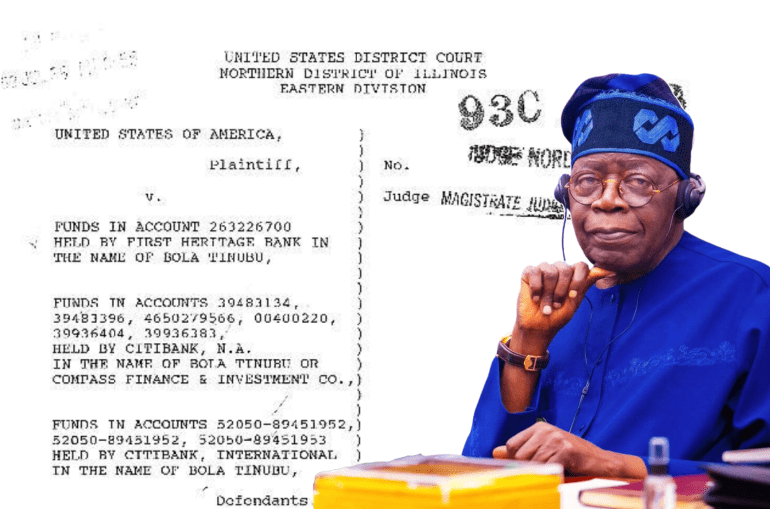
Of the few details about the Nigerian President’s early exploits which can be confirmed, many are derived from a 1993 court docket naming Tinubu as an accomplice in a massive midwestern drug smuggling operation.
As journalist David Hundeyin has detailed, court documents from the US District Court’s Northern District of Illinois make it clear that Tinubu amassed a small fortune laundering money for a heroin-trafficking relative in Chicago, and that US government officials ultimately seized well over a million dollars from various bank accounts registered under the current Nigerian president’s name.
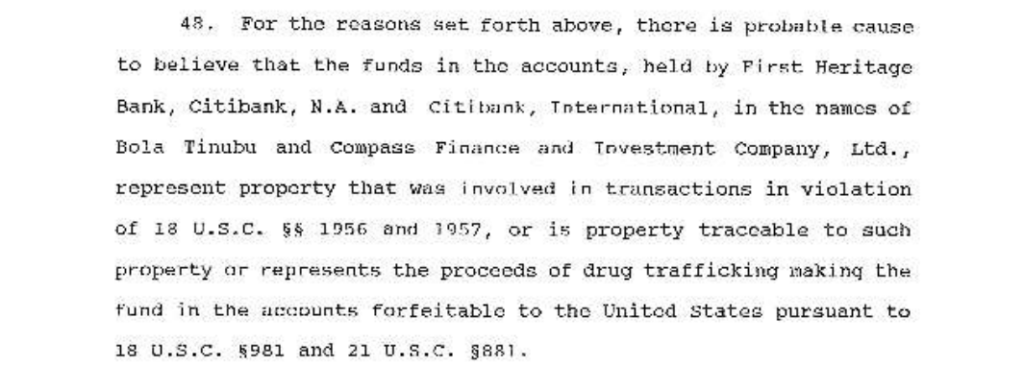
A 1993 report by IRS Special Agent Kevin Moss explained that “there is probable cause to believe that funds in certain bank accounts controlled by Bola Tinubu… represent proceeds of drug trafficking; therefore these funds are forfeitable to the United States.”
In the documents, Moss describes an extremely close working relationship between the future Nigerian president and two Nigerian heroin dealers named Abiodun Olasuyi Agbele and Adegboyega Mueez Akande, the latter of whom was listed as Tinubu’s cousin on an application for a vehicle loan.
“According to bank employees, when Bola Tinubu came to First Heritage Bank in December 1989 to open the accounts, he was introduced to them by Adegboyega Mueez Akande, who at that time maintained an account at the bank.” What’s more, bank records indicate that “Bola Tinubu also opened a joint checking account in his name and the name of his wife, Oluremi Tinubu,” who had “previously opened a joint bank account also at this bank with Audrey Akande, the wife of Adegboyega Mueez Akande,” Moss explained. In several of the applications, the addresses used by Tinubu exactly matched those previously used by Akande.
“According to bank records… Tinubu opened an individual money market account and a NOW account” at First Heritage Bank in December 1989, the special agent noted. “In the application, Tinubu stated that his address was 7504 South Stewart, Chicago, Illinois” — “the same address used previously by Akande.”
“Bank records disclosed that five days after the account was opened, on January 4, 1990, $80,000 was deposited into the NOW account at First Heritage Bank by wire transfer through First Chicago from Banc One Houston,” the report continues. According to the IRS, the money was sent by Akande.
But the Nigerian president’s financial dealings with the heroin traffickers went even further, according to the IRS special agent. He wrote that Citibank records documented “two additional corporate accounts held in the name of Compass Finance and Investment Company, Ltd. which were controlled by Bola Tinubu.”
“When Bola Tinubu opened these accounts,” he provided “a memorandum of association and articles of association” which “identified Mueez Adegboyega Akande and Abiodun Olasuyi Agbele as directors of Compass Finance and Investment Company, Ltd.,” Moss wrote.
In the end, Tinubu somehow managed to deposit over $660,000 in his First Heritage Bank account in 1990, and more than $1.2 million the next year — all while claiming to take home just $2,400 a month from his position at Mobil Oil Nigeria.
As the investigation into the money laundering scheme began to gain traction, Tinubu left the US and returned to Nigeria. Ultimately, Moss was able to speak to Tinubu by telephone on a number of occasions, and the special agent reported that the future president initially acknowledged his personal and financial dealings with the pair of drug traffickers.
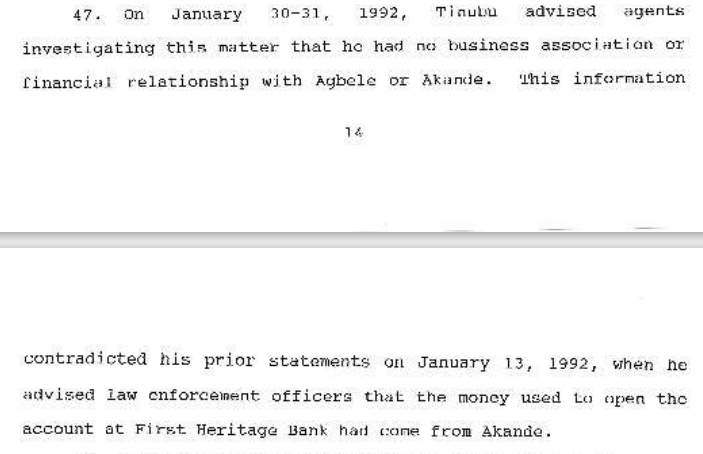
But in late January of 1992, “Tinubu advised agents investigating this matter that he had no business association or financial relationship with Abele or Akande,” Moss wrote. “This information contradicted his prior statements on January 13, 1992, when he advised law enforcement officers that the money used to open the account at First Heritage Bank had come from Akande.”
Back in Nigeria, Tinubu had already begun to transition into the political arena. By 1992, he’d been elected to the Senate, and in 1999 he became the Governor of Lagos State, a position he retained until 2007. At some point in his tenure, Tinubu established a relationship with the US Embassy which would last for years to come, according to a trove of diplomatic cables released by Wikileaks.
But even his State Department allies couldn’t help noticing Tinubu’s penchant for dishonesty. One particularly noteworthy cable pointed out that the politician was “known to play fast and loose with the facts” and “has been caught in the past embellishing his educational achievements.”
In the end, however, Tinubu’s usefulness seemed to outweigh his casual relationship with the truth, and the future Nigerian president went on to provide American officials with a near-continuous assessment of the political situation in his country. One typically intimate meeting with Tinubu ended with the US ambassador to Nigeria commenting: “as always, we found his take on the national political scene to be insightful.”
When the cables came to light in 2011, many Nigerians were shocked at the candor with which their elected officials spoke to Washington’s envoys. “The willingness of our elites to divulge unsolicited information about the nation to U.S. officials betrays an infantile thirst for a paternal dictatorship,” Nigerian-American professor and columnist Farooq Kperogi wrote.
Though Tinubu appeared to have escaped justice for his alleged role in a heroin trafficking conspiracy, accusations of corruption would continue to dog the ECOWAS chair throughout his political career in Nigeria. Since leaving office as governor of Lagos in 2007, Tinubu “picked every subsequent winning candidate,” according to German broadcaster DW, which noted earlier this year that the tycoon “is believed to be one of Nigeria’s richest politicians but the source of his wealth is unknown.”
In recent years, clues about the origins of the fortune amassed by one of Africa’s leading political players have begun to come to light.
In 2009, Tinubu came under investigation by the Metropolitan Police of London, who were probing allegations that the politician had pooled money with two other Nigerian governors to create a front company known as the “African Development Fund Incorporation.”
Investigators alleged the unusual business arrangement was actually a joint effort to illegally acquire shares of ECONET, a telecommunications firm founded by US intelligence asset and Gates Foundation trustee Strive Masiyiwa. But attempts to probe the legitimacy of the transactions in question were sidelined when the Nigerian federal government stonewalled the British investigation, which ultimately concluded without a single arrest. To this day, Nigerian authorities have yet to release the evidence requested by UK authorities.
In 2011, Tinubu was tried before the Code of Conduct Tribunal in Nigeria for illegally operating 16 foreign bank accounts. Eager to avoid the embarrassment he’d previously suffered when being photographed in court, the ECOWAS chair reportedly refused to take his place at the dock in a judicial hearing.
But the unwelcome attention appears to have done little to rein in the politician’s extravagant taste, and Tinubu once again found himself embroiled in a corruption scandal following an investigation into the luxurious 7,000-square foot mansion where the Nigerian president stays when receiving medical care in London.
According to Nigerian outlet Premium Times, the massive villa in London’s exclusive Westminster borough was picked up for a song by Tinubu’s son, who somehow managed to purchase the property at a discount of approximately $10 million from a wealthy fugitive – even though the seller’s assets, including the mansion in question, had been frozen by a Nigerian court. Photos published on social media in 2017 show Tinubu posing inside the villa alongside Nigeria’s president at the time, Muhammadu Buhari.
The current and previous president worked closely for decades, and Tinubu has publicly claimed sole credit for Buhari’s presidency while campaigning. “If it were not for me standing before you leading the army, saying ‘Buhari, go ahead, we’re behind you,’ he could never have become the president,” he told supporters at a rally last year.
But the suspicious confluence of money and influence didn’t end with the mysterious mansion in London. During Nigeria’s 2019 general election, footage of armored trucks entering Tinubu’s residence went viral on social media, and the incident was widely seen as proof that the politician was engaged in a fraudulent vote-buying scheme. But Tinubu remained defiant, telling reporters, “I keep money wherever I want.”
“Excuse me, is it my money or government money?” he asked. “If I don’t represent any agency of government and I have money to spend, if I have money, if I like, I give it to the people free of charge,” he insisted.
This January, the official explanation for the episode evolved again when one of his party’s representatives told a Nigerian TV station that the armored trucks in question had simply “missed [their] way” and arrived at the wrong address. Asked why Tinubu had seemingly admitted to dispensing cash to the public, the party’s organizing secretary in Lagos offered the bemused presenters an equally improbable explanation: “he said that jokingly.”
ECOWAS as a neocolonial weapon
While ECOWAS was officially founded via the Treaty of Lagos in 1975, its official history notes the bloc’s origins date back to the creation of the CFA Franc in 1945, which consolidated France’s West African empire into a single-currency union. Publicly, the move was described as a benevolent attempt to shield these colonies from the consequences of the French franc’s sharp devaluation in 1945, following the creation of the US-dominated Bretton Woods system. As the French finance minister said at the time:
“In a show of her generosity and selflessness, metropolitan France, wishing not to impose on her faraway daughters the consequences of her own poverty, is setting different exchange rates for their currency.”
In reality, the introduction of the CFA Franc meant that Paris was able to maintain highly unequal trading relationships with its African colonies, at a time when its economy was ravaged by World War II and its overseas empire was rapidly disintegrating. The currency made it cheap for member states to import from France and vice versa, but prohibitively expensive for them to export anything anywhere else.
This forced dependency in Francophone West Africa created a captive market for the French, and by extension the rest of Europe. That dynamic, which has stunted regional economic development for decades, persists to this day. The CFA Franc’s continued dominance ensures West African states remain under the economic and political control of France. Those African nations are powerless to enact meaningful policy changes, as they lack control over their own monetary policy.
That the currency features so prominently in the authorized history of ECOWAS is instructive, because the bloc has long-been criticized as an extension of French imperialism. It was not for nothing that in 1960, then-French President Charles de Gaulle made membership of the CFA Franc a precondition for decolonization in Africa.
Though ECOWAS is theoretically meant to maximize member states’ collective bargaining power by fostering “interstate economic and political cooperation,” such harmonization makes it easier for former imperial powers like France to exploit and enfeeble their constituent countries. The bloc imposes a strict, Western-approved legal and financial framework upon its members, and any state deviating from these rules is harshly punished.
In January 2022, ECOWAS imposed strict sanctions on Mali, prompting thousands to take to the streets in support of the military government that seized power in January the previous year. The new government’s efforts to purge the country of malign foreign influence saw a complete ban on French media imposed, a decision which was slammed by the UN but cheered by average Malians.
ECOWAS applied similar measures to Burkina Faso in response to a September 2022 military coup, which saw Paul-Henri Sandaogo Damiba removed after just eight months in power. Though Damiba himself seized via military coup, there was little condemnation from Western officials and few suggestions that ECOWAS impose sanctions — perhaps due to the ousted leader’s pro-Western orientation and status as a graduate of multiple elite US military and State Department training courses.
Since 1990, ECOWAS has waged seven separate conflicts in West Africa, in order to protect the West’s preferred despots across the region. Meanwhile, between 1960 and 2020, Paris launched 50 separate overt interventions in Africa. Figures for clandestine activities conducted during this time are unavailable, but the country’s fingerprints are plastered all over multiple rigged elections, coups, and assassinations that have sustained compliant, corrupt governments in power throughout the continent.
As President Jacques Chirac remarked in 2008, “without Africa, France will slide down into the rank of a third [world] power.” This perspective was reaffirmed in a 2013 French Senate report, Africa is Our Future. Indeed, the mere existence of anti-imperialist governments anywhere in the region is intolerable to Paris.
Luckily for the French elite, compromised figures like Bola Tinubu are still on hand to do their dirty work for them.


 After the Crash