By Iain Davis
Source: In This Together
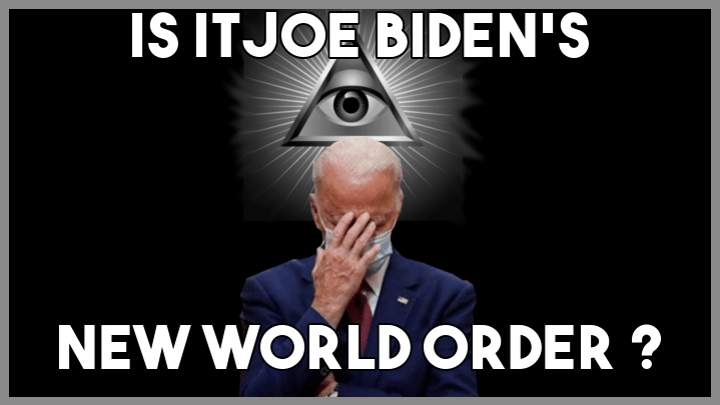
Speaking at a White House business convention on 21st March 2022 the US President, Joe Biden, said:
We are at an inflection point, I believe, in the world economy [. . .] it occurs every three of four generations. [. . .] Now is a time when things are shifting, there’s going to be a new world order out there, and we’ve got to lead it and we’ve got to unite the rest of the free world in doing it.
This caused a bit of a storm because Biden, once again, used the term “New World Order” (NWO). We are told that there is no identifiable globalist project called the NWO. Apparently, the only people who think such a project exists are “conspiracy theorists.” These people are all antesemites, can’t be trusted and absolutely must not be heard, or something like that.
In his 1992 article for the Wall Street Journal titled, How I Learned To Love The New World Order, Biden spoke about “America’s proper role in the new world order.” His latest statement indicates that his concern lingers, on this occasion with good reason. The US position as nominal leaders of the NWO is under threat from Russia and China.
Politicians, oligarchs and other alleged “leading voices” keep talking about the NWO. Every time they mention it the mainstream media (MSM) immediately spring into action, eager to “dispel the myths” or “set the record straight”, defining the term for us. Why do they feel the need to keep doing this? Why are the establishment and their media so sensitive about the term “new world order?”
The NWO Is Not an Antisemitic Trope
The “new world order” is a phrase that gets flung around by all sorts of people for a variety of reasons. It is occasionally expressed in distinctly antisemitic terms.
Some people believe that the NWO is a “Jewish plot to enslave humanity.” Very few people, who have researched and studied the NWO, share this view. It is not supported by the evidence.
Nonetheless, the false allegations of antisemitism applied to anyone who talks about the NWO provides a very useful canard which “debunkers” consistently deploy. As the historian Prof. Antony C. Sutton pointed out in his exploration of Wall Street and The Bolshevik Revolution:
The persistence with which the Jewish-conspiracy myth has been pushed suggests that it may well be a deliberate device to divert attention from the real issues and the real causes. [. . .] What better way to divert attention from the real operators than by the medieval bogeyman of anti-Semitism?
The mainstream media (MSM) role is to confuse and mislead the public. They do not want the people to know what the NWO really is. They hide its history and generally deny its existence, but if that fails they will exploit the Holocaust to bolster their disinformation.
Antisemitism means “hostility to or prejudice against Jewish people.” That hostility and prejudice led to the Holocaust. Falsely accusing people of antisemitism, simply to undermine their arguments, dilutes its true meaning. Doing so shows a lack of respect for the victims of the Holocaust and a casual disregard for Jewish people and their history.
The MSM insist that when US Presidents talk about the NWO they are simply referring to changes in the behavioural norms, regulations and laws that broadly shape international relations. This may be the case, but that doesn’t alter the fact that the NWO has a precise historical meaning.
Given that it is a heavily charged term, is it likely that senior politicians, foreign policy strategists and national leaders would routinely use it unwittingly, without understanding what it means? Perhaps so in some cases but not in all. It is clear than many presidents, prime ministers and geoplitical experts have referred to the NWO in its proper context.
The Term “New World Order” As Propaganda
In a typical example of MSM disinformation, the UK’s Independent newspaper attempted to cover up Biden’s slip by trotting-out the usual denials and obfuscations. They claimed that Biden was simply referring to the “shifting sands of geopolitical relations.”
The Independent did not divulge the reality of the NWO to their readers. Instead it relied upon the tired slurs and allegations traditionally used to discredit those who discuss the NWO. The Independent alleged:
[P]ost-war paranoia tapped into much more ancient social anxieties about the possibility of shadowy secret covens engaging in evil [. . .] The Illuminati, the model for all subsequent sinister behind-closed-doors cabals feared by conspiracy theorist [. . .] traces its origins to the German Enlightenment of the 18th century. Belief in such a group plotting insurrection to realise its “new world order” first gained real prominence in the US among anti-government extremists in the 1990s. [. . .] The movement brings together American right-wing militant instincts with Christian fundamentalist doom prophecies [. . .] and has exploded over the last three decades in tandem with the growth of the internet. [. . .] Conspiracy theories have now become a form of mass entertainment on social media. [. . .] [Z]ealots, bored in lockdown during the pandemic, blended ancient anti-Semitic smears with quest narrative mythologies and pop cultural borrowings to worrying ends.
The so-called “newspaper” followed all of the state approved propaganda to the letter. Mixing genuine history—yes, the Illuminati really did exist—with total gibberish—there is no “movement” of NWO-exposing “extremists”—the Independent managed to fuse “conspiracy theory” with “right-wing” extremism and antisemitism. This is the standard approach to NWO denialism.
By linking the whole hodgepodge together, in a word-salad of misdirection and innuendo, the Independent were able to deliver their essential message: people who talk about the NWO do not trust government and questioning government can only lead to “worrying ends.”
The Independent didn’t offer any evidence to substantiate its conclusion, but informing readers wasn’t the point of the article. Claiming that NWO investigators are all antisemites who believe in “lizard men” allows the reader to safely discount the historians and geopolitical analysts, who have published NWO research, as crazy people.
According to the Independent, no one would even bother talking about the NWO were it not for the Internet. By claiming that questioning government policy online is “extremism,” the Independent offered its support for the government’s proposed censorship of the Internet.
Ironically, the best NWO historians published their work long before the Internet was invented. As pointed out, in one of the many contradictions in the Independent’s article, the NWO was a hot topic of conversation decades before we took to our keyboards and devices.
Introducing The New World Order
Contrary to the opinions of propagandists and debunkers, the NWO is a defined globalist project. The objective is to establish global governance. It was inaugurated more than 100 years ago and it has undergone numerous changes over subsequent generations.
While it wields immense political influence it is not “all powerful.” The NWO is tyrannical and oppressive by nature, hence the need for subterfuge and concealment. Its architects cannot simply enforce their dictatorship and expect to get away with it. We would resist, and if we did so in sufficient numbers there’s not much the NWO could do about it.
Therefore we need to be controlled by other means. Education, society, culture, economics, party politics, finance, applied psychology, behaviour modification, censorship, propaganda, war and crisis management are all used to manoeuvre us into accepting the NWO’s policy agendas. We persistently fall into this trap because we imagine our “elected” leaders are making the ‘big’ decisions: they’re not.
The New World Order (NWO) is an idea that was first proposed by Cecil Rhodes’ Round Table Movement. It was envisaged as a secret system of global governance led by an anglo trans-Atlantic alliance. It didn’t stay “secret” for very long.
Not only have politicians and the leaders of industry, commerce and finance frequently spoken about it, it has also been thoroughly exposed by historians and researchers. Perhaps most notably by Professors Carroll Quigley and Antony C. Sutton.
Even in the early 20th Century, when it was first devised, the concept of the NWO wasn’t a particularly novel idea. It was simply an attempt, by a Western hegemonic power-bloc, to establish global dominion. It is an extension of the age-old game of empires.
Rhodes’ NWO project was itself built upon pre-existing global power structures. The Venetian bankers and the other private enterprises, such as the British East India Company, had already surpassed nation states in terms of their resources, wealth and global political control. Rhodes’ vision was to convert this private financial power, which he possessed in abundance, into one, cohesive system of global rule.
The NWO model, which emerged after Rhodes’ death in 1902, immediately came unstuck. Rhodes was a British imperialist who, alongside his fellow Brits, bemoaned the loss of “their” American colony. The NWO was supposed to re-assert British control in the US, with the city of London ruling Wall Street. This is not how the US contingent viewed the burgeoning trans-Atlantic alliance and it is they who would soon come to the fore. Internecine struggles have been a consistent feature of the NWO throughout its history.
The NWO that Rhodes and his subsequent movement proposed was a hierarchical, compartmentalised, authoritarian structure. It was designed as a system of rings-within-rings.
It was led from the centre by “the Society of the Elect” who would oversee, and be protected, by the first ring of power called “the Association of Helpers.” Consecutive rings were then established, affording NWO control of financial institutions, multinational corporations, governments, intelligence agencies and militaries, etc.
Only the members of the “Society” and the “Association” had a full grasp of the entire NWO project. Conceptualisation of the whole system, among the members of each subsequent ring, progressively diminished as their positions moved away from the centre of power. NWO controlled assets, placed in key administrative, academic, military, media or political roles, only knew enough to be able to perform their required tasks and report accurately back to their handlers.
There’s Nothing “New” about the NWO
Tyrants have always sought to impose their authority upon as many people as possible. Just like Sumerian kings or Roman emperors, the leaders of the NWO sought exactly the same despotism, though on a grander scale. As technology has advanced the goal of centralised authority over a global governance structure has become more attainable.
While the manipulation and control techniques have advanced, the goal hasn’t changed. This ambition is as old as civilisation itself. There have always been people who wish to rule and many more who are content to be ruled.
Our collective obedience to authority guarantees tyranny. The NWO is by no means the first kleptocracy to have cultivated and exploited our compliance.
Like all the empires that preceded it, from its inception the proposed NWO was designed to take the form of a public-private partnership between government and an immensely wealthy “Superclass.” Often these individuals and family dynasties came from the world of international finance or banking, but leading industrialists and media moguls were also prominent.
They formed the hand behind the throne. As Prof. Quigley noted in 1966:
There really is a “world system of financial control in private hands” that is “able to dominate the political system of each country and the economy of the world.” [. . .] They now control every major international institution, every major multinational and transnational corporation both public and private, every major domestic and international banking institution, every central bank, every nation-state on earth, the natural resources on every continent and the people around the world through complicated inter-locking networks that resemble giant spider webs. [. . .] They were responsible for World War I, World War II, [. . .] They have created periods of inflation and deflation in order to confiscate and consolidate the wealth of the world. [. . .] This wealth is now being used to construct and maintain the World Empire that is in the last stages of development. [. . .] The chief architects of this new World Empire are planning another war—World War III—to eliminate any vestiges of political, economic or religious freedom from the face of the earth. They will then completely control the earth and its natural resources.
Elected politicians, and the governments they formed, were always the junior partners in this network. Many were hand picked for their malleability, predisposition to corruption or loyalty to the NWO project. With the intelligence and security agencies thoroughly co-opted, the deep state—the “state within the state” or “shadow state”—flourished.
The Party Political system was permitted because it ensured that electorates could never derail the NWO project. They could be placated with a misplaced sense of democratic oversight. Party politics also kept the masses occupied and distracted, leaving the NWO to get on with business unhindered .
Policy agendas were set and then political puppets were installed to sell the desired policies to the people, no matter who they voted for. Quigley explained the NWO’s approach to party based, representative democracy:
The argument that the two parties should represent opposed ideals and policies, one, perhaps, of the Right and the other of the Left, is [. . .] a foolish idea acceptable only to the doctrinaire and academic thinkers. Instead, the two parties should be almost identical, so the American people can ‘throw the rascals out’ at any election without leading to any profound or extreme shifts in policy.
The Leaders of the New World Order
The self-proclaimed leaders of the NWO are drawn from the so-called “Superclass.” Their only distinguishing attributes are immense private wealth, a ruthless willingness to act and an unshakeable belief in their divine right to rule.
The “old money” dynasties, sometimes referred to as the Black Nobility, have maintained their financial and monetary control for nearly a thousand years. They have been joined, in recent centuries, by banking families, industrialists and latterly the “new money” from the post WWII entrepreneurial, billionaire set.
The notion of a “Superclass” was proposed by Prof. David Rothkopf. As a member of the deep state think-tanks the Council on Foreign Relations (CFR) and the Carnegie Endowment for International Peace (CEIP), among others, Rothkopf was well positioned to be personally acquainted with the robber barons he eulogised:
We’re not looking at just the wealthy; we’re looking at power. And so, the definition that we used was people who influence the lives of millions across borders on a regular basis. [. . .] It’s a tiny, tiny fraction of the people of the planet Earth. [. . .] [T]he really defining characteristics of this group is the nature of the networks, that networking is the force multiplier in any kind of power structure[.]
The “people who influence the lives of millions across borders on a regular basis” have gone by many names. “The Rhodes Crowd,” “All Souls Group,” “the Cliveden set,” “the Pilgrims” and many more. Today we often refer to them as oligarchs, thought leaders or stakeholders. No one elected Rothkopf’s “Superclass” to power.
Their wealth is often inherited from their forefathers’ war profits, often it’s the product of nepotism or profits accrued from more recent military interventions. Others have enriched themsleves from the exploitation of slave labour, rigged markets, resource theft, the drug trade, financial crime or usury, etc. The “parasite class” is a more accurate description.
The New World Order Today
It isn’t clear if the “Society of the Elect” or the “Association of Helpers” still remain. What can be said is that the current global management network is a compartmentalised, authoritarian structures. Everything first proposed by Rhodes’ pilgrims remains on track and appears to be nearing completion.
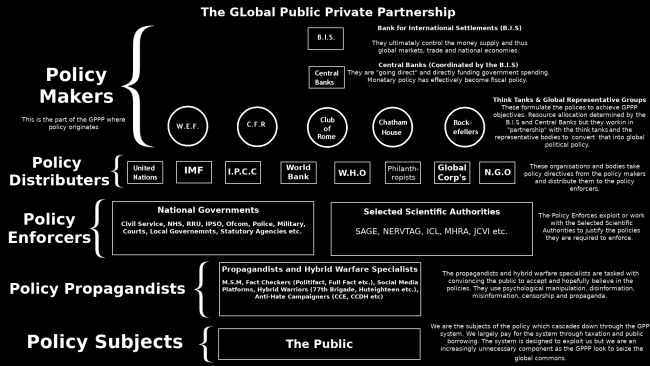
The NWO has been through several iterations and has been re-marketed in different forms. The COVID-19 pseudopandemic has seen the World Economic Forum’s Great Reset come to public attention. This is simply a new brand for the NWO as the WEF makes its bid to be the central pillar of the Global Public-Private-Partnership (G3P). The G3P represents the current management structure of the NWO.

The proposed operating system for NWO global governance is Technocracy. There are a number of key elements which, once installed, will end the last vestiges of human freedom and place the world’s population under the totalitarian control of the technocrats. In turn, the technocrats will serve the interests of the parasite class, not humanity.
Democracy will continue in name only, reassuring the masses for a while, in the form of a communitarian “civil society.” Government, working in partnership with private corporations, will encourage civil society groups to “debate” policies. Every single one of those policies will be pre-selected by the technocratic state (Technate). The apparent political choice will remain an illusion.
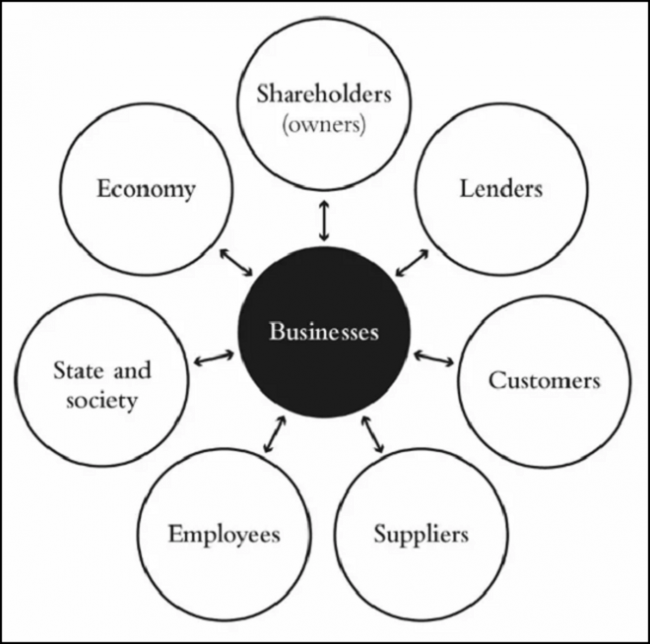
The global economy is currently being transformed as new markets are created. As outlined in the 1992 UN Agenda 21 document (section 8.41), the “basis for action” has already been established. A global accountancy system for all business will use stakeholder capitalism metrics to rate assets, ensuring “the integration of sustainability into economic management.”
The rating mechanisms, such as environmental, social and governance ratings (ESG’s), will enable centralised global economic planning. It will determine which ventures receive or do not receive investment. Favoured corporate partners within the G3P will do very well, as long as they promote G3P goals. Those who don’t will go bankrupt without question.
The ratings system provides a “better measurement of the crucial role of the environment as a source of natural capital.” Natural Asset Companies will transform forests into ‘carbon sequestration services’ and natural water sources into ‘human settlement resource services,’ or some such thing.
By claiming that they own nature, the G3P will create new markets worth a projected $4 quadrillion. Thereby removing oil, as the base commodity of value, and replacing it with nature (natural assets). This transformation is called “sustainable development.” It has nothing to do with environmentalism or combatting “climate change.”
The notion of uniting all of humanity to work together to solve the “climate crisis” is a contrivance to facilitate global governance. It was fabricated in the late 1980’s and early 1990’s by the globalist think-tanks that set the world’s policy agendas.
The Club of Rome, the think-tank which greatly influenced the nascent WEF, took credit for imagining the perfect global crisis. In their 1991 publications The First Global Revolution, on page 75 under the heading “the common enemy of humanity is Man,” the Club of Rome wrote:
In searching for a common enemy against whom we can unite, we came up with the idea that pollution, the threat of global warming, water shortages, famine and the like, would fit the bill. [. . .] All these dangers are caused by human intervention in natural processes, and it is only through changed attitudes and behaviour that they can be overcome. The real enemy then is humanity itself.
This statement expresses two of the parasite class’ core beliefs. The assumed legitimacy of their claim to rule, which enables them to imagine they have the right to “designate” a global enemy, and their shared commitment to population control. They herd us like cattle, as they decide how to change our attitudes and behaviour to suit their objectives.
The International Monetary and Financial System (IMFS) has also undergone a transformation. With the introduction of Central Bank Digital Currency (CBDC) it will be revolutionised. CBDC currency will be issued by central banks as their liability. They are solely responsible for that liability. CBDC will always be their money.
CBDC is electronic money, it is therefore programmable money. This means the central banks will have complete control over every unit of CBDC currency. Whether it is in your wallet or not, it is the central bank’s money and they will permit or deny every transaction you make with it.
For example, the decisions you currently make about where you travel have already been restricted by the global policy response to a fake pandemic. If CBDC is fully adopted, you will no longer have any choice at all.
CBDC will enable your central bank’s AI algorithm to decide where you can go and when. If CBDC becomes the only form of currency available to us, none of us, no matter how much money we think we have, will have any financial freedom.
In order for Technocracy to operate, every citizen must be continually surveilled and controlled by the state (Technate). The technology capable of doing this is already being distributed globally as part of the so-called Fourth Industrial Revolution (4ID).
The Internet of Things (IoT) will see every device that we use report that use back to the Technate’s data centres. The Internet of Bodies (IoB) will enhance the Technates ability to monitor us in real time. Combined with the Digital-ID, that every nation is rushing towards, the surveillance and control of every individual “global citizen” will be centrally managed at the global governance level.
The New World Order, under the current management structure of the Global Public-Private Partnership, is nearing completion. It is a truly global system of governance. There are no leading governments anywhere on Earth opposed to it. All are racing ahead to adopt it with equal enthusiasm.
The Way Forward For The NWO
With Russia’s recent military operation in Ukraine, it has been suggested by some that the Russian and Chinese governments are not prepared to accept the imposition of the NWO. We can only be guided by their major policy statements and their actions. If these are anything to go by, both governments are fully on-board with the NWO agenda.
Both Russia and China are absolutely committed to sustainable development, Digital ID, 4ID, COVID biosecurity and vaccine-passports. Russia is ahead of most Western nations with regards to CBDC and China has surpassed Russia, having already started to use CBDC on a significant scale.
On 4th February Presidents Vladimir Putin and Xi Jinping issued a joint statement on the future relationship between Russia and China. It read, in part:
Today, the world is going through momentous changes, and humanity is entering a new era of rapid development and profound transformation. [. . .] of the global governance architecture and world order. [. . .] The ongoing pandemic of the new coronavirus infection poses a serious challenge to the fulfilment of the UN 2030 Agenda for Sustainable Development. [. . .] In order to accelerate the implementation of the UN 2030 Agenda for Sustainable Development, the sides call on the international community to take practical steps in key areas of cooperation such as poverty reduction, food security, vaccines and epidemics control, financing for development, climate change, sustainable development, including green development, industrialization, digital economy, and infrastructure connectivity. [. . .] [We] will further increase cooperation in the development and manufacture of vaccines. [. . .] Russia and China intend to encourage interaction in the fields of public health, digital economy, science, innovation and technology, including artificial intelligence technologies [. . .] Particular emphasis will be placed on the fight against the novel coronavirus infection pandemic and economic recovery, digitalization of a wide range of different spheres of life.
There is no evidence to suggest that either Russia or China wish to derail the objectives of the WEF’s Great Reset. On the contrary, the evidence points towards Russia and China as perhaps the most enthusiastic and aggressive advocates for the NWO agenda. China is the world’s first Technate and Russia is a major WEF partner, most notably on cybersecurity.
Much has been made of the WEF’s decision to distance itself from Russia and sanctioned individuals. Notably this is a “temporary” freeze and smacks more of political expediency and PR, rather than any genuine severance.
There is no aspect of the NWO, G3P managed agenda that either Russia or China stand against. Their joint statement read like a Great Reset checklist.
Perhaps this is all a cunning deception. Part of a “secret plot” by Russia and China to fight the NWO. However, it looks far more like a pact between two powers bidding for political leadership of the NWO.
There is no doubt that the NWO was conceived as a project of Western based oligarchs. In the post WWII era it has bared its teeth on the geopolitical stage as the “international rules-based order.” This unipolar order, centred around the G7 group of nations, with the US led NATO alliance providing the muscle, has been dominant within the Global Public-Private Partnership (G3P).
Russia’s military intervention in Ukraine, and the G7/NATO alliance response to it, appears to be a watershed moment. Together, Russia and China are challenging the G7 clique with a BRICS based, G20 focused, multipolar model. It seems they are determined to seize primacy within the G3P management structure.
As a paid spokesperson for the G7 rules-based order, Joe Biden anxiously observed “there’s going to be a new world order out there, and we’ve got to lead it.” The US-led alliance’s problem is that Russia and China, in league with their BRICS partners, are pursuing exactly the same objective.
 After the Crash