
The US Economy Looks Good On Paper – Here’s Why It’s Actually A Disaster In Progress

By Brandon Smith

Source: Alt-Market.us

One of my favorite false narratives floating around corporate media platforms has been the argument that the American people “just don’t seem to understand how good the economy really is right now.” If only they would look at the stats, they would realize that we are in the middle of a financial renaissance, right? It must be that people have been brainwashed by negative press from conservative sources…

I have to laugh at this claim because it’s a very common one throughout history – It’s an assertion made by almost every single political regime right before a major collapse. These people always say the same things, and when you study economics as long as I have you can’t help but throw up your hands and marvel at their dedication to the propaganda.

One example that comes to mind immediately is the delusional optimism of the “roaring” 1920s and the lead up to the Great Depression. At the time around 60% of the US population was living in poverty conditions (according to the metrics of the decade) earning less than $2000 a year. However, in the years after WWI ravaged Europe, America’s economic power was considered unrivaled.

The 1920s was an era of mass production and rampant consumerism but it was all fueled by easy access to debt, a condition which had not really existed before in America. It was this illusion of prosperity created by the unchecked application of credit that eventually led to the massive stock market bubble and the crash of 1929. This implosion, along with the Federal Reserve’s policy of raising interest rates into economic weakness, created a black hole in the US financial system for over a decade.

There are two primary tools that various failing regimes will always use to distort the true conditions of the economy: Debt and inflation. In the case of America today, we are experiencing BOTH problems simultaneously and this has made certain economic indicators appear healthy when they are, in fact, highly unstable. The average American knows this is the case because they see the effects daily. They see the damage to their wallets, to their buying power, in the jobs market and in their quality of life. This is why public faith in the economy has been stuck in the dregs since 2021.

The establishment can shove out-of-context stats in people’s faces, but they can’t force the populace to see a recovery that simply does not exist. Let’s go through a short list of the most faulty indicators and the real reasons why the fiscal picture is not as rosy as the media would like us to believe…

The “Miracle” Labor Market Recovery

In the case of the US labor market, we have a clear example of distortion through inflation. The $8 trillion+ dropped on the economy in the first 18 months of the pandemic response sent the system over the edge into stagflation land. Helicopter money has a habit of doing two things very well: Blowing up a bubble in stock markets and blowing up a bubble in retail. Hence, the massive rush by Americans to go out and buy, followed by the sudden labor shortage and the race to hire (mostly for low wage part-time jobs).

The problem with this “miracle” is that inflation leads to price explosions, which we have already experienced. The average American is spending around 30% more for goods, services and housing compared to what they were spending in 2020. This is what happens when you have too much fiat money chasing too few goods and limited production.

The jobs market looks great on paper, but the majority of jobs generated in the past few years are jobs that returned after the covid lockdowns ended (the same lockdowns Democrats tried to keep in place perpetually). The rest are jobs created through monetary stimulus, and then there is the issue of “immigrant jobs” and data that is revised to the negative months later.  I suspect we won’t ever hear the real stats unless Trump enters office in 2025.  Then the media discussion will focus intently on how terrible the labor market really is.

Part time low wage service sector jobs are not going to keep the country rolling for very long in a stagflation environment. The question is, what happens now that the stimulus punch bowl has been removed?

Just as we witnessed in the 1920s, Americans have turned to debt to make up for higher prices and stagnant wages by maxing out their credit cards to historic levels. With the central bank keeping interest rates high, the credit safety net will soon falter. This condition also goes for businesses; businesses that will soon jump headlong into mass layoffs when they realize the party is over.  It happened during the Great Depression and it will happen again today.

Stock Market Bonanza

We saw cracks in in the armor of the financial structure in 2023 with the spring banking crisis, and without the abrupt Federal Reserve backstop many more small and medium banks would have dropped dead. The weakness of US banks is offset by the relative strength of the US dollar, which lures in foreign investors hoping to protect their wealth using dollar denominated assets.

But something is amiss. Gold and Bitcoin have rocketed higher along with stocks and the dollar. This is the opposite of what’s supposed to happen. Gold and BC are supposed to be hedges against a weak dollar and weak equities, right? If global faith in the dollar and in stocks is so high, why are investors diving into protective assets like gold?

Again, as noted above, inflation distorts everything. Tens of trillions of extra dollars printed by the Fed are floating around and it’s no surprise that much of that cash is flooding into the stock market which simply pushes higher right along with prices on the shelf. But, gold and BC are telling us a more nuanced story about what’s really happening.

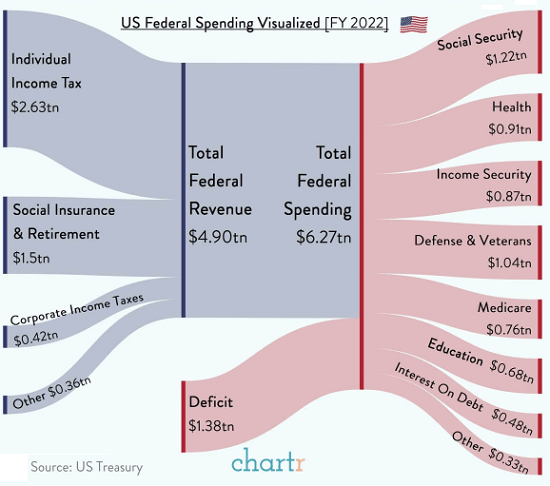
Right now, the US government is adding around $1 Trillion every 100 days to the national debt as the Fed holds rates higher to fight inflation.  Higher interest means exponential debt conditions, and this debt is going to crush America’s financial standing for global investors who will eventually ask HOW the US is going to handle that growing millstone? As I predicted years ago, the Fed has created a perfect Catch-22 scenario in which the US must either return to rampant inflation, or, face a debt breakdown. In either case, US dollar denominated assets will lose their appeal and stock markets will ultimately plummet.

Beyond this reality, stocks are not a leading indicator of anything, let alone the stability of the financial system. Stocks are a trailing indicator; they crash well after all the other warning signals have made it obvious that something is wrong. Average Americans, for good reason, do not care what stock markets have to say.

Healthy GDP Is A Complete Farce

Beyond the stock market, GDP is the most common out-of-context stat used by governments to convince the citizenry that all is well. It is yet another stat that is entirely manipulated by inflation. It is also manipulated by the way in which modern governments define “production and market value.”

GDP is primarily driven by spending. Meaning, the higher inflation goes, the higher prices go, and the higher GDP climbs (to a point). Eventually prices go too high, credit cards tap out and spending ceases. But, for a short time inflation makes GDP (as well as retail) look good.

Another factor that creates a bubble is the reality that government spending is actually included in the calculation of GDP. That’s right, every dollar of your tax money that the government wastes helps the establishment by propping up GDP numbers. This is why government spending increases will never stop – It’s too valuable for them to spend as a way to make the economy appear healthier than it is.

The Real Economy Is Eclipsing The Fake Economy

The bottom line is that Americans used to be able to ignore the warning signs because their bank accounts were not being directly affected. This is over. Now, every person in the country is dealing with a massive decline in buying power and higher prices across the board in all assets. Even the wealthy are seeing a compression to their profits and many are struggling to keep their businesses in the black.

The unfortunate truth is that the elections of 2024 will probably be the turning point at which the whole edifice comes tumbling down. Even if the public votes for change, the system is already broken and cannot be repaired without a complete overhaul. We have consistently avoided taking our medicine and our weaknesses have only accumulated.

People have lost faith in the economy because they have not faced this kind of uncertainty since the 1930s. Even the stagflation crisis of the 1970s will likely pale in comparison to what is about to happen. On the bright side, at least a large number of Americans are aware of the threat, as opposed to the 1920s when the vast majority of people were utterly conned by the government, the banks and the media into thinking all was well. Knowing is the first step to preparing.
We’re Living in a Neofeudal Bubble

By Charles Hugh Smith

Source: Of Two Minds

If you listen to conventional economists, everything’s rosy: thanks to the expansion of alt-energy like wind and solar, energy is getting cheaper, batteries will power the new global economy, we’re getting smarter — just look at the rising number of advanced college degrees, wages are finally growing, inflation is trending down, household balance sheets and corporate profits are strong, debt loads are not an issue yet and GDP is rising.

All this happy news is backed by statistics, of course, but there’s one little problem: all the conventional cheerleaders are living in a bubble of like-minded elites who are insulated from the neofeudal realities of life in the real world.

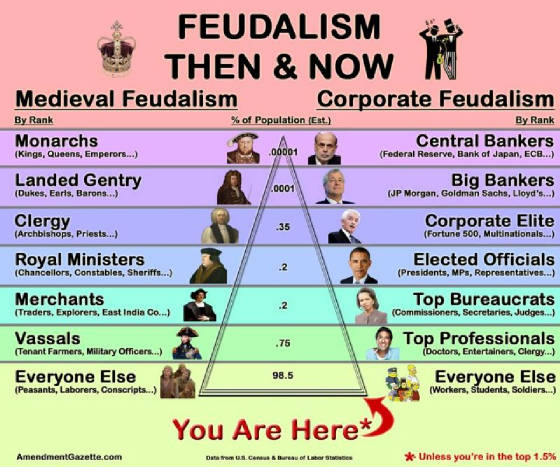
Outside the bubble of wealthy, protected elites that generate the statistics and the “news,” the global economy is completely, totally neofeudal–and so is the American economy. What does neofeudal mean? It refers to a two-tiered socio-economic system in which an aristocracy owns the vast majority of the wealth and collects the lion’s share of the income, and uses this financial dominance to buy political and narrative dominance.

In a neofeudal arrangement, the machinery of governance protects and enforces elite dominance. Cartels and monopolies have free rein to price-fix and exploit, tax revenues flow freely to cartels, elite organizations such as family trusts get tax breaks, and so on.

In other words, “the market” is rigged and the government maintains the status quo.

Toiling away to enrich the aristocratic owners of capital are the serfs and peasants, who own a tiny shred of income-producing capital. Their primary assets–the family home and vehicles–are actually income streams for the wealthy who collect the mortgage and auto-loan interest paid by the serfs.

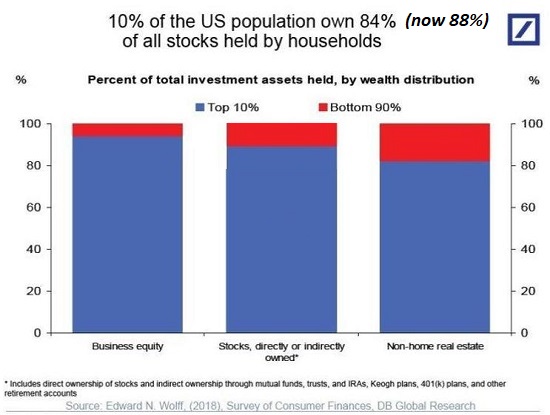
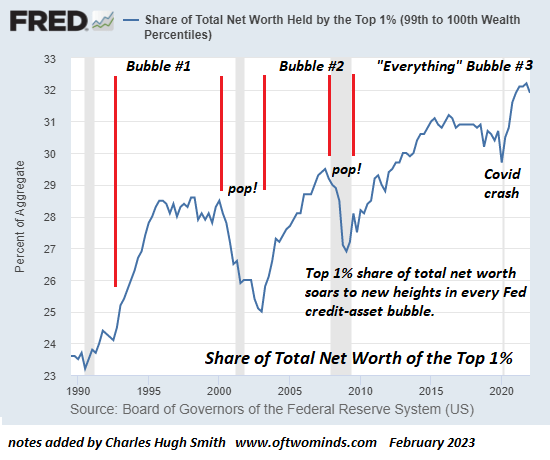
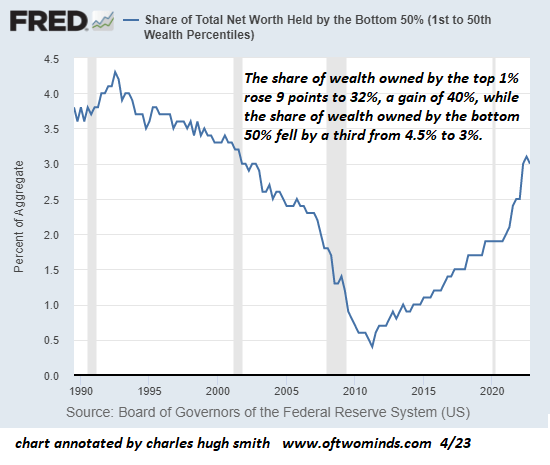
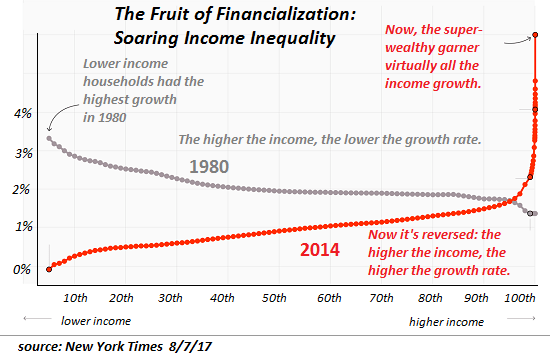
The core dynamic in neofeudalism is the already-wealthy increase their share of the wealth, and everyone else sees their meager share diminish. As the charts below show, the vast majority of financial gains generated by the US economy flow to the top 0.1% of households. The top 1%’s share has risen by 40% while the bottom 50%’s share of the wealth has slipped to 3%–essentially signal noise.

Social mobility is limited to the occasional serf clawing their way into the technocrat class, the top 5% who slavishly serve the interests of the financial aristocracy. This class lives in a self-contained, protected bubble: an echo chamber of privilege, residential enclaves, jetting around the world, and so on: everything’s great because we’re doing great.

Life is good in the bubble because there’s no homeless encampment a block away, there’s plenty of money coming in and our wealth–401Ks, inherited bonds and rental property, university pensions, corporate stock options, and so on–increases smartly, year after year and decade after decade.

The Wealthy Are Not Like You and Me–Our Terminally Stratified Society (8/3/23)

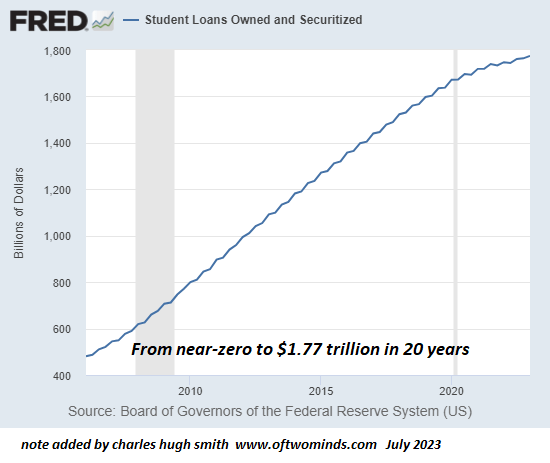
That all this wealth expansion is the result of unprecedented central bank intervention is left unsaid. As noted above, the role of the state and central bank is to maintain the status quo of the already-wealthy increasing their share of the national wealth and income, and loading more (very profitable) debt on the serfs. (See student loan debt chart below.)

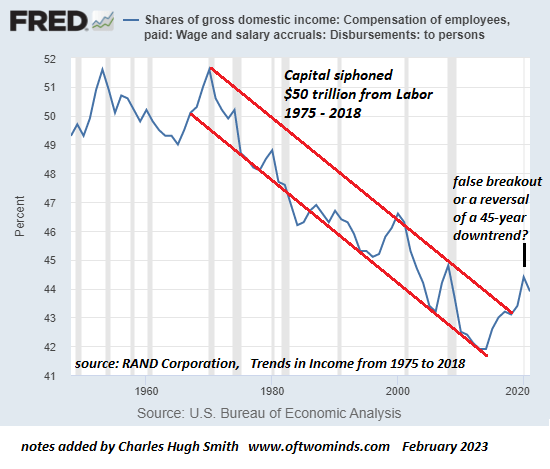
Outside the technocrats’ privileged bubble, wages’ share of the economy have been stripmined by the aristocracy for 45 years. Oh dear; could this be why I’m having such trouble finding low-wage reliable “help”?

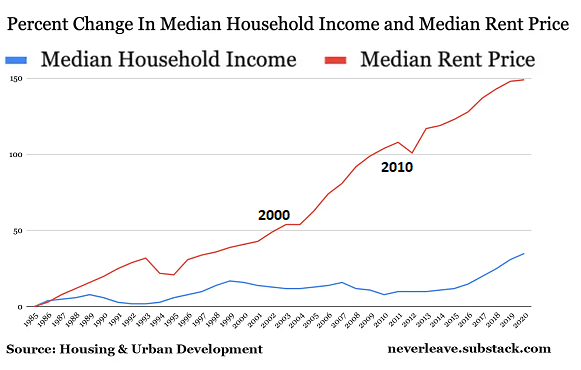
While wages inch up, costs of shelter, utilities, debt, vehicles, public transport, childcare and other essentials soar. Please glance at the chart of wages and rents below. This is neofeudalism in a nutshell. Wages have flatlined (or fallen when measured in purchasing power) while rent has steadily increased, eating away at the serfs’ disposable income.

Inside the technocrat class bubble, everything’s wunnerful. AI will boost profits (all of which flow to the aristocracy, so that’s wunnerful), energy’s getting cheaper and more abundant, and so on.

Oh, wait. Alt-energy only looks cheap because all the full lifetime costs have been ignored (i.e. externalized), and these modest additions to our vast hydrocarbon consumption aren’t actually replacing hydrocarbons, they’re simply adding more energy for us to consume.

Thousands of Old Wind Turbine Blades Pile Up in West Texas

Avangrid agrees to pay $48 million to terminate offshore wind deal

Models Hide the Shortcomings of Wind and Solar

In other words, conventional economists and the other technocrats maintain their privileged bubble by clinging to a delusionally disconnected-from-the-real-world mindset. There’s always a slew of academic papers or think-tank / corporate reports to bolster the inside-the-bubble confidence that everything’s great, because generating positive narratives that leave the neofeudal structure untouched in the primary industry of the technocrat class.

If you want to understand the neofeudal reality, study these charts. There are no rebuttals, there are only sputtering obfuscations: b-b-but the mission to Mars! Taylor Swift raked in a billion bucks! OnlyFans pulled in $5 billion! Stocks are rallying! Everything’s great!

Sure–if your dose of Delusional is high enough. Then you can go back to complaining about air travel delays, finding someone to repair your pool pump and bragging about how well your investments are doing.

ARE CENTRAL BANK DIGITAL CURRENCIES (CBDC) DESTINED TO FAIL?

By Timothy Alexander Guzman

Source: Silent Crow News

Since Bitcoin (BTC) was introduced to the world as an alternative to the current central bank system with a dying US dollar that is backed by nothing as its reserve currency, but now there is a plan by several governments to move ahead with implementing their own central bank digital currencies (CBDCs), which is a digital form of currency that is still backed by, you guessed it, nothing.  The Nigerian government had made the decision to be the financial guinea pig for the globalist CBDC scheme, and so far, it has failed and that’s the good news.  The bad news is that certain governments are still moving forward with the idea of using government-issued digital currencies.  In the case of Nigeria, its citizens rejected their government’s plan to issue CBDCs by restricting cash in efforts to create a cashless society and so far, it seems that it has failed in epic fashion according to an opinion piece by author Nicholas Anthony that was published by coindesk.com ‘Nigerians’ Rejection of Their CBDC Is a Cautionary Tale for Other Countries’ is a warning to governments who are willing to take the same step: 

In Nigeria, citizens have taken to the streets to protest the nation’s cash shortage, further objecting to their government’s implementation of a central bank digital currency (CBDC). The shortage came about due to cash restrictions aimed at pushing the country into a 100% cashless economy. Yet, instead of adopting the CBDC, Nigerian protesters are demanding paper money be restored.

The country’s experience strongly suggests the average citizen understands that CBDCs present a substantial risk to financial freedom while providing no unique benefit

Not only did the Nigerian people reject CBDCs, but they also demanded a return to paper currencies because they quickly found out that financial freedoms would be severely limited. 

The concerns ranged from risking financial privacy to the possibility of financial oppression by government institutions.  Anthony mentioned how “the Nigerian government has unleashed a flurry of tricks to spur adoption, but none has proven effective.”  He even gave credit to the Nigerian government in terms of using modest approaches to influence its citizens to use CBDCs and it still failed:

To its credit, the Nigerian government initially tried to encourage use through modest measures. In August 2022, it removed access restrictions so that bank accounts were no longer required to use the CBDC. Then, in October, it offered discounts if people used the CBDC to pay for cabs.  Yet, neither effort proved to be fruitful. Put simply, Nigerians prefer cash

However, the Nigerian government continued its assault on cash:

Unfortunately, the Nigerian government doubled down and moved to more drastic measures by restricting cash itself. In December the Central Bank of Nigeria began restricting cash withdrawals to 100,000 naira (US$225) per week for individuals and 500,000 naira ($1,123) for businesses.

To make matters worse, the Nigerian government also chose to redesign the currency during this time in a “move aimed at restoring the control of the Central Bank of Nigeria (CBN) over currency in circulation” and to “further deepen the push to [a] cashless economy,” according to a CBN press release

The Nigerians had a hard time adapting to the government’s restrictions on their hard earned cash, so they posted their concerns on Twitter, Tik Tok and other social media platforms to let the world know what went wrong.  Soon after, major protests erupted on the streets because of the cash shortages imposed by the Central Bank of Nigeria: 

The government decided to redesign the currency to restore control over the Central Bank of Nigeria as its governor, Godwin Emefiele claimed that “the destination, as far as I am concerned, is to achieve a 100% cashless economy in Nigeria.”  To add insult to injury, “the company that designed the Nigerian CBDC called the cash restrictions a creative use of marketing and said other countries could be expected to take similar steps.”  A top manager from a financial institutional ratings firm called Agusto and Co., Ayokunle Olumbunmi said that the central bank “doesn’t want us to be spending cash. They want us to be doing transactions electronically, but you can’t legislate a change in behavior.”  Anthony concluded that the idea of CBDCs will not go very far, “CBDCs may be popular among central bankers, but money is ultimately a tool for the people. So long as the risks outweigh the benefits, it’s unlikely any CBDC will gain traction in Africa or elsewhere.”

Nicholas Anthony was correct to point out that CBDCs will not become mainstream as several countries have already demonstrated their unwillingness to move forward with the new form of digitized currencies. 

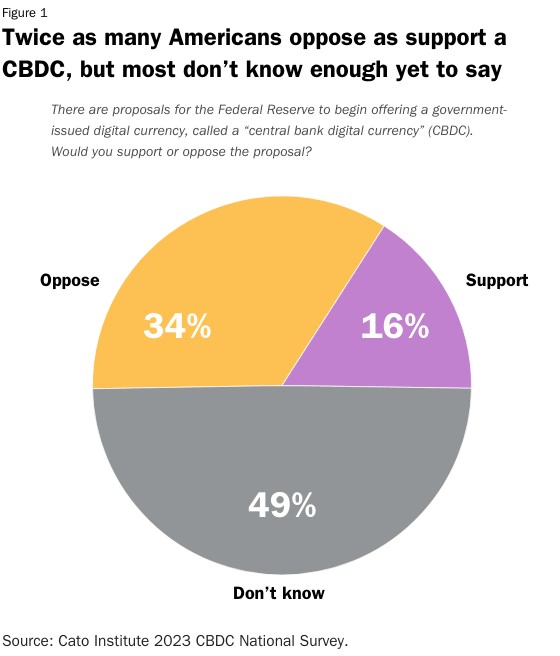
The average human being on earth understands that CBDCs is a bad idea, even in the United States where two-thirds of the population believes almost anything that their government tells them to believe are skeptical of CBDCs according to the Cato Institute, a think tank who also published an article by Nicholas Anthony on the findings of a survey that was conducted by the US federal Reserve Bank on how people view CBDCs.  Here is what they found, “Specifically, more than 66 percent of the 2,052 commenters were concerned or outright opposed to the idea of a CBDC in the United States (Figure 1).”

Bitcoin.com published an article on the GOP’s 2024 presidential candidate, Florida’s governor, Ron DeSantis who is opposed to CBDCs, ‘Ron DeSantis Vows to Prohibit CBDC, ‘Woke Politics,’ and ‘Financial Surveillance’ in Florida,’ he said “I think what the danger of the digital currency is that, one, they want to make that the sole currency, they want to get rid of crypto,” DeSantis continued, “They don’t like crypto because they can’t control crypto. So, they want to put everything in a central bank digital currency.”  There were other politicians who also have similar views on CBDCs:

DeSantis shares the view of several Republican officials who have criticized the idea of a central bank digital currency (CBDC). Minnesota congressman Tom Emmer introduced the Central Bank Digital Currency (CBDC) Anti-Surveillance State Act, while Texas senator Ted Cruz has created legislation against the government developing a CBDC. Georgia representative Marjorie Taylor Greene has also spoken out against CBDCs, and 2024 Democratic presidential candidate Robert Kennedy Jr. has warned that a central bank digital currency could lead to financial slavery

Cash is King! How the CBDC Failed in Japan and Ecuador

Cointelegraph.com, an independent digital news platform that focuses on crypto assets, blockchain technology and emerging fintech trends published an article last year written by Helen Partz based on which countries have rejected CBDCs for one reason or another titled ‘Some central banks have dropped out of the digital currency race’ mentions Japan, who is a major player in the global economy, ultimately rejected developing a CBDC scheme.  The Bank of Japan (BOJ) started testing their digital currency proof-of-concept in 2021 and had planned to finish the first phase by 2022 but in January “former BOJ official Hiromi Yamaoka advised against using the digital yen as part of the country’s monetary policy, citing risks to financial stability.” 

The BOJ issued a report in July 2022 and stated that it had no plan to establish a CBDC system since there is a “strong preference for cash and high ratio of bank account holding in Japan” and that the regulator suggested for a CBDC to be used as a “public good” and it “must complement and coexist” with “private payment services in order for Japan to achieve secure and efficient payment and settlement systems.”  However, it also said that “the fact that CBDC is being seriously considered as a realistic future option in many countries must be taken seriously,” in other words, the CBDC scheme in Japan will not move forward although several countries are still in the early stages of developing a plan for the use of CBDCs, but for Japan, cash is still and will be king well into the foreseeable future.

Ecuador is another example as its central bank, Banco Central del Ecuador (BCE) who launched its own electronic currency known as dinero electrónico (DE) in 2014 to increase some sort of financial inclusion for the public as well as to control the flow of fiat currencies.  According to Partz “As of February 2015, Ecuador managed to adopt DE as a functional means of payment, allowing qualified users to transfer money via a mobile app. The application specifically allowed citizens to open an account using a national identity number and then deposit or withdraw money via designated transaction centers.”  But industry observers were not so sure that the DE can take the form of a CBDC since Ecuador’s currency is the US dollar, and since Ecuador does not currently have its own sovereign currency, many were not so sure that they can call the DE, a form of CBDC.  “The Ecuadorian government cited the support of its dollar-based monetary system as one of the goals behind its DE platform after it started to accept U.S. dollars as legal tender in September 2000.”  It seems that Ecuador remains skeptical on any possibility that issuing CBDCs will be a success:

According to online reports, Ecuador’s DE operated from 2014 to 2018, amassing a total of 500,000 users at its peak out of a population of roughly 17 million people. The project ​​was eventually deactivated in March 2018, with the BCE reportedly citing legislation abolishing the central bank’s electronic money system. Passed in December 2021, the law stated that e-payment systems should be outsourced to private banks.

Years after dropping its central bank digital money initiative, Ecuador has apparently remained skeptical about the whole CBDC phenomenon. In August 2022, Andrés Arauz, the former general director at Ecuador’s central bank, warned eurozone policymakers that a digital euro could potentially disrupt not only privacy but also democracy

Bottom line, the CBDC will not be a standard for financial transactions for the few countries who already tried launching their versions of digital currencies. 

However, in the US, the Federal Reserve’s ‘FedNow’ was supposed to be launched sometime in July 2023.  Here is the Federal Reserve’s Press Release:

The Federal Reserve announced that the FedNow Service will start operating in July and provided details on preparations for launch.  The first week of April, the Federal Reserve will begin the formal certification of participants for launch of the service. Early adopters will complete a customer testing and certification program, informed by feedback from the FedNow Pilot Program, to prepare for sending live transactions through the system.

Certification encompasses a comprehensive testing curriculum with defined expectations for operational readiness and network experience. In June, the Federal Reserve and certified participants will conduct production validation activities to confirm readiness for the July launch.

“We couldn’t be more excited about the forthcoming FedNow launch, which will enable every participating financial institution, the smallest to the largest and from all corners of the country, to offer a modern instant payment solution,” said Ken Montgomery, first vice president of the Federal Reserve Bank of Boston and FedNow program executive. “With the launch drawing near, we urge financial institutions and their industry partners to move full steam ahead with preparations to join the FedNow Service”

For the US population, FedNow is a test that will eventually fail.  People will be skeptical about a central bank digital currency once it proves that it is used to surveil people’s spending habits and control what they spend their money on, and God forbid they are anti-war, anti-vaccine activists, homeschoolers, pro-gun supporters or conspiracy theorists, the bankers can cut them off from using CBDCs and then what happens?  Will there be riots in the streets? 

Since Bitcoin was introduced as an alternative to central bank control, the creation of the CBDC is their answer in hopes of retaining their power, but that idea is not likely to happen, it will in some way, backfire. 

When it comes to Bitcoin, it’s a different story.  In an interesting article written by Jay Speakman of beincrypto.com ‘When You Buy Bitcoin You Gain Freedom’ says that “in a world where economic and political uncertainties abound, owning Bitcoin (BTC) could provide the path toward financial freedom and autonomy. It’s no longer just about investing in a digital asset. It’s about making a revolutionary move to gain control over your finances and future.”  Speakman makes several main points on why people should own Bitcoins and one of those points is that owning sovereign cryptos such as Bitcoins, Ethereum’s and others is a step towards financial freedom:

It provides the opportunity to participate in the global economy without the limitations of traditional banking systems. Bitcoin is not subject to government regulations. At least not yet, and it is free from the inflationary policies which can erode fiat currency values. This means Bitcoin provides an alternative and potentially more secure, store of value

Another reason for owning Bitcoins is for future investment purposes:

Investing in Bitcoin is no longer simply making money. It is about investing in your future and securing your financial freedom. Bitcoin’s decentralized financial system operates independently of central authorities or governments. This means it is resistant to censorship and regulation. Bitcoin holders can make transactions without the need for banks, which are subject to government intervention

“Investment Diversification” is another reason to own Bitcoins since putting all your eggs in one basket, especially in a globalist banking system, is a bit risky:

Investing in Bitcoin can provide portfolio diversification as it is not correlated to traditional assets such as stocks and bonds. This means it may provide a hedge against inflation and market volatility, mitigating the risks associated with traditional investment portfolios

However, owning Bitcoins does have risks like everything else since the “market is notoriously volatile. Prices often fluctuate wildly based on a range of factors, from government regulations to media coverage.”  Speakman also mentions that “BTC transactions can result in a permanent loss of funds. There is also the risk of hacking and theft, as these transactions are irreversible and untraceable.” 

In conclusion, the article lays out what owning Bitcoins could mean for individuals and investors alike especially for those who do not trust the traditional banking system:

The decision to buy BTC is more than just a financial investment. It’s a move towards financial freedom, control, and security. Bitcoin’s feature of allowing individuals to act as their own banks. Providing a secure alternative to traditional banking systems which have exhibited instability and vulnerability to failures.  Furthermore, the appeal goes beyond just financial security and autonomy. The digital currency resonates with libertarians who value individual freedom and limited government intervention. Despite a torrent of dissenting voices Bitcoin continues to gain mainstream adoption. As the technology continues to mature, it may address some of the concerns raised by the dissenting voices.

Investing in digital assets may involve risks such as volatility and the potential for hacking and theft. Yet, the benefits of financial freedom outweigh the downsides. As the world becomes increasingly uncertain, owning Bitcoin could be the first step toward financial security and autonomy

When you look at the difference between CBDCs along with the system imposed by international banking cartels who still maintain some form of financial dominance versus the Bitcoin revolution, there is a difference.  CBDCs means no financial freedoms and owning Bitcoins means the exact opposite.  Even though Bitcoins are still in the early stages, there is hope in the new crypto technology.  But like everything else, you should be cautious, do not invest 100% of your net worth in just one asset, in other words, invest maybe 5% in bitcoins, and the rest? 15% in emergency preparedness (food, water filters, guns, flashlights, etc.)  20% in real estate or invest in a second passport, 20% in hard assets like gold, silver and copper, 20% in high-end watches, antiques, aged wines and liquor, collectibles etc. and the last 20% in foreign stocks especially those that are in politically stabilized environments or in gold and silver mining companies, but that’s just my opinion. 

Government-backed CBDCs will be a failure because the people already do not trust international banking cartels to totally control their finances. So, for these banks to have total control over your financial wellbeing under their CBDC scheme would be an extremely difficult task for them to manage. 

The banking cartel or the financial bureaucrats are about to discover that they will be in over their heads with an angry population.  Just imagine if the banking cartels, certain governments and their corporate conglomerates are in  control over the people’s finances, they will get to determine who eats and who will starve.  This is the ultimate power grab the globalist bankers have been dreaming about for a very long time, but will the people stop this from happening?  I’m an optimist, so I believe that they will demand their financial freedoms and that is something of value that they can hold and control in their own hands.  The case for CBDCs will be a hard sell, so central banks who are proposing this idea should think twice about what they are trying to impose on the public, if not, they will face some form of resistance just like they did in Nigeria.    

The Everything Bubble and Global Bankruptcy

By Charles Hugh Smith

Source: Of Two Minds

The resulting erosion of collateral will collapse the global credit bubble, a repricing/reset that will bankrupt the global economy and financial system.

Scrape away the complexity and every economic crisis and crash boils down to the precarious asymmetry between collateral and the debt secured by that collateral collapsing. It’s really that simple.

In eras of easy credit, both creditworthy and marginal borrowers are suddenly able to borrow more. This flood of new cash seeking a return fuels red-hot demand for conventional assets considered “safe investments” (real estate, blue-chip stocks and bonds), demand which given the limited supply of “safe” assets, pushes valuations of these assets to the moon.

In the euphoric atmosphere generated by easy credit and a soaring asset valuations, some of the easy credit sloshes into marginal investments (farmland that is only briefly productive if it rains enough, for example), high-risk speculative ventures based on sizzle rather than actual steak and outright frauds passed off as legitimate “sure-fire opportunities.”

The price people are willing to pay for all these assets soars as the demand created by easy credit increases. And why does credit continue increasing? The assets rising in value create more collateral which then supports more credit.

This self-reinforcing feedback appears highly virtuous in the expansion phase: the grazing land bought to put under the plow just doubled in value, so the owners can borrow more and use the cash to expand their purchase of more grazing land. The same mechanism is at work in every asset: homes, commercial real estate, stocks and bonds: the more the asset gains in value, the more collateral becomes available to support more credit.

Since there’s plenty of collateral to back up the new loans, both borrowers and lenders see the profitable expansion of credit as “safe.”

This safety is illusory, as it’s resting on an unstable pile of sand: bubble valuations driven by easy credit. We all know that price is set by what somebody will pay for the asset. What attracts less attention is price is also set by how much somebody can borrow to buy the asset.

Once the borrower has maxed out their ability to borrow (their income and assets-owned cannot support more debt) or credit conditions tighten, then those who might have paid even higher prices for assets had they been able to borrow more money can no longer borrow enough to bid the asset higher.

Since price is set on the margin (i.e. by the last sales), the normal churn of selling is enough to push valuations down. At first the euphoria is undented by the decline, but as credit tightens (interest rates rise and lending standards tighten, cutting off marginal buyers and ventures) then buyers become scarce and skittish sellers proliferate.

Questions about fundamental valuations arise, and sky-high valuations are found wanting as tightening credit reduces sales, revenues and profits. Once the “endless growth” story weakens, the claims that bubble prices are “fair value” evaporate.

As defaults rise, lenders are forced to tighten credit further. The first tumbling rocks are ignored but eventually the defaults trigger a landslide, and the credit-inflated bubble in asset valuations collapses.

As valuations plummet, so too does the collateral backing all the new debt. Debt that appeared “safe” is soon exposed as a potential push into insolvency. When the bungalow doubled in value from $500,000 to $1 million, the trajectory of valuation gains looked predictably rosy: every decade housing prices went up 30% or more. So originating a mortgage for $800,000 on a house that looked to be worth $1.3 million in a few years looked rock-solid safe.

But the $1 million was a bubble based solely on easy, abundant, low-cost credit. When credit tightens, the home is slowly but surely repriced at its pre-bubble valuation ($500,000) or perhaps much lower, if that value was merely an artifact of a previous unpopped bubble.

Now the collateral is $300,000 less than the mortgage. The owner who made a down payment of $200,000 will be wiped out by a forced sale at $500,000, and the lender (or owner of the mortgage) will take a $300,000 loss.

Given the banking system is set up to absorb only modest, incremental losses, losses of this magnitude render the lender insolvent. The lender’s capital base is drained to zero by the losses and then pushed into negative net-worth by continued losses.

The collateral collapses when bubbles pop, but the debt loaned against the now-phantom collateral remains.

This is the story of the Great Depression, a story that’s unloved because it calls into question the current series of credit-inflated bubbles and resulting financial crises. So the story is reworked into something more palatable such as “the Federal Reserve made a policy error.”

This encourages the fantasy that if central banks choose the right policies, credit bubbles and valuations detached from reality can both keep expanding forever. The reality is credit bubbles always pop, as the expansion of borrowing eventually exceeds the income and collateral of marginal borrowers, and this tsunami of cash eventually pours into marginal high-risk speculative vebtures that go bust.

There is no way to thread the needle so credit-asset bubbles never pop. Yet here we are, watching the global Everything Bubble finally start collapsing, guaranteeing the collapse of collateral and all the debt issued on that collateral, and the rabble is arguing about what policy tweaks are needed to reinflate the bubble and save the global economy from bankruptcy.

Sorry, but global bankruptcy is already baked in. Too much debt has been piled on phantom-collateral and income streams derived from bubble assets rising (for example, capital gains, development taxes, etc.). The asymmetry is now so extreme that even a modest decline in asset valuations/collateral due to a garden-variety business-cycle recession of tightening financial conditions will trigger the collapse of The Everything Bubble and the mountain of global debt resting on the wind-blown sands of phantom collateral.

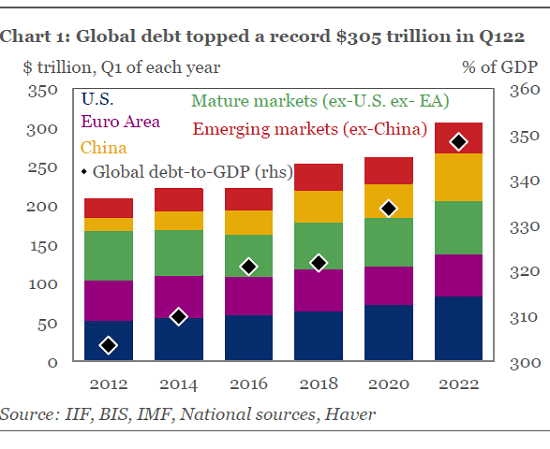
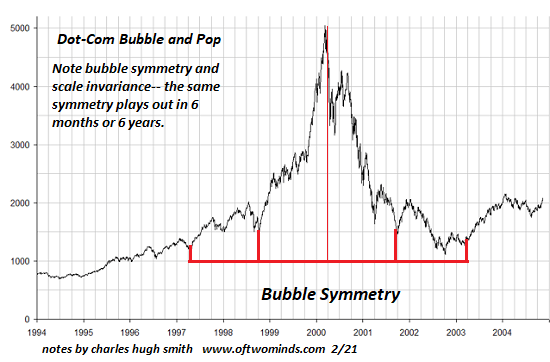
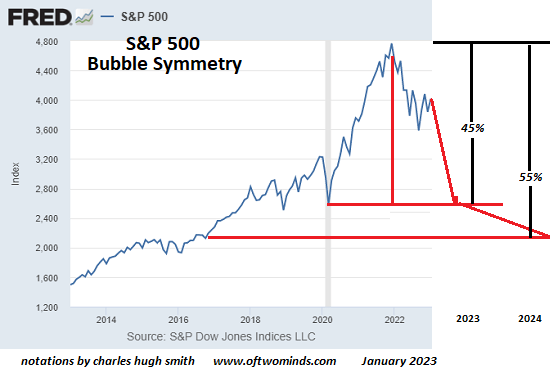
There are persuasive reasons to suspect global debt far exceeds the official level around $300 trillion, most saliently, the largely opaque shadow banking system. When assets roughly double in a few years, bubble symmetry suggests that valuations will decline back to the starting point of the bubble in roughly the same time span.

The resulting erosion of collateral will collapse the global credit bubble, a repricing/reset that will bankrupt the global economy and financial system.

A Fed-Issued Digital Currency: The Mark of the Beast

A Fed-issued digital currency would be no more in our interests than the current dollar system.

By Jeremy R. Hammond

Source: Jeremy R. Hammond Blog

China’s ‘Social Credit’ System

“And he causeth all, both small and great, rich and poor, free and bond, to receive a mark in their right hand, or in their foreheads: And that no man might buy or sell, save he that had the mark, or the name of the beast, or the number of his name.” — Revelation 13:16-17

In China, as you have likely heard, the government has been experimenting with a “social credit” system aimed at giving politicians even greater control over people’s behavior. China was, of course, also the country whose authoritarian “lockdown” response to the outbreak of SARS‑CoV‑2—the coronavirus that causes COVID‑19 and was likely engineered in a Chinese lab with US government funding—was pointed to as a model for the rest of the world to follow by the World Health Organization (WHO).

The WHO has since been aiming to acquire even more centralized global authority to issue diktats in the event of another pandemic, such as implementation of “lockdown” measures that might include travel restrictions, prevention of employment, and vaccine mandates or passport systems.

As of December 2020, around the time of the initial outbreak of the virus in Wuhan, China, social credit laws and regulations had been implemented in an estimated 80 percent of the country.

Naturally, the system is characterized by its proponents as a benevolent means to reward socially responsible people while denying privileges to unsavory and untrustworthy characters and businesses. But you and I both recognize the grave threat posed by politicians wielding this type of power and control over the population. It is an obvious threat to privacy and liberty.

The people of China regrettably but unsurprisingly appear to have welcomed this system, although the perception of public approval might be largely an artifact of people being afraid to publicly criticize the system lest their names be placed on one of the government’s “blacklists”.

As with any law or government policy, we should view it through the lens of how such power could be used as opposed to how politicians say they intend to use it.

A glimpse of how it could be used is the city of Rongcheng’s prohibition on “spreading harmful information”, violations of which could result in subtraction of points off residents’ social credit scores.

Such prohibitions must be seen in light of how governments are in the habit of interpreting “harmful information” as any information that does not align with the adopted political agenda. In the US during the COVID‑19 pandemic, there has been no greater purveyor of misinformation than the US government itself.

According to MIT Technology Review, the central government actually pressed the city to scale back the threat to individual liberty posed by its social credit system, such as enabling residents to opt-out. “The Chinese government did emphasize that all social-credit-related punishment has to adhere to existing laws,” the Review states, “but laws themselves can be unjust in the first place.”

The takeaway from that article is that “the social credit system does not (yet) exemplify abuse of advanced technologies like artificial intelligence”. But that’s no reason for the citizenry to consent to the implementation of systems that are conducive to extreme governmental abuses of authority.

A July 2019 article in Wired magazine related the example of Liu Hu, a journalist who was arrested, fined, and blacklisted, reportedly for writing about censorship and government corruption. He found himself on a “List of Dishonest Persons Subject to Enforcement by the Supreme People’s Court as ‘not qualified’ to buy a plane ticket, and banned from travelling some train lines, buying property, or taking out a loan.”

A more recent Newsweek article appropriately describes the system this way:

On an individual level, the government seeks to instill in the public an increased sense of morality to discourage everything from fraud and plagiarism to counterfeit goods and petty crime. But a system to make individual actions more transparent would necessitate the creation of tools to monitor all aspects of life. Social control, if not the original aim, could be an inevitable consequence, researchers say.

. . . While China’s vision of the system has yet to emerge as a dystopian tool for control driven by big data, there are real concerns about the way personal information is to be collected and processed to create social credit profiles, which could have lasting implications for individuals.

An untrustworthy government has no place dictating to its citizens what types of behaviors should be regarded as creating or breaking trust.

Human Rights Watch provides the example of lawyer Li Xioaolin, who was denied a plane ticket home while away on a work trip inside China because his name was on a blacklist of “untrustworthy” people in relation to a years-old court-related issue that he thought he had resolved.

According to Human Rights Watch, journalist Liu Hu was punished not for criticizing the government and exposing corruption but for having offered an apology that the government deemed “insincere” after losing a defamation case for publishing an article alleging that someone was an extortionist. Still, the organization notes, in both cases, “penalties were exacted in wildly arbitrary and unaccountable manners.” Additionally, “the courts failed to notify them, leaving them no chance to contest their treatment.”

According to the human rights organization, between 2013 and 2017, the Chinese government imposed more than seven million punishments to people for failing to carry out local court orders, which punishments have included publicly naming and shaming individuals and barring them from flights and trains.

After experiencing the totalitarianism of the disastrously harmful lockdown regimes and the accompanying efforts to coerce the population into accepting COVID‑19 vaccines and to censor truths countering the government’s incessant lies (I was permanently banned from LinkedIn, for example, for accurately reporting that the CDC’s claim that COVID‑19 vaccines provide greater protection against SARS‑CoV‑2 infection than natural immunity was a bald-faced lie), it should not be too difficult to imagine such a system being dangerously used to silence critics and punish dissenters so that whatever ruling regime can continue its crimes against humanity unobstructed.

The idea of a “social credit” score, of course, is inherently tied to the idea of central banking. In the US, the central bank is the Federal Reserve, a government-legislated private monopoly over the supply of currency. Increasingly, there is talk of a central bank digital currency, heightening concerns about the government having the means to exercise power over us and control our behavior.

“Project Hamilton”

As an example of how the Fed is exploring the idea of adopting a digital currency, the Massachusetts Institute of Technology (MIT) has teamed up with the Federal Reserve Bank of Boston under the appropriately named “Project Hamilton”.

Alexander Hamilton, of course, was instrumental in the adoption of central banking by the US government, famously at odds with Thomas Jefferson, who rightly opposed the idea and warned about the dangers inherent in such an institution. Jefferson appeared to hold the view that the means of exchange and interest rates ought to be determined by the market as opposed to being determined by fiat by a roomful of central planners.

Jefferson accurately foresaw how the government would use the central bank to pay for its spending as an alternative to raising taxes directly, and how the debt that would consequently be incurred by this uncontrolled spending would ultimately be borne by future generations.

In a letter to John Wayles Eppes in 1813, for example, Jefferson wrote:

I have said that the taxes should be continued by annual or biennial re-enactments; because a constant hold, by the nation, of the strings of the public purse, is a salutary restraint, from which an honest government ought not to wish, nor a corrupt one to be permitted, to be free. No tax should ever be yielded for longer than that of the Congress granting it, except when pledged for the reimbursement of a loan.

. . . Bank-paper must be suppressed, and the circulating medium must be restored to the nation to whom it belongs. . . . Treasury bills, bottomed on taxes, bearing, or not bearing interest, as may be found necessary, thrown into circulation, will take the place of so much gold & silver, which last, when crouded, will find an efflux into other countries, and thus keep the quantum of medium at its salutary level.

In a letter to John Taylor in 1816, Jefferson described central banking as rightly “reprobated” and as “a blot left in all our constitutions, which, if not covered, will end in their destruction”. He wrote, “And I sincerely believe with you, that banking establishments are more dangerous than standing armies; & that the principle of spending money to be paid by posterity, under the name of funding, is but swindling futurity on a large scale”.

Jefferson viewed the federal government as having no authority to institute a central banking system. As he wrote in 1791, “The incorporation of a bank, and the powers assumed by this bill, have not, in my opinion, been delegated to the United States, by the Constitution.”

The stated aim of Project Hamilton “is to investigate the technical feasibility of a general purpose central bank digital currency (CBDC) that could be used by an economy the size of the United States and to gain a hands-on understanding of a CBDC’s technical challenges, opportunities, risks, and tradeoffs.”

The project is part of MIT’s “Digital Currency Initiative”, which is aimed at bringing minds together “to conduct the research necessary to support the development of digital currency and blockchain technology.”

The aim of the collaboration with the Federal Reserve Bank of Boston has been “to develop a hypothetical CBDC.” MIT describes the possibility of a “central-bank-issued digital currency” as “a unique opportunity to address challenges in our existing payments system and design an economy that is more resilient, participatory, and open.”

We can reasonably assume that Thomas Jefferson, were he alive today, would disagree and view the idea as anathema to both a sound economy and a free society.

Noting that it was Alexander Hamilton “who laid the foundation for a U.S. central bank”, a project white paper published in February 2022 concluded that it is “critical” for research to continue for “achieving goals for a CBDC.” That is, it is not a question of whether the Fed should adopt a digital currency but how and when.

Biden’s Executive Order and Project Lithium

In January 2022, the Federal Reserve Board of Governors similarly published a paper titled “Money and Payments: The U.S. Dollar in the Age of Digital Transformation”, the aim of which was “to foster a broad and transparent public dialogue about CBDCs in general, and about the potential benefits and risks of a U.S. CBDC.”

Then in March 2022 President Joe Biden signed an “Executive Order on Ensuring Responsible Development of Digital Assets”, which declares the supposed need for the US government to “regulate” digital assets, including for the purpose of preventing circumvention of its sanctions regimes—in which context we might remember the US government’s criminal sanctions regime against Iraq in the 1990s and how Secretary of State Madeleine Albright insisted that the “price” of half-a-million dead Iraqi children was “worth it”.

The executive order, number 14067, describes how the government has an interest in maintaining the US dollar’s “central role” in “the global financial system”, which refers to the use of the dollar as a reserve currency. To that end, the order states, the Biden administration “places the highest urgency on research and development efforts into the potential design and deployment options of a United States CBDC.”

The White House is intent on determining what actions would be required to launch such a currency “if doing so is deemed to be in the national interest”. Of course, as the example of half a million excess childhood deaths in Iraq due to sanctions once again illustrates, determining just what is in the “national interest” is not a task that government policymakers seem particularly good at.

The lockdown measures, which utterly failed to project those at highest risk from COVID-19 while causing devastating harms globally, are another useful example of the ineptitude of policymakers when it comes to making decision that are in our best interests.

Following Biden’s executive order, in April 2022, the Depository Trust & Clearing Corporation (DTCC) announced “the development of the first prototype to explore how a CBDC might operate”. This endeavor was given the name “Project Lithium”, on which the DTCC is collaborating with The Digital Dollar Project (DDP), an organization that advocates US leadership “in advancing a CBDC” and encourages the executive branch of government “to support appropriate legislation” to authorize further research and development of such a currency.

The DDP published a white paper in May 2020 concluding that the US government “should, and must, take a leadership role in this new wave of digital innovation” and preserve the dollar’s role as “the world’s primary reserve currency” by working toward “the launch of a tokenized digital dollar”.

End the Fed!

Naturally, advocates of a central bank digital currency describe the aims of such a development as benign, just as the Federal Reserve system was originally established on the pretext that having a more centrally controlled economy would benefit all.

In truth, the Federal Reserve system serves the interests of the financially and political elite at the expense of the rest of us. Central banking itself, whatever the form of currency issued, is harmful to the economy because central banks essentially exist to effect a transfer of wealth upward. Schools of economic thought like Keynesianism and Modern Monetary Theory (MMT), which I like to refer to as “Keynesianism 2.0”, exist to justify the existence of central banks.

The Fed, a government-legislated private monopoly over the currency supply, enables the government to spend on whatever, including endless wars (euphemistically called “defense” spending), but the means of paying for it all, the creation of “money” out of thin air, results in upward wealth transfer. The elite classes who receive the newly created dollars first are able to spend it for purchasing assets prior to the resulting devaluation that manifests in the form of higher prices for goods and services.

Monetary inflation robs us of our purchasing power and so serves as a hidden tax. It also causes widespread malinvestment and major economic distortions like the housing bubble that burst in 2007 and precipitated the 2008 financial crisis, not to mention the current housing bubble and general asset inflation. (For more on that, see my book Ron Paul vs. Paul Krugman: Austrian vs. Keynesian Economics in the Financial Crisis.)

We are meant to believe we need centralized control over the currency supply for economic growth, but central banks instead serve to impede real economic growth in favor of enabling the government’s endlessly wasteful and harmful spending.

The chief appeal of a cryptocurrency like Bitcoin is that it is a decentralized medium of exchange that serves to compete with central-bank-issued currency and potentially enables people to opt-out of the exploitative dollar system. The idea of a “legal tender” digital currency in the hands of the bankers and politicians is anathema to the whole concept of a peer-to-peer electronic cash system.

One might argue that the replacement of print dollars with a centrally controlled cryptocurrency is just a natural evolution from the current system, in which exchange of actual cash is becoming less frequent and most transactions occur digitally anyway. We should keep up with the times and adapt to advancements in technology, the argument goes.

However, this overlooks the more fundamental issue that we should not have central banks in the first place. The way I see it, the movement towards replacing the US dollar with a Fed-issued cryptocurrency is far from benign. We have seen in the past few years just how far government policymakers are willing to go to exercise authoritarian control over us.

To illustrate, remember how businesses deemed “non-essential” were shut down by clueless bureaucrats under threat of punishment, and how coercive measures including mandates and travel restrictions were used to get people to accept COVID‑19 vaccinations?

With the World Economic Forum (WEF) having announced its “Great Reset” agenda, which ties directly into the global mass vaccination agenda, the advocates of greater centralized control over society do not deserve the benefit of our doubt about their intentions. It would be naïve to think that if the authoritarians in government had even greater means to penalize citizens for disobedience to the regime that they would not attempt to use it. It is safer to assume that if they can utilize a digital currency to control our behavior, they will.

It seems therefore imperative to oppose a centralized digital currency, but we also need to go further than that and oppose the existence of the Federal Reserve altogether. Whatever the form of currency, centralized economic planning is an abomination and anathema to the principle of a free market.

“And I heard another voice from heaven, saying, Come out of her, my people, that ye be not partakers of her sins, and that ye receive not of her plagues.” — Revelation 18:4

Silicon Valley Bank Crisis: The Liquidity Crunch We Predicted Has Now Begun

A worker, middle, tells customers that the Silicon Valley Bank headquarters is closed on Friday, March 10, 2023, in Santa Clara, California. Silicon Valley Bank was shut down on Friday morning by California regulators and was put in control of the U.S. Federal Deposit Insurance Corporation. (Justin Sullivan/Getty Images/TNS)

By Brandon Smith

Source: Alt-Market.us

There has been an avalanche of information and numerous theories circulating the past few days about the fate of a bank in California know as SVB (Silicon Valley Bank). SVB was the 16th largest bank in the US until it abruptly failed and went into insolvency on March 10th. The impetus for the collapse of the bank is tied to a $2 billion liquidity loss on bond sales which caused the institution’s stock value to plummet over 60%, triggering a bank run by customers fearful of losing some or most of their deposits.

There are many fine articles out there covering the details of the SVB situation, but what I want to talk about more is the root of it all. The bank’s shortfalls are not really the cause of the crisis, they are a symptom of a wider liquidity drought that I predicted here at Alt-Market months ago, including the timing of the event.

First, though, let’s discuss the core issue, which is fiscal tightening and the Federal Reserve. In my article ‘The Fed’s Catch-22 Taper Is A Weapon, Not A Policy Error’, published in December of 2021, I noted that the Fed was on a clear path towards tightening into economic weakness, very similar to what they did in the early 1980s during the stagflation era and also somewhat similar to what they did at the onset of the Great Depression. Former Fed Chairman Ben Bernanke even openly admitted that the Fed caused the depression to spiral out of control due to their tightening policies.

In that same article I discussed the “yield curve” being a red flag for an incoming crisis:

…The central bank is the largest investor in US bonds. If the Fed raises interest rates into weakness and tapers asset purchases, then we may see a repeat of 2018 when the yield curve started to flatten. This means that short term treasury bonds will end up with the same yield as long term bonds and investment in long term bonds will fall.”

As of this past week the yield curve has been inverted, signaling a potential liquidity crunch. Both Jerome Powell (Fed Charman) and Janet Yellen (Treasury Secretary) have indicated that tightening policies will continue and that reducing inflation to 2% is the goal. Given the many trillions of dollars the Fed has pumped into the financial system in the past decade as well as the overall weakness of general economy, it would not take much QT to crush credit markets and by extension stock markets.

As I also noted in 2021:

We are now at that stage again where price inflation tied to money printing is clashing with the stock market’s complete reliance on stimulus to stay afloat. There are some that continue to claim the Fed will never sacrifice the markets by tapering. I say the Fed does not actually care, it is only waiting for the right time to pull the plug on the US economy.”

But is that time now?  I expanded on this analysis in my article ‘Major Economic Contraction Coming In 2023 – Followed By Even More Inflation’, published in December of 2022. I noted that:

This is the situation we are currently in today as 2022 comes to a close. The Fed is in the midst of a rather aggressive rate hike program in a “fight” against the stagflationary crisis that they created through years of fiat stimulus measures. The problem is that the higher interest rates are not bringing prices down, nor are they really slowing stock market speculation. Easy money has been too entrenched for far too long, which means a hard landing is the most likely scenario.”

I continued:

In the early 2000s the Fed had been engaged in artificially low interest rates which inflated the housing and derivatives bubble. In 2004, they shifted into a tightening process. Rates in 2004 were at 1% and by 2006 they rose to over 5%. This is when cracks began to appear in the credit structure, with 4.5% – 5.5% being the magic cutoff point before debt became too expensive for the system to continue the charade. By 2007/2008 the nation witnessed an exponential implosion of credit…”

Finally, I made my prediction for March/April of 2023:

Since nothing was actually fixed by the Fed back then, I will continue to use the 5% funds rate as a marker for when we will see another major contraction…The 1% excise tax added on top of a 5% Fed funds rate creates a 6% millstone on any money borrowed to finance future buybacks. This cost is going to be far too high and buybacks will falter. Meaning, stock markets will also stop, and drop. It will likely take two or three months before the tax and the rate hikes create a visible effect on markets. This would put our time frame for contraction around March or April of 2023.”

We are now in the middle of March and it appears that the first signs of liquidity crisis are bubbling to the surface with the insolvency of SVB and the shuttering of another institution in New York called Signature Bank.

Everything is tied back to liquidity. With higher rates, banks are hard-pressed to borrow from the Fed and companies are hard-pressed to borrow from banks. This means companies that were hiding financial weakness and exposure to bad investments using easy credit no longer have that option. They won’t be able to artificially support operations that are not profitable, they will have to abandon stock buybacks that make their shares appear valuable and they will have to initiate mass layoffs in order to protect their bottom line.

SVB is not quite Bear Stearns, but it is likely a canary in the coal mine, telling us what is about to happen on a wider scale. Many of their depositors were founded in venture capital fueled by easy credit, not to mention all the ESG related companies dependent on woke loans. That money is gone – It’s dead. Those businesses are quietly but quickly crumbling which also conjured a black hole for deposits within SVB. It’s a terribly destructive cycle. Surely, there are numerous other banks in the US in the same exact position.

I believe this is just the beginning of a liquidity and credit crisis that will combine with overt inflation to produce perhaps the biggest economic crash America has ever seen. SVB’s failure may not be THE initiator, only one among many. I suspect that in this scenario larger US banks may avoid the kind of credit crash that we saw with Bear Stearns and Lehman Brothers in 2008. But, contagion could still strike multiple mid-sized banks and the effects could be similar in a short period of time.

With all the news flooding the wire on SVB it’s easy to forget that all of this boils down to a single vital issue: The Fed’s stimulus measures created an economy utterly addicted to easy and cheap liquidity. Now, they have taken that easy money away. In light of the SVB crash, will the central bank reverse course on tightening, or will they continue forward and risk contagion?

For now, Janet Yellen and the Fed have implemented a limited backstop and a guarantee on deposits at SVB and Signature. This will theoretically prevent a “haircut” on depositor accounts and lure retail investors with dreams of endless stimulus.  It is a half-measure, though – Central bankers have to at least look like they are trying. 

SVB’s assets sit at around $200 billion and Signature’s assets are around $100 billion, but what about interbank exposure and what about the wider implications?  How many banks are barely scraping by to meet their liquidity obligations, and how many companies have evaporating deposits?  The backstop will do nothing to prevent a major contagion.

There are many financial tricks that might slow the pace of a credit crash, but not by much.  And, here’s the kicker – Unlike in 2008, the Fed has created a situation in which there is no escape. If they do pivot and return to systemic bailouts, stagflation will skyrocket even more. If they don’t use QE, then banks crash, companies crash and even bonds become untenable, which puts the world reserve status of the Dollar under threat. What does that lead to? More stagflation. In either case, rapidly rising prices on most necessities will be the consequence.

How long will this process take? It all depends on how the Fed responds. They might be able to drag the crash out for a few months with various stop-gaps. If they go back to stimulus then the banks will be saved along with equities (for a while) but rising inflation will suffocate consumers in the span of a year and companies will still falter. My gut tells me that they will rely on contained interventions but will not reverse rate hikes as many analysts seem to expect.

The Fed will goose markets up at times using jawboning and false hopes of a return to aggressive QE or near-zero rates, but ultimately the trend of credit markets and stocks will be steady and downward.  Like a brush fire in a wind storm, once the flames are sparked there is no way to put things back the way they were.  If their goal was in fact a liquidity crunch, well, mission accomplished.  They have created that exact scenario.  Read my articles linked above to understand why they might do this deliberately.

In the meantime, it appears that my predictions on timing are correct so far. We will have to wait and see what happens in the coming weeks. I will keep readers apprised of events as new details unfold.  The situation is rapidly evolving.

The New Normal: Death Spirals and Speculative Frenzies

By Charles Hugh Smith

Source: Of Two Minds

There is an element of inevitability in play, but it isn’t about central bank bailouts, it’s about Death Spirals and the collapse of unsustainable systems.

The vapid discussions about “soft” or “hard” landings for the economy are akin to asking if the Titanic’s encounter with the iceberg was “soft” or “hard:” either way, the ship was doomed, just as the global economy is doomed by The New Normal of Death Spirals and Speculative Frenzies.

Death Spirals are the inevitable result of entrenched interests clinging on to the status quo and thwarting any adaptation or evolution that might threaten or diminish their share of the swag–and that includes any real change because any consequential modification has the potential to upset the gravey train.

The status quo “solution” is to borrow and blow whatever sums are needed to satisfy every entrenched interest. Filling the federal slop-trough for all the hogs now requires borrowing a staggering $1.4 trillion every year, and billions more in municipal, county and state bonds (borrowing money via selling bonds) on the local level.

This borrow and blow strategy avoids any uncomfortable discipline and difficult trade-offs: everybody gets everything they demand.

This strategy looks “unsinkable” until the iceberg looms dead ahead. History suggests that fiscal and political discipline is eventually imposed by the real world in one fashion or another when diminishing returns enter a Death Spiral.

Any limit on debt is of course “impossible,” just as it was “impossible” for the Titanic to sink. But history is rather implacable in this regard. The self-serving hubris of “impossible” limits on largesse tend to collapse on contact with currency devaluation, structural inflation or a systemic crisis of legitimacy that sweeps away the entire worm-eaten facade of stability.

In other words, the entrenched interests benefitting from the status quo will continue to do what worked in the past until it all implodes. The pain of discipline and modest sacrifices is too great to bear, so let’s collapse the entire system.

Autocracies excel at Death Spirals because they eliminate dissent, transparency and competing nodes of power. Nobody’s left to push back on disastrous policy decisions, so autocratic regimes race toward the iceberg at full speed.

Rather than invest in real long-term solutions, everyone is in the casino, buying options that expire in a few hours. Rather than invest for an entire quarter–whew, three whole months!–speculators now consider a week an unbearably long time to hold a trade.

Speculative frenzies create their own Death Spirals, as gamblers front-run the “guaranteed” bailout of speculators by central banks. This is the consequence of moral hazard being elevated to “guaranteed”: there is no need to actually wait for the inevitable central bank bailout of bets gone bad, we can place bets before the bailout because we know it’s as assured as the sun rising tomorrow morning.

Nice, except central banks and bailouts also reach diminishing returns and enter Death Spirals. Doing more of what’s failed seems to work once, then twice, if you give it enough juice, but the third time is iffy and the fourth time collapses the speculative casino that the status quo was trying to save.

No one who benefits from the Moral Hazard Casino Economy believes it’s no longer sustainable. All the gamblers, big and small, are confident the Federal Reserve and other central banks can cover any losses and make good whatever befalls the casino. The hubris of the punters, big and small, is essentially infinite.

I’ll get out before the house of cards collapses, everyone tells themselves. In the meantime, I’m going to front-run the inevitable bailout of this speculative frenzy.

There is an element of inevitability in play, but it isn’t about central bank bailouts, it’s about Death Spirals and the collapse of unsustainable systems. Death Spirals and speculative frenzies have now been completely normalized. We can’t imagine any other way to operate. But this New Normal won’t last as long as punters believe. Doing more of what worked in the past is only accelerating the casino’s demise.

The Big Stiff: Russia-Iran dump the dollar and bust US sanctions

News of Russian banks connecting to Iran’s financial messaging system strengthens the resistance against US-imposed sanctions on both countries and accelerates global de-dollarization.  

By Pepe Escobar

Source: The Cradle

The agreement between the Central Banks of Russia and Iran formally signed on 29 January connecting their interbank transfer systems is a game-changer in more ways than one.

Technically, from now on 52 Iranian banks already using SEPAM, Iran’s interbank telecom system, are connecting with 106 banks using SPFS, Russia’s equivalent to the western banking messaging system SWIFT.

Less than a week before the deal, State Duma Chairman Vyachslav Volodin was in Tehran overseeing the last-minute details, part of a meeting of the Russia-Iran Inter-Parliamentary Commission on Cooperation: he was adamant both nations should quickly increase trade in their own currencies.

Ruble-rial trade

Confirming that the share of ruble and rial in mutual settlements already exceeds 60 percent, Volodin ratified the success of “joint use of the Mir and Shetab national payment systems.” Not only does this bypass western sanctions, but it is able to “solve issues related to mutually beneficial cooperation, and increasing trade.”

It is quite possible that the ruble will eventually become the main currency in bilateral trade, according to Iran’s ambassador in Moscow, Kazem Jalali: “Now more than 40 percent of trade between our countries is in rubles.”

Jalali also confirmed, crucially, that Tehran is in favor of the ruble as the main currency in all regional integration mechanisms. He was referring particularly to the Russian-led Eurasian Economic Union (EAEU), with which Iran is clinching a free trade deal.

The SEPAM-SPFS agreement starts with a pilot program supervised by Iran’s Shahr Bank and Russia’s VTB Bank. Other lenders will step in once the pilot program gets rid of any possible bugs.

The key advantage is that SEPAM and SPFS are immune to the US and western sanctions ruthlessly imposed on Tehran and Moscow. Once the full deal is up and running, all Iranian and Russian banks can be interconnected.

It is no wonder the Global South is paying very close attention. This is likely to become a landmark case in bypassing Belgium-based SWIFT – which is essentially controlled by Washington, and on a minor scale, the EU. The success of SEPAM-SPFS will certainly encourage other bilateral or even multilateral deals between states.

It’s all about the INSTC

The Central Banks of Iran and Russia are also working to establish a stable coin for foreign trade, replacing the US dollar, the ruble, and the rial. This would be a digital currency backed by gold, to be used mostly in the Special Economic Zone (SEZ) of Astrakhan, in the Caspian Sea, already very busy moving plenty of Iranian cargo.

Astrakhan happens to be the key Russian hub of the International North-South Transportation Corridor (INSTC), a vast network of ship, rail, and road routes which will drastically increase trade from Russia – but also parts of Europe – across Iran to West Asia and South Asia, and vice-versa.

And that reflects the full geoconomic dimension of the SEPAM-SPFS deal. The Russian Central Bank moved early to set up SPFS in 2014, when Washington began threatening Moscow with expulsion from SWIFT. Merging it with the Iranian SEPAM opens up a whole new horizon, especially given Iran’s ratification as a full member of the Shanghai Cooperation Organization (SCO), and now a leading candidate to join the extended BRICS+ club.

Already three months before the SEPAM-SPFS agreement, the Russian Trade Representative in Iran, Rustam Zhiganshin, was hinting that the decision “to create an analog of the SWIFT system” was a done deal.

Tehran had been preparing the infrastructure to join Russia’s Mir payment system since last summer. But after Moscow was hit with extremely harsh western sanctions and Russian banks were cut off from SWIFT, Tehran and Moscow decided, strategically, to focus on creating their own non-SWIFT for cross-border payments.

All that relates to the immensely strategic geoeconomic role of the INSTC, which is a much cheaper and faster trade corridor than the old Suez Canal route.

Russia is Iran’s largest foreign investor

Moreover, Russia has become Iran’s largest foreign investor, according to Iranian Deputy Finance Minister Ali Fekri: this includes “$2.7 billion worth of investment to two petroleum projects in Iran’s western province of Ilam in the past 15 months.” That’s about 45 percent of the total foreign investment in Iran over the October 2021 – January 2023 period.

Of course the whole process is in its initial stages – as Russia-Iran bilateral trade amounts to only US$3 billion annually. But a boom is inevitable, due to the accumulated effect of SEPAM-SPFS, INSTC, and EAEU interactions, and especially further moves to develop Iran’s energy capacity, logistics, and transport networks, via the INSTC.

Russian projects in Iran are multi-faceted: energy, railways, auto manufacturing, and agriculture. In parallel, Iran supplies Russia with food and automotive products.

Ali Shamkhani, the secretary of Iran’s Supreme National Security Council, is fond of reminding anyone that Russia and Iran “play complementary roles in global energy and cargo transit.” The Iran-EAEU free agreement (FTA) is nearly finalized – including zero tariffs for over 7,500 commodities.

In 2022, the EAEU traded more than $800 billion worth of goods. Iran’s full access to the EAEU will be inestimable in terms of providing a market gateway to large swathes of Eurasia – and bypassing US sanctions as a sweet perk. A realistic projection is that Tehran can expect $15 billion annual trade with the five members of the EAEU in five years, as soon as Iran becomes the sixth member.

The legacy of Samarkand

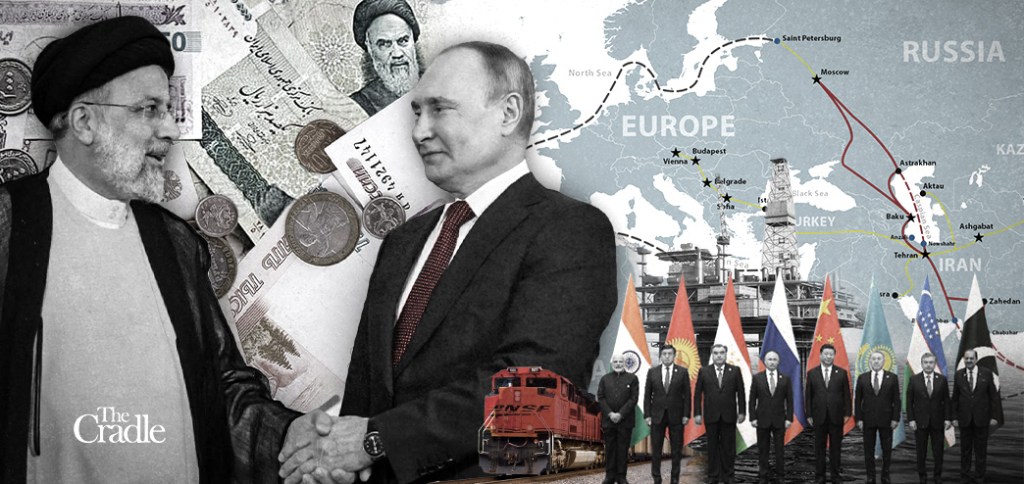
Everything we are tracking now is in many ways a direct consequence of the SCO summit in Samarkand last September, when Russian President Vladimir Putin and his Chinese counterpart Xi Jinping, in person, placed their bet on strengthening the multipolar world as Iran signed a memorandum to join the SCO.

Putin’s private talks with Iranian President Ebrahim Raisi in Samarkand were all about deep strategy.

The INSTC is absolutely crucial in this overall equation. Both Russia and Iran are investing at least $25 billion to boost its capabilities.

Ships sailing the Don and Volga Rivers have always traded energy and agricultural commodities. Now Iran’s Maritime News Agency has confirmed that Russia will grant their ships the right of passage along the inland waterways on the Don and Volga.

Meanwhile, Iran is already established as the third largest importer of Russian grain. From now on, trade on turbines, polymers, medical supplies, and automotive parts will be on a roll.

Tehran and Moscow have signed a contract to build a large cargo vessel for Iran to be used at the Caspian port of Solyanka. And RZD logistics, a subsidiary of Russian railway RZD, operates container cargo trains regularly from Moscow to Iran. The Russian Journal for Economics predicts that just the freight traffic on INTSC could reach 25 million tons by 2030 – no less than a 20-fold increase compared to 2022.

Inside Iran, new terminals are nearly ready for cargo to be rolled off ships to railroads crisscrossing the country from the Caspian to the Persian Gulf. Sergey Katrin, head of Russia’s Chamber of Commerce and Industry, is confident that once the FTA with the EAEU is on, bilateral trade can soon reach $40 billion a year.

Tehran’s plans are extremely ambitious, inserted in an “Eastern Axis” framework that privileges regional states Russia, China, India, and Central Asia.

Geostrategically and geoeconomically, that implies a seamless interconnection of INSTC, EAEU, SCO, and BRICS+. And all of this is coordinated by the one Quad that really matters: Russia, China, India, and Iran.

Of course there will be problems. The intractable Armenia-Azerbaijan conflict might be able to derail the INSTC: but note that Russia-Iran connections via the Caspian can easily bypass Baku if the need arises.

BRICS+ will cement the dollar’s descent

Apart from Russia and Iran, Russia and China have also been trying to interface their banking messaging systems for years now. The Chinese CBIBPS (Cross-Border Inter-Bank Payments System) is considered top class. The problem is that Washington has directly threatened to expel Chinese banks from SWIFT if they interconnect with Russian banks.

The success of SEPAM-SPFS may allow Beijing to go for broke – especially now, after the extremely harsh semiconductor war and the appalling balloon farce. In terms of sovereignty, it is clear that China will not accept US restrictions on how to move its own funds.

In parallel, the BRICS in 2023 will delve deeper into developing their mutual financial payments system and their own reserve currency. There are no less than 13 confirmed candidates eager to join BRICS+ – including Asian middle powers like Iran, Saudi Arabia, and Indonesia.

All eyes will be on whether – and how – the $30 trillion-plus indebted US will threaten to expel BRICS+ from SWIFT.

It’s enlightening to remember that Russia’s debt to GDP ratio stands at only 17 percent. China’s is 77 percent. The current BRICS without Russia are at 78 percent. BRICS+ including Russia may average only 55 percent. Strong productivity ahead will come from a BRICS+ supported by a gold and/or commodities-backed currency and a different payment system that bypasses the US dollar. Strong productivity definitely will not come from the collective west whose economies are entering recessionary times.

Amid so many intertwined developments, and so many challenges, one thing is certain. The SEPAM-SPFS deal between Russia and Iran may be just the first sign of the tectonic plates movement in global banking and payment systems.

Welcome to one, two, one thousand payment messaging systems. And welcome to their unification in a global network. Of course that will take time. But this high-speed financial train has already left the station.