
A Low-Trust Society Is an Impoverished Society

By Charles Hugh Smith

Source: Of Two Minds

The sole remaining reservoirs of trust in American life are personal networks, local enterprises and local institutions.

It’s not exactly news that social trust has declined significantly in the United States. Surveys find that public trust in institutions and the professional classes that dominate those institutions has cratered. (see chart below) Social trust–our confidence that other people are trustworthy–has also fallen to multi-decade lows.

This was not the case in decades past. Americans maintained high levels of trust in their institutions, government and fellow citizens. The decline in social trust is across the entire spectrum: our trust in institutions, professional elites and our fellow Americans has declined precipitously.

The causes of this decay of social trust can be debated endlessly, but several factors are obvious:

1. Institutions forfeited the trust of the citizenry by withholding / editing realities to serve the interests of hidden agendas and insiders’ careers. The Vietnam War was pursued on fabrications, as was the second Gulf War to topple Saddam. Watergate eroded trust on multiple levels, as did the Church Committee’s investigation of America’s security agencies’ domestic spying / over-reach.

2. The managerial / professional elites at the top of the nation’s institutions no longer put the citizenry’s interests above their own. The public’s trust has eroded as institutions are primarily viewed as vehicles for self-enrichment and career advancement: healthcare CEOs pay themselves millions, higher education is bloated with layers of non-teaching administration, defense contractors and the Pentagon have greased the revolving door to the benefit of incumbents and insiders, and so on, in an endless parade of self-serving cloaked with smirking PR claims of “serving the public.”

The shift from a high-trust society to a low-trust society is consequential economically, politically and socially. Low-trust societies have stagnant economies, as nobody trusts anyone they don’t know personally or through personally trusted networks, and nobody trust institutions to function effectively or fulfill their stated mission to serve the public good.

Faced with incompetent, unaccountable, corrupt bureaucracies and a culture overflowing with scams, frauds, imposters and get-rich-quick schemes, people give up and drop out. Rather than start a business and accept all the risks just to get dumped on or ripped off, they don’t even try to start a business. Given the financial insecurity that is now the norm, they decide not to get married or have children.

The vast trading networks of the Roman Empire were based on personal trusted networks and trust in Rome’s functionaries / institutions. The owners of trading ships dealt with trusted captains and merchants, who then paid duties to Roman functionaries in Alexandria and other major trading ports.

In other words, tightly bound personal trusted networks work well as long as the state institutions that bind the entire economy are trusted as fair and reliable–not perfect, of course, but efficient and “good enough.”

But when public institutions are viewed as unfair, unreliable, corrupt or incompetent, the entire economy decays. Even personal trusted networks cannot survive in an economy of unfair, unreliable, corrupt or incompetent state bureaucracies and private institutions.

The American economy is now dominated by enormous privately owned and managed monopolies and cartels that are the private-sector equivalent of self-serving state bureaucracies. Big Tech, Big Pharma, Big Healthcare, Big Ag, Big Finance, etc., are even worse than state bureaucracies because there are no legal requirements for transparency or recourse. Try getting a response from a Big Tech corporation when you’ve been shadow-banned or sent to Digital Siberia.

The sole remaining reservoirs of trust in American life are personal networks, local enterprises and local institutions. These are not guaranteed, of course; in many locales, even these reservoirs have been drained. But in other locales, enterprises and institutions such as the county water utility, the local newspaper, the local community college, etc. continue to earn the trust of the public by performing the services they exist to provide effectively and at a reasonable cost.

The larger the institution and the greater its wealth and power, the lower the social trust–for good reasons. The greater the influence of the managerial elites, the greater the disconnect from the everyday experiences of the citizenry and customers, and the more extreme the self-serving PR.

Sure, I trust Big Tech, Big Pharma, Big Healthcare, Big Finance–to rip me off, profiteer, send me obfuscating bills, jack up junk fees, make it impossible to contact them, and send me to Digital Siberia if I complain.

The divide between the elites and the commoners should prompt us to examine the low-trust path we’re sliding down:
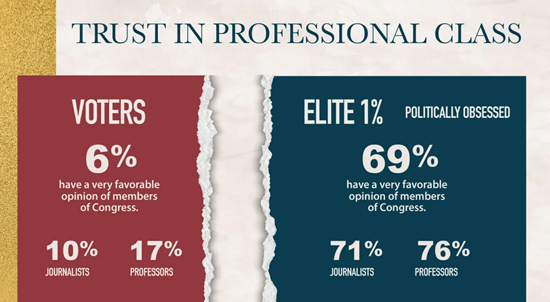
In a society in which everything is phony, low quality or fraudulent, you’re taking a chance trusting anyone you don’t know personally–and even that can be risky now that self-aggrandizing flim-flam is the last remaining path to financial security for non-elites.
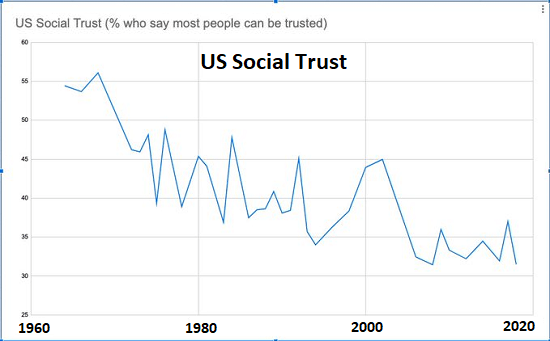
A low-trust society is an impoverished society, economically stagnant and socially threadbare. That’s where we are now, and the more fragmented, greedy, self-serving, desperate and deranged we become, the lower the odds that we’ll find the means to rebuild trust.

Sadly, we already know that anyone claiming to “rebuild trust” is spouting PR designed to mask self-enrichment. We also know that the vast army of well-paid flacks, factotums, enforcers, happy-story apologists, lackeys, toadies and sell-out minions are declaring “everything’s great!”

Just mumble, “Uh, sure” and continue to Tune in (to degrowth), drop out (of hyper-consumerism and debt-serfdom) and turn on (to self-reliance and relocalizing capital and agency).
The Illusion of Getting Rich While Producing Nothing

By Charles Hugh Smith

Source: Of Two Minds

Of all the mass delusions running rampant in the culture, none is more spectacularly delusional than the conviction that we can all get fabulously rich from speculation while producing nothing. The key characteristic of speculation is that it produces nothing: it doesn’t generate any new goods or services, boost productivity or increase the functionality of real-world essentials.

Like all mass delusions, the greater the disconnect from reality, the greater the appeal. Mass delusions gain their escape velocity by leaving any ties to real-world limitations behind, and by igniting the most powerful booster to human euphoric confidence known, greed.

Lost in the mania of easy wealth from speculative trading is the absence of any value creation in the rotation-churn of moving bets from one table to the latest hot game: in flipping houses sight unseen, no functionality was added to the house. In transferring bets on one cryptocurrency to another or from one meme stock to another, no value to the economy or society was created.

In the mass delusion that near-infinite wealth can be generated without producing anything, creating value has no value: the delusion is that I can get rich producing nothing but speculative gains, and then I can buy all the stuff somebody else is making.

The fantasy powering the speculative frenzy is once I get rich, I’ll stop working and live off my wealth. It’s interesting, isn’t it, how everyone can get rich via unproductive speculation, quit their jobs and then live off the productive work of somebody else who failed to get rich off speculation.

Maybe that’s why all the container ships are lined up at Long Beach, waiting to unload the goodies made in China for American speculators to buy. This is what happens when the incentive structure of the economy decays so that being productive has little upside (i.e., working is for chumps) while speculating is all upside (get rich quickly and easily).

Everyone knows great empires became great by transferring their critical supply chains to competing nations, living it up on borrowed/printed money, exploiting the highest bidder wins regulatory/governance system and incentivizing speculation while pushing wage earners into debt-and-tax servitude. Bone up on your history, Bucko; all great nations got there by quitting boring, tiresome productive work to speculate on illusions of value with borrowed money.

This is the result of monopolies and cartels becoming the financial and political power centers of the nation. Maximizing private gains is all that matters in this incentive structure, and so treating employees as chattel to lower costs, offshoring critical supply chains to squeeze out a few more dollars of profits, engineering products to break down (planned obsolescence), buying regulatory barriers and “free passes” and tax breaks galore with all the billions showered on financiers and other fraudsters by the Federal Reserve: in a word, a system that optimizes corruption.

This is how you hollow out a nation and guarantee collapse. The most rewarding “skillsets” are a sociopathological obsession with maximizing profits by any means available and speculating with Fed free money for financiers. The millions of “retail” speculators are simply picking up the cues being given by the billionaires who gained their wealth by issuing debt to fund stock buy-backs and other financial manipulations.

Working for monopolies and cartels is for chumps because monopolies and cartels have zero incentive to share profits with mere employees. Their profits are made not by taking care of their workforce but by regulatory captureartificial scarcities and financialized destruction of competition: first, borrow billions thanks to the Fed and Wall Street, destroy the competition (for example, the taxi industry), then once the competition has been wiped out, jack up prices because now consumers have no choice other than another member of the cartel.

Speculative “wealth” is phantom wealth, a flickering illusion of prosperity. All speculative bubbles pop, and all speculative bubbles inflated by borrowed money and central bank manipulation pop even more ferociously than bubbles funded by actual savings.

By incentivizing speculation and corruption, reducing the rewards for productive work and sucking wages dry with inflation, America has greased the skids to collapse. As with all mass delusions, the incentives to continue believing are immense and the incentives to reconnect with reality few.

So in conclusion: the speculative gains to be made in the collapse of the mass delusion will be spectacular. There’s nothing like the collapse of a hollowed out, completely corrupt economy to generate outsized profits for nimble speculators. Just keep your speculative winnings on number 22 on the roulette wheel. (A Casablanca movie reference….)

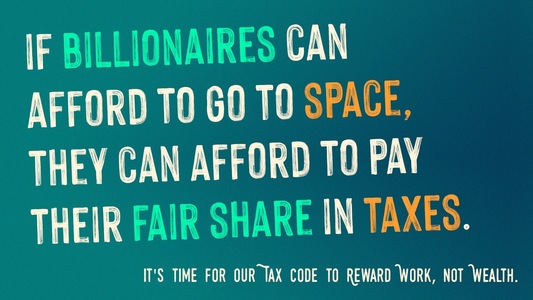
Why Don’t Billionaires Pay the Same High Tax Rates the Rest of Us Pay?

By Charles Hugh Smith

Source: Of Two Minds

The truth is America has lost its way if commoners pay a rate of 40% but its billionaires pay next to nothing.

As with everything else in polarized America, billionaires proclaiming space tourism is the next big thing for humanity neatly divides opinion into two camps: those who laud the initiative, hard work and innovations of the billionaires as examples of the American Can-Do Dream, and those who wished the billionaire space tourists had taken a one-way flight to a distant orbit of blissful silence.

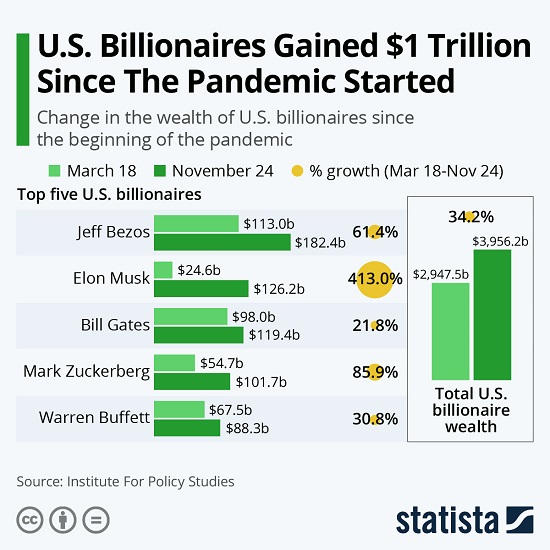
Setting aside that bitter divide, let’s explore another divide: how our two-tier tax system enables billionaires to become billionaires while the rest of us get poorer. Whenever I discuss the taxes of the non-billionaire self-employed, armies of apologists leap to the defense of the status quo with various quibbles: the 0.9% Medicare surcharge only kicks in above $200,000, the cap on Social Security taxes is $142,800, and so on.

Setting aside the quibbles–and recall the tax code with regulatory notes is thousands of pages–let’s deal with the real issue, which is that billionaires and their corporations pay a thin slice of taxes as a percentage of total income/gains if they pay any at all, while self-employed and small business pay extraordinarily high tax rates.

To all the quibblers: please add the 15.3% Social Security/Medicare tax rate (self-employed / sole proprietors pay both the employee and employer share of this tax) to the federal tax rate of 24% for income above $85,520. It’s 39.3%.

Just how hard would it be to conclude that everyone earning more than $142,000 should pay at least the same rate the rest of us pay? Aren’t we demonstrating all those same laudable traits of the billionaires, just on a smaller scale? Why should we pay 40% and the billionaires pay essentially zero?

Gee, do you reckon paying no taxes might help folks become richer? Garsh, nobody ever asked that question before. And do you reckon paying 40% of your income might make you poorer over time? Golly gee, how come the talking heads worshiping the billionaires never ask these questions?

Since Social Security and Medicare/Medicaid are the bedrock of America’s social safety net, why shouldn’t billionaires pay to support these programs? Well, why not? Just how lame do the excuses have to be to be recognized as laughably self-serving?

Here’s the trick billionaires use to evade taxes. There are countless ways for the super-wealthy to evade taxes–funnel earnings through an Irish post office box, buy a tax break in Washington DC, slide the money into one of dozens of global tax havens, and so on.

But a simple one is to report no income and live large off borrowed money. As the billions of dollars in capital gains pile up as the billionaire’s stock holdings soar (thanks, Federal Reserve, for the free trillions; awful swell of you to give us all that free money), there’s no income generated until the billionaire sells some shares. No sale, no income. Just pay yourself $1 a year in salary, borrow against your billions at super-low rates of interest, and voila, you’re tax-free while you build your super-yacht, buy your private island, and so on.

Just as a thought experiment, suppose the first $50,000 in earnings for everyone were tax-free, and a 40% tax rate was collected on all income above $1 million, both earned and unearned (capital gains), not when the gains were realized in a sale but at the end of every tax year, whether the shares that rose in value were sold or not.

So Billionaire Space Tourist reaped $10 billion in capital gains from the appreciation of stocks held, then the Billionaire pays 40% of those gains: $4 billion. There is a way to not pay any taxes on capital gains–have your portfolio lose value. No gains, no taxes. And to close all the loopholes, the tax rate is on all assets and income connected in any way, shape or form with the U.S. First they pay the U.S. taxes, then if they want to pay other nations’ taxes as well, be my guest. But the 40% is due and payable regardless of any other conditions.

You don’t like it, then stop selling any products in the U.S. or holding any assets in the U.S. Why should billionaires get to set up immensely profitable monopolies, quasi-monopolies, cartels and corporations in the U.S. but pay near-zero in taxes? Why should billionaires be free to profit from America’s economy but pay nothing to support its citizenry?

What precisely is the logic of reducing taxes on the wealthiest few to near-zero? If there is no logic, then we’re left with corruption: America is a moral cesspool.

The truth is America has lost its way if commoners pay a rate of 40% but its billionaires pay next to nothing. Please note Karma and Divine Retribution are not controlled by the billionaire’s lackeys and apparatchiks in the Federal Reserve. The pendulum of exploitation has reached its extreme, and the reversal to the opposite extreme is underway.

Sacrifice for Thee But None For Me

By Charles Hugh Smith

Source: Of Two Minds

The banquet of consequences for the Fed, the elites and their armies of parasitic flunkies and factotums is being laid out, and there won’t be much choice in the seating.

Words can be debased just like currencies. Take the word sacrifice. The value of the original has been debased by trite, weepy overuse to the point of cliche. Like other manifestations of derealization and denormalization, this debasement is invisible, profound and ultimately devastating.

Consider the overworked slogan of implied shared sacrifice: we’re all in this together. Pardon my cynicism, but doesn’t this sound like what the first class passengers in the lifeboats shouted to the doomed steerage passengers on the sinking Titanic?

Here is the ice-cold reality of America in 2020: Sacrifice for Thee But None For Me. This isn’t a new trend, of course. Any measurable sacrifices shared by all the socio-economic classes ended with World War II in 1945, and since then it’s been one long slide to Sacrifice for Thee But None For Me.

We’ve seen this slide to decay and collapse many times in history. The elites who once gained social status and political power by making real sacrifices on behalf of the nation / empire become entirely self-serving, accumulating ever greater wealth and power by transferring all the sacrifices and risks onto the lower classes.

Peter Turchin, author of War and Peace and War: The Rise and Fall of Empires, describes how civic virtue is gradually replaced by personal greed and self-interest.

This excerpt perfectly captures the current zeitgeist:

“Virtus included the ability to distinguish between good and evil and to act in ways that promoted good, and especially the common good. Unlike Greeks, Romans did not stress individual prowess, as exhibited by Homeric heroes or Olympic champions. The ideal of hero was one whose courage, wisdom, and self-sacrifice saved his country in time of peril.

Unlike the selfish elites of the later periods, the aristocracy of the early Republic did not spare its blood or treasure in the service of the common interest. When 50,000 Romans, a staggering one fifth of Rome’s total manpower, perished in the battle of Cannae, as mentioned previously, the senate lost almost one third of its membership. This suggests that the senatorial aristocracy was more likely to be killed in wars than the average citizen….

The wealthy classes were also the first to volunteer extra taxes when they were needed… A graduated scale was used in which the senators paid the most, followed by the knights, and then other citizens. In addition, officers and centurions (but not common soldiers!) served without pay, saving the state 20 percent of the legion’s payroll….

The richest 1 percent of the Romans during the early Republic was only 10 to 20 times as wealthy as an average Roman citizen.”

Now compare that to the situation in Late Antiquity when

“An average Roman noble of senatorial class had property valued in the neighborhood of 20,000 Roman pounds of gold. There was no ‘middle class’ comparable to the small landholders of the third century B.C.; the huge majority of the population was made up of landless peasants working land that belonged to nobles. These peasants had hardly any property at all, but if we estimate it (very generously) at one tenth of a pound of gold, the wealth differential would be 200,000! Inequality grew both as a result of the rich getting richer (late imperial senators were 100 times wealthier than their Republican predecessors) and those of the middling wealth becoming poor.”

Compare this to the America of World War II and the America of today. Wealthy, politically influential families such as the Kennedys could only retain their influence if their sons served in positions of combat leadership, and Joe Kennedy was killed in the European theater after volunteering for a highly risky air mission. John F. Kennedy very nearly lost his life in the South Pacific.

And how do our era’s crop of presidents and presidential contenders fare by comparison? The idea that flesh and blood should ever be at risk in defense of the nation /empire–perish the thought.

As Turchin sagely observed, it’s not just the limitless greed and avoidance of sacrifice of the elite that generates destabilizing inequality–it’s the eradication of the middle class as all the risks and sacrifices were shifted from the self-serving top to the middle and lower classes.

As I’ve often noted, risk cannot be made to disappear, it can only be transferred to others. In the grand scheme of things, the inherent risks of globalization and financialization have all been transferred to the middle and working classes (however you define them). The elite class enjoys the near-infinite support of the Federal Reserve and it’s ability to print near-infinite sums of currency to bail out the greediest, most self-serving scum of parasites and speculators.

Meanwhile, all the sacrifices required to support this unfair, corrupt, predatory system have been transferred to the middle and working classes via sleight of hand. The sacrifices weren’t transparent and up front; they were cloaked in the decline of job security, in ever-higher costs, in the decline of social mobility and the erosion of the purchasing power of wages.

The elites’ economist flunkies and factotums claimed that bailing out the freeloaders, parasites and speculators would benefit “the little people” because the grand trade-off delivered by the Federal Reserve (as correspondent R.J. pointed out to me) was: no more financial panics, which caused much misery in the working class due to business failures causing layoffs and unemployment.

But globalization, financialization and the rise of cartel-state monopolies have eviscerated the middle and working classes far more effectively and permanently than any brief financial panic, while greatly enriching the elite class–a rise in wealth that is backstopped by the Federal Reserve: profits are the elites to keep while their losses are socialized, i.e. transferred to the lower classes.

Job security, the purchasing power of wages and social mobility–nothing vital to the middle or working classes is backstopped by the Fed; the Fed’s one and only job is backstopping the wealth of our parasitic, predatory elite.

Sacrifice for Thee But None For Me. The banquet of consequences for the Fed, the elites and their armies of parasitic flunkies and factotums is being laid out, and there won’t be much choice in the seating.

No, This Is Not Another 1929, 1973, 1987, 2000, or 2008

By Charles Hugh Smith

Source: Of Two Minds

Basing one’s decisions on analogs from the past is entering a fool’s paradise of folly.

Like addicts who cannot control their cravings, financial analysts cannot stop themselves from seeking some analog situation in the past which will clarify the swirling chaos in their crystal balls. So we’ve been swamped with charts overlaying recent stock market action over 1929, 1987,2000 and 2008–though the closest analogy is actually the Oil Shock of 1973, an exogenous shock to a weakening, fragile economy.

But the reality is there is no analogous situation in the past to the present, and so all the predictions based on past performance will be misleading. The chartists and analysts claim that all markets act on the same patterns, which are reflections of human nature, and so seeking correlations of volatility and valuation that “worked” in the past will work in 2020.

Does anyone really believe the correlations of the past decade or two are high-probability predictors of the future as the entire brittle construct of fictional capital and extremes of globalization and financialization all unravel at once?

Here are a few of the many consequential differences between all previous recessions and the current situation:

1. Households have never been so dependent on debt as a substitute for stagnating wages.

2. Real earnings (adjusted for inflation) have never been so stagnant for the bottom 90% for so long.

3. Corporations have never been so dependent on debt (selling bonds or taking on loans) to fund money-losing operations (see Netflix) or stock buybacks designed to saddle the company with debt service expenses to enrich insiders.

4. The stock market has never been so dependent on what amounts to fraud–stock buybacks–to push valuations higher.

5. The economy has never been so dependent on absurdly overvalued stock valuations to prop up pension funds and the spending of the top 10% who own 85% of all stocks, i.e. “the wealth effect.”

6. The economy and the stock market have never been so dependent on central bank free money for financiers and corporations, money creation for the few at the expense of the many, what amounts to an embezzlement scheme.

7. Federal statistics have never been so gamed, rigged or distorted to support a neofeudal agenda of claiming a level of wide-spread prosperity that is entirely fictitious.

8. Major sectors of the economy have never been such rackets, i.e. cartels and quasi-monopolies that use obscure pricing and manipulation of government mandates to maximize profits while the quality and quantity of the goods and services they produce declines.

9. The economy has never been in such thrall to sociopaths who have mastered the exploitation of the letter of the law while completely overturning the spirit of the law.

10. Households and companies have never been so dependent on “free money” gained from asset appreciation based on speculation, not an actual increase in productivity or value.

11. The ascendancy of self-interest as the one organizing directive in politics and finance has never been so complete, and the resulting moral rot never more pervasive.

12. The dependence on fictitious capital masquerading as “wealth” has never been greater.

13. The dependence on simulacra, simulations and false fronts to hide the decay of trust, credibility, transparency and accountability has never been so pervasive and complete.

14. The corrupt linkage of political power, media ownership, “national security” agencies and corporate power has never been so widely accepted as “normal” and “unavoidable.”

15. Primary institutions such as higher education, healthcare and national defense have never been so dysfunctional, ineffective, sclerotic, resistant to reform or costly.

16. The economy has never been so dependent on constant central bank manipulation of the stock and housing markets.

17. The economy has never been so fragile or brittle, and so dependent on convenient fictions to stave off a crash in asset valuations.

18. Never before in U.S. history have the most valuable corporations all been engaged in selling goods and services that actively reduce productivity and human happiness.

This is only a selection of a much longer list, but you get the idea. Basing one’s decisions on analogs from the past is entering a fool’s paradise of folly.

Costs Are Spiraling Out of Control

By Charles Hugh Smith

Source: Of Two Minds

And how do we pay for these spiraling out of control costs? By borrowing more, of course.

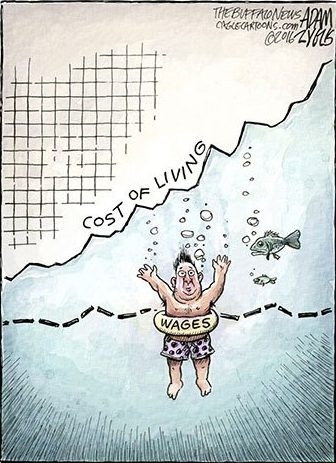
If we had to choose one “big picture” reason why the vast majority of households are losing ground, it would be: the costs of essentials are spiraling out of control. I’ve often covered the dynamics of stagnating income for the bottom 90%, and real-world inflation, i.e. a decline in purchasing power.

But neither of these dynamics fully describes the relentless upward spiral of the cost basis of our economy, that is, the cost of big-ticket essentials: housing, education and healthcare.

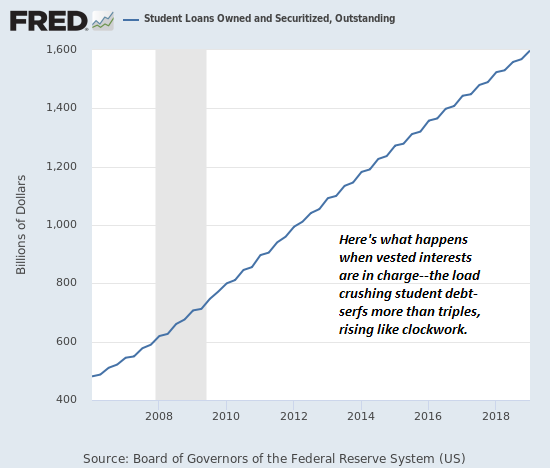
The costs of education are spiraling out of control, stripping households of income as an entire generation is transformed into debt-serfs by student loan debt. The soaring costs of healthcare are a core driver of higher costs in the education complex (and government in general), and to cover these higher costs, counties raise property taxes, which add additional cost burdens to households and enterprises as rents rise.

Rising rents push the cost structure of almost every enterprise and agency higher.

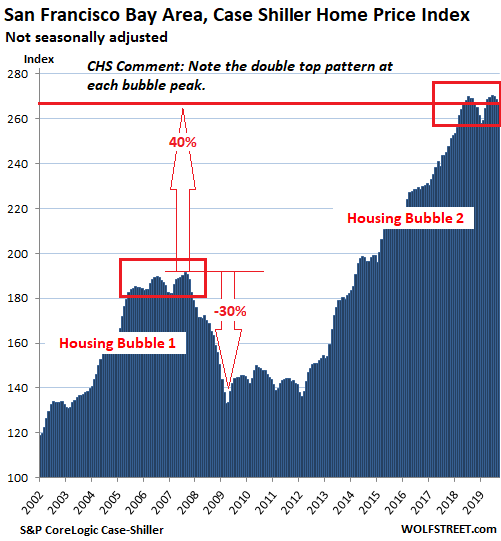
Then there’s the asset inflation created by central bank ZIRP (zero interest rate policy) which has inflated a second echo-bubble in housing that has pushed home ownership out of reach of many, adding demand for rental housing that has pushed rents into the stratosphere in Left and Right Coast cities.

The increasing dominance of monopolies and cartels has eliminated competition in sector after sector. Monopolies and cartels skim immense profits even as the value, quality and quantity of their products and services decline: The U.S. Only Pretends to Have Free Markets From plane tickets to cellphone bills, monopoly power costs American consumers billions of dollars a year.

Thanks to their political influence, monopolies and cartels have legalized looting, raising prices and evading anti-trust regulations because they can pay whatever it takes in our pay-to-play political system.

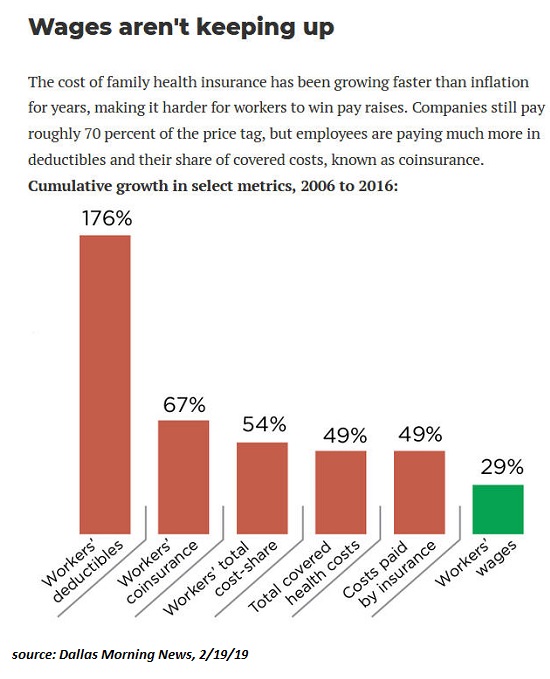
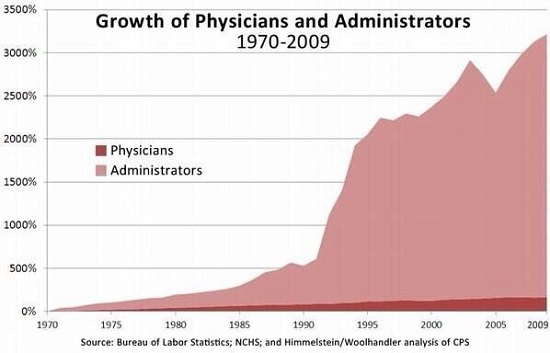
Let’s look at a few charts that illustrate the relentless rise in costs:

Do you reckon these two charts are connected–soaring costs and ballooning administrative payrolls?

Student loan debt is soaring above $1.5 trillion, guaranteeing profits to lenders and debt-serfdom to the students exiting with degrees that are in over-supply, i.e. possessing little scarcity value in an over-credentialed economy:

The echo housing bubbles in many locales exceed the nosebleed valuations of the previous bubble:

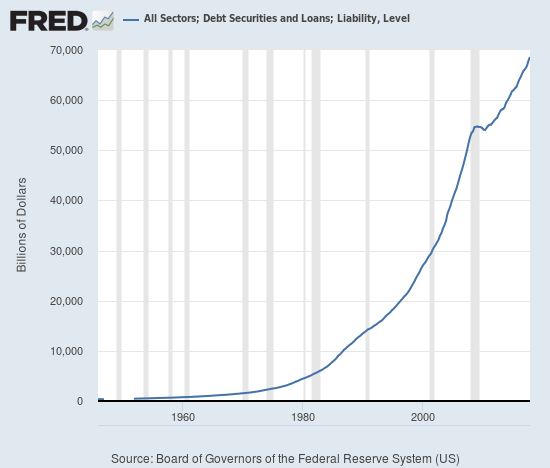
And how do we pay for these spiraling out of control costs? By borrowing more, of course:

Even at low rates of interest, the cost of servicing skyrocketing debt increases, leaving less net income to support additional borrowing.

What will it take to radically reduce the cost basis of our economy? A fundamental re-ordering that breaks up all the cartels and monopolies that push prices higher even as they deliver lower quality goods and services would be a good start.

Corporate America Is an Anti-Social Black Plague: Negative Network Effects Run Amok

By Charles Hugh Smith

Source: Of Two Minds

The anti-social carnage unleashed by Corporate America’s “lock-in” / negative network effects has no real limits.

Here’s the U.S.economy in a nutshell: Corporate America is an anti-social Black Plague, gorging on cartel-monopoly profits reaped from negative network effects running amok, enriching the few at the expense of the many and concentrating political power in the hands of the most rapacious, anti-democratic corporate sociopaths.

Let’s start with network effects: the conventional definition is “When a network effect is present, the value of a product or service increases according to the number of others using it.”

So for example, when telephone service was only available to a few users, its value was limited. As more people obtained telephone service, the value of the network increased to both its owners and to users, who could reach more people and conduct commerce more easily as a result of having telephone service.

In the conventional analysis, negative network effects occur from “congestion,” i.e. the network is adding new users so quickly that “more users make a product less valuable.”

But this superficial analysis misses the fatally anti-social consequences of corporate negative network effects, a dynamic described by analyst Simons Chase in this essay. Here is an excerpt:

Even the most imaginative and far-reaching narratives about non-obvious economic fragility and off balance sheet risks are mere rants without constructive ideas about causes and solutions.

Consider network effects, the popular economic construct applied to market concentration and increasing returns for strategies pursued by some leading tech companies. This dynamic economic agent is also known as demand side economies of scale.

W. Brian Arthur, the economist credited with first developing the theory, described the condition of increasing returns as a game of strategic positioning and building up a user base to the point where ‘lock in’ of dominant players occurs. Companies able to tap network effects have been rewarded with huge valuations and highly defensible businesses.

But what about negative network effects? What if the same dynamic applies to the U.S.’s pay-to-play political industry where the government promotes or approves of something through a policy, subsidy or financial guarantee due to private sector influence.

Benefits accrue only to the purchaser of the network effects, and consumers, induced by the false signal of large network size, ultimately suffer from asymmetric risk and experience what I’m calling a loss of intangible net worth for each additional member after the ‘bandwagon’ wares off.

If this were the case, then you would see companies experience rapid revenue growth (out of line with traditional asset leverage models), executives accumulating huge fortunes and political campaign coffers swelling.

But the most striking feature would be the anti-social outcomes, the ones not available without the instant critical mass of government-supported network effects, the ones that, at scale, monetize a society’s intangible net worth.

Some products tied to these metrics include: prescriptions drugs, junk food targeting children, mortgages, diplomas, and social media. The list of industries that are likely to have gained through the purchasing of network effects in D.C. maps closely to the decay that is visible in U.S. society.

The loss of intangible capital and other manifestations of non-obvious economic fragility (to use Simons’ apt phrase) is the subject of my latest book, Will You Be Richer or Poorer? Profit, Power and A.I. in a Traumatized World, in which I catalog the anti-social consequences of negative network effects and other forces eroding our nation’s intangible capital.

Consider Facebook, a classic case of negative network effects running amok, creating immensely anti-social consequences while reaping billions in profits: Facebook isn’t free speech, it’s algorithmic amplification optimized for outrage (TechCrunch.com).

The full social cost of social media’s negative network effects are difficult to tally, but studies have found that loneliness and alienation are correlated to how many hours a day individuals spend on social media. (An Internet search brings up dozens of reports such as NPR’s Feeling Lonely? Too Much Time On Social Media May Be Why.)

Facebook is trying to leverage its social media “lock-in” to issue its own global currency and both Facebook and Google are trying to offer banking services without any of the pesky regulations imposed on legitimate banks. (Will $10 million in lobbying do the trick? How about $100 million? We’ve got billions to “invest” in corrupting and controlling public agencies and political power.)

Once Corporate America locks in cartel-monopoly power, i.e. you have to use our services and products, the corporate sociopaths use their billions in market cap and profits to buy the sociopaths in government. Pay-to-play is the real political machinery; “democracy” is the PR fig-leaf to mask the private sector “lock-in” (monopoly) and the public-sector “lock-in” (regulatory influence, anti-competitive barriers to entry, the legalization of corporate fraud, cooking the books, embezzlement, etc.)

Consider Boeing, an effective monopoly which used $12 billion in profits to buy back its own shares and “invested” millions in buying political influence so it could minimize public-sector oversight.

Rather than spend the $12 billion designing a new safe aircraft, Boeing cobbled together a fatally flawed design dependent on software, as described in The Case Against Boeing (The New Yorker) to maximize the profitability of its “lock-in”.

Google is running amok on so many levels, it’s difficult to keep track of its anti-social “let’s be evil, it’s so incredibly profitable” agenda: Google’s Secret ‘Project Nightingale’ Gathers Personal Health Data on Millions of Americans (Wall Street Journal). The goal, of course, is to reap more billions in profits for insiders and corporate sociopaths.

The anti-social carnage unleashed by Corporate America’s “lock-in” / negative network effects has no real limits. Consider the essentially limitless private and social damage caused by Big Tech: Child Abusers Run Rampant as Tech Companies Look the Other Way (New York Times).

Then there’s the opioid epidemic, whose casualties run into the hundreds of thousands, an epidemic that was entirely a creature of Corporate America seeking to maximize “lock-in” profits by buying regulatory approval and pushing false claims that the corporate products were safe and non-addictive.

Note the media sources of these reports: these are the top tier of American journalism, not some easily dismissed alt-media source.

What does this tell us? It tells us the anti-social consequences are now so extreme and so apparent that the corporate media cannot ignore them. Once Corporate America locks-in market, financial and political power, it acts as a virulent Black Plague on the social order, legitimate democracy, and an entire spectrum of intangible social capital including the rule of law.

As Simons put it: “The ethical dimension underpinning the whole system is this: what’s moral is what’s legal and what’s legal is for sale.” Where does this Black Plague pathology take us? To a collapse of the status quo which enabled it, cheered it, and so richly rewarded it.

Prices, plutocrats, and corporate concentration

Would less corporate concentration – and a weaker corporate capacity to raise prices – mean less inequality?

By Sam Pizzigati

Source: Nation of Change

Andrew Leigh, a member of the Australian parliament, has a side gig. He just happens to be a working economist. Other lawmakers may spend their spare hours making cold calls for campaign cash. Leigh spends his doing research – on why our modern economies are leaving their populations ever more unequal.

Leigh’s latest research is making some global waves. Working with a team of Australian, Canadian, and American analysts, he’s been studying how much the prices corporate monopolies charge impact inequality.

The conventional wisdom has a simple answer: not much. Yes, the reasoning goes, prices do go up when a few large corporations start to dominate an economic sector. But those same higher prices translate into higher returns for corporate shareholders.

Thanks to 401(k)s and the like, the argument continues, the ranks of these corporate shareholders include millions of average families. So we end up with a wash. As consumers, families pay more in prices. As shareholders, they pocket higher dividends.

But this nonchalance about the impact of monopolies, Andrew Leigh and his colleagues counter, obscures “the relative distribution of consumption and corporate equity ownership.” Average families do hold some shares of stock, but not many. In the United States, for instance, the most affluent 20 percent of households own 13 times more stock than the bottom 60 percent.

These bottom 60 percent households, as a result, get precious little return from the few shares of stock they do hold, not nearly enough to offset the higher prices they pay on corporate monopoly products.

“On net, that means it’s nearly impossible for the typical U.S. family to make up for higher prices via the performance of their stock portfolio,” notes a Washington Post analysis of the Leigh team research. “When prices rise, low- and middle-class families pay. Wealthy families profit.”

By how much do these affluents profit? Leigh and his colleagues have done the math. The higher prices – and profits – that corporate concentration has generated have shifted 3 percent of national income out of the pockets of poor and middle-class families into the wallets of the affluent.

The larger our corporations become, in other words, the more unequal our societies become.

Now corporations don’t grow larger in the same way as people grow larger. Corporations have no adolescent growth spurts. They don’t mature. They have no real personhood. Corporations only become larger when the executives who run them make them larger, most typically by wheeling and dealing their way through ever grander mergers and acquisitions.

This wheeling and dealing takes up a huge chunk of modern corporate executive time and energy. Why do execs devote so much of their time and energy to getting bigger? Getting bigger pays – for execs.

Indeed, firm size determines how much executives make more than any other factor, as research has shown repeatedly over the years. Executives don’t have to “perform” – make their enterprises more efficient and effective – to make bigger bucks. They just to need to make their enterprises bigger.

Executives, in short, have a powerful incentive to grow their companies, and that powerful incentive, as the latest research from Andrew Leigh and his colleagues shows, isn’t just making these executives richer. It’s leaving our societies much more unequal.

So what can we do to ease the damage? Tougher antitrust enforcement could certainly slow our rates of corporate concentration. But the legislative activities of Andrew Leigh in Australia suggest another promising approach as well.

Leigh serves as a “shadow” minister for the Australian parliament’s Labor Party opposition. This past fall, he announced that his party, if elected to power, will require all major corporations to publicly disclose the ratio between their CEO and worker pay.

A similar disclosure mandate went into effect in the United States last year. As of January 1, 2019, the UK now has a pay-ratio disclosure mandate in effect as well.

Forcing Australian corporations to reveal their CEO-worker pay ratios, Leigh notes, would encourage these corporations “to think about how they are serving all their workers, and society as a whole.” But a growing number of progressives in the United States and the U.K. believe that pay ratios can do more than just “encourage” corporations to better serve their societies.

These progressives are pushing for consequences on CEO-pay ratios, proposing legislation that would deny government contracts and subsidies to corporations with wide gaps between their CEO and worker pay. They’re also calling for higher tax rates on companies with wider CEO-worker pay ratios, and one American city, Oregon’s Portland, already has such an “inequality tax” in effect.

More moves in this direction could significantly reduce the incentive for the executive wheeling and dealing that’s concentrating corporate power in fewer and fewer corporate hands. That wheeling and dealing – in nations with consequences on pay ratios in effect – would no longer guarantee grand windfalls to our corporate executive class.

Less wheeling and dealing, in turn, would mean less corporate concentration – and a weaker corporate capacity to raise prices. And that would mean, as the new Leigh gang’s research so clearly shows, less inequality.