De-Dollarization Accelerates: The Beginning of the End for US Dollar Hegemony in Southeast Asia?

By Timothy Alexander Guzman

Source: Silent Crow News

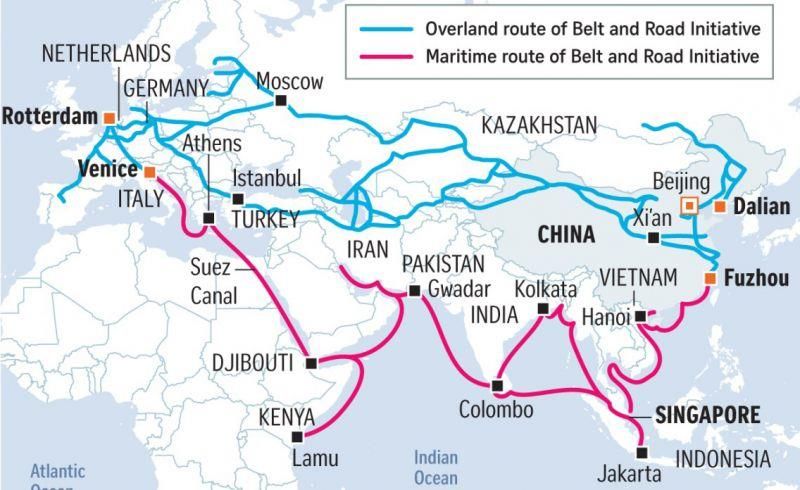
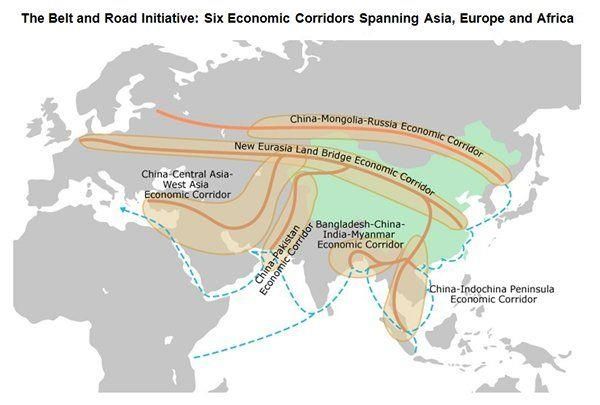
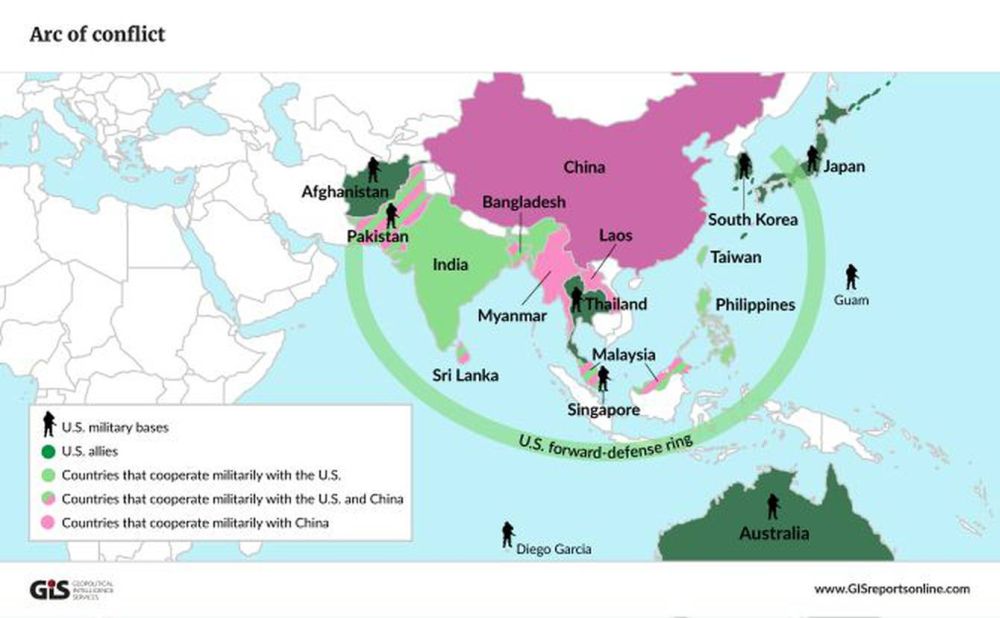
The US is facing major moves by the global community to de-dollarize their economies.  The reserve status of the US dollar will eventually come to an end, maybe not anytime soon, but sometime in the future as it is facing numerous challenges not only from major powers such as Russia and China who are actively trying to rid themselves of the toxic currency, but also countries with smaller economies who are based in the Southeast Asian region which includes Singapore, Malaysia, Indonesia, Cambodia, Thailand, and Laos.  The globalist think tank, the Carnegie Endowment for International Peace (CEIP) published an article on August 22nd, 2022, on the US dollar’s waning influence in Southeast Asia titled ‘Southeast Asia’s Growing Interest in Non-dollar Financial Channels—and the Renminbi’s Potential Role’ stated what was taking place between China and several Southeast Asian countries:

China’s central bank—announced the launch of a new emergency liquidity arrangement that can be funded using renminbi and tapped by participating central banks during times of market stress. Three of the five participating central banks are Singapore’s, Malaysia’s, and Indonesia’s, which each recently renewed agreements with the PBOC implicitly aimed at reducing dollar usage in cross-border payments. This follows policymakers in ThailandLaosCambodia, and Myanmar all announcing efforts to reduce dollar usage, as well as comments by Indonesia’s central bank head that consumers across five of Southeast Asia’s largest economies will soon be able to make intra-regional cross-border payments via linkages that avoid using the dollar as an intermediary, as is currently often the case

Interestingly, The CEIP listed several reasons why Southeast Asian countries want to dramatically reduce the use of US dollars are as follows:

Several factors are behind the various efforts aimed at reducing dollar usage in Southeast Asia. To begin with, many officials are concerned about the potential economic impacts of U.S. monetary policy tightening on the region given its high usage of the dollar; accordingly, some are seeking to reduce usage of the dollar in intra-regional trade payments as a means of curbing dollar reliance more broadly. Recent sanctions may also be spurring demand for alternative financial channels—for example, Myanmar’s military government is actively exploring how to circumvent EU and U.S. sanctions to transact with Russia

According to an article published by almayadeen.net ‘Bank Indonesia calls against payments in US Dollars’ who translated the report by an Indonesian news portal called Tempo.net on what Nugroho Joko Prastowo of the Solo Bank Indonesia Representative Office said regarding Indonesian businesses using national currencies to reduce its reliance on the US dollar:

Bank Indonesia has urged importers and exporters to use national currencies in international payments in order to reduce Indonesian financial markets’ reliance on the US dollar, according to Tempo.co, an Indonesian news portal.  “About 90% of export-import payments are conducted in US dollars, while the share of Indonesian direct exports to the US is estimated at only 10%, and US imports account for 5%”

The report also mentioned that “China, Japan, Thailand, and Malaysia have already agreed to use the two-way payment mechanism, with Singapore and the Philippines planning to join the system, according to the economist.”  

Another article published by the globaltimes.cn on December 15th, 2021, ‘GT Exclusive: Myanmar accepts yuan as official settlement currency for border trade with China’ said that Myanmar’s usage of Chinese yuan will help break the US dollar dominance in the long term:

The yuan was included in the list of Myanmar’s official settlement currencies in January 2019. The move at that time was more symbolic, as all contracts and trade were still not settled in the Chinese currency.  Zhou said that the move, in the long term, will help break the monopoly of the US dollar in Myanmar’s foreign currency reserves.  The US has been abusing the dollar’s dominant status to impose arbitrary sanctions on other countries, and the yuan’s further expansion in Myanmar’s trade settlements may provide a shield against such a potential weapon, analysts said

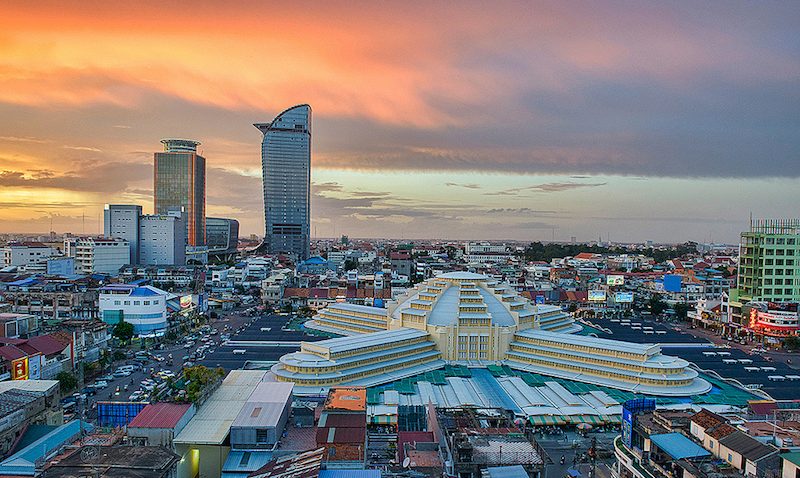
Cambodia is on Board Dumping US Dollars

Why Cambodia with a population of close to 17 million people and a much smaller economic impact on the world’s economy is willing to drop US dollars is an important development.  The Diplomat, a current-affairs magazine based on analysis and commentaries from various authors on developments throughout Asia and the rest of the world published an article by Luke Hunt on the case of Cambodia’s attempt to stop using US dollars titled ‘Cambodia Reduces its Dependency on the US Dollar’ lays out the mood of the Cambodian government.  “Ever since United Nations peacekeepers arrived in war-torn Cambodia to oversee elections held in 1993, the U.S. dollar has been a mainstay of the local economy with a dual currency system providing steady exchange rates in a volatile place” but there is a monumental shift taking place when the National Bank of Cambodia (NBC) announced that it “would phase-out small-denominated U.S. dollar bills – $1, $2, and $5 notes – following negotiations with banks and micro-finance institutions (MFIs).”  Naturally it’s a step to reduce the dependency of the US dollar according to the NBC “Cambodia has to encourage the use of its riel, more. So, allowing the circulation of small U.S. bills is an obstacle in urging the use of the riel.”

There are several reasons for Cambodia’s move, one of them is to allow the use of digital currencies to “give the central bank more control over the Cambodian economy and bolster the local riel currency, which for decades suffered from a lack of confidence due to negative sentiment stemming from a 30-year war” in addition it will allow the central bank “control over monetary policy and interest rate settings and reduced costs in handling the sheer volume of $1 dollar notes circulating through the economy.”  Hunt mentions the dark period of Cambodian history with the US-backed Pol Pot and the Khmer Rouge who destroyed Cambodia and it’s traditions and started a new revolution with a new culture that would begin on Year Zero, therefore everything before would be deemed irrelevant, “It’s a far cry from the late 1970s, when Khmer Rouge rule abandoned money, banks were abolished, and the NBC blown-up as Pol Pot tried to create a utopian, agrarian society that led to the deaths of an estimated 1.7 million Cambodians.”  One of the darkest times in world history indeed.  It is a positive development that the NBC is encouraging the use of the Cambodian Riel for its economy, so the future seems promising.  NBC Governor Chea Chanto spoke at the 40th Anniversary of the re-establishment of the Riel “he said demand for the currency had increased by an average of 16 percent a year for the last 20 years amid annual average growth rates of 7.8 percent and inflation at around 2.5 percent.”  Chanto said that “I firmly believe all ministries, institutions, companies, enterprises, and those who actively participate in the process of developing the banking system promote the use of the riel, which is our national currency.” According to an unidentified analyst “It’s also a matter of sovereignty and pride. It’s their country and they are entitled to have their own currency like anywhere else.”

Transitioning from the US dollar to the Cambodian Riel won’t be an easy task according to Michael Finn of the Khmer Times who authored ‘De-dollarisation: Views from Asia, US and Europe’ claims that “Any reduction in the use of the dollar needs to be handled carefully, according to foreign chambers of commerce in Cambodia. They say the central bank is unlikely to fully phase-out the US currency and any sudden moves to end reliance on the dollar would be bad for business.”  European Chamber of Commerce Advocacy Manager Noe Schellinck said that “To a certain extent, the dollarisation now can be ascribed to the success of the Cambodian economy, with a great influx of Foreign Direct Investment, compared to the historic context of when the dollarization came about.” But the Indonesian Chamber of Commerce President Dalton Wong disagrees with Schellinck’s assessment:

De-dollarisation is not a bad thing as it is a re-balancing of the fiscal and monetary policy tools. It is certainly not a complete displacement and substitution of the US dollar in favour of the Khmer Riel in trade and investment, which some observers and analysts seem to mischievously suggest, which is not so helpful. In fact, promoting a greater use of the Khmer riel will give greater monetary policy tools to the Cambodian author 

The collapse of the US dollar is becoming a reality as China and Russia continue to buy gold and trade with their own currencies at an accelerated pace with many more countries around the world who are also racing to de-dollarize their economies.  As we already know, several countries in Southeast Asia will soon make its move to rid itself of the toxic currency, but there are also other countries who are also making moves including India, Iran, South Africa, Syria, and Venezuela who are all motivated to drop the US dollar.  One of the main reasons for these countries to move forward by eliminating the use of US dollar is because Washington uses its currency status as a weapon to impose harsh sanctions on countries they deem as enemies.  

African countries are also starting to look for alternatives to the US dollar including Ghana according to a report published by Reuters on November 24th, 2022, ‘Ghana plans to buy oil with gold instead of U.S. dollars’ said that “Ghana’s government is working on a new policy to buy oil products with gold rather than U.S. dollar reserves” Ghana’s reason slightly differs from other countries since “The move is meant to tackle dwindling foreign currency reserves coupled with demand for dollars by oil importers, which is weakening the local cedi and increasing living costs.”  This means that the US dollar is causing inflation.  The move is expected to take place in the first quarter of 2023 as Ghana’s Vice-President Mahamudu Bawumia said that the new policy “will fundamentally change our balance of payments and significantly reduce the persistent depreciation of our currency” as he explained that “using gold would prevent the exchange rate from directly impacting fuel or utility prices as domestic sellers would no longer need foreign exchange to import oil products.”  Libya was one of the first countries in Africa to propose the idea of creating an alternative currency to bypass the US dollar called the African Dinar which would have been gold-backed but the Obama regime supported a violent coup to overthrow its president who suggested the idea, Muammar Ghaddafi who was tortured and then killed in the process making Libya a hotbed for terrorism and at the same time, re-creating the centuries-old industry of slavery.   

The bottom line is that US dollar’s dominance in the global market will come to an end sometime in the foreseeable future.  No one has a crystal ball of when it will happen, but it is certain.  The world will experience an alternative economic reality that will change the dynamics of the US and its Western powers dominating the World’s economy with an outdated and flawed currency that will eventually have the same value as toilet paper.  
Win-Win vs Lose-Lose: The Time Has Come for the World to Choose

By Matthew Ehret

Source: Strategic Culture Foundation

It is a tragedy of our age that society has been locked in a zero-sum operating system for so long that many people living in the west cannot even imagine a world order designed in any other way… even if that zero sum system can ultimately do nothing but kill everyone holding onto it.

Is this statement too cynical?

It is a provable fact that if one chooses to organize their society around the concept that all players of a “great game” must exist in a finite world of tension as all zero-sum systems presume, then we find ourselves in a relatively deterministic trajectory to hell.

You see, this world of tension which game masters require in today’s world are generated by increasing rates of scarcity (food, fuel, resources, space, etc). As this scarcity increases due to population increases tied to heavy doses of arson, it naturally follows that war, famine, and other conflict will rise across all categories of divisions (ethnic, religious, linguistic, gender, racial etc). Showcasing this ugly misanthropic philosophy during a December 21, 1981 People Magazine Interview, Prince Philip described the necessity of reducing the world population stating:

“We’re in for a major disaster if it isn’t curbed-not just for the natural world, but for the human world. The more people there are, the more resources they’ll consume, the more pollution they’ll create, the more fighting they will do. We have no option. If it isn’t controlled voluntarily, it will be controlled involuntarily by an increase in disease, starvation, and war.”

When such a system is imposed upon a world possessing atomic weapons, as occurred in the wake of FDR’s death and the sabotage of the great president’s anti-colonial vision, the predictably increased rates of conflict, starvation and ignorance can only spill over into a global war if nuclear superpowers chose to disobey the limits and “norms” of this game at any time.

Perhaps some utopian theoreticians sitting in their ivory towers at Oxford, Cambridge or the many Randian think tanks peppering foreign policy landscape believed that this game could be won if only all nation states relinquished their sovereignty to a global government… but that hasn’t really happened, has it?

Instead of the relinquishing of sovereignty, the past decade has seen a vast rise of nationalism across all corners of the earth which have been given new life by the rise of China’s Belt and Road Initiative and broader multipolar alliance. While these impulses have taken on many shapes and forms, they are united in the common belief that nation states must not become a thing of the past but rather must become determining forces of the world’s economic and political destinies.

The Case of the Bi-Polar USA

Unfortunately, within the USA itself where nationalism has seen an explosive rise in popularity under President Trump, the old uni-polar geopolitical paradigm has continued to hold tight under such neocon carryovers as Mike Pompeo, Defense Secretary Esper, CIA director Gina Haspel and the large caste of Deep State characters still operating among the highest positions of influence on both sides of the aisle.

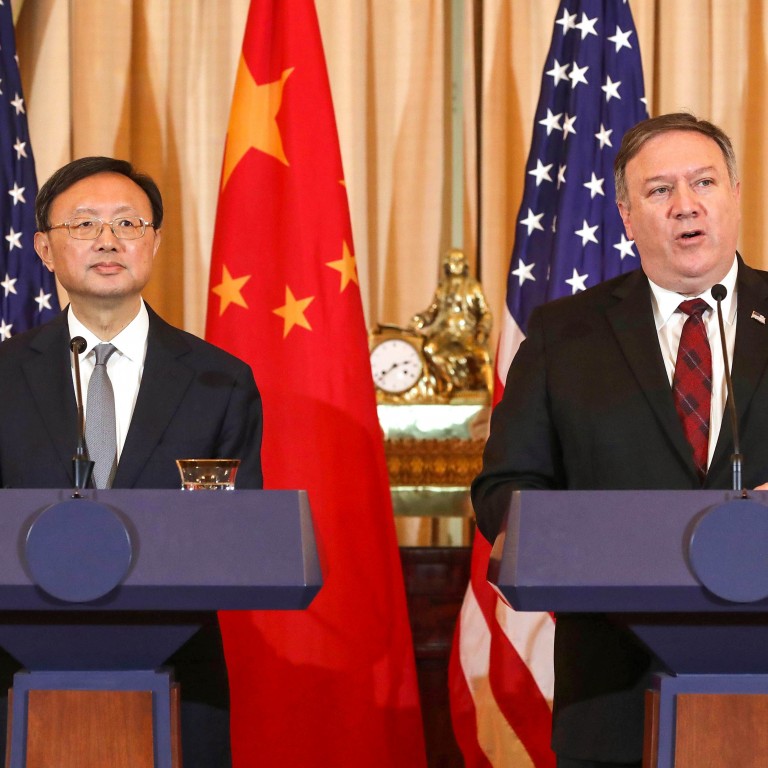
While I genuinely believe that Trump would much rather work with both Russia, China and other nations of the multipolar alliance in lieu of blowing up the world, these aforementioned neocons think otherwise evidenced by Pompeo’s October 6 speech in Japan. In this speech, Pompeo attempted to rally other Pacific nations to an anti-Chinese security complex known as the Quad (USA, Australia, Japan and India). With his typically self-righteous tone, Pompeo stated that “this is not a rivalry between the United States and China. This is for the soul of the world”. Earlier Pompeo stated “If the free world doesn’t change Communist China, Communist China will change us.”

Pompeo’s efforts to break China’s neighbours away from the Belt and Road Initiative have accelerated relentlessly in recent months, with territorial tensions between China and Japan, Vietnam, South Korea, Malaysia, Taiwan, Indonesia, Philippines, Indonesia and Brunei being used by the USA to enflame conflict whenever possible. It is no secret that the USA has many financial and military tentacles stretching deep into all of those Pacific nations listed.

Where resistance to this anti-China tension is found, CIA-funded “democracy movements” have been used as in the current case of Thailand, or outright threats and sanctions as in the case of Cambodia where over 24 Chinese companies have been sanctioned for the crime of building infrastructure in a nation which the USA wishes to control.

Pompeo’s delusional efforts to consolidate a Pacific Military bloc among the QUAD states floundered fairly quickly as no joint military agreement was generated creating no foundation upon which a larger alliance could be built.

China’s Foreign Minister Wang Yi accurately called out this regressive agenda on October 13 saying:

“In essence [the Indo-Pacific Strategy] aims to build a so-called Indo-Pacific NATO underpinned by the quadrilateral mechanism involving the United States, Japan, India and Australia. What it pursues is to trumpet the Cold War mentality and to stir up confrontation among different groups and blocs and to stoke geopolitical competition. What it maintains is the dominance and hegemonic system of the United States. In this sense, this strategy is itself an underlying security risk. If it is forced forward it will wind back the clock of history.”

China Responds with Class

China’s response to this pompous threat to peace was classy to say the least with Wang Yi teaming up with Yang Jiechi (Director of China’s Central Foreign Affairs Commission) who jointly embarked on simultaneous foreign tours that demonstrated the superior world view of “right-makes-might” diplomacy. Where Wang Yi focused his efforts on Southeast Asia with visits to the Philippines, Indonesia, Cambodia, Malaysia, Laos, Thailand and Singapore, Yang Jiechi embarked on a four-legged tour of Sri Lanka, the UAE, Algeria and Serbia.

While COVID assistance was a unifying theme throughout all meetings, concrete economic development driven by the Belt and Road Initiative was relentlessly advanced by both diplomats. In all bilateral agreements reached over this past week, opportunities for cooperation and development were created with a focus on diminishing the points of tension which geopolticians require in order for their perverse “game” to function.

In Malaysia, the $10 billion, 640 Km East Coast Rail link was advanced that will be completed with China’s financial and technical help by 2026 providing a key gateway in the BRI, as well as two major industrial parks that will service high tech products to China and beyond over the coming decades.

After meeting with Wang Yi on October 9, Indonesia’s Special Presidential Envoy announced that “Indonesia is willing to sign cooperation documents on the Belt and Road Initiative and Global Maritime Fulcrum at an early date, enlarge its cooperation with China on trade and investment, actively put in place currency swap arrangements and settlements in local currency, step up the joint efforts in human resources and disaster mitigation, and learn from China’s fight against poverty.”

In Cambodia, a major Free Trade Agreement was begun which will end tariffs on hundreds of products and create new markets for both nations. On the BRI, the New International Land-Sea Trade corridor and Lancang-Mekong Cooperation plans were advanced.

In the Philippines, Wang Yi and Foreign Minister Locsin discussed Duterte’s synergistic Build Build Build program which reflects the sort of long term infrastructure orientation characteristic of the BRI which are both complete breaks with the decades-long practices of usurious IMF loans which have created development bottlenecks across the entire developing sector.

In Thailand Wang Yi met with the Thai Prime Minister where the two accelerated the building of the 252 km Bangkok-Korat high speed rail line which will then connect to Laos and thence to China’s Kunmin Province providing a vital artery for the New Silk Road.

In the past few years, the USA has been able to do little to counter China’s lucrative offers while at best offering cash under the rubric of the Lower Mekong Initiative established under the Hillary-Obama administration in preparation for the Asia Pivot encirclement of China that was unleashed in 2012. This was done as part of a desperate effort to keep China’s neighbors loyal to the USA and was meant to re-enforce Obama’s Trans-Pacific Partnership which Trump thankfully destroyed during his first minutes in office.

Yang Jiechi’s Four-Legged Tour

In Sri Lanka, a $90 million grant was offered by China which will be devoted to medical resources, water supplies and education and which the Chinese embassy website stated “will contribute to the well being of Sri Lankans in a post-COVID era”. Another $989 million loan was delivered for the completion of a massive expressway stretching from Central Sri Lanka’s tea growing district to the Port of Hambanota. While this port is repeatedly used by detractors of the BRI like Pompeo as proof of the “Chinese debt trap”, recent studies have proven otherwise.

In the UAE, the Chinese delegation released a press release after meeting with Prince Zayed al-Nahyan stating: “Under the strategic guidance of President Xi and the Abu Dhabi crown prince, China will enrich the connotation of its comprehensive strategic partnership with UAE, cement the political trust and support, promote alignment of development strategies, and advance high-quality joint construction of the Belt and Road.”

In Algeria, Yang offered China’s full support for the New Economic Revival Plan which parallels the Philippines’ Build Build Build strategy by focusing on long term industrial growth rather than IMF-demands for privatization and austerity that have kept North Africa and other nations backward for years.

Finally in Serbia which is a vital component of the BRI, the Chinese delegation gave its full support to the Belgrade-Budapest railway, and other long term investments centered on transport, energy and soft infrastructure, including the expansion of the Chinese-owned Smederevo Steel Plant which employs over 12 000 Serbians and which was saved from bankruptcy by China in 2016. By the end of the trip, Prime Minister Brnabic announced: “Serbia strongly supports China both bilaterally and multilaterally, including President Xi Jinping’s Access and Roads Initiative and the 17+1 Cooperation Mechanism, in the context of which most of Serbia’s infrastructure and strategy projects will be realized”

The Spirit of Win-Win Must Not Be Sabotaged

Overall, the spirit of the growing New Silk Road is fast moving from a simple east-south trade route towards a global program stretching across all of Africa, to the Middle East, to the High Arctic and Latin America. While this program is driven by a longer view of the past and future than most westerners realize, it is quickly becoming evident that it is the only game in town with a future worth living in.

While China has committed to the enlightened idea that human society is more than a “sum of parts”, the Cold Warriors of the west have chosen to hold onto obsolete notions of human nature that suppose we live in a world of “each vs. all”. These obsolete notions are premised on the bestial idea that our species is destined to do little more than fight for diminishing returns of scraps in a closed -system struggle for survival where only a small technocratic elite of game masters calling themselves “alphas” control the levers of production and consumption from above.

Thus far, President Trump has distinguished himself from other dark age war hawks in his administration by promoting a foreign policy outlook centered on economic development. This has been seen in his recent victories in achieving economic normalization between Serbia and Kosovo, and endorsing the Alaska-Canada railway last month. With the elections just around the corner and the war hawks flying in full force, it is clear that these piecemeal projects, though sane and welcomed are still not nearly enough to break the USA away from its course of war with China and towards a new age of win-win cooperation required for the ultimate survival of our species.

To Liberate Cambodia

By Robert J. Burrowes

A long-standing French protectorate briefly occupied by Japan during World War II, Cambodia became independent in 1953 as the French finally withdrew from Indochina. Under the leadership of Prince Norodom Sihanouk, Cambodia remained officially neutral, including during the subsequent US war on Indochina. However, by the mid-1960s, parts of the eastern provinces of Cambodia were bases for North Vietnamese Army and National Liberation Front (NVA/NLF) forces operating against South Vietnam and this resulted in nearly a decade of bombing by the United States from 4 October 1965. See ‘Bombs Over Cambodia: New Light on US Air War’.

In 1970 Sihanouk was ousted in a US-supported coup led by General Lon Nol. See ‘A Special Supplement: Cambodia’. The following few years were characterized by an internal power struggle between Cambodian elites and war involving several foreign countries, but particularly including continuation of the recently commenced ‘carpet bombing’ of Cambodia by the US Air Force.

On 17 April 1975 the Communist Party of Kampuchea (CPK), otherwise known as the Khmer Rouge, took control of Cambodia. Following four years of ruthless rule by the Chinese-supported Khmer Rouge, initially under Pol Pot, they were defeated by the Vietnamese army in 1979 and the Vietnamese occupation authorities established the People’s Republic of Kampuchea (PRK), installing Heng Samrin and other pro-Vietnamese Communist politicians as leaders of the new government. Heng was succeeded by Chan Sy as Prime Minister in 1981.

Following the death of Chan Sy, Hun Sen became Prime Minister of Cambodia in 1985 and, despite a facade of democracy, he and the Cambodian People’s Party (CPP) have been in power ever since. This period has notably included using the army to purge a feared rival in a bloody coup conducted in 1997. Hun Sen’s co-Prime Minister, Prince Norodom Ranariddh, was ousted and fled to Paris while his supporters were arrested, tortured and some were summarily executed.

The current main opposition party, the Cambodia National Rescue Party (CNRP) was founded in 2012 by merging the Sam Rainsy Party and the Human Rights Party. Emblematic of Cambodia’s ‘democratic’ status, more than two dozen opposition members and critics have been locked up in the past year alone and the CNRP leader, Kem Sokha, known for his nonviolent, politically tolerant views, is currently imprisoned at a detention centre in Tboung Khmum Province following his arrest on 3 September 2017 under allegations of treason, espionage and for orchestrating anti-government demonstrations in 2013-2014. These demonstrations were triggered by widespread allegations of electoral fraud during the Cambodian general election of 2013. See ‘Sokha arrested for “treason”, is accused of colluding with US to topple the government’.

On 16 November 2017 the CNRP was dissolved by Cambodia’s highest court and 118 of its members, including Sokha and exiled former leader Sam Rainsy, were banned from politics for five years.


Cambodian Society

Socially, Cambodia is primarily Khmer with ethnic populations of Chinese, Vietnamese, Cham, Thai and Lao. It has a population of 16 million people. The pre-eminent religion is Buddhism. The adult literacy rate is 75%; few Cambodians speak a European language limiting access to western literature. Most students complete 12 years of (low quality public) school but tertiary enrollment is limited. As in all countries, education (reinforced by state propaganda through the media) serves to intimidate and indoctrinate students into obedience of elites. Discussion of national politics in a school class is taboo and such discussions are rare at tertiary level. This manifests in the narrow range of concerns that mobilize student action: personal outcomes such as employment opportunities. Issues such as those in relation to peace, the environment and refugees do not have a significant profile. In short, the student population generally is neither well informed nor politically engaged.

However, many other issues engage at least some Cambodians, with demonstrations, strikes and street blockades being popular tactics, although the lack of strategy means that outcomes are usually limited and, despite commendable nonviolent discipline in many cases, violent repression is not effectively resisted. Issues of concern to workers, particularly low wages in a country with no minimum wage law, galvanize some response. See, for example, ‘Protests, Strikes Continue in Cambodia: Though their occupations differ, Cambodian workers are united in their push for a living wage’. Garment workers are a significant force because their sector is important to the national economy. Land grabbing and lack of housing mobilize many people but usually fail to attract support beyond those effected. See, for example, ‘Housing Activists Clash With Police in Street Protest’. Environmental issues, such as deforestation and natural resource depletion, fail to mobilize the support they need to be effective.

Having noted that, however, Cambodian activists require enormous courage to take nonviolent action as the possibility of violent state repression in response to popular mobilization is a real one, as illustrated above and documented in the Amnesty International report ‘Taking to the streets: Freedom of peaceful assembly in Cambodia’ from 2015.

Perhaps understandably, given their circumstances, international issues, such as events in the Middle East, North Korea and the plight of the Rohingya in neighbouring Myanmar are beyond the concern of most Cambodians.

Economically, Cambodians produce traditional goods for small local households with industrial production remaining low in a country that is still industrializing. Building on agriculture (especially rice), tourism and particularly the garment industry, which provided the basis for the Cambodian export sector in recent decades, the dictatorship has been encouraging light manufacturing, such as of electronics and auto-parts, by establishing ‘special economic zones’ that allow cheap Cambodian labour to be exploited. Most of the manufacturers are Japanese and despite poor infrastructure (such as lack of roads and port facilities), poor production management, poor literacy and numeracy among the workers, corruption and unreliable energy supplies, Cambodian factory production is slowly rising to play a part in Japan’s regional supply chain. In addition, Chinese investment in the construction sector has grown enormously in recent years and Cambodia is experiencing the common problem of development being geared to serve elite commercial interests and tourists rather than the needs (such as affordable housing) of ordinary people or the environment. See ‘China’s construction bubble may leave Cambodia’s next generation without a home’.

Environmentally, Cambodia does little to conserve its natural resources. For example, between 1990 and 2010, Cambodia lost 22% of its forest cover, or nearly 3,000,000 hectares, largely to logging. There is no commitment to gauging environmental impact before construction projects begin and the $US800m Lower Sesan 2 Dam, in the northeast of the country, has been widely accused of being constructed with little thought given to local residents (who will be evicted or lose their livelihood when the dam reservoir fills) or the project’s environmental impact.

Beyond deforestation (through both legal and illegal logging) then, environmental destruction in Cambodia occurs as a result of large scale construction and agricultural projects which destroy important wildlife habitats, but also through massive (legal and illegal) sand mining – see ‘Shifting Sand: How Singapore’s demand for Cambodian sand threatens ecosystems and undermines good governance’ – poaching of endangered and endemic species, with Cambodian businesses and political authorities, as well as foreign criminal syndicates and many transnational corporations from all over the world implicated in the various aspects of this corruptly-approved and executed destruction.

In the words of Cambodian researcher Tay Sovannarun: ‘The government just keeps doing business as usual while the rich cliques keep extracting natural resources and externalizing the cost to the rest of society.’ Moreover, three members of the NGO Mother Nature – Sun Mala, Try Sovikea and Sim Somnang – recently served nearly a year in prison for their efforts to defend the environment and the group was dissolved by the government in September 2017. See ‘Environmental NGO Mother Nature dissolved’.


Cambodian Politics

Politically, Cambodians are largely naïve with most believing that they live in a ‘democracy’ despite the absence of its most obvious hallmarks such as civil and political rights, the separation of powers including an independent judiciary, free and fair elections, the right of assembly and freedom of the press (with the English-language newspaper The Cambodia Daily recently closed down along with some radio stations). And this is an accurate assessment of most members of the political leadership of the CNRP as well.

Despite a 30-year record of political manipulation by Hun Sen and the CPP – during which ‘Hun Sen has made it clear that he does not respect the concept of free and fair elections’: see ‘30 Years of Hun Sen: Violence, Repression, and Corruption in Cambodia’ – which has included obvious corruption of elections through vote-rigging but also an outright coup in 1997 and the imprisonment or exile of opposition leaders since then, most Cambodians and their opposition leaders still participate in the charade that they live in a ‘democracy’ which could result in the defeat of Hun Sen and the CPP at a ‘free and fair’ election. Of course, there are exceptions to this naïveté, as a 2014 article written by Mu Sochua, veteran Cambodian politician and former minister of women’s affairs in a Hun Sen government, demonstrates. See ‘Crackdown in Cambodia’.

Moreover, as Sovannarun has noted: most Cambodians ‘still think international pressure is effective in keeping the CPP from disrespecting democratic principles which they have violated up until this day. Right now they wait for US and EU sanctions in the hope that the CPP will step back.’ See, for example, ‘The Birth of a Dictator’. He asks: ‘Even assuming it works, when will Cambodians learn to rely on themselves when the ruling party causes the same troubles again? Are they going to ask for external help like this every time and expect their country to be successfully democratized?’

The problem, Sovannarun argues, is that ‘Cambodians in general do not really understand what democracy is. Their views are very narrow. For them, democracy is just an election. Many news reports refer to people as “voters” but in Khmer, this literally translates as “vote owners” as if people cannot express their rights or power beside voting.’

Fortunately, recent actions by the CPP have led to opposition leaders and some NGOs finally declaring the Hun Sen dictatorship for what it is. See, for example, ‘The Birth of a Dictator’. But for Sovannarun, ‘democratization ended in 1997. The country should be regarded as a dictatorship since then. The party that lost the election in 1993 still controlled the national military, the police and security force, and the public administration, eventually using military force to establish absolute control in 1997. How is Cambodia still a democracy?’

However, recent comprehensive research undertaken by Global Witness goes even further. Their report Hostile Takeover ‘sheds light on a huge network of secret deal-making and corruption that has underpinned Hun Sen’s 30-year dictatorial reign of murder, torture and the imprisonment of his political opponents’. See ‘Hostile Takeover: The corporate empire of Cambodia’s ruling family’ and ‘Probe: Companies Worth $200M Linked to Cambodian PM’s Family’.

So what are the prospects of liberating Cambodia from its dictatorship?

To begin, there is little evidence to suggest that leadership for any movement to do so will come from within formal political ranks. Following the court-ordered dissolution of the CNRP on 16 November 2017 – see ‘Cambodia top court dissolves main opposition CNRP party’ – at the behest of Hun Sen, ‘half of their 55 members of parliament fled the country’. And this dissolution was preceded by actions that had effectively neutralized the opposition, with two dozen opposition members (including CNRP leader Kem Sokha) and critics imprisoned in the past year alone, as reported above, and the rapid flight of Opposition Deputy President Mu Sochua on 3 October after allegedly being notified by a senior official that her arrest was imminent. See ‘Breaking: CNRP’s Mu Sochua flees country following “warning” of arrest’. But while Mu Sochua called for a protest gathering after she had fled, understandably, nobody dared to protest: ‘Who dares to protest if their leader runs for their life?’ Sovannarun asks.

Of course, civil society leadership is fraught with danger too. Prominent political commentator and activist Kem Ley, known for his trenchant criticism of the Hun Sen dictatorship, was assassinated on 10 July 2016 in Phnom Penh. See ‘Shooting Death of Popular Activist Roils Cambodia’ and ‘Q&A With Kem Ley: Transparency on Hun Sen Family’s Business Interests is Vital’. Ley was the third notable activist to be killed following the union leader Chea Vichea in 2004 – see ‘Who Killed Chea Vichea?’ – and environmental activist Wutty Chut in 2012. See ‘Cambodian Environmental Activist Is Slain’. But they are not the only activists to suffer this fate.

In addition, plenty of politicians, journalists and activists have been viciously assaulted by the security forces and members of Hun Sen’s bodyguard unit – see, for example, ‘Dragged and Beaten: The Cambodian Government’s Role in the October 2015 Attack on Opposition Politicians’ – and/or imprisoned by the dictatorship. See ‘Cambodia: Quash Case Against 11 Opposition Activists: No Legal Basis for Trumped-Up Charges, Convictions, and Long Sentences’. In fact, Radio Free Asia keeps a record of ‘Cambodian Opposition Politicians and Activists Behind Bars’ for activities that the dictatorship does not like, including defending human rights, land rights and the natural environment.

Moreover, in another recent measure of the blatant brutality of the dictatorship, Hun Sen publicly suggested that opposition politicians Sam Rainsy and Kem Sokha ‘would already be dead’ had he known they were promising to ‘organise a new government’ in the aftermath of the highly disputed 2013 national election result. See ‘Rainsy and Sokha “would already be dead”: PM’. He also used a government-produced video to link the CNRP with US groups in fomenting a ‘colour revolution’ in Cambodia. See ‘Government ups plot accusations with new video linking CNRP and US groups to “colour revolutions”’.

In one response to Hun Sen’s ‘would already be dead’ statement, British human rights lawyer Richard Rogers, who had filed a complaint asking the International Criminal Court (ICC) to investigate the Cambodian ruling elite for widespread human rights violations in 2014, commented that it was simply more evidence of the government’s willingness to persecute political dissidents. ‘It shows that he is willing to order the murder of his own people if they challenge his rule’. Moreover: ‘These are not the words of a modern leader who claims to lead a democracy.’ See ‘Rainsy and Sokha “would already be dead”: PM’. Whether Hun Sen is even sane is a question that no-one asks.

So what can Cambodians do? Fortunately, there is a long history of repressive regimes being overthrown by nonviolent grassroots movements. And nonviolent action has proven powerfully effective in Cambodia as the Buddhist monk Maha Gosananda, and his supporters demonstrated on their 19-day peace walk from Siem Reap to Phnom Penh through war ravaged Khmer Rouge territory in Cambodia in May 1993, defying the expectations of the United Nations Transitional Authority in Cambodia (UNTAC) coordinators at the time that they would be killed by the Khmer Rouge. See ‘Maha Gosananda, a true peace maker’. However, for the Hun Sen dictatorship to be removed, Cambodians will be well served by a thoughtful and comprehensive strategy that takes particular account of their unique circumstances.

A framework to plan and implement a strategy to remove the dictatorship is explained in Nonviolent Defense/Liberation Strategy with Sovannarun’s Khmer translation of this strategy here.

This strategic framework explains what is necessary to remove the dictatorship and, among consideration of many vital issues, elaborates what is necessary to maintain strategic coordination when leaders are at high risk of assassination, minimize the risk of violent repression while also ensuring that the movement is not hijacked by government or foreign provocateurs whose purpose is to subvert the movement by destroying its nonviolent character – see, for example, ‘Nonviolent Action: Minimizing the Risk of Violent Repression’ – as well as deal with foreign governments (such as those of China, the European Union, Japan and the USA) who (categorically or by inaction) support the dictatorship, sometimes by supplying military weapons suitable for use against the domestic population.

Sovannarun is not optimistic about the short-term prospects for his country: Too many mistakes have been repeated too often. But he is committed to the nonviolent struggle to liberate Cambodia from its dictatorship and recognizes that the corrupt electoral process cannot restore democracy or enable Cambodians to meaningfully address the vast range of social, political, economic and environmental challenges they face.


Biodata: Robert J. Burrowes has a lifetime commitment to understanding and ending human violence. He has done extensive research since 1966 in an effort to understand why human beings are violent and has been a nonviolent activist since 1981. He is the author of ‘Why Violence?’ His email address is flametree@riseup.net and his website is here.

Websites:
Nonviolence Charter
Flame Tree Project to Save Life on Earth
‘Why Violence?’
Feelings First
Nonviolent Campaign Strategy
Nonviolent Defense/Liberation Strategy
Anita: Songs of Nonviolence
Robert Burrowes
Global Nonviolence Network

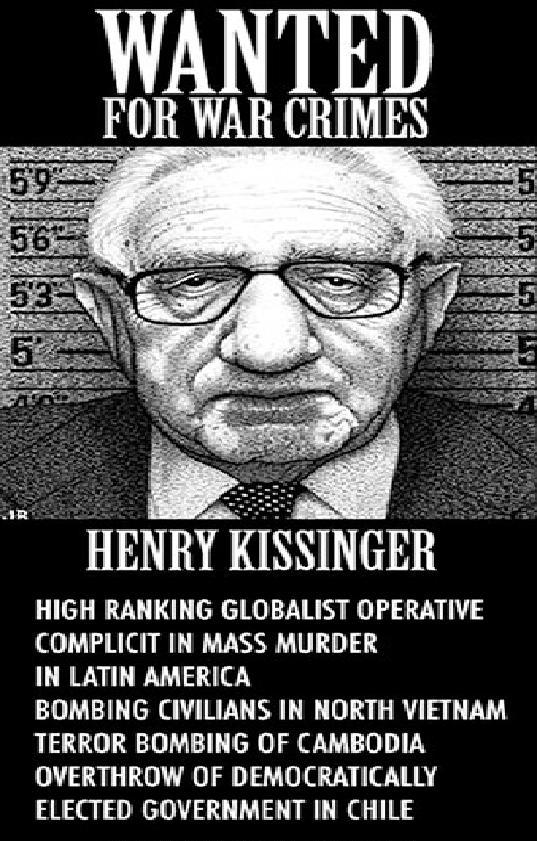
Who’s the “Low Life Scum:” Kissinger or CODEPINK?

kissinger-wanted

By Medea Benjamin

Source: Information Clearing House

A very angry Senator John McCain denounced CodePink activists as “low-life scum” for holding up signs reading “Arrest Kissinger for War Crimes” and dangling handcuffs next to Henry Kissinger’s head during a Senate hearing on January 29. McCain called the demonstration “disgraceful, outrageous and despicable,” accused the protesters of “physically intimidating” Kissinger and apologized profusely to his friend for this “deeply troubling incident.”

But if Senator McCain was really concerned about physical intimidation, perhaps he should have conjured up the memory of the gentle Chilean singer/songwriter Victor Jara. After Kissinger facilitated the September 11, 1973 coup against Salvador Allende that brought the ruthless Augusto Pinochet to power, Victor Jara and 5,000 others were rounded up in Chile’s National Stadium. Jara’s hands were smashed and his nails torn off; the sadistic guards then ordered him to play his guitar. Jara was later found dumped on the street, his dead body riddled with gunshot wounds and signs of torture.

Despite warnings by senior US officials that thousands of Chileans were being tortured and slaughtered, then Secretary of State Kissinger told Pinochet, “You did a great service to the West in overthrowing Allende.”

Rather than calling peaceful protesters “despicable,” perhaps Senator McCain should have used that term to describe Kissinger’s role in the brutal 1975 Indonesian invasion of East Timor, which took place just hours after Kissinger and President Ford visited Indonesia. They had given the Indonesian strongman the US green light—and the weapons—for an invasion that led to a 25-year occupation in which over 100,000 soldiers and civilians were killed or starved to death. The UN’s Commission for Reception, Truth and Reconciliation in East Timor (CAVR) stated that U.S. “political and military support were fundamental to the Indonesian invasion and occupation” of East Timor.

If McCain could stomach it, he could have read the report by the UN Commission on Human Rights describing the horrific consequences of that invasion. It includes gang rape of female detainees following periods of prolonged sexual torture; placing women in tanks of water for prolonged periods, including submerging their heads, before being raped; the use of snakes to instill terror during sexual torture; and the mutilation of women’s sexual organs, including insertion of batteries into vaginas and burning nipples and genitals with cigarettes. Talk about physical intimidation, Senator McCain!

You might think that McCain, who suffered tremendously in Vietnam, might be more sensitive to Kissinger’s role in prolonging that war. From 1969 through 1973, it was Kissinger, along with President Nixon, who oversaw the slaughter in Vietnam, Cambodia and Laos—killing perhaps one million during this period. He gave the order for the secret bombing of Cambodia. Kissinger is heard on tape saying, “[Nixon] wants a massive bombing campaign in Cambodia. He doesn’t want to hear anything about it. It’s an order, to be done. Anything that flies or anything that moves.”

Senator McCain could have taken the easy route by simply reading the meticulously researched book by the late Christopher Hitchens, The Trial of Henry Kissinger. Writing as a prosecutor before an international court of law, Hitchens skewers Kissinger for ordering or sanctioning the destruction of civilian populations, the assassination of “unfriendly” politicians and the kidnapping and disappearance of soldiers, journalists and clerics who got in his way. He holds Kissinger responsible for war crimes that range from the deliberate mass killings of civilian populations in Indochina, to collusion in mass murder and assassination in Bangladesh, the overthrow of the democratically elected government in Chile, and the incitement and enabling of genocide in East Timor.

McCain could have also perused the warrant issued by French Judge Roger Le Loire to have Kissinger appear before his court. When the French served Kissinger with summons in 2001 at the Ritz Hotel in Paris, Kissinger fled the country. More indictments followed from Spain, Argentina, Uruguay—even a civil suit in Washington DC.

Hitchens was disgusted by the way Henry Kissinger was treated as a respected statesman. He would have been appalled by Senator McCain’s obsequious attitude. “Kissinger should have the door shut in his face by every decent person and should be shamed, ostracized, and excluded,” Hitchens said. “No more dinners in his honor; no more respectful audiences for his absurdly overpriced public appearances; no more smirking photographs with hostesses and celebrities; no more soliciting of his worthless opinions by sycophantic editors and producers.”

Rather than fawning on him, Hitchens suggested, “why don’t you arrest him?”

Hitchens’ words were lost on Senator McCain, who preferred fawning to accountability. That’s where CodePink comes in. If we can’t get Kissinger before a court of law, at least we can show—with words and banners—that there are Americans who remember, Americans who empathize with the man’s many victims, Americans who have a conscience.

While McCain called us disgraceful, what is really disgraceful is the Senate calling in a tired old war criminal to testify about “Global Challenges and the U.S. National Security Strategy.” After horribly tragic failed wars, not just in Vietnam but over the last decade in Iraq and Afghanistan, it’s time for the US leaders like John McCain to bring in fresh faces and fresh ideas. We owe it to the next generation that will be cleaning up the bloody legacy left behind by Kissinger for years to come.


A Public Service Announcement From Adbusters

There will be blowback

Even in the seconds before their heads were about to roll away form their bodies underneath the blade of the guillotine, it still puzzled the opulent Paris elite how this could be happening.

Just months before the storming of the Bastille in 1789, everything was peachy. The social order ran smooth. The poor paid their dues. The middle class kept their mouth shut. The aristocracy parties like it was 1999.

One day they were handing out orders and advice to adoring insiders like a mall Santa dispenses candy canes, and the next day they were being dragged through the streets by their frilly collars like common thieves. Surely they wept like babies, but by then it was too late to apologize.

It always follow the same pattern. The rich and privileged overstep their mark and trigger an almighty backlash of feeding-frenzy-like-violence and cruelty.

After the Russian Revolution, the Bolshevik’s looted the royal palace and executed the entire family even the children. During the Cultural Revolution in China, the intellectual elites were publicly humiliated and carted off to camps where they were forced to work like peasants. In the 1970s, Pol Pot and the Khmer Rouge had child soldiers kill every privileged Cambodian, even those with eye glasses.

Today we are living through another one of those moments, though this time it’s not the royalty, not the land owners nor the intellectual elite … but the financial 1% running around making money off money off money off the backs of the 99% and being very arrogant and remorseless about it.

For the masses, when honest work no longer pays, the more sinister side of survival begins to take hold.

So here’s some advice to the Lloyd Blankfeins, Rex Tillersons, Jamie Dimons, Donald Trumps and Hugh Grants … Watch out! … you might be triggering something that will engulf you.

Editor’s note: While I wouldn’t hold my breath waiting for an organized revolutionary movement in this country, it’s a reminder that massive social upheaval can occur relatively quickly in a variety of different political contexts. In the U.S. I think we’re more likely to see an implosion due to top-down corruption, dysfunction and an irremediable economic situation. But the end result may be the same: systemic collapse and a vengeful backlash against those perceived as being the cause of the problems.