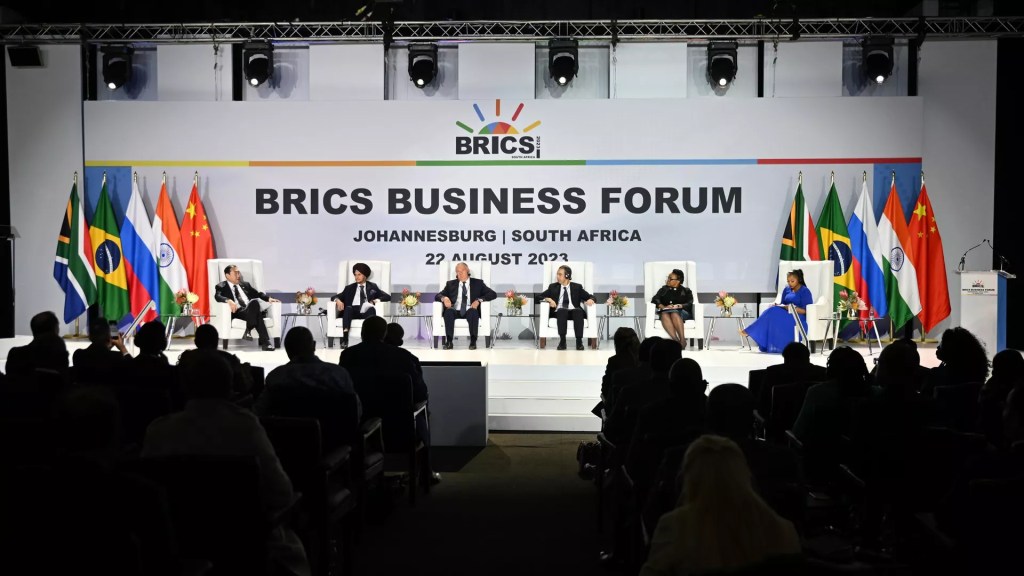
BRICS 11 – Strategic Tour de Force

By Pepe Escobar

Source: The Unz Review

Chinese President Xi Jinping defined all the major decisions embedded in the 15th BRICS summit in South Africa as “historic”. That may be seen as an understatement.

It will take time for the Global South, or Global Majority, or “Global Globe” (copyright President Lukashenko), not to mention the stunned collective West, to fully grasp the enormity of the new strategic stakes.

President Putin, for his part, described the negotiations on BRICS expansion as quite difficult. By now a relatively accurate picture is emerging of what really went down on that table in Johannesburg.

India wanted 3 new members. China wanted as many as 10. A compromise was finally reached, with 6 members: Egypt, Iran, Saudi Arabia, United Arab Emirates (UAE), Argentina and Ethiopia.

So from now on it’s BRICS 11. And that’s just the beginning. Starting with the rotating Russian presidency of BRICS on January 1, 2024, more partners will be progressively included, and most certainly a new round of full members will be announced at the BRICS 11 summit in Kazan in October next year.

So we may soon progress to BRICS 20 – on the way to BRICS 40. The G7, for all practical purposes, is sliding towards oblivion.

Bur first things first. At that fateful table in Johannesburg, Russia supported Egypt. China went all out for Persian Gulf magic: Iran, UAE and the Saudis. Of course: Iran-China are already deep into a strategic partnership, and Riyadh is already accepting payment for energy in yuan.

Brazil and China supported Argentina, Brazil’s troubled neighbor, running the risk of having its economy fully dollarized, and also a key commodity provider to Beijing. South Africa supported Ethiopia. India, for a series of very complex reasons, was not exactly comfortable with 3 Arab/Muslim members (Saudi Arabia, UAE, Egypt). Russia assuaged New Delhi’s fears.

All of the above respects geographic principles and imprints the notion of BRICS representing the Global South. But it goes way beyond that, blending cunning strategy and no-nonsense realpolitik.

India was mollified because Russian Foreign Minister Sergey Lavrov, at the table in Johannesburg negotiating on behalf of President Putin, and highly respected by New Delhi, fully understood that a new, single BRICS currency is a long way away. What really matters, short and medium term, is expanding intra-BRICS trade in their national currencies.

That was stressed by New Development Bank (NDB) president Dilma Rousseff in her report to the South African summit hosts – even as Brazilian President Lula once again emphasized the importance of setting up a work group to discuss a BRICS currency.

Lavrov understood how New Delhi is absolutely terrified of secondary sanctions by the US, in case its BRICS role gets too ambitious. Prime Minister Modi is essentially hedging between BRICS and the completely artificial imperial obsession embedded in the terminology “Indo-Pacific” – which masks renewed containment of China. The Straussian neo-con psychos in charge of US foreign policy are already furious with India buying loads of discounted Russian oil.

New Delhi’s support for a new BRICS currency would be interpreted in Washington as all-out trade war – and sanctions dementia would follow. In contrast, Saudi Arabia’s MbS doesn’t care: he’s a top energy producer, not consumer like India, and one of his priorities is to fully court his top energy client, Beijing, and pave the way for the petroyuan.

It Takes Just a Single Strategic Move

Now let’s get into the strategic stakes. For all practical purposes, in Eurasian terms, BRICS 11 is now on the way to lord over the Arctic Sea Route; the International North South Transportation Corridor (INSTC); BRI’s East West Corridors; the Persian Gulf; the Red Sea; and the Suez Canal.

That blends several overland corridors with several nodes of the Maritime Silk Roads. Nearly total integration in the Heartland and the Rimland. All with just a single strategic move in the geopolitical/geoeconomic chessboard.

Much more than an increase of BRICS 11 collective GDP to 36% of the world’s total (already larger than the G7), with the group now encompassing 47% of the world’s population, the top geopolitical and geoeconomic breakthrough is how BRICS 11 is about to literally break the bank on the energy and commodities market fronts.

By incorporating Iran, Saudi Arabia and the UAE, BRICS 11 instantly shines on as an oil and gas powerhouse. BRICS 11 now controls 39% of global oil exports; 45.9% of proven reserves; and at least 47.6% of all oil produced globally, according to InfoTEK.

With BRICS 11 possibly including Venezuela, Algeria and Kazakhstan as new members as early as in 2024, it may control as much as 90% of all oil and gas traded globally.

Inevitable corollary: operations settled in local currencies bypassing the US dollar. And inevitable conclusion: petrodollar in a coma. The Empire of Chaos and Plunder will lose its free lunch menu: control of global oil prices and means to enforce “diplomacy” via a tsunami of unilateral sanctions.

Already in the horizon, direct BRICS 11-OPEC+ symbiosis is inevitable. OPEC+ is effectively run by Russia and Saudi Arabia.

A ground-shaking geoeconomic reorientation is at hand, involving everything from routes plied by global supply chains and new BRICS roads to the progressive interconnection of BRI, the Saudi Vision 2030 and massive port expansion in the UAE.

By choosing Ethiopia, BRICS expands its African reach on mining, minerals and metals. Ethiopia is rich in gold, platinum, tantalum, copper, niobium and offers vast potential in oil and natural gas exploration. Saudi Arabia and the UAE, incidentally, are also involved in mining.

This all spells out fast, progressive integration of North Africa and West Asia.

How Diplomacy Goes a Long Way

The BRICS 11 Shock of the New, in the energy sphere, is a sharp historical counterpoint to the 1973 oil shock, after which Riyadh started wallowing in petrodollars. Now Saudi Arabia under MbS is operating a tectonic shift, in the process of becoming strategically aligned with Russia-China-India-Iran.

Diplomatic coup does not even begin to describe it. This is the second stage of the Russian-initiated and Chinese-finalized rapprochement between Riyadh and Tehran, recently sealed in Beijing. The Russia-China strategic leadership, working patiently in synch, never lost sight of the ball.

Now compare it with collective West’s “strategies”, such as the G7-imposed oil price cap. Essentially the G7 “coalition of the willing” self-imposed a price cap on Russian crude imported by sea. The result is that they had to start buying way more oil products from Global South nations which ignored the price cap and duly increased their purchase of Russian crude.

Guess who are the top two: BRICS members China and India.

After wallowing in several stages of denial, the collective West may – or may not – realize it’s a fool’s dream to attempt to “de-couple” the West-ruled part of the global economy from China, whatever is spewed out by Washington.

BRICS 11 now shows, graphically, how the “Global South/Global Majority/”Global Globe” is more non-aligned with the West than anytime in recent history.

By the way, the president of the G77, Cuban leader Diaz-Canel, was at the BRICS summit representing the de-facto new Non-Aligned Movement (NAM): the G77 actually incorporates no less than 134 nations. Most are African. Xi Jinping in Johannesburg met in person with the leaders of most of them.

The collective West, in panic, regards all of the above as “dangerous”. So the last refuge is, predictably, rhetorical: “de-coupling”, “de-risking”, and similar idiocies.

Yet that may also get practically dangerous. As in the first ever trilateral summit in Camp David on August 18 between the Empire and two Asian vassals, Japan and South Korea. That may be interpreted as the first move towards a military-political Asian NATO even more toxic than Quad or AUKUS, obsessed to simultaneously contain China, Russia and the DPRK.

The Collective Outstripping of the Global North

The UN lists 152 nations in the world as “developing countries”. BRICS 11 is aiming at them – as they outstrip the Global North on everything from population growth to overall contribution to global GDP growth measured by PPP.

In the past 10 years since the announcement of BRI first in Astana and then in Jakarta, Chinese financial institutions have lent nearly $1 trillion for infrastructure connectivity projects across the Global South. The upcoming BRI forum in Beijing will signal a renewed drive. That’s the BRI-BRICS symbiosis.

In the G20 last year, China was the first nation to lobby for the inclusion of the 55-member African Union (AU). That may happen at the G20 summit next month in New Delhi; in that case, Global South representation will be close to parity with the Global North.

Claims that Beijing was organizing a malign conspiracy to turn BRICS into a weapon against the G7 are infantile. Realpolitik – and geoeconomic indicators – are dictating the terms, configuring the Shock of the New: the G7’s irreversible irrelevance with the rise of BRICS 11.

The decline of America is becoming an accepted fact

By Veniamin Popov

Source: New Eastern Outlook

On July 5 of this year, the New York Times published an article titled “America Lives on Borrowed Money.”

It states that borrowing is expensive. A rising portion of federal earnings, money that could be utilized to help the American people, is returned to investors who buy government bonds in the form of interest payments. Instead of collecting taxes from the rich, the government pays the rich to borrow their money.

According to the Congressional Budget Office, the government will spend more on interest than on national defense by 2029, and interest payments will account for 3.6 percent of national GDP by 2033.

The authors of the article believe that the situation is becoming more and more alarming and painful, and therefore radical decisions should be made.

However, with the growing division of US political forces, these alternatives are no longer visible, especially since “Joe Biden’s global vision is too timid and pessimistic,” according to the British-based Economist.

The fact that President Biden has been indicted with impeachment by the Republican-led House of Representatives cannot be overlooked: On June 22, the House voted 219 to 208 to send two articles of impeachment to the Homeland Security and Judiciary committees, one for abuse of power and the other for dereliction of duty.

What is interesting is the evaluation of the current scenario made not only by Americans but also by political analysts from emerging countries. For example, the Saudi-based Arab News reported on June 25 this year that the United States’ political system is in disarray and the country is extremely fragmented.

The author puts the current problem in the United States on a par with the fall of the Roman Empire: “You cannot be a world leader if your society is crumbling and your leadership is divided, indecisive, and weak.” Especially when the media, once lauded as a strong weapon of truth, has devolved into a tool of political bias motivated by profit rather than principle, and free speech is dead in America.

According to the author, American influence in South America and Africa is likewise dwindling: America has never been weaker than it is today in its relatively short history.

On June 19, this year, Marwan Bishara, a senior political analyst for Al Jazeera TV, noted that signs that the American-dominated world order was crumbling had become increasingly visible over the previous decade and that America’s political and economic decline had affected its global influence and credibility.

Attempts to resurrect US leadership through the so-called “rules-based international system,” according to the author, have failed. This system was perceived as a rigged arrangement that benefited the West over the rest of the world and violated international law.

Back in the spring, well-known American journalist Ross Douthat determined that the elites of the Middle East, Africa, and Central Asia favor Russia and China, and that public opinion in emerging countries is more sympathetic to Russia and China than to America.

Richard Haas, a respected American political analyst who led a prominent think tank, the Council on Foreign Relations, for more than 20 years, went even further in his analysis: “The collapse of the American political system means that for the first time, the internal threat has surpassed the external threat. Instead of being a reliable anchor in an unstable world, the United States has become the deepest source of instability and an unreliable model of democracy.”

In September 2022, current US President Joe Biden spoke of American democracy being on the verge of collapse, clinging by a thread.

In response to this, Gulf News, one of the UAE’s leading publications, said that America today is a house divided. More and more Americans acknowledge that the country’s current status is abnormal.

The summer of 2020’s street violence and instability revealed the actual mental state of the world’s most powerful nation. The United States has long had one of the highest rates of violent crime in the world, and deteriorating public order has expedited the spread of firearms. The United States ranks first in the number of privately owned guns. Researchers at the Small Arms Survey estimated that Americans own 393 million of the 857 million available civilian guns, about 46% of the world’s civilian gun stockpile. According to the same publication, there are 120 guns per 100 Americans. According to the Pew Research Center, 48% of Americans believe that gun violence is a major issue in the country.

According to polls, only 17% of Americans believe the US criminal justice system treats everyone fairly, according to the USA Today website.

Currently, the issue of migration in America has seriously escalated.

Of course, there will be ups and downs in American domestic politics, but one of the most notable trends in recent years has been the growing polarization of the elite, which could lead to a major split of the country.

A new presidential election will be held in 2024, and many objective observers believe that both parties, Republicans and Democrats, will protest the results. Since 2000, contesting presidential elections has been a tradition.

When Hillary Clinton lost to Trump in 2016, the Democratic Party functionaries became full-time election deniers, emphasizing that the Democratic Party leadership and journalists, its supporters, had done nothing wrong: Vladimir Putin and the Russians were to blame, having hacked the election.

In 2020, Trump claimed that his loss to Biden had been the result of election fraud: the election had been stolen. Within weeks, the Republican Party’s mantra became “stop the stealing.”

A recent study found that more than half of Americans now expect another civil war “within the next couple of years,” with numerous forecasts for the end of America.

One of them says that if Trump, or any other Republican, occupies the White House, Californians are taking serious steps toward withdrawing from the United States.

Another scenario that is being seriously studied assumes that red, or Republican states will launch an independence movement if the Democratic Party wins, including Biden’s second term.

Many analysts are debating the prospect of a significant civil conflict in the United States. Meanwhile, some political analysts have noticed a discernible strengthening of the so-called neoconservative positions among the American ruling elite, who are adamant that Washington should be in charge of the entire world and harshly punish those who disagree with them. Their stance on the Ukraine issue has the potential to push the world to the verge of a nuclear war. This group’s careless acts have already generated a sizable number of issues and fresh crises.

In order to find a way out of the current impasse in international affairs, more and more developing countries are turning to Russia and China. They place their expectations in this respect, above all, on the approaching BRICS conference, where the enlargement of this association may be announced.

Ukraine Stays with the West But Russia Is Winning and Has the Receipts

By Margaret Kimberley

Source: Black Agenda Report

A delegation of African leaders travelled to Ukraine and Russia to help broker peace. But the collective west insists on prolonging the conflict.

The war in Ukraine grinds on and the Ukrainian army is being destroyed by Russia with great loss of life. One would think that Ukraine would be grateful for any and all peace efforts, but it is being used as a proxy by the United States and its NATO allies, the collective west. The seeds of this catastrophe began long before Russia’s special military operation. The European Union and NATO nations brought anti-Russian right-wing forces to power in 2014 in a coup against the elected Ukrainian president. If not for them there would be no war at all.

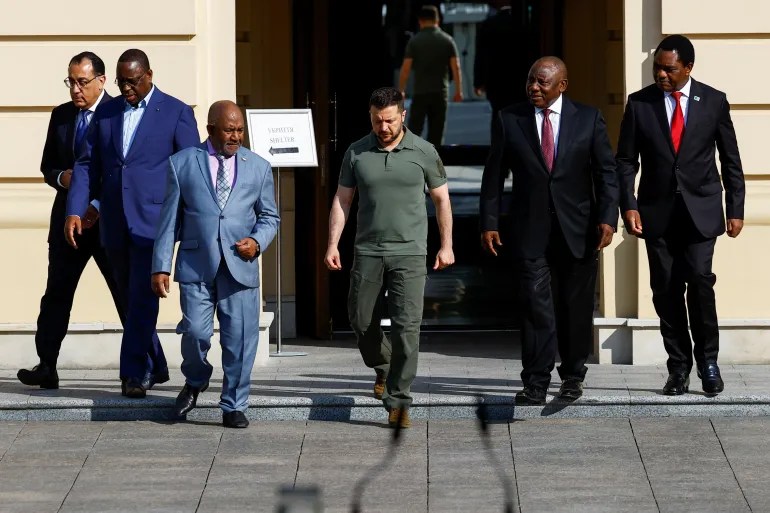
Their degree of culpability became clear recently when a delegation of African leaders traveled to Ukraine and Russia as part of a peacemaking initiative. The party included heads of state of Senegal, Egypt, Zambia, Comoros, Uganda, Republic of Congo, and South Africa. Comoros President Azali Assoumani is the current chair of the African Union. The group was greeted in Kiev by air raid sirens used to create the appearance that a Russian missile attack was underway. President Zelensky was barely polite, thanking South African president Cyril Ramaphosa and others for coming but letting them know that everything was Russia’s fault and that he had no interest whatsoever in peace talks. 

Not only is Ukraine a de facto U.S. colony which lives and dies by Washington’s whims, but it is also a deeply racist country. Much of its population is still attached to Nazi ideology and the politics of World War II collaborator Stephan Bandera. 

Nazi salutes, swastikas and other insignias are common there. So much so that the New York Times recently felt obliged to wonder in feigned innocence why these symbols are worn openly. The simple and obvious answer is that Ukraine is full of Nazis. Any likelihood that the same people would listen to Africans were indeed slim. 

Ukraine was joined in racial superiority theater by Poland. Media and security staff accompanying the presidents were delayed there and the delegation had to travel without them. When the manufactured drama was no longer needed the delegation arrived in St. Petersburg, Russia and met with president Vladimir Putin who had a surprise of his own. 

Putin listened politely to the 10-point plan and then interrupted with a surprise of his own. He not only reminded them the conflict began in 2014 but pointed out that Russia has been ready for peace ever since Turkey brokered negotiations with Ukraine in April 2022. Ukraine was on the verge of signing an agreement until its collective west friends, the US and UK in particular, scuttled the plan. 

The Treaty on Permanent Neutrality and Guarantees of Security of Ukraine offered security guarantees for Ukraine in exchange for a commitment to remain neutral, meaning that NATO membership would be off the table. Putin pointed out that as soon as Russian forces left Kiev the agreement was thrown into “the dustbin.” Just as in the case of the Minsk Agreements, the collective west offered treachery instead of peace.

The African leaders have their own self-interest which sent them to Russia. Their nations’ supplies of grain and fertilizer have been disrupted by the western sanctions and restrictions on trade with Russia. Earlier agreements on this trade have worked against Africans, as Putin pointed out, “These European neo-colonial powers, technically the US, have once again deceived the international community and the Africa countries in need: 31.7 million tonnes were exported and only three percent reached Africa’s needy countries. Is this not deception?”

It is all to the good that the international community works together to end this war, but the west is only interested in escalating and Ukraine pays the price. The collective west excels in creating propaganda and bullying its allies. The rest of the world is working to escape U.S. and NATO domination as Ukrainians die in large numbers.

Ukraine’s love of Nazi symbolism reveals why that country is content to turn its population into cannon fodder. Meanwhile western insistence on escalation brings the entire world to the brink. Yet there is still no honest discussion about how the war began, or how the Nordstream pipeline exploded. Russia is still painted as the villain and the people of this country go into another presidential election year in the dark.

Russia is not just winning on the battlefield. Nation after nation has declared an intention to use currencies other than the dollar for trade or to join the BRICS. But the collective west cannot accept defeat. The threat they represent to the world cannot be underestimated.

The BRICS Reshape the Global Geopolitical Map

By Manuel F. Diaz

Source: InfoBrics.org

Thirty years ago, pluripolarity was far from a reality in a world that had been under U.S. hegemony since the collapse of the Soviet Union in 1991. Today, however, humanity is taking important steps toward forming a plural geopolitics whose protagonists are the emerging countries that challenge Western power.

The turning point towards a new form of integration, which will generate a new world political balance, occurred in 2009 when Brazil, Russia, India, and China held the first BRIC summit.

After the incorporation of South Africa to this group in 2010, the BRICS has generated such real prospects that other nations with productive capacity and diversified economies have expressed interest in joining. Among them are Saudi Arabia, Algeria, Argentina, the United Arab Emirates, and Mexico.

In the article “Can the BRICS Trump the IMF and the World Bank?,” Palestinian-American journalist Ramzy Baroud noted that “one of the biggest opportunities and challenges” the BRICS now faces is expanding its membership while maintaining its current growth.

Recent financial reports revealed that the BRICS have the world’s largest gross domestic product (GDP) and that economic bloc contributes 31.5 percent of global GDP, while the Group of Seven (G7) stuck at 30.7 percent.

The International Monetary Fund (IMF) and the World Bank (WB) are known for providing financial support to developing countries under conditions that, under the pretext of defending human rights or democracy, seek to favor the privatization of public goods and the opening of domestic markets for Western foreign investors.

Due to these politically-driven conditionalities, the struggle for alternatives to the IMF-WB mechanisms becomes a political task. The Global South requires international institutions that are not interested in indirectly manipulating or controlling national economies.

That is the call for the BRICS to evolve towards integration schemes that go beyond the exclusively economic realm, although the basis of the fight against the U.S.-controlled institutions is the formation of an alternative economy.

Recently, the BRICS placed a capital of US$50 billion for the launch of their New Development Bank (NDB), which will be chaired by former Brazilian president Dilma Rousseff.

This happened at a time when presidents Xi Jinping (China) and Lula da Silva (Brazil) showed a shared interest in influencing the peaceful solution of the Ukrainian conflict.

Under these circumstances, to argue that the BRICS are a group with purely economic interests is to ignore much of the its history.

“The timing of the BRICS expansion, the stern political discourse of its members, potential members and allies, the repeated visits by top Russian and Chinese diplomats to Africa and other regions of the Global South, etc… indicate that the BRICS have become the new geopolitical, economic and diplomatic platform for the countries of the South,” said Baroud.

Meanwhile, the Western powers, whose economies are struggling to stay afloat, are closely and suspiciously watching the changes taking place in the Global South at the hands of the BRICS.

The Hegemon Will Go Full Hybrid War Against BRICS+

The Hybrid War 2.0 against the Global South has not even started. Swing states, you have all been warned.

By Pepe Escobar

Source: Global Research

U.S. Think Tank Land hacks are not exactly familiar with Montaigne: “On the highest throne in the world, we still sit only on our own bottom.”

Hubris leads these specimens to presume their flaccid bottoms are placed high above anyone else’s. The result is that a trademark mix of arrogance and ignorance always ends up unmasking the predictability of their forecasts.

U.S. Think Tank Land – inebriated by their self-created aura of power – always telegraphs in advance what they’re up to. That was the case with Project 9/11 (“We need a new Pearl Harbor”). That was the case with the RAND report on over-extending and unbalancing Russia. And now that’s the case with the incoming

American War on BRICS as outlined by the chairman of the New York-based Eurasia Group.

It’s always painful to suffer through the intellectually shallow Think Thank Land wet dreams masquerading as “analyses” but in this particular case key Global South players need to be firmly aware of what awaits them.

Predictably, the whole “analysis” revolves around the imminent, devastating humiliation to the Hegemon and its vassals: what happens next in country 404, also known – for now – as Ukraine.

Brazil, India, Indonesia and Saudi Arabia are dismissed as “four major fence-sitters” when it comes to the U.S./NATO proxy war against Russia. It’s the same old “you’re with us or against us” trope.

But then we are presented with the six major Global South culprits: Brazil, India, Indonesia, Saudi Arabia, South Africa and Turkey.

In yet another crude, parochial remix of a catch phrase referring to the American elections, these are qualified as the key swing states the Hegemon will need to seduce, cajole, intimidate and threaten to assure its dominance of the “rules-based international order”.

Saudi Arabia and South Africa are added to a previous report focused on the “four major fence sitters”.

The swing state manifesto notes that all of them are G-20 members and “active in both geopolitics and geoeconomics” (Oh really? Now that’s some breaking news). What it does not say is that three of them are BRICS members (Brazil, India, South Africa) and the other three are serious candidates to join BRICS+: deliberations will be turbo-charged in the upcoming BRICS summit in South Africa in August.

So it’s clear what the swing state manifesto is all about: a call to arms for the American war against the BRICS.

So BRICS packs no punch

The swing state manifesto harbors wet dreams of near-shoring and friend-shoring moving away from China. Nonsense: enhanced intra-BRICS+ trade will be the order of the day from now on, especially with the expanded practice of trade in national currencies (see Brazil-China or within ASEAN), the first step towards widespread de-dollarization.

The swing states are characterized as “not a new incarnation” of the Non-Aligned Movement (NAM), or “other groupings dominated by the Global South, such as the G-77 and BRICS.”

Talk about exponential nonsense. This is all about BRICS+ – which now has the tools (including the NDB, the BRICS bank) to do what NAM could never accomplish during the Cold War: establish the framework of a new system bypassing Bretton Woods and the interlocking coercion mechanisms of the Hegemon.

As for stating that BRICS has not “packed much punch” that only reveals U.S. Think Tank Land’s cosmic ignorance of what BRICS + is all about.

The position of India is only considered in terms of being a Quad member – defined as a “U.S.-led effort to balance China”. Correction: contain China.

As for the “choice” of swing states of choosing between the U.S. and China on semiconductors, AI, quantum technology, 5G and biotechnology, that’s not about “choice”, but to what level they are able to sustain Hegemon pressure to demonize Chinese technology.

Pressure on Brazil, for instance, is much heavier than on Saudi Arabia or Indonesia.

In the end though, it all comes back to the Straussian neocon obsession: Ukraine. The swing states, in varying degrees, are guilty of opposing and/or undermining the sanctions dementia. Turkey, for instance, is accused of channeling “dual-use” items to Russia. Not a word on the U.S. financial system viciously forcing Turkish banks to stop accepting Russian MIR payment cards.

On the wishful thinking front, this pearl stands out among many: “The Kremlin seems to believe it can make a living by turning its trade south and east.”

Well, Russia is already making excellent living all across Eurasia and a vast expanse of the Global South.

The economy has re-started (drivers are domestic tourism, machine building and the metals industry); inflation is at only 2.5% (lower than anywhere in the EU); unemployment is at only 3.5%; and head of the Central Bank Elvira Nabiullina said that by 2024 growth will be back to pre-SMO levels.

U.S. Think Tankland is congenitally incapable of understanding that even if BRICS+ nations may still have some serious trade credit issues to iron out, Moscow has already shown how even an implied hard backing of a currency can turn out to be an instant game changer. Russia is at the same time backing not only the ruble but also the yuan.

Meanwhile, the Global South de-dollarization caravan moves on relentlessly – as much as the proxy war hyenas may keep howling in the dark. When the full – staggering – scale of NATO’s humiliation in Ukraine unfolds, arguably by mid-summer, the de-dollarization high-speed train will be fully booked, non-stop.

“Offer you can’t refuse” rides again

If all of the above was not already silly enough, the swing state manifesto doubles down on the nuclear front, accusing them of “future (nuclear) proliferation risks”: especially – who else – Iran.

By the way, Russia is defined as a “middle power, but one in decline”. And “hyper-revisionist” to boot. Oh dear: with “experts” like this, the Americans don’t even need enemies.

And yes, by now you may be excused to roar with laughter: China is accused of attempting to direct and co-opt BRICS. The “suggestion” – or “offer you can’t refuse”, Mafia-style – to the swing states is that you cannot join a “Chinese-directed, Russian-assisted body actively opposing the United States.”

The message is unmistakable: “The threat of a Sino-Russian co-optation of an expanded BRICS—and through it, of the global south—is real, and it needs to be addressed.”

And here are the recipes to address it. Invite most swing states to the G-7 (that was a miserable failure). “More high-level visits by key U.S. diplomats” (welcome to cookie distributor Vicky Nuland). And last but not least, Mafia tactics, as in a “nimbler trade strategy that begins to crack the nut of access to the U.S. market.”

The swing state manifesto could not but let the Top Cat out of the bag, predicting, rather praying that “U.S.-China tensions rise dramatically and turn into a Cold War-style confrontation.” That’s already happening – unleashed by the Hegemon.

So what would be the follow-up? The much sought after and spun-to-death “decoupling”, forcing the swing states to “align more closely with one side or the other”. It’s “you’re with us or against us” all over again.

So there you go. Raw, in the flesh – with inbuilt veiled threats. The Hybrid War 2.0 against the Global South has not even started. Swing states, you have all been warned.

The Impending Economic Collapse – A Cause of Current Conflict

By Phil Butler

Source: New Eastern Outlook

Brazil’s Luiz Inacio Lula da Silva has called on BRICS nations to create an alternative to replace the dollar in foreign trade. Other experts suggest President Joe Biden’s policies will destroy America’s middle class for good. The news comes when China and Russia strengthen ties with Brazil and Latin America. Brazil’s leader questioned the institution of the U.S. dollar as the world’s trade currency in the first place and asked why each country could not trade in its currency.

This brings to the forefront the historical moment when the gold standard was abolished in favor of the current system. When President Richard Nixon moved to abolish the gold standard as a commitment mechanism, his administration ushered in decades of relative volatility and made hard currency.

The exchange of gold was severely curtailed through the Bretton Woods international monetary agreement of 1944. When the International Monetary Fund was established, the U.S. Dollar became the most potent currency in the world. Initially, the role of the IMF was only to assist with international transactions, but as we see today, that institution has far overstepped its original purpose. Today, the IMF is a leverage arm for the United States and a few European nations to fund countries/regimes that align with its policy. The U.S., for instance, has an almost 20% share of contributions to the fund.

The primary purpose of remaining off the gold standard is that the government can print money endlessly, with two primary goals. First, a massive defense budget and needless proxy wars would not be possible if the United States were on the gold standard. Secondly, the people who control the central banks cannot extract interest on national debts that are currently out of control. So, the fiat currency supposedly backed by the “full faith and credit” of the government, the dollar, is worth what lying politicians and finance ministers say it is.

One look at the worldwide bond market reveals a disturbing imbalance. The U.S., which now has over $51 trillion in outstanding debt, has borrowed more to finance wars and programs than China, Japan, Germany, Italy, France, the U.K., and Canada combined. The American taxpayer is responsible for almost 40% of all the foreign debt in the world. And the outlook for the short and long-term future could be better.

President Joe Biden wants to borrow even more when his administration conducts a proxy war against Russia in Ukraine. With billions flowing into Europe’s most corrupt country, Americans are on the precipice of an economic catastrophe not seen since the Great Depression.

According to the Bipartisan Policy Center in Washington and the Congressional Budget Office, the government will no longer be able to pay everyone — including bondholders, Social Security recipients, and federal employees — sometime this summer or early this fall. A New York Times report from late March outlines the situation. But the problem is far worse than many experts suggest. No matter which way lawmakers move, the U.S. has almost insurmountable fiscal issues. The ramifications will be dire whether or not they raise the debt limit. And if the BRICS countries go off the dollar as a trade currency… Well.

Many experts predict that American greenbacks won’t be worth the printed paper if the world stops using the U.S. dollar as its world currency reserve. Moreover, if the dollar loses its value significantly, every American who owes a credit card loan or a home mortgage will find it ten times harder to pay off those debts.

To make matters worse, millions of jobs will be sacrificed for the Federal Reserve to get any financial stability. Analysis from RSM International shows that the central banks must “induce” a recession to get America’s economic situation in check. And the dollar being made useless by the larger world community was not a factor in their analysis.

The bottom line is if we were still on the gold standard, this would be fine. The gold standard reduced the risks of such economic crises and recessions. Income levels were higher when we were on the bullion-backed system. More importantly, the gold standard created hard limits on printing money and limiting military spending. For more intuition on this, this Barron’s report reveals how our current failing system came into being. The information also serves as a crystal ball for what will happen.

As confidence in the dollar wanes and U.S. policy overseas gets more aggressive toward BRICS nations and others, the tipping point of the American hegemony draws closer.

China, Russia and India Versus USA, EU and Japan: Axis Powers of a New Global Cold War?

By Gilbert Mercier

Source: New Junkie Post

The birth of a bipolar world order?

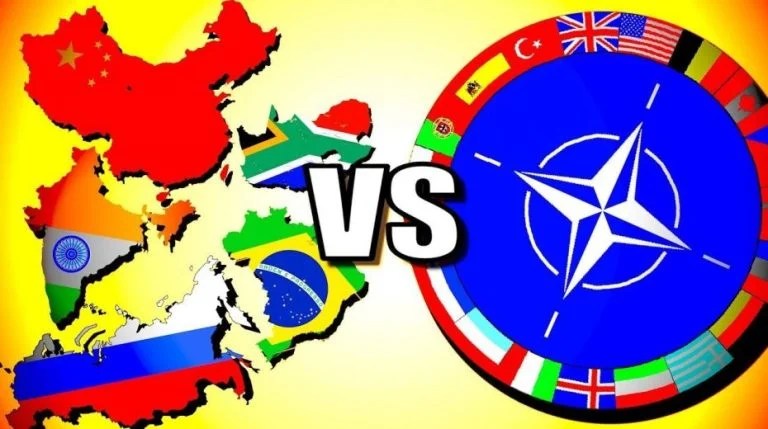
Since 2014, which marked the first Russian intervention in Ukraine, a new global geopolitical dynamic has amplified under conflicting impulses. The areas of direct, or more often proxy conflicts, have been in many senses contained with some sort of cynical pressure-cooker mechanism. If empires always seek hegemony, sane geopolitics imply balance to avoid slipping into World War scenarios. We have presently reached a Cold War-like balance between two blocks: the West and their satellites on one side, against BRICS nations and their affiliates on the other side. In the best case scenario, this new cold war could give birth to a lasting bipolar world order: curiously enough, following pretty closely Orwell’s cartography of Oceania & Eurasia.

The West is defined by the US empire and its vassals

The two axes of powers must be explained more precisely. On one side “the West” includes US, UK, EU, Canada, Japan, South Korea and Australia. The command headquarters of this imperial structure are of course located in the United States of America. The empire’s military muscle is NATO. As for the junior members such as the UK, European Union and Japan, they are, despite some claims of the contrary the vassals of big Uncle Sam.

One factor could be viewed as a miscalculation by Vladimir Putin. In many ways his decision last year to start a military operation in Ukraine had a paradoxical effect. The intervention was an attempt by Russia to prevent Ukraine from joining NATO & the EU, but this has failed as Western military gears as well as direct assistance have poured in. Just like in Afghanistan in the 1980’s Russia was effectively sucked into a West proxy war. Meanwhile, NATO has found a new raison d’etre with Finland now officially a member and Sweden soon also to become one. The general paranoia used in Western media to depict Putin as the ultimate bogeyman has worked wonders on Europe’s public opinion.

BRICS & affiliates

On the other side it is more complex as China’s dominance is more subdued than that of the US. Besides the BRICS nations of Brazil, Russia, India, China & South-Africa, other nations are gravitating into the same geopolitical orbit: notably Iran, Venezuela and African countries such as Mali and Burkina Faso. While China is clearly the biggest power within BRICS, the other two major players, which are Russia and India, also are heavyweights on an overall geopolitical and economic scale.

Russia holds vast reserves of energy products, such as gas and oil, and since the European sanctions has quickly worked on redirecting its energy production both towards China and India. India, which has become the most populous country on Earth, has just like China a considerable manufacturing power as well as a huge internal market for products and services. In other words, neither China nor India have to rely mainly on exports to sustain their respective economic growth.

Non-alignment is dead

The concept of non-alignment in a multipolar world, dear to the likes of Tito and de Gaulle, has unfortunately become a geopolitical faux pas at best, or a risky behavior for a small state wanting to stay independent at worst. Because of a lack of political will and leadership, the European Union has basically capitulated from asserting itself as a third block to become a provincial entity of the US empire. The notion of true non-alignment might have run its course in this new bipolar order.

As matter of fact, one of the Ukraine war’s major side effects has been to speed up the process of obedient realignment of the EU to the US. European leaders with their respective media propaganda divisions (either state or corporate controlled) have managed to convince the bulk of their public opinion that the ogre Vladimir Putin and Russia had to be defeated in Ukraine as if the hordes from a memory of the Red Army were about to invade Europe. The Ukraine war has been sold in Europe as a war of necessity to counter an existential threat that was never really there. Public opinion largely bought it, and the financial rewards are pouring into the coffers of the military-industrial complex, as well as US and Qatari energy businesses of natural gas liquefaction, to replace the well-organized Russian gas supply Europe used to get before the sanctions against Russia.

Ukraine war cannot be won on the battle fields

Despite what most people are lead to believe in the West, a military victory by Ukrainian forces, even with full logistic support from NATO in equipment and training is quasi impossible. After all, a lesson should be learned from Afghanistan where the Taliban managed to defeat the mighty alliance. If the EU and the United States cared for the welfare of Ukrainians, they would come to the realization that only a diplomatic solution can resolve the crisis. A sine qua non condition of diplomacy is that it requires concessions on all sides.

For example, let’s take the case of Crimea. It has a complex history. During the 15th century Crimea was under control of the Ottoman Empire. In 1783, the Russian Empire of Tsarina Catherine the Great annexed Crimea after a conflict with Turkey. Lastly, under the authority of Nikita Khrushchev, the USSR gave Crimea to Ukraine in 1954. Therefore, Crimea was Russian for 171 years while it was Ukrainian for only 60 years. The weight of history, in this case, should tilt the balance in favor of Russia.

Military-industrial complex Uber Alles

Wars have always been capitalism‘s best friend. Ultimately they are seldom about the lofty notions of patriotism but systematically about profits. Ukraine’s Western proxy adventure is no exception. As matter of fact, it has been a gargantuan bonanza for the global military-industrial complex and its stockholder war profiteers. Case in point: since Russia started its military operation in Ukraine in February 2022, the United States has spent $30 billion in military equipment which was shipped to Ukraine. This is according to the US Department of Defense.

For its part the European Union is planning a 74 billion Euros increase in military spending within three years. This trend of huge increase in military spending affects all the EU 27 members, as they are allocating bigger shares of their respective GDPs to this weapons race. In December 2022, the European Defense Agency proudly announced that EU defense spending had surpassed 200 billion Euros for the first time in the union’s history. What an accomplishment!

Needless to say, military-industrial consortium and their unscrupulous stockholders have collected huge dividends from the death and destruction business. Stocks in the so-called aerospace & defense area of the market have been incredibly profitable for investors and are therefore in high demand. On average, most defense-company stocks have seen their values increase by 25 to 30 percent since February 2022.

Naturally, in terms of military spending, the United States represents the lions’ share with a whopping 38 percent of the global military spending. It is an astronomical $800 billion a year or 3.1 percent of the US GDP. Unfortunately other major powers are catching up. In second place comes China with $293 billion or 1.7 percent of its GDP; then India with $76.6 billion; the UK with 68.4 billion; Russia with $65.9 billion or 3.1 percent of GDP; France and Germany with $56 billion each; and Japan with $54 billion. In France, despite a very concerning debt, the Macron administration has announced that 413 billion Euros will be spent on the military between 2024 and 2030.

Taiwan: the Ukraine of the far-east?

With Russia sucked into what can be called a military quagmire in Ukraine, one has to wonder if the Oceania empire, with its Washington nevralgic center, would not indeed want to take advantage or even provoke a Chinese move to take over Taiwan, in accordance to the One-China precept. This could create a Ukrainian-like situation for China in Taiwan. Instead of having the obedient EU to absorb part of the cost in the West, in the Pacific it could be US vassals such as Japan, South-Korea and Australia that could get involved into a proxy war with China, and therefore increase their military spending in US equipment. Trillion of dollars would be wasted in resources to allow the chess masters of geopolitics to keep playing their mindless criminal games. Everywhere, the brutal Russian roulette folly of capitalism, either state or corporate, would thrive while all populations suffer.

Why the CIA Attempted a ‘Maidan Uprising’ in Brazil

By Pepe Escobar

Source: The Unz Review

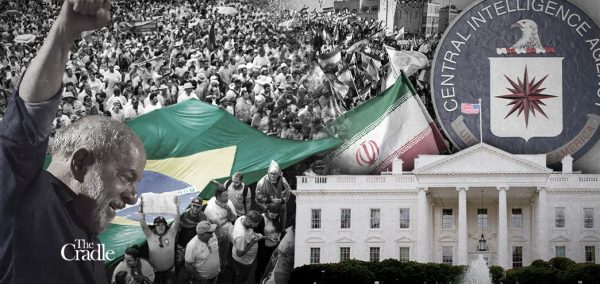
A former US intelligence official has confirmed that the shambolic Maidan remix staged in Brasilia on 8 January was a CIA operation, and linked it to the recent attempts at color revolution in Iran.

On Sunday, alleged supporters of former right-wing President Jair Bolsonaro stormed Brazil’s Congress, Supreme Court, and presidential palace, bypassing flimsy security barricades, climbing on roofs, smashing windows, destroying public property including precious paintings, while calling for a military coup as part of a regime change scheme targeting elected President Luis Inacio “Lula” da Silva.

According to the US source, the reason for staging the operation – which bears visible signs of hasty planning – now, is that Brazil is set to reassert itself in global geopolitics alongside fellow BRICS states Russia, India, and China.

That suggests CIA planners are avid readers of Credit Suisse strategist Zoltan Pozsar, formerly of the New York Fed. In his ground-breaking 27 December report titled War and Commodity Encumbrance, Pozsar states that “the multipolar world order is being built not by G7 heads of state but by the ‘G7 of the East’ (the BRICS heads of state), which is a G5 really but because of ‘BRICSpansion’, I took the liberty to round up.”

He refers here to reports that Algeria, Argentina, Iran have already applied to join the BRICS – or rather its expanded version “BRICS+” – with further interest expressed by Saudi Arabia, Turkiye, Egypt, Afghanistan, and Indonesia.

The US source drew a parallel between the CIA’s Maidan in Brazil and a series of recent street demonstrations in Iran instrumentalized by the agency as part of a new color revolution drive: “These CIA operations in Brazil and Iran parallel the operation in Venezuela in 2002 that was highly successful at the start as rioters managed to seize Hugo Chavez.”

Enter the “G7 of the East”

Straussian neo-cons placed at the top of the CIA, irrespective of their political affiliation, are livid that the “G7 of the East” – as in the BRICS+ configuration of the near future – are fast moving out of the US dollar orbit.

Straussian John Bolton – who has just publicized his interest in running for the US presidency – is now demanding the ouster of Turkey from NATO as the Global South realigns rapidly within new multipolar institutions.

Russian Foreign Minister Sergey Lavrov and his new Chinese counterpart Qin Gang have just announced the merging of the China-driven Belt and Road Initiative (BRI) and the Russia-driven Eurasia Economic Union (EAEU). This means that the largest 21st century trade/connectivity/development project – the Chinese New Silk Roads – is now even more complex, and keeps expanding.

That sets the stage for the introduction, already being designed at various levels, of a new international trading currency aimed at supplanting then replacing the US dollar. Apart from an internal debate among the BRICS, one of the key vectors is the discussion team set up between the EAEU and China. When concluded, these deliberations will be presented to BRI-EAEU partner nations and of course the expanded BRICS+.

Lula at the helm in Brazil, in what is now his third non-successive presidential term, will offer a tremendous boost to BRICS+, In the 2000s, side by side with Russian President Putin and former Chinese President Hu Jintao, Lula was a key conceptualizer of a deeper role for BRICS, including trade in their own currencies.

BRICS as “the new G7 of the East,” as defined by Pozsar, is beyond anathema – as much for Straussian neo-cons as for neoliberal.

The US is being slowly but surely expelled from wider Eurasia by concerted actions of the Russia-China strategic partnership.

Ukraine is a black hole – where NATO faces a humiliation that will make Afghanistan look like Alice in Wonderland. A feeble EU being forced by Washington to de-industrialize and buy US Liquified Natural Gas (LNG) at absurdly high cost has no essential resources for the Empire to plunder.

Geoeconomically, that leaves the US-denominated “Western Hemisphere,” especially immense energy-rich Venezuela as the key target. And geopolitically, the key regional actor is Brazil.

The Straussian neo-con play is to pull all stops to prevent Chinese and Russian trade expansion and political influence in Latin America, which Washington – irrespective of international law and the concept of sovereignty, continues to call “our backyard.” In times where neoliberalism is so “inclusive” that Zionists wear swastikas, the Monroe Doctrine is back, on steroids.

All about the ‘strategy of tension’

Clues for Maidan in Brazil can be obtained, for instance, at the US Army Cyber Command at Fort Gordon, where it’s no secret the CIA deployed hundreds of assets across Brazil ahead of the recent presidential election – faithful to the “strategy of tension” playbook.

CIA chatter was intercepted at Fort Gordon since mid-2022. The main theme then was the imposition of the widespread narrative that ‘Lula could only win by cheating.’

A key target of the CIA operation was to discredit by all means the Brazilian electoral process, paving the way for a prepackaged narrative that is now unraveling: a defeated Bolsonaro fleeing Brazil and seeking refuge at former US president Donald Trump’s Mar-a-Lago mansion. Bolsonaro, advised by Steve Bannon, did flee Brazil, skipping Lula’s inauguration, but because he’s terrified he may be facing the slammer sooner rather than later. And by the way, he is in Orlando, not Mar-a-Lago.

The icing on the stale Maidan cake was what happened this past Sunday: fabricating a 8 January in Brasilia mirroring the events of 6 January, 2021 in Washington, and of course imprinting the Bolsonaro-Trump link on people’s minds.

The amateurish nature of 8 January in Brasilia suggests CIA planners got lost in their own plot. The whole farce had to be anticipated because of Pozsar’s report, which everyone-who-matters has read across the New York-Beltway axis.

What is clear, is that for some factions of the powerful US establishment, getting rid of Trump at all costs is even more crucial than crippling Brazil’s role in BRICS+.

When it comes to the internal factors of Maidan in Brazil, borrowing from novelist Gabriel Garcia Marquez, everything walks and talks like the Chronicle of a Coup Foretold. It is impossible that the security apparatus around Lula could not have foreseen these events, especially considering the tsunami of signs on social networks.

So there must have been a concerted effort to act softly – without any preventive big sticks – while just emitting the usual neoliberal babble.

After all, Lula’s cabinet is a mess, with ministers constantly clashing and some members supporting Bolsonaro even a few months ago. Lula calls it a “national unity government,” but it is more like a tawdry patchwork job.

Brazilian analyst Quantum Bird, a globally respected physics scholar who has returned home after a long stint in NATO lands, notes how there are “too many actors in play and too many antagonistic interests. Among Lula’s ministers, we find Bolsonarists, neoliberal-rentiers, climate interventionism converts, identity politics practitioners and a vast fauna of political neophytes and social climbers, all well aligned with Washington’s imperial interests.”

CIA-stoked ‘militants’ on the prowl

One plausible scenario is that powerful sectors of the Brazilian military – at the service of the usual Straussian neo-con think tanks, plus global finance capital – could not really pull off a real coup, considering massive popular rejection, and had to settle at best for a “soft” farce. That illustrates just how much this self-aggrandizing and highly corrupt military faction is isolated from Brazilian society.

What is deeply worrying, as Quantum Bird notes, is that the unanimity in condemning 8 January from all quarters, while no one took responsibility, “shows how Lula navigates virtually alone in a shallow sea infested by sharpened corals and hungry sharks.”

Lula’s position, he adds, “decreeing a federal intervention all by himself, without strong faces of his own government or relevant authorities, shows an improvised, disorganized and amateurish reaction.”

And all that, once again, after CIA-stoked “militants” had been organizing the “protests” openly on social media for days.

The same old CIA playbook though remains at work. It still boggles the mind how easy it is to subvert Brazil, one of the natural leaders of the Global South. Attempted old school coups cum regime change/color revolution scripts will keep being played – remember Kazakhstan in early 2021, and Iran only a few months ago.

As much as the self-aggrandizing faction of the Brazilian military may believe they control the nation, if Lula’s significant masses hit the streets in full force against the 8 January farce, the army’s impotence will be graphically imprinted. And since this is a CIA operation, the handlers will order their tropical military vassals to behave like ostriches.

The future, unfortunately, is ominous. The US establishment will not allow Brazil, the BRICS economy with the best potential after China, to be back in business with full force and in synch with the Russia-China strategic partnership.

Straussian neo-cons and neoliberals, certified geopolitical jackals and hyenas, will get even more ferocious as the “G7 of the East,” Brazil included, moves to end the suzerainty of the US dollar as imperial control of the world vanishes.