Rigged

delegates

By David Swanson

Source: Let’s Try Democracy

The 2016 Republican presidential primary was rigged. It wasn’t rigged by the Republicans, the Democrats, Russians, space aliens, or voters. It was rigged by the owners of television networks who believed that giving one candidate far more coverage than others was good for their ratings. The CEO of CBS Leslie Moonves said of this decision: “It may not be good for America, but it’s damn good for CBS.” Justifying that choice based on polling gets the chronology backwards, ignores Moonves’ actual motivation, and avoids the problem, which is that there ought to be fair coverage for all qualified candidates (and a democratic way to determine who is qualified).

The 2016 Democratic presidential primary was rigged. It wasn’t rigged by bankers, misogynists, Russians, Republicans, or computer hackers. It was rigged by the Democratic National Committee and its co-conspirators in the media, many of whom have helpfully confessed (in case it wasn’t obvious) in emails leaked from the DNC and from John Podesta. The DNC chose Hillary Clinton and worked hard to make sure that she “won.” Nobody has produced a hint of evidence as to who leaked the emails that added unnecessary confirmation of this rigging, but they should be thanked for informing us, whoever they are.

The FBI investigation of Hillary Clinton’s misuse of email was as rigged as the non-prosecution of the CEO of Wells Fargo. The U.S. political system is bought and paid for. Without millions of dollars to funnel to television networks for advertising, any candidate is rigged right out of participating. This rigging of the system is not fixed by someone like Donald Trump pretending for a while that he won’t take bribes, that he’ll spend only his own money, because most people don’t have that kind of money to spend. This rigging is not fixed by making someone like Hillary Clinton take her bribes through her family foundation or requiring that her political action committees remain theoretically separate from the campaign they are collaborating hand-in-glove with, because money buys power.

The debates are rigged by a private entity with no official status that calls itself the Commission on Presidential Debates and transforms open debates among multiple candidates into exclusively bipartisan joint appearances with many large and fine points negotiated beforehand.

Actual governance of the United States is rigged. Congress plans to attempt to ram through a number of intensely unpopular measures just after the election, including a supplemental spending bill for more wars and including the Trans-Pacific Partnership. The hope is that most people will have tuned out after the election circus, and that most of them will forget what happened 2 or 4 years later.

The demonization of Vladimir Putin is rigged. Nobody has seen evidence that he or his government did us the favor of informing us of the DNC’s corruption. He proposed a ban on cyber “war” that was rejected by the United States, for goodness sake. There’s no evidence that Russia shot down an airplane in Ukraine or invaded Ukraine or seized Crimea or plotted attacks on the United States. The United States pulled out of the ABM treaty, expanded NATO to Russia’s border, built missile bases, arranged military “exercises,” facilitated a Ukrainian coup, and pushed a string of hostile lies. Russia has shown even more restraint than your typical U.S. voter (who usually sits home and does not vote, especially in primaries).

Military spending is rigged. Nobody knows it amounts to over half of U.S. discretionary spending.  Nobody knows it’s as much in the U.S. as in the rest of the world (allies and otherwise) combined. Nobody pays attention to the bribes from war profiteers, or to the threats held over Congress members to pull weapons jobs out of districts or states. Supporters of both big candidates claim their candidate plans to cut military spending. Both candidates have said the exact opposite. The debates and interviews steer clear of the whole topic.

The shapes of the districts are blatantly rigged by gerrymandering. The existence of the Senate, in which Rhode Island and Wyoming each have as much say as California is rigged against the popular will. The electoral college is rigged against the popular will and in favor of concentrating national campaigns in a handful of “swing states.”

Voter registration is rigged. A handful of states have now made it automatic, as most states have long-since done for military draft registration. In the rest of the country, thousands of young people run around registering voters, imagining they are engaged in “activism.” Meanwhile, the right to vote can be denied to anyone by claiming they aren’t registered.

People’s names are stripped from voting rolls through a so-called justice system that brands them as felons, and through the careful rigging of those rolls by corrupt and partisan state governments that intentionally strip out people likely to vote for a particular party. This includes racial profiling. Bob Fitrakis, Harvey Wasserman, Greg Palast and others have reported extensively on these practices.

Election day is rigged as well. It’s not a holiday. Most people have to work. Poor districts and racial minority districts tend to have fewer machines and longer lines. ID requirements are used to deny people the right to vote. Intimidation and racial profiling by partisan activists serve the same function of rigging the election. The myths and lies about the virtually nonexistent phenomenon of “voter fraud” also serve to rig the election.

The election machines are also rigged. That is to say: instead of verifiable paper ballots publicly hand-counted in front of observers from all interested parties in each polling place, we have a faith-based system of voting on black-box machines that can never, even in theory, be checked for accuracy. These machines have been very easily hacked in demonstrations. These machines have visibly flipped votes before the eyes (and cameras) of countless voters. These machines have almost certainly played a key role in flipping the results of numerous elections.

Now, the wider the margin of victory, the less likely an electronic flipping. And the fact that machines can easily be used to steal an election does not mean that they always will be. But it was very odd during the late summer of 2016 to watch the U.S. media announce that these machines were totally unreliable — just what many of us had been saying for years. But the media said this in order to accuse Russia of planning to sabotage the coming U.S. election, or in order to accuse Russia of exactly what these media reports themselves did: plant seeds of doubt in U.S. minds.

Those doubts should be there. People should watch for visible problems with machines and with partisan and racist intimidators, and report all such to 1-866-OUR-VOTE, to county clerks, to secretaries of state, and to corporate and independent media. Then we should work for necessary reforms, including a respectful cessation of the U.S. government’s routine practice of interfering in elections and overthrowing governments in other people’s countries — a practice that has clearly resulted in the U.S. media projecting such behavior on others.

Ultimately, an unrigging of the U.S. system might take the form of amending the U.S. Constitution to slip in words like these:

The rights protected by the Constitution of the United States are the rights of natural persons only.

Artificial entities, such as corporations, limited liability companies, and other entities, established by the laws of any State, the United States, or any foreign state shall have no rights under this Constitution and are subject to regulation by the People, through Federal, State, or local law. The privileges of artificial entities shall be determined by the People, through Federal, State, or local law.

The judiciary shall not construe the spending of money to influence elections to be speech under the First Amendment.

All elections for President and members of the United States House of Representatives and the United States Senate shall be entirely publicly financed. No political contributions shall be permitted to any federal candidate, from any other source, including the candidate. No political expenditures shall be permitted in support of any federal candidate, or in opposition to any federal candidate, from any other source, including the candidate. The Congress shall, by statute, provide limitations on the amounts and timing of the expenditures of such public funds and provide criminal penalties for any violation of this section.

State and local governments shall regulate, limit, or prohibit contributions and expenditures, including a candidate’s own contributions and expenditures, for the purpose of influencing in any way the election of any candidate for state or local public office or any state or local ballot measure.

The right of the individual U.S. citizen to vote and to directly elect all candidates by popular vote in all pertinent local, state, and federal elections shall not be violated. Citizens will be automatically registered to vote upon reaching the age of 18 or upon becoming citizens at an age above 18, and the right to vote shall not be taken away from them. Votes shall be recorded on paper ballots, which shall be publicly counted at the polling place. Election day shall be a national holiday.

Nothing contained in this amendment shall be construed to abridge the freedom of the press. During a designated campaign period of no longer than six months, free air time shall be provided in equal measure to all candidates for federal office on national, state, or district television and radio stations, provided that each candidate has, during the previous year, received the supporting signatures of at least five percent of their potential voting-age constituents. The same supporting signatures shall also place the candidate’s name on the ballot and require their invitation to participate in any public debate among the candidates for the same office.

Killing Democracy by a Thousand Cuts

illusionofvote

By Jim Heddle and Mary Beth Brangan

Source: FreePress.org

How are our votes being stolen? Let us count the ways…

Electoral Proctology

As the fateful June 7 primary election day approached in 6 states, including California, a stellar group of election protection luminaries gathered on Memorial Day weekend in a private home in Santa Monica with about 100 of their closest friends.  Their purpose, as that great American philosopher W.C. Fields once advised, was ‘to seize the bull by the tail and stare the situation squarely in the face.’

[ See videos of the meeting: Don’t Let Them Steal Your Vote –  Part 1https://youtu.be/Pax4z8AuGTU

Part 2  https://youtu.be/jF0Eab9wKQc  ]

Not a Pretty Picture

Chaired by movie star and long-time political activist Mimi Kennedy, a panel including Harvey Wasserman, Bob Fitrakis, Greg Palast, Bev Harris and John Blakey compared notes on the myriad methods their investigations have uncovered that are destroying the validity of U.S. elections. Facing these facts is the first step in the daunting task of restoring election integrity in America’s very broken electoral system.

In this year’s primary season alone we have seen:

·         Massive disenfranchisement caused by arbitrarily changing voters’ assigned precincts and then giving incorrect information on the changes.

·         Chaos caused in predominately minority districts by reducing the number of precincts  – and the number of machines per precinct – causing long lines and hours-long waits which turned away many voters with jobs or other time commitments.

·         Arcane regulations which instructed poll workers to give unprecedented numbers of voters ‘provisional ballots,’ which are rarely counted.

·         For example, in California, voters who registered ‘NPP’ for No Party Preference and were mailed a ballot, were not permitted to vote in the Democratic primary unless they took both the ballot and its envelope to a polling place and said the magic words, “I surrender this ballot and request a cross-over ballot.” Without those exact words, poll workers were instructed not to supply a ‘cross-over’ ballot AND not to inform the voter of the rule.

·         Media outlets prematurely calling elections before all ballots are counted – or, in some cases, even cast.

·         As of this writing, 2.6 million ballots yet to be counted for the California primary

But it gets worse.

Strip & Flip

The theme of the Santa Monica panel was set by a hot-off-the-press book just published by Fitrakis and Wasserman titled ‘The Strip & Flip Selection of 2016: The Five Jim Crows & Electronic Election Theft.’  [ Get it here: http://freepress.org/store.php ] This is the latest in a string of books the team has written in the last decade.  They have had a ringside seat to both observe – and also fight against – the increasing corruption of the U.S. electoral system, based, as they are in Columbus, Ohio, capitol of a key swing state.  In 2012, Fitrakis’s threatened lawsuit in Ohio state court prevented the planned electronic theft of the election and saved Obama’s election victory.

[See “Swing State: How the Fix Was Nixed in Ohio 2012”   https://www.youtube.com/watch?v=10qwtBlHeTY ]

Election Theft, as American as Apple Pie

Intentional disenfranchisement of potential voters in order to favor selected demographic sectors is simple in concept, if complex in means. It has been a part of the American electoral landscape from the git-go.  Eliminating legitimate voters from the voter rolls by various tactics – that’s the ‘strip’ part.  Skewing the ballot count in order to produce desired outcome percentages – that’s the ‘flip’ part – also achieved by multiple mechanisms, as we shall see.

“Not every conspiracy is a theory.”

The ad slogan for the current thriller ‘Money Monsters’ actually gets it right. Though poo-pooed as ‘conspiracy theory’ by pundits and vote fraud denialists across the political spectrum, Bob & Harvey’s work – in combination with the work of many other investigator/activists including co-panel members Bev Harris, Greg Palast,, Mimi Kennedy and John Blakey – has incontrovertibly revealed the plethora of means by which America’s electoral system has now been stripped of the last vestiges of whatever trustworthiness it may have ever actually possessed.

A short run down follows – to be expanded upon below – of issues discussed by the panel.

But, keep in mind that, for brevity, the list does not include additional key related issues, such as: unlimited campaign spending by anonymous persons and non-voting corporate entities and their surrogates – even from foreign states or agents; mainstream media’s biased reporting; manipulations by party officials; ‘super delegate’ and ‘contested convention’ schemes; the counter-democracy Electoral College; or the ‘gerrymandering-on-steroids’ REDMAP redistricting process carried out by Republicans following the 2010 election, which left them in control of the House of Representatives and many key state legislatures until at least 2020, when the next census-based re-districting is scheduled.  The latter major ploy is well documented in David Daley’s recent book “Rat F**ked: The True Story Behind the Secret Plan to Steal America’s Democracy.”)

Here’s the short list from the Santa Monica panel presentations:

·         Massive electronic purging of legitimate voters from voter rolls across the country

·         Massive vote suppression and disenfranchisement by myriad means on a national scale

·         Virtually decisive control of voter rolls without detection; vote counting and reporting by privately owned, secret, electronic devices and computer programs specifically designed to steal elections through cyber chicanery.

The Five Jim Crows

It all started with the constitution, Wasserman explained, a document drafted in secret, behind closed doors by a tiny elite of propertied white men, and rammed through to ratification by the states through electoral manipulation.   It denied voting rights to women and to males without property, but contained the “3/5ths clause” that gave slave owners congressional representation for their slaves despite the fact that the slaves themselves couldn’t vote.

The so-called Three-Fifths Compromise is in Article 1, Section 2, Paragraph 3 of the United States Constitution:

Representatives and direct Taxes shall be apportioned among the several States which may be included within this Union, according to their respective Numbers, which shall be determined by adding to the whole Number of free Persons, including those bound to Service for a Term of Years, and excluding Indians not taxed, three fifths of all other Persons.

The effect, according to Wikipedia, “was to give the southern states a third more seats in Congress and a third more electoral votes than if slaves had been ignored, but fewer than if slaves and free persons had been counted equally, allowing the slaveholder interests to largely dominate the government of the United States until 1861.”  https://en.wikipedia.org/wiki/Three-Fifths_Compromise

It was also a divide-and-conquer strategy to make sure black and white laborers would never again unite in revolting as they did in Virginia in 1675 in what’s called Bacon’s Rebellion.

Fitrakis and Wasserman call that ‘the First Jim Crow.’  After the Civil War and emancipation, they explain, Supreme Court rulings, KuKluxKlan terror, black lynchings, literacy tests and other apartheid strategies established the ‘Second Jim Crow,’ that “again guaranteed that blacks in the South (and parts of the North) would not be allowed to vote, and that they would be carefully divided from whites by caste as well as class.”

The Third Jim Crow was/is the ‘War on Drugs’ initiated by Richard Nixon to combat the liberalization of the southern Democratic Party, the anti-war movement and the rise of the Black Power movement.  As Nixon administration official John Erlichman recently explained to Harper’s interviewer Dan Blum,

“The Nixon campaign in 1968, and the Nixon White House after that, had two enemies: the antiwar left and black people. You understand what I’m saying? We knew we couldn’t make it illegal to be either against the war or black, but by getting the public to associate the hippies with marijuana and blacks with heroin, and then criminalizing both heavily, we could disrupt those communities. We could arrest their leaders, raid their homes, break up their meetings, and vilify them night after night on the evening news. Did we know we were lying about the drugs? Of course we did.”  https://harpers.org/archive/2016/04/legalize-it-all/

Young, left-leaning Latinos were also caught up in the Drug War dragnet.  Now, 45 years later, 41 million (mostly people of color) have been jailed for pot and other controlled substances, making private corporate prisons a growth industry, and giving the U.S. the highest prison population in the world.  Though having no significant impact on drug use, the Drug War has disenfranchised millions of potential voters, and continues to do so today.  Michelle Alexander’s recent book The New Jim Crow: Mass Incarceration in the Age of Colorblindnessshows how one system of race-based disenfranchisement has been replaced by another.  http://newjimcrow.com/

The Fourth Jim Crow, explain the authors, was born of America’s push to establish what they call “a race-based global empire” with a long series of foreign interventions – also continuing today – which “involved the white-ruled US interfering with the political systems of non-white nations.”

The impact of these interventions on our own political system, say Wasserman and Fitrakis, has been catastrophic. “They’ve established the US as a corporate-ruled race-based empire, fueling the growth of a military whose intrinsic power overshadows our entire electoral process…and set the stage for…the Fifth Jim Crow – the electronic flipping of our elections.”

Engineering Vote Fraud Abroad Comes Home to Roost

Manipulation of election outcomes in other countries has been developed into a high art by such US agencies as the CIA, USAID and other so-called ‘democracy promotion’ projects fielded abroad by both the Republican and Democratic parties.

Note the authors, “Overseas, the CIA began to apply advanced electronics to the art and science of election theft.  By the 1970’s, in front of the Church Committee, the Agency admitted to already having manipulated countless Third World elections to protect America’s corporate and ‘national security’ interests.”  They trace the subsequent development of electronic voting technology techniques, corporations and institutions up to the present day, when up to 80% of US votes in the coming presidential election will be electronically mediated.  In line with the adage that ‘what goes around, comes around,’ American expertise in foreign nations’ electronic vote rigging has now come home to compromise the integrity and validity of our own system, big time.

The New Jim Crow – “Interstate Crosscheck”

Panel member investigative journalist Greg Palast has been researching and reporting on this process for going on two decades for such outlets abroad as the BBC and the Guardian news paper.  Still, like the proverbial ‘prophet without honor in his own country,’ Palast states with deep frustration that he still has a hell of a time getting American so-called ‘mainstream’ media to pay any attention to his explosive exposes. http://www.gregpalast.com/

Now reporting for Rolling Stone, he is also using crowd funding to produce a forth-coming documentary titled, The Best Democracy Money Can Buy: A Tale of Billionaires and Ballot Bandits https://www.youtube.com/watch?v=kg2gCgFMBOg

In his presentation in Santa Monica Palast debunked claims by Donald Trump and others that ‘millions of people’ are committing ‘voter fraud’ by ‘voting more than once.’  Describing what he calls ‘the next, or Sixth Jim Crow,’  he reported that 29 state election officials across the country have announced the creation of what they call ‘The Interstate Crosscheck.’  Touted as a defense against mythical individual ‘voter fraud’ the system purports to identify people who are voting more than once, sometimes in multiple states, and purge them from polling lists.

In actuality, in violation of the Voting Rights Act, says Palast, the program uses census data to identify African American voters – tagged ‘BLA’ for black– with similar common names and fraudulently remove them from voter lists.

In the history of the South, when slaves were finally freed, they were often registered by their masters’ surnames.  As a result, to this day, many black persons carry the same or similar names, thus facilitating the “Interstate Crosscheck” scam.

Based on his findings, Palast says, “We expect 1 million voters – almost all of them voters of color – to lose their right to vote in 29 Republican-controlled states before the November election.”

But, he is quick to point out, it isn’t just Republicans who regularly mess with elections.  As questionable outcomes in this primary suggest, “the Democrats are dirty,” Palast says, pointing out that Democrats invented Jim Crow, which Nixon just adopted for his so-called ‘southern strategy.’

Palast admits to being tired of being a ‘reporter in exile,’ and hopes that, now that he is reporting for Rolling Stone, he can finally come home and report his investigative findings to his own countrymen “who need to know this stuff!”

“Fraction Magic” – A Digital Thumb on the Scale: Fractionalization & Decimalization of Votes

Harking back to the infamous “3/5ths clause” described above, what if you were hired to write a vote-counting program that could assign various arbitrary decimal or fractional values to each and all of the votes counted and come up with desired percentages for every candidate and contest?

To use a simple-minded butcher’s scale analogy: What if your program assigned a vote for Hillary the arbitrary ‘weight’ of 2 pounds, and assigned a Bernie vote just a weight of 1 pound?

Then, in a given race, Bernie got 200 votes and Hillary got 150 votes.

If you just added up the total votes for each candidate, you would call the election for Bernie with a 50-vote lead.

But, if your private, proprietary, secret counting program totaled their votes by the artificial ‘weights’ it arbitrarily assigned to them, you would announce Hillary the winner with a 300 to 200-vote lead.

That, ladies and gentlemen, is the intentionally programed ‘glitch’ that BlackBoxVoting.org founder Bev Harris and her colleague, IT expert Bennie Smith have discovered in a significant number of America’s vote counting systems. It is achieved via ‘fractionalization’ or ‘decimalization.’

They explain that it works like this: “Instead of “1” the vote is allowed to be 1/2,  or 1+7/8, or any other value that is not a whole number.”

That allows ‘weighting’ of selected electoral contests. “Weighting a race removes the principle of ‘one person-one vote’ to allow some votes to be counted as less than one or more than one. Regardless of what the real votes are, candidates can receive a set percentage of votes. Results can be controlled. For example, Candidate A can be assigned 44% of the votes, Candidate B 51%, and Candidate C the rest.”

On her excellent webite BlackBoxVoting.org, Harris and Smith report,

…the results of our review of the GEMS election management system, which counts approximately 25 percent of all votes in the United States. The results of this study demonstrate that a fractional vote feature is embedded in each GEMS application which can be used to invisibly, yet radically, alter election outcomes by pre-setting desired vote percentages to redistribute votes. This tampering is not visible to election observers, even if they are standing in the room and watching the computer. Use of the decimalized vote feature is unlikely to be detected by auditing or canvass procedures, and can be applied across large jurisdictions in less than 60 seconds.  http://blackboxvoting.org/

“GEMS vote-counting systems are and have been operated under five trade names: Global Election Systems, Diebold Election Systems, Premier Election Systems, Dominion Voting Systems, and Election Systems & Software, in addition to a number of private regional subcontractors. At the time of this writing, this system is used statewide in Alaska, Connecticut, Georgia, Mississippi, New Hampshire, Utah and Vermont, and for counties in Arizona, California, Colorado, Florida, Illinois, Indiana, Iowa, Kansas, Kentucky, Massachusetts, Michigan, Missouri, Ohio, Pennsylvania, Tennessee, Texas, Virginia, Washington, Wisconsin and Wyoming. It is also used in Canada.”

Read more: http://blackboxvoting.org/fraction-magic-1/

Adjusted Exit Polls

Around the world, so-called exit polls – which ask a sampling of exiting voters how they voted – are viewed as the Gold Standard for checking the accuracy of the ballot count.  In most countries, if the ballot count and the exit poll numbers don’t match, there is either a recount or the election is declared ‘not free and fair.’

Not so in America.  Here, as Jonathan Simon documents in his book Code Red: Computerized Election Theft and The New American Century, the exit poll numbers are instead adjusted to match the official vote count.

In the US, the exit pollster of record has been Edison/Mitofsky http://www.edisonresearch.com/election-polling/ working for a consortium of news organizations that comprise the National Election Pool (NEP): ABC, CBS, CNN, Fox, NBC and the Associated Press.  As Wasserman relates, when election researcher and statistician Dr. Steve Freeman called the late Warren Mitofsky personally to request the raw data from the 2004 exit polls, the response was “Go f**k  yourself.”

[ See also: Analysis of the 2004 Presidential Election Exit Poll Discrepancies

http://www.verifiedvoting.org/wp-content/uploads/downloads/Exit_Polls_2004_Edison-Mitofsky.pdf

Maybe that’s why respected international election observer Former President Jimmy Carter can say the USA “is not a functioning democracy.”  Maybe that’s why, as Fitrakis and Wasserman point out:

In March 2015, the Harvard Electoral Integrity Project reported that over fourteen hundred international election experts gathered data the year before and pronounced the United States was 45th in election integrity among the world’s long-standing democracies. The Project reported that on a 100-point scale, the U.S. received an integrity rating of 69.3% – one notch ahead of the narco-drug state Columbia….

What this means in practice is revealed in a recent study of three decades of data by liberal mainstream political scientists Martin Gilens of Princeton, and Benjamin Page of Northwestern. Their analysis confirmed that the U.S. political system has become “an oligarchy” – as Carter himself has said – where wealthy elites and their corporations “rule,” regardless of which party is in Congress and the White House.

“The central point that emerges from our research,” Gilens and Page wrote, “is that economic elites and organized groups representing business interests have substantial independent impacts on U.S. government policy, while mass-based interest groups and average citizens have little or no independent influence.”

As Gilens explained in an interview, “ordinary citizens have virtually no influence over what their government does in the United States.”

Citizen Exit Polls

Edison Research was scheduled to do exit polling for the NEP media consortium in the California primary.  But when Ohio election protection attorney Cliff Arnebeck gave notice that he intended to sue for the raw data, the California exit poll was canceled.

Into the breach jumped California activist/funder Lori Grace and her Institute for American Democracy and Election Integrity (www.trustvote.org), engaging professional pollsters to sample selected districts in Northern and Southern California.  The results will be forthcoming at TrustVote.org. http://trustvote.org/

Already the site reports:

In other eleven states besides California, there has been noted a significant difference between the Edison Research exit polls and the electronic vote totals presented on the morning after the primaries. These totals do not include anything from California. These differences show votes appear to be shifted from Bernie Sanders to Hillary Clinton. The chances of this kind of shift happening are considered to be statistically impossible between Tuesday night and Wednesday morning in these eleven states….

…In addition, some people may have concerns that [private election system or voting machine] companies like Scytl/SOE and ES&S which managed the votes in Kentucky, New York and Arizona, have directors who are also on the boards of other companies involved in wire-tapping, the defense industry and military interrogations.

A System Designed for Cheating

Corroborating the findings of the other Santa Monica presenters with his own recent experience, John Blakey of Audit Arizona reported that, in this very primary, in Maricopa County, domain of infamous Sherrif Joe Arpaio, 150,000 voters appear to have been ‘suppressed.’  Possibly that’s because 85% of Arizona voters use vote-by-mail ballots, which, extensive evidence shows, rarely get counted.

Blakey is suing the State of Arizona for access to records. “We have the right language for it now,” Blakey says, thanks to the work of the other panel members. “It’s not ‘voter fraud,’ it’s vote fraud.  It is a system designed for cheating.”

STD – Software Transmitted Disease

Well-known actor Mimi Kennedy is a fierce, long-term election protection activist in private life.  In this election she received poll worker training that has taken her into the heart of California’s election system.  She says her friend Bev Harris’ ‘fraction magic’ findings show how deeply what she calls “STD, Software Transmitted Disease” has infected our electoral system.  She explains, “There are seven thousand small voting jurisdictions all over America.  State law controls elections.  Seven thousand jurisdictions within and among those states can have some say in process, procedure, choice of private contractors, common servicer software and hardware.  Outside IT ‘experts’ are hired who may or may not be honest or bright. That means that fraud capacity is there.  People ask me ‘Who are the ‘them’ that may be stealing our votes?’  I tell them, ‘someone in any of those jurisdictions who can.’”

The Ohio Plan, ‘How to Nix the Fix’

Wasserman and Fitrakis admit that, “as we approach the 2016 election, the prospects for a truly democratic outcome are grim.”

However, lest we despair in the face of all these discouraging revelations, they insist that the fixes in our badly compromised electoral system CAN be nixed.

“The only cure,” they conclude, “is a bottom-up revolution in human consciousness and action.”  They hope their work “will help inform and motivate an energized grassroots uprising” based on what they call The Ohio Plan.

The Ohio Plan:

1.      Universal, automatic, same-day voter registration.

2.      A four-day national voting holiday.

3.      Votes counted by students & elders, paid the minimum wage.

4.      Universal use of hand-counted paper ballots.

5.      A universal automatic recount.

May it be so.

============

Mary Beth Brangan and James Heddle co-direct EON, The Ecological Options Network.  Since 2004, they have produced many video reports in cooperation with FreePress.org and the Columbus Institute for Contemporary Journalism which can be viewed on the EON’s YouTube channel Election Protection & Deep Democracy playlist  https://www.youtube.com/playlist?list=PLF06C90E53E4D6919  They are currently at work on a new documentary SHUTDOWN: The California-Fukushima Connection.  http://www.shutdowndoc.tv/   

BREAKING: Leaked FBI Alert Admits Hackers Penetrated US Election Systems

jf-7

By Matt Agorist

Source: The Free Thought Project

On Monday, an official FBI alert from August 18 was leaked to Yahoo News. The alert stated the FBI had uncovered evidence showing that at least two state election systems were penetrated by hackers in recent weeks. The FBI quickly issued warnings to election officials across the country to ramp up security on their systems.

It appears from the Flash Alert that the public was not supposed to know about it.

This FLASH has been released TLP: AMBER: The information in this product is only for members of their own organization and those with DIRECT NEED TO KNOW. This information is NOT to be forwarded on beyond NEED TO KNOW recipients.

The FBI then goes on to describe the nature of the attack and lists the IP addresses associated with the intrusion.

Summary

The FBI received information of an additional IP address, 5.149.249.172, which was detected in the July 2016 compromise of a state’s Board of Election Web site. Additionally, in August 2016 attempted intrusion activities into another state’s Board of Election system identified the IP address, 185.104.9.39 used in the aforementioned compromise.

Technical Details

The following information was released by the MS-ISAC on 1 August 2016, which was derived through the course of the investigation. In late June 2016, an unknown actor scanned a state’s Board of Election website for vulnerabilities using Acunetix, and after identifying a Structured Query Language (SQL) injection (SQLi) vulnerability, used SQLmap to target the state website. The majority of the data exfiltration occurred in mid-July. There were 7 suspicious IPs and penetration testing tools Acunetix, SQLMap, and DirBuster used by the actor, detailed in the indicators section below.

“This is a big deal,” said Rich Barger, chief intelligence officer for ThreatConnect, a cybersecurity firm, who reviewed the FBI alert at the request of Yahoo News. “Two state election boards have been popped, and data has been taken. This certainly should be concerning to the common American voter.”

According to the FBI, the hack is the work of a ‘foreign entity.’ However, they have not named the country of origin. This has not stopped other officials from quickly blaming the Russians.

Also absent from the alert are the names of the states involved in the hack.

According to the report from Yahoo News:

The bulletin does not identify the states in question, but sources familiar with the document say it refers to the targeting by suspected foreign hackers of voter registration databases in Arizona and Illinois. In the Illinois case, officials were forced to shut down the state’s voter registration system for ten days in late July, after the hackers managed to download personal data on up to 200,000 state voters, Ken Menzel, the general counsel of the Illinois Board of Elections, said in an interview. The Arizona attack was more limited, involving malicious software that was introduced into its voter registration system but no successful exfiltration of data, a state official said.

“The FBI is requesting that states contact their Board of Elections and determine if any similar activity to their logs, both inbound and outbound, has been detected,” the alert reads. “Attempts should not be made to touch or ping the IP addresses directly.”

While the alert lists the IP addresses from which the attacks originated, it is highly unlikely that the hackers would use any traceable address.

“This is a wake-up call for other states to look at their systems,” said Tom Hicks, chairman of the federal Election Assistance Commission.

This news comes on the heels of a report earlier this month in which a professor from Princeton University and a graduate student proved electronic voting machines in the U.S. remain astonishingly vulnerable to hackers — and they did it in under eight minutes.

Professor Andrew Appel, a Princeton University computer science professor who has studied election security, and grad student Alex Halderman took just seven minutes to break into the authentic Sequoia AVC Advantage electronic voting machine Appel purchased for $82 online — one of the oldest models, but still used in Louisiana, Pennsylvania, New Jersey, and Virginia.

Appel notes that the only “reasonably safe” voting method is paper ballots as they can be counted alongside the electronic tally. However, crucial swing states, as Appel notes, rely on more vulnerable paperless touchscreen voting which does not back up any of the numbers.

“Then whatever numbers the voting computer says at the close of the polls are completely under the control of the computer program in there,” Appel wrote in a recent blog post entitled “Security Against Election Hacking.” “If the computer is hacked, then the hacker gets to decide what numbers are reported. … All DRE (paperless touchscreen) voting computers are susceptible to this kind of hacking. This is our biggest problem.”

The fact that the FBI is now admitting to the vulnerability of the election should raise serious concern for Americans. Before 2016, talk of vote rigging, or hacking elections, remained on the fringe — in spite of whistleblowers showing the easily provable insecure nature of electronic voting machines.

As the famous quote, often attributed to Joseph Stalin, notes:

The people who cast the votes don’t decide an election, the people who count the votes do.

And now, with electronic voting and this news of how easily hackable it is, even the vote counters may not decide.

Clinton Does Best Where Voting Machines Flunk Hacking Tests: Hillary Clinton vs. Bernie Sanders Election Fraud Allegations

1015636467

By Doug Johnson Hatlem

Source: CounterPunch

At the end of the climactic scene (8 minutes) in HBO’s Emmy nominated Hacking Democracy (2006), a Leon County, Florida Election official breaks down in tears. “There are people out there who are giving their lives just to try to make our elections secure,” she says. “And these vendors are lying and saying everything is alright.” Hundreds of jurisdictions throughout the United States are using voting machines or vote tabulators that have flunked security tests. Those jurisdictions by and large are where former Secretary of State Hillary Clinton is substantially outperforming the first full wave of exit polling in her contest against Senator Bernie Sanders.

CounterPunch has interviewed hackers, academics, exit pollsters, and elections officials and workers in multiple states for this series taking election fraud allegations seriously. The tearful breakdown in Hacking Democracy is not surprising. There is a well-beyond remarkable gap between what security experts and academics say about the vulnerability of voting machines and the confidence elections experts and academics, media outlets, and elections officials place in those same machines.

In Leon County, Bev Harris’ Black Box Voting team had just demonstrated a simple hack of an AccuVote tabulator for bubble-marked paper ballots. Ion Sancho, Leon County’s Supervisor of Elections, also fights back tears in the Hacking Democracy clip: “I would have certified this election as a true and accurate result of a vote.” Sancho adds, “The vendors are driving the process of voting technology in the United States.”

In 2010, and this reminder will pain those of you who can remember when Nate Silver’s outfit did real data journalism rather than primarily yay-Clinton boo-Trump punditry, a FiveThirtyEight column argued that hacking was one of two possibilities for statistical anomalies in a Democratic Senate primary in South Carolina: “B. Somebody with access to software and machines engineered a very devious manipulation of the vote returns.”

Joshua Holland’s column in The Nation “debunking” claims of election fraud benefiting Clinton rests its case on a simple proposition: why would Clinton need to cheat when she was winning anyway? Apparently, Mr. Holland has never heard of an obscure American politician named Richard Nixon.

More importantly, entering the South Carolina primary, the pledged delegate count was 52-51. CNN’s poll two weeks out projected an 18 point Clinton win. Ann Selzer, the best pollster in the United States, projected a 22 point Clinton win. RealClearPolitics’ polling average projected a 27.5% win. FiveThirtyEight was much bolder in projecting a 38.3% Clinton win. The early full exit poll said Clinton had won by 36%, pretty close to FiveThirtyEight’s call. Tellingly, white people in that exit poll went for Sanders 58-42. But the final results said Clinton won by 47.5%, an 11.5% exit polling miss. And the exit polls had to adjust their initial figures to a 53-47 Clinton win with white Democrats in South Carolina.

Three days after South Carolina’s primary, Clinton seriously outperformed her exit polling projections again in a bunch of states on Super Tuesday, including Massachusetts where she went from a projected 6.6% loss to a 1.4% win. Super Tuesday set the narrative that Sanders had no chance of beating Clinton in pledged delegates.

Correlating Exit Polling Misses and Bad Machines

Let’s be clear: yes, correlation does not equal causality. What strong correlation does do, however, is set the agenda for reasonable investigation. Mocking fraud claims where there is a strong correlative case and actual evidence of potential vote tampering in places like Arizona, New York, and Chicago is precisely the kind of thing that has seen confidence in media outlets plummet to an all-time low. Just 6% of people in the U.S., about the same number as for Congress, have high confidence that media are unbiased and accurate.

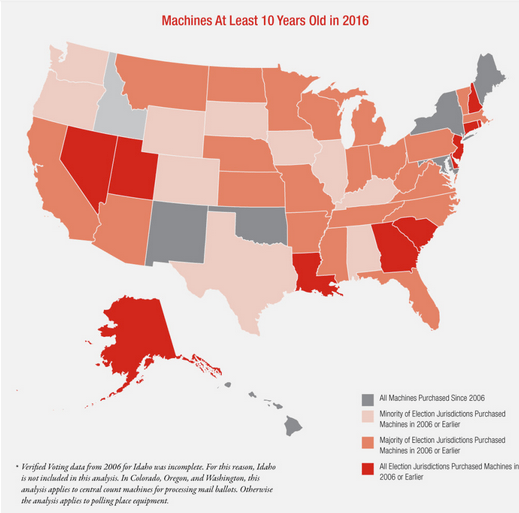
Meanwhile, according to a September 2015 study (.pdf) by the Brennan Center for Justice at New York University’s School of Law, South Carolina uses all machines more than ten years old. In fact, drawing on the source of the Brennan Center report over at Verified Voting, South Carolina uses provably hackable voting machines without a verified paper trail. Virtually all counties in South Carolina use two machines in particular – Electronic Systems and Software’s (ES&S) iVotronic, a touch screen voting machine without a paper trail, and ES&S’s Model 100, used to tabulate absentee and provisional ballots.

Kim Zetter, the best reporter on hacking and computer security at Wired Magazine, delved into the Brennan Center report with an article entitled “The Dismal State of America’s Decade-Old Voting Machines.” Zetter noted that in 2002, after the Bush v. Gore disaster, Congress passed the Help America Vote Act (HAVA) with billions of dollars available for counties throughout the U.S. to upgrade to new voting machines. Zetter then hits the critical point for discussion of election fraud allegations in the Democratic presidential primary:

But many of the machines installed then, which are still in use today, were never properly vetted—the initial voting standards and testing processes turned out to be highly flawed—and ultimately introduced new problems in the form of insecure software code and design.

Things are dismal, yes, but they are not evenly so. As this map from the Brennan Center report shows, there are just a few states that are as bad off as South Carolina (all machines ten years old or greater). But there are also just as few states that are relatively well off with all machines newer than ten years old.

state-by-state-10-year-old-voting-machines

Of the nine places where the exit polling has missed by more than 7% (South Carolina, Alabama, Georgia, Massachusetts, Tennessee, Texas, Mississippi, Ohio, New York), two-thirds are states where all or the majority of election jurisdictions are using machines ten years old or greater. For these six states the average initial exit polling miss is a whopping 9.98%. From my column on exit polling misses last week, the average exit polling miss in Clinton’s favor is 5.1%. For the three states (Oklahoma, New York, Maryland) for which there is polling and for which all election jurisdictions use machines less than ten years old (gray in the map), the average is just a 1.67% miss in Clinton’s favor. Now take note, this 1.67% average includes New York with its huge miss in Clinton’s favor. Alabama is also worth looking at, with a minority of jurisdictions having machines more than ten years old, because I have been using an “Alabama Test” to see whether theories for the exit polling misses make sense.

I put figures like this to exit pollster and Executive Vice President of Edison Research Joe Lenski for question 10, which I’d previously left out of the published version of the interview I completed with him. I wanted to know whether the gap in exit polling misses raised any red flags. Here was Lenski’s reply:

The reliability of vote equipment is a true concern but I don’t see any evidence how the concentration of older voting machines in certain states would have affected either candidate more than the other.  There are many examples of vote count errors.  Here is a link reporting a recent vote count error in the Michigan primary that inflated Ted Cruz’s vote by 3000 votes  http://uselectionatlas.org/WEBLOGS/dave/ .  These types of errors are discovered all the time but there is no evidence that these are anything more than mistakes by local election officials – not a systematic attempt to affect a single candidate’s vote totals.  This reminds me of theories after the 2008 New Hampshire Democratic Primary based upon the fact that Hillary Clinton did better in towns with voting machines while Barack Obama did better in towns that voted on paper.  That was simply an artifact of the demographics in New Hampshire of the towns that had voting machines versus those that voted on paper.  Again the states with older voting machines in 2016 may just be the same states with demographics that favored Hillary Clinton over Bernie Sanders.

But again, as I argued last Wednesday, the demographics by state and other proposed reasons for exit polling misses do not actually add up. Big misses have happened in the South, in Massachusetts, and also in Ohio where Sanders otherwise did quite well in the Midwest. Nor do age or early voting patterns predict exit polling misses. Still, what is most remarkable about Lenski’s statement is that he is one of the few non-tech experts we spoke with who recognized that the “reliability of voting equipment is a true concern.”

None of the three elections academics I spoke with for last Wednesday’s piece appeared to be familiar with the Brennan Center report on aging and vulnerable machines, and Antonio Gonzalez, an exit polling expert and Latino voter registration guru who called for parties not to seat Arizona’s delegations in last Thursday’s piece, seemed a bit floored when I presented him with question ten from my interview with Lenski. “Oh,” he said, “I thought Congress was supposed to have taken care of that with HAVA.” HAVA, as noted earlier, offered money from 2002 to 2006 for states to upgrade to the then latest and greatest voting technology.

At this point we should take a look at the proven flaws in four very old and hackable machines in particular. These machines or similar elderly and vulnerable machines are in use in almost all places where Clinton outperforms exit polling most substantially. Because I am taking evidence and counter-evidence seriously, we will also look at the machines used in New York City, which are not quite so old (about six or seven years). While those machines, ES&S’s DS200, have had several problems over the years of the type suggested by Lenski, they also have not verifiably flunked independent security tests, so far as I know.

AccuVote (TS, OS, TSX models)

AccuVote technology is among the worst of the worst. This is the Diebold technology hacked in the Hacking Democracy clip. It is more than ten years old, can be hacked in such a way that even those models (OS, TSX) with a paper trail can be tricked, and it is in use throughout Georgia (12.2% miss) and in more than 300 counties or other election jurisdictions in more than 20 states.

AVC Edge and Edge II  (from my column on Chicago Friday)

The AVC Edge and Edge II (with paper trail) were provably hacked by a “Red Team” from UC Santa Barbara hired by the State of California in 2008. Jim Allen, spokesman for the Chicago Board of Elections, called and emailed to complain after my article last Friday. He dismissed the suggestion that Edge II could be hacked because of the paper trail. Not only is this laughable since his team engaged in a wildly inaccurate audit of the paper trail from the Chicago Democratic primary, but Allen apparently failed to click on the linkregarding the UCSB Red Team test that I included in the article. The first paragraph of that article notes that Edge machines, “even those with a so-called Voter Verified Paper Trail” can be successfully hacked by a single person. AVC Edge machines are in use without a paper trail throughout Louisiana (where there were no exit polls but where Clinton seriously outperformed her pre-election day polling average) and in more than 130 counties in various other states.

Model 100 (from ES&S)

Model 100 also badly flunked (.pdf) the California “Red Team” test in 2008. Like the other machines in this list, it is hackable in a way that spreads virally to other machines in the same network. Hundreds of jurisdictions still use Model 100 to tabulate votes, including especially Wayne County (Detroit), 27 counties in Ohio, 9 counties in Tennessee, 78 counties in Texas, and many more that match very well with where Clinton has outperformed exit polls.

iVotronic (ES&S)

iVotronic machines are touchscreen voting machines, many without a paper trail. iVotronic machines flunked a University of Pennsylvania test in 2007 and are the precise machines in question in the previous suspicious Democratic primary results in South Carolina in 2010. They continue to be used throughout South Carolina (no paper trail) and in hundreds of counties in states where Clinton has suspiciously overperformed exit polling.

DS200

DS200 machines have had a wide variety of malfunctioning problems, particularly in New York City, but those problems can and mostly have been addressed in places like New York City by retraining poll workers to check immediately whether each voters’ vote was counted and then offering a new chance to vote if necessary. As stated, the DS200 has not been provably hacked so far as I know. Newer machines of this sort were put into use just this year in Maryland where the overall exit polling missed in Sanders favor, for once, but by just 0.6 points. Still, the votes in Baltimore County have now been decertifiedbecause, among other things, there were more votes than voters who checked in at the polls. In Maryland, the DS200 machines are all networked to a statewide system for tabulating votes quickly. Networking, however, is not required, and my best information suggests that networking is not how the DS200 is used in New York City. Instead, precinct workers pull the results off the machine at the end of the voting day and relay them to county headquarters, according to my discussions with a poll worker from Brooklyn.

What About the Exceptions to This Correlation?

But we also would have to deal with where there are exceptions to this strong correlation between hackable machines and Clinton beating the exit polling badly. Here’s where my conversation with a particular veteran hacker comes into play. I chatted securely with a long-time member of Anonymous whom I’ll call the King of SciAm (not the handle they use publicly or privately). The King of SciAm has long worked with the Telecommix branch of Anonymous. Telecommix rose to fame when Hosni Mubarak cut off internet access in Egypt during the Arab Spring uprising. Telecommix found work-arounds via dial-up internet to keep information from activists on the ground flowing out of Egypt. As a general rule, Telecommix does not take part in Anonymous leaks or website shutdowns and defacements, but they made an exception to that rule early in this campaign cycle. Telecommix members defaced Donald Trump’s website with a tribute to Jon Stewart upon his retirement. The New Yorker’s Alex Koppleman called it the “classiest website hack ever,” a compliment the King of SciAm relishes.

The King of SciAm emphasized to me that, if hired to hack an election (which they would never do), the first thing they would do would be to figure out the best way to leave no trace: “we’d target the network packets or their headwater.” The key idea being for “a hack to survive the security audit trail after the vote is certified.” Furthermore, “we would likely try to target the thing most likely to get it’s logs wiped first – so – whatever it plugs into to move the data. Are the voting machines in use network connected?”

The King of SciAm told me that targeting old, provably hackable machines is “not an unfair theory,” but “you asked how (if we did these sort of things) we would do them.” The problem, they noted, “is that any change to the voting machine operating system or driver stack will likely be found in the security auditor’s rotation pretty quickly. This is because once the machines are down (end of election day) – they are no longer accessible to revert any source code changes or wipe any logs that said you were there, unless you’ve written STUXnet – in which case you wouldn’t be targeting the booth machines either.”

The King of SciAm was not at all surprised that sloppy hackers may be targeting older machines in places like South Carolina and Chicago, nor that elections officials were cluelessly trusting those machines and not even properly following procedures that could catch a less sophisticated hack.

So if, instead of targeting the DS200 in New York, hackers had targeted further upstream in the voting ecosystem, how would you catch it? The King of SciAm noted that you would have to use some procedure to “match 100% of the data, not 5%,” as in Chicago.

To do this, you would need to use a methodology much more like that used in the FiveThirtyEight article on irregularities in the South Carolina 2010 primary election. There, FiveThirtyEight referred to a Benford’s law test on precinct level results. That test showed an “unusual, non-random pattern in the precinct-level results suggest[ing] tampering, or at least machine malfunction, perhaps at the highest level.”

Intriguingly, after I began this series on election fraud allegations, a reader who would like to remain anonymous, emailed to point out similar irregularities in New York’s Democratic primary this year:

Results for Kings County and Bronx county [show] deviation from perfect 60-40 and 70-30 results was the same 0.035% The increase in votes in Kings (Brooklyn) from 2008 is incredible, almost a perfect 10%. Not only that but that’s where over a 100,000 voters lost their right to vote. Another 20,000 votes in Kings would mean almost a 20% increase which would be amazing compared to other counties that experienced decreases or mild increases. 

Furthermore, the overall results in New York, as announced on election night, deviated from a perfect 58-42 split “by 0.005345%. That’s 97 votes out of over 1.8 million.” Will FiveThirtyEight apply a Benford’s law test to 2016 primary results? Not a chance. They have boosted Clinton throughout and are already quite embarrassed by how badly they missed on the GOP side with Donald Trump.

But what about our test? The “Alabama Test.” What’s good for the goose is good for the gander. Alabama only has a minority of jurisdictions using old, provably hackable machines. Is that a weak correlation for the theory that in most places sloppy hackers targeted old, provably vulnerable machines while apparently more sophisticated hackers would have had to have been involved with targeting New York’s results as well as registration switching operations in a wide variety of states?

Taking a look at Alabama on a county level gives us a fairly strong answer. Most of Alabama’s counties also use hand cast ballots tabulated by the DS200, but a minority use Model 100, one of our flunked election machines. Three of the flunked Model 100 counties, however, are three of the four biggest counties in Alabama (Jefferson, Mobile, and Montgomery) and accounted for around 40% of the vote for Democrats in Alabama. Clinton won by a 64.2% spread in Jefferson, by 66.5% in Mobile, and by a stunning 73.4% in Montgomery. What happened in Madison, the one county of the top four by population that votes using the DS200 model? Clinton won by just a 38.5% spread! In fact, Clinton did not make it to 80% of the vote in any of the top twelve counties by population except for those three counties using Model 100 to tabulate votes.

And controlling for factors like African American voters or wealth does not account for this phenomenon. Take for instance Mobile where the population is 35.3% black versus a 24.6% black population in Madison County. A 10% difference in black population does not account for a 28% difference in the Clinton-Sanders spread. What’s more, if you compare Mobile to a very similar county in North Carolina (where the exit polls did not really miss), you see something similarly telling.

Cumberland County, NC is very comparative to Mobile, Alabama. They have similar populations, similar numbers of black residents (with Cumberland slightly higher at 37.6% African American), very similar per capita income figures, and both counties had about 35,000 Democratic voters. Clinton won Cumberland by 32.8%, very close to the Madison County (DS200 model) results and about half the percentage spread Clinton saw in Mobile (Model 100).

Of the theories we have so far for why exit polling missed in Alabama by a huge 14%, the only theory that provides a reasonable explanation is vote tabulating machine tampering. Now, perhaps someone else will come up with a non-fraudulent exit polling miss theory that passes the Alabama Test and explains other states as well. Such a theory cannot be about early voting (Alabama had none) and over-projecting young voters (there were very few according to exit polls of Alabama).

Until someone comes up with such a workable theory, election fraud benefiting Hillary Clinton to the tune of a 120 to 150 pledged delegate difference, is the best explanation we have. People wanting to prove this theory should be suing for a technologically sophisticated and independent review of results and the voting results’ entire computer ecosystems in places like Ohio, South Carolina, Alabama, Boston, Chicago, New York, and many others.

Part 1: Taking Election Fraud Allegations Seriously
Part 2: Debunking Some Election Fraud Allegations
Part 3: In-depth Report on Exit Polling and Election Fraud Allegations
An Interview With Lead Edison Exit Pollster Joe Lenski
Part 4: Purged, Hacked, Switched
Part 5: Chicago Election Official Admits “Numbers Didn’t Match”

Doug Johnson Hatlem is best known for his work as a street pastor and advocate with Toronto’s homeless population from 2005-2013. He is now a film producer and free-lance writer based in Chicago.