
A closer look at the events surrounding Bari Weiss’ resignation suggests she omitted some critical details about her toxic presence inside the paper, and may have staged her resignation to drum up publicity for her next move.
By Max Blumenthal and Ben Norton
Source: The Grayzone
Neoconservative New York Times columnist Bari Weiss quit the newspaper on July 14. In a resignation letter published on her personal website, the pundit lamented a supposed “illiberal environment” at the publication in which Weiss’ colleagues mocked her right-wing views, supposedly called her “a Nazi and a racist,” and branded her a “liar and a bigot.”
Weiss’ unexpected departure came days after the hawkish columnist signed a letter in Harper’s Magazine lamenting an “intolerance of opposing views” and demanding an “open debate” in the US media.
The signatories complaining of a “censoriousness” environment included architects of disastrous US military interventions, anti-Palestinian fanatics, and some of the most powerful people in the media, including many who have spent decades censoring anyone to the left of them – and even attempting to cancel entire countries.
But there may have been more to Weiss’ dramatic resignation than her revulsion with the “illiberal” culture of a paper that had recruited her and several neocon allies. A closer look at the events surrounding her departure suggests she likely omitted some critical details about her toxic presence inside the paper, and may have staged her resignation to drum up publicity for her next move.
A neocon network rises inside the Times, embarrassment and outrage ensues
Back on June 3, neoconservative Sen. Tom Cotton published an op-ed in the New York Times calling for the US military to crack down on Americans protesting lethal police violence. The decision to publish the editorial touched off outrage among Times staff, with many demanding to know how such a fascistic piece made it into print.
It turned out that the staffer who edited the piece, Adam Rubenstein, was a card-carrying neocon hired by the Times in early 2019. Rubenstein was a former editor for the now-defunct Weekly Standard founded by William Kristol – the neocon leader responsible for rustling up pro-Israel money to support Cotton’s electoral ambitions.
New York Times staff claimed that the Cotton op-ed “was edited” by Rubenstein and other staffers “had not been aware of the article before it was published.”
The editorial disaster prompted the dismissal of op-ed page editor James Bennet, who had initially defended running Cotton’s screed.
Before joining the Weekly Standard, Rubenstein was a pro-Israel activist at Kenyon College who once attempted to cancel an appearance by the Palestian poet Remi Kanazi on the grounds that Kanazi was “part of a focus-grouped and incubated hatred.”
Rubenstein’s hiring by the Times complimented its hiring of Bari Weiss and fellow anti-Palestinian bigot Bret Stephens in 2017. In her resignation letter, Weiss acknowledged, “I was hired with the goal of bringing in voices that would not otherwise appear in [the Times’] pages: first-time writers, centrists, conservatives.”
In 2018, Weiss and Stephens responded to a critic who had called them “Zionist fanatics of near-unhinged proportions.” The two retorted: “The word ‘near’ should not have been a part of the sentence. Otherwise, we happily plead guilty as charged.”
When Rubenstein joined them at the paper, he became Weiss’s personal editor. Both Weiss and Stephens had risen to prominence at the op-ed page of the Wall Street Journal, where Rubenstein had also worked as a Robert Bartley Fellow.
In August 2019, Stephens provoked embarrassment for himself and his employers when he fired off an angry email to the employer of a George Washington University professor, David Karpf, who had compared him on Twitter to a bedbug. As Twitter users bombarded Stephens with a wave of ridicule, the NY Times apparently compelled Stephens to delete his Twitter account – but not before he staged a public meltdown in which he compared Karpf to “totalitarian regimes” and Nazis seeking to exterminate Jews.
When the Cotton column calling for a military crackdown on Black Lives Matter ran less than a year later, the Times’ neocon problem finally came to a head.
This June 5, as 300 non-editorial staffers planned a virtual walkout, Times publisher A.G. Sulzberger convened an all-hands meeting. During the question-and-answer session, according to a report by Vice, employees demanded to know “whether Opinion staff editor and writer Bari Weiss would be fired for ‘openly bad mouth[ing] younger news colleagues on a platform where they, because of strict company policy, could not defend themselves’; whether the opinion section had suggested the topic of the op-ed to Cotton; and what the Times would do to help retain and support Black employees.”
Times staff seemed to be pointing a finger at Weiss and her neocon network for soliciting the Cotton op-ed.
When Weiss resigned on July 14, she complained that colleagues “have called me a Nazi and a racist… Several colleagues perceived to be friendly with me were badgered by coworkers.” Yet she failed to acknowledge her apparent role in the Cotton op-ed affair, which was clearly the source of her colleagues’ outrage, painting herself instead as a blameless victim of “illiberal” cancel culture.
On the day that Weiss staged her dramatic self-expulsion, Andrew Sullivan – a center-right political ally of Weiss who has vigorously supported her – resigned from New York Magazine.
Sullivan eventually revealed that he was moving to another publication, and possibly one that had not yet launched.
While Sullivan does not share the Likudnik politics of Weiss, he enjoys some notable institutional and personal links to her political network. As the former editor of The New Republic, Sullivan worked under the direction of the magazine’s fanatically pro-Israel former publisher, Marty Peretz, who has since relocated to Tel Aviv. Peretz’s daughter, Evgenia, published a fawning profile of Weiss in Vanity Fair in April 2019, portraying her as an inspiring new talent who was “genuinely fueled by curiosity, the desire to connect, to cross boundaries and try out new things.”
During the time Sullivan and Peretz ran The New Republic, the magazine was funded by the pro-Israel businessman Roger Hertog. Hertog also plowed his fortune into the Shalem Center to launch a training institute for young pro-Israel pundits in 2002.
Among the first interns to pass through the Shalem training school was a Columbia University student named Bari Weiss. (Weiss’ editor at the NY Times, Rubenstein, had also been involved in the Hertog Foundation).
Whether or not Weiss plans to join Sullivan at a new outlet for disgruntled anti-SJW centrists, the circumstances surrounding her self-expulsion reveal her resignation letter as an insincere whitewash.
Besides the possibility that Weiss’ departure was a PR stunt, there is the fact that she has spent a large portion of her adult life working to cancel Palestinian academics and left-wing politicians while howling about the rise of a totalitarian “cancel culture.”
A self-styled free thinker campaigns to silence left-wing dissenters
Before Bari Weiss branded herself as an avatar of free thought, she established herself as the queen of a particular kind of cancel culture. The 36-year-old pundit has dedicated a significant portion of her adult life to destroying the careers of critics of Israel, tarring them as anti-Semites, and carrying out the kind of defamation campaigns that would result in her targets losing their jobs.
The pundit has shown a particular obsession with Palestinian-American scholar Joseph Massad and the New York City-based Palestinian-American activist Linda Sarsour. Other targets have included Keith Ellison, the Minnesota Attorney General who was the first Muslim elected to Congress, and Rep. Tulsi Gabbard, an ardent opponent of US regime change wars.
There is also ample evidence that while at Columbia University, Weiss helped bring down the dean of Columbia’s School of International and Public Affairs, Lisa Anderson, for inviting Iran’s then-President Mahmoud Ahmadenijad to speak on campus. Anderson’s son has pointed to Weiss as a key factor in her resignation:
https://twitter.com/finds_you_well/status/971771300879458304
In her resignation letter, Weiss found space to castigate the Times for publishing an interview with renowned African-American author Alice Walker, whom she casually defamed as “a proud anti-Semite who believes in lizard Illuminati.”
Weiss also flexed her bona fides as a proud neoconservative activist, saying she was “honored” to have given the world’s most prestigious media platform to a slew of regime-change activists from countries targeted by the US national security for overthrow, including Venezuela, Iran, and Hong Kong, along with notorious Islamophobe Ayaan Hirsi Ali and Chloe Valdary – a fellow Israel lobby product who previously worked as an intern for Bret Stephens.
In her three-year career as an editor of the opinion section of the newspaper of record, Weiss devoted a significant chunk of her columns to attacking her left-wing critics, while complaining endlessly of the haters in her Twitter mentions (which is risible given her lamentation in her resignation letter that “Twitter has become [the Times’] ultimate editor”).
In her 2019 book, Weiss condemned the pro-Palestine left as a whole. She insisted the idea that Zionism is a colonialist and racist movement is an anti-Semitic “Soviet conspiracy;” that the UK Labour Party under leader Jeremy Corbyn was a “hub of Jew hatred,” and that “leftist anti-Semites” are “more insidious and perhaps existentially dangerous” than far-right “Hitlerian anti-Semites.”
It is worth reviewing this historical record to show how Cancel Queen Bari Weiss’ apparent change of heart on cancel culture might more appropriately be described as an opportunist career choice.
Bari Weiss’ campaigns to cancel Palestinians Joseph Massad and Linda Sarsour, and Muslim American politician Keith Ellison
In her 2019 book “How to Fight Anti-Semitism,” Weiss revived her condemnations of Massad, whom she first targeted at Columbia University after interning at the Hertog-funded Shalem Center.
Weiss also argued that New York University (NYU) was rife with anti-Semitism. Her proof? An individual student was told some stupid anti-Semitic comments, and — much more disconcertingly for Weiss – “In December 2018, the student government successfully passed a BDS resolution,” and “NYU gave the President’s Service Award, the school’s highest honor, to Students for Justice in Palestine.”
Massad was hardly the only victim of Bari Weiss’ compulsive cancel culture campaigns. The neoconservative pundit wrote an entire New York Times column in 2017 dedicated to trying to cancel Palestinian-American activist Linda Sarsour.
Rapping progressives over the knuckles for purportedly “embracing hate,” Weiss characterized Sarsour as an unhinged anti-Semite because of her criticism of the colonialist Zionist movement, and worked to disrupt the Women’s March, which Sarsour helped to found.
Then in a tag-team cancel campaign with feverishly pro-war CNN host Jake Tapper (who has his own questionable history with racial issues), they portrayed Sarsour as an extremist for expressing support for former Black Panther leader Assata Shakur, whom they jointly demonized as a “cop-killer fugitive in Cuba.”
Next, Weiss turned her sights on the Democratic Attorney General of Minnesota Keith Ellison, claiming in a 2017 column that he had a “long history of defending and working with anti-Semites.”
Bari Weiss attempts to cancel Tulsi Gabbard
Bari Weiss’ cancelation rampage continued without a moment of self-reflection.
In an interview with podcaster Joe Rogan in January 2019, the pundit tried to cancel Hawaii Representative Tulsi Gabbard because of her work advocating against the international proxy war on Syria.
When Rogan mentioned Gabbard’s name, Weiss scoffed that the congresswoman is “monstrous,” smearing her an “Assad toady,” in reference to the Syrian leader Bashar al-Assad. Confused, Rogan asked Weiss what exactly that meant. The bumbling New York Times pundit could not answer, unable to define or even spell the insult.
Bari Weiss claims “leftist anti-Semitism” is worse than “Hitlerian anti-Semitism”
Bari Weiss’ most extreme views on Israel-Palestine and the left can be seen in her 2019 book How to Fight Anti-Semitism. In this tome, the neoconservative writer set out to cancel the pro-Palestinian anti-racist left as a whole by arguing that supposed “leftist anti-Semitism” is more dangerous than “Hitlerian anti-Semitism.”
Weiss wrote:
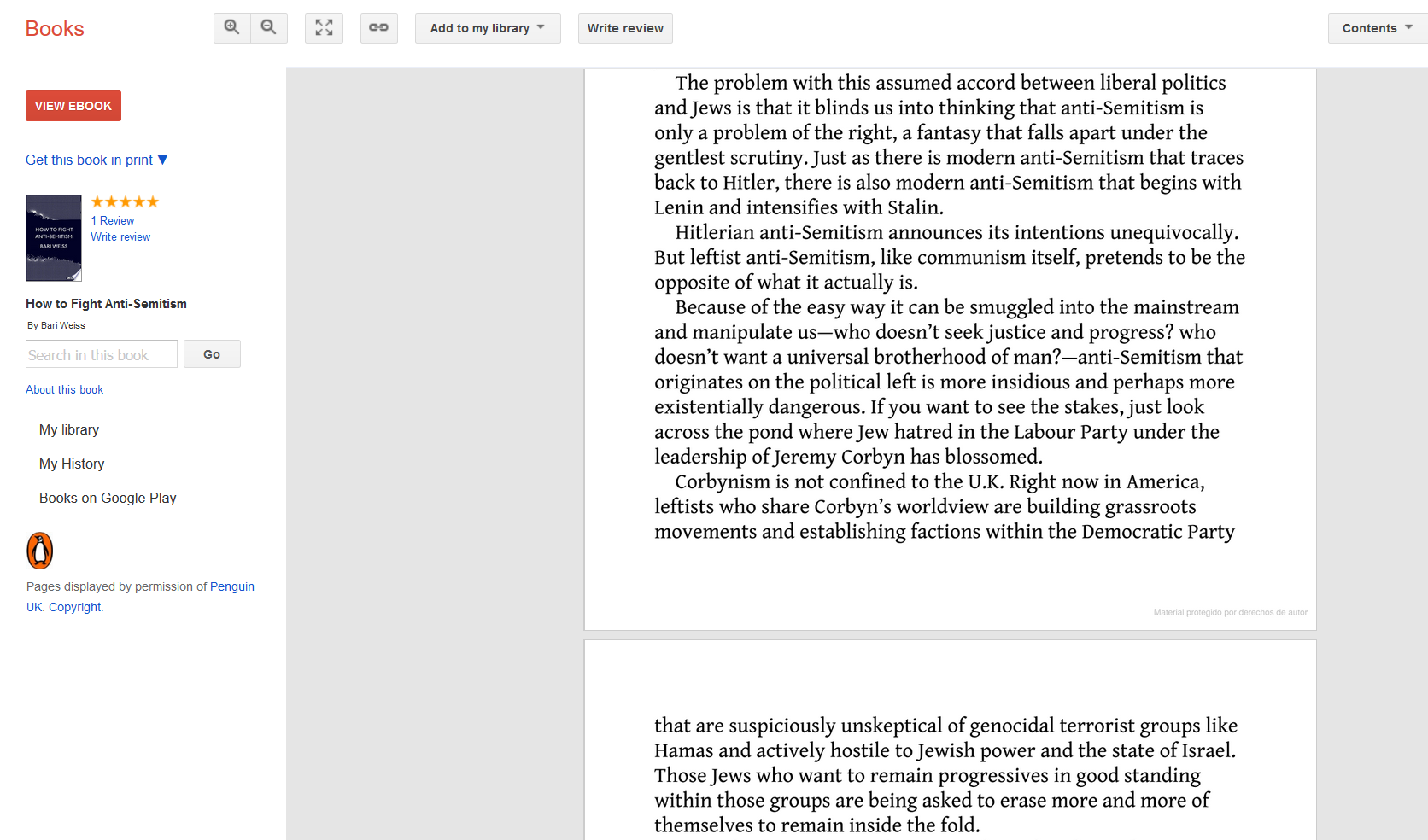
“Hitlerian anti-Semitism announces its intentions unequivocally. But leftist anti-Semitism, like communism itself, pretends to be the opposition of what it actually is.
“Because of the easy way it can be smuggled into the mainstream and manipulate us – who doesn’t seek justice and progress? who doesn’t want a universal brotherhood of man? – anti-Semitism that originates on the political left is more insidious and perhaps existentially dangerous [than on the right].”
When she says “leftist anti-Semitism,” Weiss almost invariably means progressive criticism of Israeli apartheid, racism, and brutality against the indigenous Palestinian population.
If that wasn’t already obvious, Weiss spelled it out:
“If you want to see the stakes, just look across the pond, where Jeremy Corbyn, an anti-Semite, has successfully transformed one of the country’s great parties into a hub of Jew hatred.
“Corbynism is not confided to the U.K. Right now in America, leftists who share Corbyn’s worldview are building grassroots movements and establishing factions with the Democratic Party that are suspiciously unskeptical of genocidal terrorist groups like Hamas and actively hostile to Jewish power and the state of Israel.”
In her book, Weiss insisted the idea that Zionism is a colonialist and racist movement is the product of a “Soviet conspiracy” spread by USSR in order to destroy Israel. She expressly ignored the words of the father of Zionism himself, Theodor Herzl, who wrote that Zionism “is a colonial idea” and requested help from British colonialists, including colonial master Cecil Rhodes.
“Progressives have, knowingly or unknowingly, embraced the Soviet lie that Israel is a colonialist outpost that should be opposed,” Weiss lamented.
“In the most elite spaces across the country, people declare, unthinkingly, that Israel is a racist state and that Zionism is racism, without realizing that they are participating in a Soviet conspiracy, without realizing that they are aligning themselves with the greatest mass murderers in modern history,” she bemoaned.
Not mincing her words, Weiss concluded, “When anti-Zionism becomes a normative political position, active anti-Semitism becomes the norm.”
With these passages, it became clear that her How to Fight Anti-Semitism was a book-length attempt to cancel anti-Zionists as a whole, by conflating their opposition to Israeli apartheid as anti-Semitism.
Anyone who disputes that Israel is “a political and historical miracle” is secretly a Jew hater, Weiss has argued. She effused, “That I can walk the streets of Tel Aviv today as a feminist woman in a tank top,” she marveled, “that it is a free and liberated society in the middle of the Middle East, is an achievement so great that it is often hard for many people to grasp.”
As with much of the content Weiss produces, her gushing praise for Israel’s supposedly “liberated society” could have been lifted from a propaganda pamphlet distributed on campus by a pro-Israel lobbying outfit. But it was never quality writing or original ideas that won Weiss the attention she sought, and which has virtually ensured she will be “cancelled” into a new, high-profile position in the mainstream commentariat.

 After the Crash