It’s A Fact That Needs Repeating: The Federal Reserve Is A Suicide Bomber

By Brandon Smith

Source: Alt-Market.us

For many years now I have been examining the policies and behaviors of the Federal Reserve because they are in fact the most powerful institution in the US, with far more influence over the fate of America than any single president or branch of government. They have the power to end the economic life of our country in a matter of moments. They hold their finger on the button of multiple financial nuclear bombs, and to this day there are people that still pretend as if they are a mere moderating presence subservient to the White House or Congress.

This is a fallacy proven by history and the admissions from central bankers own mouths. The Fed answers to no one in our government. They answer to a different set of masters, and the blame for the consequences of their policies falls to them and their cohorts.

Last year I published an article titled ‘The Fed’s Catch-22 Taper Is A Weapon, Not A Policy Error.’ In that article I predicted that the Fed would embark on a hiking spree on interest rates in response to inflationary/stagflationary events. I noted that:

We are now at that stage again where price inflation tied to money printing is clashing with the stock market’s complete reliance on stimulus to stay afloat. There are some that continue to claim the Fed will never sacrifice the markets by tapering. I say the Fed does not actually care, it is only waiting for the right time to pull the plug on the US economy.”

At the time I received a lot of resistance to the idea. The usual argument was: “The fed will never raise rates and put stock markets at risk. Why would they destroy the golden goose?”

This position showcases a common misconception about the central bank and its purpose. You see, a lot of people think the Fed exists to keep the US economy afloat, and specifically to keep stock markets afloat. This is incorrect. Every single policy of the Fed since its inception has been a long train of abuses designed to slowly and scientifically whittle down the US economy and bring it to the point of extinction.

The next most common argument is: “Wouldn’t the fed sabotaging the economy eventually destroy them as well?”

The answer is YES, and they don’t care. If you have read my previous work on this issue then you know that the Fed is inexorably tied to the Bank for International Settlements (the “central bank of central banks”) and that they call the shots in terms of coordinated global banking initiatives. The BIS is a globalist institution, not an American one, and its agenda is ideologically globalist in nature. The Fed is a servant of globalism; and if the US economy or our currency need to be brought down through a controlled demolition in order to make the globalist dream of a one world socialist “Utopia” come true, that is exactly what the Fed will do.

I was able to predict that the Fed would continue onward with its interest rate hikes and hawkish position only because I acknowledge what the Fed really is: A suicide bomber. And, they have decided the time is ripe to hike interest rates into economic weakness, just like they did at the onset of the Great Depression.

At the beginning of the Depression the Fed increased interest rates after years of artificially stimulating markets with low cost debt. This prolonged the deflationary crash for many years after. It was not until decades later when former Fed chair Ben Bernanke gave a speech celebrating economist Milton Friedman’s 90th birthday that a central bank official finally admitted that the organization was culpable for the Depression debacle.

In short, according to Friedman and Schwartz, because of institutional changes and misguided doctrines, the banking panics of the Great Contraction were much more severe and widespread than would have normally occurred during a downturn.

Let me end my talk by abusing slightly my status as an official representative of the Federal Reserve. I would like to say to Milton and Anna: Regarding the Great Depression. You’re right, we did it. We’re very sorry. But thanks to you, we won’t do it again.” – Ben Bernanke, 2002

What Ben Bernanke did not admit to was that the engineered deflationary crisis greatly benefited the allies of the Fed – The international corporate bankers. Companies like JP Morgan and Chase National were suddenly in a prime position to seize unlimited power in the US.

So, they’ve done it before, why wouldn’t they do it again?

The next argument that I hear constantly is that the Fed is “ignorant” and they don’t know what they are doing. This is nonsense. Jerome Powell knows EXACTLY what he is doing, and here is the proof – In October of 2012 the Fed held a meeting in which Powell warned that markets and corporations had become addicted to the Fed’s easy money policies. If they decided to taper their stimulus measures and raise rates, there would be potentially disastrous blowback. Powell argued that:

“…I think we are actually at a point of encouraging risk-taking, and that should give us pause. Investors really do understand now that we will be there to prevent serious losses. It is not that it is easy for them to make money but that they have every incentive to take more risk, and they are doing so. Meanwhile, we look like we are blowing a fixed-income duration bubble right across the credit spectrum that will result in big losses when rates come up down the road. You can almost say that that is our strategy.” – Jerome Powell

As he admitted, it is indeed their strategy. Powell was not the Fed chairman at the time, so he may not have been aware of the full agenda, but he is certainly aware now. Why would Powell undertake the exact policy action he once warned would result in a full spectrum implosion of the credit bubble? Probably because he was told to.

Powell knows the history of the Great Depression and he knows what will happen when the Fed raises rates into economic weakness and he is doing it anyway. He already tried a test run of rate hikes back in 2018 and the results were not hard to figure out; markets began to tank. We should never forget that the central banks are fully cognizant of the effects of their endeavors. As I stated back in February:

The rate hikes of 2018 were a test run for a more aggressive and deliberately engineered crisis down the road. The Fed has its own agenda, it does not care about protecting U.S. markets, nor does it even care about protecting the U.S. economy in general.

I hold that the Fed is a weapon for social and political change within America and part of its job is to greatly reduce the standard of living of the population while making it appear as if this decline is a “natural” consequence of the U.S. System.”

This leads us to the final question – What happens next?

That’s easy to answer: The fed continues to hike rates well into next year and will not reverse course or capitulate and return to stimulus. The dovish predictions were wrong. The people that said the Fed would not raise rates were wrong. The people that said the Fed would never remove support from stock markets were wrong. This process is ongoing and the effects will grow as the months pass, but those that were hoping for a manic return to the days of bailouts and QE are going to be deeply disappointed.

This is a stagflationary crash, and as such we are going to experience the worst of both deflationary and inflationary worlds. Prices will remain high while GDP goes negative. Sales will decline and jobs will decline as we enter into the end of this year. There is no way around this. The Fed will have all kinds of theories and misdirections on why these things are happening, and they will try to distract the public as much as possible in the meantime.

What the Fed will never do is admit that a crash is happening until it is too late for people to act. They will never warn the populace of the dangers and they will never tell people to prepare. Watch as they tap dance and tell the public that all the pain is “transitory.” Then, watch as the dust settles and they tell people that “no one could have seen this coming.” It’s all very predictable, because it’s all been done before.

Stagflation Subterfuge: The Real Disaster Hidden By The Pandemic

By Brandon Smith

Source: Alt-Market.us

In recent economic news, headlines are being dominated by concerns over rising bond yields. Increased bond yields are a sign of a possible spike in inflation and, logically, they call for the Federal Reserve to raise interest rates in order to prevent that inflation.

Higher bond yields also mean there is a competitive alternative to stocks for investors – both factors that could trigger a plunge in the stock market.

If one studies the real history behind the stock market crash during the Great Depression, they will find that it was the Federal Reserve’s interest rate hikes that caused and prolonged the disaster after they had created an environment of cheap and easy money throughout the 1920s. Former Chairman Ben Bernanke openly admitted the Fed was responsible back in 2002 in a speech honoring Milton Friedman. He stated:

“In short, according to Friedman and Schwartz, because of institutional changes and misguided doctrines, the banking panics of the Great Contraction were much more severe and widespread than would have normally occurred during a downturn. Let me end my talk by abusing slightly my status as an official representative of the Federal Reserve. I would like to say to Milton and Anna: Regarding the Great Depression. You’re right, we did it. We’re very sorry. But thanks to you, we won’t do it again.”

This then raises the question – inflation or deflation? Will the Fed “do it again?”

Probably not in exactly the same way, but we will see elements of both inflation and deflation soon in the form of stagflation.

It’s a Catch-22 that the central bank has created, and many (including myself) believe that the Fed has created the conundrum deliberately. All central banks are tied together by the Bank for International Settlements (BIS) and the BIS is a globalist institution through and through. The globalist agenda seeks to trigger what they call the “Great Reset,” a complete reformation of the global economy and capitalism into a single one world socialist system… managed by the globalists themselves, of course.

In my view the Fed has always been a kind of institutional suicide bomber; its job is to self-destruct at the right moment and take the U.S. economy down with it, all in the name of spreading its cult-like globalist ideology.

The only unknown at this point is how they will go about their sabotage. Will the central bank continue to allow inflation to explode the cost of living in the U.S., or will they intervene with higher interest rates and allow stock markets to crash?

Either way, we face a serious economic crisis in the near future.


Increasing Inflation Means Economic Recovery?

Mainstream economists will often argue that rising yields and inflation are a “good thing.” They claim this is a sign of rapid economic recovery. I disagree.

If “inflation” was the same as “recovery,” then there would not have been total economic collapses in Argentina in 2002, in Yugoslavia in 1994, or in Weimar Germany in the early 1920s.

I do not see recovery. What I see is the rapid devaluation of the dollar’s buying power due to massive fiat printing through stimulus measures. The Fed and the U.S. government are buying a short-term surge in economic activity, but at a hidden cost. This is a condition that the Dollar Index does not even begin to address, but obvious in prices of necessary goods and commodities.

Keep in mind that all of this is being done in the name of responding to the pandemic. The pandemic is the ultimate excuse for the active destruction of the U.S. economy. Stimulus measures have devolved into helicopter money being thrown about haphazardly as billions are siphoned primarily by major corporations and through fraud. People who are clamoring for a $2,000 relief check from the government have no idea that corporate welfare has been ongoing for the past year along with billions in retroactive tax refunds. All of that money printing is going to cause damage somewhere. It cannot be avoided.


It’s Not About The Pandemic

Let’s make something clear first: The pandemic is NOT the reason for the stimulus flood. The pandemic did very little to hurt actual business in the U.S. Rather, it was the lockdowns that did most of the damage.

Think about that for a moment – federal and state governments crushed the economy through lockdowns, then offered the solution of vast stimulus measures. This in turn is destroying financial stability and generating rapid price inflation.

Conservative states and counties that refused to shut down are recovering at a much faster pace than leftist states which imposed draconian restrictions on citizens. Yet, the lockdowns did nothing to stop the spread of COVID-19 in blue states. So, the lockdowns accomplished no discernible advantage for the public, but they did give the central bank a perfect rationale to further erode the dollar.

This resulting price inflation is something that not even the red states can escape.

For example, home prices are rapidly expanding beyond the market bubble of 2006. This is partially due to millions of people participating in perhaps the largest migration in the U.S. since the Great Depression. Anyone who is able is moving away from major cities into suburban and rural areas. But, home prices also have a historic habit of inflating along with currency devaluation. The cost of maintaining and remodeling an older home, or building a new home, rises as the prices of commodities like lumber inflate.

And lumber prices are certainly inflating! Softwood lumber prices are up at least 110% from a year ago, and are climbing as much as 10% in a week.

Home rentals also do not escape inflation, as the rising cost of maintaining properties forces landlords to increase rents. The only places where rents are decreasing are major cities that Americans are seeking to flee, such as New York and San Francisco.


Inflation In More Than Just Housing

The majority of commodities continue to see price inflation across the board. Food and energy prices have been creeping higher for the past year. Governments are once again blaming the pandemic and “stresses on the supply chain,” which may have been a believable claim nine months ago, but not today. Anything to hide the fact that all that stimulus has inflationary consequences.

Dollar devaluation is the most visible in terms of imported goods. In other words, it costs more dollars to buy goods outside the U.S. as the value of the dollar falls. And since the majority of U.S. retail is supplied by foreign producers, this means that average American consumers will suffer the brunt of inflationary consequences. Public stress and anger will be high.


Pandemic Lockdowns Are Just An Excuse

This is why the COVID-19 lockdowns must continue and the pandemic fear factory must remain active. The globalists need a cover event for the Reset and they need to keep the citizenry under control, and the pandemic can be blamed for just about anything. I think this is why we are already seeing the media hyping the existence of “COVID mutations.” Do not be surprised if the Biden Administration tries to implement a national lockdown sometime this year in the name of stopping the spread of a “more deadly” COVID-19 variant.

It won’t matter that the previous lockdowns were useless and all the data shows that keeping the economy open is a superior policy. It might seem like logic is going completely out the window, but there is a very logical reason for what is happening in the minds of globalists.

Stagflation comes into play through losses in certain sectors of the economy, high unemployment and the inability of wages to keep up with costs.

There is the continued dismantling of the small business sector, which, again, I believe is being destroyed deliberately. It’s not a mistake that small businesses were predominantly targeted as “non-essential” during the lockdowns. It’s also not a coincidence that the majority of COVID-19 PPP loans went to big box corporations while small businesses received almost nothing. The small business sector is being erased, leaving only the corporate sector to provide for consumers.

This may be why Democrats are so adamant about raising the federal minimum wage to $15 an hour. Wages are already rising according to market demand and region. The average non-skilled worker in the U.S. is making around $11 an hour. There is no need for the government to interfere, unless they have ulterior motives.

A $15 minimum wage would likely crush what’s left of small businesses, and only corporations that are receiving the bulk of stimulus dollars will be able to afford to pay workers the higher rate. On top of that, years from now the government could claim they “took action” to front-run stagflation by increasing people’s pay. But a $15 minimum wage is most useful to the establishment in the short term because it muddies the waters on the inflation issue.

Prices will continue to rise due to dollar devaluation, but the media and government will say that it has nothing to do with the dollar and everything to do with companies raising shelf prices to offset increased labor costs.


The Biggest Threat In The History Of American Society

I suspect that the establishment will do everything in its power to distract the public from the biggest threat in the history of American society – the stagflationary time bomb.

If they admit to its existence then the public could prepare for it, and they don’t want that. If Americans were to decentralize their local economies, support local small businesses instead of big box retailers, start producing necessities for themselves, and if they started developing currency alternatives like local scrip backed by commodities… then they would be able to survive a national financial crisis.

In fact, I guarantee that any community, county or state that takes these steps will immediately be targeted by the federal government, further revealing the truth: The establishment wants the public to suffer.

They want economic disaster. They do not want people to have the option of taking care of themselves. They need people scared, desperate and malleable, or they will never achieve their Reset agenda.

Exposing the Giants: The Global Power Elite

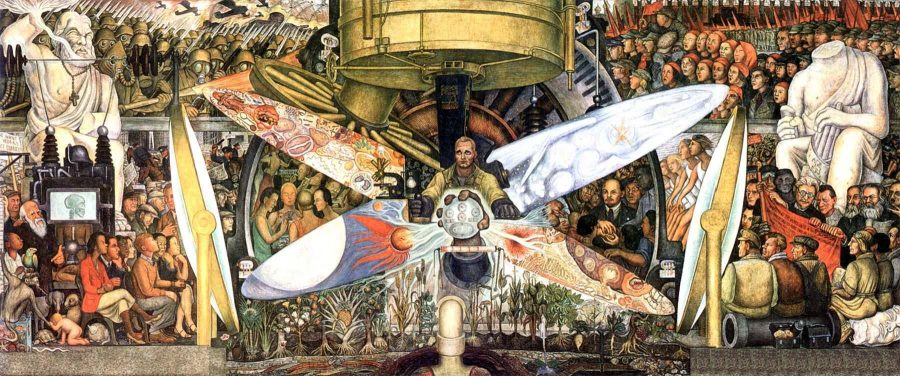
Diego Rivera, Man at the Crossroads/Man, Controller of the Universe, 1933

By Robert J. Burrowes

Developing the tradition charted by C. Wright Mills in his 1956 classic The Power Elite, in his latest book, Professor Peter Phillips starts by reviewing the transition from the nation state power elites described by authors such as Mills to a transnational power elite centralized on the control of global capital.

Thus, in his just-released study Giants: The Global Power Elite, Phillips, a professor of political sociology at Sonoma State University in the USA, identifies the world’s top seventeen asset management firms, such as BlackRock and J.P Morgan Chase, each with more than one trillion dollars of investment capital under management, as the ‘Giants’ of world capitalism. The seventeen firms collectively manage more than $US41.1 trillion in a self-invested network of interlocking capital that spans the globe.

This $41 trillion represents the wealth invested for profit by thousands of millionaires, billionaires and corporations. The seventeen Giants operate in nearly every country in the world and are ‘the central institutions of the financial capital that powers the global economic system’. They invest in anything considered profitable, ranging from ‘agricultural lands on which indigenous farmers are replaced by power elite investors’ to public assets (such as energy and water utilities) to war.

In addition, Phillips identifies the most important networks of the Global Power Elite and the individuals therein. He names 389 individuals (a small number of whom are women and a token number of whom are from countries other than the United States and the wealthier countries of Western Europe) at the core of the policy planning nongovernmental networks that manage, facilitate and defend the continued concentration of global capital. The Global Power Elite perform two key uniting functions, he argues: they provide ideological justifications for their shared interests (promulgated through their corporate media), and define the parameters of action for transnational governmental organizations and capitalist nation-states.

More precisely, Phillips identifies the 199 directors of the seventeen global financial Giants and offers short biographies and public information on their individual net wealth. These individuals are closely interconnected through numerous networks of association including the World Economic Forum, the International Monetary Conference, university affiliations, various policy councils, social clubs, and cultural enterprises. For a taste of one of these clubs, see this account of The Links in New York. As Phillips observes: ‘It is certainly safe to conclude they all know each other personally or know of each other in the shared context of their positions of power.’

The Giants, Phillips documents, invest in each other but also in many hundreds of investment management firms, many of which are near-Giants. This results in tens of trillions of dollars coordinated in a single vast network of global capital controlled by a very small number of people. ‘Their constant objective is to find enough safe investment opportunities for a return on capital that allows for continued growth. Inadequate capital-placement opportunities lead to dangerous speculative investments, buying up of public assets, and permanent war spending.’

Because the directors of these seventeen asset management firms represent the central core of international capital, ‘Individuals can retire or pass away, and other similar people will move into their place, making the overall structure a self-perpetuating network of global capital control. As such, these 199 people share a common goal of maximum return on investments for themselves and their clients, and they may seek to achieve returns by any means necessary – legal or not…. the institutional and structural arrangements within the money management systems of global capital relentlessly seek ways to achieve maximum return on investment, and … the conditions for manipulations – legal or not – are always present.’

Like some researchers before him, Phillips identifies the importance of those transnational institutions that serve a unifying function. The World Bank, International Monetary Fund, G20, G7, World Trade Organization (WTO), World Economic Forum (WEF), Trilateral Commission, Bilderberg Group, Bank for International Settlements, Group of 30 (G30), the Council on Foreign Relations and the International Monetary Conference serve as institutional mechanisms for consensus building within the transnational capitalist class, and power elite policy formulation and implementation. ‘These international institutions serve the interests of the global financial Giants by supporting policies and regulations that seek to protect the free, unrestricted flow of capital and debt collection worldwide.’

But within this network of transnational institutions, Phillips identifies two very important global elite policy-planning organizations: the Group of Thirty (which has 32 members) and the extended executive committee of the Trilateral Commission (which has 55 members). These nonprofit corporations, which each have a research and support staff, formulate elite policy and issue instructions for their implementation by the transnational governmental institutions like the G7, G20, IMF, WTO, and World Bank. Elite policies are also implemented following instruction of the relevant agent, including governments, in the context. These agents then do as they are instructed. Thus, these 85 members (because two overlap) of the Group of Thirty and the Trilateral Commission comprise a central group of facilitators of global capitalism, ensuring that ‘global capital remains safe, secure, and growing’.

So, while many of the major international institutions are controlled by nation-state representatives and central bankers (with proportional power exercised by dominant financial supporters such as the United States and European Union countries), Phillips is more concerned with the transnational policy groups that are nongovernmental because these organizations ‘help to unite TCC power elites as a class’ and the individuals involved in these organizations facilitate world capitalism. ‘They serve as policy elites who seek the continued growth of capital in the world.’

Developing this list of 199 directors of the largest money management firms in the world, Phillips argues, is an important step toward understanding how capitalism works globally today. These global power elite directors make the decisions regarding the investment of trillions of dollars. Supposedly in competition, the concentrated wealth they share requires them to cooperate for their greater good by identifying investment opportunities and shared risk agreements, and working collectively for political arrangements that create advantages for their profit-generating system as a whole.

Their fundamental priority is to secure an average return on investment of 3 to 10 percent, or even more. The nature of any investment is less important than what it yields: continuous returns that support growth in the overall market. Hence, capital investment in tobacco products, weapons of war, toxic chemicals, pollution, and other socially destructive goods and services are judged purely by their profitability. Concern for the social and environmental costs of the investment are non-existent. In other words, inflicting death and destruction are fine because they are profitable.

So what is the global elite’s purpose? In a few sentences Phillips characterizes it thus: The elite is largely united in support of the US/NATO military empire that prosecutes a repressive war against resisting groups – typically labeled ‘terrorists’ – around the world. The real purpose of ‘the war on terror’ is defense of transnational globalization, the unimpeded flow of financial capital around the world, dollar hegemony and access to oil; it has nothing to do with repressing terrorism which it generates, perpetuates and finances to provide cover for its real agenda. This is why the United States has a long history of CIA and military interventions around the world ostensibly in defense of ‘national interests’.


Wealth and Power

An interesting point that emerges for me from reading Phillips thoughtful analysis is that there is a clear distinction between those individuals and families who have wealth and those individuals who have (sometimes significantly) less wealth (which, nevertheless, is still considerable) but, through their positions and connections, wield a great deal of power. As Phillips explains this distinction, ‘the sociology of elites is more important than particular elite individuals and their families’. Just 199 individuals decide how more than $40 trillion will be invested. And this is his central point. Let me briefly elaborate.

There are some really wealthy families in the world, notably including the families Rothschild (France and the United Kingdom), Rockefeller (USA), Goldman-Sachs (USA), Warburgs (Germany), Lehmann (USA), Lazards (France), Kuhn Loebs (USA), Israel Moses Seifs (Italy), Al-Saud (Saudi Arabia), Walton (USA), Koch (USA), Mars (USA), Cargill-MacMillan (USA) and Cox (USA). However, not all of these families overtly seek power to shape the world as they wish.

Similarly, the world’s extremely wealthy individuals such as Jeff Bezos (USA), Bill Gates (USA), Warren Buffett (USA), Bernard Arnault (France), Carlos Slim Helu (Mexico) and Francoise Bettencourt Meyers (France) are not necessarily connected in such a way that they exercise enormous power. In fact, they may have little interest in power as such, despite their obvious interest in wealth.

In essence, some individuals and families are content to simply take advantage of how capitalism and its ancilliary governmental and transnational instruments function while others are more politically engaged in seeking to manipulate major institutions to achieve outcomes that not only maximize their own profit and hence wealth but also shape the world itself.

So if you look at the list of 199 individuals that Phillips identifies at the centre of global capital, it does not include names such as Bezos, Gates, Buffett, Koch, Walton or even Rothschild, Rockefeller or Windsor (the Queen of England) despite their well-known and extraordinary wealth. As an aside, many of these names are also missing from the lists compiled by groups such as Forbes and Bloomberg, but their absence from these lists is for a very different reason given the penchant for many really wealthy individuals and families to avoid certain types of publicity and their power to ensure that they do.

In contrast to the names just listed, in Phillips’ analysis names like Laurence (Larry) Fink (Chairman and CEO of BlackRock), James (Jamie) Dimon (Chairman and CEO of JPMorgan Chase) and John McFarlane (Chairman of Barclays Bank), while not as wealthy as those listed immediately above, wield far more power because of their positions and connections within the global elite network of 199 individuals.

Predictably then, Phillips observes, these three individuals have similar lifestyles and ideological orientations. They believe capitalism is beneficial for the world and while inequality and poverty are important issues, they believe that capital growth will eventually solve these problems. They are relatively non-expressive about environmental issues, but recognize that investment opportunities may change in response to climate ‘modifications’. As millionaires they own multiple homes. They attended elite universities and rose quickly in international finance to reach their current status as giants of the global power elite. ‘The institutions they manage have been shown to engage in illegal collusions with others, but the regulatory fines by governments are essentially seen as just part of doing business.’

In short, as I would characterize this description: They are devoid of a legal or moral framework to guide their actions, whether in relation to business, fellow human beings, war or the environment and climate. They are obviously typical of the elite.

Any apparent concern for people, such as that expressed by Fink and Dimon in response to the racist violence in Charlottesville, USA in August 2017, is simply designed to promote ‘stability’ or more precisely, a stable (that is, profitable) investment and consumer climate.

The lack of concern for people and issues that might concern many of us is also evident from a consideration of the agenda at elite gatherings. Consider the International Monetary Conference. Founded in 1956, it is a private yearly meeting of the top few hundred bankers in the world. The American Bankers Association (ABA) serves as the secretariat for the conference. But, as Phillips notes: ‘Nothing on the agenda seems to address the socioeconomic consequences of investments to determine the impacts on people and the environment.’ A casual perusal of the agenda at any elite gathering reveals that this comment applies equally to any elite forum. See, for example, the agenda of the recent WEF meeting in Davos. Any talk of ‘concern’ is misleading rhetoric.

Hence, in the words of Phillips: The 199 directors of the global Giants are ‘a very select set of people. They all know each other personally or know of each other. At least 69 have attended the annual World Economic Forum, where they often serve on panels or give public presentations. They mostly attended the same elite universities, and interact in upperclass social setting[s] in the major cities of the world. They all are wealthy and have significant stock holdings in one or more of the financial Giants. They are all deeply invested in the importance of maintaining capital growth in the world. Some are sensitive to environmental and social justice issues, but they seem to be unable to link these issues to global capital concentration.’

Of course, the global elite cannot manage the world system alone: the elite requires agents to perform many of the functions necessary to control national societies and the individuals within them. ‘The interests of the Global Power Elite and the TCC are fully recognized by major institutions in society. Governments, intelligence services, policymakers, universities, police forces, military, and corporate media all work in support of their vital interests.’

In other words, to elaborate Phillips’ point and extend it a little, through their economic power, the Giants control all of the instruments through which their policies are implemented. Whether it be governments, national military forces, ‘military contractors’ or mercenaries (with at least $200 billion spent on private security globally, the industry currently employs some fifteen million people worldwide) used both in ‘foreign’ wars but also likely deployed in future for domestic control, key ‘intelligence’ agencies, legal systems and police forces, major nongovernment organizations, or the academic, educational, ‘public relations propaganda’, corporate media, medical, psychiatric and pharmaceutical industries, all instruments are fully responsive to elite control and are designed to misinform, deceive, disempower, intimidate, repress, imprison (in a jail or psychiatric ward), exploit and/or kill (depending on the constituency) the rest of us, as is readily evident.


Defending Elite Power

Phillips observes that the power elite continually worries about rebellion by the ‘unruly exploited masses’ against their structure of concentrated wealth. This is why the US military empire has long played the role of defender of global capitalism. As a result, the United States has more than 800 military bases (with some scholars suggesting 1,000) in 70 countries and territories. In comparison, the United Kingdom, France, and Russia have about 30 foreign bases. In addition, US military forces are now deployed in 70 percent of the world’s nations with US Special Operations Command (SOCOM) having troops in 147 countries, an increase of 80 percent since 2010. These forces conduct counterterrorism strikes regularly, including drone assassinations and kill/capture raids.

‘The US military empire stands on hundreds of years of colonial exploitation and continues to support repressive, exploitative governments that cooperate with global capital’s imperial agenda. Governments that accept external capital investment, whereby a small segment of a country’s elite benefits, do so knowing that capital inevitably requires a return on investment that entails using up resources and people for economic gain. The whole system continues wealth concentration for elites and expanded wretched inequality for the masses….

‘Understanding permanent war as an economic relief valve for surplus capital is a vital part of comprehending capitalism in the world today. War provides investment opportunity for the Giants and TCC elites and a guaranteed return on capital. War also serves a repressive function of keeping the suffering masses of humanity afraid and compliant.’

As Phillips elaborates: This is why defense of global capital is the prime reason that NATO countries now account for 85 percent of the world’s military spending; the United States spends more on the military than the rest of the world combined.

In essence, ‘the Global Power Elite uses NATO and the US military empire for its worldwide security. This is part of an expanding strategy of US military domination around the world, whereby the US/ NATO military empire, advised by the power elite’s Atlantic Council, operates in service to the Transnational Corporate Class for the protection of international capital everywhere in the world’.

This entails ‘further pauperization of the bottom half of the world’s population and an unrelenting downward spiral of wages for 80 percent of the world. The world is facing economic crisis, and the neoliberal solution is to spend less on human needs and more on security. It is a world of financial institutions run amok, where the answer to economic collapse is to print more money through quantitative easing, flooding the population with trillions of new inflation-producing dollars. It is a world of permanent war, whereby spending for destruction requires further spending to rebuild, a cycle that profits the Giants and global networks of economic power. It is a world of drone killings, extrajudicial assassinations, death, and destruction, at home and abroad.’


Where is this all heading?

So what are the implications of this state of affairs? Phillips responds unequivocally: ‘This concentration of protected wealth leads to a crisis of humanity, whereby poverty, war, starvation, mass alienation, media propaganda, and environmental devastation are reaching a species-level threat. We realize that humankind is in danger of possible extinction’.

He goes on to state that the Global Power Elite is probably the only entity ‘capable of correcting this condition without major civil unrest, war, and chaos’ and elaborates an important aim of his book: to raise awareness of the importance of systemic change and the redistribution of wealth among both the book’s general readers but also the elite, ‘in the hope that they can begin the process of saving humanity.’ The book’s postscript is a ‘A Letter to the Global Power Elite’, co-signed by Phillips and 90 others, beseeching the elite to act accordingly.

‘It is no longer acceptable for you to believe that you can manage capitalism to grow its way out of the gross inequalities we all now face. The environment cannot accept more pollution and waste, and civil unrest is everywhere inevitable at some point. Humanity needs you to step up and insure that trickle-down becomes a river of resources that reaches every child, every family, and all human beings. We urge you to use your power and make the needed changes for humanity’s survival.’

But he also emphasizes that nonviolent social movements, using the Universal Declaration of Human Rights as a moral code, can accelerate the process of redistributing wealth by pressuring the elite into action.


Conclusion

Peter Phillips has written an important book. For those of us interested in understanding elite control of the world, this book is a vital addition to the bookshelf. And like any good book, as you will see from my comments both above and below, it raised more questions for me even while it answered many.

As I read Phillips’ insightful and candid account of elite behavior in this regard, I am reminded, yet again, that the global power elite is extraordinarily violent and utterly insane: content to kill people in vast numbers (whether through starvation or military violence) and destroy the biosphere for profit, with zero sense of humanity’s now limited future. See ‘The Global Elite is Insane Revisited’ and ‘Human Extinction by 2026? A Last Ditch Strategy to Fight for Human Survival’ with more detailed explanations for the violence and insanity here: Why Violence? and Fearless Psychology and Fearful Psychology: Principles and Practice.

For this reason I do not share his faith in moral appeals to the elite, as articulated in the letter in his postscript. It is fine to make the appeal but history offers no evidence to suggest that there will be any significant response. The death and destruction inflicted by elites is highly profitable, centuries-old and ongoing. It will take powerful, strategically-focused nonviolent campaigns (or societal collapse) to compel the necessary changes in elite behavior. Hence, I fully endorse his call for nonviolent social movements to compel elite action where we cannot make the necessary changes without their involvement. See ‘A Nonviolent Strategy to End Violence and Avert Human Extinction’ and Nonviolent Campaign Strategy.

I would also encourage independent action, in one or more of several ways, by those individuals and communities powerful enough to do so. This includes nurturing more powerful individuals by making ‘My Promise to Children’, participating in ‘The Flame Tree Project to Save Life on Earth’ and signing the online pledge of ‘The People’s Charter to Create a Nonviolent World’.

Fundamentally, Giants: The Global Power Elite is a call to action. Professor Peter Phillips is highly aware of our predicament – politically, socially, economically, environmentally and climatically – and the critical role played by the global power elite in generating that predicament.

If we cannot persuade the global power elite to respond sensibly to that predicament, or nonviolently compel it to do so, humanity’s time on Earth is indeed limited.


Biodata: Robert J. Burrowes has a lifetime commitment to understanding and ending human violence. He has done extensive research since 1966 in an effort to understand why human beings are violent and has been a nonviolent activist since 1981. He is the author of ‘Why Violence?’ http://tinyurl.com/whyviolence His email address is flametree@riseup.net and his website is here. http://robertjburrowes.wordpress.com

Robert J. Burrowes
P.O. Box 68
Daylesford, Victoria 3460
Australia

Email: flametree@riseup.net

Websites:
Nonviolence Charter
Flame Tree Project to Save Life on Earth
‘Why Violence?’
Feelings First
Nonviolent Campaign Strategy
Nonviolent Defense/Liberation Strategy
Anita: Songs of Nonviolence
Robert Burrowes
Global Nonviolence Network

Freedom Is Not Necessarily The Absence Of Tyranny

By Brandon Smith

Source: Alt-Market

Is it true that freedom is an overly idealized concept? Perhaps, but it is one of the few concepts worthy of idealization. It is so worthy, that it is worth dying for.

Since the dawn of recorded history human beings have fought and sacrificed to attain freedom. It is an inherent psychological construct. It is a principle that is rooted not only in the mind of man, but his spirit or soul. Scientists in the realm of the mind have struggled for generations to understand where it comes from — others have sought to dismiss it as a fanciful notion or societal construct. Nihilists claim it doesn’t really exist, while other people center their entire lives on the proliferation of it. The concept of freedom, love it or hate it, is central to all cultures and all civilizations. The most common dismissal of the idea of freedom that I have seen is the argument that none of us is really free because “tyranny exists”. Tyranny is a constant, therefore, in the view of the nihilists, freedom cannot exist. I believe this dim way of thinking stems from a misconception of what freedom is and where it comes from.

Freedom, first and foremost, begins in the mind, or the heart; whatever you are inclined to put more stock in. To think critically or to imagine wildly is indeed to be free. Tyranny, by extension, rises from the mire and muck in the physical world around us and ends in the mind and the heart. If one is free of mind, then one is never truly enslaved.

I have heard so many times the ignorant accusation that freedom requires action before consequence. That is to say, if you have suffered the consequences of a tyrannical system, then you have already failed to prevent your own enslavement. This is not how freedom functions. It has never worked this way.

There is no such thing as a world without the consequences of tyranny. Tyrants are everywhere, always. There are little tyrants in our everyday lives, and big tyrants that pull strings from behind the curtains and from the darker places. There are people reading this article right now that think they are liberty-minded, but act like tyrants towards those around them. There are people who think they are slaves when one simple choice or action could easily make them free. There are people who see private property as tyranny and seek to supplant it….with an even greater tyranny of entitlement and socialism. And, there are people who think freedom means freedom for them, but not for others. Each tyrant takes time to understand and remove from our lives. Some we simply need to walk away from; others need to be destroyed.

The point is, we are forever dealing with tyranny, and many of us are forever working to topple it. As long as we are able to pursue that goal, we are still free. The true slaves are those that have given up completely out of laziness or fear. Tyranny is always present, after all; why take a bath today when you are just going to end up soiled again tomorrow?

The idea that one can do nothing in the face of the machine is an old idea proven wrong time and time again, yet, it is also a very easy and comfortable lie to live in. Struggle is difficult. Sacrifice is foreboding and ugly. There are a million-and-one excuses and rationalizations as to why it is better to “accept fate” or circumstances. There is always another excuse that can be used to paper over cowardice.

Tyrants can, in fact, win and keep winning for the length of an epoch, exactly because of the logical fallacy that they cannot be resisted or be beaten. It is the self-fulfilling prophecy of nihilism that makes tyranny possible. Without it, tyrants inevitably fail and fall.

The great monster of our time that must be slayed is the monster of organized conspiracy. Past generations have confronted and defeated appendages of this monster, but they never beheaded it, and this is why our particular brand of tyranny persists. It is not enough for us to fight the tentacles of the beast anymore — it is the job of the freedom fighters of our era to stab at the brains of the wretched thing.

I am of course speaking of the banking cabal, the cult of financiers and elites that make up the globalist hierarchy. They pervade the halls of numerous institutions and think tanks, from the Federal Reserve and the Council on Foreign Relations to the International Monetary Fund and the Bank for International Settlements. They sit in positions of great political influence and hold council (and some would say considerable sway) over world leaders. They write “theoretical” policies which are quickly adopted by governments and made into law. They are primary stockholders and owners of our mainstream media. Their slithering fingers are wrapped around academia and many scientific communities. They insinuate themselves into every foundation of thought, because thought is what they most wish to control.

They prefer to divide and conquer, to pit one group against another, or to give their ideological enemies enough rope to hang themselves with. If they can’t rule the psyche of a society or succeed in 4th generation warfare, they will fall back to the old standard of brute force. In fact, they might just do that anyway, because what tyrant doesn’t love instilling abject terror every once in a while?

And yet, these “elites” stand on a razor’s edge. Despite all their supposed power, despite all their wealth, despite the vast spiderwebs they weave, all of it can be turned to ash in an instant and they know it. Empires like this rely on anonymity, and they are anonymous no longer. The cabal is out in the open; they have to be.

To shift the world into true globalism and true centralization requires actions which can be masked from some people but not all people. They believe the intricate digital networks they have funded will buy them total information awareness, but these same networks also provide us with the tools to understand who they are and what they want. This double-edged sword of full spectrum data creates a Catch-22 timeline. The longer the globalists wait to implement the one world system they desire, the more time we have to educate millions of people. The faster they implement their one-world system, the more likely they are to make a mistake.

Time is running out. Time is working against them. Time is the master here, and the globalists are nothing but paper boats on a tidal wave.

This organized conspiracy increases its odds of success through psychological manipulation. There will come a time, perhaps sooner rather than later, when banking elites and their political allies can no longer stand outside the game unscathed. Risk is coming. So, they must encourage as much self-defeat in the minds of freedom champions as possible.

They will conjure crisis and catastrophe, they will conjure puppet enemy after puppet enemy, they will exploit useful idiots with collectivist views as cannon fodder, they will engineer conflicts between East and West. They will try to grind us down and break the legs of our resolve.

However, as long as there are people who know who the globalists are that are willing to hunt them down, the globalists cannot win. For what they desperately want is to stand out in the sun with criminal impunity, and without fear. They want to be untouchable. They want to be gods.

Real gods do not suffer consequences, and these people will suffer consequences.

The nihilists will cry, “When?! How?! Never!” But this is the nature of freedom. Freedom is in the fighting; winning is transitory. Tyranny can be subtle and it can be blunt, freedom is the same way. If you think because there is no shooting going on yet that a war is not happening, then you do not understand the nature of warfare.

Yes, it is possible that the fall of one globalist cabal might give rise to another, and another. But we are free to be there and to fight again. As long as we fight, we prevail. When we abandon the fight completely, that is when true slavery begins. Today, we fight using information versus propaganda, and we must be adept at this. We also must be adept at other forms of combat as the conflict escalates.

There will never be total absence of tyranny. The naysayers against the principle of freedom are delusional, or maybe they know such a standard is unattainable and this will make them forever “right.” When will the fight begin? It already has. It has been going on since time immemorial and we are merely here to continue it. This might seem like a task for Sisyphus – an endless circular nightmare. I look at it another way: We are a changing of the guard. We have inherited a responsibility beyond all responsibilities. In this age, we are the freedom fighters, and if we fail now then we pass an even more difficult horror on to some other generation down the line.

In my view this is unacceptable. The opportunity to end one longstanding tyranny is now. We must counter using information as long as is needed, and we must wake up as many people as possible, so when the time comes to storm the castle, the shared sacrifice is that much easier to bear. If you have taken up this fight in one form or another never let anyone tell you you are not free. Your ability to think and to act is concrete proof otherwise.

How Do You Know When Your Society Is In The Midst Of Collapse?

boot

By Brandon Smith

Source: Activist Post

As economic turmoil worldwide becomes increasingly apparent, I have been receiving messages from readers expressing some concerns on the public “perception” of collapse. That is to say, there are questions on the average person’s concept of collapse versus the reality of collapse. This is a vital issue that I have discussed briefly in the past, but it deserves a more in-depth analysis.

What is collapse? How do we define it? And, are some of the notions of collapse in the public consciousness completely wrong?

It’s funny, because skeptics opposed to the idea of a U.S. collapse in particular will most often retort with a question they think I cannot or will not answer – “So, Mr. Smith, when specifically is this supposed collapse going to take place? What day and time?”

My response has always been – “We’re in the middle of a collapse right now; you really can’t see it right in front of your sneering face?”

The reason these people are incapable of grasping this kind of answer is in large part due to the popular mainstream conceptions of systemic collapse. These are conceptions that are for the most part delusional and not in line with the facts. The public idea of collapse comes predominantly from Hollywood, and not from personal experience. For the masses (and some preppers, unfortunately), a collapse is an “event” that happens visibly and usually swiftly. You wake up one morning and behold; the television and phones don’t work anymore and zombies are at your doorstep! Yes, it’s childish and cartoonish, but anything less than a Walking Dead/Mad Max scenario and many people act as if all other threats are benign.

This is the driving reason why many Americans are absolutely oblivious to the economic instability that is rampant and blatant within our system the past few months. They might see the same signals that alternative analysts see, but these signals do not register in their brains as dangers.

Look at it this way; say you told a person their whole life that a tiger is a 10-foot tall behemoth with four heads that breathes fire while urinating flesh-rending acid. Say you make movies and TV shows about it and they never have any experience to the contrary. When they finally come across a real tiger, they might try to pet the damn thing instead of running in terror or searching for a means of defense.

To use another vicious animal analogy, when I encounter skeptics with false assumptions of what a collapse actually is, I am often reminded of that woman in Anchorage, Alaska who jumped an enclosure fence at the zoo to get a closer picture of Binky the polar bear. These people have been made so inept when it comes to identifying threats that they will continue arguing with you as the animal takes a football-sized bite out of their meaty thigh.

So what is the root of the problem beyond Hollywood fantasies? Well, the problem is that social and economic collapse is not a singular event, it is a PROCESS. Collapse is a series of events that sometimes span years. Each event increases in volatility over the last event, but as time goes on these events tend to condition the masses. The public develops a normalcy bias towards crisis (like the old “frog in a boiling pot” analogy). They lose all sense of what a healthy system looks like.

It is not uncommon for a society to wade through almost a decade or more of violent decline before finally acknowledging the system is imploding on a fundamental level. It is also not uncommon for societies to endure years of abuse by corrupt governments before either organizing effectively to rebel, or caving in and submitting to totalitarianism.

But how does one recognize a failing system? How does a person know if they are in the middle of a collapse rather than on the “verge” of collapse? Here are some signals I have derived from research of various breakdowns in modern nations and why they indicate we are experiencing collapse right now…

The Criminals Openly Admit To Their Crimes

The surest way to know if your society is in the midst of disintegration is to see if the criminals who created the instability in the first place are openly discussing a collapse scenario or warning that one is imminent.

A year ago, central bankers presented little more than a chorus of recovery propaganda. Today, not so much. The Royal Bank of Scotland is now warning investors to “sell everything” ahead of a “cataclysmic” year in markets.

The Federal Reserve’s Richard Fisher has admitted that the Fed “frontloaded” (manipulated) stock markets into a bubble and that payment is about to come due in the form of severe economic volatility (up to 20% crash in equities).

The Bank for International Settlements, the central bank of central banks, has a track record of warning the public about collapse conditions – right before they happen, leaving little or no time for people to prepare. They have followed their habit by warning in September and December that a Fed rate hike would “shatter” the uneasy calm in markets.

The former Chief Economist of the BIS now says the economy is in worse shape than it was in 2008 and is headed for a larger fall.

What happened between last year and this year and why are these internationalists suddenly so forthcoming about our economic reality? The fact that central bankers are the cause of our current collapse leads me to believe that such admissions are designed to deflect guilt. If they put out a few warnings now, they can then later claim they are prognosticators rather than culprits, and that they were trying to “help us.” Beyond that, the reality is that our situation was just as dire in 2014/2015 as it is today; the difference is that now we are about to enter a new phase in the ongoing collapse, a much more detrimental phase, but still a phase of a breakdown that has been progressing since at least 2008.

The Fundamentals Break Through The Manipulation Barrier

Governments and central banks do not have the capacity to artificially create demand for goods or a supply of well-paying jobs in a crashing economy. What they can do, though, is hide the visible problems in supply and demand with false numbers.

I examined such false economic statistics in great detail last year in a six-part series titled “One Last Look At The Real Economy Before It Implodes.” I will not cover them all again here. I would only point out that recently the fundamentals of supply and demand have begun to break through the deceit of manipulated numbers, and this is a sign that the collapse is about to move from one stage to the next.

With global shipping and trucking freight in steep decline, with retail inventories in stasis and current oil consumption falling to levels not seen since 1997 despite a larger population, the mainstream can no longer deny that consumer demand is crumbling. If demand is falling dramatically, then the financial system is in the middle of falling dramatically; there is simply no way around this truth.

Stocks And Commodities Become Violently Erratic

Let’s be clear, if stock markets represent anything at all, they are merely lagging indicators of economic instability.  Stock markets are NOT predictive indicators of anything useful.  Therefore, any person who does nothing but track equities each day is going to be completely oblivious to the bigger picture behind the economy until it is too late.  They will be so mesmerized by the green numbers and red numbers and lines on minute-to-minute graphs that they will lose all sense of reality.

Violent swings in stocks are a sign of a financial system that is at the middle or end of the collapse process, not the beginning.

It is also important to note that extreme shifts in stocks and commodity values to the upside are just as much a signal of instability as shifts to the downside.  For instance, if you witnessed the recent 9% explosion in oil markets and thought to yourself “Ah, the markets are being stabilized again and nothing is different this time…”, then you are an idiot.

Of course, the next day oil markets lost almost all of the gains they made the day before.  And this is how markets behave when they are about to die; they expand and implode chaotically each day on nothing more that meaningless news headlines rather than hard data.  This heart attack in equities inevitably trends downwards as the weeks and months pass.  Keep in mind, equities are down nearly 10% from their recent highs, and oil is down approximately 50% in the past six months.  Every time there is a dead cat bounce in stocks skeptics come out of the woodwork to call alternative analysts “doomers”, yet they are nowhere to be found when markets come crashing back down.  They are not looking at the overall trend because their short attention spans hinder them.  Again, extreme swings in markets, whether up or down, are a sign of progressing collapse.

Deterioration Of Cultural Values, Heritage And Identity

I have written extensively over the years about the Cloward-Piven strategy; a strategy used by collectivists to destabilize social systems by dumping overt numbers of foreign immigrants into the population without demand for integration. This process has been obvious in the U.S. and Europe for quite some time, but only now is it peaking to the point that collapse is seen as an inevitable result by the public. Europe is worse off than the U.S. in this regard as millions upon millions of Muslim immigrants are injected into the EU’s already dying body; immigrants that intend to transplant their culture from their own failed societies rather than adopting the values and principles of the societies that have invited them in.

Natural-born Americans and legal immigrants with aspiration of integration appear to be fighting back against the Cloward-Piven strategy with some success by holding onto traditional American values despite being labeled “barbarians” and “racists.” Illegal immigration, though, is still completely unchecked.

In the EU, the long campaign of cultural Marxism has made natural-born Europeans perhaps the most self-hating people on the planet as well as the most passive and weak. Organized opposition to massive immigration programs in the EU should have taken place years ago. Now it is far too late, and the European system is finishing a social implosion which should have already been obvious to average citizens.

Open Discussion Of Totalitarian Measures

When corrupt leadership moves from quiet totalitarianism to more open totalitarianism, your society is in the FINAL stages of collapse, not the beginning of a collapse. The U.S. in particular has been slowly strangled with subversive legal directives and political policies ever since the so called “War on Terror” began. However, there are now multiple signals of a much deeper and open tyranny in the works.

A few recent examples stand out, including Barack Obama’s insistence that the office of the president has the legal authority to issues executive orders that affect constitutional protections such as the 2nd Amendment. As many liberty movement activists are aware, there is absolutely no constitutional precedent for the use of executive orders and such powers are not mentioned anywhere in the document. They were simply created out of thin air to be used by the federal government and sometimes state governments to supersede normal checks and balances.

While numerous presidents have issued executive orders, including some that were outright tyrannical, like Franklin Delano Roosevelt’s unconstitutional internment of Japanese Americans into concentration camps, George W. Bush and Barack Obama have been the most subversive in their bypassing of the Constitution. Obama, in particular, has tried to hide the number of executive actions he has taken by issuing hundreds of “presidential memorandums,” which are basically the same dirty play by another name.

These actions have been progressively setting the stage for the removal of checks and balances entirely in the name of crisis management. They are so broad in their nature and vague in their definitions and applications that they could be interpreted by federal authorities to mean just about anything in any given situation.

If executive actions are not scary enough, corrupt politicians are now becoming blunt in their demands for dominance. Two Republican Senators, Mitch McConnel and Lindsay Graham, are calling for unlimited AUMF-style (authorization of use of military force) war powers to be given to the president. Such powers would allow the president to project U.S. military forces anywhere in the world for any reason without review or time limits. This includes the use of military forces on U.S. soil.

The rationale for this is, of course, the threat of ISIS. The same group of terrorists the U.S. government helped to create.

And finally, if you want perhaps the most nonchalant admission of future tyranny in recent days, check out former General Wesley Clark’s call for “disloyal” Americans to be placed in internment camps through the duration of the war on terror, a war that could ostensibly go on forever.

One could argue that all of these measures are meant only to deter “Islamic extremism.” I would point out that government officials could have stemmed that tide at any time by enforcing existing immigration laws, or, by stopping all immigration for a period of years until the problem is handled. Instead, they have allowed open borders to remain, and have even imported potential terrorists while focusing Department of Homeland Security efforts more on evil white guys with guns.

If we accept the violation of the constitutional rights of any group of citizens, if we allow the concept of “thought crime” to become commonplace, then we leave the door open to the violation of our own rights someday. And that is how tyrants trick populations through incremental collapse; by applying despotism to a claimed dangerous minority, then expanding it to everyone else.

America is sitting near the end of the spectrum in terms of economic collapse and in the middle of the spectrum in terms of social collapse.  While more violent events are certainly gestating and are likely to be triggered in the near term, we should not overlook the reality that collapse is happening in stages all around us.  This process gives us at least some time.  All is not lost yet, and the steps we take to organize and prepare today will affect how the collapse process unfolds tomorrow. People who continue to ignore the outright evidence of collapse based on false assumptions of what collapse should look like are only preventing themselves from taking proper action until it is too late. Make no mistake, our system is dying. We cannot allow our false perceptions of this death to cloud the reality of it, or our response to it.


You can read more from Brandon Smith at his site Alt-Market.com. If you would like to support the publishing of articles like the one you have just read, visit our donations page here.  We greatly appreciate your patronage. You can contact Brandon Smith at: brandon@alt-market.com

A Warning From the B.I.S.: the Calm Before the Storm?

banker-thief

By Mike Whitney

Source: CounterPunch

The Bank for International Settlements (BIS) is worried that recent ructions in the equities markets could be a sign that another financial crisis is brewing. In a sobering report titled “Uneasy calm gives way to turbulence”  the BIS states grimly: “We may not be seeing isolated bolts from the blue but the signs of a gathering storm that has been building for a long time.”

The authors of the report are particularly concerned that the plunge in stock prices and the slowdown in global growth are taking place at the same time that investor confidence in central banks is waning. The Bank Of Japan’s announcement that it planned to introduce negative interest rates (aka–NIRP or negative interest rate policy) in late January illustrates this point. The BOJ hoped that by surprising the market, the policy would have greater impact on borrowing thus generating more growth. But, instead, the announcement set off a “second phase of turbulence” in stock and currency markets as nervous investors sold off risk assets and moved into safe haven bonds. The BOJ’s action was seen by many as act of desperation by a policymaker that is rapidly losing control of the system. According to the BIS:

“Underlying some of the turbulence of the past few months was a growing perception in financial markets that central banks might be running out of effective policy options.”

This is a recurrent theme in the BIS report, the notion that global CBs have already used their most powerful weapons and are currently trying to muddle-by with untested, experimental policies like negative rates that slash bank profitability while having little impact on lending.

While the BIS report provides a good rundown of recent events in the financial markets, it fails to blame central banks for any of the problems for which they alone are responsible. The sluggish performance of the global economy, the massive debt overhang, and the erratic behavior of the stock market are all directly attributable to the cheap money policies coordinated and implemented by central banks following the Great Recession in 2008.  It’s hard to believe that the BIS’s failure to insert this fact into its narrative was purely accidental.

But the real problem with the BIS report is not that it refuses to assign blame for the current condition of the markets and the economy,  but that it deliberately misleads its readers about the facts. While it’s true that China is facing slower growth, oil prices are plunging, emerging markets have been battered by capital flight, and yields on junk bonds are relentlessly rising, it’s also true that central bank policy is not primarily designed to address these problems, but to ensure the continued profitability of its main constituents,  the big banks and mega-corporations. Keep in mind, the global economy has been sputtering for the last 6 years, but the BIS has only expressed alarm just recently.  Why? What’s changed?

What’s changed is profits are down, and when profits are down,  Wall Street and its corporate allies lean on the central banks to work the levers to improve conditions. Here’s more on the so called “earnings recession” from an article in the Wall Street Journal titled “S&P 500 Earnings: Far Worse Than Advertised”:

“There’s a big difference between companies’ advertised performance in 2015 and how they actually did.

How big? ….S&P earnings per share fell by 12.7%, according to S&P Dow Jones Indices. That is the sharpest decline since the financial crisis year of 2008. Plus, the reported earnings were 25% lower than the pro forma figures—the widest difference since 2008 when companies took a record amount of charges.

The implication: Even after a brutal start to 2016, stocks may still be more expensive than they seem. Even worse, investors may be paying for earnings and growth that aren’t anywhere near what they think. The result could be that share prices have even further to fall before they entice true value investors.” ( “S&P 500 Earnings: Far Worse Than Advertised“, Wall Street Journal)

Profits are down and stocks are in trouble. Is it any wonder why the BIS is running around with its hair on fire?

Also, corporate earnings have dropped for two straight quarters which is a sign that the economy is headed for a slump. Take a look at this clip from CNBC:

“Recessions have followed consecutive quarters of earnings declines 81 percent of the time, according to an analysis from JPMorgan Chase strategists, who said they combed through 115 years of records for their findings.”(CNBC)

“81 percent” chance of a recession?

Yep.

This is what the BIS is worried about.  They could are less about China or the instability they’ve created with their zero rates and cheap money policies. Those things simply don’t factor into their decision-making. It’s all just fluff for the sheeple. Here’s more from Jim Quinn at Burning Platform:

“The increasing desperation of corporate CEOs is clear, as accounting gimmicks and attempts to manipulate earnings in 2015 has resulted in the 2nd largest discrepancy between reported results and GAAP results in history, only surpassed in 2008…..Based on fake reported earnings per share, the profits of the S&P 500 mega-corporations were essentially flat between 2014 and 2015…..earnings per share plunged by 12.7%, the largest decline since the memorable year of 2008….

With approximately $270 billion of “one time” add-backs to income used to deceive the public, the true valuation of the median S&P 500 stock is now the highest in history – higher than 1929, 2000, and 2007. Wall Street’s latest con game, with the active participation of corporate CEO co-conspirators, is a last ditch effort to fend off the inevitable stock market crash….All economic indicators are flashing red for recession. Stocks are poised for a 40% decline faster than you can say Wall Street criminal banks.” (“The Great Corporate Earnings Fraud“, Burning Platform)

Get it? When the profitability of the world’s biggest corporations are at stake, the central banks will move heaven and earth to lend a hand. This was the basic subtext of the discussions at the recent G-20 summit in Shanghai, China. The finance ministers and central bankers wracked their brains for two days to see if they could settle on new strategies for boosting earnings. In fact, the austerity-minded IMF even called on the G-20 to support a coordinated plan for fiscal stimulus to  boost activity and decrease the risks to the equities markets. Unfortunately, finance ministers balked because fiscal stimulus puts upward pressure on wages and shifts more wealth to working stiffs. That’s why the idea was shelved, because the oligarchs can’t stand the idea that workers are getting a leg-up. What they want is a workforce that scrapes by on minimum wage and lives in constant fear of losing their job.  The class war continues to be a top priority among the nations voracious CEOs and corporate bigwigs.

The “failed” G-20 summit was clearly a turning point for the markets. Now that the central banks are out of ammo, the only hope to keep stock prices artificially high rested on Keynesian fiscal stimulus injected directly into the real economy. That hope was extinguished at the meetings. The prospect that equities can continue to climb higher in the face of shrinking profits, tighter credit, slower growth and bigger corporate debtloads is unrealistic to say the least. Just check out this excerpt from a recent article at Bloomberg:

“Companies still have a little time before they must pay down the bulk of $9.5 trillion of debt maturing in the next five years….But it’s not getting any easier for these corporations to borrow, at least not in the U.S. In fact, many of these obligations are becoming harder and more expensive to repay at a time when companies face a historic pile of bonds and loans coming due.

It’s not terribly surprising that companies have a bigger debt load to pay down. They borrowed trillions of dollars on the heels of unprecedented stimulus efforts started by the Federal Reserve at the end of 2008 during the worst financial crisis since the Depression. They kept piling on the leverage as central banks around the world doubled down on low-rate policies and kept purchasing assets to encourage investors to buy riskier securities….”(“Scaling the $9.5 trillion debt wall, Bloomberg)

DB-US-Corp-leverage-close-to-peak

What the author is saying is that central bank policy seduced corporations into borrowing tons of money that they frittered-away on stock buybacks and dividends, neither of which create the revenue streams necessary to repay their debts. So rather than build their companies for the future, (Business investment is at record lows) corporations have been behaving the same way the Wall Street banks acted before the Crash of ’08. They’ve been borrowing trillions from Mom and Pop investors via the bond market, goosing their share prices through stock buybacks, increasing executive compensation, and dumping the money in offshore accounts. Now the bill is coming due, and they don’t have the money to repay the debt or the earnings-potential to avoid default. Something’s gotta give.

unnamed

Corporate red ink is one of many reasons why the BIS thinks “We may not be seeing isolated bolts from the blue but the signs of a gathering storm that has been building for a long time.” Like the gigantic asset-price bubble in stocks, it’s a sign that the economy and the markets are headed for a long and painful period of adjustment.


MIKE WHITNEY lives in Washington state. He is a contributor to Hopeless: Barack Obama and the Politics of Illusion (AK Press). Hopeless is also available in a Kindle edition. He can be reached at fergiewhitney@msn.com.


83 Numbers From 2013 That Are Almost Too Crazy to Believe

global-economic-crisis

Michael Snyder of The Economic Collapse blog recently compiled a long list of astounding social-economic statistics from the past year. They paint a bleak picture of the future of our current economic system and unless major changes are made, the numbers will only worsen in 2014. There’s probably many more indicators left off the list, but just a small sampling of what’s on it would be enough to worry even the most die-hard optimists:

#1 Most people that hear this statistic do not believe that it is actually true, but right now an all-time record 102 million working age Americans do not have a job.  That number has risen by about 27 million since the year 2000.

#2 Because of the lack of jobs, poverty is spreading like wildfire in the United States.  According to the most recent numbers from the U.S. Census Bureau, an all-time record 49.2 percent of all Americans are receiving benefits from at least one government program each month.

#3 As society breaks down, the government feels a greater need than ever before to watch, monitor and track the population.  For example, every single day the NSA intercepts and permanently stores close to 2 billion emails and phone calls in addition to a whole host of other data.

#4 The Bank for International Settlements says that total public and private debt levels around the globe are now 30 percent higher than they were back during the financial crisis of 2008.

#5 According to a recent World Bank report, private domestic debt in China has grown from 9 trillion dollars in 2008 to 23 trillion dollars today.

#6 In 1985, there were more than 18,000 banks in the United States.  Today, there are only 6,891 left.

#7 The six largest banks in the United States (JPMorgan Chase, Bank of America, Citigroup, Wells Fargo, Goldman Sachs and Morgan Stanley) have collectively gotten 37 percent larger over the past five years.

#8 The U.S. banking system has 14.4 trillion dollars in total assets.  The six largest banks now account for 67 percent of those assets and all of the other banks account for only 33 percent of those assets.

#9 JPMorgan Chase is roughly the size of the entire British economy.

#10 The five largest banks now account for 42 percent of all loans in the United States.

#11 Right now, four of the “too big to fail” banks each have total exposure to derivatives that is well in excess of 40 trillion dollars.

#12 The total exposure that Goldman Sachs has to derivatives contracts is more than 381 times greater than their total assets.

#13 According to the Bank for International Settlements, the global financial system has a total of 441 trillion dollars worth of exposure to interest rate derivatives.

#14 Through the end of November, approximately 365,000 Americans had signed up for Obamacare but approximately 4 million Americans had already lost their current health insurance policies because of Obamacare.

#15 It is being projected that up to 100 million more Americans could have their health insurance policies canceled by the time Obamacare is fully rolled out.

#16 At this point, 82.4 million Americans live in a home where at least one person is enrolled in the Medicaid program.

#17 It is has been estimated that Obamacare will add 21 million more Americans to the Medicaid rolls.

#18 It is being projected that health insurance premiums for healthy 30-year-old men will rise by an average of 260 percent under Obamacare.

#19 One couple down in Texas received a letter from their health insurance company that informed them that they were being hit with a 539 percent rate increase because of Obamacare.

#20 Back in 1999, 64.1 percent of all Americans were covered by employment-based health insurance.  Today, only 54.9 percent of all Americans are covered by employment-based health insurance.

#21 The U.S. government has spent an astounding 3.7 trillion dollars on welfare programs over the past five years.

#22 Incredibly, 74 percent of all the wealth in the United States is owned by the wealthiest 10 percent of all Americans.

#23 According to Consumer Reports, the number of children in the United States taking antipsychotic drugs has nearly tripled over the past 15 years.

#24 The marriage rate in the United States has fallen to an all-time low.  Right now it is sitting at a yearly rate of just 6.8 marriages per 1000 people.

#25 According to a shocking new study, the average American that turned 65 this year will receive $327,500 more in federal benefits than they paid in taxes over the course of their lifetimes.

#26 In just one week in December, a combined total of more than 2000 new cold temperature and snowfall records were set in the United States.

#27 According to the U.S. Census Bureau, median household income in the United States has fallen for five years in a row.

#28 The rate of homeownership in the United States has fallen for eight years in a row.

#29 Only 47 percent of all adults in America have a full-time job at this point.

#30 The unemployment rate in the eurozone recently hit a new all-time high of 12.2 percent.

#31 If you assume that the labor force participation rate in the U.S. is at the long-term average, the unemployment rate in the United States would actually be 11.5 percent instead of 7 percent.

#32 In November 2000, 64.3 percent of all working age Americans had a job.  When Barack Obama first entered the White House, 60.6 percent of all working age Americans had a job.  Today, only 58.6 percent of all working age Americans have a job.

#33 There are 1,148,000 fewer Americans working today than there was in November 2006.  Meanwhile, our population has grown by more than 16 million people during that time frame.

#34 Only 19 percent of all Americans believe that the job market is better than it was a year ago.

#35 Just 14 percent of all Americans believe that the stock market will rise next year.

#36 According to CNBC, Pinterest is currently valued at more than 3 billion dollars even though it has never earned a profit.

#37 Twitter is a seven-year-old company that has never made a profit.  It actually lost 64.6 million dollars last quarter.  But according to the financial markets it is currently worth about 22 billion dollars.

#38 Right now, Facebook is trading at a valuation that is equivalent to approximately 100 years of earnings, and it is currently supposedly worth about 115 billion dollars.

#39 Total consumer credit has risen by a whopping 22 percent over the past three years.

#40 Student loans are up by an astounding 61 percent over the past three years.

#41 At this moment, there are 6 million Americans in the 16 to 24-year-old age group that are neither in school or working.

#42 The “inactivity rate” for men in their prime working years (25 to 54) has just hit a brand new all-time record high.

#43 It is hard to believe, but in America today one out of every ten jobs is now filled by a temp agency.

#44 Middle-wage jobs accounted for 60 percent of the jobs lost during the last recession, but they have accounted for only 22 percent of the jobs created since then.

#45 According to the Social Security Administration, 40 percent of all U.S. workers make less than $20,000 a year.

#46 Approximately one out of every four part-time workers in America is living below the poverty line.

#47 After accounting for inflation, 40 percent of all U.S. workers are making less than what a full-time minimum wage worker made back in 1968.

#48 When Barack Obama took office, the average duration of unemployment in this country was 19.8 weeks.  Today, it is 37.2 weeks.

#49 Investors pulled an astounding 72 billion dollars out of bond mutual funds in 2013.  It was the worst year for bond funds ever.

#50 Small business is rapidly dying in America.  At this point, only about 7 percent of all non-farm workers in the United States are self-employed.  That is an all-time record low.

#51 The six heirs of Wal-Mart founder Sam Walton have as much wealth as the bottom one-third of all Americans combined.

#52 Once January 1st hits, it will officially be illegal to manufacture or import traditional incandescent light bulbs in the United States.  It is being projected that millions of Americans will attempt to stock up on the old light bulbs before they are totally gone from store shelves.

#53 The Japanese government has estimated that approximately 300 tons of highly radioactive water is being released into the Pacific Ocean from the destroyed Fukushima nuclear facility every single day.

#54 Back in 1967, the U.S. military had more than 31,000 strategic nuclear warheads.  That number is already being cut down to 1,550, and now Barack Obama wants to reduce it to only about 1,000.

#55 As you read this, 60 percent of all children in Detroit are living in poverty and there are approximately 78,000 abandoned homes in the city.

#56 Wal-Mart recently opened up two new stores in Washington D.C., and more than 23,000 people applied for just 600 positions.  That means that only about 2.6 percent of the applicants were ultimately hired.  In comparison, Harvard offers admission to 6.1 percent of their applicants.

#57 At this point, almost half of all public school students in America come from low income homes.

#58 Tragically, there are 1.2 million students that attend public schools in the United States that are homeless.  That number has risen by 72 percent since the start of the last recession.

#59 According to a Gallup poll that was recently released, 20.0 percent of all Americans did not have enough money to buy food that they or their families needed at some point over the past year.  That is just under the all-time record of 20.4 percent that was set back in November 2008.

#60 The number of Americans on food stamps has grown from 17 million in the year 2000 to more than 47 million today.

#61 Right now, one out of every five households in the United States is on food stamps.

#62 The U.S. economy loses approximately 9,000 jobs for every 1 billion dollars of goods that are imported from overseas.

#63 Back in 1950, more than 80 percent of all men in the United States had jobs.  Today, less than 65 percent of all men in the United States have jobs.

#64 According to one survey, approximately 75 percent of all American women do not have any interest in dating unemployed men.

#65 China exports 4 billion pounds of food to the United States every year.

#66 Overall, the United States has run a trade deficit of more than 8 trillion dollars with the rest of the world since 1975.

#67 The number of Americans on Social Security Disability now exceeds the entire population of Greece, and the number of Americans on food stamps now exceeds the entire population of Spain.

#68 It is being projected that the number of Americans on Social Security will rise from 57 million today to more than 100 million in 25 years.

#69 Back in 1970, the total amount of debt in the United States (government debt + business debt + consumer debt, etc.) was less than 2 trillion dollars.  Today it is over 56 trillion dollars.

#70 Back on September 30th, 2012 our national debt was sitting at a total of 16.1 trillion dollars.  Today, it is up to 17.2 trillion dollars.

#71 The U.S. government “rolled over” more than 7.5 trillion dollars of existing debt in fiscal 2013.

#72 If the U.S. national debt was reduced to a stack of one dollar bills it would circle the earth at the equator 45 times.

#73 When Barack Obama was first elected, the U.S. debt to GDP ratio was under 70 percent.  Today, it is up to 101 percent.

#74 The U.S. national debt is on pace to more than double during the eight years of the Obama administration.  In other words, under Barack Obama the U.S. government will accumulate more debt than it did under all of the other presidents in U.S. history combined.

#75 The federal government is borrowing (stealing) roughly 100 million dollars from our children and our grandchildren every single hour of every single day.

#76 At this point, the U.S. already has more government debt per capita than Greece, Portugal, Italy, Ireland or Spain.

#77 Japan now has a debt to GDP ratio of more than 211 percent.

#78 As of December 5th, 83 volcanic eruptions had been recorded around the planet so far this year.  That is a new all-time record high.

#79 53 percent of all Americans do not have a 3 day supply of nonperishable food and water in their homes.

#80 Violent crime in the United States was up 15 percent last year.

#81 According to a very surprising survey that was recently conducted, 68 percent of all Americans believe that the country is currently on the wrong track.

#82 Back in 1972, 46 percent of all Americans believed that “most people can be trusted”.  Today, only 32 percent of all Americans believe that “most people can be trusted”.

#83 According to a recent Pew Research survey, only 19 percent of all Americans trust the government.   Back in 1958, 73 percent of all Americans trusted the government. [While it’s unfortunate we can’t trust government, it’s a good thing that more are now aware of reasons why we shouldn’t trust it.]