America’s Bottom 50% Have Nowhere To Go But Down

By Charles Hugh Smith

Source: Of Two Minds

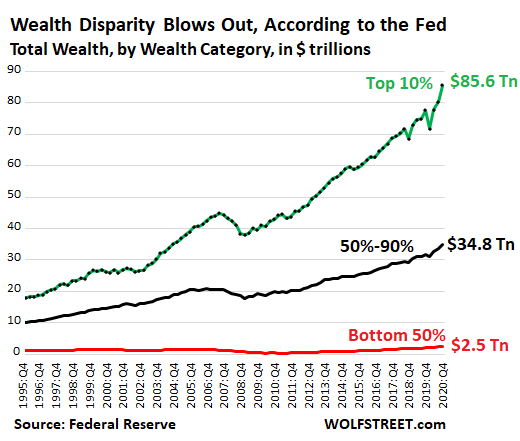
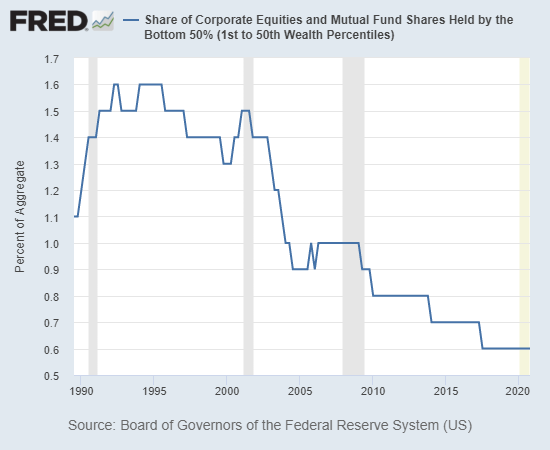
One might anticipate that the bottom 50%’s meager share of the nation’s exploding wealth would have increased as smartly as the wealth of the billionaires, but alas, no.

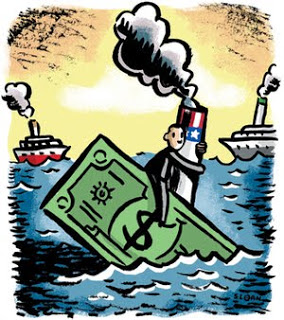
America’s economy has changed in ways few of the winners seem to notice, as they’re too busy cheerleading their own brilliance and success. In the view of the winners, who just so happen to occupy all the seats at the media-punditry-Federal Reserve, etc. table–the rising tide of stock, bond and real estate bubbles are raising all boats. What’s left unsaid is except for the 50% of boats with gaping holes below the waterline, i.e. stagnant wages and a fast-rising cost of living.

The truth the self-satisfied winners don’t include in their self-congratulatory rah-rah is there’s no place for the bottom 50% of American households to go but down. All the winnings flow to those who already owned assets back when they were affordable– the already-wealthy–whose wealth has soared as assets have shot to the moon while the the burdens of inflation and debt service hit the bottom 50% the hardest.

Meanwhile, the Federal Reserve is whining that inflation isn’t high enough yet for their refined tastes. Boo-hoo, how sad for the Fed–inflation isn’t yet high enough. Oh wait–didn’t they each mint millions by front-running their own policies? No wonder they’re not worried about inflation.

The reality few acknowledge is that globalization and financialization have stripped the American economy of low-skilled jobs that don’t demand much of the employee. The reality is that a great many people don’t have what it takes to learn high-level skills and work at a demanding pace under constant pressure–the description of the average job in America.

There were once millions of low-skill, low-pay jobs for people who for whatever mix of reasons were unable to muster the wherewithal to fulfill the fantasy of working extra hard, going to night school, soaking up high-level skills, moving quickly up the ladder to higher pay, buying the starter home and then moving up the food chain to middle class security from there.

The cost of living was low enough that those working these low-skill, low-pay jobs could still have an independent life. There were still low-cost rentals, often derided by the wealthy, in nooks and crannies of even the costliest cities. (I once lived in a room stuffed with old tax records in a poolside shack in an upscale neighborhood. The room had been cleared for a single bed and a path to the decrepit bathroom. Its most important attribute was that I could afford it on my low earnings.)

Affordable housing has vanished, eliminated by the financialization of America’s economy. Once landlords pay double the price for the property, rents have to double to pay their higher expenses. The apartment didn’t double in size or amenities–the rent doubled without any increase in utility to the renter. You get nothing more for double the price–nice.

Yes, people could make better choices, and some do. The point here is the game is rigged against those in the lower tier of the economy who can no longer afford a house or other stake in the only winning game in town–speculative asset bubbles. Go ahead and work a second job and go to night school–you’ll still be left behind the already-rich.

Globalization opened every job in America to global competition via offshoring or the influx of undocumented workers so desperate to support their families back home that no pay was too low and no working condition too wretched to refuse.

Many overindulged pundits who never worked an honest day in their lives sneer about burger flippers without realizing how hard those burger flippers have to work. I doubt the well-dressed pundits, snobbish about their university degrees and general brilliance, could manage to work a single day in a demanding fast-food job.

As the price of housing and other assets have soared, enriching the already rich, they’re out of reach for the bottom 50% who struggle to pay their bills as wages have stagnated and the costs of essentials have skyrocketed.

The rising cost of parking tickets, junk fees, user fees, utilities and food don’t impact the well-paid top 5% technocrat class, whose stake in the Everything Bubble keeps expanding by tens or hundreds of thousands of dollars. But for the bottom 50%, those incremental increases are, when added to higher rents, absolutely crushing.

As for getting high-quality healthcare that includes mental health support–those are reserved for the rich. But no worries, self-medication is always a “choice.”

Getting a boost in pay from $12 an hour to $15 an hour is welcome, but that doesn’t put the worker any closer to affording a house or equivalent stake in the Everything Bubble.

The new feudalism is masked by the glossy SillyCon Valley PR of a gig economy where (per the PR fantasy) bright, shiny and totally independent workers freely choose to serve the winners in the rigged sweepstakes for low pay and zero benefits.

In the SillyCon Valley PR, serfs freely choose to serve their noble masters for nothing but survival because they love the “freedom” and “choice” of kissing the nobility’s plump derrieres. (After all, there were “choices” even back in the good old days of feudalism–one could join the brigands in the forest, or enlist in a poorly paid mercenary army where the odds of dying were high–you know, “choices” of “gigs.”)

One might anticipate that the bottom 50%’s meager share of the nation’s exploding wealth would have increased as smartly as the wealth of the billionaires, but alas, no–the bottom 50%’s share of stocks (equities) actually plummeted in the the glorious decades of Federal Reserve free money for financiers, stock buy-backs and asset bubbles.

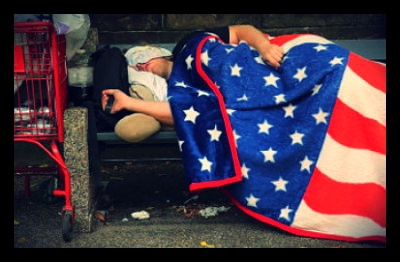
All this suits the billionaires and those collecting the crumbs of the Everything Bubble just fine. So what if the bottom 50% have nowhere to go but down? There’s plenty of room in the homeless encampment for another broken down station wagon or an old camper. There’s lots of “choices.”

And no consequences for the winners, of course, because The Fed has our backs.
2021 is Already Optimized for Failure

By Charles Hugh Smith

Source: Of Two Minds

One sure way to identify a system “optimized for failure” is if all the insiders are absolutely confident the system is “optimized for my success”.

I often discuss optimization here because it offers an insightful window into how systems become fragile and break down. When we optimize something, we’re aiming to get the most bang for our buck: maximize our efficiency, profit, productivity, etc., while minimizing our costs.

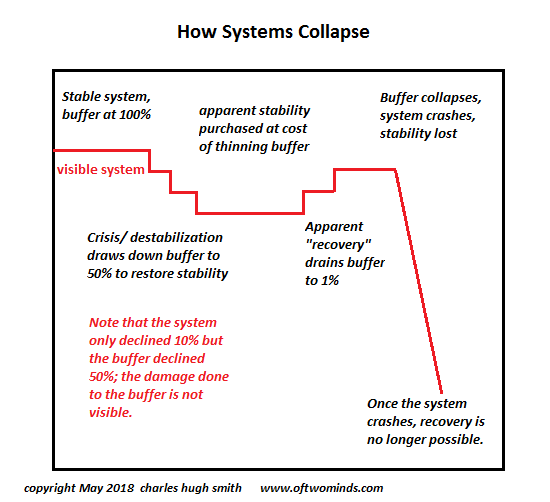
To maximize our goal, whatever it is–profits, power, whatever– we strip away redundancy and buffers because these add costs and don’t boost our desired output. They create resilience, i.e. the ability to survive disruptions, but the logic of optimization is relentless: get rid of all extraneous costs, because resilience doesn’t boost the bottom line.

This trade-off–trading resilience for optimization–looks brilliant when everything goes according to plan. But when events veer outside the narrow parameters of the optimized system, the system breaks down: supply chains break, safety procedures fail, and so on.

Even more consequentially, optimization strips away anti-fragility, Nassim Taleb’s term for the ability to not just survive disruptions but emerge stronger and more adaptable.

What happens when inflexible, sclerotic systems optimized to benefit self-serving insiders encounter chaotic turbulence or conditions outside the expected parameters? They collapse because the system is optimized for failure. Put another way: when a system is optimized to benefit insiders at the expense of resilience and anti-fragility, it is effectively optimized to fail because life is not programmable to a steady-state, predictable stability.

2021 is already optimized for failure in key ways:

1. The mRNA vaccines have not been properly tested to answer essential questions such as: can a vaccinated individual retain enough of the virus to infect an unvaccinated individual?

As I explained before, the only way to really test a viral vaccine is to put the vaccinated volunteers in a controlled setting saturated with the virus for many hours. If none of the volunteers have any virus in their post-exposure serological tests, then the vaccine works. If the volunteers still have the virus but didn’t become severely ill, this doesn’t mean they can’t infect others.

One of the problems is the goal of the Covid vaccine trials wasn’t to determine if the virus was eliminated by the volunteers’ immune system; the goal of the trials was to determine whether the vaccinated individuals became severely ill with Covid or not–with “severely ill” being conveniently left undefined.

Individuals who’d already had Covid and who took the vaccine were not tested separately for safety and after-effects, so this remains an unknown.

The unanswered questions about the vaccines’ real-world results will be answered in due time, but not in the lab; they’ll be answered in a public-health “experiment” without precedent.

If you wanted to design a testing process that was optimized for failure, you’d end up with this haphazard, hurried process careening toward approval. The trials and testing of the Covid vaccines are not equivalent to those applied to previous generations of vaccines.

The bigger the claims and the harder the sell, the greater the number of red flags raised. If a product works as wonderfully as advertised, it will sell itself. If “consumers” have to be coerced into buying the product, that speaks volumes–whether we’re free to discuss it or not.

2. The fiscal-monetary “solution” being readied for 2021–print/borrow as many trillions as needed to prop up zombie corporations and obsolete institutions–is optimized for failure. The unstated goal here is to save everything that’s been rigged to benefit self-serving insiders and never mind the consequences: we’ve “proven” we can print infinite trillions with no ill effects.

This appears to be true until diminishing returns hit the wall and linear dynamics suddenly spin into non-linear semi-chaos. At that point, all the levers that we reckoned were god-like in their stability and power–the Treasury selling bonds which the Federal Reserve then buys, and all the other financial tricks and manipulations–no longer work as expected.

3. The sacrosanct “solutions” that we worship as secular gods–central bank-dominated “markets” and the machinery of politics–are both optimized for failure. The “market” and politics have both incentivized extremes of indebtedness, leverage, corruption, fraud and waste, all under the happy belief that the banquet of consequences will never be served. Alas, the tables are groaning with consequences that have been piling up for 12 long years of excess speculation, manipulation and happy-talk PR.

The policies of the past 20 years boil down to this: if we keep blowing ever-larger private-sector asset bubbles, rewarding the few who own most of these assets, this “wealth” will magically restore our economic health. This is of course completely delusional: by concentrating wealth in the hands ofthe few, the policies have also concentrated political power in these same hands.

Ours is a system perfected for extremes of inequality and corruption.

If you set out to design a social-political-economic system that was supremely optimized for failure, you’d end up with America’s status quo. Today’s financiers are like French nobles being led off in chains discussing their next glorious party, oblivious to the end-game just ahead. The political class are like the elites haggling over games in Rome’s Forum in 475 AD, months before what was left of the empire collapsed in a heap.

4. America’s social cohesion has been lost, leaving only empty platitudes, suppression and coercion. “We’re all in this together” shouts the captain of the galley as those chained to the oars are flogged to keep a thoroughly corrupt and illusory “growth” alive. With civic virtue lost to the moral corruption of maximizing private gain by any means available, the foundations of society have crumbled, as I explained in Moral Decay Leads to Collapse.

One sure way to identify a system optimized for failure is if all the insiders are absolutely confident the system is optimized for my success regardless of how many policies serve the infinite greed of insiders and how many red warning flags are ignored.

Why Are so Few Americans Able to Get Ahead?

By Charles Hugh Smith

Source: Of Two Minds

Our entire economy is characterized by cartel rentier skims, central-bank goosed asset bubbles and stagnating earned income for the bottom 90%.

Despite the rah-rah about the “ownership society” and the best economy ever, the sobering reality is very few Americans are able to get ahead, i.e. build real financial security via meaningful, secure assets which can be passed on to their children.

As I’ve often discussed here, only the top 10% of American households are getting ahead in both income and wealth, and most of the gains of these 12 million households are concentrated in the top 1% (1.2 million households). (see wealth chart below).

Why are so few Americans able to get ahead? there are three core reasons:

1. Earnings (wages and salaries) have not kept up with the rising cost of living.

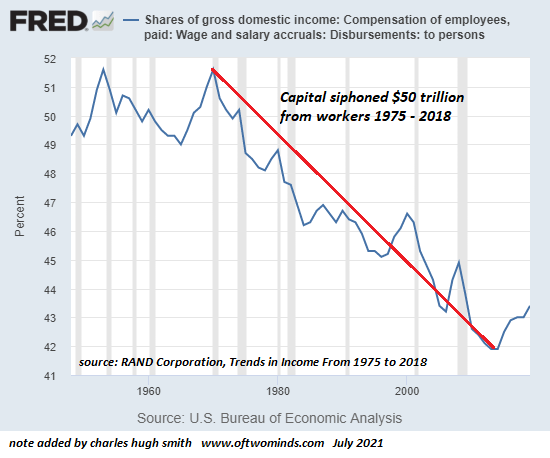
2. The gains have flowed to capital, which is mostly owned by the top 10%, rather than to labor ((wages and salaries).

3. Our financialized economy incentivizes cartels and other rentier skims, i.e. structures that raise costs but don’t provide any additional value for the additional costs.

It’s instructive to compare today’s household with households a few generations ago. As recently as the early 1970s, 45 years ago, it was still possible for a single fulltime-earner to support the household and buy a home, which in 1973 cost around $30,000 (median house price, as per the St. Louis FRED database).

As recently as 20 years ago, in 1998, the median house price in the U.S. was about $150,000— still within reach of many two-earner households, even those with average jobs.

As the chart below shows, real median household income has only recently exceeded the 1998 level— and only by a meager $1,000 annually. If we use real-world inflation rather than the under-estimated official inflation, real income has plummeted by 10% or more in the past 20 years.

This reality is reflected in a new study of wages in Silicon Valley, which we might assume would keep up due to the higher value of the region’s output. The study found the wages of the bottom 90% declined when adjusted for inflation by as much as 14% over the past 20 years:

“The just-released report showed that wages for 90 percent of Silicon Valley workers (all levels of workers except for the top 10 percent)are lower now than they were 20 years ago, after adjusting for inflation. That’s in stark contrast to the 74 percent increase in overall per capita economic output in the Valley from 2001 to 2017.”

source: Why Silicon Valley Income Inequality Is Just a Preview of What’s to Come for the Rest of the U.S.

Meanwhile, the median house price has more than doubled to $325,000 while median household income has stagnated. Please note this price is not adjusted for inflation, like the median income chart. But if we take nominal household income in 1998 (around $40,000 annually) and compare it to nominal household income now in 2018 (around $60,000), that’s a 50% increase–far below the more than doubling of house prices.

To raise stagnant incomes, the Federal Reserve and other central banks have attempted to generate a wealth effect by boosting the valuations of risk-on assets such as stocks, bonds and commercial real estate. But the Fed et al. overlooked the fact that the vast majority of these assets are owned by the top 10%–and as noted above, the ownership of the top 10% is concentrated in the top 1% and .1%.

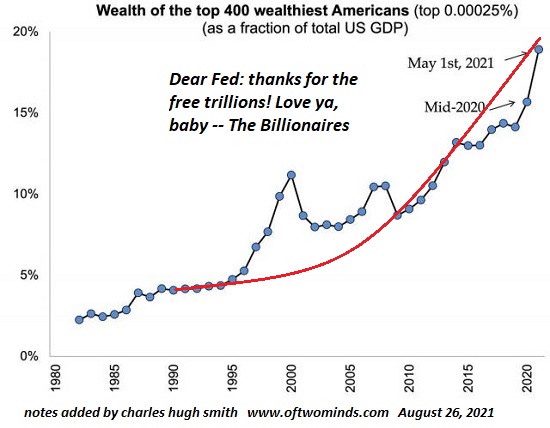
As a result, the vast majority of the wealth effect capital gains have flowed to the top 1%:

Lastly, the cartel structure of the U.S. economy has raised costs while providing no additional value. One example is higher education, a cartel that issues diplomas with diminishing economic value that now cost a fortune, a reality reflected in this chart of student loan debt, which simply didn’t exist a generation ago:

Our entire economy is characterized by cartel rentier skims, central-bank goosed asset bubbles and stagnating earned income for the bottom 90%. Given these realities, the bottom 90% are left with few pathways to get ahead in terms of financial security and building secure family wealth.


What’s Wrong with the Economy: 9 Toxic Dynamics

By Charles Hugh Smith

Source: Of Two Minds

These nine dynamics are mutually reinforcing.

Beneath the surface signals of an eternally rising stock market and expanding GDP, we all sense something is deeply, systemically wrong with the U.S. economy. These nine structural dynamics generate secondary dynamics, all of which are toxic to social mobility, sustainable prosperity, accountability and democracy:

1. The financialization of the economy, which transformed services, credit, risk and labor into commodities that could be traded globally. Financialization generates enormously asymmetric returns: those with access to low-cost credit, global markets and expertise in finance collect the lion’s share of gains in income and wealth.

2. The technological transformation of the economy, which has placed a substantial scarcity premium on specific tech/managerial/communication skills and devalued ordinary labor and capital. As a result, the majority of gains in wealth and income flow to those with the scarce skills and forms of capital, leaving little for ordinary labor and capital.

3. The end of cheap fossil fuels. The fracking boom/bubble has obscured the long-term secular trend: the depletion of cheap-to-access and process oil. As many analysts have observed (Nate Hagens, Gail Tverberg, Richard Heinberg, Chris Martenson et al.), the global economy only grows if energy and credit are both cheap.

4. Globalization, which transformed the developing world into the environmental dumping ground of the wealthy nations and enabled the owners of capital to offshore waste and labor.

5. The destructive consequences of “growth at any cost” are piling up. “Growth” is the one constant of all existing political-economic systems, and none of the current Modes of Production (i.e. the structures that organize production, consumption, the economy and society) recognize that “growth” is not sustainable.

The first two dynamics drive three other dynamics that have hollowed out the productive economy:

6. The dominance of debt-funded speculation as the means of “getting ahead” as opposed to producing products and services of intrinsic value that serve the core needs of communities.

7. The economy’s gains in income and wealth are concentrated in the very top of the wealth-power pyramid: the top 5%–entrepreneurs, professionals and technocrats, etc., and within this class, most of the gains go to the top 1/10th of 1% –the existing owners of wealth, and financiers/speculators with access to cheap credit.

The net result is the bottom 95% have few opportunities to “get ahead” outside of gambling in the asset bubbles du jour: the stock and housing market. While the average middle class household may be able to borrow enough to speculate in the housing bubble, two factors limit the odds of success for ordinary investors/gamblers:

A. The gains in housing are concentrated in specific markets; outside these hot markets, gains are modest.

B. Asset bubbles eventually pop, leaving those still owning the assets with losses. The risks are thus intrinsic and high. The average investor/gambler lacks the experience needed to recognize the bubble has stopped expanding and exit the market before ll the other speculators rush for the narrowing exit.

8. The devaluation of ordinary labor and capital means the bottom 60% of the economy that lacks the requisite skills with a scarcity premium in the Emerging Economy have lost easy access to the ladder of social mobility.

9. The concentration of wealth and power in the hands of the self-serving few corrupts the economy and democracy. The U.S. economy is dominated by insider and elite rackets, skims, scams and cartels/quasi-monopolies, all of which corrupt the economy by creating perverse incentives for exploitation and gaming the system to benefit the few at the expense of the many.

This corruption in service of maximizing private/personal gains at the expense of the system itself also corrupts the mechanisms of governance, which are now little more than cloaking devices that protect insiders and elites from scrutiny and consequences.

The 20% above the bottom 60% may appear to have some access to social/economic mobility, but this is largely an artifact of the bubble economy since 2009. Once the bubble deflates, the illusion of social mobility for the “middle class” between the bottom 60% and the upper 20% vanishes.

The “upper middle class” between the bottom 80% and the top 5% is being squeezed by the over-production of elites, i.e. the over-abundance of those with college degrees and the relative scarcity of secure jobs within the top 5%. As a result, credential inflation is rampant, with Masters Degrees replacing Bachelors Degrees as the default for a white-collar job, and PhDs replacing Masters diplomas as the new default for positions that lack security and upward mobility.

In other words, the number of people who qualify for and desire a slot in the elite class (top 5%) far exceeds the number of slots available. As Peter Turchin has explained, this competition generates social disorder at the top of economic heap as the top 20% fight over the few positions open in the top 5%. The disgruntled, frustrated losers far outnumber the relatively few winners.

These nine dynamics are mutually reinforcing, meaning that each dynamic strengthens one or more of the others, reinforcing each other so the sum of the nine is far more powerful than a mere addition might suggest.

The New Aristocracy (the top 9.9%) (The Atlantic)