This list of perpetrators is not meant to be exhaustive, but it can help us begin a conversation that should lead to indictments for treason, in addition to other crimes. The harms these perpetrators are doing must be stopped. Survival is at stake.
If COVID-19 was a laboratory-created disease for which people were denied palliative treatments and forced to receive harmful injections, then that was treason.
If global warming is occurring because of refusals by coal, oil and gas producers to curb those uses and switch to renewables, then that conduct was treason.
If coal, oil and gas producers knew of new energy technologies that could have eased our environmental crisis and stood in the way of their implementation, then that was treason.
If anyone in authority knew of new or unique energy technologies that could have eased our environmental crisis and stood in the way of implementation, then they were guilty of treason.
If harsh weather patterns and damaging weather events are being created that are destroying regions and parts of this country, then those manipulations of the weather are acts of treason.
If earthquakes, tsunamis, and fires are being created by weapons of war, like HAARP (High-frequency Active Auroral Research Program) and DEW (directed energy weapons), then bringing about that devastation is treasonous conduct.
If high-flying airplanes are spraying nanoparticulates of toxic metals and harmful materials upon the population, then those bombardments, which sorely affect physical health and mental acuities, are acts of treason.
If the communications industry persists in expanding wireless technology without allowing governmental oversight to make reasonable regulations for safety against harmful EMF (electro-magnetic frequency) exposures, then that conduct is treason.
If World Trade Center Buildings 1, 2 and 7 came down, not as a result of airplane collisions, but by controlled demolition, then that was treason.
If the Pentagon was struck on 9/11, not by an airplane but by one of our own missiles, then that was treason.
If U.S. weapons-grade anthrax was used against Congressmen who were holding up passage of the USA Patriot Act after 9/11, then that was treason.
The American people are now beset with harms from an extraordinary array of toxic chemical exposures that began four generations ago. If the large agricultural and industrial interests continue to harm our significantly burdened population with toxic exposures, then that will be treason.
The American people are now experiencing extensive health deficits, including physical, mental and behavioral declines. Our health-care system was created in the early 1900s. It was and continues to be dominated by allopathic medicine to the exclusion of a great number of safe, effective and inexpensive healing modalities. Pharmaceutical companies are the major beneficiaries of an insurance-funded allopathic system that’s incapable of bringing about adequate and preventive health care for all. Continued resistance by the pharmaceutical companies to necessary changes that must be made can and should be considered treason.
What Is Treason?
The crime of treason is set forth in the U.S Constitution. “Treason against the United States, shall consist only in levying War against them, or in adhering to their Enemies, giving them Aid and Comfort.” See Article III, Section 3, Clause 1. A number of states have identical treason provisions.
The punishment for those who owe “allegiance to the United States” and commit treason is death or imprisonment for not less than five years and a fine of not less than $10,000. See 18 U.S. Code, Chapter 115, Section 2381.
People often make the mistake of believing that we need to be at war for there to be an indictment for treason. That is incorrect. To commit the crime of treason (the levying of war part), one need only use force to prevent the carrying out of laws or to affect the public policies of the nation.
For example, our history books are filled with charges of treason that were leveled against those who used force in efforts to stop the capture and return of runaway slaves before the Civil War. Defendants were charged with treason because they interfered with the Fugitive Slave Acts. Abraham Lincoln, as a young lawyer, participated in those cases.
And the case of United States v. Aaron Burr, Circuit Court, D Virginia, 25 F. Cas 49 (1807) is most instructive. Chief Justice John Marshall presided over the trial of Aaron Burr who was charged with treason. Marshall carefully instructed the jury that they could find Burr guilty of treason only if they had proof that he used force in an effort to interfere with laws or public policies of the United States. Planning alone was insufficient, said the Chief Justice. There had to have been some force—like actually having soldiers marching with weapons to do harm.
The perpetrators listed above went far beyond planning. They used force to poison us, to kill us, to make this Earth less habitable for us, and to take us into unnecessary wars. They trampled upon our most sacred public policies of respect for due process, the expectation of health protections, and the basic right of reliance upon representative government to act on our behalf.
Misprision of Treason
Prosecutions for the crimes of treason will be relatively easy as a result of 18 USC, Chapter 115, Section 2382, which provides: “Whoever, owing allegiance to the United States and having knowledge of the commission of any treason against them, conceals and does not, as soon as may be, disclose and make known the same to the President or to some judge of the United States, or to the governor or to some judge or justice of a particular State, is guilty of misprision of treason and shall be fined under this title or imprisoned not more than seven years, or both.” A few states have identical misprision of treason statutes.
There are millions of upstanding and brave witnesses to the ongoing crimes of COVID-19. Thousands of them have been unfairly vilified and falsely charged with lying.
And so many witnesses know the details about how global warming was allowed to occur and how weather has been made into a weapon of mass destruction.
The bombing of people with nanoparticulates of poisonous materials requires meteorologists, air traffic controllers, and pilots to abide by the official story that trails in the sky are merely water vapor, even though the trails remain in the skies indefinitely. Anyone who has ever used a humidifier knows differently. Water vapor evaporates quickly.
Anyone with an eighth-grade science background can see through the falsehoods of the official story of the 9/11 attacks, especially the way in which Building 7 came down. It came down in its own footprint, seven hours after Buildings 1 and 2, having experienced nothing more than a few sporadic office fires.
Similarly, anyone who has any observational skills knows that an airplane with wide wings, massive engines, and a tall tail could not have hit the Pentagon on 9/11, leaving no aircraft debris and only one circular hole in the outside wall and circular holes in a succession of interior walls.
Everyone involved in the anthrax investigation knows that the anthrax used against U.S. Congressmen to assure passage of the USA Patriot Act was manufactured at a particular U.S. Army base.
And scientists who continually create new versions of things like forever chemicals are firsthand witnesses to how agricultural and manufacturing interests continue to knowingly make the world more toxic by the day.
Finally, the medical profession is filled with practitioners who have come to understand that there are gentler ways to assure that their patients survive and thrive. And millions of us have been successfully treated by alternative methods which are safe and inexpensive.
A Last Line of Defense
There are thousands of federal, state, and county prosecutors across the United States. All have a sworn obligation to investigate and bring crimes to the attention of grand juries in their jurisdictions.
They should be thought of as our last line of defense. We might have only a decade before this Earth reaches the point of no return concerning habitability. Vested interests have largely captured both state and federal regulatory systems. The two major political parties are incapable of bringing forth adequate responses and leaders capable of quickly making necessary changes for our protection.
Meanwhile, public health continues to deteriorate. In 1970, René Dubos, a world renowned microbiologist, in an essay titled “The Limits of Adaptability,” pleaded for us to stop the toxic exposures that are so far beyond human tolerance. Not stopping the exposures, he feared, will lead us to the development of “a form of life that will retain little of true humanness.”
The evidence all around us makes it apparent that we are fast approaching that point. Certainly, the skills to bring about major analyses of current affairs is slipping away, as are the abilities to bring about large societal changes. Indeed, human consciousness itself is waning. So now, as never before, we need the prosecutors to fully investigate and prosecute the crimes of treason, while there is still time to turn this world around.
The treasons that are now being carried out are interfering with and violating our basic rights. The perpetrators are making a mockery of what should be the blessings of life, liberty and justice.
Two corrupt companies were in rocky financial territory just a few weeks ago. Now, with concerns over a global monkeypox outbreak being hyped by media and global health organizations alike, the worries – and sins – of these two firms are quickly being forgotten.
In recent days, concern over a global outbreak of monkeypox, a mild disease related to smallpox and chickenpox, has been hyped in the media and health ministries around the world, even prompting an emergency meeting at the World Health Organization (WHO). For some, fears have centered around monkeypox being the potential “next pandemic” after Covid-19. For others, the fear is that monkeypox will be used as the latest excuse to further advance draconian biosecurity policies and global power grabs.
Regardless of how the monkeypox situation plays out, two companies are already cashing in. As concern over monkeypox has risen, so too have the shares of Emergent Biosolutions and SIGA Technologies. Both companies essentially have monopolies in the US market, and other markets as well, on smallpox vaccines and treatments. Their main smallpox-focused products are, conveniently, also used to protect against or treat monkeypox as well. As a result, the shares of Emergent Biosolutions climbed 12% on Thursday, while those of SIGA soared 17.1%.
For these companies, the monkeypox fears are a godsend, specifically for SIGA, which produces a smallpox treatment, known by its brand name TPOXX. It is SIGA’s only product. While some outlets have noted that the rise in the valuation of SIGA Technologies has coincided with recent concerns about monkeypox, essentially no attention has been given to the fact that the company is apparently the only piece of a powerful billionaire’s empire that isn’t currently crumbling.
That billionaire, “corporate raider” Ron Perelman, has deep and controversial ties to the Clinton family and the Democratic party as well as troubling ties to Jeffery Epstein. Aside from his controlling stake in SIGA, Perelman has recently made headlines for rapidly liquidating many of his assets in a desperate bid for cash.
Similarly, Emergent Biosolutions has also been in hot water. The company, which has troubling ties to the 2001 Anthrax attacks, came under fire just under two weeks ago for engaging in a “cover up” over quality control issues relating to their production of Covid-19 vaccines. A Congressional investigation found that quality control concerns at an Emergent-run facility led to more than 400 million doses of Covid-19 vaccines being discarded. The Emergent factory in question had been shut down by the FDA in April 2021. They were allowed to reopen last August before the government terminated the contract. Given that the majority of the company’s business is tied to US government contracts, the loss of this contract, and the accompanying poor publicity, the news that its smallpox vaccine may soon be of international interest is likely seen as a godsend by the company.
Notably, this the second time in a year that both companies have benefitted from pandemic or bioterror fears propagated by the media. Last November, speculation rose that a re-emergence of the eradicated virus that causes smallpox would soon take place. This first began with Bill Gates’ comments on the prospects of smallpox bioterrorism during a November 4th, 2021 interview and was followed by the November 16th announcement of a CDC/FBI investigation into 15 suspicious vials labeled “smallpox” at a Merck facility in Philadelphia. Now, roughly six months later, the same fears are again paying off for the same two companies.
A Killer Enterprise
Emergent Biosolution was previously known as BioPort. The company was founded by Fuad el-Hibri, a Lebanese businessman, who leveraged his contacts with powerful US former military officials and politicians, to take control of a flailing Michigan factory. It was the only factory authorized to produce an anthrax vaccine.
The anthrax vaccine was known to have major problems even before BioPort had acquired it, and is believed by many investigators to be one of the main causes of “Gulf War” syndrome. The vaccine itself, originally developed at Fort Detrick, had little to no safety track record at the time it was administered to US troops in the First Gulf War – a problem that was never remedied. However, its chronic safety issues and its clumsy, multi-dose regimen would later prompt BioPort/Emergent Biosolutions to spend years developing a new formulation of its anthrax vaccine.
The creation of BioPort coincided with the Clinton administration’s efforts to mandate the anthrax vaccine for all members of the US Armed Forces. With control over the only source of anthrax vaccine, BioPort was poised to make a killing.
Once the company acquired the Michigan facility, it took large amounts of US government funds, ostensibly to make improvements at the site. However, the company declined to use the funds to make the necessary repairs, instead spending that money on its executives’ offices, as opposed to the vaccine factory, and millions more on bonuses for “senior management.” Pentagon auditors would later find that still millions more had gone “missing” and BioPort’s staff were unaware of the cost of producing a single dose of the vaccine. Despite the clear mismanagement and corruption, BioPort demanded to be bailed out by the Pentagon, and they were. Meanwhile, the Michigan facility lost its license after a government inspection found numerous safety issues.
However, by August 2001, BioPort stood to lose the Pentagon contracts – its only source of income. The Pentagon began preparing a report, due to be released in September 2001, that would detail a plan for letting BioPort go. Thanks to the September 11, 2001 attack on the Pentagon, that report was never released. Shortly thereafter, the 2001 anthrax attacks began.
Just months before, BioPort had contracted Battelle Memorial Institute to help rescue its flailing vaccine program. The deal gave Battelle “immediate exposure to the vaccine” and it was used in connection with the Pentagon-funded, gain-of-function anthrax program that involved both Ken Alibek and William C. Patrick III, two bioweapons experts with deep ties to the CIA. That program was housed at Battelle’s West Jefferson facility in Ohio. That facility is believed by many investigators to be the source of the anthrax used in the 2001 attacks.
The ensuing panic from the anthrax attacks led the Department of Health and Human Services (HHS) to intervene. They gave BioPort its license back in January 2002 despite persisting safety concerns at its vaccine production facility in Michigan. BioPort was not content to merely see its past contracts with the Pentagon restored, however, as it began lobbying heavily for new contracts for anthrax vaccines intended for American civilians, postal workers and others. They would get them, largely thanks to HHS’ then-counter-terrorism adviser and soon to be HHS’ newest Assistant Secretary — Jerome Hauer. Hauer would later join the board of BioPort, after it reformed as Emergent Biosolutions, in 2004.
Such examples of cronyism are more common than not when it comes to Emergent Biosolutions. Indeed, the company has frequently relied on individuals who spend their careers passing through the “revolving door” between the pharmaceutical industry and government, particularly those who also moonlight as bioterror alarmists. One of the main individuals critical to the company’s success over the years has been Robert Kadlec. Kadlec served as the top bioterror advisor to the Pentagon in the weeks leading up to the 2001 anthrax attacks. Months prior, he had participated in the June 2001 simulation Dark Winter, which “predicted” major aspects of the subsequent anthrax attacks. Kadlec subsequently crafted much of the legislation that would create the country’s subsequent bioterror/pandemic response policy, including BARDA and the Strategic National Stockpile.
Soon after leaving government, Robert Kadlec helped found a new company in 2012 called “East West Protection,” which develops and delivers “integrated all-hazards preparedness and response systems for communities and sovereign nations.” The company also “advises communities and countries on issues related to the threat of weapons of mass destruction and natural pandemics.”
Kadlec formed the company with W. Craig Vanderwagen, the first HHS Assistant Secretary for Preparedness and Response (a position Kadlec had helped write into law and would later hold himself). The other co-founder of East West Protection was Fuad El-Hibri, the founder of BioPort/Emergent Biosolutions, who had just stepped down as Emergent’s CEO earlier that year.
Kadlec then became a consultant. Kadlec’s consultancy firm, RPK Consulting, netted him $451,000 in 2014 alone, where he directly advised Emergent Biosolutions as well as other pharmaceutical companies like Bavarian Nordic. Kadlec was also a consultant to military and intelligence contractors, such as the DARPA-backed firm Invincea and NSA contractor Scitor, which was recently acquired by SAIC.
Kadlec would return to government as HHS ASPR under Trump, a position which he held at the time the Covid-19 crisis began. The year prior, in 2019, Kadlec had conducted a months-long simulation focused on a global pandemic originating in China called Crimson Contagion. Once the Covid-19 crisis began in earnest, he played a major role in securing Covid-19 vaccine contracts for Emergent Biosolutions, despite his conflicts of interest, some of which he had declined to disclose upon being appointed to serve as ASPR.
Emergent Biosolutions’ pattern of corrupt behavior, beginning with its anthrax vaccine, can be seen with its recent actions as it relates to its production of Covid-19 vaccines. Per the recent Congressional report, released just days before the recent spike in concern over monkeypox began, Emergent lab workers “intentionally sought to mislead government inspectors about issues” at its Baltimore-based plant and also repeatedly “rebuffed” efforts by AstraZeneca and Johnson & Johnson to inspect their facilities. “Despite major red flags at its vaccine manufacturing facility, Emergent’s executives swept these problems under the rug and continued to rake in taxpayer dollars,” House Oversight and Reform Committee Chairwoman Carolyn Maloney (D-NY) stated upon the report’s release. Yet such “major red flags” can be found throughout the company’s entire history, for those willing to take the time to look.
Just days after the Congressional report was released, Emergent Biosolutions announced that it would acquire the exclusive worldwide rights to the “first FDA-approved Smallpox Oral Antiviral for all ages” from the company Chimerix. The drug, called TEMBEXA, is only for the treatment of smallpox, which the company refers to as “a high priority public health threat.” The press release on the company’s acquisition of TEMBEXA states that multi-million US government contracts for the product are anticipated. The FDA formally approved the drug last June.
Emergent Biosolutions also has the rights to the smallpox vaccine known as ACAM2000, which can also be used to treat monkeypox. The vaccine, originally produced by Sanofi, was acquired by the company in 2017. As a result, the company has an essential monopoly over smallpox vaccines as ACAM2000 is “the only vaccine licensed by the FDA for active immunization against smallpox disease for people determined to be at high risk of smallpox infection.”
Given their track record, it’s worth asking why Emergent Biosolutions has been working in recent months to pivot much of its business into smallpox treatments. However, there is no speculation needed when observing that the current monkeypox fears and helping rescue the company, whose shares had fallen some 26% year to date before concern over the recent monkeypox outbreak began to grow.
Whatever comes of the monkeypox situation, Emergent Biosolutions’ decades-long track record is undeniably one of corruption and cronyism.
“BioArmor” for Ron Perelman’s Flailing Business Empire
SIGA Technologies, which likens its products to “Human BioArmor”, features a quote from Bill Gates at the top of its about page. The quote reads: “[…] the next epidemic could originate on the computer screen of a terrorist intent on using genetic engineering to create a synthetic version of the smallpox virus […]” The quote is from Bill Gates’ speech to the 2017 Munich Security Conference, where he used to the threat specifically of smallpox to argue that “health security” and “international security” be merged. Notably, last March, the Munich Security Conference hosted a simulation of a global pandemic caused by a “genetically engineered monkeypox virus.”
SIGA is one example of a company that seeks to find its niche in the middle of “health security” and “international security.” It specifically provides “solutions for unmet needs in the health security market that comprises medical countermeasures against chemical, biological, radiological, and nuclear (CBRN) threats, as well as emerging infectious diseases.” The majority of contracts for CBRN medical countermeasures in the US are funded by the Pentagon. While it promotes itself as a CBRN threat-focused company, SIGA is, for now, singularly focused on smallpox.
Indeed, SIGA Technologies is only currently profitable in the event of an actual outbreak of smallpox or a related disease, or when fear of a smallpox bioterror event is high. Specifically, concern over the latter has led to the company to win government contracts to produce TPOXX for the Strategic National Stockpile (SNS). This is because TPOXX is only used to treat active smallpox or monkeypox infection, not prevent it. This means that it is only useful if smallpox, monkeypox or a related disease is actively infecting people or if there is a high risk that one of these diseases will soon infect large groups of people. TPOXX was first approved in 2018 by the FDA and was approved by the European Medicine Agency (EMA) this past January. The FDA approved an intravenous version of TPOXX just this past Thursday. Overall, SIGA has received over $1 billion from the US government to develop TPOXX.
SIGA is currently partnered with HHS’ BARDA, the Department of Defense, the CDC and the NIH. Another partner is Lonza, a European pharmaceutical manufacturing firm that is partnered with both the World Economic Forum and Moderna. SIGA’s CEO, Phillip Gomez, is an alumni of PRTM Consulting, where he would have worked closely with Robert Kadlec, as the two men overlapped as directors of the firm and both worked advising government agencies on matters of public health and biodefense.
SIGA is also notable because it is possibly the only company in the business empire of corporate raider Ron Perelman that is not attached to growing mountains of debt. Perelman is one of the notorious corporate raiders from the 1980s who conducted corporate takeovers fueled by junk bonds, particularly those connected to Michael Milken’s Drexel Burnham Lambert. Perelman’s business tactics have long been informed by his volcanic temper and his ruthlessness, with former Salomon Brothers CEO John Gutfruend once remarking that “believing Mr. Perelman has no hostile intentions is like believing the tooth fairy exists.”
Perelman is also known for being a long-time patron of the Clinton family, even though, more recently he donated to Donald Trump’s political campaigns. Perelman apparently first became interested in courting influence with the Clintons after marrying Patricia Duff in 1994. Duff was deeply connected to the Democratic Party, having worked for Democratic pollster Pat Cadell, and she had also worked for the House panel that “investigated” the assassinations of John F. Kennedy and Martin Luther King Jr. Prior to marrying Perelman, she had been married to movie mogul Michael Medavoy and had “introduced Clinton to the Hollywood establishment,” according to the Washington Post.
As Perelman’s wife, Duff styled herself a leading Democratic fundraiser, with the 1995 fund-raising dinner being emblematic of that. Also, in 1995, Perelman attended a $1,000-a-plate dinner in New York for the Clintons, where Perelman sat across from the President, as well as a state dinner for Brazil’s president at the White House.
For Perelman, his generosity to the Clinton political machine resulted in an appointment by Clinton to the board of trustees of the Kennedy Center in 1995. Other, less public gestures from the Clintons were likely, as Perelman offered much more to the First Family than he appears to have received in return. Perhaps most notable of Perelman’s favors for Bill Clinton was his offering of jobs to scandal-ridden members of his administration, Webster Hubbell and Monica Lewinsky, in the wake of their respective controversies. However, after the job offers were publicly reported, both Hubbell and Lewinsky were let go, though the offers later caught the attention of independent counsel Ken Starr. Starr never subpoenaed or investigated Perelman or the offers he had made to Hubbell or Lewinsky.
The controversial hirings had been arranged between Perelman and Clinton advisor Vernon Jordan, who sat on the board of Revlon, a Perelman-controlled company, while his wife was on the board of another Perelman-owned firm. Jordan was known as Clinton’s “conduit to the high and mighty” and had taken Clinton to the 1991 Bilderberg conference. On the decision to hire Lewinsky following the scandal, a former business associate of Perelman’s told the Washington Post that “It’s like the Mafia, it’s all done in code,” adding that “I can assure you that Ronald made the decision to give Lewinsky the job. And I can assure you he wouldn’t want to know why Jordan was asking.”
In 1995, Perelman held a Clinton fundraiser at his mansion, with guests including singer Jimmy Buffett, Miami Vice actor Don Johnson, actor Michael Douglas’ then-wife Deandra and DNC co-chair Don Fowler. Other guests included A. Paul Prosperi, a corrupt Clinton crony, and the now infamous Jeffrey Epstein. Clinton himself attended the fundraiser. According to the Palm Beach Post, guests had donated at least $100,000 to the DNC to attend the dinner with the President. This was, of course, in the lead up to the 1996 election, and the DNC would later come under heavy scrutiny due to illegal fundraising. This fundraiser was not Epstein’s only interaction with Perelman – Perelman would later be listed as a frequent dinner guest of Epstein’s in the 2003 Vanity Fair profile penned by Vicky Ward and is listed in Epstein’s black book of contacts.
For most of the 2000s, Perelman has sat atop a massive, ever-growing fortune. Yet, since 2020, Perelman has “been unloading assets ‘A lot of them. Rapidly.’” It stated with sales of valuable paintings at Sotheby’s and soon extended to Perelman’s investment company MacAndrews & Forbes, which disposed of its interest in two companies that same year, including $1 billion in shares in Scientific Games. According to MoneyWeek, Perelman’s net worth dropped from $19 billion in 2018 to $4.2 billion in late 2020, “prompting speculation that he’s runnings out of money.” Over the course of last year, Perelman has continued to “downsize”, looking to sell off his estate in the Hamptons for $115 million, another 57-acre estate worth $180 million and two townhouses in Manhattan’s Upper East Side for $60 million.
Other assets held by Perelman’s company MacAndrews & Forbes are also drowning in debt. One of the few assets of the company that isn’t currently haemorrhaging money or struggling with debt is its shares in SIGA Technologies. Perelman’s main company, MacAndrews & Forbes, has long been one of SIGA’s biggest investors and remains its largest shareholder, controlling 33% of all shares.
Since Perelman got involved with SIGA, accusations of corruption have plagued the company. For instance, in May 2011, SIGA was given a no-bid contract worth about $433 million to develop and produce 1.7 million doses of anti-viral drug for smallpox. At the time there was no evidence the smallpox drug in question was capable of treating the disease and there was alarm among some HHS staffers that SIGA’s return on investment from the contract was “outrageous.” The contract began to be investigated over concerns that the contract had been awarded to SIGA precisely because it was controlled by Perelman, who had donated heavily to Barack Obama. At the time, CNN noted the following about Perelman’s connections to the Obama White House:
“Ronald Perelman is controlling shareholder of Siga Technologies and a longtime Democratic Party activist and fundraiser. He’s also a large contributor to Republicans, but has been a particular friend of the Obama White House.
Also on Siga’s board of directors is Andy Stern, former president of the Service Employees International Union, who has had close relations with the Obama administration and who has supported President Barack Obama’s health care initiatives.”
As a result of these concerns and the potential conflict of interest, a congressional investigation began. Days after learning that this key government contract may be in jeopardy, SIGA executives sold off large amounts of company stock at an average price of $13.46 per share, netting its Chief Executive Officer and Chief Scientific Officer at the time millions of dollars. A month later, the company announced that its contract had been downsized and shares in the company fell to under $2 by that December.
Given past “pay-to-play” accusations around Perelman’s role in the firm during the Obama administration, when President Joe Biden served as Vice President, what are we to make of the recent media hype around monkeypox? Or concerns raised last year of a bioterrorism event involving smallpox?
Perhaps it’s more important to ask other questions – why has Perelman’s role in SIGA been largely obfuscated or totally ignored by recent reporting on the company? Similarly, why has Emergent Biosolutions’ horrific track record also been excluded from recent reports, including the major complaints from Congress made against the company less than two weeks ago? It seems the fear being generated around monkeypox is not only boosting shares for these two rotten companies, it’s helping the public forget their past sins.
This is the UPMC logo on the UPMC Building in downtown Pittsburgh,Monday, Oct. 29, 2018. (AP Photo/Gene J. Puskar)
Researchers at a BSL-3 lab tied to the organizers of the 2001 Dark Winter simulation, DARPA, and the post-9/11 biodefense industrial complex are genetically modifying anthrax to express Covid-19 components, according to FOIA documents.
Soon after having been fired from his post as secretary of the treasury in December 2002, after a policy clash with the president, Paul O’Neill became a trustee of the University of Pittsburgh Medical Center. Despite having just worked under and clashed with George W. Bush and Dick Cheney, it wasn’t until O’Neill began answering to UPMC CEO Jeffrey Romoff as a member of the Center’s board that he chose to publicly denounce a superior as “evil.”
“He wants to destroy competition. He wants to be the only game in town,” O’Neill would later state of Romoff, adding that “after 18 months I quit [the UPMC board] in disgust” due to Romoff’s “absolute control” over the board’s actions. O’Neill subsequently noted that UPMC “board members who have wealth of hundreds of millions of dollars are not willing to take this guy on.” When pressed by a local reporter, O’Neill further elaborated that he had been told by other board members that they were “afraid” of Romoff because Romoff might “harm them in some way.”
O’Neill’s criticisms of Romoff are hardly an outlier, as local community activists and even a state attorney generalhave noted that UPMC’s board lets Romoff do as he pleases. Jeffrey Romoff has ruled UPMC with an iron fist since his predecessor, Thomas Detre, had a heart attack in 1992. As a result of the Center’s massive wealth accumulation, at first spurred by his magic touch for receiving National Institutes of Health (NIH) grants, Detre was able to use the financial power afforded to him to consolidate control over enough of the University of Pittsburgh to create his “own personal fiefdom,” which is now the stand-alone corporation known as UPMC.
Not long after Romoff took over the Center’s reins, he made his intentions clear to faculty and staff, stating at one 1995 UPMC meeting that his “vision” for the future of American health care was “the conversion of health care from social good to a commodity.” Motivated by profit above all else, Romoff aggressively expanded UPMC, gobbling up community hospitals, surgery centers, and private practices to create a “health-care network” that has expanded throughout much of Pennsylvania and even abroad to other countries, including China. Under Romoff, UPMC has also expanded into the health-insurance business, with 40 percent of the medical claims it pays out going straight back into places of care that are owned by UPMC—meaning UPMC is essentially paying itself.
In addition, since UPMC is officially a “charitable nonprofit corporation,” it is exempt from property taxes and has special access to the tax-exempt municipal bond market. UPMC can also solicit tax-deductible grants from private individuals and organizations, as well as governments. These grants totaled over $1 billion dollars between 2005 and 2017.
Despite these perks being officially justified because of UPMC’s “charitable institution” status, the UPMC board, with Romoff at the top, have seen their own multimillion-dollar-per-year salaries continue to climb. Perhaps this perk also comes from UPMC being a nonprofit corporation, as there are no stockholders to whom Romoff and the board must explain their increasingly exorbitant salaries. For instance, Romoff made $8.97 million last year as UPMC’s CEO, a marked increase over the $6.12 million he had raked in the prior year.
UPMC’s financial chicanery is so out of control that even Pennsylvania’s attorney general has taken action against it, suing UPMC in February 2019 for violations of the state’s charity laws based on their “unjust enrichment” and engaging in “unfair, fraudulent or deceptive acts or practices.” Though UPMC decided to settle out of court, the Center and Romoff came out of the affair relatively unscathed.
Now, thanks to the crisis caused by Covid-19, UPMC is once again on the path toward growing even larger and more powerful in pursuit of Romoff’s ultimate goal, which is, in his own words, to make UPMC the “Amazon of health care.”
In this fourth installment of the The Last American Vagabond series“Engineering Contagion: Amerithrax, Coronavirus and the Rise of the Biotech-Industrial Complex”, the “nonprofit” health-care behemoth that is UPMC is squarely placed at the intersection of post-9/11 “biodefense” public-private partnerships; corporate-funded academics who shape public policy on behalf of their private-sector benefactors; and risky research on dangerous pathogens that threatens to unleash the very “bioterror” that these institutions claim to guard against.
The Odd Trajectory of UPMC’s Covid-19 Vaccine Efforts
In January 2020, when much of the world remained blissfully unaware of the coming global pandemic, UPMC was already at work developing a vaccine to protect against the novel coronavirus that causes Covid-19, known as SARS-CoV-2. That month, before the state of Pennsylvania had a single case of Covid-19, UPMC formed a “coronavirus task force,” which was initially focused on lobbying the US Centers for Disease Control and Prevention (CDC) to obtain samples of live SARS-CoV-2 for research purposes. That research was to be conducted at the Biosafety Level 3 (BSL-3) Regional Biocontainment Laboratory (RBL) housed within UPMC’s Center for Vaccine Research. A day after the director of UPMC’s Center for Vaccine Research, W. Paul Duprex, revealed UPMC’s efforts to access the SARS-CoV-2 virus, he announced that the virus samples, containing an estimated 50 to 60 million coronavirus particles, were already en route to the university. At the time, UPMC was one of only a handful of institutions on the CDC’s short list to receive live SARS-CoV-2 samples.
UPMC later stated that they began work on a vaccine for Covid-19 on January 21st, weeks before the February 14th announcement that the virus was on its way to the university. That original vaccine candidate used the published genetic sequence of SARS-CoV-2, released in early January 2020 by Chinese researchers, to synthetically produceSARS-CoV-2 spike proteins that would be transported into cells by an adenoviral vector, which is commonly used in a variety of vaccines. The vaccine candidate was nicknamed PittCoVacc, short for Pittsburgh Coronavirus Vaccine.
A little over a month after the live SARS-CoV-2 samples were received by UPMC’s Center for Vaccine Research, UPMC received a $5 million grant from the Coalition for Epidemic Preparedness Innovations (CEPI), an international organization founded in 2017 by the governments of Norway and India along with the World Economic Forum and the Bill and Melinda Gates Foundation. The grant was officially awarded to “an international academic-industry partnership” that the Center for Vaccine Research had recently formed with the Institut Pasteur in France and Austrian vaccine manufacturer Themis. Soon after, in May, Themis was acquired by vaccine giant Merck, which began recruiting volunteers for human trials earlier this month on September 11. Merck has incrediblyclose ties with UPMC, particularly its commercialization arm known as UPMC Enterprises.
The CEPI grant seems to have drastically altered the Center for Vaccine Research’s interest in the original adenovirus-vector vaccine candidate, PittCoVacc, as the CEPI grant was specifically aimed at funding a different vaccine candidate that instead uses the measles virus as a vector. The measles virus and the genetic manipulation of measles for use in the measles vaccine is, notably, the principal research interest and expertise of Center for Vaccine Research director Paul Duprex.
This measles-based vaccine candidate has been described as “a modified [genetically altered] measles virus that delivers bits of the new coronavirus into the body to prevent Covid-19” as well as an “attenuated [genetically modified yet weakened] measles virus as a vector with which to introduce genetic material from SARS-[CoV-]2 to the immune system.” The combination of this weakened measles virus and SARS-CoV-2, per Duprex, will produce a “more benign version of coronavirus [that] will acquaint a person’s immune system” with SARS-CoV-2. No vaccine using this modality has ever been licensed.
On April 2nd, less than a week after the CEPI award had been announced, the UPMC researchers who had developed the original vaccine candidate using the more traditional adenovirus-vector approach published a study in EBioMedicine (a publication of themedical journalLancet) that reported promising results of their vaccine candidate in animal studies. The news that a US institution was among the first in the world to develop a Covid-19 vaccine candidate with promising results from an animal study was heavily amplified by mainstream US media outlets, with those reports noting that UMPC was requesting government permission to quickly move onto human trials.
This original vaccine candidate, however, was mysteriously dropped from subsequent reports and statements from UPMC regarding its Covid-19 vaccine efforts. Indeed, in recent months, Duprex’s statements on the center’s Covid-19 vaccine candidates no longer mention the once-promising PittCoVacc at all. Instead, new reports, citing Duprex, claim that the only UPMC vaccine candidates are the CEPI-funded measles-vaccine candidate and another, more mysterious vaccine candidate, whose nature has only been recently revealed by documents obtained through a Freedom of Information Act (FOIA) request.
Equally odd is that recent media reports on the original vaccine candidate have stopped mentioning UPMC at all, instead citing only Themis, its new owner Merck, and France’s Institut Pasteur. There are no reports indicating a break-up of the original “academic-industry partnership” that had received the CEPI grant. It seems that this is what may have come to pass, as Duprex stated that the UPMC measles-vector vaccine candidate had partnered withthe Serum Institute of India for mass production, first for trials and then for public use, depending on how the vaccine advances through the regulatory process. In contrast, Themis/Merck have stated that their vaccine is being produced in France. It remains unclear what the relation is between these two, and apparently analogous, vaccine candidates.
Though Duprex has been relatively forthcoming about the nature of the first UPMC vaccine candidate (i. e., the CEPI-funded measles-vector vaccine), he has been much more tight-lipped about its second vaccine candidate. In late August, he told the Pittsburgh Business Times that the second vaccine candidate that UPMC was developing “works by delivering genetic material coding for a viral protein instead of the entire weakened or killed virus as is standard in other vaccines.” Yet Duprex declined to state what vector will be used to deliver the genetic material into human cells. Recent FOIA revelations, nevertheless, have revealed that UPMC’s second vaccine candidate involves genetically engineering a combination of SARS-Cov-2 and anthrax, a substance better known for its potential use as a bioweapon.
Corona-thrax
The recently obtained documents reveal that the BSL-3 lab that is part of UPMC’s Center for Vaccine Research is conducting eyebrow-raising research involving combining SARS-CoV-2 with Bacillus anthracis, the causative agent of anthrax infection. Per the documents, anthrax is being genetically engineered by a researcher, whose name was redacted in the release, so that it will express the SARS-CoV-2 spike protein, which is the part of the coronavirus that allows it to gain access into human cells. The researcher asserts that “the [genetically engineered anthrax/SARS-CoV-2 hybrid] can [be] used as a host strain to make SARS-CoV-2 recombinant S protein vaccine,” and the creation of said vaccine is the officially stated purpose of the research project. The documents were produced by the University of Pittsburgh’s Institutional Biosafety Committee (IBC), which held an emergency meeting on June 22nd of this year to “discuss specific protocols involving research with the coronavirus,” which included a vote on the aforementioned proposal.
Edward Hammond, the former director of the Sunshine Project, an organization that opposed chemical and biological weapons and the expansion of “dual use” biodefense/bioweapon research, obtained the documents. Other FOIA documents recently obtained by Hammond have revealed an “explosion” of risky Covid-19-related research at other academic institutions, such as the University of North Carolina, which has already had lab accidents involving genetically engineered variants of SARS-CoV-2.
Hammond told The Last American Vagabond that the experiment, which he dubs “Corona-thrax,” is “emblematic of the pointless research excesses that often characterize the response of scientists to the federal government throwing billions of dollars at health crises.” Hammond added, “While I don’t think that Corona-thrax would be infectious, it falls into the categories of pointless and crazy. The biggest immediate risk of all this activity is that a researcher will deliberately or inadvertently create a modified form of SARS-CoV-2 that is even more difficult to treat, or more deadly, and this virus will escape the lab. It only takes a stray droplet.”
Jonathan Latham, a virologist who previously taught at the University of Wisconsin and who is the current editor of Independent Science News, agreed with Hammond that the Corona-thrax experiment is odd and said that he was “concerned here specifically about the research process and the risks of these specific experiments at Pittsburgh.” In an interview with The Last American Vagabond,Latham asserted that it is “unusual by historical standards . . . the combining of two highly pathogenic organisms in a single experiment.” He did note, however, that such studies for the purposes of vaccine research have become more common in recent years, as is made clear in a 2012 study.
Few experiments have been conducted that specifically utilize anthrax in this way. Since 2000, the studies that have examined the use of genetically modified anthrax as a potential vaccine vector have been affiliated with Harvard University. One of these studies was on the use of anthrax as a vector in a potential HIV vaccine and was jointly conducted in 2000 by Harvard researchers and the vaccine company Avant Immunotherapeutics (now part of Celldex).
Despite reporting positive preliminary results in their experiments, Avant/Celldex did not fund further experiments into a vaccine that used this anthrax-based modality, and it does not currently market or have any such vaccine in its product pipeline. This suggests that, for whatever reason, this company did not see much value in this vaccine, despite the preliminary study with Harvard claiming that the methodology was safe and effective.
The Harvard researchers involved in that 2000 study, however, continued to investigate the possibility of an anthrax-based HIV vaccine in 2003, 2004, and 2005, though without corporate sponsorship. Related yet different research has explored the use of “disarmed” anthrax components as an adjuvant in vaccines and as the basis for enzyme-linked immunospot assays.
The aforementioned Harvard researchers patented their methodology of using anthrax in this way for the production of a vaccine in 2002. This means that the anthrax-based “vaccine” currently being developed by UPMC’s Center for Vaccine Research would have to develop a new method that utilizes anthrax in much the same way so as not to infringe on the patent, which is unlikely. The other alternative is that UPMC would pay the patent holders for use of their methodology if they want to commercialize it in a vaccine. Yet, given UPMC’s business model in general, as well as that of UPMC’s Center for Vaccine Research specifically, this also seems unlikely.
Also odd is what sort of incentive UPMC’s Center for Vaccine Research possesses for the Corona-thrax experiment. There are currently over a hundred vaccine candidates that use existing and tested vaccine platforms in pursuit of a Covid-19 vaccine, a fact Duprex himself has acknowledged. As Hammond told The Last American Vagabond, “It is perfectly obvious that there are numerous existing vaccine platforms for Covid-19 and that some of them will, sooner or more likely later, succeed. There is no serious need for some sort of quite strange bacterial platform, much less one that happens to be anthrax. It’s completely unnecessary and frankly bizarre.”
The creation of UPMC’s RBL was first announced in 2003, when the National Institute of Allergy and Infectious Diseases (NIAID, then and currently led by Anthony Fauci) stated it would fund the laboratory’s construction with an $18 million grant. It was originally planned to be mainly “dedicated to research on agents that cause naturally occurring and emerging infections, as well as potential agents of bioterrorism.” The plan to create the lab was part of the US government decision to dramatically ramp up “biodefense” research in the wake of the 2001 anthrax attacks.
The lab was also intended to work on “developing a vaccine program focusing on basic and translational research” related to viruses of pandemic potential that are at risk of being “weaponized,” including SARS. After the creation of the lab was initially announced, the project expanded, eventually becoming UPMC’s Center for Vaccine Research, which was launched in 2007. The Center for Vaccine Research was the second such institution to be officially added to the NIAID’s “biodefense” RBL network.
The opening of both this lab and UPMC’s Center for Vaccine Research was made reality thanks to the efforts of the main authors of the June 2001 Dark Winter bioterror simulation, a controversial exercise that eerily predicted the 2001 anthrax attacks as well as the initial, yet bogus, narrative that Iraq and Islamic extremist terror groups were responsible for those attacks. However, the anthrax used in the attacks was later revealed to be of US military origin. As noted in Part I of this series, participants in the Dark Winter exercise had foreknowledge of the anthrax attacks and others were involved in the subsequent “investigation,” which many experts and former FBI investigators describe as a cover-up.
Dark Winter was largely written by Tara O’Toole, Thomas Inglesby, and Randall Larsen, all three of whom played integral roles in the founding or operations of UPMC’s Center for Biosecurity, along with O’Toole’s mentor, D. A. Henderson. UPMC’s Center for Biosecurity was launched in September 2003, just days before the NIAID announced it would fund the RBL lab that would later become the UPMC’s Center for Vaccine Research.
Notably, just days after the attacks on September 11, 2001, O’Toole, Inglesby, and Larsen personally briefed Vice President Cheney on Dark Winter. Simultaneously, Cheney’s office at the White House began taking the antibiotic Ciprofloxacin to prevent anthrax infection. In the weeks between that briefing and the 2001 anthrax attacks, Dark Winter participants and several associates of Cheney, namely members of the Project for a New American Century (PNAC) like Donald Kagan and Richard Perle, asserted that a bioterror attack involving anthrax would soon take place.
In the aftermath of the 2001 anthrax attacks, Henderson “was tapped by the federal government to vastly increase the number of [biodefense] labs, both to detect suspected pathogens like anthrax and to conduct bio-defense research, such as developing vaccines,” with the announcement of UPMC’s RBL being part of the launch of the O’Toole-led Center for Biosecurity at UPMC, where Henderson was named senior adviser. In 2003, the Center for Biosecurity was set up at UPMC partially at the request of Jeffrey Romoff to be “the country’s only think tank and research center devoted to the prevention and handling of biological attacks,” with UPMC’s Center for Vaccine Research being the hub of a new “biodefense research” lab network Henderson was setting up and managing at the time. That network remains technically managed by the Fauci-led NIAID.
Also noteworthy is that the Center for Vaccine Research’s director, from its opening in 2007 until 2016, was Donald Burke. Burke is a former biodefense researcher for the US military at Fort Detrick and other installations and, immediately prior to heading the UPMC center, was a program director at the Johns Hopkins Bloomberg School of Public Health, where he worked closely with O’Toole and Inglesby.
At the time of the 2003 announcement regarding the creation of what would become UPMC’s Center for Vaccine Research, Tara O’Toole stated:
“This new laboratory will enable University of Pittsburgh medical researchers to delve further into possible treatments and to develop vaccines against diseases that might result from bioterrorist attack or from natural outbreaks.”
A few years later, after she was nominated to a top post at the Department of Homeland Security, O’Toole was slammed by experts over her excessive lobbying “for a massive biodefense expansion and relaxation of provisions for safety and security.” Rutgers microbiologist Richard Ebright remarked at the time that “she makes Dr. Strangelove look sane.” It was also noted in hearings that O’Toole had worked as a lobbyist for several “life sciences” companies specializing in the sale of biodefense products to the U.S. government, including Emergent Biosolutions – a very controversial company and a key suspect in the 2001 anthrax attacks.
The history of the Center for Vaccine Research’s RBL, particularly the network of people who prompted the lab’s creation, raises concerns about the nature of the Corona-thrax experiment currently being conducted within the facility. This is especially true because the researcher conducting the experiment appears to be ignorant about key parts of the research he or she is conducting.
For instance, the FOIA-redacted researcher incorrectly states that a recombinant virus proposed for use in the study is incapable of infecting human cells, while the IBC members note that this is not the case. In addition, the unnamed researcher falsely claimed that one of the viral vectors for use in the investigator’s study did not express Cas9 (a protein associated with CRISPR gene editing) and gRNA (“guide RNA,” also used in CRISPR) and was unaware that handling those agents requires an enhanced BSL-2 lab (BSL-2+) as opposed to a typical BSL-2 lab.
Apparently such errors among researchers involved in Covid-19 research at UPMC is not an anomaly. During another UPMC IBC meeting included in the FOIA release, the IBC noted the following about a separate research proposal:
“In the investigator’s notes in responses to changes requested by the IBC pre-reviewers, the investigator indicates that RNA from SARS-CoV-1 and SARS-CoV-2 infected cells will be obtained from BEI resources. Genomic RNA isolated from cells infected with SARS-CoV-1 is regulated as a Select Agent by the Federal Select Agent Program and neither the University nor this investigator are registered for possession and use of these materials [emphasis added] (SARS-CoV-1). The investigator must NOT obtain SARS-CoV-1 genomic RNA without prior consultation with the University’s RO/AROs for Select Agents.”
This part, in particular, caught the attention of Jonathan Latham, who noted that it was odd that “a university researcher is trying to obtain approval for an experiment which no one at the university is allowed to do.” Latham added in an interview that “apparently this applicant is totally ignorant of the regulatory environment and by extension the risks of SARS-CoV, which is a highly infectious virus whose escape from a lab has already led to at least one death.”
While Latham assumed that this was a “university researcher,” it is worth noting that the use of the UPMC Center for Vaccine Research’s RBL is not exclusive to researchers affiliated with the university. Indeed, as noted on the NIH website, “Investigators in academia, not-for-profit organizations, industry, and government studying biodefense and emerging infectious diseases may request the use of biocontainment laboratories,” including the RBL managed by the Center for Vaccine Research.
In addition, the Center for Vaccine Research website notes that “scientists from outside the University of Pittsburgh can work in the RBL through a collaboration or contract. Outside scientists must comply with all University of Pittsburgh training, documentation, regulatory, and medical requirements.” This means that outside scientists using the facility are also subject to IBC review. Both the NIH and Center for Vaccine Research sites note that, for an outside researcher to use the UPMC RBL facility, approval from the center’s director must be obtained.
Since the name of the Corona-thrax researcher is redacted, there is no way of knowing if he or she is affiliated with the university or a separate institution, corporation, or government agency. Regardless of who is conducting this experiment, however, it is possible to examine the history and motivations of the man who ultimately signed off on it—the Center for Vaccine Research’s director, Paul Duprex.
Paul Duprex: DARPA-Funded Researcher and Gain-of-Function Enthusiast
In terms of his research funded by DARPA, Duprex was most closely associated with DARPA’s “Prophecy” program, the creation of which was overseen by Michael Callahan. Callahan’s suspect past and his ties to the origin of the current Covid-19 crisis in Wuhan, China, were the subject of a recentUnlimited Hangout article by Raul Diego.
In that article, Diego notes that the now-defunct Prophecy program had “sought to ‘transform the vaccine and drug development enterprise from observational and reactive to predictive and preemptive’ through algorithmic programming techniques” and that the program further “proposed that ‘viral mutations and outbreaks’ could be predicted in advance to more rapidly counter the unknown disease with preemptive drug and vaccine development.”
By all indications, Prophecy was DARPA’s first major foray into “predictive” AI-powered health care, which has expanded considerably in the years since. It also involved a component, which Duprex was particularly involved in advancing, whereby the “predictive” viral evolutions algorithms would be “validated and tested . . . by using multiple selective pressures on at least three closely related virus strains in an experimental setting.”
Such experiments, like this study by Duprex, involved the genetic engineering of three viral pathogen strains and then seeing which would become most transmissible and virulent in an animal host. Such studies are often referred to as gain-of-function (GOF) research and are incredibly controversial given that they often create pathogens that are more virulent and/or transmissible than they otherwise would be. It is also worth noting that UPMC, before Duprex joined the center, had also received millions in funding from DARPA’s Prophecy program “to develop in vitro and computational models for predicting viral evolution under selection pressure from multiple evolutionary stressors.”
Duprex has also been involved in conducting research for DARPA’s current INTERfering and Co-Evolving Prevention and Therapy (INTERCEPT) program, a successor to Prophecy that “aims to harness viral evolution to create a novel, adaptive form of medical countermeasure—therapeutic interfering particles (TIPs)—that outcompetes viruses in the body to prevent or treat infection.” TIPs are genetically engineered viruses with defective genomes that theoretically compete with real viruses for viral components in the human body but “evolve with” the viruses they are meant to protect the body against and are “susceptible to mutation over time.”
The goal of the INTERCEPT program is to use TIPs as “therapeutics” and have them injected into the human body to “preemptively” protect against the virus from which a particular TIP was developed. It is worth noting that, while DARPA frames much of its gene-editing research (including its “genetic extinction” technology research) as being aimed at promoting either human or environmental health, it has also openly admitted that these same technologies are of interest to DARPA for their ability to “subvert” the genes of human adversaries of the US military via “genetic weapons.”
Duprex led an INTERCEPT study published in February of this year in which he and his coauthors explored how to create a synthetic TIP of the Nipah virus, a deadly virus with a fatality rate of over 70 percent. In that study, they used both wild and genetically engineered strains of Nipah virus. Notably, the Clade X pandemic simulation, which will be discussed in detail in the next installment of this series, involved a genetically engineered combination of the Nipah virus and a parainfluenza disease.
Clade X took place in 2018 and was led by much of the same team that was responsible for the 2001 Dark Winter bioterrorism simulation, including former FDA commissioner Margaret Hamburg and Tara O’Toole and Thomas Inglesby of the UPMC Center for Biosecurity. Another notable participant at Clade X was Julie Gerberding, former CDC director and current executive vice president at Merck, which has close ties to UPMC as well as the Center for Biosecurity’s failed “21st Century Biodefense” project.
A few months after publishing the study funded by DARPA’s INTERCEPT program, Duprex coauthored another study on the use of synthetic “nanobodies” (i. e., bioengineered synthetic nanoparticles acting as antibodies) that was published in August. This effort mirrors other DARPA “health-focused” projects. That study was funded by the University of Pittsburgh, the NIH, and Israel’s Ministry of Science and Technology.
In addition to his ties to DARPA programs involving the genetic engineering of viral pathogens, Duprex is a leading advocate for controversial gain-of-function research and was appointed to direct UPMC’s Center for Vaccine Research less than three months after the federal moratorium on GOF research ended.
In October 2014, five days after that moratorium was first imposed, Duprex gave a talk to the National Science Advisory Board for Biosecurity entitled “Gain-of-Function Studies: Their History, Their Utility, and What They Can Tell Us.” In the talk, he asserted that “cross-species infection studies have already helped to improve surveillance in the field, have shed new light on basic influenza virus biology, and could assist in growing vaccine viruses better” and argues against the recently imposed moratorium.
In 2014, Duprex also wrote in a paper published inNaturethat “GOF approaches are absolutely essential in infectious disease research; although alternative approaches can be very useful, these can never replace GOF experiments.” He added that, in his view, there were only two reasons for GOF research, the first being to “improve surveillance or to develop therapeutics” and the second being merely to learn “interesting biology.”
In that same paper, he also argued that “genetic engineering that is intended and likely to endow a low-pathogenicity, low-transmissibility agent with either enhanced pathogenicity or enhanced transmissibility may be appropriate if the benefits are substantial.” He also suggested in this 2014 paper that it “might” be necessary “to enhance pathogenicity of coronaviruses in order to develop a valid animal model for coronaviruses.” Years later, during the current coronavirus crisis, Duprex and other officials from the UPMC’s Center for Vaccine Research co-developed a Covid-19 research and development “blueprint” for the UN’s World Health Organization.
In addition, Duprex’s work for DARPA’s Prophecy program involved GOF research, as noted above, and the creator of that program, Michael Callahan – former head of DARPA’s biodefense therapeutics initiatives, is also a proponent of GOF who believes that such risky research is inseparable from “the research and development enterprise in the life sciences and for biotechnology.”
Duprex is also a founding member of Scientists for Science, a group of researchers (most of whom are involved in GOF research) who opposed the GOF moratorium and were “confident that biomedical research on potentially dangerous pathogens can be performed safely and is essential for a comprehensive understanding of microbial disease pathogenesis, prevention and treatment.” Another of the group’s founding members is Yoshihiro Kawaoka, whose controversial GOF experiments that made pathogenic viruses more deadly have garneredconsiderablemedia attention.
When the moratorium on GOF was lifted in December 2017, Duprex called it a “sign of progress,” adding that “on a personal level I’m really pleased these NIH funded scientists [conducting GOF research] get some clarity.” As previously mentioned, he became the Center for Vaccine Research’s director less than three months later, in March 2018.
The “Darkest Winter” Looms
After a cursory examination of the background of UPMC, its Regional Biocontainment Laboratory, and the man directing its Center for Vaccine Research, the question about the nature of the Corona-thrax experiment becomes: Is this yet another ill-advised experiment by a lab led by a GOF enthusiast and fueled by a feeding frenzy over the billions of dollars thrown by the government and other entities into Covid-19 research? Or is there perhaps a more nefarious motive to genetically engineering something as bizarre as Corona-thrax?
While the latter question may appear conspiratorial, it is worth pointing out that the institutions most likely to have been the sources for the anthrax used in the 2001 anthrax attacks were conducting GOF research on anthrax funded by the Pentagon and the CIA that was justified as “improving” the controversial anthrax vaccine known as BioThrax.
For instance, Battelle Memorial Institute—a Pentagon and CIA contractor—began genetically engineering a more virulent form of anthrax “to see if the [anthrax] vaccine the United States intends to supply to its armed forces is effective against that strain.” While these experiments were going on, the embattled manufacturer of the anthrax vaccine now known as Emergent Biosolutions, entered into a contract with Battelle that gave Battelle “immediate exposure to the vaccine” it was using in connection with the genetically modified anthrax program.
As noted in Part II of this series, BioPort was set to lose its Pentagon contract for anthrax vaccine entirely in September 2001, and the entirety of its anthrax vaccine business was rescued by the 2001 anthrax attacks, which saw concerns over BioPort’s corruption and its horrendous safety track record replaced with fervent demands for more of its anthrax vaccine. Furthermore, as noted in detail in Part III of this series, Battelle was the most likely source of the anthrax used in the 2001 attacks. The ties between UPMC’s Center for Biosecurity, Battelle, and Emergent Biosolutions will be discussed in the next installment in the series.
What is also notable about these Corona-thrax experiments occurring at UPMC are the ties of UPMC’s RBL and Center for Vaccine Research to another key component of the center’s “biodefense” complex, the UPMC Center for Biosecurity. As previously mentioned, the people recruited to head this center at its founding in 2003 were intimately involved in the 2001 bioterror simulation Dark Winter, namely Tara O’Toole and Thomas Inglesby.
While leading the UPMC’s Center for Biosecurity, O’Toole and/or her successor Inglesby engaged in other notable bioterror simulations, including one that took place last year— Event 201, which eerily predicted the coronavirus crisis that began this year. Inglesby, who is also the director of the Johns Hopkins Center for Health Security in addition to his post at UPMC, was the moderator at Event 201.
Though Event 201 has garnered considerable scrutiny in recent months, another but less well-known exercise in 2018 that involved O’Toole and Inglesby, examined how a bioterror attack involving a genetically engineered pathogen could trigger a Continuity of Government (CoG) scenario, a government roadmap for the imposition of martial law in the United States. As other investigative series of mine have noted, there have recently been a myriad of intelligence agency–linked simulations that predict the imminent imposition of martial law in the United States following the 2020 election.
It is also notable that George W. Bush’s controversial and classified update to CoG plans in 2007, known as Executive Directive 51, was directly inspired by Dark Winter, and Barack Obama’s subsequent executive orders on CoG gave near-complete control of American infrastructure to the Department of Homeland Security in a such a situation. At the time Obama issued those executive orders, O’Toole was the DHS undersecretary for science and technology and also influenced those updates to the CoG plans. O’Toole is currently the executive vice president of the CIA’s In-Q-tel.
The simulation known as Clade X will be examined in greater detail in the next installment of this series as will the numerous and recent “predictions” from US government sources, controversial billionaires such as Bill Gates, and a web of individuals tied to UPMC who have warned that a bioterror attack or related public health catastrophe is set to take place in the United States in the latter half of 2020. As one high-ranking government official put it earlier this year, this allegedly imminent event will result in “the darkest winter in modern history.”
This story is so complicated and long, I’ve tried to break it into threads of different colors to make it easier to digest. I’ve made separate pages for each thread, in addition to webpages with all the threads together.
Central Asian oil, Enron and the Afghanistan pipelines. For a separate page of these entries only, click here. Information that should have shown what kind of attack al-Qaeda would make. For a separate page of these entries only, click here. US preparing for a war with Afghanistan before 9/11, increasing control of Asia before and since. For a separate page of these entries only, click here. Incompetence, bad luck, and/or obstruction of justice. For a separate page of these entries only, click here. Suggestions of advanced knowledge that an attack would take place on or around 9/11. For a separate page of these entries only, click here. Cover-up, lies, and/or contradictions. For a separate page of these entries only, click here. Israeli “art student” spy ring, Israeli foreknowledge evidence. For a separate page of these entries only, click here. Anthrax attacks and microbiologist deaths. For a separate page of these entries only, click here. Pakistani ISI and/or opium drug connections. For a separate page of these entries only, click here. Bin Laden family, Saudi Arabia corruption and support of terrorists, connections to Bush. For a separate page of these entries only, click here. Erosion of civil liberties and erection of a police state. For a separate page of these entries only, click here.
Names/Abbreviations
For simplicity’s sake I don’t always use the full names and jobs of some of the major people or organizations in this story. For instance, every time I say “bin Laden,” I mean the terrorist Osama bin Laden, not one of his family members. I have standardized the spellings of the Islamic names, even within quotes. Al-Qaeda, for instance, can be spelled many ways, and the person known as Saeed Sheikh has too many name variations and spelling variations to count.
Organizations:
CIA: US Central Intelligence Agency
DEA: US Drug Enforcement Administration
FAA: US Federal Aviation Administration
FDA: US Food and Drug Administration
FBI: US Federal Bureau of Investigations
FEMA: US Federal Emergency Management Agency
ISI: Inter-Services Intelligence, the Pakistani intelligence agency
Mossad: The Israeli intelligence agency
NORAD: US North American Aerospace Defense Command
NSA: US National Security Agency
SEC: US Security and Exchange Commission
Taliban: The rulers of Afghanistan, 1996 – 2001
WTC: World Trade Center
USAMRIID: US Army Medical Research Institute of Infectious Diseases
Important individuals: Ahmad: General Mahmud Ahmad, Director of the ISI, the Pakistani intelligence agency Ashcroft: John Ashcroft, US Attorney General under Bush Jr. Atta: Mohamed Atta, lead 9/11 hijacker bin Laden: Osama bin Laden, leader of al-Qaeda terrorist organization Bush: George Bush Jr., US President since January, 2001 Cheney: Richard “Dick” Cheney, US Vice President under Bush Jr. Clinton: Bill Clinton, US President before Bush Jr. Mueller: Robert Mueller, Director of the FBI since July, 2001 Musharraf: General Pervez Musharraf, President of Pakistan since 1999 Powell: Colin Powell, US Secretary of State under Bush Jr. Rice: Condaleezza Rice, US National Security Advisor under Bush Jr. Rumsfeld: Donald Rumsfeld, US Secretary of Defense Saeed: Ahmad Omar Saeed Sheikh (and many variations thereof), ISI agent, al-Qaeda money man and supposed murderer of reporter Daniel Pearl Tenet: George Tenet, Director of the CIA since 1997 under Clinton and remaining under Bush Jr.
The hijackers: There are many spellings and aliases – the names and spellings below are the versions preferred by the FBI. *= Some evidence suggests the identity of this person may be incorrect (see September 16-23, 2001).
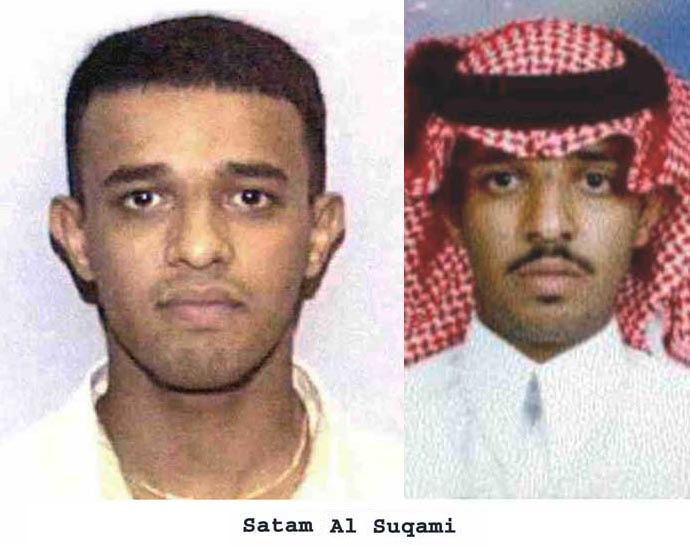
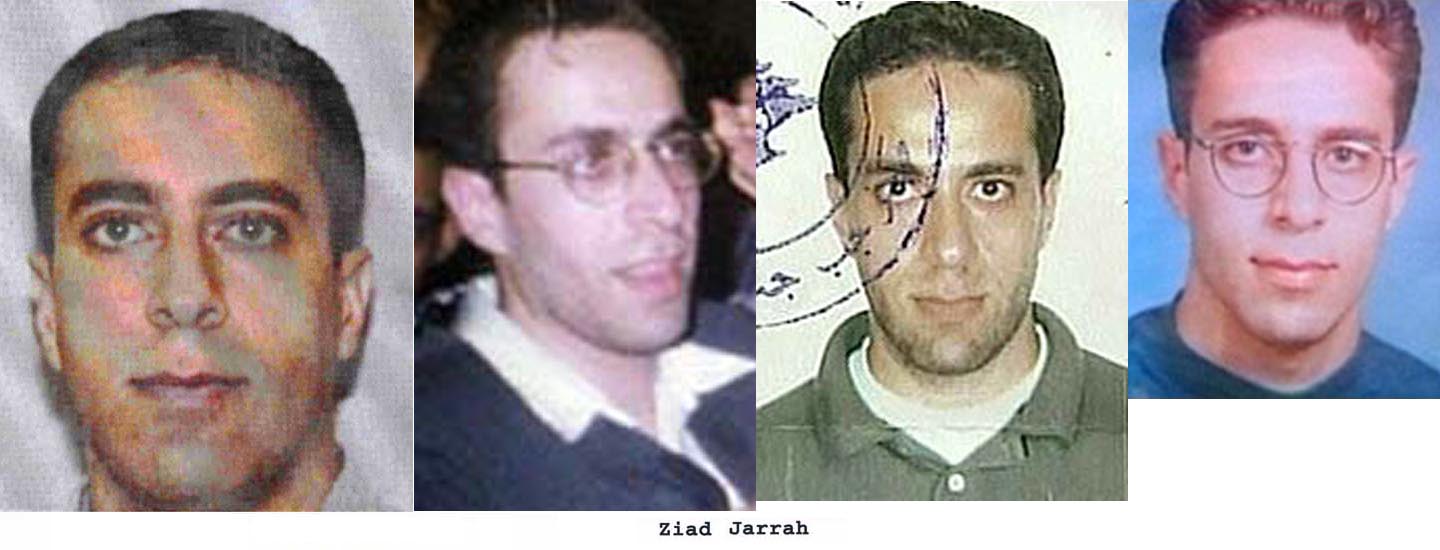
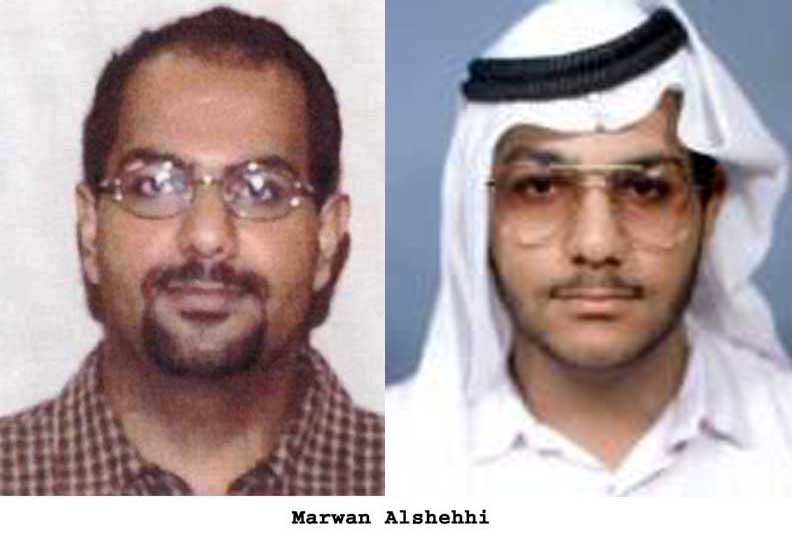
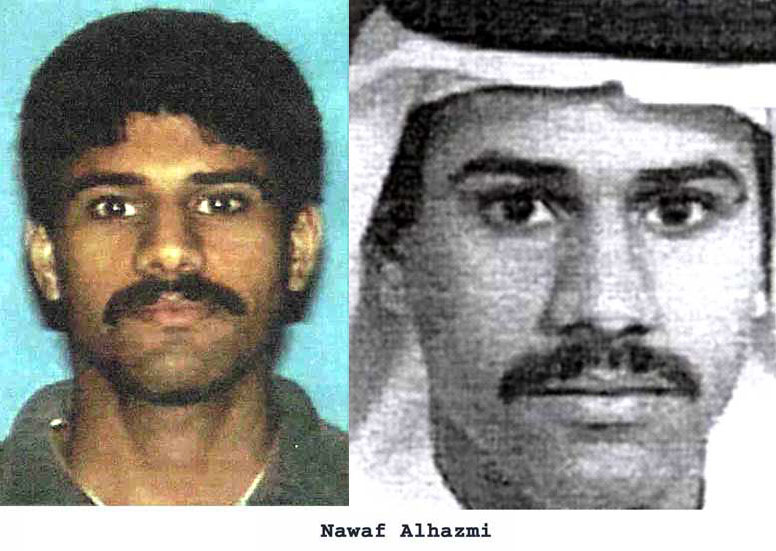
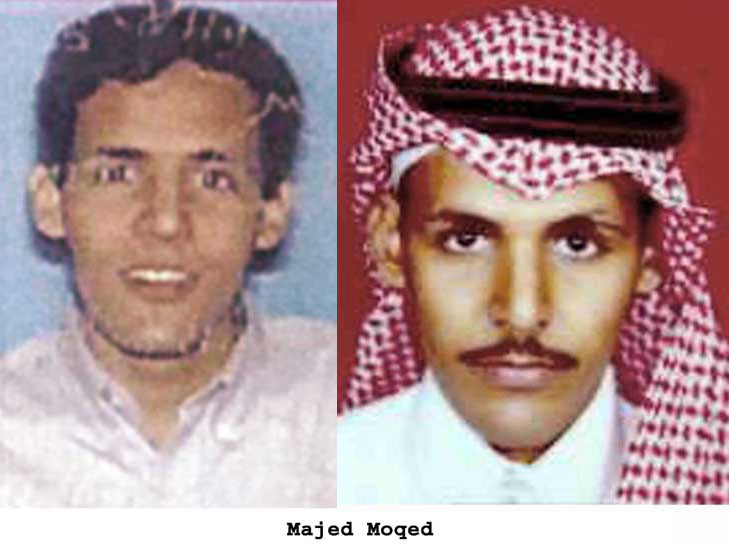
American Airlines Flight 11 Waleed Alshehri, 22, from Saudi Arabia * Wail Alshehri, 28, from Saudi Arabia, brother of Waleed Alshehri, had psychological problems * Abdulaziz Alomari, 22, from Saudi Arabia * Satam Al Suqami, 25, from Saudi Arabia Mohamed Atta, 33, from Egypt (the likely pilot) * United Airlines Flight 93 Saeed Alghamdi, 21, from Saudi Arabia (had flight training) * Ahmed Alhaznawi, 20, from Saudi Arabia * Ahmed Alnami, 23, from Saudi Arabia * Ziad Jarrah, 26, from Lebanon (the likely pilot) * United Airlines Flight 175 Ahmed Alghamdi, 22, from Saudi Arabia Hamza Alghamdi, 20, from Saudi Arabia, brother of Ahmed Alghamdi * Marwan Alshehhi, 23, from United Arab Emirates (the likely pilot) * Mohand Alshehri, 22, from Saudi Arabia, possible cousin of Marwan Alshehhi and/or from the same extended family as Wail and Waleed Alshehri Fayez Ahmed Banihammad (Alshehri), 24, from United Arab Emirates (had flight training) American Airlines Flight 77 Khalid Almihdhar, 26, from Saudi Arabia (originally from Yemen, changed citizenship in 1996) * Nawaf Alhazmi, 25, from Saudi Arabia Salem Alhazmi, 20, from Saudi Arabia, brother of Nawaf Alhazmi * Hani Hanjour, 29, from Saudi Arabia (the likely pilot) Majed Moqed, 24, from Saudi Arabia *
December 26, 1979:Soviet forces invade Afghanistan. They will withdraw in 1989 after a brutal 10-year war. It has been commonly believed that the invasion was unprovoked. But in a 1998 interview, Zbigniew Brzezinski, President Carter’s National Security Adviser, reveals that the CIA began destabilizing the pro-Soviet Afghan government six months earlier, in a deliberate attempt to get the Soviets to invade and have their own Vietnam-type costly war: “What is most important to the history of the world? The Taliban or the collapse of the Soviet empire? Some stirred-up Moslems or the liberation of Central Europe and the end of the cold war?” The US and Saudi Arabia give a huge amount of money (estimates range up to $40 billion total for the war) to support the mujaheddin guerrilla fighters opposing the Russians.
1987-1989: Michael Springman, the head US consular official in Jeddah, Saudi Arabia, later claims that he is “repeatedly told to issue visas to unqualified applicants.” He turns them down, but is repeatedly overruled by superiors. He claims the visas were issued for recruits fighting for bin Laden against Russia in Afghanistan. Springman loudly complains about the practice to numerous government offices but no action is taken. He eventually is fired and the files he has kept on these applicants are destroyed. Springman speculates the issuing of visas to radical Islamic fighters continued until 9/11. 15 of the 19 9/11 hijackers getting their visas through his former Jeddah office. A government report later concludes that all of the known hijacker visa applications should have been rejected, and numerous experts say its improbable that more than a few should have been accepted through luck or incompetence.
1988: Bin Laden forms al-Qaeda this year (some reports claim 1989).
1988: Prior to this year, George Bush Jr. is a failed oil man. Three times friends and investors have bailed him out to keep him from going bankrupt. But in this year, the same year his father becomes President, some Saudis buy a portion of his small company, Harken, which has never worked outside of Texas. Later in the year, Harken wins a contract in the Persian Gulf and starts doing well financially. These transactions seem so suspicious that the Wall Street Journal in 1991 states it “raises the question of … an effort to cozy up to a presidential son.” Two major investors in Bush’s company during this time are Salem bin Laden, Osama bin Laden’s father, and Khaled bin Mahfouz. In 1999 bin Mahfouz will be placed under house arrest in Saudi Arabia for contributions he gave to organizations closely linked to al-Qaeda. His sister is married to Osama bin Laden.
August 12, 1988:The first media report appears about Echelon, a high-tech global electronic surveillance network between the US, Britain, Canada, Australia and New Zealand. Australia and Britain later admit Echelon exists, but the US still denies it. Echelon is capable of “near total interception of international commercial and satellite communications,” including taps into transoceanic cables. The BBC describes Echelon’s power as “astounding,” and elaborates: “Every international telephone call, fax, e-mail, or radio transmission can be listened to by powerful computers capable of voice recognition. They home in on a long list of key words, or patterns of messages. They are looking for evidence of international crime, like terrorism.” With such data collecting ability, and al-Qaeda the biggest threat for years, how could the US miss hearing of the 9/11 plot?
1993:Bin Laden buys a jet from the US military in Arizona (the Pentagon approved the transaction). This aircraft is later used to transport missiles from Pakistan that kill American special forces in Somalia. He also has some of his followers begin training as pilots in US flight schools.
1993: An expert panel commissioned by the Pentagon privately postulates that an airplane could be used as a missile to bomb national landmarks. In 1994 one of the panel’s experts will write in Futurist magazine: “Targets such as the World Trade Center not only provide the requisite casualties but, because of their symbolic nature, provide more bang for the buck. In order to maximize their odds for success, terrorist groups will likely consider mounting multiple, simultaneous operations with the aim of overtaxing a government’s ability to respond, as well as demonstrating their professionalism and reach.”
February 26, 1993: A bombing attempt to knock down the WTC fails. Six people are killed in the misfired blast. The bombing is organized by Ramzi Yousef, who has close ties to bin Laden. The New York Times later reports that an undercover agent testifies that the FBI knew about the attack beforehand and told him they would thwart it by substituting a harmless powder for the explosives. However, this plan was called off by an FBI supervisor, and the bombing was not stopped. Several of the bombers were trained by the CIA to fight in the Afghan war – the CIA later concludes in internal documents that it was “partly culpable” for this bombing attempt. Two years later, a statement from bin Laden is found that says, “on the second attempt they would be successful.” Security at the WTC doesn’t appear to have been noticeably improved after these revelations, or later.
1994: Three separate attacks this year involve hijacking airplanes to crash them into buildings. A disgruntled Federal Express worker tries to crash a DC-10 into a company building in Memphis but is overpowered by the crew. A lone pilot crashes a small plane onto the White House grounds, just missing the President’s bedroom. An Air France flight is hijacked by a terrorist group linked to al-Qaeda, with the aim of crashing it into the Eiffel Tower, but French Special Forces storm the plane before it takes off.
September 1994: Starting as Afghani exiles in Pakistan religious schools, the Taliban begin their conquest of Afghanistan. CNN reports, “The Taliban are widely alleged to be the creation of Pakistan’s military intelligence [the ISI]. Experts say that explains the Taliban’s swift military successes.” The CIA also worked with the ISI to create the Taliban. A regional expert with extensive CIA ties says: “I warned them that we were creating a monster.” After 9/11, the Wall Street Journal states: “Despite their clean chins and pressed uniforms, the ISI men are as deeply fundamentalist as any bearded fanatic; the ISI created the Taliban as their own instrument and still supports it.” 1995-April 1996: In 1995, the government of Sudan offers the US all of its files on bin Laden and al-Qaeda, but the US turns down the offer. Bin Laden had been living in Sudan since 1991. The Sudanese government collected a “vast intelligence database on Osama bin Laden and more than 200 leading members of his al-Qaeda terrorist network… [The US was] offered thick files, with photographs and detailed biographies of many of his principal cadres, and vital information about al-Qaeda’s financial interests in many parts of the globe.” In April 1996, the US again rejects Sudan’s offer of the files. An American involved in the secret negotiations later says that the offer was blocked by another arm of the federal government: “I’ve never seen a brick wall like that before. Somebody let this slip up… We could have dismantled his operations and put a cage on top. It was not a matter of arresting bin Laden but of access to information… and that’s what could have prevented September 11. I knew it would come back to haunt us.” Sudan again offers the US the files in May 2000, and again is turned down. In 1996 Sudan also offers their files to British intelligence, and are also rebuffed. Sudan makes a standing offer to the British to take the information at any time, but the offer is not taken up until after 9/11.
January 6, 1995: While investigating a possible assassination plan against the Pope, Philippine police uncover plans for Operation Bojinka, an al-Qaeda operation led by 1993 WTC bomber Ramzi Yousef and 9/11 mastermind Khalid Shaikh Mohammed. The plan is to explode 12 passenger planes over the Pacific Ocean simultaneously on January 21, 1995. If successful, up to 4,000 people would have been killed. Plans found for a second phase of attacks are also found. Planes would be hijacked and flown into buildings. The WTC, CIA headquarters, Pentagon and the Sears Tower are specifically mentioned as targets. One pilot, who learned to fly in US flight schools, confesses that his role was to crash a plane into CIA headquarters.
November 13, 1995 and June 25, 1996: Two truck bombs kill five Americans and two Indians in a US-operated training center in Riyadh, Saudi Arabia.On June 25, 1996, bombs destroy the Khobar Towers in Dhahran, Saudi Arabia, killing 19 American soldiers and wounding 500. Al-Qaeda is blamed for both of the attacks.
1996: FBI investigators are prevented from carrying out an investigation into Abdullah and Omar bin Laden, two brothers of Osama. The FBI suspected the World Assembly of Muslim Youth (WAMY) was terrorist organization and Abdullah was the US director of WAMY. Apparently the case involved espionage, murder, and national security. Four of the 9/11 hijackerslater lived only three blocks from the WAMY offices near Washington DC, at the same time the two bin Laden brothers were there. WAMY still has not been put on a list of terrorist organizations in the US, but has been banned in Pakistan. A high-placed intelligence official tells the Guardian: “There were always constraints on investigating the Saudis. There were particular investigations that were effectively killed.” An unnamed US source says to the BBC, “There is a hidden agenda at the very highest levels of our government.”
1996: A paid informant, Aukai Collins, later says provided detailed information about hijacker Hani Hanjour to the FBI at this time. Hanjour was living in Phoenix, Arizona and taking flying lessons. Collins says the FBI “knew everything about the guy.” The FBI denies knowing about Hanjour before 9/11, though they acknowledge that they paid Collins for four years to monitor the Islamic and Arab communities in Phoenix.
1996: The Saudi Arabian government starts paying huge amounts of money to al-Qaeda, becoming its largest financial backer. They also give money to other extremist groups throughout Asia. This money vastly increases the capability of al-Qaeda. US officials later privately complain “that the Bush Administration, like the Clinton Administration, is refusing to confront this reality, even in the aftermath of the September 11th terrorist attacks.”
1996:After learning that an al-Qaeda terrorist trained at a US flight school, the FBI visit two flight schools where the terrorist trained. They abandon the investigation when they fail to find any other suspicious students at those schools.
March-May 18, 1996: Pressured by the US to do something about bin Laden, Sudan offers to extradite bin Laden to anywhere he might stand trial. The US decides not to take him because they apparently don’t have enough evidence at the time to charge him with a crime. Saudi Arabia doesn’t want him either. US officials nonetheless insist that Sudan must expel bin Laden. One US intelligence source in the region later states: “We kidnap minor drug czars and bring them back in burlap bags. Somebody didn’t want this to happen.” On May 18, bin Laden and about 150 supporters take a flight to Afghanistan, bringing all of their money, resources and personnel. The US knows in advance that bin Laden is going to Afghanistan, but does nothing to stop him. Sudan’s minister of state for defense later says in an interview: “We warned [the US]. In Sudan, bin Laden and his money were under our control. But we knew that if he went to Afghanistan no one could control him. The US didn’t care; they just didn’t want him in Somalia. It’s crazy.”
June 24, 1996: The Central Asian nation of Uzbekistan signs a deal with Enron “that could lead to joint development of the central Asian nation’s potentially rich natural gas fields.” The $1.3 billion venture teams Enron with the state companies of Russian and Uzbekistan. Two months later, Unocal and Delta Oil of Saudi Arabia come to agreement with state companies in Turkmenistan and Russia to to build a natural gas pipeline from Turkmenistan to Pakistan via Afghanistan. They form the CentGas consortium in October 1997.Halliburton, a company with future Vice President Cheney as CEO, announces an agreement to provide technical services and drilling for Turkmenistan.
July 6-August 11, 1996: US officials identify crop-dusters and suicide flights as potential terrorist weapons that could threaten the Olympic Games in Atlanta, Georgia. Planes are banned from getting too close to Olympic events. During the games, Black Hawk helicopters and US Customs Service jets are deployed to intercept suspicious aircraft over the Olympic venues. Agents monitor crop-duster flights and airports within hundreds of miles of downtown Atlanta.
August 1996: Bin Laden issues a religious decree, authorizing attacks on Western military targets in the Arabian Peninsula. In February 1998, he expands the decree, declaring it the religious duty of all Muslims “to kill the Americans and their allies – civilians and military … in any country in which it is possible.” In May, 1998, bin Laden publicly discusses “bringing the war home to America.”
September 27, 1996: The Taliban conquer Kabul, establishing control over much of Afghanistan. The oil company Unocal is hopeful that the Taliban will stabilize Afghanistan, and allow its pipeline plans to go forward. In fact, “preliminary agreement [on the pipeline] was reached between the [Taliban and Unocal] long before the fall of Kabul.” “Oil industry insiders say the dream of securing a pipeline across Afghanistan is the main reason why Pakistan, a close political ally of America’s, has been so supportive of the Taliban, and why America has quietly acquiesced in its conquest of Afghanistan.”
October 1996: US intelligence learn of an Iranian plot to hijack a Japanese plane over Israel and crash it into Tel Aviv. The plot is never carried out.
1997: Former National Security Advisor Zbigniew Brzezinski publishes a book in which he portrays the Eurasian landmass as the key to world power, and Central Asia with its vast oil reserves as the key to domination of Eurasia. He notes that because of popular resistance to US military expansionism, his ambitious strategy could not be implemented “except in the circumstance of a truly massive and widely perceived direct external threat.”
1997: It is later claimed that the special CIA paramilitary teams start entering Afghanistan in this year. In 1999, they place listening devices within range of al-Qaeda’s tactical radios. CIA Director Tenet states that by 9/11, “a map would show that these collection programs and human networks were in place in such numbers to nearly cover Afghanistan. This array meant that, when the military campaign to topple the Taliban and destroy al-Qaeda began [in October 2001], we were able to support it with an enormous body of information and a large stable of assets.”
December 4, 1997: Representatives of the Taliban are invited guests to the Texas headquarters of Unocal to negotiate their support for the pipeline. Future President Bush Jr. is Governor of Texas at the time. The Taliban appear to agree to a $2 billion pipeline deal, but will do the deal onlyif the US officially recognizes the Taliban regime. The Taliban meet with US officials, and the Telegraph reports that “the US government, which in the past has branded the Taliban’s policies against women and children ‘despicable,’ appears anxious to please the fundamentalists to clinch the lucrative pipeline contract.”
1998: According to later closed session congressional testimony by the heads of the CIA, FBI and NSA, al-Qaeda begins planning the 9/11 attacks in this year. In a June 2002 interview, 9/11 mastermind Khalid Shaikh Mohammed also says the planning for the attacks begin at this time.
February 12, 1998: Unocal Vice President John J. Maresca – later to become a Special Ambassador to Afghanistan – testifies before the House of Representatives that until a single, unified, friendly government is in place in Afghanistan the trans-Afghani pipeline will not be built. He suggests that with a pipeline through Afghanistan, the Caspian basin could produce 20 percent of all the non-OPEC oil in the world by 2010.
May 18, 1998: The FBI office in Oklahoma City sends a memo on this day warning that “large numbers of Middle Eastern males” are getting flight training in Oklahoma and could be planning terrorist attacks. The memo is apparently ignored. In 1999 it is learned that an al-Qaeda agent had studied flight training in Norman, Oklahoma. Hijackers Atta and Marwan Alshehhi consider studying at that school in 2000; Zacarias Moussaoui does study at the school in 2001.
August 1998: A CIA intelligence report asserts that Arab terrorists loosely tied to al-Qaeda are planning to fly a bomb-laden aircraft from a foreign country into the WTC. The FBI and the FAA don’t take the threat seriously because of the state of aviation in that unnamed country.
August 7, 1998: Al-Qaeda terrorists bomb the US embassies in Kenya and Tanzania. The bomb in Nairobi, Kenya kills 213 people, including 12 US nationals, and injures more than 4,500. The bomb in Dar es Salaam kills 11 and injures 85.
August 9, 1998: Northern Alliance capital Mazar-e-Sharif is conquered by the Taliban, giving them control of 90% of Afghanistan, including the entire pipeline route. The CentGas consortium, led by Unocal and the Saudi Arabian Delta Oil, is now “ready to proceed” with the gas pipeline that would run through Afghanistan.
August 20, 1998: The US fires approximately 60 missiles at six training camps in Afghanistan and about 20 missiles at a pharmaceutical factory in Khartoum, Sudan in retaliation for the US embassy bombings. About 30 people are killed in the attacks, but no important al-Qaeda figures. It is later revealed the Sudanese factory had no terrorist connections. Of the six camps targeted in Afghanistan, only four were hit, and of those only one had connections to bin Laden. The missiles were aimed at a “gathering of key terrorist leaders” that actually took place a month earlier, in Pakistan. A US defense analyst later states, “My sense is that because the attack was so limited and incompetent, we turned this guy into a folk hero.”
September 1998: US intelligence finds information that bin Laden’s next operation could possibly involve crashing an aircraft loaded with explosives into a US airport.
October-November 1998: US intelligence learns that al-Qaeda is trying to establish a terrorist cell within the US and are planning to strike a US domestic target.
Autumn 1998: US intelligence hears of a bin Laden plot involving aircraft in the New York and Washington areas. It’s unknown if this is connected to the 9/11 plot or something else.
November 1998: US intelligence learns that a Turkish extremist group loosely connected to al-Qaeda had planned to crash an airplane packed with explosives into a famous tomb during a government ceremony. They were arrested before they could try it.
December 1, 1998: A US intelligence assessment: “[bin Laden] is actively planning against US targets… Multiple reports indicate [he] is keenly interested in striking the US on its own soil… al-Qaeda is recruiting operatives for attacks in the US but has not yet identified potential targets.” Later in the month, a classified document signed by a senior US official states: “The intelligence community has strong indications that bin Laden intends to conduct or sponsor attacks inside the US.”
December 4, 1998:CIA Director Tenet issues a “declaration of war” on al-Qaeda, in a memorandum circulated in the intelligence community. Tenet says, “Each day we all acknowledge that retaliation is inevitable and that its scope may be far larger than we have previously experienced… We are at war… I want no resources or people spared in this effort, either inside CIA or the [larger intelligence] community.” Yet it is later found that few FBI agents had ever heard of the declaration. There is no shift in budget priorities, either. For example, the number of CIA personnel assigned to its Counter-Terrorism Center (CTC) stays roughly constant until 9/11.
December 21, 1998: In a Time magazine cover story entitled “The Hunt for Osama,” it is reported intelligence sources “have evidence that bin Laden may be planning his boldest move yet – a strike on Washington or possibly New York City in an eye-for-an-eye retaliation. ‘We’ve hit his headquarters, now he hits ours,’ says a State Department aide.”
Late 1998: A captured al-Qaeda operative tells the FBI learns of a telephone number in Yemen, in a safe house owned by hijacker Khalid Almihdhar’s father-in-law. US intelligence taps the phone line and learns the house is an al-Qaeda “logistics center” used by agents around the world to communicate with each other and plan attacks. Even bin Laden called the safe house dozens of times. In late 1999 the phone line will lead the CIA to an important al-Qaeda “summit” in Malaysia. It appears al-Qaeda was still using the phone line until a government raid in February 2002. It also appears the US was able to decipher much of al-Qaeda’s code language. For instance, in 1998 they learned “wedding” meant bomb, and the code name for 9/11 was “The Big Wedding.” Why didn’t monitoring of this phone expose the 9/11 attack?
Late 1998: President Clinton signs a directive authorizing the CIA to plan an assassination of bin Laden. The assassination never happens, supposedly because of inadequate intelligence. An officer who helped draw up the plans says, “We were ready to move” but “we were not allowed to do it because of this stubborn policy of risk avoidance… It is a disgrace.”
1999: British intelligence warns US intelligence that al-Qaeda has plans to use “commercial aircraft” in “unconventional ways”, “possibly as flying bombs.”
1999: Mohamed Atta’s telephone is monitored by the Egyptian secret service in this year. They learn that he had visited Afghanistan at least once recently, but it’s not known if the information was shared or when the surveillance stopped.
July 14, 1999: A government informant records a conversation between some illegal arms dealers and Pakistani ISI agents held within view of the WTC. An ISI agent points to the WTC and says, “Those towers are coming down.” He later makes other references to an attack on the WTC. The informant passes these warnings on to Senator Bob Graham and others, but later claims “The complaints were ordered sanitized by the highest levels of government.” Senator Graham admits being “concerned” about this warning before 9/11, but apparently the warning is not passed on. September 1999: A report prepared for US intelligence entitled the “Sociology and Psychology of Terrorism” is completed. It suggests: “Al-Qaeda could detonate a Chechen-type building-buster bomb at a federal building. Suicide bomber(s) belonging to al-Qaeda’s Martyrdom Battalion could crash-land an aircraft packed with high explosives into the Pentagon, the headquarters of the CIA, or the White House.”
December 14, 1999: Al-Qaeda terrorist Ahmed Ressam is arrested trying to enter the US with components of explosive devices. Documents found with Ressam lead to arrests of co-conspirators in New York, Boston and Seattle. These arrests and more in Jordan foil a series of attacks against US targets over the New Year’s weekend. Ressam was to bomb the Los Angeles International Airport. Counterterrorism head Richard Clarke later says, “I think a lot of the FBI leadership for the first time realized that … there probably were al-Qaeda people in the United States.” Yet Clinton’s National Security Adviser Sandy Berger says, “Until the very end of our time in office, the view we received from the [FBI] was that al-Qaeda had limited capacity to operate in the US and any presence here was under surveillance.” No analysis is done before 9/11 to investigate just how big that presence might be.
January 2000:Former PresidentGeorge Bush Sr. meets with the bin Laden family on behalf of the Carlyle Group. He had also met with them in 1998, but it’s not known if he met with them after this.
January-May 2000: The CIA surveils hijacker Mohamed Atta in Germany. He is “reportedly observed buying large quantities of chemicals in Frankfurt, apparently for the production of explosives [and/or] for biological warfare. The US agents reported to have trailed Atta are said to have failed to inform the German authorities about their investigation. The disclosure that Atta was being trailed by police long before 11 September raises the question why the attacks could not have been prevented with the man’s arrest.” The surveillance stopped when he left for the US at the start of June. But “experts believe that the suspect remained under surveillance in the United States.”
January 5-8, 2000: About a dozen of bin Laden’s trusted followers hold a secret, “top-level al-Qaeda summit” in the city of Kuala Lumpur, Malaysia. Plans are made for the 9/11 attacks. The CIA knows it is an al-Qaeda planning meeting and has Malaysia follow, photograph, and even videotape the attendees, but the meeting is not wiretapped. Even before the meeting begins, the CIA learns that hijackers Khalid Almihdhar and Nawaf Alhazmi will be attending, and that Almihdhar has a multiple-entry visa for the US good until April 6, 2000. The two already began living in San Diego in November 1999, and the NSA learned earlier in 1999 that Alhazmi is a terrorist. Yet somehow, the CIA fails to notice under after 9/11 that Khalid Shaikh Mohammed, a top al-Qaeda leader, the mastermind of the 9/11 attacks, and someone the US has been trying to catch since 1995, is at the meeting. Khallad bin Atash, a “trusted member of bin Laden’s inner circle” who was in charge of bin Laden’s bodyguards, also attends, as does top al-Qaeda operative Fahad al-Quso, and a number of terrorists from the Islamic Jihad.Ramzi bin al-Shibh, the would-be 20th hijacker, also attends, but the US says they don’t realize that until after 9/11, despite photographs and video footage of him at the meeting. However, one account says he was recognized at the time of the meeting, which makes it hard to understand why he wasn’t tracked back to Germany and his housemate, hijacker Mohamed Atta. The chances to foil the 9/11 plot based on knowledge of this meeting are many. Had the meeting been wiretapped, presumably the details of the entire 9/11 plot would have been recorded.
January 15, 2000-March 5, 2000: The CIA tracks hijackers Nawaf Alhazmi and Khalid Almihdhar from the al-Qaeda meeting in Malaysia to Thailand, and then tracks Alhazmi as he flies from Bangkok, Thailand, to Los Angeles, California. The US keeps a watch list database known as TIPOFF, with tens of thousands of names of suspected terrorists – even a “reasonable suspicion” that a person is connected with a terrorist group warrants being added to the database. Almihdhar and Alhazmi are important enough to have been mentioned to the CIA Director several times this month, but are not added to the watch list. Furthermore, “astonishingly, the CIA … [didn’t] notify the FBI, which could have covertly tracked them to find out their mission.” In March 2000, another country tells the CIA that Alhazmi flew to Los Angeles and that Almihdhar was on the same flight. Yet again, the CIA fails to put their names on a watch list, and fails to alert the FBI so they can be tracked, and fails to do either until August 23, 2001.
April 2000: A man walks into an FBI office and claims he had trained in Pakistan as part of a plot with 5 or 6 others to hijack a plane in the US, then pilot it to Afghanistan or blow it up. The individual passes a polygraph test, but the FBI is unable to learn more about the plot.
April-May 2000: Hijacker Marwan Alshehhi boasts of planning an attack to a Hamburg librarian. He says, “There will be thousands of dead. You will think of me… In America something is going to happen.” He specifically mentions the WTC. Meanwhile, at the same time in the US, hijacker Mohamed Atta is even more forthcoming when applying for a $650,000 loan at the Department of Agriculture. Atta says he just arrived from Afghanistan, asks about security at the WTC, discusses al-Qaeda and its need for American membership, says bin Laden “would someday be known as the world’s greatest leader,” threatens to cut the throat of the bureaucrat and steal the money from her safe, asks “How would America like it if another country destroyed [Washington] and some of the monuments in it like the cities in [my] country had been destroyed?,” referring to a government building in Washington, asks “How would you like it if somebody flew an airplane into your friends’ building?”, and so on. Incredibly, neither the librarian nor the bureaucrat warn anyone of what they heard. In June 2002, FBI Director Mueller will say of the hijackers, “There were no slip-ups. Discipline never broke down. They gave no hint to those around them what they were about.”
June 29, 2000-September 18, 2000: On the orders of Pakistani ISI Director Lt. Gen. Mahmood Ahmed, Saeed Sheikh wires about $100,000 to hijacker Atta between these dates using the alias Mustafa Ahmed. Saeed Sheikh, later convinced for kidnapping and murdering reporter Daniel Pearl in February 2002.The role of Mahmood Ahmed and the identity of Saeed Sheikh are briefly reported in the US press in early October, 2001, but since then this remarkable story appears to have been forgotten and there have been attempts to connect the Mustafa Ahmed alias with other people. The financial connection between Saeed and the hijackers continues until the day before 9/11, and it’s likely Saeed gave at least half of the $500,000 or so the hijackers spent in the US for the 9/11 plot.
August-September 2000: An unmanned spy plane called the Predator begins flying over Afghanistan, showing incomparably detailed real-time video and photographs of the movements of what appeared to be bin Laden and his aides. Its use is stopped after a few trials when a Predator crashes. It is decided to arm the Predator with a missile, but delays prevent this from happening before 9/11, and no more unarmed flights are conducted.
August 12, 2000-March 2001: Italian intelligence successfully wiretap the al-Qaeda terrorist cell in Milan, Italy from late 1999 until summer 2001. In a wiretapped conversation from this day, terrorist Abdulsalam Ali Abdulrahman tells terrorist Es Sayed about a massive strike against the enemies of Islam involving aircraft and the sky, a blow that “will be written about in all the newspapers of the world. This will be one of those strikes that will never be forgotten… This is a terrifying thing…” In another conversation, Abdulrahman tells Es Sayed: “I’m studying airplanes. I hope, God willing, that I can bring you a window or a piece of an airplane the next time we see each other.” The comment is followed by laughter. In January 2001, a different terrorist asks Es Sayed about some fake documents: “Will these work for the brothers who are going to the United States?” Sayed responds angrily, saying: “Don’t ever say those words again, not even joking! If it’s necessary … whatever place we may be, come up and talk in my ear, because these are very important things. You must know … that this plan is very, very secret, as if you were protecting the security of the state.” Beginning in October 2000, FBI experts begin helping Italian police analyze the intercepts. Neither Italy nor the FBI understands their meaning until after 9/11, but apparently the Italian government understands enough to give the US an official warning based on these intercepts in March 2001.
September-December 2000: Hijackers Nawaf Alhazmi and Khalid Almihdhar live with an FBI informant in San Diego. Supposedly, he never told the FBI the hijackers’ names. Neighbors claim that Mohamed Atta and Hani Hanjour are frequent visitors. Neighbors also witness strange late night visits with Alhazmi and Almihdhar, matching reports of neighbors at other buildings the two lived in. For instance, one neighbor says, “There was always a series of cars driving up to the house late at night. Sometimes they were nice cars. Sometimes they had darkened windows. They’d stay about 10 minutes.”
September 15-October 1, 2000: Olympics officials later reveal that “A fully loaded, fueled airliner crashing into the opening ceremony before a worldwide television audience at the Sydney Olympics was one of the greatest security fears for the Games.” During the Olympics, Australia has six planes in the sky at all times ready to intercept any wayward aircraft. In fact, “IOC officials said the scenario of a plane crash during the opening ceremony was uppermost in their security planning at every Olympics since terrorists struck in Munich in 1972.” Bin Laden was considered the number one threat.
October 12, 2000: The USS Cole is bombed in the Aden, Yemen harbor by al-Qaeda terrorists. 17 US soldiers are killed. The Prime Minister of Yemen at the time later claims that hijacker “Khalid Almihdhar was one of the Cole perpetrators, involved in preparations. He was in Yemen at the time and stayed after the Cole bombing for a while, then he left.” John O’Neill and his team of 200 hundred FBI investigators enter Yemen two days later, but are unable to accomplish much due to restrictions placed on them, and tensions with US Ambassador Barbara Bodine. All but about 50 investigators are forced to leave by the end of October. Even though O’Neill’s boss visits and finds that Bodine is O’Neill’s “only detractor,” O’Neill and much of his team is forced to leave in November, and the investigation stalls without his personal relationships to top Yemeni officials. The Sunday Times later notes, “The failure in Yemen may have blocked off lines of investigation that could have led directly to the terrorists preparing for September 11.”
October 24-26, 2000: Pentagon officials carry out a “detailed” emergency drill based upon the crashing of a hijacked airliner into the Pentagon. The Pentagon is such an obvious target that, “For years, staff at the Pentagon joked that they worked at “Ground Zero”, the spot at which an incoming nuclear missile aimed at America’s defenses would explode. There is even a snack bar of that name in the central courtyard of the five-sided building, America’s most obvious military bullseye.” After 9/11, a Pentagon spokesman will say to the press, “The Pentagon was simply not aware that this aircraft was coming our way, and I doubt prior to Tuesday’s event, anyone would have expected anything like that here.”
December 2000-April 2001: According to later German reports, “a whole horde of Israeli counter-terror investigators, posing as students, [follow] the trails of Arab terrorists and their cells in the United States … In the town of Hollywood, Florida, they [identify] … Atta and Marwan Alshehhi as possible terrorists. Agents [live] in the vicinity of the apartment of the two seemingly normal flight school students, observing them around the clock.” Supposedly, around April, the Israeli agents are discovered and deported, terminating the investigation. This is popularly known as “the art student spy ring” because all of the spies claim to be art students, when in fact all had “recently served in the Israeli military, the majority in intelligence, electronic signal intercept or explosive ordnance units.”Other reports suggest the spy ring began in January 2000. Over 200 “students” are eventually expelled from the US. Supposedly, the Mossad waits until late August 2001 before informing the CIA what it learns, and the CIA doesn’t take the warning seriously. The US government later admits that large numbers of young Israelis were expelled, but denies they were spies.
Early December 2000: Terrorist Fahad al-Quso is arrested by the government of Yemen. In addition to being involved in the USS Cole bombing, al-Quso was at the January 2000 Malaysian meeting with hijackers Nawaf Alhazmi and Khalid Almihdhar. FBI head investigator John O’Neill feels al-Quso is holding back important information and wants him interrogated but the interrogation doesn’t happen because O’Neill had been kicked out of Yemen by his superiors a week or two before. Al-Quso is finally interrogated days after 9/11, and admits to meeting with Alhazmi and Almihdhar in January 2000. One investigator calls the missed opportunity of exposing the 9/11 plot through al-Quso’s connections “mind-boggling.” The CIA has pictures from the Malaysian meeting of al-Quso next to hijacker Khalid Almihdhar, but the CIA doesn’t share the pictures with the FBI, and Alhazmi and Almihdhar remain undetected in the US.
2001: At some point during the year, Julie Sirrs, a Defense Intelligence Agency (DIA) agent, travels twice to Afghanistan. She claims DIA officials knew in advance about both trips. Sirrs sees a terrorist training center, and meets with Northern Alliance leader Ahmad Massoud, who is assassinated by the Taliban two days before 9/11. She returns with what she later claims is a treasure trove of information, including evidence that bin Laden is planning to assassinate Massoud. However, upon returning, a security officer meets her flight and confiscates her material. The DIA and the FBI investigate her. She says no higher-ups want to hear what she had learned in Afghanistan. Ultimately, Sirrs’ security clearance is pulled and she eventually quits the DIA in frustration.
January 4, 2001:The FBI’s investigation into the USS Cole bombing learns that terrorist Khallad bin Atash had been a principal planner of the bombing, and that two other participants in the bombing had delivered money to bin Atash at the time of the January 2000 meeting in Malaysia. The FBI shares this information with the CIA, and when CIA analysts reexamine pictures from the Malaysian meeting to learn more about this, they find a picture of him standing next to hijacker Khalid Almihdhar. The CIA is aware that Almihdhar entered the US a year earlier, yet they don’t attempt to find him or warn the FBI. CNN later notes that, again, the CIA at least “could have put [Nawaf] Alhazmi and Almihdhar and all others who attended the meeting in Malaysia on a watch list to be kept out of this country. It was not done.” More incredibly, even bin Atash is not placed on the watch list at this time, despite being labeled the principal planner of the USS Cole bombing. In July, the CIA rediscovers bin Atash’s role, and a CIA agent warns the CIA’s Counter-Terrorism Center (CTC), that bin Atash “is a major league killer, who orchestrated the Cole attack and possibly the Africa bombings.” Yet bin Atash is still not put on a terrorist watch list, and hijackers Alhazmi and Almihdhar continue to live openly in the US.
January 21, 2001: George Bush Jr. is inaugurated as the 43rd US President, replacing Clinton.
January 30, 2001: Hijacker Ziad Jarrah is questioned for several hours at the Dubai International Airport, United Arab Emirates, at the request of the CIA for “suspected involvement in terrorist activities.” He freely admits that he was in Afghanistan for much of the past two months and that he is headed to Florida. US officials were informed of the results of the interrogation before Jarrah left the airport, but he is allowed to go, and he returns to his flight training in Florida. His questioning “fits a pattern of a CIA operation begun in 1999 to track suspected al-Qaeda operatives who were traveling through the United Arab Emirates.”
January 31, 2001: The final bipartisan report of the US Commission on National Security/21st Century, launched in 1998 by then-President Bill Clinton and then-House Speaker Newt Gingrich, is issued. The report has 50 recommendations on how to combat terrorism in the US, but all of them are ignored by the Bush Administration. Instead, the White House announces in May that it will have Vice President Cheney study the potential problem of domestic terrorism, despite the fact that this commission had just studied the issue for 2 1/2 years. According to Senator Hart, Congress was taking the commission’s suggestions seriously, but then, “Frankly, the White House shut it down…”
Late January 2001: The BBC later reports, “After the elections, [US intelligence] agencies [are] told to ‘back off’ investigatingthe Bin Ladens and Saudi royals,and that anger[s] agents.”
February 9, 2001: US intelligence tells Vice President Cheney that it has been conclusively proven bin Laden was behind the October 2000 attack on the USS Cole. However, fearful of ending secret pipeline negotiations begun just days after Bush took office, the US does not retaliate against known al-Qaeda bases in Afghanistan as Clinton did in 1998. The US also discontinues the covert deployment of cruise missile submarines and gunships on six-hour alert near Afghanistan’s borders that gave President Clinton the option of assassinating bin Laden.
March 2001: A Taliban envoy meets with US officials in Washington and discusses turning bin Laden over. But the US wants to be handed bin Laden directly, and the Taliban want to turn him over for trial in some third country. About 20 more meetings on giving up bin Laden take place up till 9/11, all fruitless.
March 26, 2001: The Washington Post reports on a major improvements of the CIA’s intelligence gathering capability “in recent years.” A new program called Oasis uses “automated speech recognition” technology to turn audio feeds into formatted, searchable text. It can distinguish one voice from another and differentiates “speaker 1” from “speaker 2” in transcripts. Software called Fluent performs “cross lingual” searches, even translating difficult languages like Chinese and Japanese as well as automatically assessing their importance. One week later, the BBC reports that Echelon has become particularly effective against mobile phones, recording millions of calls simultaneously and checking them against a powerful search engine designed to pick out key words that might represent a security threat. Laser microphones can pick up conversations inside buildings from up to a kilometer away by monitoring window vibrations. If a bug is attached to a computer keyboard it is possible to monitor exactly what is being keyed in, because every key on a computer has a unique sound when depressed.However, the government will later report that messages about the 9/11 attacks weren’t translated until after 9/11 because analysts were “too swamped.”
April 8, 2001: Supposedly, Atta flies from the US to Prague, Czech Republic, and meets with an Iraqi spy. But the US and Czech governments later conclude the meeting never happened and Atta never even flew to Europe at the time. But the story is influential – in October 2002, a few days before Congress votes to approve a possible war with Iraq, a poll shows 66% of Americans believe Iraq was involved in the 9/11 attacks.
April 23-June 29, 2001: The 13 hijackers commonly known as the “muscle” – the brute force to protect the hijacker pilots – first arrive in the US.
May 2001: Around this time, intercepts from Afghanistan warn that al-Qaeda could attack an American target in late June or on the July 4 holiday. However, The White House’s Counterterrorism Security Group does not meet to discuss this prospect. This group also fails to meet after intelligence analysts overhear conversations from an al-Qaeda cell in Milan suggesting that bin Laden’s agents might be plotting to kill Bush at the European summit in Genoa, Italy, in late July. In fact, under Bush, the group only meets twice before 9/11 (June 3 and September 4). Under Clinton, the group met two or three times a week between 1998 and 2000. The White House later “aggressively defend[s] the level of attention, given only scattered hints of al-Qaeda activity.”
May 31, 2001: The Wall Street Journal summarizes tens of thousands of pages of evidence disclosed in a recently concluded trial of al-Qaeda terrorists. They are called “a riveting view onto the shadowy world of al-Qaeda.” The documents reveal numerous connections between al-Qaeda and specific front companies and charities. They even detail a “tightly organized system of cells in an array of American cities, including Brooklyn, N.Y.; Orlando, Fla.; Dallas; Santa Clara, Calif.; Columbia, Mo., and Herndon, Va.” Apparently nothing is done. The 9/11 hijackers had ties to many of these same cities and charities.
June 2001: German intelligence warns the CIA, Britain’s MI6, and Israel’s Mossad that Middle Eastern terrorists are planning to hijack commercial aircraft to use as weapons to attack “American and Israeli symbols, which stand out.” German intelligence sources later state the information came from Echelon surveillance.
June 2001: A 60-page internal memo on the Israeli “art student” spy ring is prepared by the DEA’s Office of Security Programs. The memo is a compilation of dozens of field reports, and was meant only for the eyes of senior officials at the Justice Department, but it is leaked to the press around December 2001. The report connects the spies to efforts to foil DEA investigations into Israeli organized crime activity involving the importation of the drug Ecstasy. Salon later suggests this was a cover for the more important goal of spying on Muslim radicals. By the time of the report, the US has “apprehended or expelled close to 120 Israeli nationals.” Twenty more are arrested before 9/11, at least 60 more by the end of 2001, and arrests continue until at least May, 2002.
June 4 , 2001: Three Afghan or Pakistani men living in the Cayman Islands are overheard discussing hijacking attacks in New York City. These men are already being investigated by Cayman and British investigators. On this day, they are taken into custody, questioned and released some time later. This information is forwarded to US intelligence. In late August, an anonymous letter to a Cayman radio station will allege these same men are agents of bin Laden “organizing a major terrorist act against the US via an airline or airlines.” The letter is forwarded to the Cayman government, but it is unknown what they did with it.
June 9, 2001: Robert Wright, an FBI agent who spent ten years investigating terrorist funding, writes a memo that slams the FBI. He states, “There is virtually no effort on the part of the FBI’s International Terrorism Unit to neutralize known and suspected international terrorists living in the United States.” He claims “FBI was merely gathering intelligence so they would know who to arrest when a terrorist attack occurred,” rather than actually trying to stop the attacks. Wright claims the FBI shut down his 1998 criminal probe into alleged terrorist-training camps in Chicago and Kansas City. He says his superiors repeatedly blocked his attempts to shut off money flows to al-Qaeda, Hamas and other terrorist groups. Yet his story is largely ignored by the media because the FBI will not allow Wright to provide details. He is now suing the FBI so he can tell his story.
June 11, 2001: FBI agents from the New York office and Washington headquarters meet with CIA officials to discuss the USS Cole investigation. The FBI agents are shown photographs from the al-Qaeda meeting in Malaysia in January 2000, including pictures of hijackers Khalid Almihdhar and Nawaf Alhazmi, but are not given copies. “The FBI agents recognized the men from the Cole investigation, but when they asked the CIA what they knew about the men, they were told that they didn’t have clearance to share that information. It ended up in a shouting match.” A CIA official later admits that he knew more about Alhazmi and Almihdhar that he was willing to tell the FBI. The two are still not put on a terrorist watch list.
June 23, 2001: Reuters reports that “Followers of exiled Saudi dissident Osama bin Laden are planning a major attack on US and Israeli interests in the next two weeks.” The report is based on the personal impression of a reporter who interviewed bin Ladenand some of his followers two days earlier. This reporter is quoted as saying: “There is a major state of mobilization among the Osama bin Laden forces. It seems that there is a race of who will strike first. Will it be the United States or Osama bin Laden?”
Summer, 2001: Around this time, the NSA intercepts telephone conversations between al-Qaeda leader Khalid Shaikh Mohammed and lead hijacker Mohamed Atta, but does not share the information with any other agencies. Mohammed is on the FBI’s Most Wanted Terrorist List at the time, and is later considered the mastermind of the 9/11 attacks. Supposedly, however, the NSA either fails to translate important messages in a timely fashion, or fails to understand the significance of what was translated. The NSA Director later contradicts other senior US officials and claims no calls involving any of the hijackers have been found.
Summer, 2001: An informant tells an FBI field office agent that he has been invited to a commando training course at a camp operated by al-Qaeda in Afghanistan. The information is passed up to FBI headquarters, which rejects the idea of infiltrating the camp.
July 2, 2001: Indian sources claim that “bin Laden, who suffers from renal deficiency, has been periodically undergoing dialysis in a Peshawar military hospital with the knowledge and approval of the Inter-Services Intelligence (ISI), if not of [Pakistani President] Musharraf himself.” CBS later reports bin Laden had emergency medical care in Pakistan the day before 9/11, again protected by the ISI.
July 4-14, 2001: Bin Laden, the US’s most wanted criminal with a $5 million bounty on his head, supposedly receives lifesaving treatment for renal failure from American surgeon at the American hospital in Dubai, United Arab Emirates. Witnesses claim that on July 12, bin Laden meets with CIA agent Larry Mitchell and possibly another agent. The CIA, the Dubai hospital and even bin Laden deny the story; the doctor named refuses to comment. Le Figaro and Radio France International, who broke the story from French intelligence sources, stand by it.The explosive story is prominently and widely reported in Europe, but barely at all in the US.
July 10, 2001: Phoenix, ArizonaFBI agent Ken Williams sends a memo to FBI headquarters and several other FBI offices, warning about suspicious activities of 10 Middle Eastern men taking flight training lessons in Arizona. The memo specifically suggests that bin Laden’s followers might be trying to infiltrate the civil-aviation system as pilots, security guards or other personnel, and recommends a national program to track suspicious flight-school students. The memo is ignored and no action is taken, not even surveillance of the 10 suspected students. One of the students mentioned periodically roomed and trained with hijacker Hani Hanjour for several years in Arizona. In May 2002, Vice President Cheney states that the memo should never be released to the media or public.
Mid-July 2001: FBI counter-terrorism expertJohn O’Neill privately tell an investigator:”The main obstacles to investigate Islamic terrorism were US oil corporate interests and the role played by Saudi Arabia in it … All the answers, everything needed to dismantle Osama bin Laden’s organization, can be found in Saudi Arabia.” O’Neill also believes the White House is obstructing his investigation of bin Laden because they are still keeping the idea of a pipeline deal with the Taliban open.
July 16, 2001: British spy agencies warn that al-Qaeda is in “the final stages” of preparing a terrorist attack in the West. The report states there is “an acute awareness” that the attack is “a very serious threat.” In early August, the British add that the attack will involve multiple airplane hijackings. This warning is included in Bush’s briefing on August 6.
July 20-22, 2001: The G8 summit is held in Genoa, Italy. Acting on warnings that al-Qaeda would attempt to kill Bush and other leaders with “an airplane stuffed with explosives,” Italy surrounds the summit with antiaircraft guns, keeps fighters in the air, and closes off local airspace to all planes. Bush sleeps in an aircraft carrier off the coast. The attack is called off because of the heavy security.
July 21, 2001: Three former US officials meet with Pakistani and Russian intelligence officers in a Berlin hotel. It is the third of a series of back-channel conferences using ex-officials called “brainstorming on Afghanistan.” Department official Lee Coldren passes on a message from Bush officials. He later says, “I think there was some discussion of the fact that the United States was so disgusted with the Taliban that they might be considering some military action.” One specific threat made at this meeting is that the Taliban can choose between “carpets of bombs” – an invasion – or “carpets of gold” – the oil and gas pipelines.
July 26, 2001: CBS News reports that Attorney General Ashcroft has stopped flying commercial airlines due to a threat assessment, but “neither the FBI nor the Justice Department … would identify [to CBS] what the threat was, when it was detected or who made it.” The San Francisco Chronicle later concludes, “The FBI obviously knew something was in the wind … The FBI did advise Ashcroft to stay off commercial aircraft. The rest of us just had to take our chances.” CBS’s Dan Rather later says of this warning: “Why wasn’t it shared with the public at large?”
Late July 2001: The Taliban Foreign Minister Wakil Ahmed Muttawakillearns that bin Laden is planning a “huge attack” on targets inside America. The attack is imminent, and will kill thousands. He learns this from the leader of the rebel movement in Uzbekistan, which is allied with al-Qaeda. Muttawakil sends an emissary to pass this information on to the US consul general, and another US official, “possibly from the intelligence services,” as well as a United Nations office. The message is not taken very seriously; one source blames this on “warning fatigue” from too many warnings.
Late July 2001: David Schippers, noted conservative Chicago lawyer and the House Judiciary Committee’s chief investigator in the Clinton impeachment trial, later claims that FBI agents in Chicago and Minnesota contact him around this time and tell him that a terrorist attack is going to occur in lower Manhattan. According to Schippers, the agents had been developing extensive information on the planned attack for many months.However, the FBI soon pulls them off the terrorist investigation and threatens them with prosecution under the National Security Act if they go public with the information. As a result, they contact Schippers hoping he can persuade the government to take action. Schippers tries to pass the information on to high government officials but apparently his efforts are ignored. Partly in conjunction with Judicial Watch, the public interest law firm, Schippers is now representing at least ten FBI agents in a suit against the US government in an attempt to have their testimony subpoenaed, which would enable them to legally tell what they know without going to jail.
Late July 2001: CBS reports: “Just days after Atta return[s] to the US from Spain, Egyptian intelligence in Cairo says it received a report from one of its operatives in Afghanistan that 20 al-Qaeda members had slipped into the US and four of them had received flight training on Cessnas. To the Egyptians, pilots of small planes didn’t sound terribly alarming, but they [pass] on the message to the CIA anyway, fully expecting Washington to request information. The request never [comes].”
Late summer 2001: Jordanian intelligence warns the US that a major attack, code named The Big Wedding, is planned inside the US and that aircraft will be used.
Late summer 2001: The Guardian later reports, “Reliable western military sources say a US contingency plan existed on paper by the end of the summer to attack Afghanistan from the north.”
August 2001: A Moroccan informant learns that bin Laden is “very disappointed” that the 1993 bombing had not toppled the WTC, and plans “large scale operations in New York in the summer or fall of 2001.” The International Herald Tribune later calls the story “not proved beyond a doubt” but intriguing.
August 2001: Russian President Putin later states that during this month, “I ordered my intelligence to warn President Bush in the strongest terms that 25 terrorists were getting ready to attack the US, including important government buildings like the Pentagon.” He states that suicide pilots are training for attacks on US targets. The head of Russian intelligence also states, “We had clearly warned them” on several occasions, but they “did not pay the necessary attention.” A Russian newspaper on September 12, 2001 claims that “Russian Intelligence agents know the organizers and executors of these terrorist attacks. More than that, Moscow warned Washington about preparation to these actions a couple of weeks before they happened.”
August 2, 2001: The last secret meeting between US officials and the Taliban is held, apparently in a last ditch attempt to secure a pipeline deal. Talks break off, and the US prepares plans to invade and occupy Afghanistan.
August 6, 2001: President Bush receives classified intelligence briefings at his Crawford, Texas ranch indicating that bin Laden might be planning to hijack commercial airliners. The memo read to him is titled “Bin Laden Determined to Strike in US”, and the entire 11 page memo focuses on the possibility of terrorist attacks inside the US. The contents have never been made public. The existence of this memo is kept secret until May 2002. Vice President Cheney later calls the memo just a “rehash” containing nothing new or interesting. But he says Congress and the public should not see it, “because it contains the most sensitive sources and methods. It’s the family jewels.”
August 6, 2001-September 11, 2001: Inside trading based on advanced knowledge of the 9/11 attacks between August 6, if not earlier, and the day of the attack later lead to investigations around the world. The Securities and Exchange Commission (SEC) later announces that they are investigating the trading of shares of 38 companies in the days just before 9/11. Both the SEC and the Secret Service announce probes into an unusually high volume trade of five-year US Treasury note purchases (considered good investments in a world crisis) around this time. These transactions included a single $5 billion trade.German central bank president Ernst Welteke later says his researchers have found “almost irrefutable proof of insider trading,” not only in shares of heavily affected industries such as airlines and insurance companies, but also in gold and oil. Unusual stock transactions of Munich Re, the world’s largest reinsurer, is also noted by German investigators. US investigators reports that salvaged computers from within the WTC show that over $100 million was rushed through computers even as the disaster unfolded. Investigators say, “There is a suspicion that some people had advance knowledge of the approximate time of the plane crashes… [and] thought that the records of their transactions could not be traced after the main frames were destroyed.” There are ongoing investigations in Belgium, France, Switzerland, Luxembourg, Monte Carlo, Cyprus, Japan, Italy, Britain and other countries. Apparently all of these investigations are still continuing, except one in Britain which found no evidence of inside trading.
August 8-15, 2001: At some point between these dates, Israel warns the US that an al-Qaeda attack is imminent. Two high ranking agents from the Mossad come to Washington and warn the FBI and CIA that from 50 to 200 terrorists have slipped into the US and are planning “a major assault on the United States.” They say indications point to a “large scale target”, and that Americans would be “very vulnerable.” Later in the month, France gives a warning that apparently “echoes” this one.
August 15, 2001: After only a few days training to fly a 747 at a Minnesota flight school, terrorist Zacarias Moussaoui is arrested and detained in Minnesota on the excuse of an immigration violation. The FBI confiscates his possessions, including a computer laptop, but doesn’t have a search warrant to search through them. Moussaoui acted so suspiciously that a flight school staffer warned the FBI about Moussaoui, saying, “A 747 fully loaded with fuel could be used as a weapon!”One local FBI agent speculates that Moussaoui might “fly something into the World Trade Center.” But Minnesota FBI agents quickly become frustrated at the lack of interest in the case from higher ups, who refuse to allow the agents to ask for a search warrant from a secret court that, in over 10,000 cases from the FBI, that had never turned down a warrant request. French intelligence then gives evidence clearly tying Moussaoui to al-Qaeda, including evidence that he had trained in Afghanistan on several occasions. But an official at FBI headquarters edits out all the information tying Moussaoui to terrorism, and another attempt to apply for the warrant is rejected. One Minneapolis agent warns that FBI headquarters is “setting this up for failure,” and another agent later asks: “Why would an FBI agent deliberately sabotage a case?” A few weeks earlier, the headquarters official handling the Moussaoui case was also sent a copy of the Ken Williams memo warning that al-Qaeda terrorists might be training in US flight schools, but he apparently fails to see the connection. The search warrant is not approved until after the 9/11 attacks. Too late, evidence is found suggesting Moussaoui could be involved in a hijacking involving New York City. One newspaper claims that information on his computer “might have been enough to expose the Hamburg cell, which investigators believe was the key planning unit for 11 September.” FBI agent Coleen Rowley later suggests that if they would had received the search warrant sooner, “There is at least some chance that … may have limited the Sept. 11th attacks and resulting loss of life.”
August 21, 2001: Walid Arkeh, a Jordanian serving time in a Florida prison, warns FBI agents of an impending terrorist attack. He had befriended three important al-Qaeda figures in a British jail from September 2000 to July 2001. Bin Laden had telephoned one of them over 200 times prior to 1998. Arkeh tells the FBI that he had learned from these three that “something big was going to happen in New York City,” and they had called the 1993 attack on the WTC “unfinished business.” Tampa FBI agents determine that he had associated with these al-Qaeda agents, but nonetheless don’t believe him then or even after 9/11. One agent responds to his warning by saying: “Is that all you have? That’s old news.” The agents fail to learn more from him, but they do pass his warning to the FBI office in New York that is in charge of investigating al-Qaeda. In May 2002 he tells his story to different FBI agents. They are stunned, and later officially deem his warning valid. One says to him: “Let me tell you something. If you know what happened in New York, we are all in deep shit. We are in deep trouble.”
August 22, 2001: Counter-terrorism expert John O’Neill, the government’s “most committed tracker of Osama bin Laden and his al-Qaeda network of terrorists,” quits the FBI. He says it’s partly because of the recent power play against him apparently led by Tom Pickard, then interim director of the FBI, but also because of repeated obstruction of his investigations into al-Qaeda. He never hears the CIA warning about hijackers Alhazmi and Almihdhar sent out just one day later nor Ken Williams’ flight school memo, nor of Walid Arkeh’s warning, nor about the arrest of Zacarias Moussaoui, nor is he at a June meeting when the CIA revealed some of what it knew about Alhazmi and Almihdhar. The next day he begins a new job as head of security at the WTC. He dies in the 9/11 attack, one day after moving into his office inside the WTC.
August 23, 2001: According to German newspapers, the Mossad gives the CIA a list of 19 terrorists living in the US and say that they appear to be planning to carry out an attack in the near future. It is unknown if these are the 19 9/11 hijackers or if the number is a coincidence. However, four names on the list are known and are names of the 9/11 hijackers: Nawaf Alhazmi, Khalid Almihdhar, Marwan Alshehhi, and Mohamed Atta.The Mossad appears to have learned about this through its “art student” spy ring. Yet apparently this warning and list are not treated as particularly urgent by the CIA and also not passed on to the FBI.
August 23, 2001: The CIA finally notifies the State Department, INS, Customs Service, and FBI that hijackers Nawaf Alhazmi and Khalid Almihdhar be put on the terrorism watch list, which watches for them on any flight to or from the US (but not domestic flights). The CIA also requests that Khallad bin Atash be added to the watch list – eight months after he was known to have been the main planner of the Cole bombing. However, the FBI and other agencies are not told this is an urgent matter, and according to the Wall Street Journal, the search “consisted of little more than entering their names in a nationwide law enforcement database that would have triggered red flags if they were taken into custody for some other reason.” The FBI also fails to check national or state credit card, car registration, driver’s license or bank account databases. All of these would had positive results. Alhazmi’s name was even in the 2000-2001 San Diego phone book, listing the address where he and Almihdhar may have been living off and on until about September 9, 2001. The INS and State Department are not asked to help find the two; both later strongly suggest they could have found them. Although the FBI determines that Almihdhar had previously listed a Los Angeles address, FBI offices in Los Angeles and San Diego are not asked to assist in the search for the two until after 9/11.
August 24, 2001: Frustrated with lack of response from FBI headquarters about Zacarias Moussaoui, the Minnesota FBI asks the CIA for help. The CIA sends messages to stations and bases overseas requesting information about Moussaoui, stating that he might be “involved in a larger plot to target airlines traveling from Europe to the US,” and calls him a “suspect 747 airline attacker” and a “suspect airline suicide hijacker.” In contrast, on September 4, the FBI sends out a message about Moussaoui to the intelligence community and the FAA, but doesn’t suggest he’s a threat or possibly part of a larger plot, and doesn’t ask for any action or help. The FAA decides the warning is not important enough to pass on to the airlines. A terrorist turned informant held by the FBI Seattle knew Moussaoui from an al-Qaeda training camp in Afghanistan, but because of the vague FBI message the Seattle FBI doesn’t know to ask the informant about Moussaoui until after 9/11.
August 24-29, 2001: The 19 hijackers book their flights for 9/11, all use their real names. Most pay using credit cards on the internet. An official later states that had the FAA been properly warned about the watchlist on hijackers Nawaf Alhazmi and Khalid Almihdhar, “they should have been picked up in the reservation process.” Almihdhar in turn was in charge of arrangements for 13 other hijackers, and Alhazmi met regularly with Mohamed Atta.
August 28, 2001: The FBI’s New York office recommends that an investigation be launched “to determine if [Khalid] Almihdhar is still in the United States,” but FBI headquarters immediately turns the idea down on the grounds that there should be a wall between criminal investigations and intelligence work. One FBI agent expresses his frustration in an e-mail the next day, saying, “Whatever has happened to this – someday someone will die – and wall or not – the public will not understand why we were not more effective and throwing every resource we had at certain ‘problems.’ Let’s hope the [FBI’s] National Security Law Unit will stand behind their decisions then, especially since the biggest threat to us now, UBL [Usama bin Laden], is getting the most ‘protection.”‘
August 30-September 4, 2001: According to Egyptian President Mubarak, Egyptian intelligence warns American officials that bin Laden’s network is in the advanced stages of executing a significant operation against an American target, probably within the US. He says he learned this information from an agent working inside al-Qaeda.
Early September 2001: The NSA intercepts “multiple phone calls from Abu Zubaida, bin Laden’s chief of operations, to the United States.” The timing and information contained in these intercepted phone calls has not been disclosed.
Early September 2001: According to British inside sources, “shortly before September 11,” bin Laden contacts an associate thought to be in Pakistan. The conversation refers to an incident that will take place in the US on, or around 9/11, and discusses possible repercussions. In another conversation, bin Laden contacts an associate thought to be in Afghanistan. They discuss the scale and effect of a forthcoming operation; bin Laden praises his colleague for his part in the planning. Neither conversation specifically mentions the WTC or Pentagon, but investigators have no doubt the 9/11 attacks were being discussed.
Early September 2001: Bin Laden moves his training bases in Afghanistan “in the days before the attacks.” Presumably this is noticed by US spy satellites.
Early September 2001: Attendees of a New York mosque are warned to stay out of lower Manhattan on 9/11. The FBI’s Joint Terrorist Task Force interviews dozens of members of the mosque, who confirm the story. An agent in the 9/11 investigation later claims the news “had been out on the street” and the number of leads turning up later is so “overwhelming” that it is difficult to tell who knows about the attacks from secondhand sources and who knows about it from someone who may have been a participant. On September 6, a child in a class of Pakistani immigrants points towards the WTC, and says: “Do you see those two buildings? They won’t be standing there next week.” The FBI later confirms the event. One official at the school says many Arab-American students have come forward with their own stories about having prior knowledge before 9/11: “Kids are telling us that the attacks didn’t surprise them. This was a nicely protected little secret that circulated in the community around here.” Police say that on September 10, a sixth-grade student of Middle Eastern descent in Jersey City, New Jersey, warns his teacher to “to stay away from lower Manhattan because something bad was going to happen.” A few days before 9/11, a Seattle security guard of Middle Eastern descent tells an East Coast friend on the phone that terrorists will soon attack the US; the FBI later verifies the story. Three presumed terrorists talk threateningly in a Florida bar the night before the attacks, one saying: “Wait ’til tomorrow. America is going to see bloodshed.” In June 2002, FBI Director Mueller will claim: “To this day we have found no one in the United States except the actual hijackers who knew of the plot…” In February 2002, CIA Director Tenet claims the 9/11 plot was “in the heads of three or four people” and even most of the hijackers didn’t know the targets or that it would be a suicide attack until just before the attack.
September 3, 2001: Author Salman Rushdie, the target of death threats from radical Muslims for years, is banned by US authorities from taking internal US flights. He says the FAA told his publisher the reason was because it had “intelligence of something about to happen.” One newspaper states, “The FAA confirmed that it stepped up security measures concerning Mr. Rushdie but refused to give a reason.”
September 6-10, 2001: Suspicious trading occurs on American and United, the two airlines used in the 9/11 attacks, but no other airlines. The New York Stock Exchange sees “unusually heavy trading” in the stocks for these two airlines “and related stocks.” The Chicago Board Options Exchange sees a drastic imbalance between purchases of put options (a speculation that the stock will go down) versus call options (a speculation the stock will go up). One analyst says: “I saw put-call numbers higher than I’ve ever seen in 10 years of following the markets…” On September 29, 2001, $2.5 million in put option profits on American Airlines and United Airlines are reported unclaimed, presumably to avoid being caught. “To the embarrassment of investigators, it has also emerged that the firm used to buy many of the ‘put’ options … on United Airlines stock was headed until 1998 by ‘Buzzy’ Krongard, now executive director of the CIA.” Krongard was chairman of Alex Brown Inc., which was bought by Deutsche Bank. Krongard was head of the Bankers Trust, a private client business handling investments of the extremely wealthy. The Chicago Board Options Exchange also sees suspicious trading on Merrill Lynch and Morgan Stanley, two of the largest WTC tenants, with numbers so unusual that one expert states,”This would be one of the most extraordinary coincidences in the history of mankind if it was a coincidence.” On September 10, the trading ratio on United Airlines is 25 times greater than normal at the Pacific Exchange. According to CBS News, by the afternoon of September 10, “alarm bells were sounding over unusual trading in the US stock options market.” It has been documented that the CIA and many other intelligence agencies monitor stock trading in real time using highly advanced programs to look for such warnings. So presumably CIA should have had advance warning something unusual was happening with American and United Airlines.
September 7, 2001: A priest famous for his expertise on the Muslim world is told at a wedding in Todi, Italy of a plot to attack the US and Britain using hijacked airplanes as weapons. He isn’t told time or place specifics. He immediately passes what he knows to a judge and several politicians.
September 8-11, 2001: Saeed Sheikh, associated with both al-Qaeda and the Pakistani ISI, transfers money from the United Arab Emirates to Mohamed Atta in Florida on September 8 and 9. On September 9, three hijackers, Atta, Walid Alshehri and Marwan Alshehhi, transfer about $15,000 back to Saeed’s account. Apparently the hijackers were giving money meant for the 9/11 attacks that they didn’t use. Saeed then flies from the United Arab Emirates to Karachi, Pakistan on 9/11. These last minute transfers are touted as the “smoking gun” proving al-Qaeda involvement in the 9/11 attacks, because of Saeed’s al-Qaeda ties. But shouldn’t it also be a “smoking gun” proving ISI involvement in 9/11?
September 9, 2001: General Ahmed Shah Massoud, the leader of Afghanistan’s Northern Alliance, is assassinated by two men posing as journalists. Massoud was far and away the most popular and powerful figure opposing the Taliban, and would have been the natural choice the lead the country had he lived. His killers are connected to both al-Qaeda and the Pakistani ISI. It is widely believed that the killing was a preemptive strike to prevent a resurgence of the Northern Alliance after the 911 attacks. Congressman Dana Rohrabacher, an expert on Afghanistan, claims he immediately saw Massoud’s assassination as a sign that “something terrible was about to happen” but the 9/11 attacks happen just a few hours before he is to meet to warn top White House officials about this.
September 9, 2001: It is later reported that on this day, bin Laden calls his mother and said, “In two days, you’re going to hear big news and you’re not going to hear from me for a while.” US officials later tell CNN that they had been monitoring calls between bin Laden and his mother for years.
September 9, 2001: A “game plan to remove al-Qaeda from the face of the Earth” is placed on Bush’s desk for his signature. The plan deals with all aspects of a war against al-Qaeda, ranging from diplomatic initiatives to a military invasion in Afghanistan. According to NBC News reporter Jim Miklaszewski, the “directive outlines essentially the same war plan … put into action after the Sept. 11 attacks. The administration most likely was able to respond so quickly to the attacks because it simply had to pull the plans ‘off the shelf.'” Bush was expected to sign it but still hadn’t done so by 9/11. Sandy Berger, Clinton’s National Security Advisor, has stated, “You show me one reporter, one commentator, one member of Congress who thought we should invade Afghanistan before September 11 and I’ll buy you dinner in the best restaurant in New York City.” In July 2002, British Prime Minister Tony Blair will state: “To be truthful about it, there was no way we could have got the public consent to have suddenly launched a campaign on Afghanistan but for what happened on September 11.”
September 9-10, 2001: Donald Rumsfeld threatens to urge a veto if the Senate proceeds with a plan to divert $600 million from missile defense to counter-terrorism. The next day, Attorney General Ashcroft rejects a proposed $58 million increase in financing for the bureau’s counter-terrorism programs. On the same day, he sends a request for budget increases to the White House. It covers 68 programs, but none of them relate to counter-terrorism. He also sends a memorandum to his heads of departments, stating his seven priorities – none of them relating to counter-terrorism. This is more than a little strange, since Ashcroft stopped flying public airplanes in July due to terrorist threats and he told a Senate committee in May that counter-terrorism was his “highest priority.”
September 10, 2001: Amr Elgindy, a notorious inside trader on the financial markets, orders his broker to liquidate his children’s $300,000 trust account fearing a sudden crash in the market the next day. He tells his stock broker that the Dow Jones average, then at 9,600, will fall to below 3,000. Elgindy is later arrested along with two FBI agents. Government prosecutors claim the FBI agents were using their FBI positions to feed him inside information on various corporations. They also claim Elgindy had foreknowledge about the 9/11 attacks.
September 10, 2001: Hijacker Mohamed Atta calls Khalid Shaikh Mohammed, the operational planner of the 9/11 attacks, in Afghanistan. Mohammed gives final approval to launch the attacks. This call is monitored and translated by the US, though it isn’t known how quickly that takes and details of the conversation haven’t been released.
September 10, 2001: At least two messages in Arabic are intercepted by the NSA:”The match begins tomorrow” and “Tomorrow is zero hour.” They were sent between someone in Saudi Arabia and someone in Afghanistan. The NSA claims that they weren’t translated until September 12, and that even if they were translated in time, “they gave no clues that authorities could have acted on.” These are only two of about 30 pre-9/11 communications from suspected al-Qaeda operatives or other militants referring to an imminent event, including “There is a big thing coming,” “They’re going to pay the price” and “We’re ready to go.” The NSA Director later claims the “NSA had no [indications] that al-Qaeda was … planning an attack on US soil.”
September 10, 2001: US officials later admit American agents had infiltrated al-Qaeda cells in the US, though how many and how long they had been in al-Qaeda remains a mystery. On this day, electronic intercepts connected to these undercover agents hear messages such as: “Watch the news” and “Tomorrow will be a great day for us.” At least until February 2002, officials claimed the “CIA failed to penetrate al-Qaeda with a single agent.”
September 10, 2001: Two days after 9/11, Newsweek reports: “The state of alert had been high during the past two weeks, and a particularly urgent warning may have been received the night before the attacks, causing some top Pentagon brass to cancel a trip. Why that same information was not available to the 266 people who died aboard the four hijacked commercial aircraft may become a hot topic on the Hill.” Far from becoming a hot topic, the incident is never mentioned in the media again, except in the next issue of Newsweek.
September 11, 2001: In Israel, two employees of Odigo, Inc., an Israeli paging company, receive warnings of an imminent attack on the WTC around two hours before the first plane hits the WTC. Odigo has its headquarters two blocks from the WTC. Israeli security and the FBI are notified immediately after the 9/11 attacks begin. The two employees claim not to know who sent the warnings. The company suggests the warning may have been sent to a larger audience.
September 11, 2001: The 9/11 attack: four planes are hijacked, two crash into the WTC, one into the Pentagon, and one crashes into the Pennsylvania countryside. More than 2,800 people are killed.
September 11, 2001: A CIA team at the National Reconnaissance Office, an agency that runs many of the nation’s spy satellites, runs “a pre-planned simulation to explore the emergency response issues that would be created if a plane were to strike a building. Little did they know that the scenario would come true in a dramatic way that day.” The simulation was to start at 9:00 A.M., four miles from where one of the real hijacked planes took off. The government calls the simulation a “bizarre coincidence.”
September 11, 2001: At the time of the 9/11 attacks, and at least until the second crash into the WTC, Pakistani ISI Director Lt. Gen. Mahmood Ahmed is meeting in Washington, DC, with the chairmen of the House and Senate Intelligence Committees, Senator Bob Graham and Representative Porter Goss (who is also a former CIA clandestine operations agent). Both later head the joint House-Senate investigation into the 9/11 attacks, and claim there is no 9/11 “smoking gun.” Also present are Senator John Kyl and the Pakistani ambassador to the US, Maleeha Lodhi. All of the people named in this meeting also met in Pakistan a few weeks earlier. As previously mentioned, Lt. Gen. Mahmood Ahmed ordered $100,000 sent to hijacker Mohamed Atta in 2000.The New York Times says the terrorist threat from bin Laden is being discussed in the meeting when the 9/11 attacks begin.
September 11, 2001: A National Public Radio correspondent states: “I spoke with Congressman Ike Skelton – a Democrat from Missouri and a member of the Armed Services Committee – who said that just recently the director of the CIA warned that there could be an attack – an imminent attack – on the United States of this nature. So this is not entirely unexpected.”
September 11, 2001: Hours after the 9/11 attacks, Defense Secretary Rumsfeld is given information that three of the names on the airplane passenger manifests are suspected al-Qaeda operatives. The notes he composes at the time are leaked nearly a year later. Rumsfeld writes he wants the “best info fast. Judge whether good enough hit S.H. [Saddam Hussein] at same time. Not only UBL. [Usama bin Laden] Go massive. Sweep it all up. Things related and not.” It is later revealed that shortly after 9/11, Rumsfeld sets up“a small team of defense officials outside regular intelligence channels to focus on unearthing details about Iraqi ties with al-Qaeda and other terrorist networks.” It has continued to sift “through much of the same databases available to government intelligence analysts but with the aim of spotlighting information the spy agencies have either overlooked or played down.”
September 11, 2001: Hours after the attacks, five Israelis are arrested for “puzzling behavior” related to the WTC attacks.Neighbors alerted the police after seeing them film the burning WTC from the roof of a building, then shouting in what was interpreted as cries of joy and mockery. One man was found with $4,700 in cash hidden in his sock, another had two passports on him, and a box cutter was found in the van they were driving when arrested. Investigators say that “There are maps of the city in the car with certain places highlighted… It looked like they’re hooked in with this. It looked like they knew what was going to happen.” One of these Israelis later says, “Our purpose was to document the event.” ABC News later reports that the FBI determined at least two are Mossad agents, and that all were on a Mossad surveillance mission. The FBI holds them on immigration violations and interrogates them for weeks. They are released on November 20, 2001 as part of a deal with the Israeli government. The owner of the moving van company they all worked for flees to Israel on September 13 and is still wanted by US authorities. The FBI later claims that none of them had any advanced knowledge of the 9/11 attacks.
September 11, 2001: An FAA memo written on the evening of 9/11 suggests a man on Flight 11 was shot and killed with a gun before the plane crashed into the WTC. The memo, based on information from a flight attendant’s phone call, stated “that a passenger located in seat 10B shot and killed a passenger in seat 9B… The passenger killed was Daniel Lewin, shot by passenger Satam Al Suqami.” Lewin is later identified as a former member of the Israel Defense Force Sayeret Matkal, Israel’s most successful special-operations unit, a deep-penetration unit with a record of infiltrating then destroying terrorist plots. Officials later deny the gun story and suggest that Lewin was probably stabbed to death instead.
September 12, 2001: The government’s initial response to the 9/11 attacks is there was no evidence whatsoever that bin Laden planned an attack in the US. “There was a ton of stuff, but it all pointed to an attack abroad,” says one official. Furthermore, in the 24 hours after the attack, investigators have been searching through “mountains of information,” “but the vast electronic ‘take’ on bin Laden, said officials who requested anonymity, contained no hints of a pending terror campaign in the United States itself, no orders to subordinates, no electronic fund transfers, no reports from underlings on their surveillance of the airports in Boston, Newark and Washington.”
September 12, 2001: The passport of hijacker Satam Al Suqami is found a few blocks from the WTC. The Guardian says, “the idea that [this] passport had escaped from that inferno unsinged [tests] the credulity of the staunchest supporter of the FBI’s crackdown on terrorism.” (Note the passport did not belong to Atta, as is sometimes claimed.)
September 13-19, 2001: Members of bin Laden’s family and important Saudis are flown out of the US. The New York Times explains, “The young members of the bin Laden clan were driven or flown under FBI supervision to a secret assembly point in Texas and then to Washington from where they left the country on a private charter plane when airports reopened three days after the attacks.” A Tampa Tribune article describes a flight carrying Saudi royalty from Tampa, Florida to Lexington, Kentucky on September 13, while the ban on all nonmilitary flights in the US is still in effect. Witnesses describe multiple 747’s with Arabic lettering on their sides are already in Lexington, suggesting another secret assembly point. It appears that the FBI were able to only interview the bin Ladens and Saudis only briefly, if at all. The existence of such flights during this ban is now unfortunately often called an urban legend.
September 14, 2001: FBI Director Mueller describes reports that the hijacker pilots had received flight training in the US as “news, quite obviously,” adding: “If we had understood that to be the case, we would have – perhaps one could have averted this.” It is later discovered that contrary to Mueller’s claims, the FBI had interviewed various flight school staffs about Middle Eastern terrorists on numerous occasions, from 1996 until a few weeks before 9/11. Three days later he says, “There were no warning signs that I’m aware of that would indicate this type of operation in the country.”
September 14, 2001: The Director of the Air National Guard claims that in 1997, the number of air forces bases defending the US with fighters on 24-hour alert is reduced from over 100 to only 7. This is done to reduce expenses. On 9/11, supposedly there are only 14 fighters (2 at each base) in the entire US ready to defend against an attack, and, as one newspaper puts it, “they no longer included any bases close to two obvious terrorist targets – Washington, DC, and New York City.” The Director explains this is why jets failed to scramble towards the hijacked aircraft for so many minutes. There is evidence suggesting additional bases on the East Coast had fighters on 24-hour alert on 9/11. But if the story is even remotely accurate, why didn’t Bush increase the number of fighters on alert in response to an increasing number of warnings of hijackings and suicide attacks from the air?
September 15, 2001: CIA Director Tenet briefs Bush with a military plan to conquer Afghanistan that was developed before 9/11 (mostly in May 2001), and is nearly exactly the same as the plan eventually used to conquer Afghanistan. In contrast, the Defense Department is caught relatively unprepared and has to defer to the CIA plans. Tenet then divulges a top secret document called the “Worldwide Attack Matrix,” which describes covert operations against al-Qaeda in 80 countries that are either underway or now recommended. The actions range from routine propaganda to lethal covert action.
September 15-17, 2001:Articles in the New York Times, Washington Post and other newspapers suggest that at least seven of the 9/11 hijackers had training in US military bases. Four were at the Naval Air Station in Pensacola, Florida, and three of those listed that base as their permanent address on their driver’s licenses. The media drops the story after the Air Force makes a not-very-definitive statement, saying that while the names are similar, “we are probably not talking about the same people.” But the military fails to provide any information about the individuals whose names supposedly match those of the alleged hijackers, making it impossible to confirm or refute the story.
September 16-23, 2001: Reports appear in many newspapers suggesting that some of the people the US says were 9/11 hijackers are actually still alive. The London Times reports, “Five of the hijackers were using stolen identities, and investigators are studying the possibility that the entire suicide squad consisted of impostors.”People with the same names and other biographical information of the hijackers speak to the press and governments in the Middle East and claim they were nowhere near the US on 9/11. In some cases, their passports and/or photos appear to have been stolen and used by the hijackers. In a secret report to banks, the US even suggests that one hijacker, Khalid Almidhar, is still alive. However, in November 2001, FBI Director Mueller states, “We at this point definitely know the 19 hijackers who were responsible,” and says that they were sticking with the names and photos released in late September. The Salem Alhazmi still alive in Saudi Arabia says the FBI photo of hijacker Salem Alhazmi is of him, and other details of the hijackers appear to refer to obviously stolen information.
Late September-Early October, 2001: Leaders of Pakistan’s two Islamic parties negotiate bin Laden’s extradition to Pakistan to stand trial for the 9/11 attacks. Bin Laden would be held under house arrest in Peshawar and would face an international tribunal, which would decide whether to try him or hand him over to the US. This plan has both bin Laden’s approval and that of Taliban leader Mullah Omar. However, the plan is vetoed by Pakistan’s president Musharraf who says he “could not guarantee bin Laden’s safety.” But it appears the US did not want the deal: a US official later says that“casting our objectives too narrowly” risked “a premature collapse of the international effort [to overthrow the Taliban] if by some lucky chance Mr. bin Laden was captured.”
October 7, 2001: The US begins bombing Afghanistan. Note that shortly after 9/11 former Pakistani Foreign Secretary Niaz Naik claimed that in July 2001 he was told by senior US officials that a military action to overthrow the Taliban in Afghanistan would “take place before the snows started falling in Afghanistan, by the middle of October at the latest.”
October 7, 2001: Pakistani ISI Director Lt. Gen. Mahmood Ahmed is replaced after the FBI establishes that he had ordered Saeed Sheikh to transfer $100,000 into hijacker Mohamed Atta’s bank account prior in 2000. The story is widely reported by Pakistani newspapers, and even by the Wall Street Journal, which says US government sources helped them to confirm the story. The Times of India says: “A direct link between the ISI and the WTC attack could have enormous repercussions. The US cannot but suspect whether or not there were other senior Pakistani Army commanders who were in the know of things. Evidence of a larger conspiracy could shake US confidence in Pakistan’s ability to participate in the anti-terrorism coalition.” However, the story is quickly forgotten, and has never been mentioned in the US media since.
October 27, 2001:Furious government intelligence officials accuse the NSA of destroying data pertinent to the 9/11 investigation. They claim that possible leads aren’t being followed because of the NSA’s lack of cooperation.
December 12-15, 2001: Fox News broadcasts a remarkable series about the Israeli “art student” spy ring: “There is no indication that the Israelis were involved in the 9/11 attacks, but investigators suspect that the Israelis may have gathered intelligence about the attacks in advance, and not shared it.” “Investigators within the DEA, INS and FBI have all told Fox News that to pursue or even suggest Israeli spying … is considered career suicide.” A highly placed investigator says there are ‘tie-ins’ between the spy ring and 9/11. But when asked for details, he flatly refuses to describe them, saying, ‘evidence linking these Israelis to 9-11 is classified. I cannot tell you about evidence that has been gathered. It’s classified information.'” When a government source is asked if the Israeli spies knew about the 9/11 attacks before they happened, he responds: “The principal question is ‘how could they have not known?'”
January 24, 2002: Democratic Senate Majority Leader Tom Daschle later claims that on this day, Vice President Cheney calls him and urges that no 9/11 inquiry be made. Bush repeats the request on January 28, and Daschle is repeatedly pressured thereafter. Newsweek summarizes one of these conversations: “Bush administration officials might say they’re too busy running the war on terrorism to show up. Press the issue… and you risk being accused of interfering with the mission.”
February 6, 2002: CIA Director Tenet tells a Senate hearing that there was no 9/11 intelligence failure. When asked about the CIA record on 9/11, he says, “We are proud of that record.”
March 2002: Reuters, Le Monde, Salon and others report that many spies in the uncovered Israeli “art student” spy ring seemed to have been trailing some of the 9/11 hijackers. For instance, five Israeli spies are intercepted in the tiny retirement community of Hollywood, Florida, living at the address 4220 Sheridan Street, and four 9/11 hijackers are known to have lived in the same town at 3389 Sheridan Street. Salon claims Israeli spies appear to have been in close proximity to at least 10 of the 19 9/11 hijackers. However, a short Washington Post article completely denies the existence of any Israeli spy ring, and the New York Times has never mentioned the spy ring at all. By mid-March, Jane’s, the respected British intelligence and military analysis service, notes: “It is rather strange that the US media seems to be ignoring what may well be the most explosive story since the 11 September attacks – the alleged breakup of a major Israeli espionage operation in the USA.” Forward, the largest Jewish audience publication in the US, admits that there has been an Israeli spy ring in the US, saying “Israelis in the United States [were] spying on a common enemy, radical Islamic networks suspected of links to Middle East terrorism.”
April 19 , 2002: FBI Director Mueller states: “In our investigation, we have not uncovered a single piece of paper—either here in the United States or in the treasure trove of information that has turned up in Afghanistan and elsewhere—that mentioned any aspect of the September 11 plot.” He also claims that the attackers used “extraordinary secrecy” and “Investigators have found no computers, laptops, hard drives or other storage media that may have been used by the hijackers, who hid their communications by using hundreds of pay phones and cell phones, coupled with hard-to-trace prepaid calling cards.” Yet the Wall Street Journal previously reported, “A senior FBI official says investigators have obtained hundreds of e-mails in English and Arabic, reflecting discussions of the planned Sept. 11 hijackings,” USA Todayreported investigators have recovered a ”substantial” number of e-mails by the hijackers “coordinat[ing] their activities,” a letter by a hijacker discussing the plot has been found, and so on.
May 8, 2002: FBI Director Mueller: “There was nothing the agency could have done to anticipate and prevent the [9/11] attacks.”
May 15 , 2002: CBS reveals that President Bush had been warned about al-Qaeda domestic attacks in August 2001. Bush had repeatedly said that he had “no warning” of any kind. White House Press Secretary Ari Fleischer had stated that while Bush had been warned of possible hijackings, “The president did not – not – receive information about the use of airplanes as missiles by suicide bombers.” The Guardian will state a few days later, “the memo left little doubt that the hijacked airliners were intended for use as missiles and that intended targets were to be inside the US … ‘Conspiracy’ begins to take over from ‘incompetence’ as a likely explanation for the failure to heed – and then inform the public about – warnings that might have averted the worst disaster in the nation’s history.”
May 16 , 2002: Vice President Cheney states: “my Democratic friends in Congress … need to be very cautious not to seek political advantage by making incendiary suggestions, as were made by some today, that the White House had advance information that would have prevented the tragic attacks of 9/11.” He calls such criticism “thoroughly irresponsible … in time of war” and states that any serious probe of 9/11 foreknowledge would be tantamount to giving “aid and comfort” to the enemy.
May 16 , 2002:National Security Advisor Rice states: “I don’t think anybody could have predicted that these people would take an airplane and slam it into the World Trade Center, take another one and slam it into the Pentagon, that they would try to use an airplane as a missile,” adding that “even in retrospect” there was “nothing” to suggest that. In contrast, former CIA Deputy Director John Gannon has stated that scenario has long been taken seriously by US intelligence: “If you ask anybody – could terrorists convert a plane into a missile? – nobody would have ruled that out.” Rice also states, “The overwhelming bulk of the evidence was that this was an attack that was likely to take place overseas.” Rice later concedes that “somebody did imagine it” but says she didn’t know about such intelligence until well after this conference.
May 16 , 2002: The major airlines claim they were never warned of a specific hijacking threat, and were not told to tighten security. For instance, an American Airlines spokesman states the airline ”received no specific information from the US government advising the carrier of a potential terrorist hijacking in the United States in the months prior to Sept. 11, 2001. American receives FAA security information bulletins periodically, but the bulletins were extremely general in nature and did not identify a specific threat or recommend any specific security enhancements.”
May 17 , 2002: CBS anchorman Dan Rather claims that he and other journalists haven’t been properly investigating since 9/11: “There was a time in South Africa that people would put flaming tires around people’s necks if they dissented. And in some ways the fear is that you will be necklaced here, you will have a flaming tire of lack of patriotism put around your neck. Now it is that fear that keeps journalists from asking the toughest of the tough questions.” Three months later, the executive vice-president and general manager of CNN International states: “Anyone who claims the US media didn’t censor itself is kidding you … And this isn’t just a CNN issue – every journalist who was in any way involved in 9/11 is partly responsible.”
May 23, 2002: President Bush says he is opposed to establishing a special, independent commission to probe how the government dealt with terror warnings before 9/11. In September 2002 he changes his stance in the face of overwhelming support for the idea, but in October he sabotages an agreement that Congress had reached to establish the commission. The legislation is then delayed until after the midterm elections in early November. After Republicans win control of the Senate, a much weaker commission is finally approved by Congress in mid-November. In contrast to the previous agreement, Bush now appoints the committee head, and Democrats cannot issue subpoenas without at least one consenting Republican.
May 30, 2002: Afghanistan’s interim leader, Hamid Karzai, Turkmenistan’s President Niyazov, and Pakistani President Musharraf meet in Islamabad and sign a memorandum of understanding on the trans-Afghanistan gas pipeline project. Karzai (who formerly worked for Unocal) calls Unocal the “lead company” in building the pipeline. The Los Angeles Times comments, “To some here, it looked like the fix was in for Unocal when President Bush named a former Unocal consultant, Zalmay Khalilzad, as his special envoy to Afghanistan late last year.” Since then, construction has yet to start, due to continuing violence between warlords along the pipeline route.
June 7, 2002: President Bush states, “Based on everything I’ve seen, I do not believe anyone could have prevented the horror of September the 11th.” Five days earlier, Newsweek reported that FBI agents had prepared a detailed chart showing how they could have uncovered the terrorist plot if the CIA been told them what it knew about the hijackers Almihdhar and Alhazmi sooner. One FBI official says, “There’s no question we could have tied all 19 hijackers together.”
July 23, 2002: The New York City government decides that the audio and written records of the Fire Department’s actions on 9/11 should never be released to the general public. Senior fire officials want to material released and say they were never told that their remarks would be kept confidential.
August 2, 2002: It is revealed that the FBI is questioning and investigating the members of the Senate and House intelligence committees about 9/11-related information leaks. Members of these committees have been investigating the FBI for its 9/11 failures. Congresspeople express “grave concern” for this historically unprecedented and possibly unconstitutional move. A law professor states, “Now the FBI can open dossiers on every member and staffer and develop full information on them. It creates a great chilling effect on those who would be critical of the FBI.” Senator John McCain says, “What you have here is an organization compiling dossiers on people who are investigating the same organization.” The FBI asks senators to take lie detector tests, and turn over phone records, appointment calendars and schedules. One senator says the FBI is “trying to put a damper on our activities and I think they will be successful.”
September 11, 2002: On the first anniversary of the 9/11 attacks, The New York Times writes, “One year later, the public knows less about the circumstances of 2,801 deaths at the foot of Manhattan in broad daylight than people in 1912 knew within weeks about the Titanic, which sank in the middle of an ocean in the dead of night.” A former police commissioner of Philadelphia, says: “You can hardly point to a cataclysmic event in our history, whether it was the sinking of the Titanic, the Pearl Harbor attack, the Kennedy assassination, when a blue-ribbon panel did not set out to establish the facts and, where appropriate, suggest reforms. That has not happened here.”
September 18-October 17, 2002: The Congressional joint committee 9/11 inquiry holds public hearings. The committee was formed in February 2002 but suffered months of delays. The first head of the inquiry was forced to resign after being caught trying to hire a CIA employee who had failed an agency polygraph test as an inquiry staffer. The inquiry is widely seen to be limited by political considerations, but the hearings lead to new interest in an independent commission. The Washington Post reports, “lawmakers from both parties … [protest] the Bush administration’s lack of cooperation in the congressional inquiry into Sept. 11 intelligence failures…” The committee’s director testifies that “the President’s knowledge of intelligence information relevant to this inquiry remains classified even when the substance of that intelligence information has been declassified.” She adds that “the American public has a compelling interest in this information and that public disclosure would not harm national security.”
October 17, 2002: The directors of the US’s three most famous intelligence agencies, the CIA, FBI and NSA, testify before a Congressional inquiry on 9/11. All three say no individual at their agencies has been punished or fired for any of missteps connected to 9/11. Senator Carl Levin says “People have to be held accountable.”
November 11, 2002: It is revealed that while the government didn’t ban box cutters, the airlines’ own rules did. It had been widely reported the hijackers used box cutters because they were legal. It now appears pepper spray was also banned, and like box cutters, should have been confiscated. There is evidence the hijackers used pepper spray as well. It has been reported that nine of the hijackers were given special security screenings on 9/11, and six of those had their bags checked for weapons.

 After the Crash