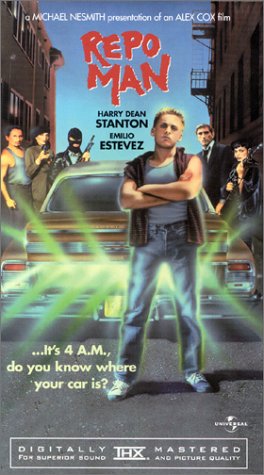
By Alex Cox
Source: AlexCoxFilms
HOW DID REPO MAN OCCUR?
After I left UCLA I was hired to write a script for United Artists about the British World War One deserter and agitator, Percy Topliss. When I delivered the screenplay it was rejected as “too English, too expensive, and too anti-war.”
Shortly thereafter I met the British director, Adrian Lyne. He had directed one feature, FOXES, and he wanted his next to be about what he felt was the most important issue of the day: the imminent possibility of a nuclear war. I scouted Seattle and Vancouver as locations, and wrote him a script called THE HAPPY HOUR.
Adrian read it and went off to direct FLASHDANCE. And I ran into two old chums from UCLA – Jonathan Wacks and Peter McCarthy. They had been in the Production programme; Jon had directed a documentary, Pete a drama. Now they had a company, and even more impressive, an office in Venice, California, where they were making commercials (“Gene Kelly assures the public the MGM Grand is safe again!”) and public service announcements. I suggested to them that they should also be feature film producers, and hire me as a director. They agreed to consider this, but instructed me to come up with a script.
The first one I wrote for them was called THE HOT CLUB (a comedy about nuclear blast veterans and nerve gas thieves set in the early years of the 21st century). They budgeted and Marie Canton (also ex-UCLA) budgeted it; it turned out to be rather expensive. So I went off and wrote another screenplay instead: REPO MAN. This was based on my own personal Los Angeles horrors and the tutelage of Mark Lewis, a Los Angeles car repossessor and my neighbour in Venice, CA.. When the screenplay was published, Dick Rude and I interviewed Mark for the introduction: his take on the repo trade and the movie can be found at pscweb.com/repo/whatever.
To make the package more interesting to investors, I drew four pages of a comic book based on the script and we included them with the screenplay. I had planned at one stage to do an entire comic book, but it is too much work: a page a day at the very most, and hard on the eyes. Michael Nesmith, the former Monkee, saw the script/comic package, became interested, and took it to Bob Rehme at Universal.
WHAT WAS THE RESPONSE TO REPO MAN?
REPO MAN was made as a “negative pickup” by Universal at the time when Bob Rehme was head of the studio. At the time, the big deal over there was STREETS OF FIRE, and nobody really noticed our film at all. Which was lucky for us, since Bob Rehme had “green-lighted” a film which was quite unusual by studio standards. Unfortunately, just before we were completely done, Rehme was ousted from his post, and a new boss came in. It is, we quickly discovered, the primary task of a new boss to make an old boss look bad, and so as much of Rehme’s product as possible was quickly junked. That which was already made, or almost complete – REPO MAN and RUMBLEFISH, for instance – was swiftly consigned to the Chute of No Return.
We took out an ad in Variety, reprinting a good review we got there (we also got a very bad one – in the weekly edition – but we didn’t reprint that) as a challenge to Universal to get the picture out into the theatres.
The studio’s response was to lean on the head of public relations at Pan American World AIrlines, Dick Barkle, to condemn the film. Mr Barkle declared himself shocked by REPO MAN, adding, “I hope they don’t show this film in Russia.” It is the world of DILBERT there.
The theatrical life of the film was prolonged by Kelly Neal at Universal, who went out of his way to support both REPO MAN and RUMBLEFISH. And, even more, the record was a major element in promoting the film; it was popular with the punk rock community and that got the word around. And rightly so. I was an enthusiast, and the film has a major punk influence – in addition to the protagonists Otto, Duke, Debbi, Archie and Kevin, there’s a tailor-made hardcore score by Los Plugz, Circle Jerks, Fear, Suicidal Tendencies, Black Flag, and Juicy Bananas, and a title song by Iggy Pop, who suffers under the sobriquet of The Godfather of Punk.
DID YOU HAVE ANYTHING TO DO WITH THE TV VERSION?
Yes. Because the film REPO MAN had so much swearing and a scene of speed-snorting, the studio made their own re-edited video version. It was very odd. In an effort to “explain” the film, someone had gone and shot an insert of the license plate of the Chevy Malibu, and made the Hopi symbol dissolve into the HEAD OF THE DEVIL!
YOU’RE JOKING.
No, this is really true. It made me wonder, could it be that the Christian Fundamentalists are right, and that the multinationals and Hollywood are controlled by Satanists? I cannot say. It seems so, most of the time. But perhaps those executives were just confused by the film, and trying to explain, in their own innocent, satanistic way, what it was about. “Whut the heck is in that trunk?” “Gee I don’t know.” “Maybe it’s the… Devil hisself!” They were just trying to improve it in their own way, and make it clearer.
WEREN’T YOU HORRIFIED THAT THEY WERE BUTCHERING YOUR FILM?
I was a bit alarmed, yes. They’d intercut static shots of this license plate with shots of the car moving, and it looked completely cheesy, worse than an Ed Wood film. But the thing was, they weren’t really bad guys: they knew what they’d done was a mistake, and now they were looking for the filmmaker to fix it.
They knew they had done wrong.
In the end I removed their strange insertions, and included two funny scenes which hadn’d made it into the theatrical version: the one with Jac MacInally shaving (where Harry Dean says his name is “I.G.Farben”) and the the one where Harry Dean smashes the phone booth with his baseball bat.
BUT WHAT ABOUT CUTTING OUT ALL THE SWEARING?
And who cares. By then I’d made SID & NANCY and I was sick of swearing. It was fun coming up with synonyms for the swear words – “Melon Farmers” was a particular favourite.
Sometimes, for television and aeroplane screening, or for a film to play in prisons or at children’s tea-parties, changes need to be made. It is always better for the filmmaker to be invited to participate than to be excluded. Excluding the filmmaker results in what in Liverpool is called a dog’s breakfast.
WHAT WAS REPO MAN ABOUT – REALLY?
Nuclear War. Of course. What else could it be about? And the demented society that contemplated the possibility thereof. Repoing people’s cars and hating alien ideologies were only the tip of the iceberg. The iceberg itself was the maniac culture which had elected so-called “leaders” named Reagan and Thatcher, who were prepared to sacrifice everything — all life on earth — to a gamble based on the longevity of the Soviet military, and the whims of their corporate masters. J. Frank Parnell – the fictitious inventor of the Neutron Bomb – was the central character for me. He sets the film in motion, on the road from Los Alamos, and, as portrayed by the late great actor, Fox Harris, is the centrepoint of the film.
Fourteen years later, I had a call from one Sam Cohen, who announced himself the father of the Neutron Bomb. I imagined a cross between Jack D. Ripper and Edward Teller in a dark Brentwood apartment, raging because there hadn’t been an intercontinental thermonuclear war…
The following week Sam Cohen and I had lunch in Venice, California. Sam had lived in LA since 1923 – “Grew up in the Jewish ghetto of East LA – grew up knowing all your locations.” His daughter saw REPO MAN when it came out in 1984 and took him to see it. He’s seen the video “a couple of dozen times”.
“It starts off with nostalgia for me… the map at the beginning, I spent World War Two at Los Alamos, working on the Fat Man device. My job was to study what the neutrons did. I know more about neutrons than you would ever want to ask.
“My daughter took me to see this film, and here was this nutcake, our hero, lobotomized, head bobbing. A cop stops him, opens the trunk, and — voila! He’s neutronized!” Sam had no doubt there was a Neutron Bomb in Otto’s trunk.
“It was the quintessential neutron bomb in the trunk… what we call a SADM – a Strategic Area Denial Munition.” He and the Russian politician General Lebed gave press conferences a couple of years ago to draw attention to the number of ex-Soviet SADMs which had gone missing — hundreds of them, sold on the black market to whoever was buying. He thinks a SADM may have levelled the Federal Building in Oklahoma.
Sam’s next destination was Washington, DC. “I’ve got a grand bash to attend: two friends of mine, aged 87 and 90, both four-star Air Force generals, are having a birthday party. One of them is General Schraber. Perhaps you’ve heard of him. He put together the ICBM program.”
Later he reconsidered, and called me again. “It wasn’t a Neutron Bomb in the trunk – it was an enormous concentration of nuclear material – it was gamma rays that killed the cop.”
Sam had one more observation, re. his contribution to thermonuclear devastation: “The Neutron Bomb was the most moral weapon ever devised… it was a weapon for good Christians… a defensive weapon, it spares innocents, keeps war to the warriors, doesn’t damage the economy, has no hideous, crippling, lasting effects as in conventional warfare… if you survive, a lot of the victims will recover… no significant level of radiation is produced… it disappears very rapidly. My friends Graves and Slotin were in just such an accident. Slotin died horribly; Graves had a fifty-fifty chance of dying, but recovered, and in a few months was playing handball.”
I asked if he meant his Bomb was intended as a battlefield (“theater” in the vernacular) weapon. He insisted that was its only possible application: “The Neutron Bomb totally conformed to the so-called Christian principles of a Just War. I got a medal from the Pope in Rome, in 1979.”
WILL THERE BE A REPO MAN SEQUEL?
I would be delighted. But Universal have already released a faux-sequel, “REPO MEN” and don’t seem interested in pursuing the real McCoy. So the sequel will have to wait till March 2019, when the rights to the original script revert to me.
THE RIGHTS TO REPO MAN REVERT TO YOU?
To the screenplay, yes. So if you are a wealthy patron of the fine arts, seeking to see a sequel, or a remake, or a REPO MAN series, just get in touch.



 After the Crash