
By Micah White
Source: Reconstruction 10.3
<1> Contemporary activism begins from the realization that for the first time in history, a synergy of catastrophes face us. Our physical environment is dying, our financial markets are collapsing and our culture, fed on a diet of junk thought, is atrophying — unable to muster the intellectual courage to face our predicament. While some may caution against immediate action by pointing out that societies often predict perils that never come, what is remarkable about our times is that the apocalypse has already happened.
<2> When we compare the anxiety of our age to that of the Cold War era, we see that what differentiates the two periods is where the threat is temporally located. During the Cold War, the threat of nuclear destruction was always imagined to be in the future. What terrorized the Cold War generation was the thought of life after a nuclear holocaust. Anxiety was therefore centered on what life would be like “the day after” the future event, which was symbolized by the blinding light of a mushroom cloud on the horizon. Thus the post-apocalyptic narrative was deployed in a series of nuclear holocaust science-fiction stories either to mobilize fear in the name of anti-nuke peace — the exemplar of this tactic being the horrifying and scientifically realistic 1984 BBC docudrama Threads in which civilization collapses into barbarism — or, like Pat Frank’s 1959 novel Alas, Babylon, convince a wary public that winning and happily surviving nuclear war is possible, given resourcefulness, discipline and patriotism.
<3> But for those of us alive today, the catastrophic event is not located in the future. There is no “post”-apocalyptic per se because we are already living in the apocalyptic. And although we can anticipate that life is going to get starker, darker and hellish, the essential feature of our times remains that we do not fear the future as much as we fear the present. We can notice this temporal shift in the work of James Lovelock, whose Gaia Hypothesis is gaining traction inside and outside of the scientific community. According to Lovelock’s latest book, The Vanishing Face of Gaia: A Final Warning, even if we were to immediately cease all C02 emissions, sudden and drastic climate change will still occur. In fact, Lovelock argues that a drastic decrease in emissions would trigger climate catastrophe immediately whereas continuing emissions will trigger climate catastrophe eventually and unpredictably. This realization — that the line into a post-climate-change world has already been crossed — fundamentally changes the temporal and spatial assumptions underpinning activist struggles. And the first aspect of activism that must be rethought is our notion of temporality.
<4> The typical activist project is inscribed within the horizon of a modern conception of temporality. The modernist activist acts as if we occupy a present moment that is a discrete point on the linear progression between a mythical, ancient past and an either utopian or dystopian future. But if we accept this model, then the goal of the activist can only be to change the future by preventing the dystopian possibility from being realized. This involves pushing for changes in laws and behaviors in the present that will impact our predictions of how the future will be. But activism based on this temporal model — which as John Foster points out in The Sustainability Mirage: Illusion and Reality in the Coming War on Climate Change underpins “green capitalism” and “sustainable development” — inevitably fails. For one, unable to accurately predict the future, we constantly play the game of basing our actions on rosy predictions while the future grows increasingly gloomier. Another problem with relying on linear temporality is the assumption that time moves in only one direction. Without the freedom to imagine going backwards, we are left the task of steering the runaway train of industrialization without hope of turning around.
<5> Of course, linear time is not the only way to understand temporality and some models can have even worse political consequences. Take for example, the notion that time is cyclical. For the Roman Stoics, time was marked by a series of conflagrations in which the world was razed and a new one formed only to be razed again. In times of adversity when resistance seems impossible, such as the build-up to World War 2, a watered down version of cyclical temporality sometimes enters the cultural consciousness. It infected Nazis who cheered total war and anti-Nazis who used the spurious argument that only by a catastrophic Nazi triumph would a communist state be realized because only then would the people rise up. A similar line of thought was pursued by Martin Heidegger in a letter to Ernst Jünger in which he wondered if the only way to “cross the line” into a new world is to bring the present world to its awful culmination. Unlike the linear conception of time that calls the activist to act in order to realize an alternate future, the cyclical conception is often leveraged to justify inaction or worse, action contrary to one’s ideals.
<6> To escape the problems of linear time and cyclical time, activism must rely on a new temporality. Perhaps the best articulation of this new activist temporality is in the work of Slavoj Žižek. In his most recent book, First as Tragedy, Then as Farce, Žižek blames the failure of contemporary activism on our assumption that time is a one-way line from past to future. He argues that activism is failing to avert the coming catastrophe because it is premised on the same notions of linear time that underpin industrial society. According to Žižek, therefore, a regeneration of activism must begin with a change in temporality. Paraphrasing Jean-Pierre Dupuy, Žižek writes, “if we are to confront adequately the threat of (social or environmental) catastrophe, we need to break out of this ‘historical’ notion of temporality: we have to introduce a new notion of time.” This new notion of time is a shift of perspective from historical progress to that of the timelessness of a revolutionary moment.
<7> The role of the activist should not be to push history in the right direction but instead to disrupt it altogether. Žižek writes, “this is what a proper political act would be today: not so much to unleash a new movement, as to interrupt the present predominant movement. An act of ‘divine violence’ would then mean pulling the emergency cord on the train of Historical Progress.” To accomplish this act of revolutionary violence involves a switch of perspective from the present-looking-forward to the future-looking-backward. Instead of trying to influence the future by acting in the present, Žižek argues that we should start from the assumption that the dread catastrophic event — whether it be sudden climate catastrophe, a “grey goo” nano-crisis or widespread adoption of cyborg technologies — has already happened, and then work backwards to figure out what we should have done. “We have to accept that, at the level of possibilities, our future is doomed, that the catastrophe will take place, that it is our destiny — and then, against the background of this acceptance, mobilize ourselves to perform the act which will change destiny itself and thereby insert a new possibility into the past.” In other words, only by assuming that the feared event has already happened, can we imagine what actions would need to have been taken to prevent its occurrence. These steps would then be actualized by the present day activist. “Paradoxically,” he concludes, “the only way to prevent the disaster is to accept it as inevitable.”
<8> Žižek is right to suggest that activism is at a crossroads; any honest activist will admit that lately our signature moves have failed to arouse more than a tepid response. The fact is that our present is being swallowed by the future we dreaded — the dystopian sci-fi nightmare of enforced consumerism and planet-wide degradation is, day-by-day, our new reality. And thus, activism faces a dilemma: how to walk the line between false hope and pessimistic resignation. It is no longer tenable to hold the nostalgic belief that educating the population, recycling and composting our waste and advocating for “green capitalism” will snatch us from the brink. Likewise, it is difficult to muster the courage to act when the apocalyptic collapse of civilization seems unavoidable, imminent and, in our misanthropic moments, potentially desirable. Žižek’s shift in temporality offers us a way to balance the paralyzing realization that our demise is inevitable with the motivating belief that we can change our destiny. By accepting that as the world is now we are doomed, we free ourselves to break from normalcy and act with the revolutionary fervor needed to achieve the impossible.
<9> The question for would-be activists is therefore not, “how does one engage in meaningful activism when the future is so bleak?” but instead “how does one engage in revolutionary activism when the present is so dark?”
<10> Corresponding to the necessary temporality shift is a spatial change in activism. The future of activism will be the transformation of strictly materialist struggles over the physical environment into cultural struggles over the mental environment. Green environmentalism, red communism and black anarchism will merge into blue mental environmentalism — activism to save our mental environment will eclipse activism to reclaim our physical environment. A key opening to this new form of politics appeared in 1989 with the founding of Adbusters, the internationally distributed anti-consumerism magazine whose subtitle is The Journal of the Mental Environment.
<11> Adbusters is a Situationist inspired offspring of the environmentalism movement. At the time of its formation, there was an active anti-logging movement in British Columbia, Canada. And responding to sagging public support for cutting down old growth trees, the logging industry introduced the “Forests Forever” advertising campaign. As the name suggestions, this campaign argued that the logging industry was not cutting down forests as much as they were protecting forests. It was the kind of disingenuous advertising ploy known as “greenwashing”– a term that, it is worth noting, originated in that same year. Disgusted by what he saw, Kalle Lasn, who was an experimental filmmaker at the time, created a short claymation anti-ad in which an old-growth tree explains to a sapling that a ancient forests are being replaced by tree farms. His intention was to air the anti-ad on the same television stations that the logging industry had used.
<12> When Lasn tried to buy airtime for his anti-ad on the same television station that aired the Forests Forever advertisements, he was refused. That was the founding event of Adbusters: the realization that while corporations can lie to us via the airwaves, we are unable to respond using the same means. But the message of Adbusters goes beyond concerns over the veracity of the information we receive — and here we would do well to follow Jacques Ellul who spoke of the difficulty in distinguishing between information and propaganda. Instead, it is a matter of how the advertisements we see populate our minds with a picture of reality. This picture of reality, our worldview, colors everything we perceive. Thus, the mental environmentalist movement is concerned with the pollution of our minds.
<13> While some may wish to frame this transition in terms of a new development, I think it is just as accurate to view it as an old phenomenon. Hundreds of years ago, for example, “pollution” had an exclusively unscientific, immaterial and spiritual meaning. In the 14th century to pollute meant to desecrate, defile, or contaminate what is sacred such as one’s soul or moral sensibility. Not until the late nineteenth-century did pollution take on the scientific and materialist connotation it has today. The unfortunate consequence is that with the changing meaning of the word pollution, we’ve become increasingly concerned about desecration of our external, natural environment while ignoring the defilement of our internal, mental environment. The future of activism is a return to the early meaning of pollution.
<14> Activism is entering a new era in which environmentalism will cease viewing our mental environment as secondary to our physical environment. No longer neglecting one in favor of the other, we will see a push on both fronts as the only possible way of changing either. This will involve a shift away from a materialist worldview that imagines there to be a one-way avenue between our interior reality and the external reality. Instead, recognition of the permeability of this barrier, an exploration of the mutually sustaining relationship between mindscape and landscape, will open, and reopen, new paths for politics.
<15> This movement toward an activism of the mental environment is based on an ontological argument that can be stated succinctly: our minds influence reality and reality influences our minds. Although simply stated, this proposition has profound implications because it challenges the West’s long standing Cartesian divisions between internal and external reality that serve to ignore the danger of mental toxins. Whereas traditional politics has assumed a static mind that can only be addressed in terms of its rational beliefs, blue activism believes in changing external reality by addressing the health of our internal environment. This comes from an understanding that our mental environment influences which beings manifest, and which possibilities actualize, in our physical reality.
<16> At first it may seem like a strange argument. But the imaginary has been a part of environmentalism since the beginning. Most people trace the lineage of the modern environmentalist movement back to Rachel Carson’s 1961 Silent Spring. Carson’s book argued that the accumulation of toxic chemicals in our environment could work its way up the food chain, causing a widespread die- off. It may not have been the first time the bioaccumulation argument had been made, but it was the first time that it resonated with people. Suddenly, a movement of committed activists and everyday citizens rallied under the environmentalism flag.
<17> Looking back on Carson’s book from the perspective of mental environmentalism, it is significant that it begins, not with hard science as we may expect because Carson was a trained scientist, but with fantasy. The first chapter, entitled “A Fable for Tomorrow,” reads like a fairy tale: “There once was a town in the heart of America where all life seemed to live in harmony with its surroundings.” She then goes on to describe an idyllic, pastoral community known for its abundant agriculture and wild biodiversity. She writes of foxes and deer; laurel, virburnum and alder; wild birds and trout. However, the beauty of the place is not permanent – an evil, invisible malady spreads across the land. Birds die, plants wilt and nature grows silent. The suggestion is that the land has been cursed; if this were a different story perhaps the farmers would have prayed, offered sacrifices to the gods or asked their ancestors for help. Instead, Carson shifts the blame away from transcendental forces and back to the materialist domain of man. “No witchcraft, no enemy action had silenced the rebirth of new life on this stricken world.” Carson concludes, “The people had done it to themselves.”
<18> Some literary critics have argued that the reason “Silent Spring” resonated with the larger public, sparking a movement of everyday people is largely due to this opening fable. They explain that Carson’s story takes Cold War era fears of radioactivity (an invisible, odorless killer) and redirect them into a new fear over environmental pollution that is, likewise, an invisible, odorless killer. This is a compelling interpretation that explains the rhetorical power of Carson’s story but it misses the larger point. Namely, that at its origin, environmentalism was grounded in a mythological story about a cursed land. Faced with a choice over whether to continue in this fantastical, narrative vein or enter the domain of scientific facts, environmentalism tried the latter. Environmentalism has thus become a scientific expedition largely regulated by Western scientists who tell us how many ppb of certain pollutants will be toxic and how many degrees hotter our earth can be before we are doomed. But here we see again the linear temporal model cropping up again which may explain the inability, according to James Lovelock, of the Intergovernmental Panel on Climate Change to predict the rising temperatures we have experienced. In light of the failures of the exclusively scientific approach, it is worth considering another option.
<19> What if Carson had written about how the disappearance of birds was accompanied by the appearance of flickering screens in every home? What if she had drawn a connection between the lack of biodiversity and the dearth of infodiversity? Or the decrease in plant life and the increase in advertised life? To do so would necessitate a new worldview: a blue worldview that acknowledges the interconnection between mental pollution and environmental degradation, spiritual desecration and real-world extinctions.
<20> Keeping one foot within the domain of imagination, environmentalism could speak not only of the disappearance of the wild birds due to physical pollutants but also their disappearance due to mental pollutants. We could wonder at the connection between a culture’s inability to name more than a handful of plants, and the lack of biodiversity in the surrounding nature. And instead of assuming that the lack of biodiversity in external reality caused our poor recognition skills, we would entertain the opposite possibility: that the fewer plants we recognize, the fewer plants will manifest.
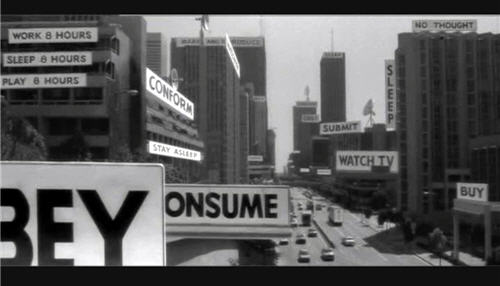
<21> Blue activism begins with the realization that internal reality is connected to external reality and then wonders at the relation between pollution of internal reality and the desecration of external reality. The primary pollutant of our mental environment is corporate communication. It is no longer controversial to claim that advertisers stimulate false desires. Any parent knows that after their child watches the Saturday morning cartoons they will suddenly “need” new toys, new treats, new junk. But the effects of advertising go beyond, what the marketers call, “demand generation”. Advertising obliterates autopoesis, self-creation. It is an info-toxin that damages our imagination and our world picture, essential elements of our mental environment. Activists must work on the assumption that there is a connection between the level of pollution in our minds and the prevalence of pollution in our world. At the most basic level, this is because when our minds are polluted, and our imaginations stunted, we are unable to think of a different way of doing things. At a more complex level, it is because our mental environment dictates, to a certain extent, whether certain beings manifest in our physical environment. Naming calls beings into existence and when all the words we know are corporate-speak, the only beings that will manifesto are corporate- owned.
<22> To understand how the pollution of the mental environment can impact the manifestation of beings, consider the story of the Passenger Pigeon. In 1810 one of the great American ornithologists, Alexander Wilson, observed a flock of Passenger Pigeons so plentiful that it blacked out the sun for three days. On another occasion he documented a flock estimated to be two hundred and forty miles long and a mile wide and comprised of over a billion — 1,000,000,000 — birds. A century later, the last passenger pigeon died in the Cincinnati Zoological Garden on September 1, 1914. How do we explain this alarming extinction of the Passenger Pigeon?
<23> If we take a materialist activist position, then we will argue that their sudden demise is due to a combination of forces, all of which are located outside the psyche: overhunting combined with unenforced laws against killing the birds in their nesting places was exacerbated by the telegraph which was used to track the birds over hundreds of miles. The species death of the passenger pigeon is thus interpreted as a tragedy of specific technologies: guns, nets, laws and communication systems. Of course, this account is not wrong; it would be mistaken to argue that these technologies did not play a major factor in their extinction.
<24> But physical environmentalism boils down to conservationism. It is allopathic, only able to treat the symptom, the disappearance of the birds, without considering the root cause. By focusing our attention exclusively on material forces, we are confined to certain activist tactics: a spectrum from reformist gestures of calling for greater enforcement of environmental protection laws, courageous tree sits and militant ELF arsons. And while these actions are commendable, and with open acknowledgment that a diversity of tactics is necessary, the focus on a secular materialist politics is limiting our success. Under this model, Ted Turner is considered a philanthropic hero because he is the nation’s largest landowner and maintains the largest privately owned bison herd. What we do not need is a rich patron of endangered species, but instead a world without endangered species. That requires more than money, it necessitates a paradigm shift.
<25> The unexplainable extinction of the passenger pigeon is a symptom of the state of our mental environment. Species facing extinction can only be saved if we take their disappearance as a symptom and address the root cause of their disappearance. Because of an over-reliance on a secular, materialist conception of politics, scientists dictate the aims of activists. The irony is that our exclusive concern over the physical environment renders us unable to save it.
<26> The curious interplay between our imagination and external reality gives credence to the argument that the struggles over the mental environment are the future of activism. The future of activism begins with the realization that only with a clear mind, a clean mental environment, do we approach the possibility of a clean physical environment.
<27> Dispel immediately the notion that our mental environment is unique to each individual. Just as we share our natural environment, we also share our mental environment, which is crafted through the culture we consume – the television shows we watch, the websites we frequent and the symbols and concepts that comprise our thoughts. Thus, the mental environment is not something entirely within us but is instead something that is outside of our complete control and shared collectively.
<28> Activism of the mental environmentalism is not a politics of solipsism, or an attempt to dodge the imperative of direct action. Instead, developing a politics of anti-consumerism and anti-materialism, places the role of imagination back into the forefront. Denying corporations the right to dominate our mental environment is the most effective long-term strategy of insurrection in the twenty- first century because it directly influences the manifestation of our natural environment. By targeting the mental polluters, vandalizing billboards and blacking out advertisements, we do more than clean up urban blight — we clear a creative space for a revolutionary moment.




 After the Crash