
8 Facts About American Inequality

income-inequality-graphic

By Pierce Nahigyan

Source: Nation of Change

…that dream of a land in which life should be better and richer and fuller for everyone, with opportunity for each according to ability or achievement. It is a difficult dream for the European upper classes to interpret adequately, and too many of us ourselves have grown weary and mistrustful of it. It is not a dream of motor cars and high wages merely, but a dream of social order in which each man and each woman shall be able to attain to the fullest stature of which they are innately capable, and be recognized by others for what they are, regardless of the fortuitous circumstances of birth or position.”

– James Truslow Adams, The Epic of America (1931)

The American Dream has been defined many ways by writers of both poetic and prosaic bent, but its essentials tend to involve life, liberty and the pursuit of happiness (or property, depending on your source).

The Declaration of Independence, upon which an entire nation was radically brought into existence, asserts that not only are all men created equal but that this is a “self-evident” truth. The significance of this fact lies not in its semantics, which epistemologists would challenge, but in its utilization as a primary foundational creed. By this “unanimous Declaration of the thirteen united States of America,” a contract was agreed to, that their union would be founded on this principle. Furthermore, life, liberty and the pursuit of happiness are rights that governments are created to uphold. Thus, America was endowed with its dream at the moment of its conception: the freedom to succeed.  

The United States has promoted a self-congratulating exceptionalism for decades, waving its Declaration and Constitution in the faces of other sovereign nations as if the latter had never beheld such concepts. Our capital F “Freedom” sets us apart from the rest of the world, as the political rhetoric has repeated ad nauseam, no matter the freedoms enjoyed by democracies on every continent. And yet our basic freedom, the freedom to succeed, America’s contractual promise, has been shrinking for thirty years.

The freedom to succeed transcends economic systems but it is most potently expressed by capitalist gains. The ability to go “from rags to riches” is ingrained in this nation’s ethos and there is nothing intrinsically immoral about that goal. However, the current state of American inequality reveals a very real and expanding gap between the rich and poor that betrays the foundational endowment of this Union. When the freedom to succeed is denied every citizen, their equality is equally denied. 

The wealth and income inequalities in America do not require socialist reforms to fix, and capitalism is not the problem. The problem is that we have let inequality advance in this country so gradually that its obviousness is masked by its familiarity. Below I outline eight facts about inequality in America that every American should know. 

1) 400 Americans have more wealth than half of all Americans combined. To put that into context, as of 2013 there are an estimated 316,128,839 people living in the United States, according to the U.S. Census Bureau. Just 400 Americans have more money than over 158 million of their fellow citizens. Their net worth is over $2 trillion, which is approximate to the Gross Domestic Product of Russia. This ratio has been verified by Politifact and former Labor Secretary Robert Reich. One explanation for the vast discrepancy in wealth is the definition of “worth,” which includes everything a person or household owns. This means savings and property but also mortgages, bills and debt. Poorer households can owe so much in debt that they possess a negative net worth.

2) America has the second-highest level of income inequality, after Chile. The Organization for Economic Cooperation and Development studies thirty-four developed countries and ranks them both before and after taxes and government transfers take effect (government transfers include Social Security, income tax credit and unemployment insurance). Before taxes and government transfers, America ranks tenth in income inequality. After taxes and transfers, it ranks second. Whereas its developed peers reduce inequality through government programs, the United States’ government exacerbates it. 

3) The current state of inequality can be traced back to 1979. After the Stock Market Crash of 1929, the gap between the rich and the poor began to narrow. For fifty years, wages still differed greatly between the upper- and working-classes, but a robust middle-class took shape, as well as the opportunity for working-class individuals to ascend. In his book, “The Great Divergence,” journalist Timothy Noah traces today’s inequality to the beginning of the 1980s and the widening gap between the middle- and upper-classes. This gap was influenced by the following factors: the failure of American schools to prepare students for new technology; poor immigration policies that favor unskilled workers and drive down the price of already low-income labor; federally-mandated minimum wage that has failed to keep pace with inflation; and the decline of labor unions.

4) Non-union wages are also affected by the decline of unions. The Economic Policy Institute claims that 20% of the growth in the wage gap between high-school educated and college educated men can be attributed to deunionization. Between 1978 and 2011, union representation for blue-collar and high-school educated workers declined by more than half. This has also diminished the “union wage effect,” whereby the existence of unions (more than 40% of blue-collar workers were union members in ’78) was enough to boost wages in non-union jobs – in high school graduates by as much as 8.2%. Not only did unions protect lower- and middle-class workers from unfair wages, they also established norms and practices that were then adopted by non-union employers. Two prime examples are employee pensions and healthcare. Today about 13% of workers belong to unions, which has reduced their bargaining power and influence. 

5) There is less opportunity for intergenerational mobility. In December 2011, President Obama spoke at Osawatomie High School in Kansas. He was very clear about the prospects of the poor in today’s United States:

“[O]ver the last few decades, the rungs on the ladder of opportunity have grown farther and farther apart, and the middle class has shrunk. You know, a few years after World War II, a child who was born into poverty had a slightly better than 50-50 chance of becoming middle class as an adult. By 1980, that chance had fallen to around 40 percent. And if the trend of rising inequality over the last few decades continues, it’s estimated that a child born today will only have a one-in-three chance of making it to the middle class – 33 percent.”

As refreshing as that honesty is, Obama promised no fix beyond $1 trillion in spending cuts and a need to work toward an “innovation economy.” 

In a speech one month later, Obama’s Chairman of Economic Advisers, Alan Krueger, elaborated on the dire state of America’s shrinking middle-class. The contraction, he stated, could partially be attributed to “skill-biased technical change”: work activities that have become automated over time, reducing the need for unskilled labor and favoring those with analytical training. He also highlighted the 50 year decline in tax rates for the top 0.1%, increased competition from overseas workers, and a lack of educational equality for children. Poor children are denied the private tutors, college prep and business network of family and friends available to their wealthier peers, which locks them into the class they are born into.

6) Tax cuts to the wealthiest have not improved the economy or created more jobs. Krueger also revealed that the tax cuts of the 2000s for top earners did not improve the economy any better than they did in the 1990s (meanwhile, income growth was stronger for lower- and middle-class families in the 1990s than in the last forty years). Tax rates for the top income earners in America peaked in 1945 at 66.4 percent. Following decades of gradual reductions, they have since been cut in half. During the same time, the payroll tax has increased since the 1950s and individual income tax has bounced between 40-50% through the present day. Conversely, corporate tax declined from above 30% in the 1950s to under 10% in 2011. All of these tax cuts are made ostensibly to improve the economy and create jobs. However, the National Bureau of Economic Research has concluded that it is young companies, “regardless of their size,” that are the real job creators in America. Tax cuts to the wealthiest do not create jobs

7) Incomes for the top 1% have increased (but the top 0.01% make even more). Between 1979 and 2007, the average incomes of the 1% increased 241%. Compare that to 19% growth for the middle fifth of America and 11% for the bottom fifth. Put another way, in 1980 the average American CEO earned forty-two times as much as his average worker. In 2001, he earned 531 times as much

Average income across the 1% is actually stratified into widely disparate echelons. Compare the $29,840 average income for the bottom 90% to the $161,139 of the top 10%. Compare the $1 million average income of the top 1% to the $2.8 million of the top 0.1%. Yet both still pale beside the $23 million average income of the top 0.01%. 

If those numbers seem a bit overwhelming, Politizane has created a video that illustrates this staggering inequality:

8) The majority of Congress does not feel your pain. Empowered by the Constitution to represent their constituents, United States Congress members are, for the first time in history, mostly millionaires. The 2012 financial disclosure information of the 534 current Congress men and women reveals that over half of them have a net worth of $1 million or more. After the past seven facts it is difficult to read this last one and believe that these 268 legislators have the best interests of the remaining 99% at heart. But if that is too presumptuous a leap, it is not too bold to say that wealthier donors, lobbyists and special interest groups enjoy greater access to these lawmakers than the average American. 

Life, and the Liberty to Go Hungry

Last week Congress failed to extend emergency benefits for unemployment, leaving 1.3 million people without federal aid. Congress is currently on a weeklong recess that will keep them from debating the issue until their return on January 27. The bill was too divisive for Republicans and Democrats to reach an agreement on, though unemployment is still above 7% nationally. 

Thankfully, the unemployed have their Congress working for them. And at $174,000 annual pay, those representatives are sure to return from vacation committed to fresh solutions. 

The pursuit of happiness is an ephemeral affair, but the freedom to succeed is not. It is something one possesses or lacks. It is the difference between enjoying a more prosperous life than one’s parents and believing there is no way out. A “self-evident” truth is one that is meaningful without proof, much akin to faith. If inequality continues to rise in America, the self-evident truths of its founding will be no more than words on an old piece of paper, its American Dream a tattered faith paid lip service by the deceitful and the blind.

Diary of an American Terrorist

91aDKdJ-UHL._SL1500_

While searching for some light reading a few months ago I was delighted to discover the work of Thomas Ligotti. His unique take on the horror genre in “My Work is Not Yet Done” was so powerful and relevant to our times, it made me wonder why are there not more writers exploring Corporate Horror?

It seems Brian Whitney at Disinfo.com has found another voice that, judging from his description in the following article, may be just as compelling:

The Wall Street bankers and billionaires had better watch out. A new novel, Diary of an American Terrorist, by Chuck Darwin, pictures them mowed down by machine gun fire, dropped from high places, and having their throats slit – in general, being rubbed out in increasingly gruesome and wholesale ways.

“This is a startling document,” says Patrick Quinlan, president of Strawberry Books, the publisher of Diary. “There’s a lot of anger in it, and why not? The bankers have been getting up to all kinds of mayhem for a long time. A lot of jobs have gone overseas. Let’s face it: we’ve all been waiting for a novel where an ordinary working person decides to strike them back.”

In the story, an unnamed middle-aged man has lost everything – his family, his job, his very life. His humiliation becomes anger, which boils over into a murderous rage. He turns it toward the people he blames for his predicament – the very wealthy, who so often profit from the misery of working people.

The man is a military veteran and has wide ranging technology skills. He doesn’t go berserk. Instead, he slowly and methodically begins to choose targets, stalk them, and kill them. Most of the book takes the form of a diary, in which the man – who renames himself Spartacus, after the leader of the Roman slave revolt – records his preparations for each murder, then describes the murder itself in graphic detail. Readers embark on a vicarious kill spree, hunted by both the FBI and an elite secret society.

“People worry about Islamic terrorists from the Middle East,” says author Chuck Darwin. “I think they’re looking in the wrong direction. Who do you think is joining these terrorist organizations in the Middle East, the poor? That’s wrong. Study after study shows that terrorist groups recruit from the same pool as the American military – people from the former middle class who no longer have other options.”

According to Darwin, it’s only a matter of time before well-educated, once middle class people in America begin to turn their daunting skill sets against their oppressors. Who are their oppressors? The ones who sent their jobs to low-paying countries so the company could reap bigger profits.

“My hero is a guy whose life has been ruined. He has no prospects. It’s really the end of the line for him. But he has a lot of skills. He knows how to use weaponry. He knows how to use technology. He knows how to plan and how to cover his tracks. He’s patient. He’s ambitious. He has determination. All those good American things. He starts picking soft targets, wealthy people, ones he has no obvious relationship to.

“How do you stop someone like this, once he gets going? Simple answer: you don’t.”

Diary of an American Terrorist is available for pre-order  at Amazon.

See more at: http://disinfo.com/2014/09/diary-american-terrorist/#sthash.Q36h9Wlw.dpuf

The “Makers” and “Takers” — Not Who You Think

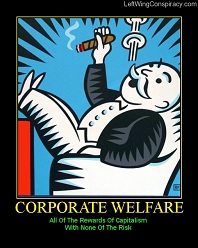
corporate_welfare_medium

By Kevin Carson

Source: Center for a Stateless Society

The old “53% vs. 47%” meme that got so much attention in the 2012 election resurfaced this week when it came out that Colorado gubernatorial candidate Bob Beauprez apparently first coined it at a 2010 Rotary Club speech. The 47% who pay no income tax, he said back then, are “dependent on the largesse of government” and “perfectly happy that someone else is paying the bill.” The talking point got traction with the Tea Party and was soon picked up by politicians like Paul Ryan (who warned we were approaching “a net majority of takers vs. makers”) and Mitt Romney.

Of course this is pure buncombe.  It presupposes that high taxable incomes result primarily from being “makers,” when the truth is just the opposite. The higher your income, in fact, the more likely you’re a taker who’s — all together now! — dependent on government.

It’s possible to get moderately wealthy — say, an income that qualifies you for the “top 1%,” which is somewhere under $400,000, or assets in the low millions — through genuine entrepreneurship. Even at this level, of course, it’s more likely you have an income heavily inflated by membership in a licensing cartel, or help manage a highly authoritarian, statist corporation where your “productivity” — and bonuses — are defined by how effectively you shaft the people whose skills, relationships and other human capital are actually responsible for the organization’s productivity. But it’s at least possible to get this rich by being a maker of sorts, by being more adept than others at anticipating and meeting real human needs.

But you don’t get to be super-rich — to the tune of hundreds of millions or billions of dollars — by making stuff. You get that filthy rich only through crime of one sort or another (even if it’s technically perfectly legal in this society). You get the really big-time money not by making stuff or doing stuff, but by controlling the conditions under which other people are allowed to make stuff and do stuff. You get super-rich by getting into a position where you can fence off opportunities to produce, enclosing those natural opportunities as a source of rent. You do it by collecting tolls and tribute from those who actually make stuff, as a condition of not preventing them from doing so. In other words you get super-rich by being a parasite and extorting protection money from productive members of society, with the help of government.

So don’t be fooled by the fact that some of us aren’t paying any income taxes. We pay lots of taxes — to rich takers who live off our largesse. The portion of your rent or mortgage that results from the enormous tracts of vacant and unimproved land held out of use through artificial property rights is a tax to the landlord. The 95% of the price of drugs under patent, or Bill Gates’s software, is a tax you pay to the owners of “intellectual property” monopolies. So is the portion of the price you pay for manufactured goods, over and above actual materials and labor, that results from embedded rents on patents and enormous brand-name markups on (for example) Nike sneakers over and above the few bucks a pair the sweatshops contract to make them for. So is the estimated 20% oligopoly price markup for industries where a few corporations control half or more of output. If by chance you do pay federal income tax, half of it goes to support the current military establishment or pay off debt from past wars — wars fought for the sake of giant corporations.

The “takers,” in short, are the people Romney spoke to at $1000/plate fundraisers, who pay Hillary Clinton several hundred grand for a speech reassuring them Wall Street’s not to blame. The entire Fortune 500, the entire billionaire plutocracy, depends on largesse from us makers — and they can only do it with government help.

Inside the Psyche of the 1%

na50_3514938_1_px_470_

Don Fitz, editor of Synthesis/Regeneration, recently wrote an illuminating overview of what current scientific studies can tell us about psychopaths in positions of power. In the following passage he examines why the psychiatric establishment has focused less on “successful psychopathy” than on other anti-social personality disorders:

The concept of “successful psychopath” is not new. An early text described “complex psychopaths” who were very intelligent and included unscrupulous politicians and businessmen. [6] By the 1970s it was more widely recognized that “this category includes some successful businessmen, politicians, administrators.” [7] In other words, the unsuccessful psychopath might go to jail for swindling dozens of people with home improvement scams while successful psychopaths might swindle millions with bank deals, get bailed out by friends in government, and never spend a day in jail.

Perhaps the most fascinating aspect of the medicalization of the disorder is how the psychiatric establishment departed from science in order to grant partial exemption from being characterized as psychopaths to the wealthy. According to the Diagnostic and Statistical Manual of the American Psychiatric Association, in order to receive a diagnosis of “anti-social personality disorder” (i.e., psychopathy) a person must exhibit at least 3 of 7 listed behavior patterns. These include “arrest,” “physical fights or assaults,” and “failure to sustain consistent work behavior.” [8] This means that those who can pay off cops (or never have charges pressed against them due to their social status), or pay someone else to commit violence on their behalf, or own companies instead of having to work for a living are all less likely to receive an official label of “psychopath.”

An increasing number of psychologists are becoming aware that traditional research was limited by the bias of only looking at people in jail. One wrote that subjects in psychopathy research “were usually institutionalized at the time of testing, and consequently our research may not accurately capture the internal structure and dynamics of the successful antisocial or psychopathic individual.” [9]

Support for the concept of successful and unsuccessful psychopaths is provided by the discovery that the “Psychopathic Personality Disorder” syndrome actually has two factors. [10] Statistical analyses have revealed an “emotional detachment” factor, which includes superficial charm and skill at manipulating others, as well as an “anti-social behavior” factor, which includes poor impulse control and the tendency to engage in activities that are illegal.

Multiple studies have confirmed that run-of-the-mill psychopaths (often studied while in jail) score particularly high on anti-social behavior while successful psychopaths score higher on emotional detachment factors. For example, Babiak [11] looked at “industrial psychopaths” and found that they scored higher on “emotional” factors than “deviant life style” factors. Functioning smoothly in the corporate world, they had a “charming façade” that allowed them to easily manipulate others.

In a study of “disordered personalities at work” other researchers [12] were able to give personality tests to business managers and chief executives. They contrasted their personality scores to psychiatric patients and “mentally disordered offenders.” Compared to the mental patients, the corporate executives showed greater “emotional” components of personality disorder and less “acting out” (such as aggressiveness).

There were no clear-cut differences between “psychopaths” and “normals.”
The authors concluded that “participants drawn from the non-clinical population [i.e., business managers] had scores that merged indiscernibly with clinical distributions.” There were no clear-cut differences between “psychopaths” and “normals.” The most likely explanation of psychopathy is that, like any other personality dimension, it has a bell-shaped curve: a few people have almost none of the characteristics, most people have some characteristics of psychopathy, and a few people have a lot. The most visible outlets for people high on psychopathy scales are petty con artists and corporate conniving. Operating in different worlds, their psychopathy expresses itself in different ways.

Now that it is clear that a streak of psychopathy runs through the 1%, it would be worthwhile to go back to those who espouse that “there is no ethic which requires we treat him [the psychopath] as we treat other adults” and ask if that would apply to corporate psychopaths as well. Will editors of scholarly volumes seek out articles heaping abuse on the 1% with the same vigor with which they find articles despising prison inmates? Will academics proclaim that “public health needs” dictate that we suspend civil liberties of corporate executives even if they “have not been convicted of any crime?” Will professors compare the “needed treatment” of the 1% to the “necessary slaughter” of animals?

Since academics know very well where funding for their research comes from, my guess is that they will be a wee bit less harsh on the corporate class than the jailed burglar who provides no grant money. We can be confident that the Tea Party will not be proposing that, if corporate psychopaths who blast the tops off of mountains wreak a thousand times the havoc of petty thieves who steal copper wire from air conditioners, then their punishments should be 1000 times as great.

Yet, it is important not to overstate the evidence and suggest that every capitalist is a psychopath. Not all corporate executives score high on scales of psychopathy. This is likely because many actually believe their ideology of greed makes for a better world.

Fitz also offers plausible explanations for various studies indicating that, on average, test subjects of a higher income have lower levels of empathy while test subjects of a lower income have higher levels of empathy:

Compassion reflects the opposite of psychopathy. When those with wealth and power plan to strangle social security, they never say they intend to hurt people, but rather they want to help them stand on their own. When corporations drive native people from forests, they tell us it is part of their grand scheme to stop climate change. Are we to believe that they are just as compassionate as everyone else…but that they reveal their compassion in their own way? There is now good evidence that there are, in fact, class differences in levels of compassion.

Social class could be linked to compassion more than to any other emotion.
By definition, the rich and powerful have more material resources and spend more of their time telling others what to do. Those with fewer material resources get told what to do. As a result, the rich value independence and autonomy while those with less money think of themselves as more interdependent with others. [13] In other words, the rich prize the image of the “rugged individual” while the rest of us focus on what group we belong to.

How do people explain the extremely unequal distribution of wealth? Those with more money attribute it to “dispositional” causes—they believe that people get rich because their personality leads them to work harder and get what they deserve. Those with less money more often attribute inequality to “external” factors—people’s wealth is due largely to events beyond their control, such as being born into a rich family or having good breaks in life. [14]

People with fewer financial resources live in more threatening environments, whether from potential violence, being unable to pay medical bills, or fearing the possibility of being evicted from their homes. This means that social classes differ in the way that they view the world from an early age. Children from less financially secure homes respond to descriptions of threatening and ambiguous social scenarios with higher blood pressure and heart rate. [15] Adults with lower incomes are also more reactive to emotional situations than are those with more money.

This means that people with fewer financial resources are more attentive to others’ emotions. Since low income people are more sensitive to emotional signals, they might pay more attention to the needs of others and show more altruism in response to suffering.

This was the thinking behind research linking higher income to less compassion. In one study people either watched a neutral video or one depicting a child suffering from cancer. People with lower income had more change in their heart rate and reported feeling more compassion. But they did not rate other emotions as higher. Social class could be linked to compassion more than to any other emotion. [16]

In another study, people reported their emotions toward a partner when the two of them went through a hypothetical job interview. Lower income people perceived more distress in their partners and expressed more compassion toward them. Again, they did not report more intense feelings of other emotions. Nor did participants show more compassion toward people with the same income level as their own. [17]

Like most psychological research, these findings are limited by their use of university students. This makes it hard to conclude that their findings apply to those not in school. Of course, it is quite possible that effects would be even stronger in situations that are far more intense than the somewhat mild experiences that occur in psychological laboratories. A greater problem is interpreting psychological findings as showing absolute differences between groups rather than shades of grey.

It would not be accurate to claim that research proves that the 1% have no compassion while all of the 99% do. But it strongly implies that the 1% feel less compassion, whether watching a videotape of suffering or participating in a live social interaction. Also, lab studies are consistent with findings that people with fewer financial resources give a higher proportion of what they do have to charity. In economic game research, they give more to others. [18]

The greatest reason is the huge jump in happiness as people move out of poverty …
This line of research confirms that (1) people with fewer financial resources identify with a larger “in-group;” (2) “attention to and recognition of suffering is a prerequisite step before compassion can take place;” and (3) “moral emotion is not randomly distributed across social classes…” [19] Compassion toward the suffering of others is less likely among the 1%.

He follows this with a recap of studies indicating how once the accumulation of wealth and material possessions get people above poverty level, it generally doesn’t correlate to increased levels of happiness. There tends to be a “tolerance” effect for happiness derived from wealth while social connection and altruism are more important for sustained happiness for most non-psychopaths. In his conclusion, Fitz argues that for corporate psychopaths, obtaining wealth and power is an addiction with harmful consequences for everyone and the entire planet, and it’s a societal problem requiring nothing less than a cultural transformation to solve:

The 1% could easily find compassion getting in their way as their actions affect an increasing number of lives. Gaining enough wealth to move out of poverty makes a significant difference in the life satisfaction of a person who has little. Gaining the same amount of wealth has no effect on the happiness of the very rich. They must grab the wealth of many impoverished people in order to have a perceptible increase in happiness. As for a drug addict, the rush from an increase in material possessions of those who already have more than enough is merely a temporary fix.

Soon they will have to prevent even more from rising out of poverty if they are to get another short-term happiness rush. Whether the rush is from the actual possessions or the power that they manifest, it still won’t be enough. They must increase the rate of wealth accumulation that they push through their veins. If those with spectacular quantities of obscene wealth are to get their next high, they cannot merely snort enough happiness objects to prevent masses of people from rising out of poverty—they have to manipulate markets to grind an ever-increasing number into poverty.

The petty psychopath and the grand corporate psychopath seek happiness through the act of obtaining material possessions as much as having them. A major difference between them is that the grand psychopath has the ability to cause so much harm. Even more important, the amount of harm that corporate psychopaths cause grows at an exponential rate. Their financial schemes are no longer millions or billions, but now trillions. Not content to drive individual farmers off their land, they design trade deals that force entire countries to plow under the ability to feed their own people and replace it with cash crops to feed animals or produce biofuels.

Finding that the pollution of small communities generates insufficient funds, they blow off the tops of mountain ranges for coal, raze boreal forests for tar sands, attack aquatic ecosystems with deep sea drilling, and contaminate massive natural water systems by mining gold or fracking for gas. While the petty psychopath may become proficient enough to become a godfather, the grand psychopath is driven not merely to planetary destruction but to a frenetic increase in the rate of destruction at precisely the moment when the tipping point of climate change is most haunting. A natural question might seem to follow: Would getting rid of the current batch of corporate psychopaths benefit the world greatly? Actually, no. It would do no good whatsoever because what psychologists call the “reward contingencies” of the corporate world would still exist. The fact that capitalism prizes accumulation of wealth by the few at the expense of the many would mean that, even if the worst corporate criminals disappeared, they would soon be replaced by marketplace clones.

Progressives should avoid using the same “categorical” model so adored by right wing theorists for its utility in hating the poor. A much better explanation for psychopathy among the 1% is that the corporate drive to put profits before all else encourages norms of manipulating people without compassion. The more readily corporate leaders succumb to this mind set, the more likely they will be to climb the ladder. As the corporate mentality dominates society, it reproduces its attitudes and expectations of behavior throughout every organization, institution and individual it touches.

In challenging what the market does to our souls, Alan Nasser said it so well:

A certain kind of society tends to produce a certain kind of person. More precisely, it discourages the development of certain human capacities and fosters the development of others. Aristotle, Rousseau, Marx and Dewey were the philosophers who were most illuminating on this. They argued that the postures required by successful functioning in a market economy tend to insinuate themselves into those areas of social intercourse which take place outside of the realm of the market proper. The result, they claimed, was that the arena for potentially altruistic and sympathetic behavior shrinks over time as society is gradually transformed into a huge marketplace. [35]As mentioned, there are differences in compassion and types of psychopathy between high and low income people. But the differences are not large. Perhaps, even in the corporate board room, many feel the old norms of group loyalty. It is also possible that differences are small, not because of the unwillingness of corporate executives to be ultra-manipulative, but because capitalism pushes everyone toward a “use people” mode.

Thus, building a new society involves going beyond equalizing material wealth. It means changing the core nature of interpersonal relationships. This requires vastly reducing the emphasis on material possessions. Relationships of people to people can never flourish as long as relationships of people to objects reign supreme.

As long as society continues to be deeply divided between those who tell others what to do and those who get told, it will not be possible to establish the emotional sharing that is the basis of widespread altruism. If the 1% are to develop the same level of understanding of others that the 99% has, they will need to walk in their shoes. If they continue to be the ones who live their lives telling others what to do while the rest of us continue being told what to do, they will not develop levels of compassion typical of the 99%.

This means that in office jobs, they should be able to share the joys of typing letters rather than ordering others to type for them. If we decide mining is necessary, those who are now the 1% should get to know that work life. In work at home, they should not be excluded from washing toilets but should participate in the same human activities as the rest of society. Creating a world of universal compassion requires a world of shared experiences.

Read the full article here: http://www.greens.org/s-r/60/60-06.html