Two for Tuesday
Reply

By Sheila O’Malley
Source: RogerEbert.com
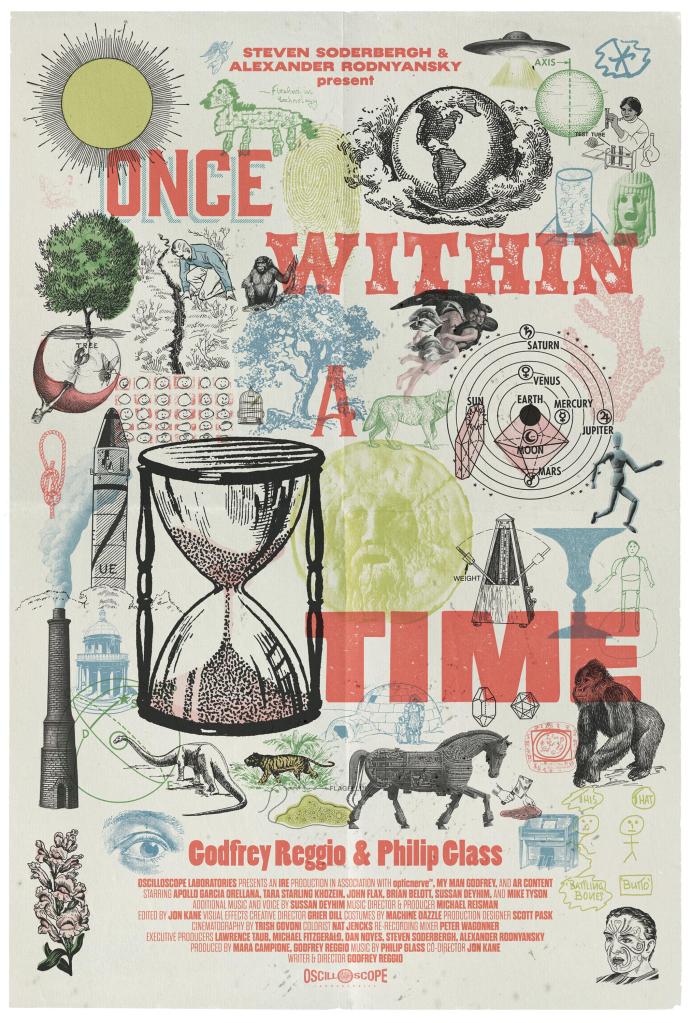
Beatrice Loayza’s fascinating New York Times article “When Did the Plot Become the Only Way to Judge a Movie?” examines films that eschew linear storytelling, films more interested in mood and emotional tones than plot points, breaking free from the “tyranny of story.” The article was fresh in my mind when I watched Godfrey Reggio’s whimsical-terrifying doomsday-fable “Once Within a Time.” Clocking in at 51 minutes, the film is all mood, all rhythm, with a kaleidoscope structure and undulating ever-shifting visuals in a constant state of flux. It’s not a “story” so much as a tone-poem collage about technology, knowledge, innocence/experience, and the potential end of the world. Maybe something new will be born from the ashes, although considering the evidence that something may very well be a monster.
It all started in the Garden of Eden, when curious Eve ate the apple, and “Once Within a Time” starts there, too, in the gentle framing device that opens it. An audience sits in a darkened theatre, a red velvet curtain rises, and the “show”—i.e., human life on the spinning planet—begins. Adam and Eve, holding hands, wander underneath a white cotton-ball tree with red hanging apples. Around them, children play and cavort. The same six or seven children are used throughout: we get to know their faces and their expressions. Behind them, a grand visual drama unfolds, made up of stop-motion animation figures, real humans, found footage, and eerie created images: solar systems, a giant hourglass in the desert, black and white newsreel footage of bomb blasts, spindly trees bending backward. The children look on with wonder, humor, interest, and sometimes concern. They are trying to understand. The apple is a portal to another world, another time. The apple is also directly linked to another 20th-century apple, the Mac apple. The garden path Adam and Eve walk down is made up of iPhone cobble stones. The meaning is obvious.
Technology is a blessing and a curse, yes, but more than that, it’s inevitable. It can’t be stopped. Nineteen-year-old Mary Shelley wrote one of the most prescient books of all time, her imagination stretching forward 200 years, its warning message still and always relevant. The obsessed maniac Frankenstein doesn’t know when to stop with his experiment. He has to see it through, even if it destroys his mind, his life, and the world as we know it. Mary Shelley saw it all. “Once Within a Time” has almost as bleak an outlook.
Reggio’s celebrated “Koyaanisqatsi,” the first of the Qatsi Trilogy, features a similar cascade of images placed in fluid shifting juxtaposition: power plants and rain forests, rush-hour highways and crashing ocean, pollution and clouds, modernity and its ruins. The images are often beautiful, but the overall effect is anxiety-provoking, sometimes even despairing. What have we done to our beautiful world? Music holds it all together. Philip Glass composed the main score, with additional music by Iranian composer Sussan Deyhim (who also plays a “muse” type character, half-woman, half-tree).
Reggio’s vision has three central figures, symbolic and archetypal, but with shifting meanings. An opera maestro declaims his incomprehensible song to the masses, his figure a towering monolith, his eyes wild and fanatical. Behind him looms the walls of a Coliseum, and his figure is threatening, a demi-god dictator, gesturing and bending the masses to his will. There’s a female figure, a living half-human Yggdrasill (Sussan Deyhim), whose song helps create—or at least sustain—the living world. In the final segment, a “mentor” appears (Mike Tyson, of all people!), who encourages the cowed lost children, acting as a sort of Pied Piper.
Once you leave Eden, of course, you can’t get back in. That’s the deal. At the end of the film, a question is asked in multiple languages: “Which age is this: the sunset or the dawn?” In the atom-bomb-haunted “Rebel Without a Cause,” Plato (Sal Mineo) asks Jim (James Dean) if he thinks the end of the world will come at night. Jim says, “No. At dawn.” Either way, it’s the end.
Watch Once Within a Time on Hoopla here: https://www.hoopladigital.com/movie/once-within-a-time-mike-tyson/17458850

The Legend of The Stardust Brothers (1985) review.
By P-J Van Haecke
Source: Psycho Cinema
Introduction
In 1985, the young Makoto Tezuka, son of manga godfather Osamu Tezuka, was approached by the famous musician and tv-personality Haruo Chicada with the question to make a movie for the soundtrack he had created for a non-existing movie. Makoto Tezuka, which by then had already directed various experimental narratives, accepted and directed what would become his feature-debut narrative.
Review
One day, Kan (Kan Takagi) and Shingo (Shingo Kubota), both singers of rival bands and both vying for fame and popularity, are given an invitation by a representative of the president of the talent agency Atomic Promotion, Minami (Kiyohiko Ozaki).
The following day, having arrived at the agency, they meet the innocent and charming Marimo (Kyoto Togawa), a girl who has, driven by her desire to force an audition with the president, been caught trespassing several times. Ultimately, in order to make Kan and Shingo agree to Minami’s proposal,she gives up her desire to become a singer, instead settling for a role as president of their fan-club. But as Kan and Shingo become stars, the will soon learn that fame always comes with nasty side effects.
The Legend of the Stardust Brothers is not just another over-the-top narrative about fame and the side-effects that often go together with fame, e.g. jealousy and addiction. The Legend of the Stardust Brothers – and this is amazing – still manages, even though the narrative is envisioned as pure entertainment, to evoke (intended or unintended) a political message against uniformity (Narra-note 1). This message, which might be more relevant today than at the time of this narrative’s release, is specifically important for Japan as such, as the concept of harmony still dictates much of the social fabric. One can formulate the ultimate message of the narrative as follows: In order to combat the political forces focused on disciplining society into uniformity and obedience, diversity and the freedom of expression – subjectivity as such – are our only weapons.
The Legend of Stardust Brothers – see the visuals framing Minami’s first song – also criticizes the system of agencies as well as the blind desire for fame that drives many young people. Besides evoking the problematic power agencies have – a problem persisting up until this day – it also underlines the naivety of people who willingly give up their own agency, their own right to decide. Last but not least, The Legend of The Stardust Brothers questions the often problematic connection between mass media and politics, i.e. media as the mouthpiece of politics, entertainment as crowd-control and political influence.
The Legend of The Stardust Brothers truly deserves the signifier ‘legend’. While the main narrative thread may very well be an approximation of “what truly happened” – as is implied by the very end – the framed and presented narrative is nothing other than the exaggerated and at some times rather absurd version of Shingo and Kan. This absurdity at the level of the narrative is supported by cinematographical absurdity and the energy to be found at the level of the acting performances.
The cinematographical ‘absurdity’ is especially sensible at the level of the effects. While the various cheap special-effects betray the limitations of the budget ‐ and may even cause some frowns – these effects have after 33 years also attained a certain charm. We would even say that the cheapness of various effects help emphasizing the craziness and absurdity of the narrative as such. But these so-called cheap effects should not detract the spectator from those effects that blend fluently into the narrative fabric, e.g. the colour divide in the opening song, the fun practical horror effects, the animation sequence, and the instances of stop-motion. As a matter of fact, it has to be applauded that Makoto Tezuka, in full knowledge of the limitations of his budget, realized, in a rather bold fashion, his cinematographical vision without much compromise.
In Makoto’s framing, it is very easy to realize that, at various instances in the narrative, visual composition took preference over cinematographical continuity. In the catchy opening song, there are some compositional choices – choices deliberately braking the continuity – that have no other effect than heighten the fun. In other words, they function successfully as tongue-in-the-cheek visual puns.Furthermore, many of the visual effects – the effects we mentioned above – applied in the later narrative can be seen in the same way, as visual elements focused on fun.
There is a certain youthful energy that supports the entire narrative, an energy that emanates from Shingo Kubota and Kan Takagi and – as mentioned before – gets empowered by the bold way the narrative is framed as such. It is especially this energy, paired with those moments of charming comedic over-acting – over-acting often function of the amateurism of the concerned actors (see for instance Kiyohiko Ozaki’s performance) – that turn The Legend Of The Stardust Brothers into a 100 minutes long crazy roller-coaster of fun and musical entertainment.
The music of The Legend Of The Stardust Brothers is utterly fantastic. Besides creating the fun eighties vibe that persists throughout the narrative, the infectious songs allow the spectator to enjoy a wide range of genres popular in the eighties. It is also evident that the music genres have also dictated the performances as such – ISSAY’s performance for instance brings the style of David Bowie wonderfully to live.
The Legend of the Stardust Brothers is one of those rare narratives that has become better by aging, instead of turning ugly and sour. While the ripeness of the narrative is not able to beautify all its faults, the pure fun oozing from the narrative and the performances secures the enjoyment the spectator can extract from this energetic and truly irresistible legend. In other words, the time for this narrative to become, thanks to the release of the DVD/Blu-ray by Third Windows Films, a cult-classic has finally arrived.
Narra-note 1: This concerns the revelation of Kaoru’s father. For more information, one can read our exclusive report of our meeting with Makoto Tezuka.
Watch The Legend of the Stardust Brothers on Hoopla here: https://www.hoopladigital.com/movie/the-legend-of-the-stardust-brothers-shingo-kubota/17400468
As much as Danielle’s support motivated me and as fortunate as I was to have it, I couldn’t help but question whether I deserved it. Before the crash I was well aware that my job pulled in less income than her’s, so I compensated by doing chores she was less inclined to do such as vacuuming, fixing things, taking out the trash and recycling, anything dealing with technology, etc. I also took pride in providing at least a sense of security and stability. Now I’ve become a liability and source of instability, no longer being able to contribute economically other than disability claims and needing a lot more resources to sustain my health.
Just as my role in my marriage was altered, I thought about how all of my relationships would be fundamentally changed. I regretted never deepening any of the numerous workplace friendships I formed over the past few years. There were many coworkers I genuinely liked but never spoke to at greater length than sharing short anecdotes or trading compliments and pleasantries either because of social awkwardness or perceived lack of time. Now I know I should have made time because I’ll miss even those brief interactions and it’ll be just a matter of time before we fade out of each other’s lives.
I’ve never had a huge circle of friends but felt close to all of them, though I could have done more to express it. I’d make an effort to show up when invited to get-togethers and even organized my own, though in recent years such occasions became less frequent. I assumed most friends had become too busy with major life changes such as new jobs, new homes, kids, etc. When I saw all of them come out in support after my injury, I felt intense gratitude as well as regret for not reaching out more before.
Seeing my mother in Neuro ICU and the hazy memory of my father in Trauma ICU, while comforting, also reminded me of how relatively frail they now are compared to my childhood memories of the 70s and 80s. This should have been the time I started doing more to help them instead of needing more of their help. The same could be said for my in-laws, who continue to do so much to help Danielle and me despite having health issues of their own.
As an escape from the guilt and regret associated with others, my thoughts drifted further inward.

RIP David Lynch (January 20, 1946 – January 16, 2025)
The Elephant Man (1980) is not often considered one of David Lynch’s masterpieces, though it’s one of his most critically acclaimed films, having been nominated for eight Academy Awards and winning a BAFTA Award for Best Film. It also happens to be a film of great personal significance because it was my first David Lynch film experience.
Though only six, I still remember seeing a daytime screening with my mom and being disturbed yet fascinated by the stark black and white imagery and lead character (played by John Hurt and loosely based on Joseph Merrick). Though I may have been too young to follow the plot, the film’s emotional journey and compassionate message left a lasting impression.
INDIAN COUNTRY NEWS
"It is the duty of every man, as far as his ability extends, to detect and expose delusion and error"..Thomas Paine
Human in Algorithms
From the Roof Top
I See This
blog of the post capitalist transition.. Read or download the novel here + latest relevant posts
अध्ययन-अनुसन्धानको सार
 After the Crash