Gallery of Creepy NRO Satellite Logos

BawJ5tCCEAAQ6AN

Last Thursday, the Office of the Director of National Intelligence live-tweeted the launch of a US National Reconnaissance Office surveillance satellite from Vandenberg Air Force Base in California. What made the tweet quickly go viral was the attachment of the mission’s ominous and unsubtle logo: a giant malevolent octopus with it’s tentacles all over the planet. As reported by RT:

Along with the National Security Agency and more than a dozen others, the NRO is one of 16 federal offices under the directive of DNI James Clapper and is responsible for building and operating the spy satellites used to collect intelligence around the world. NRO-gathered intelligence was reportedly instrumental in the mission that brought US Navy SEAL’s to the home of former al-Qaeda leader Osama bin Laden in 2011, and decades earlier the agency launched a school-bus sized satellite into orbit to spy on Soviets at the height of the Cold War.

This time around the ODNI says the satellite’s payload is mostly classified, but did admit over Twitter that around a dozen mini satellites funded by both the NRO and NASA will be brought along to orbit as well. Another thing they didn’t bother to acknowledge, of course, is how the lack-of-subtlety apparent in the Earth-strangling octopus emblem could quickly be used by critics of the US intelligence community as fodder to further condemn the government for admitting to their sheer and unmatched ability to control the world’s information.

…”You may want to downplay the massive dragnet spying thing right now,” Chris Soghoian, the chief technologist at the American Civil Liberties Union, tweeted Thursday. “This logo isn’t helping.”

Andy Cush of AnimalNewYork uncovered a number of equally disturbing logos for past N.R.O. spy satellite missions including the following:

National Reconnaissance Office Launch 49, January 2011:  To celebrate its 50th anniversary, the NRO launches six satellites into space in 2010 and 2011. One of them, NROL-49, gets a black hawk rising from flames in front of the American flag for a logo. Its motto: melior diabolus quem scies, or “Better the devil you know.”

National Reconnaissance Launch 66, February 2011: One month after NROL-49, launch 66 took the devilish into goofier territory, featuring a satanic-looking minotaur flying over the Earth holding a modified Route 66 sign.

National Reconnaissance Office Launch 19, September 2003: NROL-19′s patch features the world’s most patriotic dragon clutching the globe with a diamond wrapped in its tail.

National Reconnaissance Office Launch 11, August 2000: This patch, featuring the eyes of what looks like an owl hovering over a darkened planet, could have used some cleaner design. Still, “We Own The Night” is an appropriately terrifying sentiment. Animals in space is beginning to feel like a theme.

National Reconnaissance Launch 38, June 2012: This three headed, world-destroying dragon is made only slightly less threatening by its latin motto, non morieris bello, which means something like “you will not die at war.” An alternate patch depicts the Egyptian god Anubis with a giant spear.

National Reconnaissance Office Launch 32, November 2010: The most illuminati-esque of the bunch, this terrible gradient-laden design puts an all-seeing eagle’s eye on top of a golden pyramid.

National Reconnaissance Launch 16, April 2005: The patch for NROL-16 may have marked the first time the U.S. government used a gorilla as a patriotic symbol.

National Reconnaissance Office Launch 10, December 2000: Last but not least, the “Great Bear” patch for NROL-10 is perhaps creepiest of all. What’s this jolly, star-covered guy doing as the symbol of a spy mission? We may never know.

Pearl Harbor: The Original 9/11

pearl-harbor

Yesterday marked the 72nd anniversary of the Pearl Harbor attack, which from today’s perspective can be viewed as the template on which 9/11 was modeled after. In both cases, documentation exists implicating the U.S. government. In the case of Pearl Harbor, there’s the McCollum Memo which describes in detail the strategy used to successfully provoke the Japanese government into attacking. Shortly before the Pearl Harbor attack, Secretary of State Hull presented “peace terms” to the Japanese government that all but guaranteed an inevitable attack.

In the case of 9/11, there’s a policy document from Project for a New American Century called Rebuilding America’s Defenses, which provides a clear motive to create a “catastrophic and catalyzing event – like a new Pearl Harbor”. It’s not conclusive proof they were behind the attacks, but it’s suspicious to say the least that the people with established motives for conducting an event like 9/11 were responsible for national security at the time multiple unlikely and implausible coincidences made such a successful attack possible.

A number of other dubious aspects of the Pearl Harbor attack were compiled at Washington’s Blog last year, including:

Active Interference with Military’s Ability to Defend

It has also recently been discovered that the FDR administration took numerous affirmative steps to ensure that the Japanese attack would be successful. These steps included taking extraordinary measures to hide information from the commanders in Hawaii about the location of Japanese war ships (information of which they would normally be informed), denying their requests to allow them to scout for Japanese ships, and other actions to blind the commanders in Hawaii so that the attacks would succeed. See, for example, this book (page 186).

Key Military Players Incommunicado

In addition, the heads of the Army and Navy suddenly disappeared and remained unreachable on the night before Pearl Harbor. And they would later testify over and over that they “couldn’t remember” where they were (pages 320 and 335).

Gagging Whistleblowers

Two weeks after Pearl Harbor, the Navy classified all documents top secret, and the Navy Director of Communications sent a memo ordering all commanders to “destroy all notes or anything in writing” related to the attacks. More importantly, all radio operators and cryptographers were gagged on threat of imprisonment and loss of all benefits. (page 256).

Media Complicity

Amazingly, the Army’s Chief of Staff informed the Washington bureau chiefs of the major newspapers and magazines of the impending attacks before they occurred, and swore them to an oath of secrecy, which the media honored (page 361); and listen to interview here (we personally spent an hour speaking with Stinnett, and find him to be a highly credible and patriotic American.)

Postscript: Coincidentally, Philip Zelikow – the Executive Director of the 9/11 Commission, the administration insider whose area of expertise is the creation and maintenance of “public myths” thought to be true, even if not actually true, who controlled what the 9/11 Commission did and did not analyze, then limited the scope of the Commission’s inquiry so that the overwhelming majority of questions about 9/11 remained unasked – also happened to be the main guy defending the alleged unforeseeablity of the Pearl Harbor attack, who wrote a hit piece on Pearl Harbor historians like Stinnett.

Just like 9/11, Pearl Harbor was used as a tool to focus mass hatred on a race demonized by propaganda. The attack created a culture of fear allowing for suspension of civil liberties while crushing opposition to the war. Most importantly (for powerful interests pushing for war) the attacks were a pretense for pursuing and expanding global political and economic hegemony.

For a comprehensive compilation of evidence of U.S. government involvement in the Pearl Harbor conspiracy, see: http://whatreallyhappened.com/WRHARTICLES/pearl/www.geocities.com/Pentagon/6315/pearl.html

NSA Under Fire

(PHOTO by Nemo, 21WIRE/GMN)

(PHOTO by Nemo, 21WIRE/GMN)

The past few days have been especially turbulent ones for the NSA and its Director Keith Alexander. On Friday afternoon the NSA website experienced a shutdown which was widely reported as a denial of service attack, possibly involving members of hacker collective Anonymous. The NSA later claimed the problem was due to an “internal error” during a scheduled update. It goes without saying that we should take what the NSA says with an industrial-sized carton of salt.

On Friday night Foreign Policy magazine reported a multinational coalition has formed in the U.N. to draft a General Resolution to curb the power of the NSA’s surveillance network. The delegations involved include Brazil, Germany, France, Mexico, Cuba, Venezuela, Argentina, Austria, Bolivia, Ecuador, Guyana, Hungary,
India, Indonesia, Liechtenstein, Norway, Paraguay, South Africa,
Sweden, Switzerland, and Uruguay. This action follows the political upheaval caused by Thursday’s release of Snowden documents which revealed at least 35 world leaders were spied on by the NSA. Since it’s doubtful they were under suspicion of terrorism, what’s a more likely explanation for the spying? Blackmail.

Just yesterday a massive “Stop Watching Us” rally demonstrated near the White House demanding an investigation, regulatory reform and accountability for those found to be responsible for unconstitutional surveillance. Twelve large boxes of 575,000 petition signatures were shown to the crowd at the foot of the US Capitol. According to a Reuters report:

The march attracted protesters from both ends of the political spectrum as liberal privacy advocates walked alongside members of the conservative Tea Party movement in opposition to what they say is unlawful government spying on Americans.

The event was organized by a coalition known as “Stop Watching Us” that consists of some 100 public advocacy groups and companies, including the American Civil Liberties Union, privacy group Electronic Frontier Foundation, Occupy Wall Street NYC and the Libertarian Party.

As damaging as the NSA has been to our privacy, they may prove to be more damaging to the government itself. The first steps towards ending an abusive relationship are to snap out of denial, seek support, and address the underlying root of the problem. A positive aspect of the NSA spying scandal is that it’s helping the world wake up to the previously hidden (to many) evil behind the friendly facade. It’s truly a hopeful development to see countries around the world and groups of different political stripes in solidarity organizing around the issue of NSA criminality. We need more of this type of focus and cooperation if we are to confront the sources of our biggest problems and make positive changes in this arena and others.

Are We Living In a Police State?

police-share-1

Based on the criteria listed by Sibel Edmonds here, we definitely are. Even folks at the “Top Criminal Justice Degrees” website (Your Online Guide to the Best Criminal Justice Degrees) seem to think so.

The Militarization of the Police
Image source: www.topcriminaljusticedegrees.org

The Militarization of the Police

Are we living in a police state?

– There has been a 4000% increase in “no knock,” militarily-armed swat team raids over the past thirty years.
– Mid 80’s: 2,000-3,000 raids per year[1]
– Present day: 80,000 raid estimate[1]
– ——————
– Pros:
– –Element of Surprise
– –Suspect can’t destroy evidence
– Cons:
– –Invasion of privacy
– –Seconds for suspect to decide if these or cops or break in.
– –Faulty intelligence

– ————
Case Study

– Basics:[4]
– Ogden, Utah. 1/4/12 8:40 pm.
– Local swat team battered down Matthew David Stewart’s door with no warning. Thinking his home was being invaded, Stewart readied his pistol.
– Stewart: 31 rounds fired
– Swat: 250 rounds fired
– Tip: Stewart’s girlfriend saying he might be growing weed.
– Previous record: Clean, veteran.
– Result: 6 wounded swat. 1 killed. Stewart shot twice.
– Findings: 16 small pot plants. No intent to sell.
– Outcome: Upon losing hearing about search warrent legality. Stewart hangs himself in jail cell.

– ————-

And that’s just one of potentially hundreds of similar tragedies.

– Spotlight: NY
– 1994: 1,447 swat style drug raids
– 2002: 5,117
– “I have my own army in the NYPD–the seventh largest army in the world.” Michael Bloomberg

– ————
– Swat Armament:[3]
– Submachine Guns
– Automatic Weapons
– Breaching Shotguns
– Sniper Rifles
– Stun Grenades
– Heavy Body Armor
– Motion Detectors
– Advanced Night Vision Wear
– Armored Personal Carriers
– “From the Gulf war to the drug war–Battle proven” Heckler and Koch’s slogan for the M5[6]

– ————-

These “criminals” are heavily armed too, right?

– WRONG:
– [Weapon used in violent crime: %]
– Gun: 12.7%
– Knife: 10.1%
– Other: 12.1%
– Unknown weapon: 1.8%
– None: 55.8%
– Don’t Know: 5.8%

– —-
– So how can we allow this? The fact is, we don’t.
– 1970: The “no-knock” law is passed with the beginning of the war on drugs.
– 1974: The law was repealed.
– Today: “No knock” happens ALL THE TIME.
– ——
– Leading to more and more unecessary, intrusive, illegal, and deadly SWAT raids.
– Raids leading to civilian injuries, death, or intrusion of the privacy of innocents.
– While injuries from “no knock” raids have been around since the inception of the swat team. Paramilitary like brutality has become a feature of the increasing armed SWAT of the last 10 years.

– Using the military in civic life is like using a hammer when you need a butter knife. There’s bound to be collateral damage. It could happen to you, your neighbors, your friends, or your family. Speak out against the militarization of the police.
Citations- http://usatoday30.usatoday.com/news/nation/2011-02-14-noknock14_ST_N.htm
https://www.aclu.org/blog/criminal-law-reform-free-speech-technology-and-liberty/too-many-cops-are-told-theyre-soldiers
http://en.wikipedia.org/wiki/SWAT
http://online.wsj.com/article/SB10001424127887323848804578608040780519904.html?mod=WSJ_hpp_LEFTTopStories
http://www.cato.org/raidmap


Update 10/25:

Lee Camp recently posted his thoughts on the topic of police militarization:

Building Bridges: Top 10 Issues That 99% Can Agree On

building_bridges

On a recent episode of PBS Newshour, Jeffrey Brown hosted a roundtable discussion exploring the dangers of polarized politics for American Governance. The guests were Eric Liu, Steven Hayward and Beverly Gage. Most of the discussion was an analysis of the recent government shutdown from a typical left vs. right perspective, but I thought their view of reactions of average citizens was interesting:

JEFFREY BROWN: And so, Eric Liu, let me ask you, because I know you’re very — you’re trying to engage people in the act of citizenship. What do you see the effect of all of this? Are they more engaged? Are they just more disgusted and turned off?

ERIC LIU: Well, I don’t think those are mutually exclusive. There is disgust.

(LAUGHTER)

ERIC LIU: But, because of the disgust, there’s actually more engagement.

And that’s true on both the left and the right. Look, I think the reality is, when Steven was speaking a moment ago about the kind of encroachment of ever-growing and ever-larger government, we can have reasonable debates in this country about what the proper size and scope of government ought to be, but we ought to regard those debates not as “on/off, yes/no, my way or we shut the whole thing down” kind of debates.

…so people from both left and right watching these last two weeks are ready for something different.

They’re ready to actually hear each other and see one another and not the caricatures of one another, and try to figure out, well, where is it that we can manage to agree on the role of government, and where we can’t agree, how can we recognize that to be a citizen isn’t just a single-shot sudden death game. It’s infinite repeat play, and you’re going to win some, and I’m going to win some.

JEFFREY BROWN: All right, let me ask Steven Hayward to respond to this.

Do you see the result of this as people ready to work together or more divisions that ever more polarizes?

STEVEN HAYWARD: Well, I think there’s two things to think about here.

One is, is we have divided government once again. The voters, God bless them, have a lot of cognitive dissonance. Right? In the last week, what you saw is people say, I don’t like Obamacare, but I don’t want the government shut down. I don’t want it to be a matter of a budget fight the way it’s become. And that’s why Republicans lost this proximate battle.

But if you look at some of the poll numbers right now, I think they ought to be very worrying for everybody, but I think more worrying ultimately for liberals, for this reason. You have seen record high numbers of people who now say — I think 65 percent in one poll — that government is a threat to their rights.

You have seen a long-term trend going back really to the 1960s of the number of people saying they have confidence that the federal government will do the right thing down in 15 percent, 20 percent, when it used to be in the ’50s up around 60 to 70 percent. And to the extent that if you’re liberal and that you believe in political solutions to our social problems or government engagement with our problems, you want the public to have confidence in the federal government’s capacities.

And so it seems to me that, as much as this might have been a train wreck for Republicans, the long-term effect of this might not necessarily play out that way.

JEFFREY BROWN: Well, Beverly, when you look back at political — what could be called political crises of the past, what does it — what happens in terms of public response to those?

BEVERLY GAGE: Well, I think to some degree, Steven’s quite right, in that I would kind of like to subscribe to Eric’s view that we’re going to have a much more serious conversation, a much more bipartisan conversation.

But I think it’s equally possible that you’re actually going to see people throw their hands up and say, oh, it’s all such a mess. I don’t really want to make sense of it. I don’t want to deal with it. And, in that way, it sort of serves an anti-government message, and in some ways, even serves sort of the Tea Party message in ways that maybe were intended and maybe weren’t.

But I think there’s also a danger for the Republican Party in all of this, which is to say that these divisions that we’re seeing right now within the Republican Party between moderates and Tea Party conservatives and also between a sort of establishment business class, which is very, very alarmed about what’s happening, and this more right-wing part of the party, that actually may in fact spell destruction for the Republican Party.

Those are divisions that have been there for a long time. They have often been papered over. But when you’re on the brink of financial catastrophe in the way that we were, we may not see them be papered over, and we may in fact see some sort of political realignment coming out of this.

You can read the complete transcript here: http://www.pbs.org/newshour/bb/politics/july-dec13/governing_10-17.html

All three guests made good points, though the views of conservatives and liberals are typically generalized in such discussions and I think issues of most concern to citizens on a grassroots level are often not the ones being debated enough in Washington D.C. There definitely needs to be more political discussion between left and right not just within government but among the general public. Increased communication and education is the best defense against “divide and conquer” tactics but of course this is easier said than done because politics has become a taboo subject for many, mainly due to fear of getting into heated arguments. But perhaps this fear is unwarranted because there’s many issues that the left and right can agree on (though motives and priorities may differ). These are just some of the more topical examples:

  1. End the Wars – As demonstrated by widespread negative reaction to war threats against Syria, people are perhaps becoming more aware of political trickery thus becoming harder to persuade. Also, as living standards drop for more people, the connection between costly foreign policy and the nation’s declining economy and infrastructure has never been more obvious.
  2. Stop the Surveillance State – Privacy is a universal human need. Mass spying on citizens is illegal and unethical whether online or through drones and informants.
  3. End Unjust Trade Agreements – Agreements such as NAFTA and the Trans-Pacific Partnership (TPP) hurt working people and endangers health and safety, the environment, and national sovereignty.
  4. End the Fed – We’ve endured 100 years of a “Federal” Reserve run by private bankers and all we have to show for it is a debt of tens of trillions of dollars. It will never be paid off as long as we continue to use interest-bearing federal reserve notes as currency.
  5. Create Affordable Health Care – It can be argued that Obamacare is an incremental improvement but everyone knows it’s not enough and is far more beneficial for greedy insurance companies than the poor.
  6. End the Drug War – We can all agree the Drug War is a colossal failure (when it comes to the stated purpose of reducing drug addiction). It has only increased incarceration rates while enriching the prison-industrial complex and drug cartels. We need to adopt policies that have proven to be effective such as legalization, decriminalization and harm-reduction.
  7. Stop GMOs – GMOs are unnecessary, physically and economically harmful to farmers, may have potentially catastrophic effects on the ecosystem, and only serves to increase profits for companies like Monsanto.
  8. End Obscene Economic Inequality – Complete economic equality might not be possible, but when economic inequality reaches absurd and unsustainable levels as they have today, obviously something needs to change.
  9. Protect Internet Freedom – Legislation such as the NDAA, SOPA and PIPA indicate that government and corporations are threatened by the internet. Attacks against internet freedom are attacks against freedom of speech, freedom of information and cognitive liberty.
  10. Ignore Corporate News – Another point of agreement between right and left is the corporate news media’s increasing irrelevancy and bias. Today it is not so much a liberal or conservative bias as it is a neoliberal and neoconservative bias.

Rushkoff on the Economy

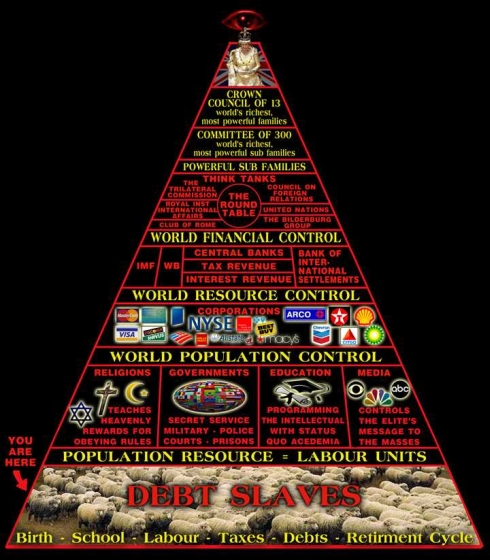
pyramid_of_power

I’ve been reading Douglas Rushkoff’s “Present Shock: When Everything Happens Now” and have by coincidence just reached a chapter of the book covering the topic of currencies and the economy as Washington D.C. attempts to avoid another default. I found similar writings from Rushkoff on the same topic in two articles published by Arthur Magazine. As can be seen from these excerpts, they’re helpful for understanding our current situation:

Local currencies favored local transactions, and worked against the interests of large corporations working from far away. In order to secure their own position as well as that of their chartered monopolies, monarchs began to make local currencies illegal, and force locals to instead use “coin of the realm.” These centralized currencies worked the opposite way. They were not earned into existence, they were lent into existence by a central bank. This meant any money issued to a person or business had to be paid back to the central bank, with interest.

What does that do to an economy? It bankrupts it. Think of it this way: A business borrows 1000 dollars from the bank to get started. In ten years, say, it is supposed to pay back 2000 to the bank. Where does the other 1000 come from? Some other business that has borrowed 1000 from the bank. For one business to pay back what it owes, another must go bankrupt. That, or borrow yet another 1000, and so on.

An economy based on an interest-bearing centralized currency must grow to survive, and this means extracting more, producing more and consuming more. Interest-bearing currency favors the redistribution of wealth from the periphery (the people) to the center (the corporations and their owners). Just sitting on money—capital—is the most assured way of increasing wealth. By the very mechanics of the system, the rich get richer on an absolute and relative basis.

The biggest wealth generator of all was banking itself. By lending money at interest to people and businesses who had no other way to conduct transactions or make investments, banks put themselves at the center of the extraction equation. The longer the economy survived, the more money would have to be borrowed, and the more interest earned by the bank.

[…]Commerce is good. Commerce is not the problem. Monopolies are.

Except in a few rare cases, corporate charters and centralized currency were never intended to promote commerce. They were intended to prevent locals and non-chartered entities from creating and exchanging value. They are not extensions of the free market, but efforts at extracting value from the free market. Corporate monopoly charters were extended to a king’s favorite companies in return for shares. Then, no one else was allowed to do business in that industry. Centralized currency forced businesses to run their revenue through the king’s coffers. Likewise, in its current form, centralized currency is more akin to a ponzi scheme of interest rates, each borrower paying up to the banker above him.

Both of these innovations—corporate charters and centralized currency—tend towards resource exploitation rather than innovation. They are extractive in nature, not productive. And, more importantly, these particular innovations cause wealth to end up being generated through speculation rather than creation. They cause scarcity, not abundance. Over time, it becomes easier to make money by having money than by doing anything. And this was the pure, stated intent of centralized currency and banking in the early Renaissance: to keep the wealthy wealthy, in the face of a rising merchant class.

This isn’t some extremist perspective. It’s just historical fact, though largely forgotten and seemingly refuted by our collective false memory of the Renaissance’s greatness. If you’re interested in finding out more about this, or seeing the evidence on which my research is based, take a look at the best historians writing about the era: Fernand Braudel (The Wheels of Commerce: Civilization and Capitalism: 15th-18th Century, Volume 2, Univ. of California Press, 1992), Carlo M. Cipolla (Before the Industrial Revolution: European Society and Economy, 1000-1700, WW Norton, 1994) or Bernard A. Lietaer, whose book On Human Wealth used to be available for free download off his site, but doesn’t seem to be anymore. In these books, you can find out about the sustainable local economic systems of the Late Middle Ages, learn that the Black Plague actually began after mandated centralized currency had impoverished Europe, and find support of my contention that cathedrals were built with local money before the Renaissance, not Vatican money during the Renaissance.

I highly recommend checking out both articles here (as well as his most recent book “Present Shock”):

http://arthurmag.com/2009/03/16/let-it-die-rushkoff-on-the-economy/

http://arthurmag.com/2009/03/23/hack-money-hack-banking-rushkoff-on-the-economy/

More voices of sanity (Nicole Voss and Laurence Boomert) calling for an overhaul of the monetary system can be heard on the C-Realm podcast :

How to End the National Debt

military_industrial_complex_by_party9999999-d55z8r1

One solution is to stop the war machine. At Boiling Frogs there’s a great recent post from Sibel Edmonds called “What National Debt? US Taxpayer Dollars Continue to Flow to the World’s Despots, Torturers & Human Target Practice Fields”. Among her findings:

Afghanistan gets around $7 Billion= $7,000,000,000. Now, don’t mistake this for our money spent on our war in Afghanistan. That’s in the trillions of dollars. That’s a separate deal. No, this money goes to Afghanistan’s government – known for being crooks, criminals, heroin dealers, and terrorist breeders. They take the money, and misplace it- so the money, some of it, ends up with the guys we are supposedly bombing and waging war against. Then we point at those guys and say, hey, you see these armed terrorists, and then we go bomb the hell out of them. They take the money and invest it in some highly lucrative poppy fields and heroin production, so that we can spend billions of dollars pretending to destroy those poppy fields and production centers.  And then we give more money to these government guys, so that we can go and bomb them some more, and target more poppy fields … and the cycle continues, and continues. Trust me, it makes sense …Not necessarily to you and me, but it makes lots of sense to our fat war-profiteers here at home. After all, who gives a damn if things make sense to the people-since when have they counted?

Of course Israel gets quite a lion’s share. That goes without saying. They get nearly $3 billion=$3,000,000,000, in military aid and another large sum as financial aid for …well, let’s put aside all the diplomacy and political correctness and call a duck a duck: They get all the military and foreign aid so that they can turn around and spend those dollars through their powerful network and lobby here, to make sure we are all screwed up in developing and implementing our foreign policy. Does that make sense? Just think about the billions of dollars, directly or indirectly, spent by the Israel lobby to form and control our foreign policy, aka war-war and more war. They get all those billions of dollars in foreign and military aid, come over here, get us into wars so that we go spend trillions of additional dollars in wars and screwing up the world … and ourselves… and then give Israel more in foreign and military aid. It doesn’t make sense, does it? Of course not, It’s not supposed to make sense, dude!

Egypt gets its $1 billion of our tax money for … for what? Thank God it’s been in the news lately so even the mass ignoramus population in our nation is able to have an idea: guns and bullets to kill political dissenters, tanks and tear gas to be used against civilians, helicopters to fire at civilians below … bring about a coup de tat, and then bring about another one …Okay, so that one we get. We know what they use our money and military equipment for. No brainer. As to why we would shower Egypt with all this money and military power? Why in the world do we end up giving all these dollars to the side that gets in via a coup, and to the side who takes out those who brought about the coup and gets in with its own coup … and another coup after that, and many dead … Why? Well, duh. It’s because that’s what we do. Since when has our government been in the business of providing reasons and justification to its people? Since when do they worry about having to make sense to their lowly people? Maybe, referring to the paragraph above, maybe it’s because of the billions of dollars we gave Israel, which came back here and were spent so that our government would put together this policy of giving billions of dollars to many different sides in Egypt – so that they would continue coups and butcher their people.

Pakistan gets more or less $1 Billion. They get military aid to make sure they create desirable conditions so that our military can send its drones out there and bomb the hell out of them every day. Makes sense. No? All right, try this: How else do we give these drones and our other killing machines a real-life test run? See! Like shooting ranges, our government needs to go out there, pick countries (and their inhabitants), and make them viable war-practice fields.  Call them Human Target Practice Fields. You haven’t heard?! Nothing like a real test drive. Of course these things ain’t free, so of course the money has to be spent, thus, our foreign aid to countries like Pakistan. Why is the price so high? Because Pakistan is dangerous, and it has nuclear weapons that we made sure they would get, and that makes Pakistan kinda expensive.

Those are just the largest recipients. For the complete list read the full article here: http://www.boilingfrogspost.com/2013/10/08/what-national-debt-us-taxpayer-dollars-continue-to-flow-to-the-worlds-despots-torturers-human-target-practice-fields/#more-24922

Another way to end the national debt is to switch to government issued debt-free money. Michael Snyder of The Economic Collapse Blog describes what the process might look like:

#1) The U.S. Congress votes to take back all of the functions that it has delegated to the Federal Reserve and begins to issue debt-free United States Notes.  These United States Notes would have the exact same value as existing Federal Reserve Notes, and over time all existing Federal Reserve Notes would be taken out of circulation.

#2) The U.S. Congress nationalizes all debt held by the Federal Reserve.  That would instantly reduce the national debt by 1.6 trillion dollars.  In fact, there are a few members of Congress that have already proposed this.

#3) A Constitutional amendment is passed limiting future U.S. government deficits to a reasonable percentage of GDP.  Any future deficits would not be funded by borrowing.  Rather, future deficits would be funded by newly created United States Notes.  Therefore, the federal government would never again accumulate another penny of debt.

And it would be important to inject new money into the economy from time to time.  When existing money is destroyed or when the population grows it is important to inject a certain amount of new money into the system in order to avoid deflation.

#4) The existing national debt would be very slowly paid off with newly created United States Notes.  The U.S. government spent over 454 billion dollars on interest on the national debt during fiscal year 2011, and over time this expense would go to zero.

If the national debt is paid off slowly enough, it would not create too much inflation.  I believe that it could be paid off gradually over 50 years without shocking the economy too much.

Read the full article here: http://theeconomiccollapseblog.com/archives/debt-free-united-states-notes-were-once-issued-under-jfk-and-the-u-s-government-still-has-the-power-to-issue-debt-free-money

Such a solution may seem simple, but the obvious obstacle would be overcoming the immense political and economic influence of the central banks. The only U.S. presidents who challenged the central banking scheme were John F. Kennedy, James Garfield, Abraham Lincoln and Andrew Jackson. Kennedy, Garfield and Lincoln were assassinated in office. Jackson would have been assassinated in an attempt in 1835 were it not for two guns miraculously misfiring. Jackson later famously stated:

The Bank is trying to kill me – but I will kill it!

…If the American people only understood the rank injustice of our money and banking system – there would be a revolution before morning.