

By DC
Source: Open Culture
Between 1982 and 2002, director Godfrey Reggio shot his well known Qatsi trilogy – Koyaanisqatsi, Powaqqatsi, and Naqoyqatsi. Somewhere between the 2nd and 3rd installment, Reggio took a little detour and directed a short eight minute film called Evidence. The main characters? Kids watching cartoons (Dumbo, actually) and looking “drugged,” “like the patients of a mental hospital,” he writes on his web site.
The villain? “Television technology,” which “is eating the subjects who sit before its gaze.” The weapon? Television again. That “radiation gun aimed at the viewer” “holds its subjects in total control.” A little house of horrors, to be sure. We have added Koyaanisqatsi (featuring the music of Philip Glass) and Evidence to our collection of Free Movies Online.

Synopsis from Icarus Films:
In his newest film, French documentarian and cinema-essayist Chris Marker reflects on French and international politics, art and culture at the start of the new millennium. In November 2001, the filmmaker became intrigued, as did many other Parisians, by the sudden appearance of alluring portraits of grinning yellow cats on buildings, Metro walls and other public surfaces. Marker’s cinematic efforts to document the mysterious materializations of this charming feline throughout Paris are a recurring theme of THE CASE OF THE GRINNING CAT.
This engaging record of Marker’s cinematic peregrinations throughout the city, visually energized by his free-association montage style, chronicles strikes, demonstrations, memorials, election campaigns, celebrity scandals, international political incidents, and a seemingly endless variety of political protests (against the Iraq War, against China’s occupation of Tibet, against the government’s ban on the wearing of Muslim headscarves). The personalized commentary running throughout THE CASE OF THE GRINNING CAT offers the simultaneously learned and witty reflections of the filmmaker, now in his early eighties, on both the contemporary and historical implications of these varied events and personalities.
The mysterious grinning yellow cats soon begin to appear amidst the banners and signs in some of the political demonstrations. Eventually, the creator of the grinning cats is revealed to be an art collective known as Mr. Cat, whose members are shown painting a massive representation of their mascot on the plaza before the Pompidou Center. The filmmaker’s own famous cat caricature soon allies with Mr. Cat, as Marker speculates on the political possibilities of such a feline association.
Chris Marker concludes THE CASE OF THE GRINNING CAT with thoughts on the vital importance of such expressions of imagination in our public lives, echoing the May ’68 slogan that “La poésie est dans la rue” (“Poetry is in the street”).

(In memory of Terence McKenna, November 16, 1946 – April 3, 2000)
By Richard Kadrey
Source: Wired
METAMORPHOSIS – A video “trialogue” featuring Ralph Abraham, Terence McKenna, and Rupert Sheldrake – is part shamanic journey and part New Physics 101. It’s mostly talk, with touches of simple computer graphics and music adorning the presentation. But what talk it is. We’ve got Abraham, a mathematician and the godfather of chaos theory; McKenna, a shamanologist, ethnopharmacologist, and psychedelic philosopher; and Sheldrake, a radical biologist and originator of the idea of “morphic resonance,” a memory embedded in all natural systems. Their free-form discussion ranges from drug experiments to the anima mundi (world soul), chaos and complexity, and the effects of language and imagination on the shape of the universe – all in search of a new field theory that encompasses art, science, and philosophy.
In this particular chaotic system, McKenna is the strange attractor around which Abraham and Sheldrake orbit. The three unite in a quest for knowledge and an exchange about the sciences they’ve studied. Sheldrake talks passionately about trying to redefine biology in terms of living organisms, not the abstract dead things found in textbooks and labs. Abraham, not surprisingly, explains how protests over the Vietnam War lead him to leave his sheltered academic life, pursue meditation in the Himalayas, and study chaos theory.
With McKenna as the ringleader (and biggest talker), imagination and chaos are the principal themes. Chaos, as McKenna describes it, is a science to study, an opportunity to reshape the world by looking through the lens of nonlinear processes, and a metaphor to help us think about our place in the universe. In McKenna’s words, chaos “is telling us that the intimation of mysticism, the intimation of a possibility of transcendence, is all firmly grounded in science.”
This is heady stuff. Though you half expect the psychedelic proselytizing to drift off into some kind of Birkenstock-and-bean-sprout dead end, the rigor, intelligence, and wit of these three minds keep the ideas sharp and fast. For anyone interested in the edge of science, this video is both entertaining and inspiring.
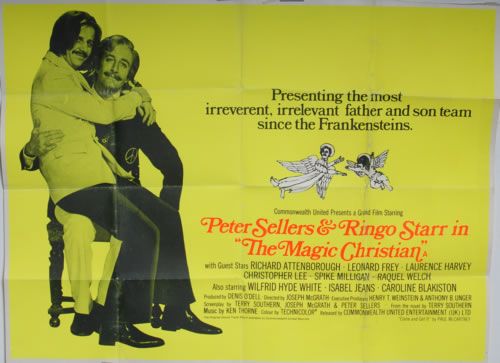
“The Magic Christian” (1969) is a British satire directed by Joseph McGrath and loosely adapted from the 1959 novel of the same name by Terry Southern, who co-wrote the screenplay with McGrath. Peter Sellers stars as billionaire Sir Guy Grand, who adopts a homeless man (Ringo Starr) and demonstrates to his new heir how virtually everyone in the world can be bought through an escalating series of pranks. Cameo appearances are made by John Cleese, Graham Chapman, Raquel Welch, Spike Milligan, Christopher Lee, Richard Attenborough and Yul Brynner among others.
INDIAN COUNTRY NEWS
"It is the duty of every man, as far as his ability extends, to detect and expose delusion and error"..Thomas Paine
Human in Algorithms
From the Roof Top
I See This
blog of the post capitalist transition.. Read or download the novel here + latest relevant posts
अध्ययन-अनुसन्धानको सार
 After the Crash