Bonus Album:


O’er the years EIT! has built upon their classic Holiday Special, each year creating a more abominable video collage of everyone’s least favorite time of the year! A millennium’s worth of VHS memories of misplaced sentimentalities, fist fights over toys for tots, erotic Santas, Nazi elves, and an endless parade of singing kids will surely teach everyone the true meaning of it all.
Watch the special here.
Bonus clip:
The story behind one of the worst renditions of a Christmas song ever recorded:
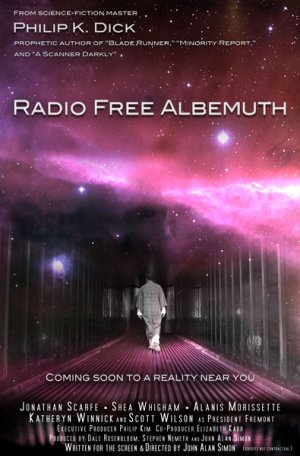
In light of Philip K. Dick’s birthday tomorrow (he would have been 90), it’s an appropriate time to visit (or revisit) the film adaptation of his posthumously published novel “Radio Free Albemuth”. Being a longtime PKD fan and one of the film’s Kickstarter contributors, I admittedly wouldn’t be a completely objective critic, but after having seen it a few times its achievements and shortcomings become more apparent.
Like the novel it’s based on, Radio Free Albemuth is one of the most personal of Philip K. Dick’s narratives, featuring the most faithful retelling of his 2-3-74 experiences. Filmed on a shoestring budget by John Alan Simon the movie has a fitting late 70s/early 80s aesthetic. Much of the dialogue is straight out of the novel but I personally would have wanted a more streamlined and nuanced script with less tangential details and exposition, though the actors across the board do a commendable job delivering their lines as naturally and believably as possible. The many dream sequences could have benefited from a higher budget and better visual consistency, but were able to accomplish what was needed for the plot. The prison scenes near the end seemed a bit rushed and not reflective of the oppressiveness of actual prisons, though that was probably largely due to budgetary reasons as well.
Despite its flaws, I still find the film engaging and worth recommending. Aspects of the story may come across to modern audiences as cheesy but still works on a meta level. In our sophisticated real life corporate techno-dystopia, the idea of individuals trying to incite revolution through subliminal messaging embedded in pop songs requires a suspension of disbelief. However in a more general general sense, countless creators through history (including writers and filmmakers) have made attempts to subvert society and culture with varying and impossible to quantify results.
Watch the full film on Hoopla here: https://www.hoopladigital.com/title/11350683

“The Boxer’s Omen” (1983) is a gonzo Hong Kong horror film directed by Kuei Chih-Hung and produced by the Shaw Brothers. Phillip Ko stars as Fei Kao, a boxer whose brother is nearly killed in a match by a rival from Thailand (played by Bolo Yeung). To get revenge, Fei travels to Thailand where he discovers he happens to be a spiritual twin of a revered Buddhist monk whose temple is under siege from a black magic cult. In a series of spiritual battles, the protagonist and his fellow monks must overcome demonic bats, spiders, snakes and caterpillars, floating human heads, animated crocodile skulls and statues, and a she-devil among other obstacles. While some of the puppetry work may seem amateurish by today’s standards, the often strikingly bizarre visuals evoke psychedelic fare such as Altered States and The Holy Mountain as well as aspects of giallo cinema or the supernatural genre films produced by Tsui Hark.

“Bimbo’s Initiation” (1931) is an unnerving and surreal Fleischer Studio short animation. It’s an early example of mass media featuring blatant occult symbolism and has influenced a number of artists such as Jim Woodring (the Frank cartoons), Richard Elfman (Forbidden Zone), Joe Dante (Twilight Zone: The Movie) and Jared Moldenhauer (the Cuphead video game).
INDIAN COUNTRY NEWS
"It is the duty of every man, as far as his ability extends, to detect and expose delusion and error"..Thomas Paine
Human in Algorithms
From the Roof Top
I See This
blog of the post capitalist transition.. Read or download the novel here + latest relevant posts
अध्ययन-अनुसन्धानको सार
 After the Crash