

Source: Spirituality & Practice
In the opening scene of this exquisite Japanese animated film directed by Satoshi Kon [10/12/63 – 8/24/10], Genya Tachibana, a documentary filmmaker, and his cameraman are climbing a hill to the retreat of Chiyoko Fujiwara, a popular actress who mysteriously abandoned her career 30 years ago. The meeting with her has great significance for Genya since he has secretly been in love with her all these years and can’t wait to present the famous 70-year-old with an old key that was once her fondest possession. When she holds it in her hand, the memories of her past begin to unspool in a narrative that intermixes the movies she was in and the real events of her personal life. As an added treat that often provides some funny and delightful moments, Genya and his cameraman find themselves magically transported into the story as befuddled participants in Chiyoko’s movies and daily life.
The actress was born in 1923 when a gigantic earthquake hit Tokyo. She becomes an actress as a little girl despite the pleas of her mother that she is too timid. Oddly enough the most poignant moment in her early life is not her first major role but a brief encounter with an artist who is being pursued by government authorities for some unknown actions against the state. Chiyoko puts herself in jeopardy by taking this handsome and wounded stranger to their storage shed. In gratitude for her assistance, he presents her with a key. After he leaves, this remains a talisman of her love for him, and she recalls again and again his words that the key is the most important thing there is.
In each of her movies, Chiyoko moves through a different period of Japanese history from the fifteenth century to the space age playing a princess, a ninja, a geisha, and even an astronaut. Over the years, the actress still yearns for connection with the mysterious stranger. It is the force that carries her through her career and supercedes anything that she does on the screen. Of course, this intensity of feeling draws out the ire of a competing older actress and a man with a scar who is pursuing the artist. In this retelling of her life, the documentary filmmaker is always rescuing her in moments of distress. He did work on several films with her as a young man when he was breaking into the business, but she never knew of his ardor until they meet for the interview.
Spiritual writer Joan Chittister has written, “Longing is a compass that guides us through life. We may never get what we really want, that’s true, but every step along the way will be determined by it.” In this Japanese animated film, Chiyiko’s longing is represented by her always running to find the mysterious artist. Those who are propelled through their lives by a deep yearning of the heart are lucky individuals: some might even call them enchanted. Millennium Actress is an enchanting movie that will appeal to those who are looking for something special at the multiplex.
Watch the full film here: https://fantasyanime.com/anime/millennium-actress-sub

“Perfect Blue” (1997) is a psychological thriller anime directed by Satoshi Kon, written by Sadayuki Murai, and based on the novel “Perfect Blue: Complete Metamorphosis” by Yoshikazu Takeuchi. The film follows Mima Kirigoe, a member of a Japanese idol group, who retires from music to pursue an acting career. As she becomes a victim of stalking, gruesome murders begin to occur, and she starts to lose her grip on reality. Like Kon’s later work, Paprika, the film deals with the blurring of the lines between fantasy and reality in contemporary culture.
Watch the film on Hoopla here: https://www.hoopladigital.com/title/12319819

By DM
Source: blastingnews
Based on Chuck Palahniuk’s novel of the same name, a film that was initially a commercial failure is now widely considered a cult classic and a philosophical marvel. Fight Club is one of the most important films of its generation and one of Fincher’s best. This thought-provoking masterpiece scratches the surface of various philosophical concepts and makes its audience think.
It is still as relevant as ever, perhaps even more so than before. Emasculation, Consumerism, beauty standards, identity, chaos vs order — these philosophical concepts are perhaps even more topical today than they’ve ever been.
Philosophically radical, this is a film that condemns the society of consumerism. As Edward Norton’s character says: “It’s just, when you buy furniture, you tell yourself, that’s it.
That’s the last sofa I’m gonna need. Whatever else happens, I’ve got that sofa problem handled.”
Fight Club also takes a critical look at beauty standards for men and women both and at advertisements that are served to us through mass media. Identity and alter-ego are philosophical concepts on which Fight Club is based on. Tyler Durden (Brad Pitt’s character) is what the narrator (Edward Norton’s character) wants to be.
The ideal alpha male. A leader of men. Tyler Durden gradually appears throughout the movie, emerging from the narrator’s subconscious and almost destroying him in the process.
Order, anarchy and chaos are perhaps the most prominent theme of Fight Club. At one point, Tyler Durden says: “It’s only after we’ve lost everything that we’re free to do anything.” Although primarily a critique of consumerism, this is a rejection of order and an acceptance of chaos.
When the underground fight club evolves into Project Mayhem and starts pouring into the outside world, members of it begin to dismantle every societal concept, causing controlled, deliberate and channeled chaos. Installing anarchy and rejecting every societal norm that had turned them into slaves. This is how they attempt to set themselves free, but the main protagonist loses himself in the chaos, initially merging with his alter-ego and then rejecting it.
In today’s America, where controlled chaos is caused by the media and fed to the panicked public, Fight Club resembles a warped house of mirrors in which the reflection of today’s America is seen.
Review By nfaust1
Source: IMDB
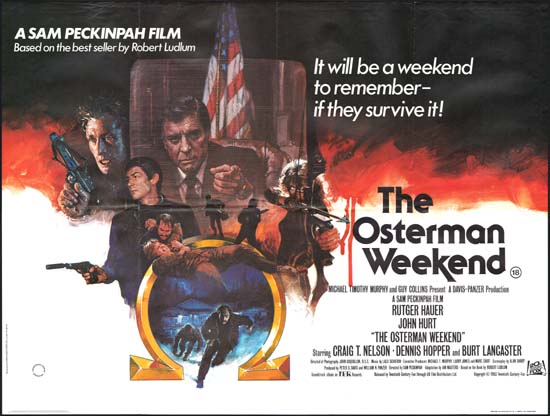
When this movie originally came out, five years after CONVOY (a muddled, but in many ways spectacular entertainment), many critics moaned that Peckinpah had yet again displayed his diminished talent. A Ludlum spy thriller, pulp material, given the Peckinpah stamp was not to be taken seriously, period. What nonsense. To begin with, all of Peckinpah’s films spring from pulp, and all of them, even the least successful ones, buck and spin with the way Sam applies his vision to the genre conventions he’s messing with.
In simple terms, a Peckinpah movie always illustrates the world according to Sam; like a novelist writing in first person, Sam’s point of view is the movie’s. And that’s why they endure today. In THE OSTERMAN WEEKEND, Peckinpah focuses Ludlum’s cold war spy antics into a exploration of urban paranoia and governmental abuse. Video as a means to manipulate perception is one of the themes he exploits here, but that’s not his main thrust. A group of affluent characters come together for a weekend that turns into a surreal nightmare. The trappings of success that surround this group are not in any way secure enough to withstand the violent, reckless games played on them by a rouge CIA agent (played by John Hurt) who’s motive is personal revenge. And that motive, the revenge that fuels his need, in actual fact, has absolutely nothing to do with the affluent group he’s playing with. Like the gods in Greek tragedy, the Hurt character uses the Osterman Weekend and its players as pawns, stepping stones, as a way to get at his real goal, the head of the CIA. This notion obviously strikes a chord in Peckinpah; the vision is certainly domestic, but the idea is epic: in the privacy of our homes a kind of virus colors our perceptions and poisons friendships, creates anarchy, and causes death. And the virus – where does it come from? Our own back yard – the CIA.
The film is charged with a constant underlying tension that holds and holds until all hell breaks loose and the affluent house becomes a battle ground. Visually, the movie is stunning. But then, so was CONVOY, but this time Peckinpah has harnessed what he shows and what he wants to say in a simple, tightly wound spy thriller package, Watching the movie today, it’s hard to believe that some of the notions that seemed more like the paranoiac mechanics of a potboiler in 1983 have actually come true and don’t seem quite as far fetched. By all accounts, Sam Peckinpah was a terribly difficult man, but he was also a visionary film maker who’s work gets better and better as the years pass. THE OSTERMAN WEEKEND is not the bad film critics at the time bitched about, and it’s not the sad conclusion to a career that started out brimming with possibility. It’s a splendid, brilliant – better than brilliant – work of American art by a true American artist: a giant. The world according to Sam is a world that will be looked at a hundred years from now; it will inspire debate, continual analysis, and be ranked with the major artist of the entire 20th century. By 1983,Peckinpah’s health may have diminished, but as a film maker he was still powerful and strong as hell.
Watch the full film on Hoopla at: https://www.hoopladigital.com/title/11049252
INDIAN COUNTRY NEWS
"It is the duty of every man, as far as his ability extends, to detect and expose delusion and error"..Thomas Paine
Human in Algorithms
100% Accurate Google Sheets + KDP Book Formatting | 24hr Delivery
From the Roof Top
I See This
blog of the post capitalist transition.. Read or download the novel here + latest relevant posts
अध्ययन-अनुसन्धानको सार
 After the Crash