
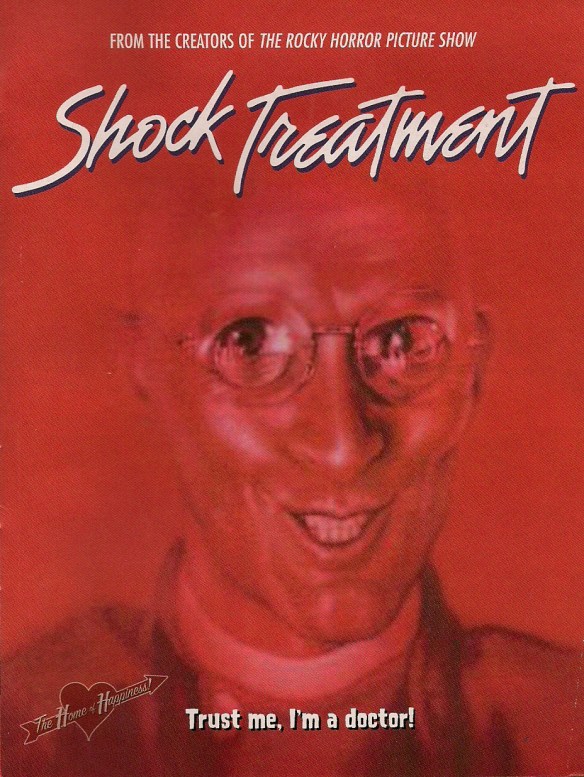
By Aimee Knight
Source: Little White Lies
It’s a few years since Brad Majors and Janet Weiss escaped the leather-clad clutches of Dr Frank-N-Furter and his frenemies. Back in their native Denton, USA – the so-called “home of happiness” – their marriage has hit the skids. While attending a live taping at their local TV station, they become embroiled in a series of interrelated game shows. This plays out in front of ever-present townspeople, who soak up the C-list exploits 24/7.
So goes the plot of Shock Treatment, the maligned sequel to cult staple The Rocky Horror Picture Show. Before its theatrical release, the creator, composer and star Richard O’Brien said, “It’s not a sequel, it’s not a prequel, it’s an equal.” Audiences and critics disagreed.
Like its older sibling, it was directed by Jim Sharman, produced by Lou Adler and Michael White, and featured several of the same key cast members. Just like Rocky Horror, it was a box office flop – one that O’Brien went so far as to call “an abortion”. The musical black comedy was foisted upon the midnight circuit in 1981. Though it celebrates its 35th anniversary this Halloween, it remains mostly obscure. Would Shock Treatment be remembered were it not positioned in the stilettoed shadow of its big sis?
Produced at the height of Rocky Horror’s cult frenzy, it failed to garner the titillating ubiquity of its forebear. A healthy dose of ‘easter eggs’ couldn’t convert even Rocky Horror’s most devoted disciples, who were deterred by the conspicuous absence of core cast members Tim Curry, Susan Sarandon and Barry Bostwick, among others.
Cult films are like Domino’s pizzas. You can’t scrimp on ingredients, deliver at midnight and expect everyone to love it. But when either comes with extra cheese, it’s definitely a plus. With its synth-heavy soundtrack, saturated neon palette and hammy performances, Shocky’s certainly not as gouda cult movies can get. But for all its flaws, the film deserves recognition at least for its prescient prediction of reality TV and the coming devotion to the cult of celebrity.
Sure, the premise seems absurd. Fast food tycoon Farley Flavors (one of two characters played by Cliff De Young) owns a television station, which is seemingly home to the town’s entire population. Plucked from the crowd, Brad (De Young again) and Janet (Suspiria’s Jessica Harper) try their hand at the Marriage Maze game. They soon find themselves committed and seduced, respectively, by the kooky cohorts who run the joint. Among them are O’Brien, Patricia Quinn and Nell Campbell, playing new wave exports of their Rocky Horror foils, and providing familiar faces to the core audience.
They’re joined by such inexplicable new casting choices as Ruby Wax (taking over minor Rocky Horror role Betty Hapschatt), Barry Humphries (arbitrarily Austrian game show host Bert Schnick) and baby-faced Rik Mayall in one of his first roles (‘Rest Home’ Ricky, an orderly at the station’s on-site mental health ward).
A carnivalesque crowd (strewn with former Transylvanians) watches in real time as the soap operatic narrative unfurls over 36 hours, ad break inclusive. Brad is seen bound, gagged and locked away on the Dentonvale set, while Janet flaunts her newfound sexuality on the breakfast show. When Janet refuses to sell her husband out in exchange for smalltown stardom (reminiscent of her role in Phantom of the Paradise – Rocky Horror’s glam rock godmother), the cast, crew and crowd spurn the couple, just as real world audiences would with Shock Treatment itself.
Criticised for its convoluted plot – the result of excessive redrafting – perhaps Shock Treatment was misunderstood because it arrived dreadfully ahead of its time. O’Brien depicts reality TV, and society’s interest in the sex lives of strangers, twenty-plus years prior to The Bachelor’s premiere. Denton’s addicted masses crave content around the clock, and they’re wholly invested in the shows they watch, almost three decades before Netflix began streaming. Shock Treatment shows how advertising and sponsorship influence production, and even explores the link between media and mental health – one of today’s most pertinent Western concerns.
With the 2016 remake of The Rocky Horror Picture Show comes a tidal wave of pop proprietary scorn, decrying this cinematic era of remakes, reboots, prequels, sequels and spin-offs. (Re)visit Shock Treatment for a filmic follow-up that was satirical, psychic and truly inventive.
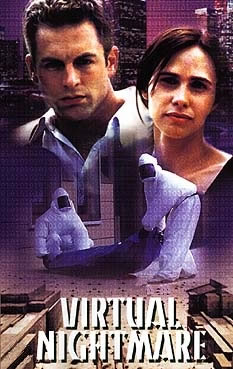
“Virtual Nightmare” (2000) is an Australian television film adaptation of the 1955 science fiction short novel by Frederik Pohl. It was directed by Michael Pattinson and written by Dan Mazur and David Tausik (who two years earlier collaborated for a tv adaptation of Brave New World). Like the stories of Philip K. Dick and the late 90s wave of gnostic films such as Dark City, Fight Club, eXistence, Pleasantville, The Matrix, The Thirteenth Floor, The Truman Show, etc. (some of which were inspired/influenced by PKD), the plot centers on protagonists piercing the veil of a superficial and hegemonic consensus reality.
Astute viewers may also recognize plot elements reminiscent of a couple of other literary works which Pohl’s source novel predates: Eight O’ Clock in the Morning (1963) by Ray Faraday Nelson (a short story adapted into the 1988 film They Live and whose author happened to be a close friend of PKD’s), and The Futurological Congress (1971) by Stanislaw Lem (a satirical dystopian novel loosely adapted for the 2013 film The Congress).
Visually and technically, Virtual Nightmare is comparable to made for television and direct-to-home video sci-fi fare of the late 90s and early 2000s, but where it stands apart is its intelligent and compelling storytelling. It’s a prime example of how limited budget/FX and occasionally subpar acting can be transcended by a narrative addressing eternally relevant questions.
A big shout-out to Tom of Montalk.net for bringing wider attention to this diamond in the rough via random tweet.

By Manik Sharma
Source: Firstpost.
In the animated short film Shehr e Tabassum, the ‘Supreme Leader’ of a dystopian Pakistan in 2071 passes a law declaring all expressions other than smiling a crime. It’s the state’s way of manufacturing both consent and a flimsy yet persuasive image of a happy civilisation. People who refuse are deemed as traitors. The drugged, exclusionary vision of the future that the short film offers is eerily echoed by the present of many countries around the world.
Mimicking to an extent the consumerist hell of Blade Runner, Shehr e Tabassum released earlier this year on YouTube. Behind the film is Puffball Studio, a group of young creators from the country, led by Arafat Mazhar. In November, Puffball released its second film Swipe, a Black Mirror-ish reflection of the intolerance of today, through the lens of technology. In Swipe, an app basically mimics mob justice, by enabling users to have people executed via a simple swipe.
“My research has been centered around the way ideas like ghairat (honour), ishq (love) ghaddar (traitor) and tauheen (insult) have been distorted in the recent past and forcibly circumscribed to violence while at the same time, the definition for blasphemous or traitorous acts continue to broaden,” Mazhar says. Curiously, the protagonist of Swipe is a child. “I have seen so many videos of young people at rallies organised by religious activists and NGOs calling for violence against other groups, videos of children taking part in mob violence. I can’t help but think that we’re failing our children when we teach them manufactured meanings of honour and love that are devoid of any spirituality,” he adds.
Mazhar and his team created Swipe during the pandemic. The intersection of technology and culture is something the filmmaker has always been interested in. He also leads other initiatives like Engage Pakistan, a project that counters the country’s blasphemy laws with research and alternative histories. Procuring funding for all these projects can’t possibly be a cakewalk.
“Swipe and Shehr e Tabassum were both self-financed for the most part,” Mazhar explains. “What helps is that our team is very versatile: we have excellent traditional artists but also an excellent 3D and motion graphics team which means that we do premium service work for clients too. Aside from that, we also have an alternative critical histories channel called Hashiya, where we collaborate with local and international universities to create historical short films and explainers.”
Both Shehr e Tabasum and Swipe cross paths with technology, intolerance and the brutalising nature of consumerist economies. If empathy and humanism are shown the door, the natural course culture takes is the commodification of everything human — from faith to love. It’s a lesson the young protagonist of Swipe learns the hard way.
“We knew from the outset that both Shehr e Tabassum and Swipe would be unapologetically political films but I was just as set on making them a thrilling and evocative experience for viewers. So when we wanted to explore how different fundamental freedoms — to express, to protest etc. — are stifled in a hyper-surveillant and increasingly oppressive society, we used the allegory of a smile as the only expression allowed to citizens,” Mazhar says of his first film.
“Other times, the story writes itself: when we wanted to show a city hooked to an app (iFatwa) that generates allegations against citizens and gamifies extrajudicial violence, we would look to news stories around us to draw inspiration for the app cases,” he adds about Swipe. (The anecdotal stories that feature on iFatwa are reminiscent of outrage we witness every other day on this side of the border.)
Through both films, Mazhar channels a kind of activism that he promises the group will continue to work on. But with activism these days comes the risk of outing yourself to trolls and self-appointed moralists. It’s a price some have paid heavily for on both sides of the border, and perhaps around the world.
“I believe storytelling, fiction or otherwise, speaks to possibilities of greater awareness, understanding and connection between people and communities. I believe in creating art that speaks to our collective humanity, that forces us to think beyond our biases and our conditioned hate towards those who are different from us. With Swipe, there was no pretense about what we had set out to do: we aren’t claiming to change the fabric of our society or our thinking. Swipe is just a heartfelt plea to pause and reflect collectively,” Mazhar says.
Filmmaking is hard enough; such provocative, truthful and political filmmaking even more so. “For those who attack us online because they fear an agenda behind our films, I always try and respond to their anxieties which usually stem from perceived threats to tradition, religion, etc. Beyond that, there isn’t much that anyone can do. I think our viewers recognise and appreciate that though our films are uncomfortable to watch, they go beyond mere cynicism and derision,” Mazhar says, optimistic that his work will be afforded the tolerance his films paint the absence of.

INDIAN COUNTRY NEWS
"It is the duty of every man, as far as his ability extends, to detect and expose delusion and error"..Thomas Paine
Human in Algorithms
From the Roof Top
I See This
blog of the post capitalist transition.. Read or download the novel here + latest relevant posts
अध्ययन-अनुसन्धानको सार
 After the Crash